We use the details you submit to review and respond to your project enquiry. Entries are handled in this website’s WordPress database using Fluent Forms; our hosting and email providers may process the submitted details. Other technical providers receive only the data described in our Privacy Policy.
Please do not send passwords, payment-card details, government identification numbers, sensitive personal data, or unnecessary confidential third-party information.
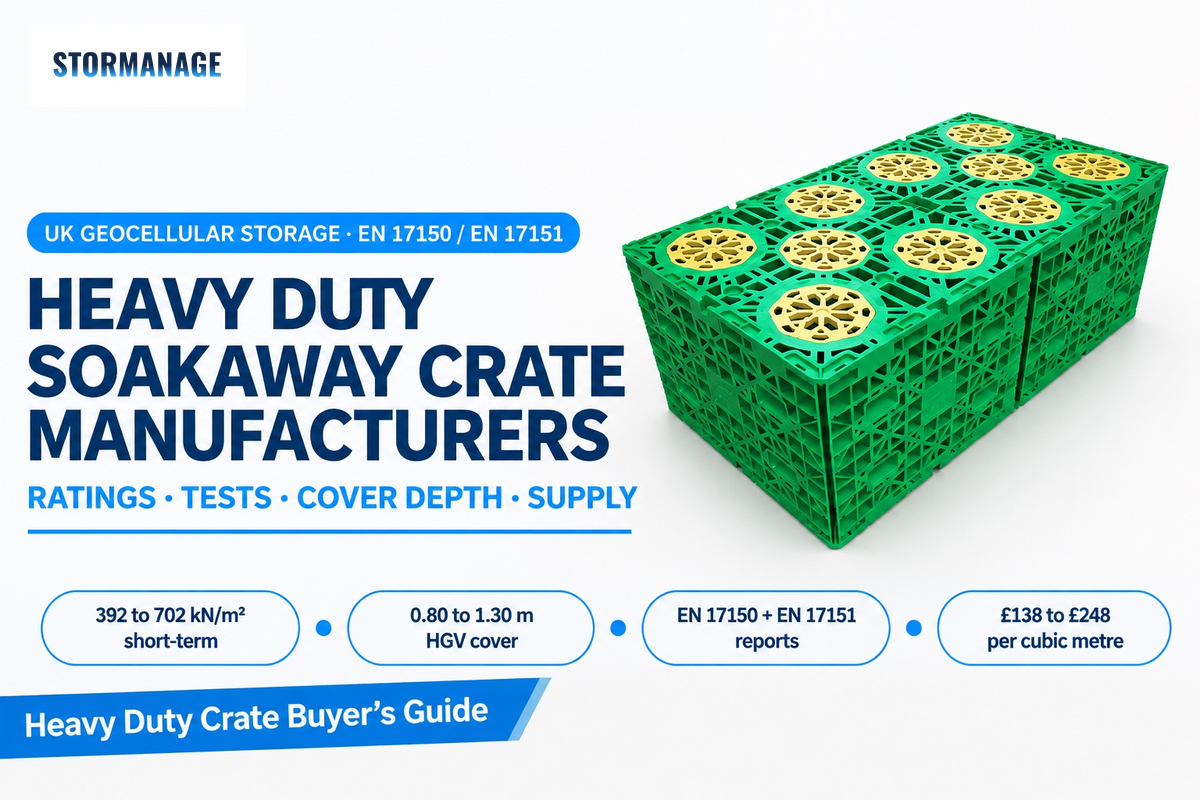
Heavy duty soakaway crate manufacturers selling into the UK list short-term vertical strengths between about 390 and 702 kN/m² for their trafficked ranges. Means of measurement differ. This guide compares eight ranges on a level basis, shows which test produced each figure, and sets out what the buried crate needs before a lorry drives over it.
A heavy-duty soakaway crate is a polypropylene box for underground stormwater storage rated for short-term vertical strength of 40 to 70.2 tonnes per square metre (t/m²) on UK datasheets. Compare makers on kN/m², lateral strength and long-term strength, then size cover depth for your heaviest vehicle.
Key points
Polystorm-R, made from over 90% recycled material, lists 610 kN/m² vertical against 440 kN/m² for the standard Polystorm cell, and both list 63 kN/m² lateral.
A tonne figure on a crate datasheet is a pressure per square metre, not the weight of a vehicle.
Published cover for lorry traffic ranges from 0.80 m to 1.30 m, depending on the manufacturer and mass of the vehicle.
Defra’s National Standards for Sustainable Drainage Systems, published on 19th June 2025, require structural integrity for the design life of the development.
Quick Specs
Typical module
1000mm x 500mm x 400mm, 0.2 m³ (five per cubic metre)
Void ratio
95% to 95.8% on published datasheets
Heavy-duty vertical strength
392 to 702 kN/m² short-term, as printed
Lateral strength
63 to 186 kN/m² short-term
Test standards
EN 17150 short-term, EN 17151 long-term, EN 17152-1 product
Crate-only price
about £138 to £248 per m³ ex VAT (UK listings, October 2026)
Heavy Duty Soakaway Crate Manufacturers Supplying the UK
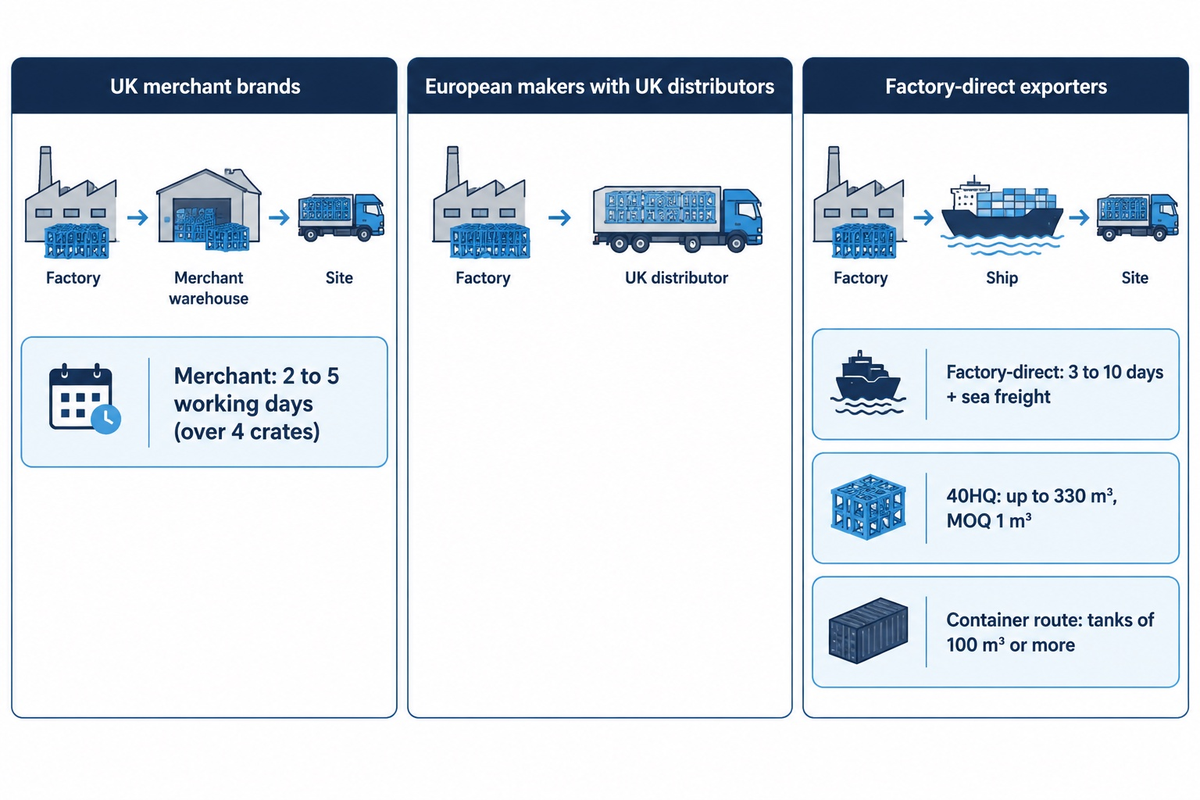
Heavy duty soakaway crate manufacturers supplying the UK can be placed in three groups. The first is the leading UK range, distributed via builders’ merchants (Polypipe, Wavin, ACO, Brett Martin, etc.). The second is made up of European manufacturers with a presence in the UK (GRAF). The last group is made up of manufacturers who export direct from the factory, such as Storm Manage. Each group has different ways of presenting their load data, and therefore the table only includes data as it’s presented by each group.
Polypipe makes the Polystorm family, and its datasheets give two different strengths for two different cells. The standard Polystorm cell lists 44 tonnes/m², while Polystorm-R lists 61 tonnes/m² from over 90% recycled material. The Polypipe Polystorm soakaway crate also takes 300mm and 450mm flange adapters. Those adapters join the tank to Ridgidrain underground drainage pipes, so the crates and the drainage network can come from one maker.
Heavy duty soakaway crate manufacturers compared: published short-term strengths from 200 to 702 kN/m²
Maker and range
Vertical (short-term)
Lateral (short-term)
Module
Resin and approvals
Polypipe Polystorm (PSM1)
440 kN/m²
63 kN/m²
1000 x 500 x 400 mm
virgin PP
Polypipe Polystorm-R
610 kN/m²
63 kN/m²
1000 x 500 x 400 mm
over 90% recycled; BBA certificate listed
Wavin AquaCell Plus-R
702 kN/m², printed as 70.2 t/m²
151 kN/m²
1 x 0.5 x 0.4 m, 190 litres
12.7 kg per unit
GRAF EcoBloc Inspect flex
rated for 60 t lorries at 800 mm cover
not stated in kN/m²
800 x 800 x 320 mm, 205 litres
BBA 15/5200, DIBt
Brett Martin StormCrate55
562 kN/m² (153 long-term)
70 kN/m² (19 long-term)
1200 x 600 x 347 mm, 0.25 m³
100% recycled polymer
Plastech StormMaster Standard
400 kN/m²
90 kN/m²
1.0 x 1.0 x 0.4 m, 400 litres
100% recycled
Plastech StormMaster Lite
200 kN/m²
80 kN/m²
1.0 x 1.0 x 0.4 m
100% recycled
Storm Manage ST-M40
392 kN/m² grade; 468.5 kN/m² in a witnessed test
121.9 kN/m² in the same test
1000 x 500 mm, 400 or 500 mm high
PP; SGS-witnessed test at the factory lab
Storm Manage ST-H60
588 kN/m² grade; did not fail at 600 kN/m²
186 kN/m²
1000 x 500 x 500 mm, 0.25 m³
100% virgin PP; no EN 17151 report or BBA, Kiwa or WRc approval yet
Access for inspections is standard on EcoBloc Inspect flex, with GRAF building a channel for standard inspection cameras. Wavin aims AquaCell Plus-R at applications where inspectability is required, and Polypipe access is provided by separate Polystorm Access & Inspect units. StormMaster figures come from the Plastech Southern brochure for the system supplied by Balstreet Ltd. All figures are from each manufacturer’s datasheet or product page read in October 2026; ACO’s StormBrixx HD brochure is over 30 pages in length so it isn’t included in the table. The supply route affects lead time more than strength does. One UK merchant states orders of more than four crates may take 2 to 5 working days, and a factory-direct order adds production time and sea freight.
Storm Manage, the publisher of this guide, makes crates for drainage applications from driveways to lorry yards and ships its soakaway crates factory-direct from Shenzhen: production takes 3 to 10 days and a 40HQ container holds up to 330 m³ of installed storage, with a minimum order of 1 m³. Its vertical figures are based on the older CIRIA C680:2008 test method. That supply route is slower than a merchant pallet for a single driveway, and no Storm Manage grade yet has a BBA, Kiwa or WRc certificate. Buyers who also compare tank suppliers can see the wider attenuation tank manufacturers list.
What “Heavy Duty” Means on a Soakaway Crate Datasheet
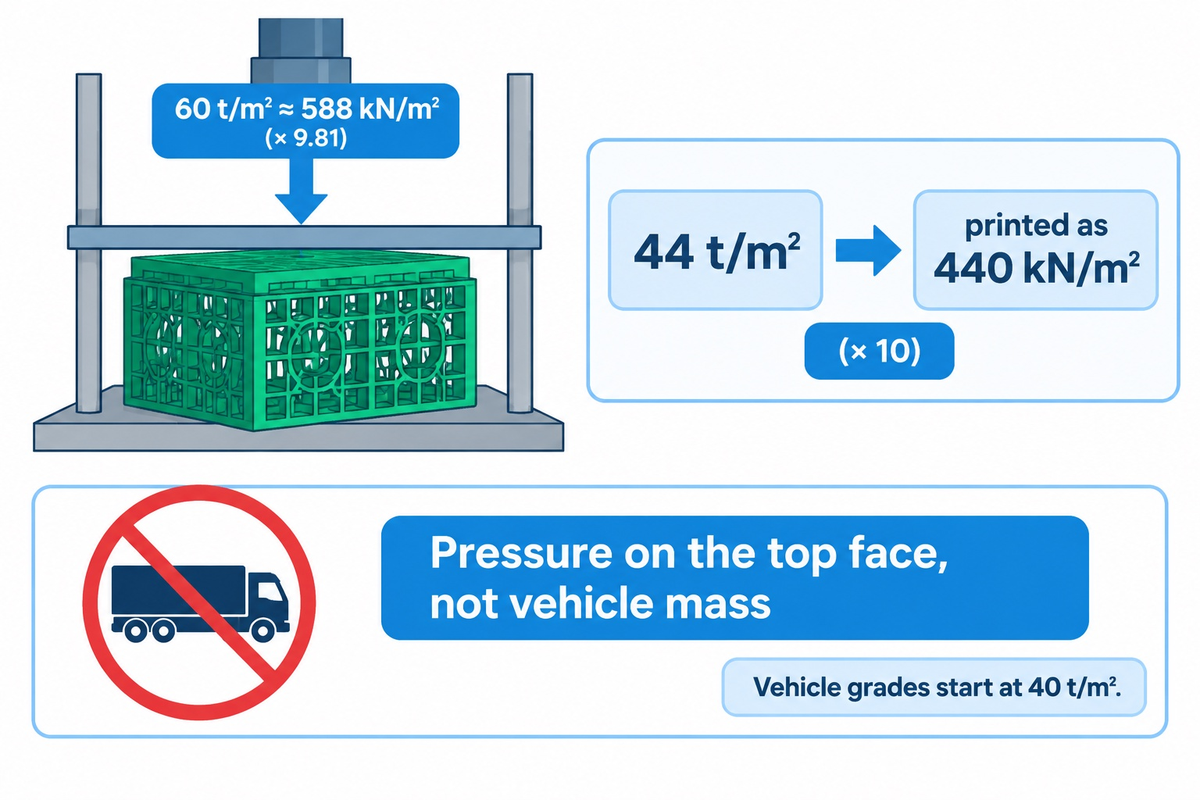
Heavy duty on a soakaway crate datasheet means a short-term vertical compressive strength rated for vehicle loads; on the datasheets compared here, vehicle grades start at 40 t/m². The tonne figure is a pressure on the top face, and product specification sheets provide the value in t/m², kN/m², or both.
Three European standards define how these test numbers are produced. EN 17150 sets the short-term compression test, EN 17151 the long-term compression test and EN 17152-1 the product standard for PP and PVC-U boxes which are used in landscape, pedestrian or vehicular traffic areas. TEPPFA’s note on the three CEN standards describes them as the minimum requirements and a unified way of testing.
Tonnes convert at 9.81 kN/m² per t/m², so 60 t/m² is about 588 kN/m². Several UK datasheets round the factor to 10, which is why Polypipe prints 44 t/m² as 440 kN/m².
Tonne ratings and the kN/m² figures printed on heavy duty soakaway crate datasheets
Datasheet figure
kN/m² as printed
At 9.81 kN/m² per t/m²
Product
20 t/m²
196
196
Storm Manage ST-E20, landscape only
40 t/m²
392
392
Storm Manage ST-M40
40 t/m² (“40T”)
400
392
Plastech StormMaster Standard
44 t/m²
440
432
Polypipe Polystorm
60 t/m²
588
589
Storm Manage ST-H60
61 t/m²
610
598
Polypipe Polystorm-R
70.2 t/m²
702
689
Wavin AquaCell Plus-R
The common misreading is to treat 60 tonnes as a vehicle mass. A crate rated at 60 t/m² carries that pressure only on its top face in a press, and the wheel load reaching it depends on the cover and pavement above. The full load path is set out in our D400 load class guide.
Does a 60 tonne crate mean a 60 tonne lorry can drive over it?
No. A 60 tonne vertical load rating is a short-term pressure of roughly 588 kN/m² on the crate’s top face, measured in a test press. A 60 tonne lorry is a vehicle mass spread through tyres, pavement and cover, and makers tie lorry use to a minimum cover depth.
GRAF, for example, rates EcoBloc Inspect flex for 60 t lorries with 800 mm of earth cover, and Wavin lists 1.30 m of cover for their Plus-R crate for use under low speed roads carrying vehicles of less than 60 t. The class printed on manhole covers above is a different matter. BS EN 124-1 grades gully and manhole covers, and not the buried crate.
Crate Ratings for Driveways, Car Parks and HGV Yards
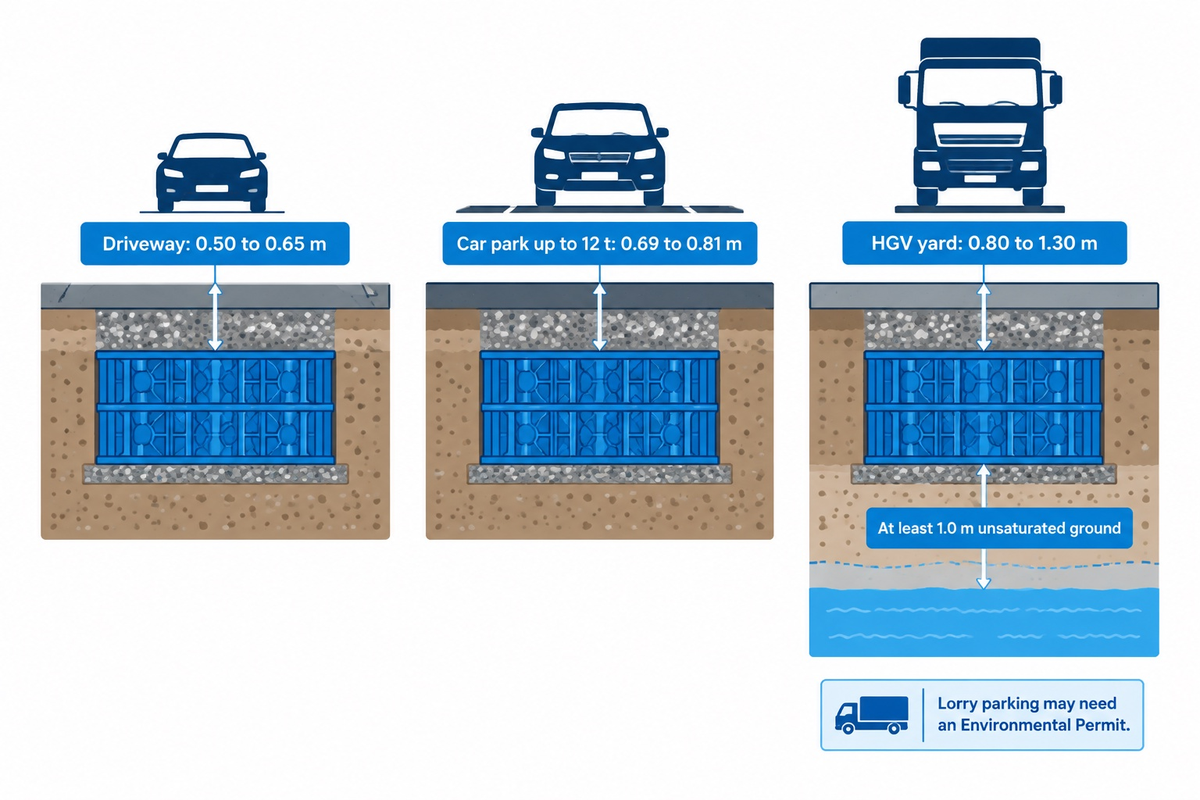
For a domestic driveway, Polypipe lists 0.50 to 0.65 m of cover for Polystorm-R; for car parks with vehicles up to 12 t, Wavin lists 0.69 to 0.81 m; and for HGV yards, makers list 0.80 to 1.30 m for high strength soakaways rated for 60 t vehicles. The table shows the references for the figures.
Minimum cover over heavy duty soakaway crates by surface use, from 0.30 m to 1.30 m
Surface use
Product
Minimum cover
Landscaped, no vehicles
Wavin AquaCell Plus-R
0.30 m
Landscaped or non-vehicular
Plastech StormMaster
0.50 m
Vehicles under 3,000 kg
Polypipe Polystorm-R
0.50 m
Vehicles under 9,000 kg
Polypipe Polystorm-R
0.65 m
Car parks, vehicles under 9 t
Wavin AquaCell Plus-R
0.69 m
Vehicular areas
Plastech StormMaster
0.75 m
Car parks, vehicles under 12 t
Wavin AquaCell Plus-R
0.81 m
Lorries up to 60 t
GRAF EcoBloc Inspect flex
0.80 m
Heavily trafficked areas
Hydro International design guidance
0.80 to 1.00 m
Low-speed roads, vehicles under 60 t
Wavin AquaCell Plus-R
1.30 m
The figures belong to the product, so a figure from one row can’t be moved to another crate. Hydro International gives two worst cases in their design guidelines: the shallowest cover for wheel loads and deepest cover for the soil weight, and both of these limits need to be considered for your site. Our load-class and cover-depth selector runs the same two checks for each grade.
The fact that a crate can take the weight of an HGV doesn’t make infiltration acceptable on an HGV yard. Defra standard 4.9 names lorry, bus or coach parking and turning sites among uses that may need an Environmental Permit, and standard 4.16.1 asks for at least 1.0 m of unsaturated ground between the base of an infiltration-only feature and the maximum likely groundwater level. Where either fails, the same crates are wrapped in an impermeable membrane to temporarily store rainwater and release it at a controlled rate. In this role the crates function as attenuation crates, and a geocellular attenuation tank functions as the drainage solution instead of a soakaway. The heavy duty soakaway crate page gives the grades for both functions.
How deep should soakaway crates be installed?
Soakaway crates sit with 0.50 to 1.30 m of cover depending on the expected traffic, and manufacturers publish maximum burial depths of 3.7 to 7.8 m to the base. The deepest limit is Wavin’s figure for landscaped areas in dense sand and gravel. Polypipe lists 3.7 m for Polystorm under light traffic, Plastech 3.9 m for StormMaster, and GRAF up to 5 m for EcoBloc Inspect flex.
For Wavin’s Plus-R, maximum depth depends on the sub-soil condition. Under vehicles below 44 t, Wavin’s Plus-R table restricts the depth to 4.17 m in an over-consolidated stiff clay and 7.30 m in dense sand and gravel. A complete description of the procedure is found in our soakaway crate installation guide.
Comparing Manufacturer Figures on the Same Basis
Two geocellular crates sold as “60 tonne” can perform differently, as the headline number is a short-term vertical result, and a buried tank also depends on lateral strength and long-term strength. Check every shortlisted datasheet on the three values in kN/m², and then compare prices.
Three-Number Datasheet Read
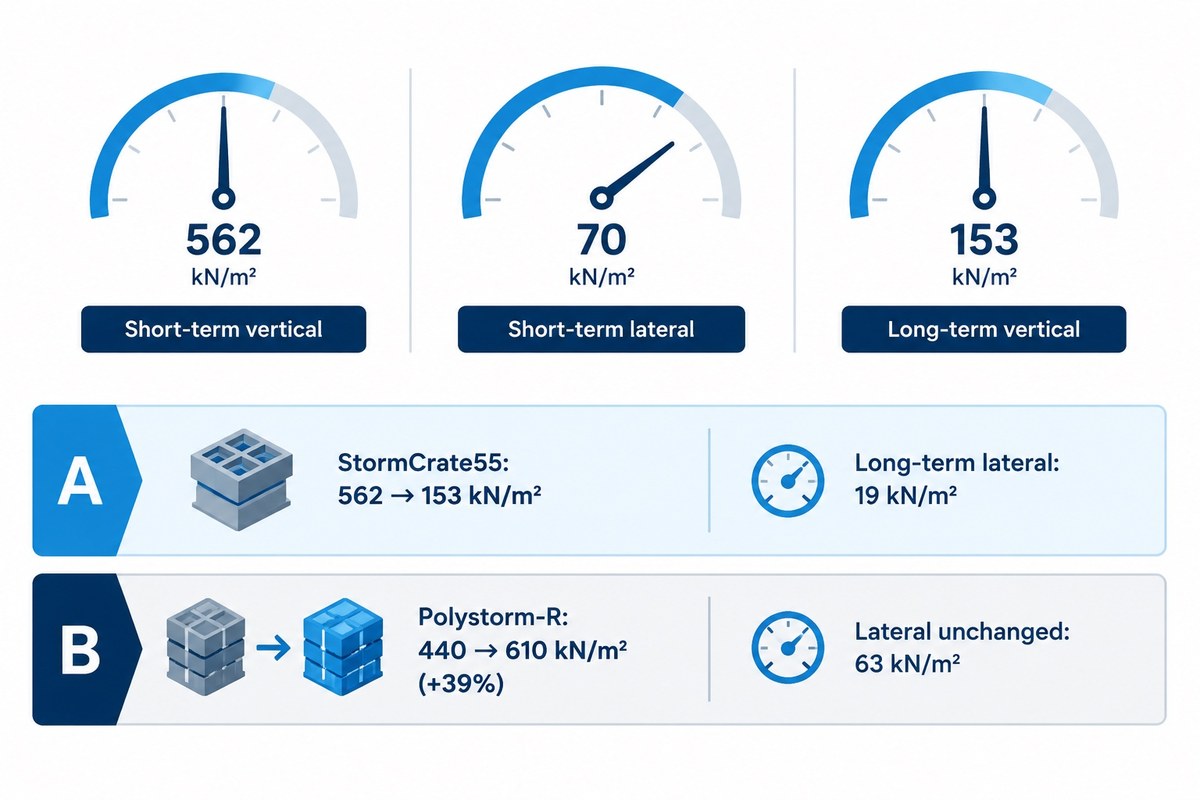
The Three-Number Datasheet Read checks the short-term vertical, short-term lateral, and long-term strength in kN/m², converted with the same factor, and flags any datasheet that leaves a value empty.
562 kN/m²StormCrate55 short-term vertical
153 kN/m²same crate, long-term vertical
19 kN/m²same crate, long-term lateral
Brett Martin includes all four values. The long-term vertical strength is 27% of the short-term value, and the long-term lateral is 19 kN/m². That ratio is unique to StormCrate55 and can’t be extrapolated to other crates, because long-term strength comes from each product’s own creep test.
Polypipe’s two cells show a second pattern. Polystorm-R raises vertical strength from 440 to 610 kN/m², a 39% increase, yet both cells list 63 kN/m² lateral. A deep tank next to a retaining wall is governed by side pressure, so the higher vertical figure buys nothing there.
📐 Engineering Note
Example: a Storm Manage ST-H60 crate is graded at 60 t/m², or 60 x 9.81 = 588.6 kN/m², and its test report shows no failure at 600 kN/m² with 186 kN/m² lateral. That makes 600 kN/m² a short-term ceiling only, and the ST-H60’s 50-year strength isn’t yet known. For StormCrate55 the published long-term value is 153 kN/m², which is the figure to carry into a long-term design check, not 562 kN/m².
Strength isn’t defined by resin type alone. Polystorm-R, made from over 90% recycled material, lists a higher vertical figure than the standard Polystorm cell, so ask for the test results rather than relying on “virgin” or “recycled” on the label. TEPPFA notes that EN 17152-1 takes account of the call for more recycled content.
The BPF Pipes Group paper on geocellular lifespan explains the long-term method: creep rupture tests are extrapolated to 50 years and the 95% lower confidence limit becomes the characteristic strength.
Test Reports and Certificates to Request Before You Order
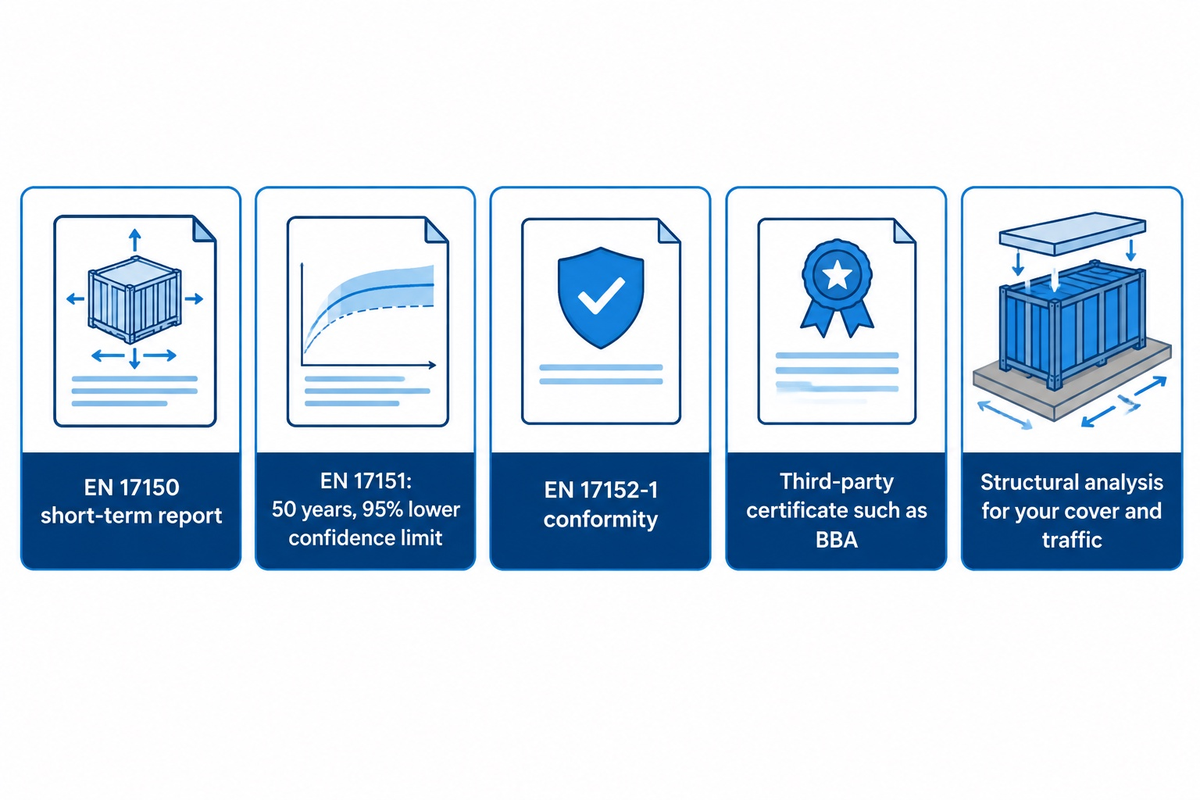
When requesting heavy duty crates, contact the manufacturer for an EN 17150 short-term report in kN/m² for vertical and lateral loads, an EN 17151 long-term result, conformity with EN 17152-1, any third-party certificate such as BBA, and a structural analysis for your cover and traffic. EN 17152-1 covers boxes for infiltration applications, attenuation and storage, so ask which use the declaration names.
Failures usually trace back to design and installation rather than the box. A 2025 New Civil Engineer article on buried drainage design notes that CIRIA C737 lists insufficient structural and geotechnical design, and failure to consider ground conditions or unit deformation, as the first two contributing factors in most failures. Please complete the checklist below as part of your quote request.
RFQ checklist for heavy duty soakaway crates, copy these into your quote request:
Parameter
Recommended range
Why it matters
How to verify
Short-term vertical strength
rated by the maker for your heaviest vehicle at your cover depth
sets the top-face capacity under wheel loads
EN 17150 test report with lab name and report number
Short-term lateral strength
63 to 186 kN/m² on the datasheets in this guide; deep tanks need a site check
side pressure governs deep tanks and tanks beside walls
same EN 17150 report, lateral face tested
Long-term strength
a stated 50-year value in kN/m²
plastic creeps under permanent soil load
EN 17151 result with the 95% lower confidence limit
Product conformity
EN 17152-1 for PP or PVC-U boxes
covers dimensions, materials and marking
declaration naming the exact module and its components
Third-party approval
BBA, Kiwa or WRc certificate where held
adopting bodies often ask for independent assessment
certificate number checked on the issuer’s register
Structural design
CIRIA C737 calculation for your cover range
checks shallowest cover for wheels and deepest for soil
calculation signed by the designer, cover depths stated
Resin and batch
virgin, recycled or mixed, stated per batch
test results only hold for the tested formulation
batch number on the test report matches the delivery
Merchant private labels usually arrive with a brochure only, while UK brands with a BBA certificate and some factory-direct manufacturers can send laboratory reports. Storm Manage provides its Intertek and SGS compression reports per project and states that it has no EN 17151 report or BBA certificate, which a reviewer may handle as a departure from standard. The heavy duty supplier spec checklist covers the same items.
Heavy Duty Crates vs Rubble Soakaways and Arch Chambers
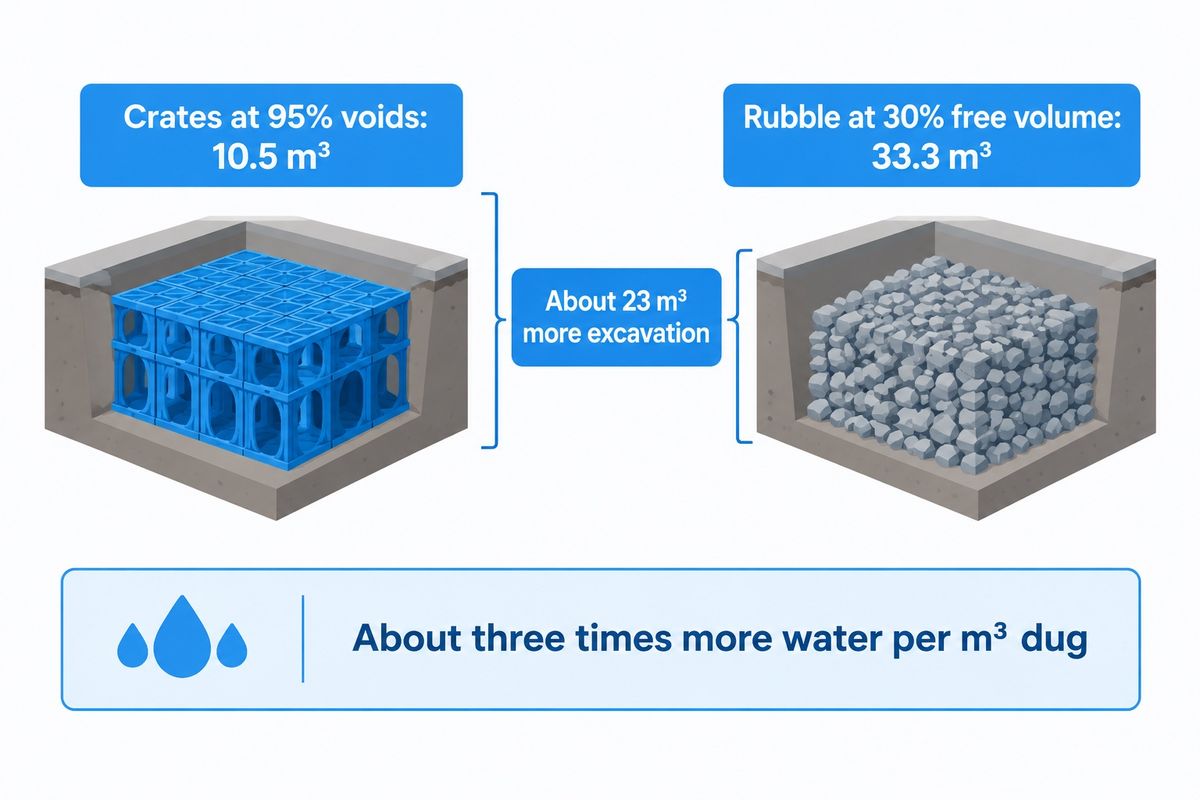
Heavy duty crates store about three times more water per cubic metre dug than a rubble soakaway under lorry traffic, because crates are about 95% void while the example in BRE Digest 365 is worked with a 30% free volume granular fill. Arch chambers are a third option for long, narrow runs.
Worked example, using void figures published by Polypipe and BRE: for 10 m³ of storage, crates at 95% voids need 10 / 0.95 = 10.5 m³ of crate volume, while rubble at 30% free volume needs 10 / 0.30 = 33.3 m³ of fill. That’s roughly 23 m³ more excavation and spoil to remove, before allowing for the working space around the tank. Less spoil would also reduce soil transport and installation time on a constricted site.
Susdrain’s geocellular storage component guidance sets maintenance as regular inspection of silt traps, manholes and pipework, with sediment removal as required. Water infiltration is fastest in sandy and loamy soils. Cotterills’ soakaway guide notes that clay-heavy soils have low permeability and aren’t always compatible with a soakaway system; in such cases, crates become an attenuation system with a controlled outlet.
On lorry yards, the infiltration limits from the ratings section still apply: Defra asks for at least 1 m of unsaturated ground above the maximum likely groundwater level, and lorry parking may require an Environmental Permit.
Where soakaway crates are used on larger sites, they are one of the components of surface water management. Permeable paving, grass swales and bioretention basins can slow and clean runoff before it reaches the tank, and therefore reduce the silt load on crates.
Crates are modular, so soakaway crate systems can be shaped to the plot; Polypipe lists Polystorm-R for shallow excavations, narrow strips and restricted areas. Our comparison of stormwater chambers vs modular crates covers footprint, depth and access for maintenance.
Price per Cubic Metre and How Supply Routes Change It
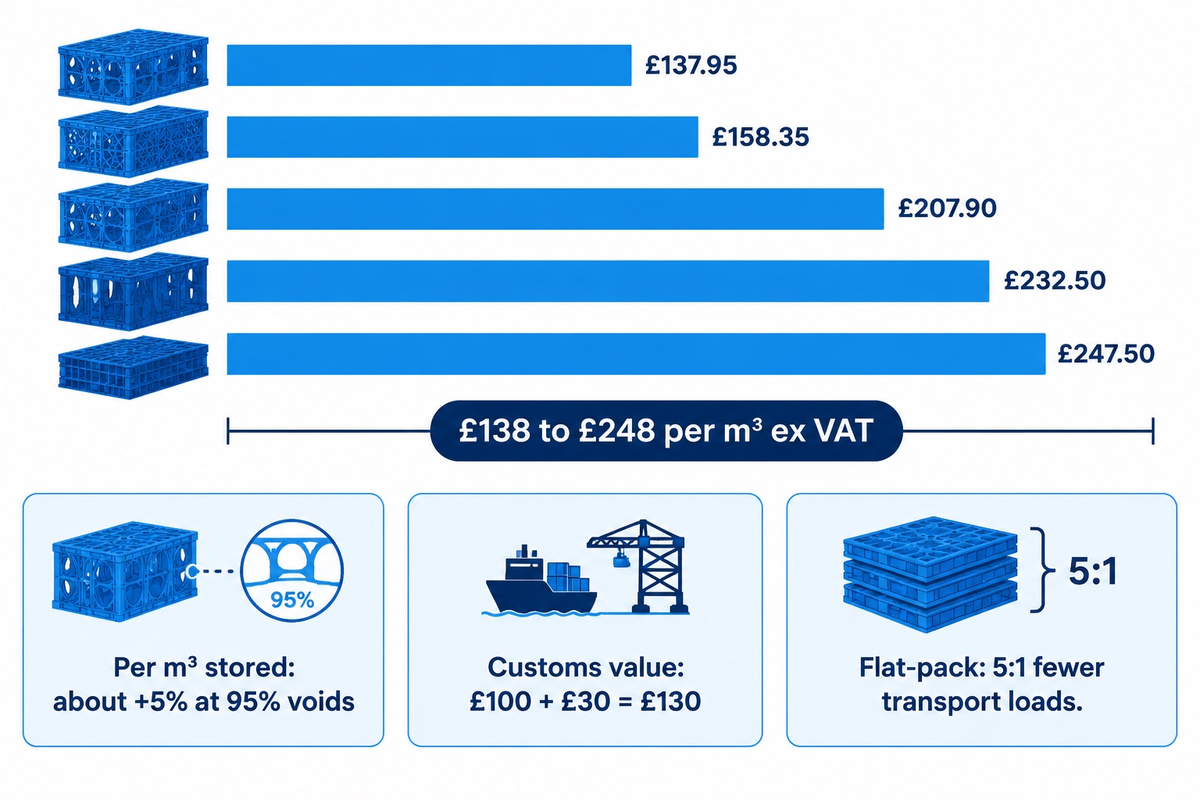
Crate-only prices for heavy duty soakaway crates in UK drainage merchant listings sat between about £138 and £248 per m³ ex VAT in October 2026, before membrane, excavation and installation. Factory-direct supply alters the price of the crates, while excavation, backfill and labour make up much of the installed cost.
How much do heavy duty soakaway crates cost per cubic metre?
Heavy duty soakaway crates cost about £138 to £248 per cubic metre ex VAT from UK merchants in October 2026. Polystorm cells listed at £27.59 to £41.58 per 0.2 m³ crate, and a 65 tonne Aqua Storm crate at £99 per 0.4 m³.
Heavy duty soakaway crate prices per cubic metre, UK listings, October 2026 (ex VAT)
Listing
Price per crate
Per m³ of crate
Per m³ of storage at 95%
Polystorm-R PSM1a, bulk buy price
£27.59 (0.2 m³)
£137.95
£145.21
HydroCell soakaway crate
£31.67 (0.2 m³)
£158.35
£166.68
Polystorm PSM1A, single crate
£41.58 (0.2 m³)
£207.90
£218.84
Aqua Storm 65T, 2.4 m³ pack
£558 per 6 crates
£232.50
£244.74
Aqua Storm 65T, single crate
£99 (0.4 m³)
£247.50
£260.53
Divide the crate price per m³ by the void ratio to get the price per m³ of water stored; at 95% that adds about 5%. Prices fluctuate with resin and freight, and the Environment Agency’s SuDS cost estimation report states that published unit costs need adjusting for inflation, and costs specific to a site also depend on several factors.
Factory-direct supply alters the freight line and the duty base. According to HMRC’s Customs valuation guidance, separately paid transport is included in the value of imported goods, using the example of £100 of goods and £30 of transport valued together at £130. The transport cost included is the cost up to the point where the goods enter the UK. Crates that nest or pack flat reduce lorry loads: at Oakengates in Telford, a Susdrain case study records a 5:1 reduction in transport after switching to a geocellular system that packed efficiently.
Merchant stock suits a single driveway requiring 1 cubic metre to 3 m³ of crates. A factory-direct container is appropriate for housing developments, commercial applications and infrastructure projects with tanks of 100 m³ or more, where the crate line is large enough to absorb sea freight. Module sizes and kit contents are compared in our soakaway crate sizes and kits guide.
What Changed for UK Crate Specifiers in 2025
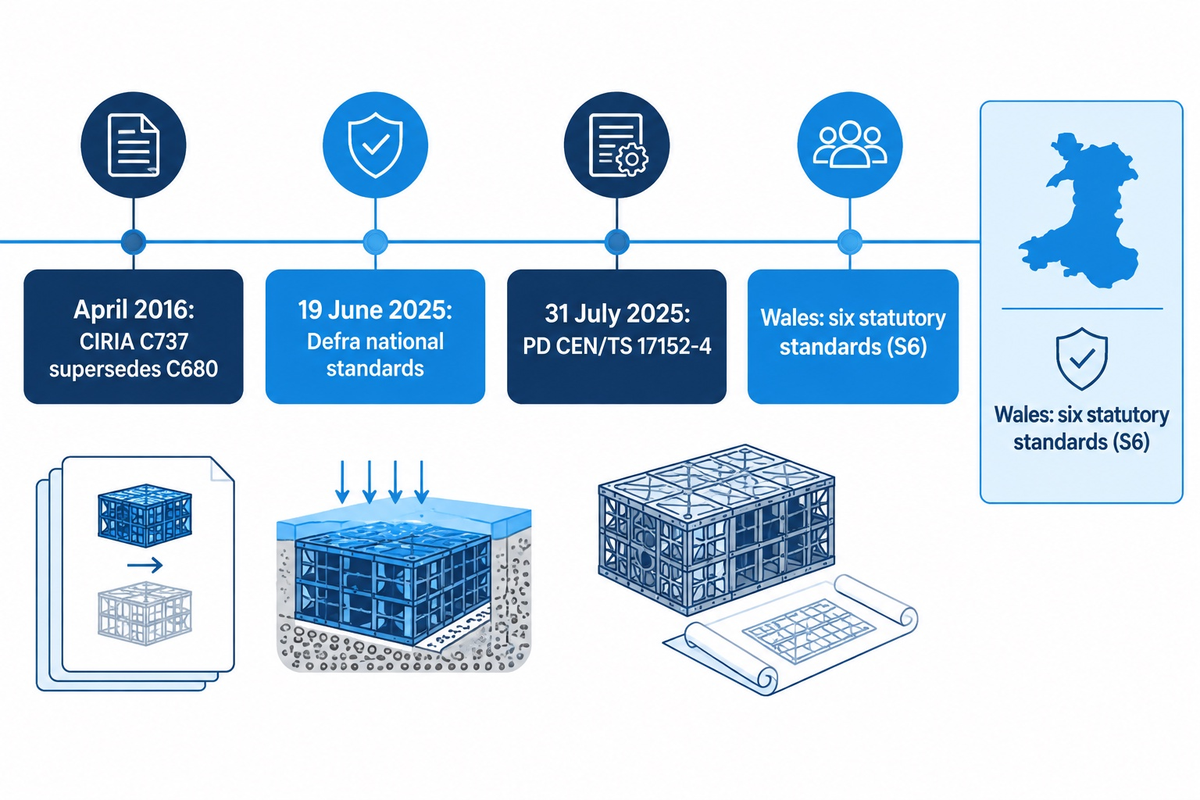
In 2025 England published new National Standards for Sustainable Drainage Systems on 19 June, and PD CEN/TS 17152-4, structural design guidance for modular crate systems, was published in the UK on 31 July. Both focus on the site’s structural design rather than the tonne rating.
The Defra standards are non-statutory in England. Standard 7.4 states that the surface water drainage system shall be designed to:
“…ensure structural integrity of all components under anticipated loading conditions for the design life of the development so that it does not affect the structural integrity of any existing or proposed components within, or adjacent to, the development.”
Wales already works to statutory standards: Natural Resources Wales states six, and S6 covers construction, operation and maintenance and structural integrity. A crate supplier serving both nations should expect the drainage approver to request the same evidence of structural integrity.
The design basis is still debated. CIRIA states that C737, published in April 2016, supersedes C680 and that designs should now be based on C737. The BPF Pipes Group position statement of November 2025 still describes C680 as an effective and conservative method and points to CEN TS 17152-4 as the European route.
The new PD CEN/TS 17152-4 guidance relates to systems made up of EN 17152-1 boxes. It excludes seismic loads, lateral loads from adjacent structures and embankments, the influence of trees, backfill outside CEN/TR 17179, and the geotextile or geomembrane wrap. A crate tank installed beside a building or an embankment should therefore get its own lateral check.
Frequently Asked Questions (FAQ)
Q: How many tonnes should a soakaway crate be for a driveway?
Choose a crate its maker rates for cars and lay it at that maker’s minimum cover; on the datasheets in this guide, vehicle grades start at 40 t/m², about 392 kN/m².
Polypipe states that 0.50 m of cover is required for Polystorm-R, when used for vehicles under 3,000 kg and 0.65 m cover for use with vehicles under 9,000 kg. The ST-E20 grade of Storm Manage, which is for non-trafficked areas only, has a strength of 20 t/m². If you pave over the tank, the paving build-up is considered part of the cover. If larger vehicles such as delivery lorries or skip loaders use the drive, the crate and cover should be sized for that larger vehicle.
Q: How many soakaway crates do I need?
Five 1000 x 500 x 400 mm crates make up a 1 cubic metre tank, which has a capacity of about 0.95 m³ of water, with a void ratio of 95%.
Work out the storage volume from the drained area, rainfall and a soil percolation test, then divide by the crate volume. A 1000 x 500 x 500 mm module holds 237.5 litres, so four of those give just under 1 m³ of storage. Add a silt trap or catchpit upstream to keep the storage usable.
Q: How long do soakaway crates last?
Heavy duty soakaway crates are designed around a 50-year design point, set by the long-term strength test, and BPF Pipes Group notes that this is not the same as the expected lifespan.
EN 17151 extrapolates creep tests to 50 years and uses the 95% lower confidence limit as the characteristic strength. Meanwhile, Polypipe states a design life in excess of 60 years for Polystorm-R, also from long-term extrapolated creep testing. In practice the tank lasts as long as the silt control and cover stay sound, so regular checks of silt traps and the inlet chamber play as important a role as the crate grade.
Q: Are recycled polypropylene crates suitable under traffic?
Yes, when the test results support it.
According to its datasheet, Polystorm-R uses over 90% recycled material, lists 610 kN/m² vertical and has BBA approval. Judge the crate on its EN 17150 and EN 17151 results, not on the resin label.
Q: How can you stop a soakaway crate from getting blocked?
Place silt traps or catchpits on the drainage pipe before the crates and keep every soakaway crate wrapped in geotextile membrane so fines from the surrounding soil stay out.
Hydro International, which makes vortex separators, says a simple silt trap may wash out at high flow and calls a hydrodynamic vortex separator a much safer alternative. Plan an inspection chamber so the tank can be checked and jetted without digging.
Q: Do soakaway crates need Building Regulations approval?
A new soakaway serving a building needs Building Regulations approval under Approved Document H, Drainage and Waste Disposal, and the inspector may examine the excavation before it’s backfilled.
Approved Document H sets out the order of discharge, starting with infiltration where the ground allows it. Building Control often asks for a percolation test. Larger sites also go to the drainage approving body, which works to the 2025 national standards in England and the statutory standards in Wales. Practitioners on a UK trade forum add that some Building Control officers insist on crates and that a soakaway should sit at least 5 m from the house. Our guide on soakaway regulations in the UK has more.
Send us the volume of the tank, cover depth, and the heaviest vehicle and we’ll provide a grade, a shop drawing and a container loading plan.
This comparison of heavy duty soakaway crate manufacturers uses datasheets and product pages read in October 2026, UK merchant listings from the same month, and the 2025 Defra and BSI documents. Storm Manage grade figures are nominal short-term ratings; test figures come from Intertek and SGS-witnessed compression tests. Reviewed by the Storm Manage technical team.