US & North America · Modular Geocellular

Stormwater Detention Tank

Underground Stormwater Detention Tank Systems

Detain peak runoff beneath your parking lots and reclaim the ground above, 95%-void polypropylene crates that beat arch chambers on excavation footprint and ship flat-packed from our own factory.

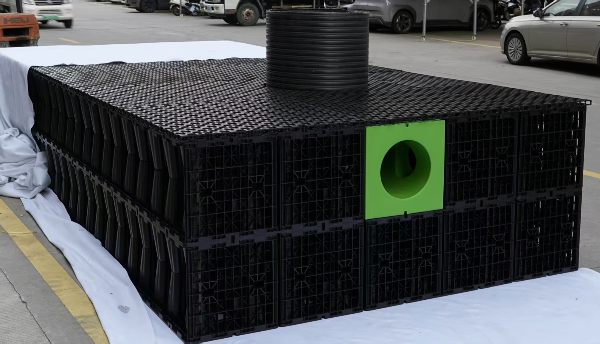
An underground stormwater detention tank temporarily stores stormwater runoff and then releases it at a controlled rate. Storm Manage builds it as a 95%-void polypropylene SG-series crate rated from 20 to 60 t/m² (matched to AASHTO H-20 and HS-25 cover-depth classes), so the surface above — landscape or roadway — stays usable.

Request a US spec quote →
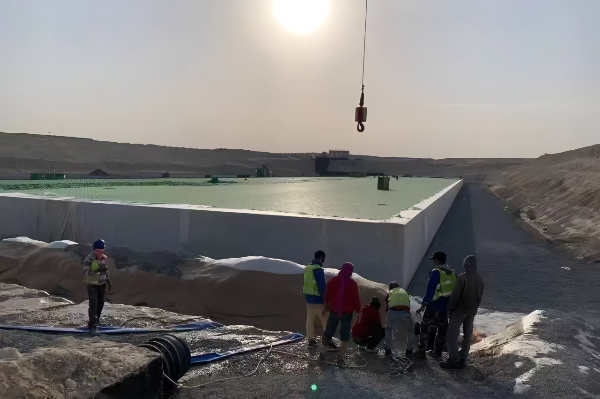
Underground Stormwater Detention Tank Hub showing 95%-void polypropylene crates and multi-load classes

What this hub covers — at a glance:

  • Range and load class SG-E20 to SG-H60, rated 200–600 kN/m² (20–60 t/m²), matched to AASHTO cover-depth classes.
  • Footprint math 95% void against ~35–40% effective for a stone bed, roughly 1.05× excavation instead of ~2.6×.
  • Proof SGS compression, Intertek CIRIA C680, CE EN1852/EN15381, ASTM D4632, plus the ASCE creep data most makers omit.
  • Routes to a live cost & sizing workflow and a low-impact development / EPA / BMP compliance breakdown.

Why site runoff fails approval, and how underground detention fixes it

Development replaces pond-capable ground with roofs and parking lots, so stormwater runoff leaves the site faster and in far greater volume than the pre-development watershed ever discharged. Managing that runoff is what a plan reviewer score, and in most jurisdictions they reject the post-development hydrograph because during severe weather it drives downstream flooding and erosion, overloads the storm drain and sewer systems, and pushes sediment into surface waters. On land-constrained sites where land availability rules out a surface retention basin, that rejection is where an underground approach start.

Underground detention answers that rejection by storing the peak below grade and metering it out through an outlet control at the pre-development rate. Unlike an above-ground detention pond, a subsurface storage system frees the paved area above it and keeps that space for parking or landscape, the whole reason engineers choose underground stormwater detention solutions and move the storage into underground structures on land-constrained sites where space is limited.

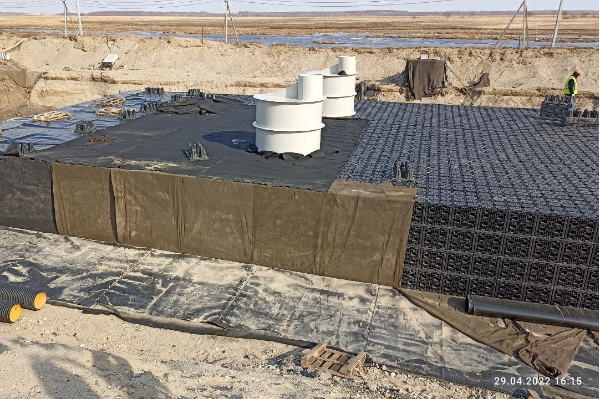
Underground stormwater detention tank hub system
ACTIVE SIMULATION

Detention vs the words reviewers use around it:

  • Detention temporarily store runoff, then slowly release it to attenuate peak flows at a controlled rate (peak attenuation).
  • Retention / infiltration hold water so it soaks into the subgrade for groundwater recharge; the open-bottom underground detention and infiltration system variant.
  • Pretreatment a sediment and debris capture stage upstream of the tank, required by most jurisdictions to protect storage capacity and improve water quality.

Detention is one best management practice, not the whole permit

Storm Manage builds the storage layer of that chain: a modular detention tank sized to manage runoff and prevent flooding for the design storm, with pretreatment and outlet structures specified alongside it. The trade-off buyers miss is that detention attenuates the peak but doesn’t by itself earn water-quality, low-impact development (LID) or green stormwater infrastructure credit, so this hub routes the permitting and LID/EPA/BMP work to a dedicated compliance breakdown.

Not sure what your jurisdiction will accept?

Talk to our team for a permitting and compliance guide →

The Storm Manage modular detention range, models & US load classes

The SG series is one open-cell geocellular crate family scaled across four load ratings, so you specify by the traffic over the tank rather than by a single badge. Every model hold the same ~95% void ratio; what changes is the vertical compressive rating, the polypropylene formulation and the resulting service life, not the cell size.

Stormwater Detention Tank Hub

SG-series modular detention tank — specification table (all models ~95% void)

Model Vertical load rating Typical use Material
SG-E2020 t/m² (200 kN/m²)Landscape, pedestrian, non-traffickedRecycled PP
SG-L3030 t/m² (300 kN/m²)Car parks, light vehicles (~AASHTO H-20)Recycled PP
SG-M4040 t/m² (400 kN/m²)Access roads, fire and garbage lanes (~AASHTO HS-25)100% virgin PP
SG-H6060 t/m² (600 kN/m²)Heavy industrial yards, port and airport aprons100% virgin PP
SG-CustomProject-specifiedNon-standard footprint or cell heightPer spec

Cell heights of 400 mm and 500 mm give roughly 190 L and 237.5 L of storage per module, so capacity scales in predictable increments. Under-rating the load class is an expensive failure mode when a 25-ton fire truck crosses the slab, which is why any model at or above 50 t/m² ships in 100% virgin polypropylene rather than recycled PP.

Hook C, US Cover-Depth → Load-Class Selector

A plastic crate doesn’t wear an “HS-25 badge” the way a manhole cover carries a class mark; it wears a rated wheel load applicable within a stated cover-depth range. Size the cover-over-the-tank, plus the heaviest vehicle expected, and select a model:

Surface above tank Heaviest load Min. cover AASHTO class Model
Lawn / landscapePedestrian, mower12–18 inSG-E20
Car park, drivewayPassenger / light truck18–24 inH-20SG-L30
Access road, service laneFire apparatus, garbage truck18–24 in compacted fillHS-25SG-M40
Industrial / port apronLoaded container handler24–48 in (per AHJ)>HS-25SG-H60

HS-25 covers the types of fire apparatus and garbage trucks municipal reviewers commonly test against. US highway live-load classes AASHTO H-20 and HS-25 are often the reference standard for underground detention structures carrying traffic in many DOT and municipality specs. Ultimately, your project is dictated by the AHJ’s site-specific requirements – not some all-purpose badge. For sites where the AHJ requires an open-bottom system for access and inspection, this tool prompts that decision instead of obscuring it.

Need the numbers for a submittal? Download the US spec sheet (PDF) — per-model load ratings and cover-depth tables, no quote required.

Get Instant Quote →

Modular crate vs arch chamber vs concrete vault, footprint & void ratio

The metric that decides an underground detention system budget isn’t the price of a crate, it’s the installed cost of void space, the real test of which system is cost-effective and a framing even concrete-arch vendors now concede. Confusing the price per cubic foot of material with the price per cubic foot of storage is the most expensive mistake in this category, and it skews roughly four out of ten project bids.

Hook A, Void-Ratio Footprint Index

System Effective void Excavation per CF stored Trade-off
Geocellular crate (SG) ~95% ~1.05× Needs engineered cover + creep-rated design
HDPE arch chamber ~40–50% ~2.2× Open-bottom inspection; more stone backfill
Stone / gravel bed ~33–43% ~2.6× Cheapest material, largest dig
Precast concrete vault High Efficient Heavy: ~73 vs ~8 truckloads; joint and crack risk

While the Philadelphia municipal stormwater manual rates stone at 0.40 porosity, it also acknowledges that grid systems can reach 95% void, which makes void ratio a design and permitting input rather than a marketing metric. EPA’s own storage modeling puts an aggregate bed at a 0.5–0.75 void-to-solids ratio (roughly 33–43% of the gross envelope), which independently confirms the ~35–40% stone figure.

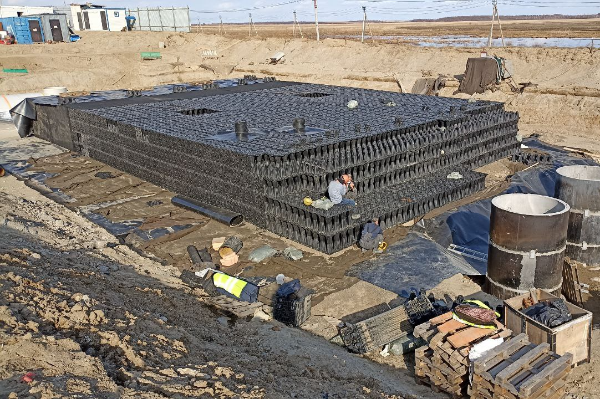
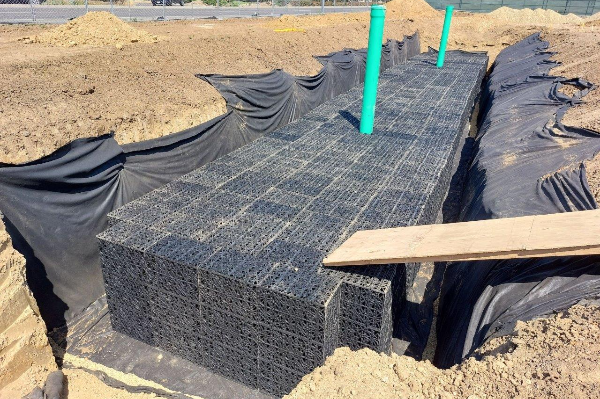
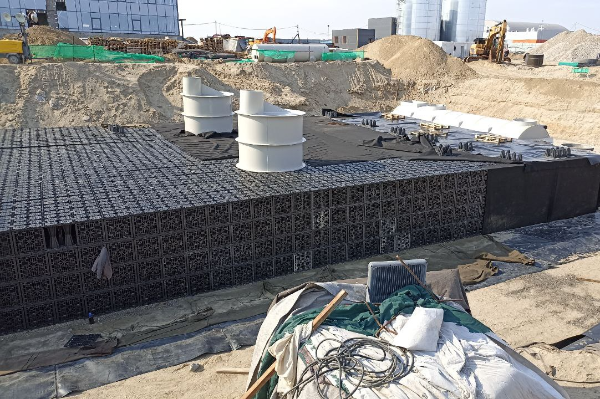
Underground stormwater detention tank hub installation

When compared against large arched chambers, corrugated metal pipe systems and solid stone, crates offer substantial advantages in excavation footprints: the 95% void of the crate requires approximately 1.05:1 earthwork fill (relative to protected storage) versus ~2.6:1 for gravel beds, and installers estimate around 40-60% less stone than for arch chambers. One Houston job site reported that this excavation difference saved $224,000, while a New Jersey one saved $493,000 during the construction phase (based on contractor estimates of excavation).

Against a concrete vault, the honest comparison is narrower

Because of their efficient use of excavation area, EPA guidelines indicate that rectangular concrete box structures, the concrete underground detention tanks and vaults many older specs default to, are capable of higher storage densities than arches or pipe. The primary advantage with crates lies in handling and logistics; for example, a flat-packed system delivering 75,000 cubic feet of storage may only require 8 truckloads versus around 73 for precast, and installation is efficient: two workers snap-lock 3,000–4,000 cubic feet of capacity per day.

Want this run against your soil rate and land value?

Request a void-normalized cost estimate for your site →

Plan your detention system, cost, sizing & compliance

Two decisions govern most detention projects and shape the wider site design: how big, and how compliant against local stormwater requirements. Under-sizing is the expensive failure reviewers catch late, so each decision gets its own worksheet below, all drawing on installed cost data between $8.60 and $15.08 per cubic foot.

Cost & sizing

Enter your site area, peak flow, soil excavation rate and cover condition to get a rough model selection, storage volume, and a footprint-versus-excavation cost comparison that shows how much valuable land the crate frees against arch and gravel.

Rather than a vendor quote, it’s built on competitor-published installed $/CF bands, module $8.60–10.98, arch $9.45–13.24, precast $13.22–15.08 — so the estimate is grounded, not guessed.

Get a sizing estimate →
Cost and sizing calculation tool interface for underground stormwater detention systems
LID, EPA, and BMP compliance parameter mapping for stormwater detention infrastructure

LID / EPA / BMP compliance

Inside an NPDES/MS4 permit, detention is a single best management practice for managing stormwater runoff, it attenuates the peak but doesn’t by itself treat stormwater runoff, so stormwater treatment, water-quality and low-impact development credit have to come from other controls.

This breakdown maps where the tank sits against pretreatment, the inlet and outlet controls, infiltration for groundwater recharge, drain-down and overflow rules, and the geotextile and setback specs a plan reviewer check against your submittal.

Send permit for breakdown →

Tested & certified, submittal-ready compliance

An unfamiliar import brand earns an AHJ’s trust with third-party test data, not adjectives, so the specifying engineer who carries the liability gets a documented trail. The tank unit is validated by compressive-strength testing in kN/m² and by the CIRIA C680 vertical-load design method, not by ASTM F2787, which governs arch-shaped collection chambers and does not certify geocellular crates.

  • ✓ SGS Compression 2024
  • ✓ Intertek CIRIA C680 Vertical Load 2019
  • ✓ CE EN1852
  • ✓ CE EN15381
  • ✓ ASTM D4632 geotextile

When a plan reviewer or inspector cross-references the submittal, the accredited-lab test report has to line up with the load-class table, so the 50-year design-life claim is a qualified one. It rests on ISO 9080 / EN 17151:2019 long-term compression testing of the crate unit, and it holds only when the tank is installed within its rated cover depth and load class.

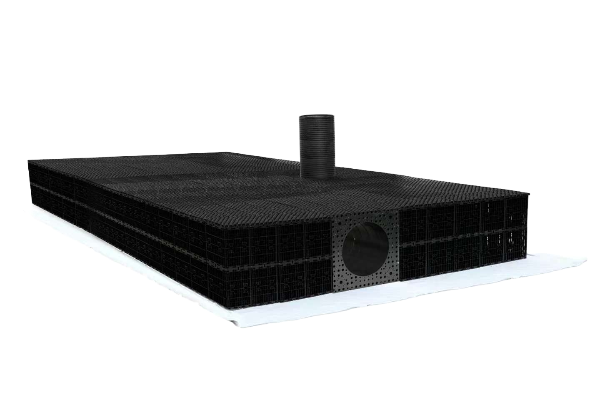
Stormwater detention tank geocellular crate unit

“We moved every model at or above 50 t/m² onto 100% virgin polypropylene after our own long-duration compression runs, recycled resin held the short-term load fine, but virgin PP is what keeps creep within the buckling-resistance margin over decades under a fire-lane wheel load.”

Storm Manage Engineering Team, Shenzhen
(injection-moulding since 2014, 60,000+ m³/yr)

Submittal-ready is not the same as approved

“Submittal-ready” means the certified compression reports, load-rating tables and geotextile specifications assemble into a package a jurisdiction can act on. Unlike vendors who badge crates “F2787 compliant,” it doesn’t imply pre-approval: approval is the AHJ’s call against local code, and this hub says so plainly rather than implying a stamp we can’t issue.

Specifying & sourcing for US projects

Sourcing injection-moulded underground stormwater storage straight from the factory removes the distributor markup layered onto rep-gated catalogs; the trade-off is that logistics and submittal support fall to your procurement team to verify. Storm Manage runs an 8,000 m² plant producing 60,000+ m³ of modular units a year, and the flat-pack format is what makes overseas sourcing viable on freight.

Underground stormwater storage installation components

What to pin down before you specify:

01

Cover Depth and Live load

Ensure model selected is appropriate for your cover depth and the heaviest wheel load; do not assume based on the general designation of ‘traffic rated.’

02

Groundwater

Where the water table can rise above the empty tank, specify anti-flotation ballast or anchoring, because buoyancy is a documented failure mode.

03

Install Envelope

Excavate 12 in wider around the footprint. Install and compact bedding 6 in thick. Backfill the excavated area and the annular space with 6-12 in lifts compacted as required. Dewater the area continuously if there is high groundwater water.

04

Access for inspection & maintenance

Observation wells and cleanout manholes at sensible intervals, since sediment is much more difficult to remove from grid storage than from an open-bottom system.

Shipping and minimums scale with model and fill of the container, not on a flat price, so lead and landed costs are quoted against your volume and port. That transparency is a feature, as the rep-gated numbers others lock behind a form for these underground systems are the exact same data the Storm Manage Hub is built to provide.

When a plastic detention tank is the wrong call, and what the profession actually warns about

In 2024 the American Society of Civil Engineers published a warning after plastic underground detention tanks under a 94,500 ft² church parking lot settled roughly four months after loading, tracing the failure to thermoplastic creep eroding buckling resistance over time.

The review pressed an uncomfortable question, why didn’t the tanks fail when they were first loaded? — and reached a pointed conclusion: the profession need more manufacturer creep and long-duration load-test data, better model selection and monitoring, not a retreat from plastic.

[+] EXPAND ENGINEERING LIMITS [-] COLLAPSE DETAILS

Two honest limits follow. Gravel or an arch chamber can beat modular when excavation is cheap (under ~$22/CY), storage is small, or the AHJ requires open-bottom inspection access, specify by site condition, not by absolutes. And a crate is only as good as its creep engineering and its install: get cover depth, compaction or anti-flotation wrong and no void ratio saves it.

Stormwater Detention Tank Engineering Tools

  • us load class model selector

    Select the appropriate detention tank configuration engineered to meet specific US traffic and load-bearing requirements.

    Access Tool
  • void ratio footprint comparator

    Evaluate site layout efficiency by comparing storage capacity and void ratios across different module specifications.

    Access Tool
  • runoff volume module presizer

    Calculate the required detention volume based on peak runoff data to estimate precise module quantities for your project.

    Access Tool
REQ-01
[SYSTEM_REQ]

Get a US-spec detention tank quote

Send your site area, peak flow, cover condition and load class. We return a model selection, a footprint-versus-excavation comparison, and the compression and load-rating test data your reviewer will ask for.

// EXECUTE WORKFLOW Request a US spec quote →

Frequently asked questions

01 /

How much does an underground detention system cost?

Installed cost runs roughly $8.50 to $17 per cubic foot of storage, and the spread is driven by system type and soil rather than by the crate itself. Geocellular modules land about $8.60 to $13 per cubic foot, arch chambers $9.45 to $17, and precast concrete sits highest. Confusing the price per cubic foot of material with the price per cubic foot of storage is the most expensive mistake in this category, and it skews roughly four out of ten project bids.

02 /

How long does water stay in a detention tank?

Detention is designed to drain down within a set window. Philadelphia’s manual, for example, requires full drain-down within 72 hours after a 24-hour storm, with positive overflow sized up to the 100-year event. The outlet control, not the tank, sets that release rate.

03 /

Do engineers actually see crates beating concrete on cost?

Often, yes. As one civil engineer put it on r/civilengineering, “by the time you take into account all the prep and backfill requirements, the cost difference is not much and possibly leans towards the crates.”

04 /

Is “ASTM F2787 compliant” a valid claim for a geocellular crate?

No. ASTM F2787 is the structural-design standard for arch-shaped thermoplastic collection chambers, not open-cell crates. A crate should be validated by compressive-strength testing in kN/m², creep data, and the CIRIA C680 design method instead. If a supplier badges a crate as “F2787 compliant,” treat it as a category error worth questioning before you specify it.

05 /

What about flotation in high groundwater?

Flotation of empty underground stormwater detention systems during rising water tables is a documented failure mode. Specify anti-flotation ballast or anchoring, and dewater throughout installation.