We use the details you submit to review and respond to your project enquiry. Entries are handled in this website’s WordPress database using Fluent Forms; our hosting and email providers may process the submitted details. Other technical providers receive only the data described in our Privacy Policy.
Please do not send passwords, payment-card details, government identification numbers, sensitive personal data, or unnecessary confidential third-party information.
Updated October 2026 | Civil & Subsurface Stormwater Engineering Guide
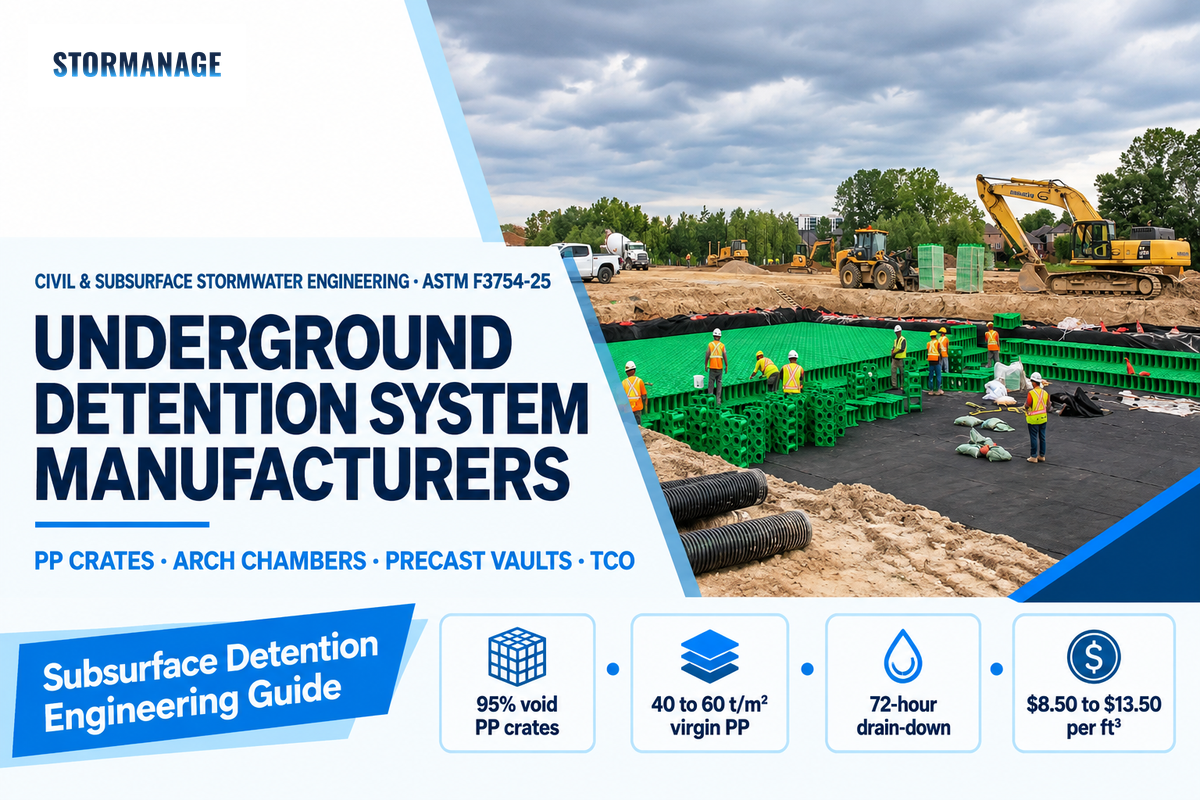
Underground detention system manufacturers supply four types of subsurface storage: modular polypropylene geocellular crates, open-bottom plastic arch chambers, precast concrete vaults, and large-diameter pipe manifolds. Polypropylene crate assemblies provide a 95% internal void ratio. Installed costs run from $8.50 to $13.50 per cubic foot for modular crates, $9.45 to $17.00 for arch chambers, and $13.22 to $35.00+ for precast concrete vaults. Civil engineers match each supplier category to AASHTO HS-20 axle loads, seasonal groundwater elevations, and container freight budgets before issuing tender specifications.
Direct Answer. Underground detention system manufacturers supply modular polypropylene crates (95% void ratio, $8.50–$13.50/ft³ installed per commercial cost studies) and open-bottom arch chambers (55%–68% composite trench void, $9.45–$17.00/ft³). They also manufacture precast concrete vaults (90%–95% internal void, $13.22–$35.00+/ft³) and custom pipe manifolds. Under AASHTO HS-20 vehicular loads, engineers verify project-specific ASTM F3754-25 or ASTM F2418 crush reports and 50-year CIRIA C737 creep curves. Storm Manage ships every model rated at or above 50 t/m² (its 60 t/m² ST-H60) in 100% virgin polypropylene; its 20–40 t/m² grades are recycled PP.
Key Engineering Takeaways for Specifiers.
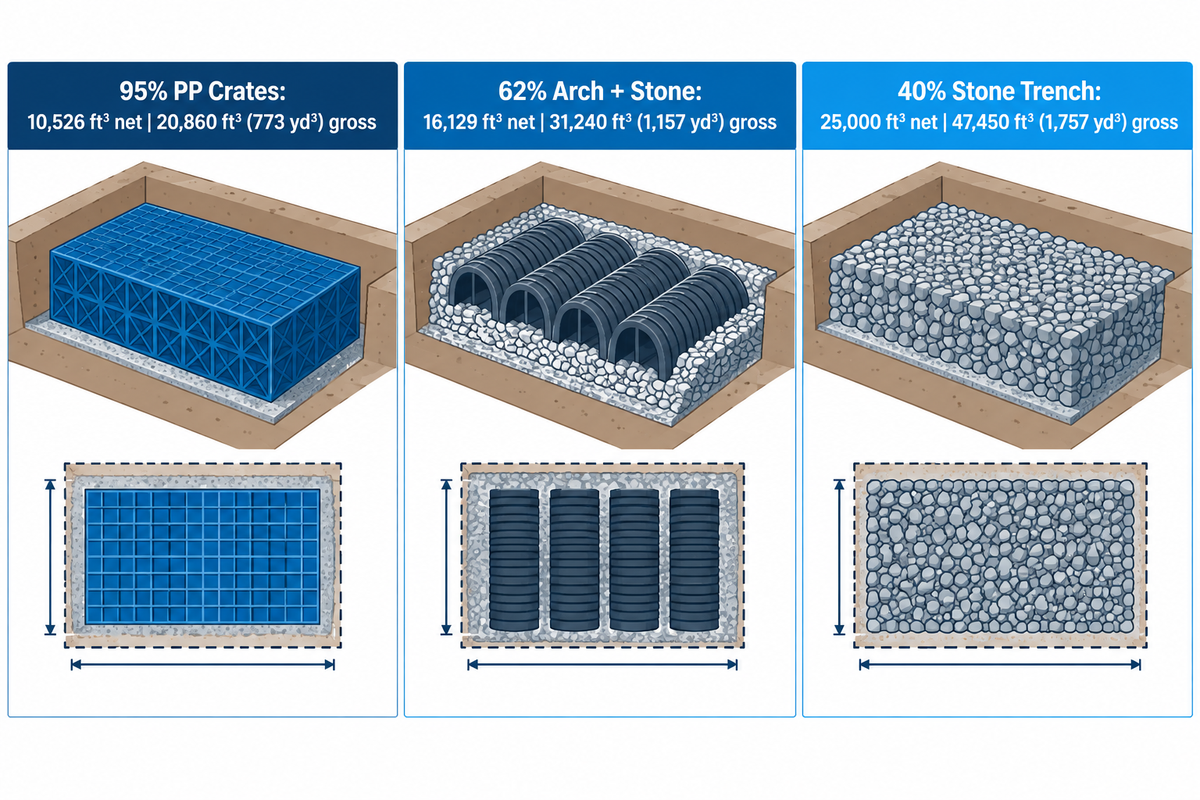
Void Ratio vs. Gross Trench Envelope. Modular polypropylene crates hold 95% net water volume inside the module. That high porosity cuts the net storage footprint by 58% compared to a 40% stone trench.
Traffic Load & Virgin Resin Policy. Buried thermoplastics experience viscoelastic creep under sustained earth and wheel loads. ASTM F3754-25 and CIRIA C737 govern industry-wide structural verification. Storm Manage ships ST-H60 (60 t/m²), and any model rated at or above 50 t/m², in 100% virgin polypropylene; whether a class suits an HS-20 parking area or an HS-25 fire lane depends on cover depth, bedding, backfill compaction and safety factors checked by the engineer of record.
Flat-Pack Freight Economics. One 40-foot high-cube container carries about 341 m³ (12,040 ft³) of assembled module envelope, or about 324 m³ (11,440 ft³) of stored water at 95% void, because the modules ship flat and nest.
Regulatory Pretreatment and Drain-Down. These limits are local: Philadelphia Water Department requires pretreatment of runoff from every inlet and a maximum drain-down time of 72 hours after the 24-hour storm for subsurface detention, while Washington Ecology’s TAPE program sets 50% TSS removal for pretreatment devices and 80% for basic treatment.
Underground Detention System Architectures: How Manufacturers Engineer Subsurface Stormwater Storage
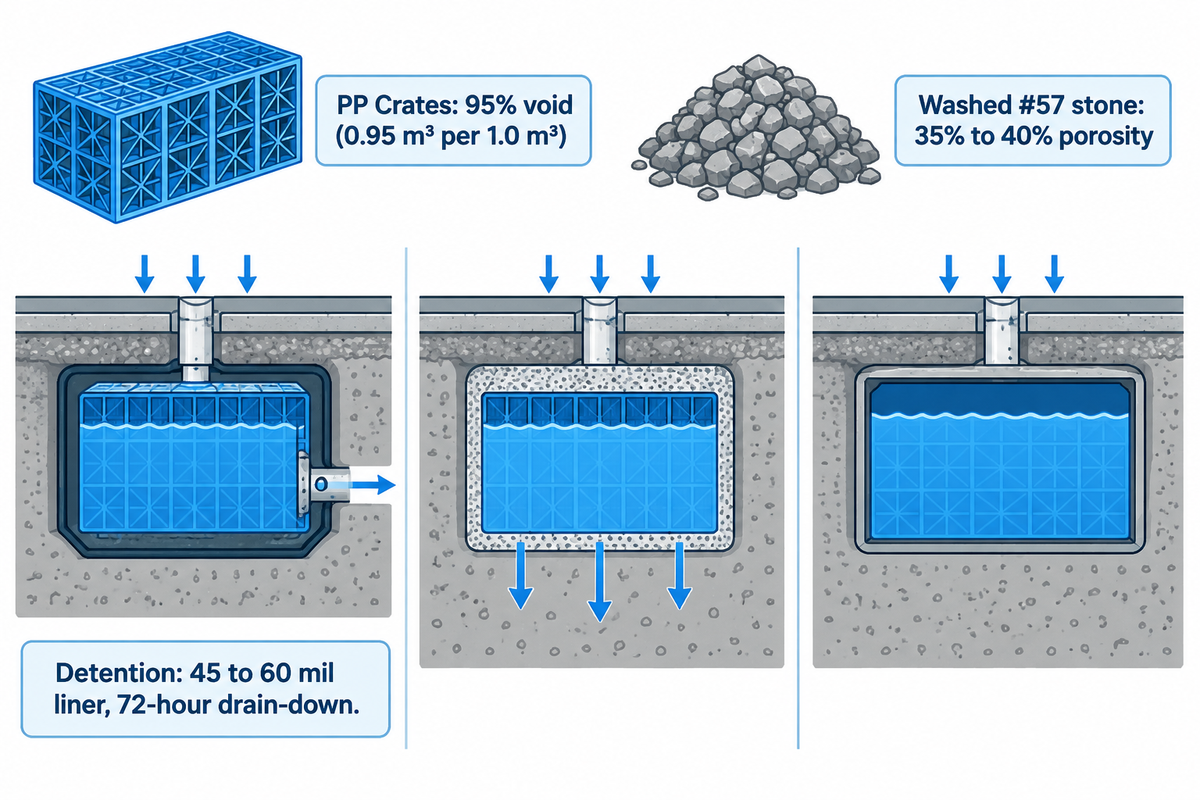
Modular polypropylene detention crates deliver a 95% internal void ratio. They store 0.95 m³ of runoff per 1.0 m³ of module displacement, compared to 35% to 40% porosity in washed ASTM No. 57 stone. Manufacturers engineer four subsurface architectures, geocellular crates, arch chambers, precast vaults, and manifold pipes, to temporarily store peak runoff and release it at a controlled rate within the drain-down time the local manual sets (72 hours after the 24-hour design storm in Philadelphia). In clay subsoils or high groundwater tables where infiltration fails, engineers seal the basin inside a 45 to 60 mil impermeable geomembrane liner.
An underground detention basin functions like a highway metering ramp during rush hour. Cars still enter the main highway, but a ramp signal holds back the surge so downstream lanes don’t gridlock. During a heavy rainfall, a modular stormwater detention tank system captures sheet flow from impermeable asphalt roofs and parking aprons. An outlet control structure with a calibrated orifice plate or vortex valve then meters the flow to the municipal storm drain. By doing this, peak water flow is kept at or below pre-development rates.
What is the difference between an underground stormwater detention system and a retention or infiltration tank?
An underground stormwater detention system collects runoff for temporary subsurface storage and releases it through an outlet orifice at a controlled rate, within the drain-down limit set by the local manual. It also employs an impermeable geomembrane liner in clay soils or high groundwater tables. In contrast, an infiltration tank employs a permeable geotextile to allow runoff to seep into the surrounding soils. A retention system holds water for permanent storage or on-site reuse.
As stated in Section 4.8 of the Philadelphia Water Department Stormwater Plan Review Manual, all subsurface detention systems must drain down completely within 72 hours following the end of a 24 hour storm event. The CIRIA Susdrain on Retention and Detention Systems notes guidance on peak runoff discharge and what controls it. Civil specifiers assessing retention versus detention stormwater systems should review the geotechnical report to assess soil suitability. Clay soils, high seasonal groundwater tables, karst limestone, brownfields, and adjacent building foundations preclude use of unlined infiltration. Those sites need detention instead of infiltration, plus a sealed liner where spills or groundwater contamination are likely (Philadelphia Water Department).
Underground Detention System Manufacturers by Category: Arch Chamber Brands, Precast Plants, and Direct Geocellular Crate Factories
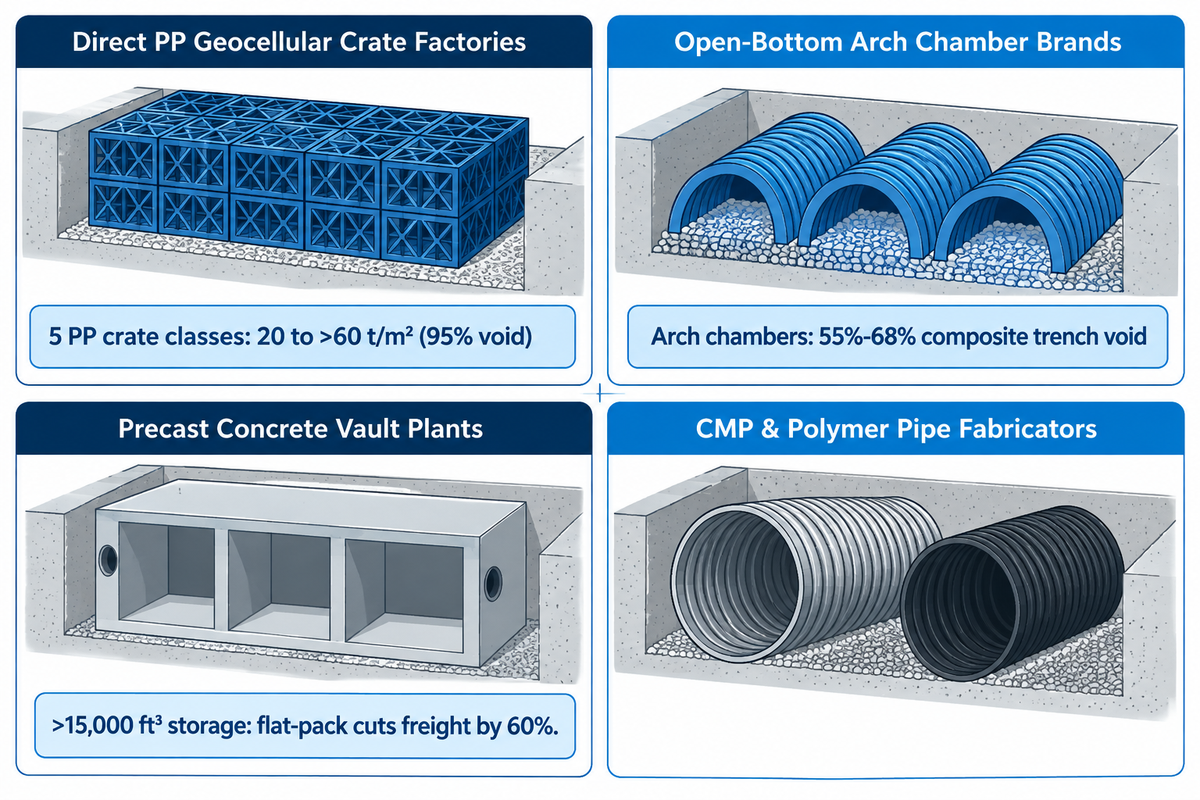
Direct injection-molding factories such as Storm Manage manufacture 5 load-graded polypropylene module classes spanning 20 to over 60 t/m² (ST-E20, ST-L30, ST-M40, ST-H60, and ST-Custom). Open-bottom corrugated arch chambers are molded in polypropylene or HDPE by chamber brands such as ADS StormTech, CULTEC and Prinsco, while heavy crane-set vaults come from precast concrete plants such as Oldcastle Infrastructure and StormTrap. Specifiers evaluating underground detention system manufacturers are therefore comparing four supply chains: arch-chamber brands, geocellular crate molders, precast concrete plants and pipe fabricators. Because the modules ship flat and nest, one 40-foot high-cube container delivers about 341 m³ of assembled envelope (Storm Manage container-loading calculation), so a 15,000 ft³ (425 m³) system ships in two containers.
Which underground detention system manufacturers supply HS-20 rated modular systems, and how do chamber brands differ from direct polypropylene crate factories?
Storm Manage (ST-M40 recycled-PP and ST-H60 virgin-PP crates) and Brentwood Industries (StormTank Module 25 Series) state traffic load capabilities of modular polypropylene crates based on AASHTO HS-20 and HS-25. ADS (StormTech), Contech (ChamberMaxx), and CULTEC supply open-bottom arch chambers, while Oldcastle (StormCapture) and StormTrap (SingleTrap/DoubleTrap) supply precast concrete vaults. Chamber brands use a crushed-stone arch envelope, while direct polypropylene crate factories (manufacturers) use injection-molding to form an internal column grid that ships in a flat-packed state. Public catalogs don’t guarantee each model across all 12 manufacturers for traffic loads, so engineers have to verify project-specific ASTM F3754-25, ASTM F2418/F2787, or stamped precast submittals.
USPTO patent US7806627B2 discloses open-bottom corrugated stormwater chambers with alternating crests and valleys, while ASTM F2787 governs the surrounding angular stone structural envelope. Conversely, load-bearing honeycomb and cellular thermoplastic blocks are described in USPTO patents US6991402B2 and US10626580B2. Those blocks transfer vertical axle loads through internal pillars without structural stone between the units. The Federal Highway Administration (FHWA) Ultra-Urban BMP Report 3FS6 notes that underground detention is used mainly where space is limited and there is no practical alternative, because high land costs in ultra-urban settings can make it feasible.
Manufacturer Classification Matrix: 12 Documented Underground Detention System Manufacturers Across 4 Hardware Families.
Up to 82% by plan area (7 × 15 ft inside an 8 × 16 ft module) | HS-20 / HS-25
StormTrap
Precast Concrete Module
SingleTrap & DoubleTrap leg-supported vaults
High-strength precast stormwater concrete
Total void storage inside the module; SingleTrap internal heights 1′-1″ to 7′-6″ | HS-20 / HS-25
Terre Hill Concrete Products
Precast Concrete Arch
Terre Arch TA26 & TA48 modular concrete arches
Precast concrete / AASHTO LRFD
54.9% (TA26: 236 ft³ in an 8.00 × 19.00 × 2.83 ft unit) to 65.5% (TA48: 480 ft³ in 8.00 × 20.00 × 4.58 ft) | HS-20 / HL-93
A specialized factory such as Storm Manage injection-molds geocellular structural modules in H400 (1,000 × 500 × 400 mm) and H500 (1,000 × 500 × 500 mm) heights. Other diversified infrastructure groups like Contech Engineered Solutions, Oldcastle, and ADS maintain broad stormwater management products portfolios covering pipe, precast concrete, and chambers. Check out our comparison of stormwater arch chambers versus modular crates or our global attenuation tank manufacturers guide to compare regional production footprints.
Structural Load Ratings, ASTM Testing Standards, and Virgin vs. Recycled Polypropylene Creep Compliance
Industry-wide AASHTO HS-20 (32,000 lb axle) and HS-25 (40,000 lb fire lane) structural compliance requires third-party ASTM F3754-25 crush and 50-year CIRIA C737 creep submittals. Short-term crush numbers alone do not warrant 50-year durability of buried plastics, which, under sustained soil and wheel loads, exhibit viscoelastic creep. Storm Manage draws its resin line at 50 t/m² (about 490 kPa): every model at or above it, today the 60 t/m² ST-H60, ships in 100% virgin polypropylene, because the company’s long-duration compression runs showed recycled resin holding the short-term load but virgin PP keeping creep within the buckling margin. ST-E20, ST-L30 and ST-M40 are recycled PP.
How do polypropylene geocellular crates compare to open-bottom arch chambers and precast concrete vaults for subsurface stormwater detention under HS-20 parking lots?
Under AASHTO HS-20 parking lots, modular polypropylene crates carry axle loads through internal columns at a 95% to 97% internal void ratio ($8.50–$13.50/ft³ installed). Structural qualification requires project-specific ASTM F3754-25 crush and 50-year CIRIA C737 viscoelastic creep submittals. Open-bottom arch chambers (ASTM F2418/F2787) transfer wheel loads through a composite crushed-stone arch at 55% to 68% net trench porosity ($9.45–$17.00/ft³ installed). Precast concrete vaults support heavy axle loads through rigid reinforced slabs at 90% to 95% internal void ($13.22–$35.00+/ft³ installed). Minimum cover thickness depends on each manufacturer’s submittal; Storm Manage uses 100% virgin polypropylene only from 50 t/m² up (ST-H60), with ST-E20 to ST-M40 in recycled PP.
“The first sign of a problem could be seen when the parking lot above the tanks began to settle, indicating a failure of the plastic tanks to support the overburden.”
An October 2024 Civil Engineering Source case study by the American Society of Civil Engineers (ASCE) describes a church parking lot where buried polypropylene tank modules failed four months after the overburden was placed: under sustained load, creep reduced the boxes’ buckling resistance, and small irregular loads pushed their sides out of plane until they buckled.
PP-Resin & Creep Submittal Gate
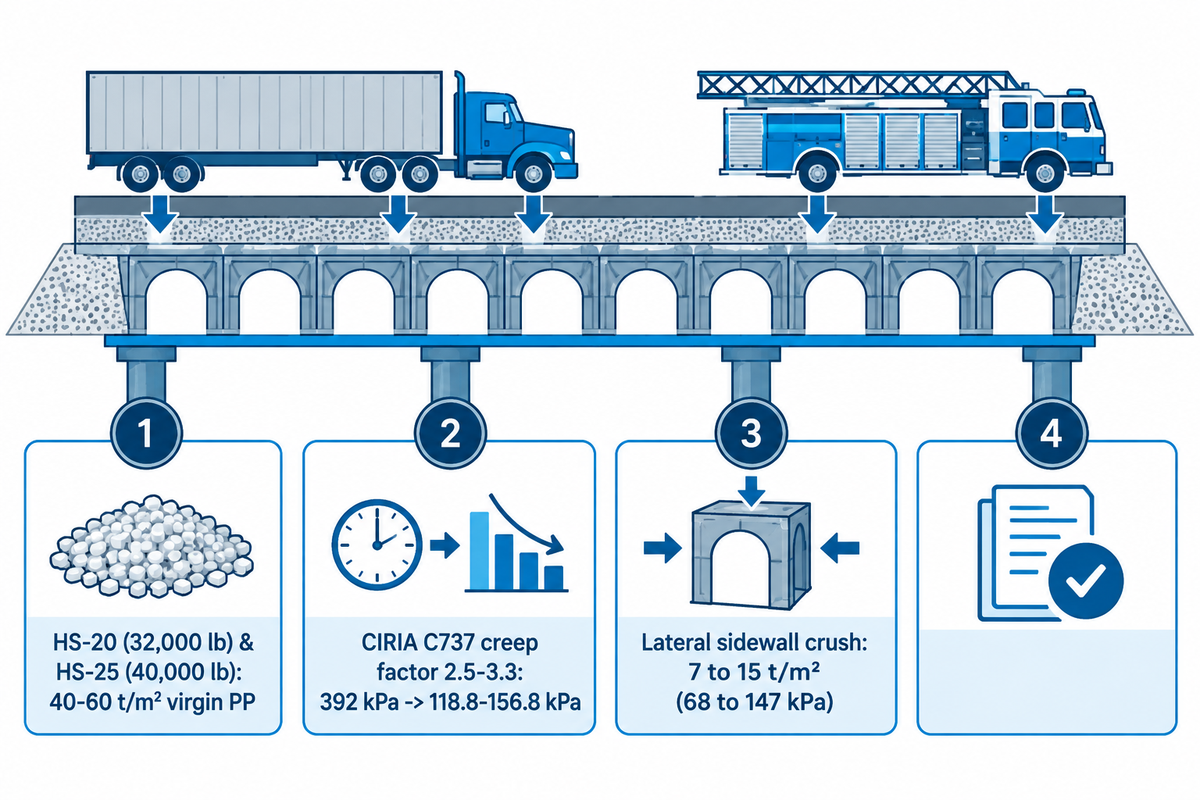
The PP-Resin & Creep Submittal Gate is a four-point engineering assessment to evaluate resin purity, yield under ASTM F3754-25, lateral wall strength, and 50-year creep factors.
ASTM F3754-25 defines the requirements for materials, structural and other testing, marking and installation for buried modular polypropylene underground stormwater storage units. Site-specific hydraulic routing and water quality pretreatment remain the civil engineer’s design responsibility under municipal codes, such as the Philadelphia Water Department Section 4.8 Manual. To ensure the overall system in commercial parking lot stormwater detention installations, four checks are mandatory:
✔ Resin Policy by Load Class. Storm Manage makes ST-E20 (20 t/m²), ST-L30 (30 t/m²) and ST-M40 (40 t/m²) in recycled PP and ships ST-H60 (60 t/m²), and any model at or above 50 t/m², in 100% virgin polypropylene; confirm the resin declared for each class on the batch certificate.
✔ 50-Year Creep Reduction Factor (CIRIA C737). Under CIRIA C737, long-term strength comes from creep and creep-rupture tests of at least 10,000 hours, and the design value is that 50-year characteristic strength divided by a material partial factor of no less than 1.5. In the BPF Pipes Group worked example to C737, a unit with 440 kN/m² ultimate vertical strength has a 50-year characteristic vertical strength of 124 kN/m² and a design strength of 83 kN/m², so a 392 kPa (40 t/m²) short-term rating cannot be used directly as long-term capacity.
✔ Tri-Axial & Lateral Sidewall Crush Rating. Active earth pressure and compaction rollers push inward on tank walls. Verify lateral compressive strength of at least 7 to 15 t/m² (68 to 147 kPa) alongside vertical crush testing.
✔ Standard Alignment Across Architectures. Audit open-bottom polypropylene chambers against ASTM F2418 and ASTM F2787, HDPE chambers against ASTM F2922, and modular crates against ASTM F3754-25. Proper specification ensures durable subsurface structures withstand 50 years of cyclic axle loads.
Hydraulic Sizing, Void Ratio Math (95% vs. 40%), and Excavation Footprint Calculations
A 95% void modular polypropylene detention assembly requires a 58% smaller net storage envelope than a 40% void stone trench. That shrinks a 10,000 ft³ (283.2 m³) storage zone from 25,000 ft³ down to 10,526 ft³. Civil engineers must separate internal module void space from the gross excavation trench envelope, which adds foundation bedding, perimeter side backfill, top cover, and dead-storage sump depth. When urban utility corridors limit plan area, multi-layer H500 or H400 crates cut excavation spoils haul-off by more than half.
How do you calculate the excavation footprint and storage volume for a 95% void modular detention tank versus a 40% void crushed-stone chamber bed?
Divide the net stormwater storage volume by the system void ratio (0.95 for modular polypropylene crates, 0.55 to 0.68 for composite arch-chamber stone beds, or 0.40 for washed ASTM No. 57 stone). Add foundation stone bedding, side backfill clearance, top cover and external perimeter header manifold trench width to get gross excavation volume. Internal isolator tunnels, situated within the crate matrix, do not require any additional trench width, while the composite arch-chamber stone beds’ void space is variable and depends on the thickness of the stone envelope.
Physical and computational fluid dynamics modeling by Ngu, Mah, and Bong, indexed in the U.S. EPA Health & Environmental Research Online (HERO) Database, models roof runoff collection capacity and internal flow across a set of modular multi-unit detention chambers during a 15-minute, 10-year design storm. For the hydraulics of the inlet manifold to work, the active storage must be placed above the outlet invert. The following equations are to be used for preliminary site calculation:
Net Storage Envelope Volume. V_envelope = V_required / n (where n = 0.95 for Storm Manage PP crates, n = 0.55 to 0.68 composite for arch chambers in 40% void stone, and n = 0.40 for gravel trenches). Dead storage volumes below the outlet orifice invert (typically a 150 mm sediment sump in municipal manuals) aren’t included in active detention credit.
Active Plan Area of Tank. A_tank = V_envelope / H_active (where H_active = 1.0 m / 3.28 ft for two stacked layers of H500 crates, or 1.2 m / 3.94 ft for three layers of H400 crates). Internal distribution tunnels are within this module footprint, and external headers add a pipe perimeter manifold trench allowance.
Gross Trench Excavation Volume. V_excavation = (L_tank + 2 × W_side) × (W_tank + 2 × W_side) × (H_active + H_bedding + H_cover), with bedding depth, side clearance and cover taken from the manufacturer’s installation instructions, which ASTM F3754-25 (Sections 1.2–1.3) requires the manufacturer to supply.
Assumed inputs for the worked example below: 10,000 ft³ (283.2 m³) of required active live storage above the outlet invert, and a 1.0 m (3.28 ft) active storage depth. The illustrative trench includes 150 mm (0.5 ft) of compacted foundation bedding, 450 mm (1.5 ft) of side backfill clearance, and 600 mm (2.0 ft) of HS-20 traffic cover.
Worked Example Hydraulic Sizing Benchmark: 10,000 ft³ (283.2 m³) Active Storage Across 3 Subsurface Systems.
Sizing Metric
95% Void PP Crate Tank (2-Layer H500)
62% Composite Arch Chamber + Stone
40% Void Crushed-Stone Trench
Required Net Live Storage
10,000 ft³ (283.2 m³)
10,000 ft³ (283.2 m³)
10,000 ft³ (283.2 m³)
Effective Storage Void Ratio (n)
95% (0.95 internal cellular void)
62% (0.62 assumed arch + stone composite)
40% (0.40 washed ASTM No. 57 stone)
Net Storage Zone Envelope
10,526 ft³ (298.1 m³)
16,129 ft³ (456.7 m³)
25,000 ft³ (707.9 m³)
Storage Zone Plan Area (at 3.28 ft depth)
3,209 ft² (298.1 m²)
4,917 ft² (456.8 m²)
7,622 ft² (708.1 m²)
Gross Excavation Volume (including bedding, cover, and sides)
On these inputs, the 95% void polypropylene crate assembly reduces net storage envelope volume by 58% against gravel trenches and 35% against arch chambers. Spoils haul-off drops by 384 to 984 cubic yards. That comparison reflects active storage geometry; final civil grading drawings must add any dead-storage sump depth below the outlet orifice invert. Run your site dimensions in our preliminary stormwater storage module estimator or check our stormwater detention tank cost and sizing guide.
Impermeable Geomembrane Liners (HDPE, LLDPE, EPDM) vs. Permeable Geotextile Wraps for Subsurface Detention
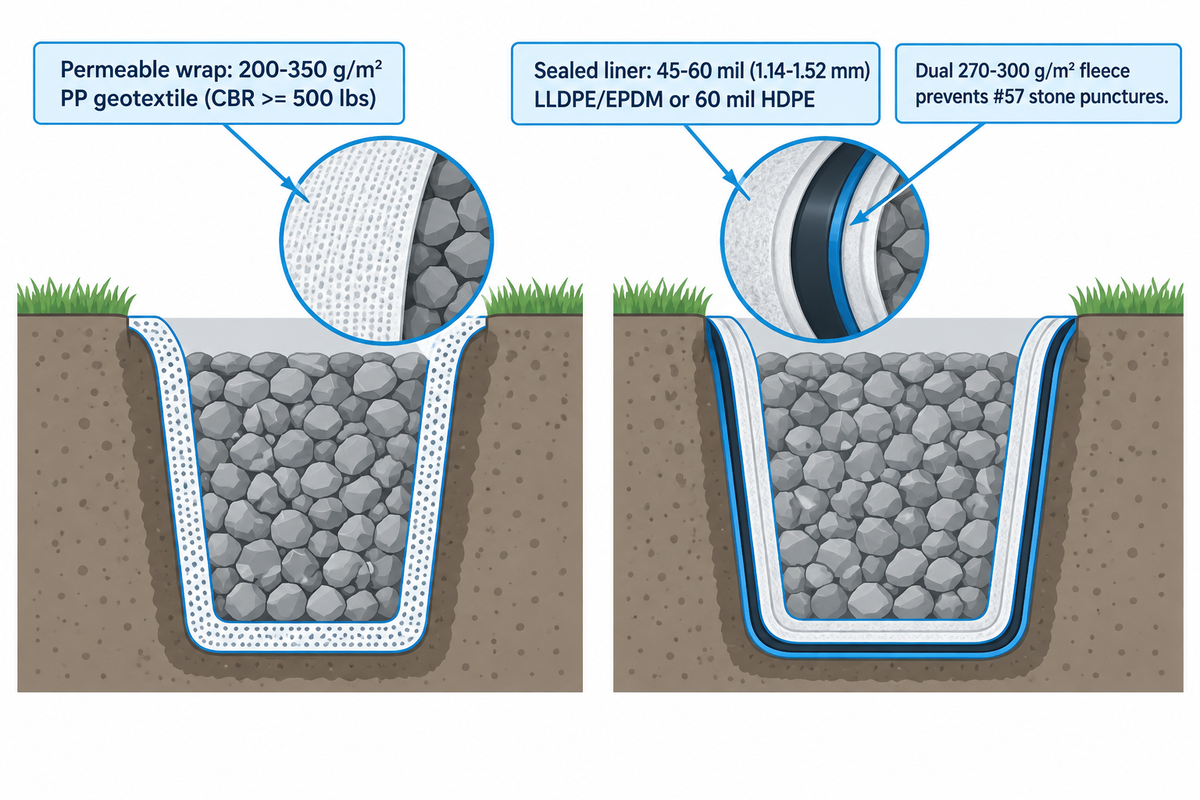
A watertight liner is a site decision, not a default: Philadelphia’s manual says impervious liners should be avoided but may be necessary where spills or groundwater contamination are likely, and must then be continuous and run up the sides of any structure inside the lined footprint. For permeable sandy loams where recharge is acceptable, envelop the crate matrix with 200 to 300 g/m² non-woven filtration geotextile with an ASTM D6241 CBR puncture strength of at least 500 lbs. Never use a woven slit film silt-fence fabric around detention crates as clay will quickly blind the weave.
⚠️Common Field Mistake: Unprotected Geomembrane Punctures.
Backfilling angular ASTM No. 57 crushed stone up against a 30 or 45 mil geomembrane, especially without an outer protective geotextile, can tear the liner during compaction. Always place the watertight membrane between inner and outer 270 to 300 g/m² needle-punched geotextile fleeces. Pressure-test dual-track hot-wedge field seams and backfill.
Both Section 9.13 of the Iowa Stormwater Management Manual and the Philadelphia Water Department Manual dictate strict separation of permeable recharge beds and watertight containment structures. When a sealed stormwater management system or stormwater system is used for rainwater capture and reuse, select the envelope material from one of the four grades given below. Our Subsurface Attenuation Tank Design and installation Manual provides detailed pipe boot clamping diagrams.
Subsurface Envelope Selection: Geotextile Wraps vs. Impermeable Geomembrane Liners.
Envelope Material
Thickness / Weight
Target System Mode
Seam & Penetration Method
Soil & Site Condition
Non-Woven Needle-Punched PP Geotextile
200–350 g/m² (6–10 oz/yd²), CBR ≥ 500 lbs
Stormwater detention and infiltration
300–450 mm (12–18 in.) overlapped or sewn seams
Permeable sand/loam (infiltration ≥ 0.5 in./hr), >20 ft from foundations
Low-permeability clay (<0.5 in./hr), flexible folding around 90° crate corners
HDPE (High-Density Polyethylene)
60 mil (1.5 mm) + dual 300 g/m² cushion
Industrial containment & retention systems
Certified field thermal fusion weld + stainless boot clamps
Brownfield sites, hydrocarbon runoff zones, high chemical resistance
EPDM Synthetic Rubber Membrane
45–60 mil (1.14–1.52 mm) prefabricated box liner
Small-to-medium watertight detention or reuse
Factory vulcanized 3D liner + compression flange collars
Fast cold-weather installation where thermal welding crews are unavailable
Matching Subsurface Detention Hardware to Site Constraints: Parking Lots, Fire Lanes, High Groundwater, and Shallow Invert Depths
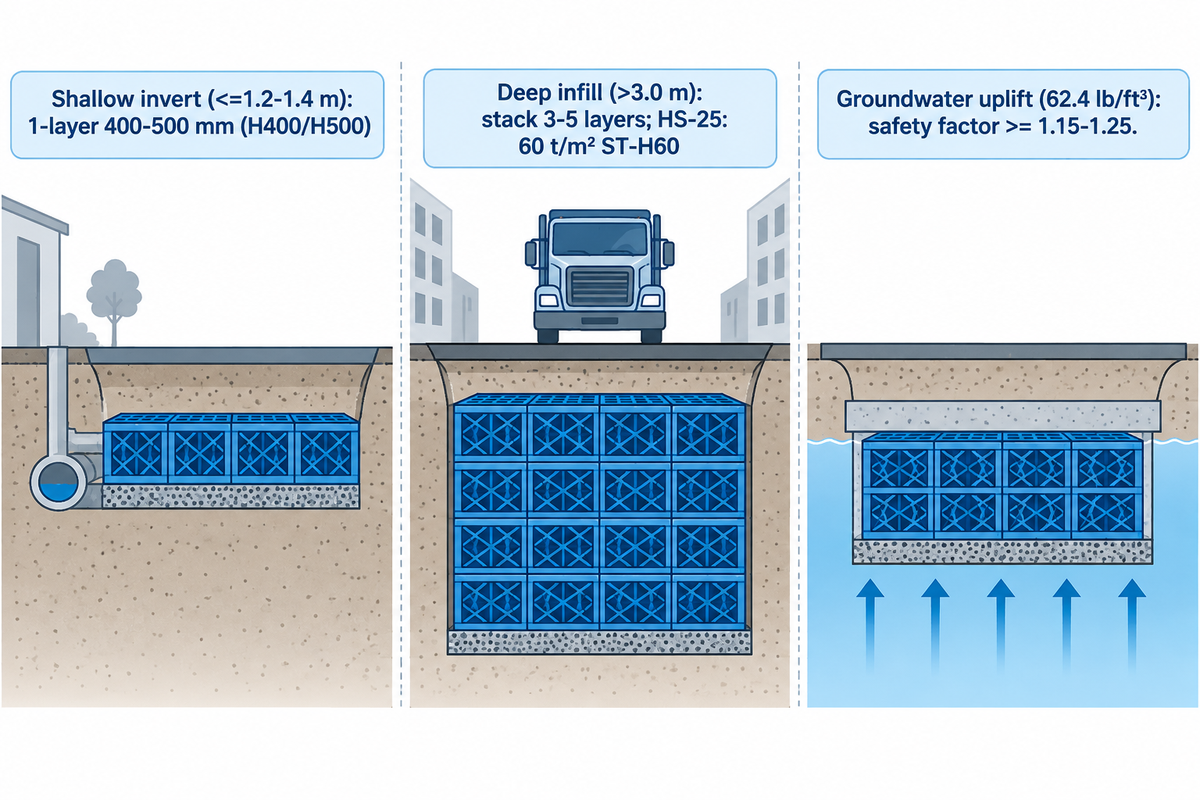
Polypropylene modules of 400 mm (15.7-inch) H400 and 500 mm (19.7-inch) H500 allow civil engineers to install single-layer subsurface detention and watertight containment where a shallow sewer invert limits trench depth to 1.2 to 1.5 m. Shallow module geometry solves the problem of vertical burial clearance, but doesn’t address other discharge issues. In a 100-year tailwater event, the discharge sewer HGL must not submerge the module outlet orifice. If groundwater rises to the level of a lined tank’s base, a minimum factor of safety of 1.15 to 1.25 should be used to determine buoyancy.
Assessments of commercial land development and of high-groundwater site design on civil engineering forums often state that 6-foot-tall precast vaults can’t drain by gravity if a street main is located 4.5 feet below grade. Pairing low-profile H400 modules with wide horizontal headers preserves positive gravity slope toward the downstream outfall. A fact sheet from the FHWA Ultra-Urban BMP design framework shows why this matters: most pipe and vault systems sit with inverts 1.8 to 3 m (6 to 10 ft) down, which can make an adequate outfall hard to reach (see also the CIRIA Susdrain guidance). Use these five engineering rules to choose hardware to address site-specific constraints:
1. Shallow Storm Sewer Outfall Invert (Trench Depth ≤ 1.2 – 1.4 m). When a shallow sewer invert restricts active storage depth to 400–500 mm, specify a single-layer Storm Manage H400 or H500 crate matrix (ST-M40, 40 t/m², recycled PP).
2. Tight Urban Infill Parcel with Deep Outfall Clearance. When a zero-lot-line developer site has a deep sewer connection (>3.0 m) and tight boundaries, stack ST-M40 or ST-H60 crates 3 to 5 layers high (1.5 to 2.5 m depth).
3. Municipal Fire Lanes, Loading Docks, and HS-25 Outrigger Zones. When the on-site basin sits beneath an AASHTO HS-25 fire lane (40,000 lb axle load), use ST-H60 (60 t/m² virgin PP) or ST-Custom (>60 t/m²). Employ the crates in conjunction with an engineered pavement cover section, as standard 20-30 t/m² landscape modules will creep under concentrated wheel loads.
4. High Ground Water Table on a Lined Detention Basin. If seasonal high groundwater rises above the bottom invert of a lined detention system, raise the invert using H400 modules. Alternatively, anchor the tank with overburden soil or a concrete base slab (uplift safety factor ≥ 1.15–1.25). An empty sealed 95%-void module displaces 62.4 lb/ft³ (9.81 kN/m³) of water and will float if upward buoyant force exceeds dead weight.
5. Irregular Utility Corridors and Residential Subdivision Retrofits. When existing utilities or tree roots require an L-shaped basin layout for a residential homeowner association or commercial retrofit, step 1,000 × 500 mm modular crates in 0.5 m increments. Rectangular 0.5 m² blocks adapt around manholes without custom formwork, helping mitigate localized flooding and support downstream erosion control. Refer to our underground detention systems in New Jersey guide to understand how state rules govern these designs.
Pretreatment, Inspection Access, and Hydro-Jetting Maintenance Requirements (EPA NPDES & Municipal MS4 Compliance)
Water-quality and drain-down targets come from the local program: Washington Ecology’s TAPE program, for example, asks 80% TSS removal of basic-treatment devices and 50% of pretreatment devices, and Philadelphia caps subsurface detention drain-down at 72 hours after the 24-hour storm. Detention alone does not supply that treatment; FHWA notes that underground detention provides no significant water-quality control without extensive modification. Federal NPDES Phase II regulations (40 CFR 122.34) require regulated small MS4 permits to include post-construction runoff controls and adequate long-term operation and maintenance provisions. Local municipal MS4 reviewers check civil drawings for physical pretreatment units, 6-to-24-inch CCTV inspection ports, and flushable bottom-row sediment channels before issuing a grading permit.
A modular polypropylene matrix is a storage vessel, not a sediment trap. If there’s untreated grit in a wrapped tank without upstream stormwater treatment, silt will accumulate on the bottom and reduce storage capacity. Both the Philadelphia Water Department Section 4.8 Standards and the Iowa Stormwater Management Manual require pretreatment and inspection risers on all basins. To keep the storage volume usable over the system’s design life, three hardware layers are built in: a pretreatment unit on every inlet (a sumped, trapped catch basin or a hydrodynamic separator), a sediment isolator row or inspection tunnel along the inlet side of the matrix, and cleanouts, manholes or inspection risers that let crews check sediment depth and flush the isolator row with a vacuum truck.
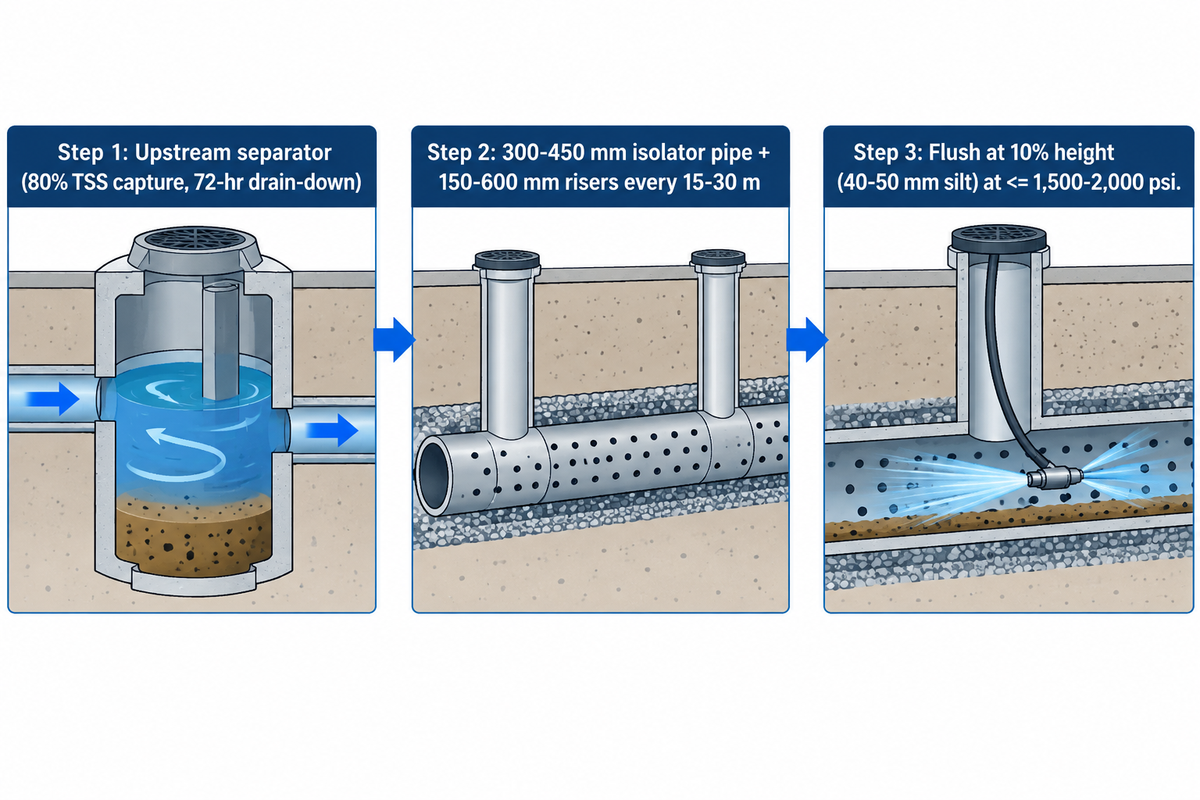
Step 1 — Upstream Hydrodynamic Pretreatment (80% TSS Capture). Install a deep-sump catch basin with a hooded outlet trap or a verified hydrodynamic vortex separator upstream of the inlet header pipe. Capturing coarse sand, trash, and hydrocarbons before runoff enters the crate matrix prevents internal siltation and helps address the water quality mandate of your municipality.
Step 2 — Integrated Isolator Conduits & Inspection Risers. Embed a perforated 300 to 450 mm sediment isolator distribution pipe or bottom-tier inspection tunnel along the primary inlet row. Connect 150 to 600 mm (6 to 24 in.) vertical surface risers every 15 to 30 meters so crews can lower a dipstick or CCTV camera without confined-space entry.
Step 3 — Scheduled Low-Pressure Hydro-Jetting & Vacuum Extraction. Measure sediment depth semi-annually and after major 10-year storm events. When accumulated silt reaches 10% of the bottom module height (40 to 50 mm), flush the isolator row using a vacuum truck nozzle set at or below 1,500 to 2,000 psi.
Using low-impact development (LID) pretreatment in combination with modular subsurface storage creates a sustainable drainage train. It helps manage runoff and detain peak surges prior to discharge to a public waterway. Check our LID and EPA BMP stormwater compliance guide and underground attenuation tank maintenance schedule for municipal O&M agreement templates.
Installed Cost per Cubic Foot, Flat-Pack Container Shipping Economics, and 5-Year Lifecycle Cost Breakdown
Commercial cost studies place installed underground stormwater detention costs at $8.50 to $13.50 per cubic foot for modular polypropylene geocellular crates ($8.60–$10.98/ft³ in regional 75,000 ft³ comparisons). Open-bottom arch chambers cost $9.45 to $17.00 per cubic foot installed, precast concrete vaults cost $13.22 to $35.00+ per cubic foot, and pipe manifolds vary by gauge. Flat-pack crates ship about 341 m³ (12,040 ft³) of assembled envelope in one 40HQ container.
How much does a commercial underground stormwater detention system cost per cubic foot installed, and how does flat-pack factory shipping affect total project cost?
Commercial cost studies place installed underground detention systems at $8.50 to $13.50 per cubic foot for modular polypropylene crates ($8.60–$10.98/ft³ regional benchmark). Open-bottom arch chambers run $9.45 to $17.00 per cubic foot installed, while precast concrete vaults cost $13.22 to $35.00+ per cubic foot. Flat-pack factory shipping puts about 341 m³ (12,040 ft³) of assembled envelope into one 40-foot high-cube (40HQ) container, and the hand-portable modules need no crane on site.
Unit material quotes frequently mislead general contractors. When a contractor prices an arch chamber shell or precast vault, the hardware invoice omits two major expenses: shipping empty air on flatbed trucks and importing hundreds of tons of washed stone. The FHWA Ultra-Urban Detention Vault Report (fact sheet 3FS6) calls concrete vaults costly to build and corrugated metal pipe systems significantly less expensive for storing large volumes, while the EPA HERO modular detention studies cover storage sizing and internal flow, not cost. Excavation, imported stone and freight sit outside the hardware invoice, which is why the example below prices them as separate lines. Consider the following example of a 20,000 ft³ (566 m³) modular commercial parking lot detention basin:
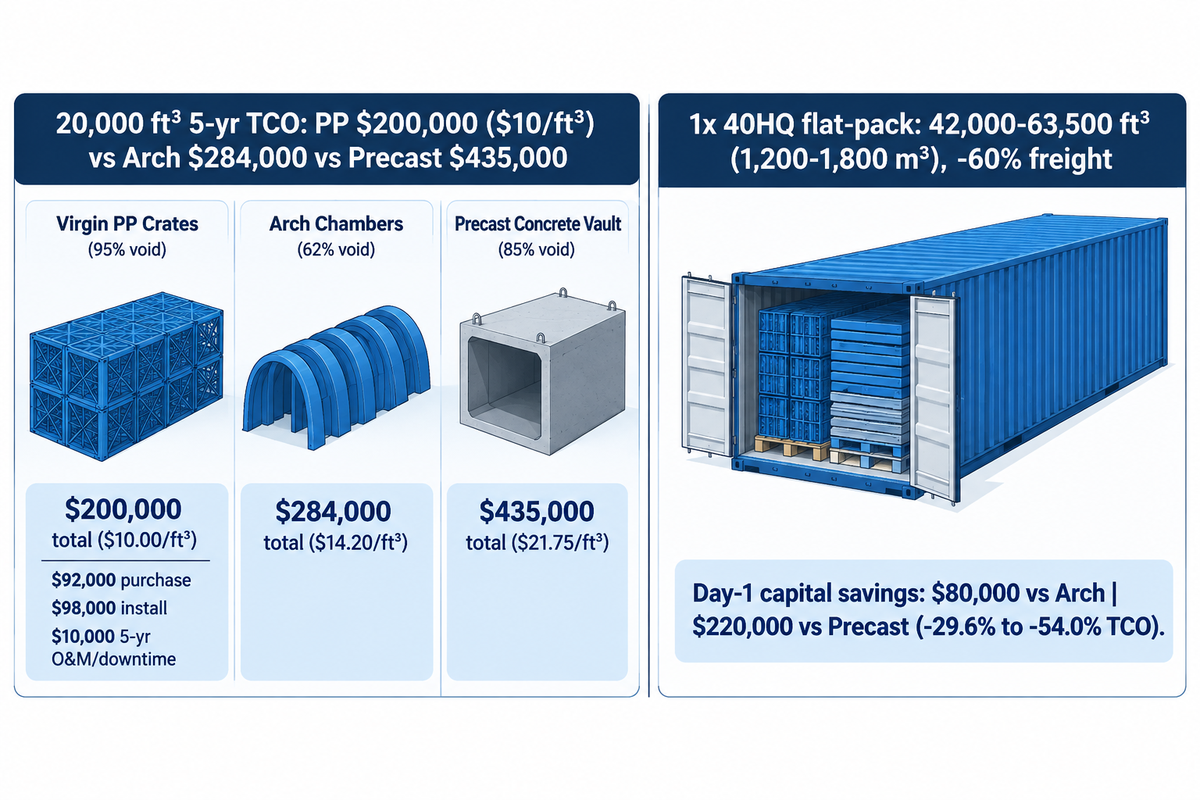
Worked Example — 5-Year Total Cost of Ownership (Assumed 20,000 ft³ / 566 m³ Commercial HS-20 Parking Lot Detention System).
Downtime risk (5-yr assumed parking lot lane closure during install/service)
$3,500 (assumed 5–6 day hand assembly; surface riser access)
$6,500 (assumed 8–10 day stone haul & spreading window)
$12,500 (assumed crane pad setup & heavy truck staging closures)
Payback & Direct Savings Calculation (Worked Example). In this illustrative 20,000 ft³ worked example, total 5-year TCO for the Virgin PP Crate system equals $92,000 + $98,000 + $0 + $6,500 + $3,500 = $200,000 ($10.00/ft³). Arch Chambers total $284,000 ($14.20/ft³) and Precast Vaults total $435,000 ($21.75/ft³). Specifying flat-pack virgin PP crates in this sample calculation yields an immediate Day-1 capital savings of $80,000 ($270,000 − $190,000) against arch chambers and $220,000 ($410,000 − $190,000) against precast concrete, cutting 5-year lifecycle cost by 29.6% to 54.0%.
Material savings are only one benefit of using flat-pack detention manufacturers. Simple nesting of modular polypropylene crates simplifies jobsite logistics. Two laborers can snap together 3,000 to 4,000 ft³ (85 to 113 m³) of crates in a shift using shear pins and side clips, requiring no crane lifts. For urban sites where space is a premium, using modular polypropylene crates is a good solution.
The 7-Criterion Detention Vendor Audit Scorecard: How Civil Engineers and Contractors Vet Manufacturer Submittals
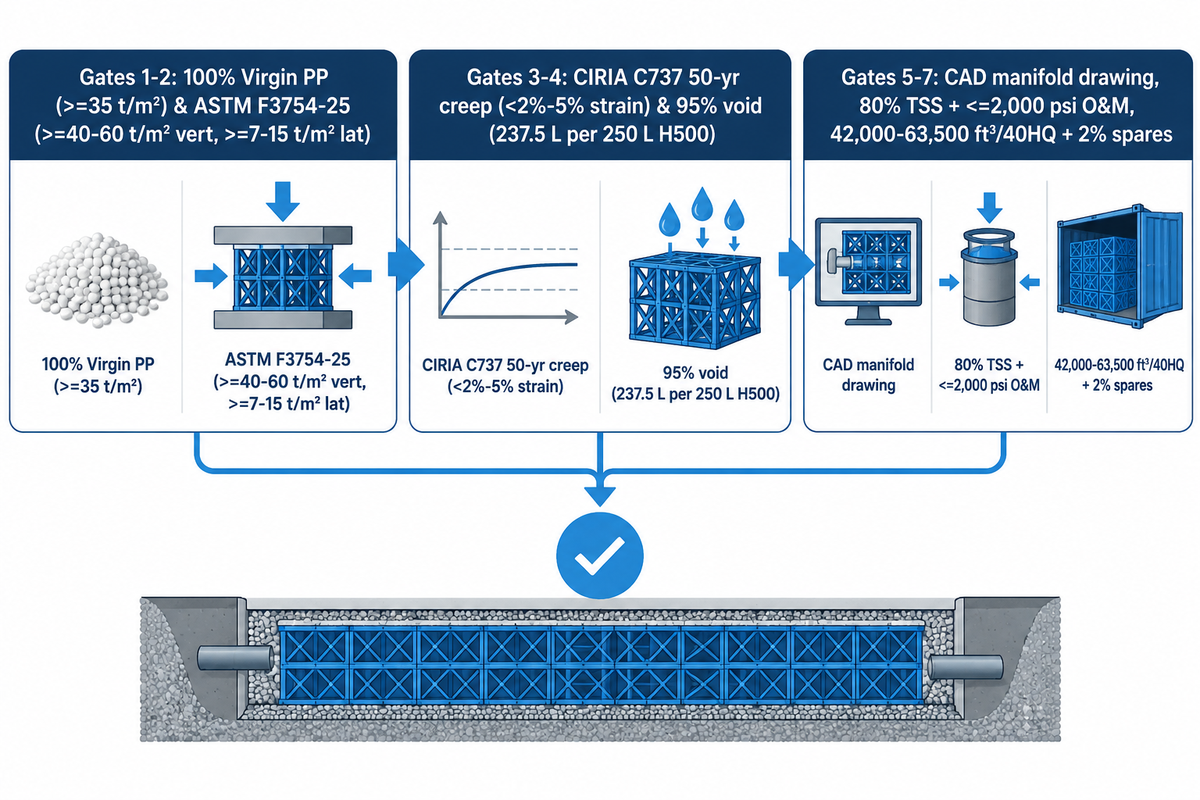
Civil engineers and general contractors impose 7 mandatory submittal verification gates on underground detention manufacturers. They also check 95% displacement void tests, CAD manifold drawings, CCTV channel layouts, and container packing schedules. Requiring all seven reviews before releasing a purchase order ensures the resin, crush and creep data in the submittal match the load class specified.
7-Criterion Detention Vendor Audit Scorecard
7-Criterion Detention Vendor Audit Scorecard is a pre-award engineering checklist grading subsurface detention manufacturers across resin purity, structural crush, creep, hydraulics, and logistics.
Prior to stamping an “or equal” product substitution on a commercial site plan, score the manufacturer’s submittal package against the seven pass/fail thresholds below. These gates reflect ASCE buried plastic tank failure findings and cellular module patents (USPTO US10626580B2):
Vertical-only brochure number with zero lateral wall test
3. 50-Year Creep Curve
CIRIA C737 long-term (50-year) creep assessment backed by sustained-load compression test data
Documented creep reduction factor confirming <2%–5% strain at 50 yr
Applying short-term ultimate crush load without safety factors
4. Hydraulic Void Verification
Water displacement or dimensional solid-volume calculation
95% net internal void ratio (237.5 L net per 250 L H500 module)
Confusing gross module displacement with net water volume
5. Site-Specific Shop Drawing
CAD / BIM layout with header manifolds & cover depth
Shows bedding, cover, side backfill, inlet/outlet inverts & buoyancy
Generic catalog cut-sheet with no manifold connection detail
6. O&M & Pretreatment Plan
Inspection port layout & hydro-jetting pressure spec
Pretreatment on every inlet to the level the local manual sets (TAPE pretreatment: 50% TSS removal) + 150–600 mm risers + ≤2,000 psi jetting
Zero inspection risers or unflushable blind module rows
7. Container Packing Schedule
Pallet count, nested stack height & clip spares list
Packing list showing modules per pallet and assembled envelope per container (Storm Manage: about 341 m³ per 40HQ) + 2% spare clips/pins
Loose unpalletized panels or missing shear-pin quantities
When you’re prepared to request a factory engineering quote or a custom CAD drawing from a leading manufacturer, copy the specification table below to your RFQ package:
RFQ Checklist — Copy These Engineering Parameters Into Your Quote Request.
Parameter
Recommended Range
Why It Matters
How to Verify
Required Live Storage Volume
1,000 to 250,000+ ft³ (28 to 7,000+ m³) above outlet invert
Determines exact H400/H500 module count at 95% void ratio
Pretreatment device approved for the local requirement (e.g., a TAPE pretreatment or basic-treatment use level) + 150–600 mm risers + ≤2,000 psi jetting
Satisfies municipal MS4 post-construction maintenance audits
NJDEP/TAPE pretreatment certificate & riser location plan
Frequently Asked Questions
Can modular polypropylene detention crates be installed under fire lanes and HS-25 truck loading aprons?
Yes, if the engineer of record’s check of cover depth, bedding, backfill compaction and safety factors confirms the load class; Storm Manage makes ST-M40 (40 t/m²) in recycled PP and ships ST-H60 (60 t/m²), and any model at or above 50 t/m², in 100% virgin polypropylene.
Given a concrete loading apron and outriggers on fire trucks, civil engineers pair 60 t/m² virgin polypropylene crates with an engineered pavement and aggregate cover, per manufacturer structural tables. Compacting the structural backfill to a minimum 95% Standard Proctor density helps evenly distribute wheel point loads to the cellular columns.
When does an underground stormwater detention basin require an impermeable geomembrane liner instead of a geotextile wrap?
A geomembrane liner is needed where water must not leave the system; Philadelphia’s manual names areas where spills or groundwater contamination are likely. Slow-draining native soil makes infiltration infeasible but does not by itself call for a liner.
In those soil conditions, an unlined infiltration would be risking foundation settlement, sinkhole piping, or the migration of contaminant plumes. In sandy or loamy soils that are free draining above the seasonal high water table, and where building code requires the recharge of groundwater, engineers call for a permeable 200 to 300 g/m² non-woven needle-punched geotextile.
How do you prevent groundwater uplift and buoyancy flotation in a lined underground detention tank?
Keep a tank’s invert above the seasonal high water table, or counter buoyant uplift with overburden dead weight.
An empty sealed 95%-void detention tank displaces 62.4 lb/ft³ (9.81 kN/m³) of water, so groundwater rising above the base exerts strong upward force. Switching to single-layer 400 mm (H400) crates raises the invert elevation out of the water table. Deeper basins use increased soil cover or a concrete anti-flotation slab to achieve a safety factor of at least 1.15.
What pretreatment devices are required upstream of an underground stormwater detention system?
In commercial parking lots, a deep-sump catch basin with a hooded outlet trap is used, while high-traffic industrial parking lots use a hydrodynamic vortex separator.
Philadelphia’s manual requires pretreatment of runoff from every inlet before it reaches subsurface storage; where a percentage applies it is set locally, and Washington’s TAPE program, for example, asks 50% TSS removal of pretreatment devices. External separators are coupled with internal sediment isolator rows and surface risers for trapped sediment to be removed via vacuum flushing.
What is the typical design service life of virgin polypropylene detention modules?
100% virgin polypropylene detention modules have a 50-year structural design life underground, based on CIRIA C737.
Protective soil and pavement cover shields buried modules from direct UV radiation. When sized with CIRIA C737 creep safety factors, virgin polypropylene resists biological decay, road salts, and soil acids for five decades.
How many cubic feet of flat-pack geocellular detention modules fit in one 40-foot high-cube shipping container?
One 40-foot high-cube (40HQ) container holds about 341 m³ (12,040 ft³) of assembled module envelope, which stores about 324 m³ (11,440 ft³) of water at 95% void; a 20-foot container carries 132.5 m³ of envelope.
The modules ship flat and nest, so that figure is the volume they build into, not the space they take up in the container.
Request a Factory-Direct Subsurface Detention Layout & Container Quote
Need a stamp-ready module count, ASTM F3754-25 crush submittal package, or 40HQ flat-pack container freight estimate for your next commercial site? Send your storage volume (m³ or ft³), maximum invert depth, and class of traffic (ST-E20 to ST-H60) to our engineering team to create your customized design-build system.
Engineering Methodology Behind This Comparison
This buyer’s guide consolidates ASTM F3754-25, ASTM F2418/F2787, CIRIA C737 50-year creep design standards, and subsurface stormwater detention manuals, and incorporates factory compression tests for Storm Manage ST-Series polypropylene geocellular crates. All hydraulic sizing and 20,000 ft³ worked examples incorporate documented North American civil construction and container freight rates. Edited by the Storm Manage technical team.