Applications › Commercial & Residential Development / Residential SuDS Drainage for Housing and Mixed-Use Developments

StormGrid Geocellular Stormwater Tank — one supplier, the full below-ground kit

Residential SuDS drainage is the sustainable drainage system a housing or mixed-use development must provide so that post-development surface water runoff does not exceed the site’s permitted discharge rate. Geocellular crates supply the underground storage stage of that system. They manage surface water quantity only — water quality, amenity and biodiversity come from other parts of the SuDS management train.

95% VOID STORAGE VALUE
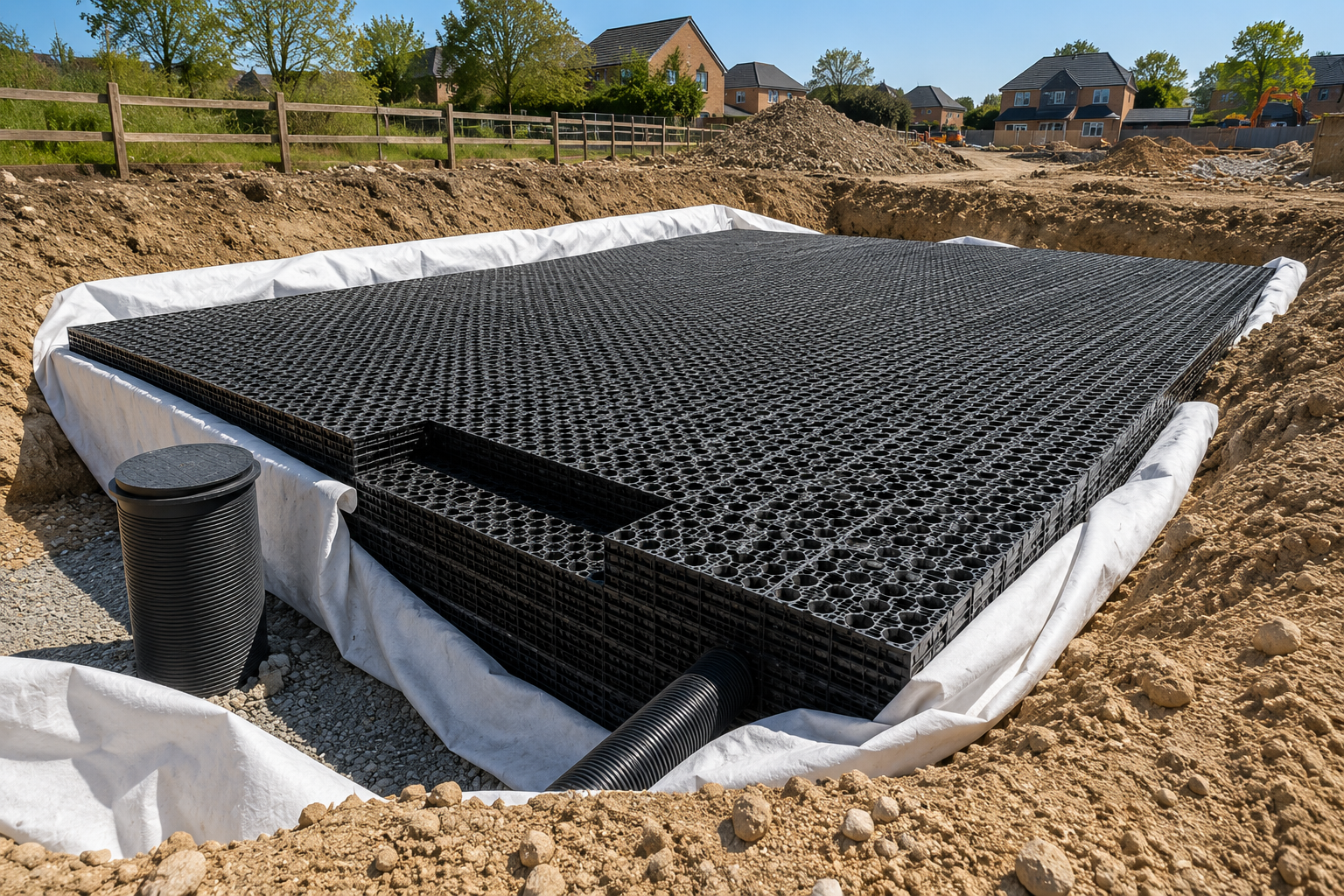
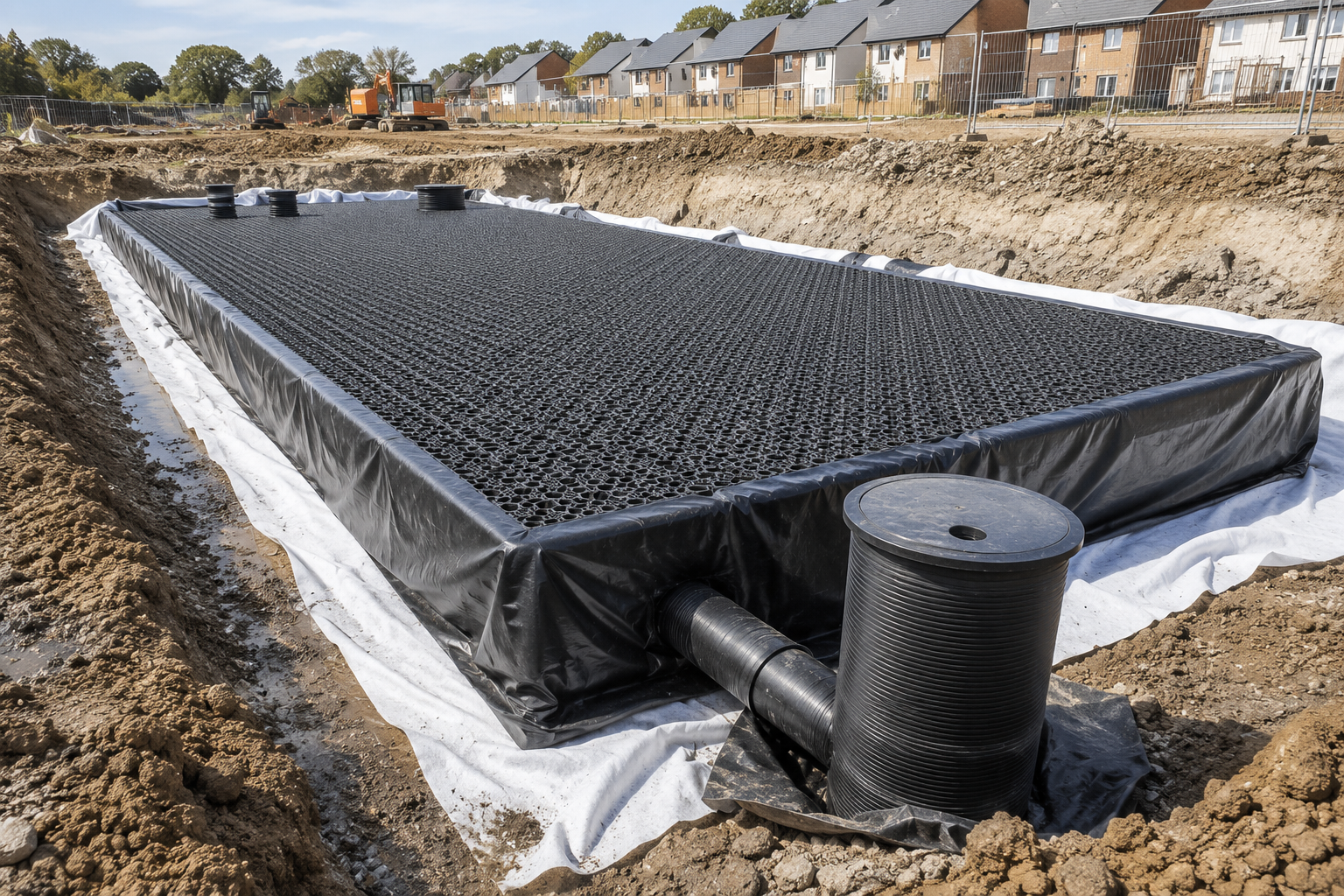
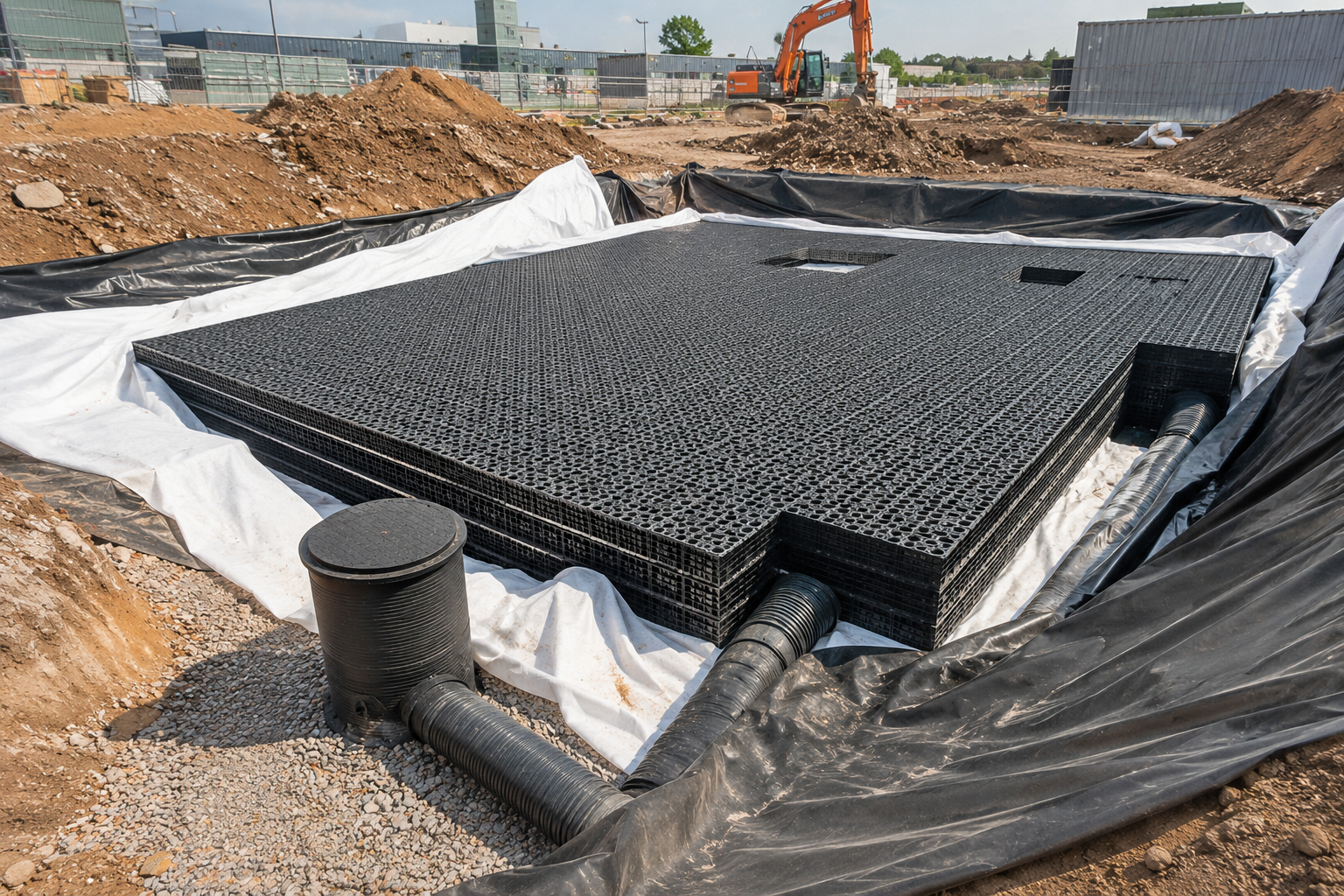
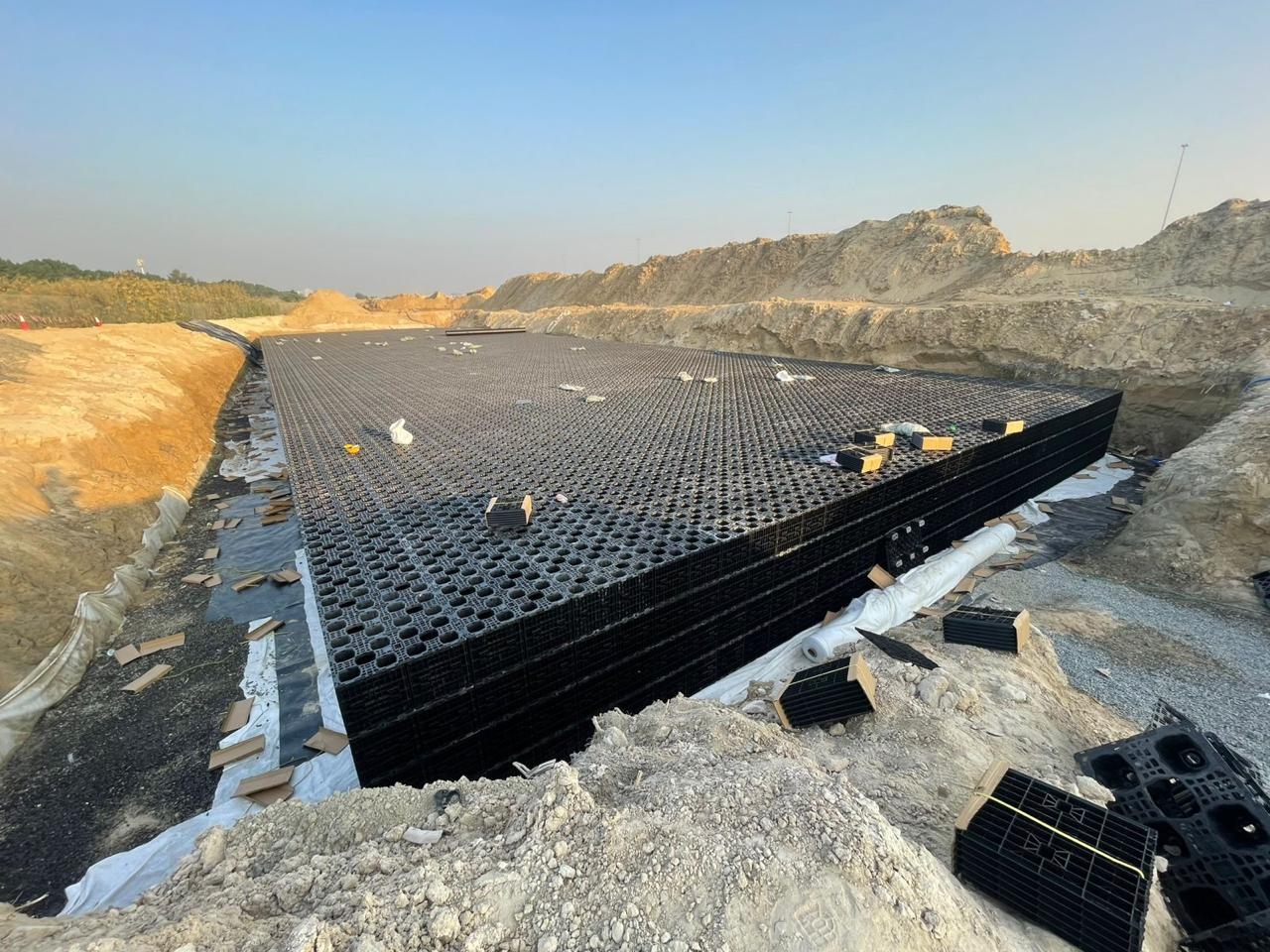
StormGrid Geocellular Stormwater Tank - Below-Ground Kit Assembly
SG-E20 – SG-H60 LOAD CLASS

Technical Specifications Matrix

  • 01/SG

    Four load grades from SG-E20 to SG-H60 (nominal 200–600 kN/m² classes), for anything from non-trafficked landscape up to a heavy-duty car-park build-up

  • 02/SG

    95% void ratio, modular H400 / H500 units — 400 mm and 500 mm deep, 190 L / 237.5 L each, recycled or 100% virgin PP

  • 03/SG

    Vertical load tested by Intertek, an ISO/IEC 17025-accredited laboratory, using the CIRIA C680 method

  • 04/SG

    Geotextile, geomembrane, flow control, pipe joints and access for inspection from one factory base in Shenzhen

What that buys the scheme:

Storage without losing a plot

At a 95% void ratio nearly all the excavation volume is effective storage so the function can sit under a car park, road or garden rather than require developable land for an open pool.

Single package, single responsible party

Boxes, wrap, flow control and access come from one production base, so the adopting body receives a single submittal set rather than four suppliers’ certificates that have to be reconciled.

Where Geocellular Storage Sits in a Development’s SuDS Management Train

System Flow Engine

Residential SuDS design starts from one constraint: a new housing or mixed-use development in the UK must manage its surface water so the scheme does not add to flood risk downstream.

As urban areas expand and roofs and hard surfaces spread, the urban drainage systems that once leaned on the sewer now have to hold water back to prevent flooding. On new residential developments, rising rainfall and climate change have pushed local authorities to require sustainable drainage, so the surface water drainage design now behaves as a drainage network that stores runoff and releases it at a controlled rate, with a flood risk assessment a standard part of the planning application.

From traditional drainage to a SuDS management train

Traditional drainage sent surface water straight to the sewer. Sustainable drainage instead mimics natural drainage — slowing runoff, cutting the pollutant load and the risk of flooding, and letting rainwater infiltrate where ground conditions allow. That’s the change national standards for sustainable drainage systems want to see a developer produce.

Within that train, a geocellular crate does one job: it is a water-quantity device. It stores surface water so the peak flow rate to the sewer system or watercourse is held to a controlled rate, but on its own it treats no pollution and adds no amenity.

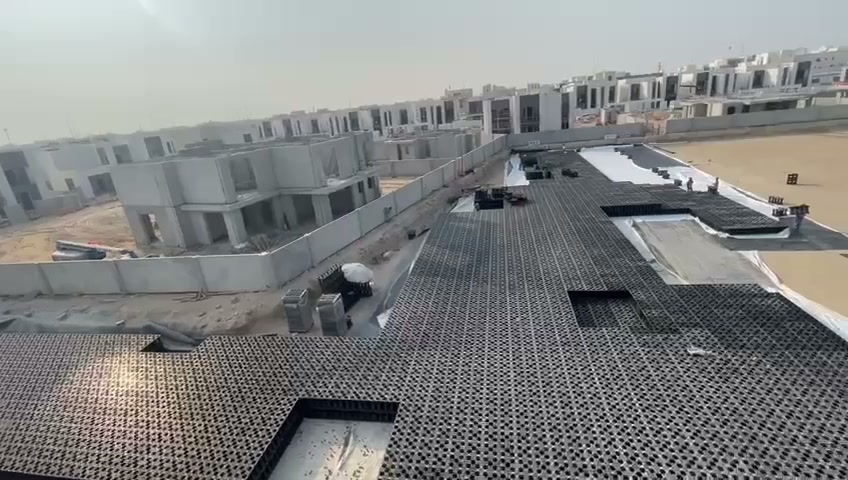
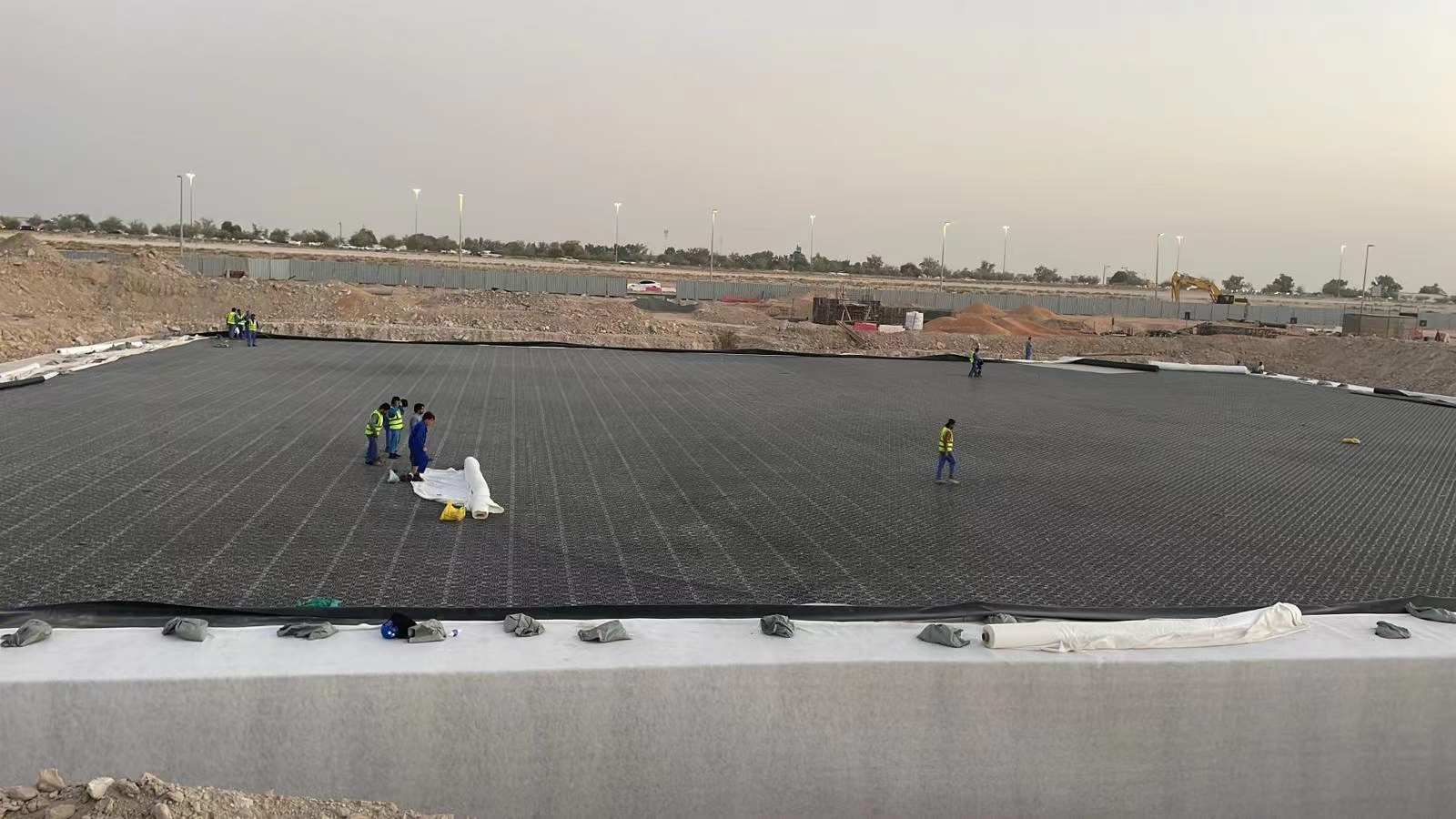
StormGrid integrated geocellular system installation and sustainable rooftop surface water drainage strategy layout
Data Specification Console
Management-train stage Typical SuDS components What StormGrid does here
Source control Permeable paving, green roof, water butts, rain garden
Conveyance Swale, filter drain, detention basin
Underground storage Geocellular crates, oversized pipe StormGrid attenuation / infiltration / OSD
Flow control Hydrobrake, orifice, outfall to sewer Inlet, outlet, flow-control interface

Honest positioning. In one respect a StormGrid crate does mimic natural drainage — it slows runoff and cuts surface water flooding at source. It does not deliver the water quality treatment, amenity or biodiversity that swales, ponds, filter drains and permeable surfaces provide. Local authority guidance is explicit that geocellular storage alone, without accompanying above-ground SuDS, will not meet sustainable drainage requirements on most new developments. For how a full SuDS management train is designed across a site, see our sustainable drainage systems guide.

So the crate earns its place where the development needs compact, high-capacity storage below a surface that still has to carry traffic or landscaping. Unlike a pond, it consumes no developable land — but that is not free, because a StormGrid array storing at a 95% void ratio delivers no amenity, and the water quality treatment has to happen upstream of the crate. In new residential areas and dense urban design, the crate’s role is narrow but real: it captures the storage benefits of SuDS within a sustainable urban drainage system and a compact footprint — one piece of green infrastructure inside a wider surface water drainage strategy, with the rest carried by the drainage design and the site’s flood management plan.

Load grade by surface, not by guesswork

Written for: the design engineer selecting a grade — secondary: procurement, who needs the grade fixed before a kit take-off can be priced.

Picking a crate on price and hoping the cover does the job is the most common error in designing SuDS storage. Load grade should align with the finished surface, what drives over it, and then be verified against the cover depth and structural engineer’s build-up. Miss this point and the risk is a collapse under a delivery lorry, not a slow leak.

MOD.01 / LADDER

The development load-grade ladder

Grade alone will not determine the suitability of a build-up because the load actually acting on a crate is governed by the depth it lies and what’s above it. In practice the same 400 mm module behaves in radically different ways beneath 1m of soil or under 3m of estate road, which is why this ladder – rather than the price list – should be the starting point for the specification. Below it each grade has been matched against compression data produced by an ISO/IEC 17025-accredited laboratory.

[01] 1–2 m cover under light-to-medium surfaces SG-M40
[02] 3 m+ cover SG-H60 recommended
[03] 4–5 m cover (page-level maximum before project-specific design) SG-H60 required
SYS.ALERT / BOUNDARY
Boundary honesty.

Load class does not by itself certify trafficability. Cover depth, pavement build-up and a structural engineer’s design to CIRIA C737 together decide what a buried crate field can carry. Unlike a certified cover grade, a crate class is a design designation — so confirm against the project’s structural calculation, not against the brochure.

MOD.02 / MATRIX

Decision matrix, grade by development surface

StormGrid grade Nominal load class* Material Where it fits in a development
SG-E20
(Eco Light 20)
200 kN/m² class
(≈20 t/m²)
Recycled PP Landscape, gardens, non-trafficked areas
SG-L30
(Light Standard 30)
300 kN/m² class
(≈30 t/m²)
Recycled PP Footpaths, communal green space, light-traffic paths
SG-M40
(Medium Duty 40)
400 kN/m² class
(≈40 t/m²)
Recycled PP Default for most schemes: driveways, light parking, commercial hardstanding
SG-H60
(Heavy Duty 60)
600 kN/m² class
(≈60 t/m²)
100% virgin PP Heavy-duty car park, estate roads, deep cover
*Nominal load classes are design designations, not exact unit conversions. Measured short-term vertical compressive strength: SG-M40 tests at ~46–47 t/m², SG-H60 at ~65 t/m²; Intertek recorded ≥600 kN/m² on SG-H60 at the 300 kN rig ceiling without failure.

Not sure which grade your build-up needs?

Request a detailed load-grade and cover-depth check

What Was Actually Measured, By Whom, and Where the Limits Are

Asset Integrity / Risk Analysis
Below-ground attenuation is often treated as a commodity, and all too often the cheapest product is specified, with, as trade journals are quick to report, significant risk for the asset’s future owner.

“De-specification to choose cheaper products can increase the risks of failure. An alternative below-ground SuDS attenuation product may appear to perform in the same way, but adopting bodies and asset owners should check that they meet all the relevant standards and that they have undergone the appropriate certification and testing.”

— ADS Pipes, “Below-ground SuDS attenuation: when design life and service life don’t tally”
Validation Philosophy

Storm Manage takes that challenge at face value. To the question “why trust this product”, the only defensible answer is the full detail of the tests, the tester and the performance limits — not a louder boast.

Accredited Laboratory Metrics

What the Test Report Actually Says

Body Accreditation Test Measured value Limit / caveat
Intertek ISO/IEC 17025 Vertical compression, CIRIA C680 method ≥600 kN/m² (face), 186 kN/m² (section) Floor value at 300 kN rig ceiling — not a failure point
Intertek ISO/IEC 17025 Vertical compression after 40 °C conditioning 600 / 179 kN/m² Short-term vertical compressive strength
SGS Witnessed test Compression (client lab, client criteria) 468.5 / 121.9 kN/m² SGS witnessed only — not an SGS-run test
TRI Environmental GAI-LAP Geotextile tensile, ASTM D4632 GT200P / GT270P / GT300P Wrap fabric data — separate from box strength

“Everyone quotes that 600 kN/m² figure back at us, and it is where our rig stopped, not where the box failed. We publish it as a floor because that is what the certificate supports — read that report as an ultimate strength and you are reading it wrong.”

— Storm Manage engineering and quality team, on the Intertek vertical-compression report
Compliance Standards

The BBA gap — stated plainly

Some rivals do carry one. GRAF publishes a BBA Agrément certificate for its EcoBloc stormwater box range, and Wavin states the service life of Q-Bic Plus “in the opinion of the BBA”, while Storm Manage holds no BBA or WRc third-party product certification. That is a real hole in the argument, and one which simple transparency alone does not bridge because BBA Agrément certification also confirms suitability for use against Building Regulations as well as factory production control – which an accredited-lab test report cannot do. So, in lieu of a product certificate, here is a range of traceable evidence that an engineer or adopting body could use:

Traceability Matrix

The correct product-standard family for these boxes is BS EN 17152-1:2019 (storm water boxes for infiltration, attenuation and storage), with structural design guided by CEN/TS 17152-4:2025 and CIRIA C737. Both Intertek reports are issued under ISO/IEC 17025 accreditation. The product is progressing towards full conformity with BS EN 17152-1, and because every grade is produced in-house on a single production line, the dimensions tested are the dimensions installed.

  • Intertek ISO/IEC 17025 structural test data (vertical compression, CIRIA C680 method)
  • Conformity approach against BS EN 17152-1 and CIRIA C737 / C753 (The SuDS Manual)
  • Geotextile and geomembrane specifications with ASTM / EN test references
  • Full bill of materials and factory production records on request

Need the evidence pack for a submission?

Request the evidence pack

Geocellular Crates vs Ponds, Concrete Tanks and Arch Chambers on Land-Constrained Sites

The honest case for a crate is a very narrow and strong one: at 95% void space, it buys you compact footprints, whereas a pond or concrete tank buys the same volume at the expense of wall thickness or land area. Whereas a surface pond needs open land, a buried crate hands the surface back to the development — but where that land exists, the pond is usually cheaper per cubic metre and scores better across the four SuDS pillars — quantity, quality, amenity and biodiversity — set out in the national standards for sustainable drainage systems and discussed in the government’s sustainable drainage systems review. That’s the trade-off they don’t spell out in brochures.

Option
Footprint
Water quality & amenity
Indicative installed cost*
Geocellular crate (StormGrid)
Smallest — buildable surface above
Quantity only (needs upstream treatment)
~£200–350 / m³
Pre-cast concrete tank
Compact, but heavy & carbon-intensive
Quantity only
~£400–600 / m³
Surface pond / detention basin
Large — needs open land
Quantity + quality + amenity + biodiversity
Lowest per m³ where land exists
*Indicative ranges from published UK cost guides, inclusive of typical excavation and lining; they are not an independent quantity-surveyor benchmark and vary by site.

Ground conditions decide infiltration vs attenuation

Before a crate is even sized, the ground decides how it can work — and whether infiltration systems are viable at all on the plot. Water table level and type of soil combine with the outcome of percolation testing to confirm whether a crate can be installed as a soakaway, requires attenuation to a controlled outfall, or whether a crate wouldn’t be a suitable option at all. Get this wrong and it is the costliest mistake you can make here, because the cost only shows up after the first major storm.

  • Free-draining soil with a low water table
    Free-draining soil with a low water table
    infiltration soakaway (wrap in geotextile)
  • Clay or a high water table
    Clay or a high water table
    attenuation only, with a lined crate and flow-controlled outlet; a soakaway here would simply fill and overflow
  • Contaminated land or a source protection zone
    Contaminated land or a source protection zone
    infiltration may be unacceptable, so design to attenuation with an impermeable liner

Phased Delivery for Multi-Plot Programmes, Lead Time, Container Loading, Single-Source Kit

Written for: procurement and the buying desk — secondary: the project manager sequencing plot handovers against a shipping schedule.

On many multi-plot schemes the crate hardware is rarely the expensive item; excavation, lining and outlet controls usually dominate the installed cost.

Unit price is rarely the real cost problem on installation; a fragmented supply chain is.

Lead Time
~15–30 days
ex-works
Container Loading
~330 m³
per 40HQ (flat-packed)
Port of Origin
FOB Shenzhen /
Yantian / Shekou
Order Band
1 to 100,000+ m³
across a phased programme

Because Storm Manage makes the crate, the geotextile spec and the inspection base in-house, the programme can be designed as one project with a single delivery date, rather than four separate items delivered on four dates. Unlike a merchant-sourced kit, the tolerance between module and connector is held on one in-house production line, whose output is load-tested by an ISO/IEC 17025-accredited laboratory.

Boundary Honesty

Phasing has to track adoption, not just groundworks. A plot handed over under Ofwat’s Code for Adoption Agreements needs its evidence pack complete before the sewerage undertaker will take the asset, so the certificates for plot one cannot wait on the delivery for plot four. Lead time, loading and order bands are commercial terms supplied by Storm Manage, not independently verified performance data.

The full below-ground kit, from one supplier

  • Crate modules — SG-E20 to SG-H60, H400 (400 mm) or H500 (500 mm), 190 L or 237.5 L, with clips and connectors.
  • Geotextile — 200–800 g/m² (300 g/m² typical) for the soakaway wrap.
  • Geomembrane — HDPE / LLDPE liner 1.0-1.5 mm for attenuation.
  • Pipe connection & inspection — DN200 / DN300 inlet and outlet, DN800 inspection base for jetting access.

Phasing a multi-plot programme?

Request custom delivery schedule & kit take-off

Adoption, Approval Path and Whole-Life Maintenance, What De-Risks a Buried System

An adopting authority rarely asks whether the system works on day one; it asks whether the thing still works 20 years down the line, and who maintains it. That is where a buried crate has to earn trust, and where the SuDS approval path differs across the UK.

Storm Manage Buried SuDS Crate System wide-standard Load

Approval differs by nation

Nation Route Status
England Planning-led; Lead Local Flood Authority consultation; water-company adoption of SuDS via Section 104 under Ofwat’s Code for Adoption Agreements and its Design & Construction Guidance, in force since 1 April 2020 Schedule 3 announced (2023) but not enacted as of 2026 — SuDS delivered through planning, per the government’s SuDS review
Wales SuDS Approving Body (SAB) approval under Schedule 3 of the Flood and Water Management Act Mandatory since Jan 2019 — chargeable pre-application service
Scotland Scottish Water adoption (Sewers for Scotland) plus SEPA on water quality Established regime

On BBA and adoption of SuDS

BBA certification is not a legal requirement, but it is the due-diligence proof many drainage engineers and adopting bodies look for, and they will interrogate why a cheaper product was chosen.

Because a SuDS Approving Body sets the commuted sum from projected maintenance over a 50-year design life, a supplier that hands over ISO/IEC 17025 structural test data, standards conformity and a maintenance plan de-risks the adoption conversation. Unlike a certificate number, that evidence pack can be checked line by line.

Whole-life maintenance

Silt is the real cause of failure for a buried crate in the long term. Certain systems are harder to jet clean if silt enters them than others, so the maintenance design matters as wide-standard Load – a silted, undersized tank quietly stops controlling flooding. Often the best fix is upstream and structural, not a bigger tank.

  • Upstream silt trap or catchpit to prevent sediment entering the crate field.
  • DN800 inspection access and jetting ports are integrated into the crate field design from the outset.
  • Crate capacity sized with an allowance for silt accumulation, in line with CIRIA C737.
  • A detailed, written maintenance schedule provided to the adopting authority or asset owner.

Whole-life performance

Whole-life question What the evidence supports Provenance
Design life used for the commuted sum 50 years, the basis a SuDS Approving Body works to Sector guidance
Material degradation in the ground Polypropylene does not corrode or spall the way steel and concrete can; the geotextile and geomembrane are the wear items Material property
Structural margin under a car park Vertical compression measured by Intertek under ISO/IEC 17025, reported as a floor at the rig ceiling First-party test report
Serviceability at year 20 Governed by upstream silt control and DN800 access designed in on day one, not by the crate itself CIRIA C737 practice

What isn’t here. We don’t present a whole life cost saving % or payback period as we’ve no UK based, audited project cost data on which to base one. Be wary of any supplier presenting an exact maintenance saving percentage on buried crates – ask them what scheme, what years, who measured it.

Technical Assessment & Calculation Utilities

Suite of engineering calculators and triage protocols for commercial and residential development site planning. Select a utility below to configure system parameters.

SYS-01

Load Grade & Cover Depth Selector

Determine the appropriate structural crate grade based on surface loading, trafficked areas, and required cover depth limits.

Launch Selector Protocol
SYS-02

Storage Volume & Crate Count Estimator

Calculate required attenuation storage volume and automatically convert to modular crate unit quantities.

Launch Volume Estimator
SYS-03

Ground Suitability Triage

Assess site-specific soil conditions, water table levels, and infiltration potential for crate field placement.

Start Triage Protocol
SYS-04

Adoption Route & Evidence Pack

Generate the necessary structural data, maintenance schedules, and conformity documents for SAB or water company adoption.

Generate Evidence Pack

Frequently asked questions

Are geocellular attenuation crates adoptable by the water company or SuDS Approving Body?

Yes, in principle, though the route differs by nation. In England, water and sewerage companies can adopt qualifying SuDS via Section 104 under Ofwat’s Code for Adoption Agreements and its Design & Construction Guidance; in Wales, a SuDS Approving Body must approve the drainage under Schedule 3. Adoption depends on meeting the relevant national standards and providing certification and testing evidence, and the adopting body then sets a commuted sum from projected whole-life maintenance. Building that evidence in early is what keeps a buried crate field adoptable.

Do I need a BBA certificate — will an engineer accept a non-BBA crate?

It is not legally mandatory, but a BBA Agrément is the due-diligence proof many engineers and adopting bodies expect. Where a product does not hold one, the substitute is traceable third-party evidence: accredited-lab structural test data, conformity against BS EN 17152-1 and CIRIA C737 / C753, and full material specifications.

Will a crate on its own pass SuDS planning?

Usually not by itself. It manages surface water quantity only, so a full surface water drainage system normally adds swales, filter drains or permeable paving for water quality, amenity and biodiversity — the crate is one component, not the whole SuDS design.

What load grade do I need under a driveway, an estate road and a car park?

As a starting point, SG-M40 (400 kN/m² class) suits driveways, light parking and commercial hardstanding, while SG-H60 (600 kN/m² class) suits heavy-duty car parks, estate roads and deep cover. The final grade depends on cover depth and pavement build-up, confirmed by a structural engineer to CIRIA C737.

What happens on clay or a high water table?

An infiltration soakaway will not work — with nowhere for water to go, the crate fills and overflows, which can push flooding onto the rest of the site. On clay or a high water table you design for attenuation instead: a lined crate with a flow-controlled outlet to a sewer or watercourse, sized after a percolation test.

What is the maximum cover depth over a geocellular tank?

StormGrid installs to 5 m cover in stacked layers as a page-level maximum; anything deeper needs project-specific structural design.

How do I stop it silting up and losing capacity?

Keep sediment out and design inspection in. Fit an upstream silt trap or catchpit, build in DN800 inspection access and jetting ports, and size the crate capacity with an allowance for silt loss in line with CIRIA C737. Buried assets rarely get inspected unless the access is planned from the start, so a written maintenance schedule is what protects capacity across a 50-year design life and supports the adoption of SuDS on the scheme.

Do you supply the geotextile, geomembrane and inspection wells too?

Yes — the full below-ground kit ships from one supplier, which removes the coordination gaps that push up installed cost on multi-plot programmes.