Underground Rainwater Harvesting Systems

Commercial rainwater harvesting on an industrial scale means capturing and holding back the collecting runoff from acres of rooftop, rather than single downspouts. Our sub-surface modular tanks contain that volume at 95% void ratio, rated for pedestrian, vehicle and HGV loading, and available FOB Shenzhen in a standard 40HQ box.

Request a Project Quote
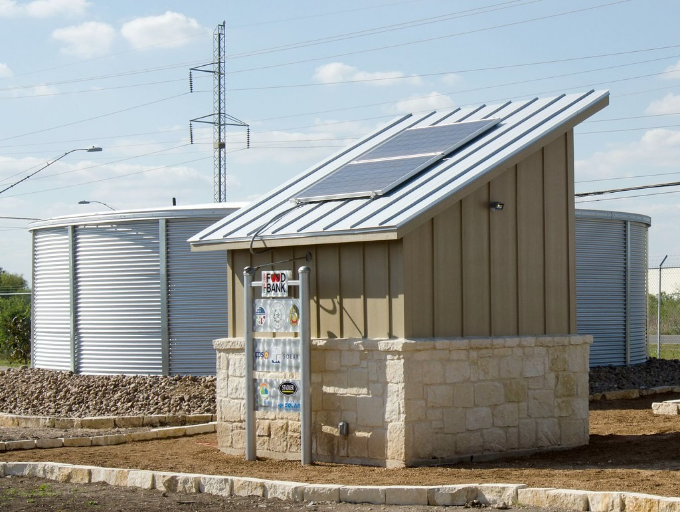
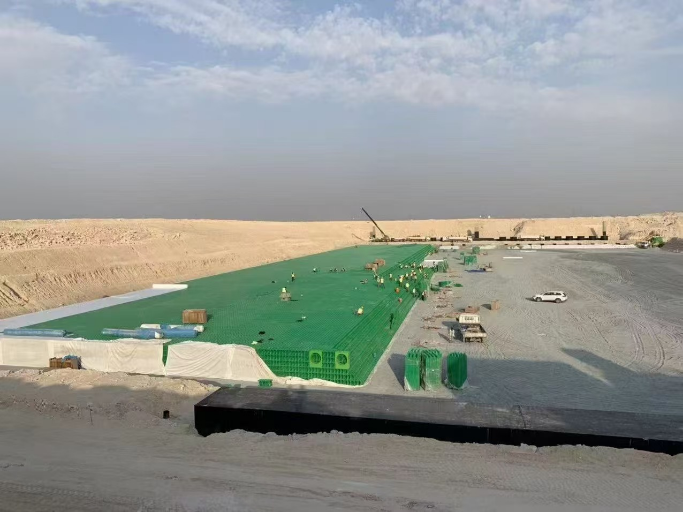
Commercial Underground Rainwater Harvesting Systems installation
95%
Void Ratio
Load-Rated
to EN 124 D400
15-30 Day
FOB Lead Time
330 m³
Per 40HQ Container
50+ yr
Design Life
400+
Projects, 30+ Countries

Commercial Rainwater Harvesting for Non-Potable Reuse at Scale

Commercial rainwater harvesting is no longer a rooftop gimmick once your site’s catchment totals in the several thousands of meters. At that distance the roof of a warehouse, distribution center or factory peels away far more collecting runoff from a single storm than all below-ground holding tanks can ever contain, and the captured flow is worth harvesting for irrigation, toilet flushing and process water rather than letting through the storm drain. The U.S. Department of Energy’s Federal Energy Management Program covers the technical basics of this approach in its own rainwater harvesting systems technology review.

  • Irrigation for landscaping and green space
  • Toilet and urinal flushing (non-potable, indoor plumbing)
  • Cooling tower makeup water and industrial process water
  • Vehicle washdown and outdoor cleaning
Underground Modular Storage: 1000×500×500mm Cells, 95% Void, Load-Rated to D400
Underground Beats Above-Ground on Space, Not Just Cost
What Ties Into the Same Project
Sizing It Correctly the First Time
What’s Included in the Kit

Storage density not rainfall is the limiting factor at this distance. Above ground tanks take up unusable yard space, and concrete vaults are expensive, costly and slow to lay. An underground modular system solves both these problems by going below the parking lot or landscaping strip instead of fighting to be above it.

Commercial properties that commit to harvesting rainwater at this scale are likely doing so as part of a larger water management plan, not as a mere green gesture — water conservation targets, green building credits and stormwater-fee savings are often tied into the same project.

Sizing in such a way that it won’t be over or under seems straightforward: teams that design a system by a rule-of-thumb often find a punishing mismatch between the tank they bought and the storage their roof actually requires during a major storm – requiring retrofit within 1-2 years of installation. Under sizing the tank by even a slight 15% means losing reuse days for irrigation and flushing, because demand peaks exactly when storage is lacking. Storm Manage avoids this, by designing based on catchment area and design-storm intensity at the outset, unlike a flat per-square-foot estimate.

Call our team for a sizing quote before fixing a tank size
Underground modular crate system, geotextile and geomembrane wrap, inlet/outlet connectors — supplied as one kit, not sourced piecemeal.

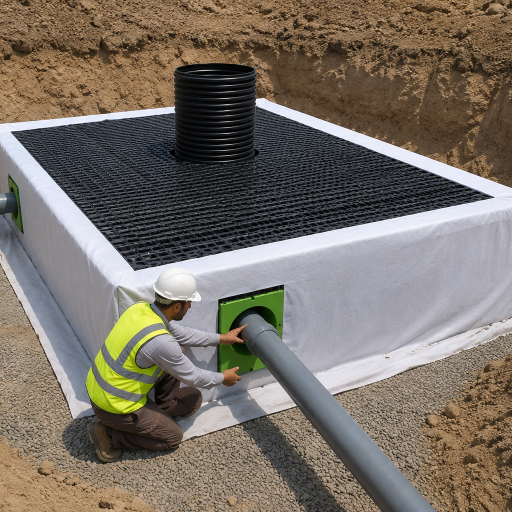
Storm Manage supplies the underground modular crate system, the geotextile and geomembrane wrap, and the inlet/outlet connectors as a complete kit engineered to collect and store runoff – designed for the non-potable reuse applications above, not adapted from a stormwater-only detention product. It’s a pure rainwater harvesting system for commercial buildings and industrial sites, unlike the below ground rainwater tank kits available for a single house roof.

Commercial Rainwater Harvesting Scale

What This Actually Costs

A large scale rainwater harvesting project changes the cost conversation entirely compared to a residential kit. Asking what a commercial rainwater harvesting system cost actually depends on is the right question, and the answer is catchment area, load class, and container count, not a flat retail price tag.

  • Municipal water rates rising faster than general inflation in most markets
  • A separate stormwater discharge fee often applies on top
  • Together, these are why commercial/industrial designers now build this in from day one

The price you pay reflects both of those pressures, and the savings run the same direction: capturing and reusing rooftop water offsets the water bill and the stormwater fee at the same time, which is what makes the system cost-effective over the life of the building. A system sized for acres of roof is a different scale problem than a single gutter downspout, so the price and the savings both look proportionally different too, not just different in absolute terms.

Underground Modular Storage: 1000×500×500mm Cells, 95% Void, Load-Rated to D400

Each modular system module is one piece and injected-moulded to a size of 1000mm x 500mm x 500mm, and are produced from either virgin PP or recycled PP. Each module acts as a discrete storage tank rather than one monolithic vault. Each module has 95% void capacity to hold approx. 237.5 L of usable rainwater storage out of 250 L gross capacity.

  • Geocellular module (this product): 95% void
  • Gravel-filled trench: 30-35% void
  • Poured concrete vault: ~100% void, but 2,400 kg/m³ vs. this module’s 30 kg/m³

Current UK design guidance for this class of structure is published by CIRIA as C737, Structural and geotechnical design of modular geocellular drainage systems.

Underground Modular Storage Cell

Load-Class Ladder, Industry Reference Table

Load Class Typical Application Cover Depth Guidance
HS-20 Pedestrian & light landscaping areas Shallowest cover of the four classes
HS-25 Passenger car parking Moderate cover, per project engineering
SLW60 HGV / heavy truck access yards Deeper cover than car-rated zones
EN 124 D400 Highway, port, and overload traffic Deepest cover; per site-specific structural design

Please refer to project specific drawings for exact minimum/maximum cover depths, as this is dependent on backfill, traffic load and local soil conditions and may vary from the below table values.

Non-Potable Reuse, Not a Potable Cistern

This product is designed for the collection of rainwater and stormwater runoff to be utilized in on-site process water (e.g. non-potable reuse, irrigation, flushing). This system isn’t intended for potable water use and shouldn’t be specified, or procured to meet potable water standards for a cistern or domestic water storage application.

Quality Assurance

“Every batch that leaves the Shenzhen line gets a compression test and a per-unit weight check before it’s cleared for container loading — that consistency check is what lets us quote a 50-year design life with a straight face.”

— Storm Manage Engineering Team

The Virgin/Recycled PP structure is rated for operating temperatures between -10°C to +80°C, and our 12+ standard mould designs cover standard applications, high load capacity, shallow crate applications, connection points, end cap components, and accessory items. Material ratio (Virgin/Recycled PP) and per unit weight are validated per batch, not on a random sample basis.

No two zones on the same site are ever necessarily the same load classification. A standard HS-25 load-classified area such as a parking lot can be connected into the same rainwater harvesting network as a higher-load HGV dock classified SLW60, for instance. Load-bearing elements, however, must be engineered to the highest classification present on site.

This often gets ignored as a design simplification — lumping the whole site together under a single load classification and cover-depth spec. It over-engineers the non-traffic areas and under-engineers the load-bearing ones.

  • Standard module – General commercial catchment and underground tank storage zones.
  • Heavy-duty module, HGV yards, loading docks, D400-rated access
  • Shallow crate module – Applications with limited cover depths where the water table or utilities may be shallow.
  • Modular expansion without redesigning the entire footprint

For mixed-use sites, an incorrectly specified load class (often on car parks where the capacity is planned for car, not heavy-vehicle use) is by far the most expensive, and the most common, design error. An HS-25 classified load class may fail and deform within two years if, as is likely, the car park subsequently experiences HGV use – the module’s safety factors were never designed for this level of loading. Storm Manage assesses each stormwater or rainwater system zone separately, rather than adopting a single ‘one-size-fits-all’ rating for the entire footprint that many other suppliers would use simply because it’s easier, and not necessarily better for a mixed-traffic scenario.

Request a detailed load-class assessment before you specify what goes where.

Request a Project Quote →

Commercial Harvesting Case Studies: Factories, Malls & Logistics Parks

Storm Manage has completed over 400 installations across 30+ countries since 2014, providing their modular tank system for commercial and industrial facilities in areas where both non-potable reuse and stormwater compliance are critical. Sizing methodology on those projects is consistent with what engineers use throughout the industry: catchment area, non-potable demand, and local design storm data — not a static formula — dictate the required storage volume. Washington State’s Department of Ecology maintains a public overview of rainwater collection for water supply that covers similar non-potable use cases.

Industry Precedent — Peer-Reviewed Case Study

An academic case study conducted at an industrial facility in Vila Real, Portugal, found that a rainwater harvesting system installed to service a 2,765 m² rooftop catchment supplying 33 toilets, 10 urinals, and 8,957 m² of irrigable green space, was best sized with a 330 m³ storage tank (interestingly, near the storage capacity of a single Storm Manage 40HQ container delivery), and the authors concluded that an annual savings of roughly 1,969 m³ could be realized, with a 7-11 year payback “quite feasible.”

STATEMENT

Please note this is an independent third-party case, not a Storm Manage project, referenced for precedent with similar catchment sizes.

Utility water rates are the biggest single lever on that payback math. In the U.S., they have increased between 4% and 7% per year, faster than general inflation, which only makes a tank installed today that much more valuable each year it’s in service.

These same economics hold true for stormwater management and detention regulations, the reason the same modular tank family performs double duty on many Storm Manage sites, fulfilling both captured water storage needs and satisfying on-site drainage permit requirements within a single module that also fits inside a 40HQ. Often, constructing two separate underground structures (a rainwater storage tank and a detention facility) will be more expensive in terms of earthworks and land footprint, especially on tightly constrained sites in urban areas.

Non-Potable Reuse, Not a Potable Cistern

This product is designed for the collection of rainwater and stormwater runoff to be utilized in on-site process water (e.g. non-potable reuse, irrigation, flushing). This system isn’t intended for potable water use and shouldn’t be specified, or procured to meet potable water standards for a cistern or domestic water storage application.

Certifications & Compliance for Harvested Stormwater Reuse

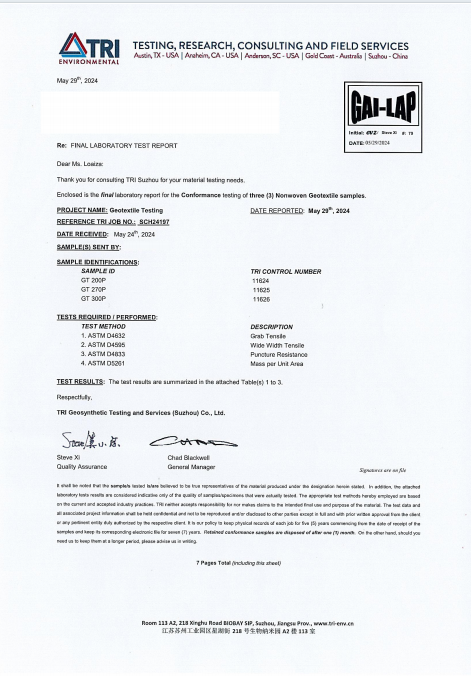
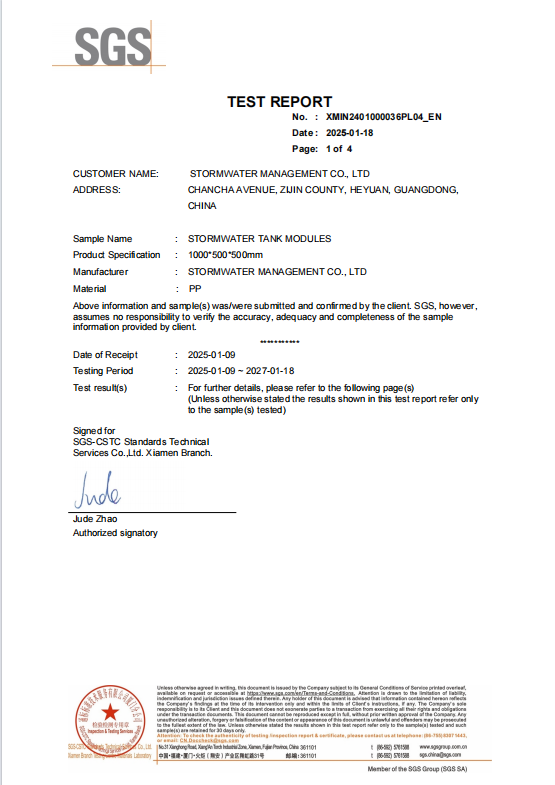
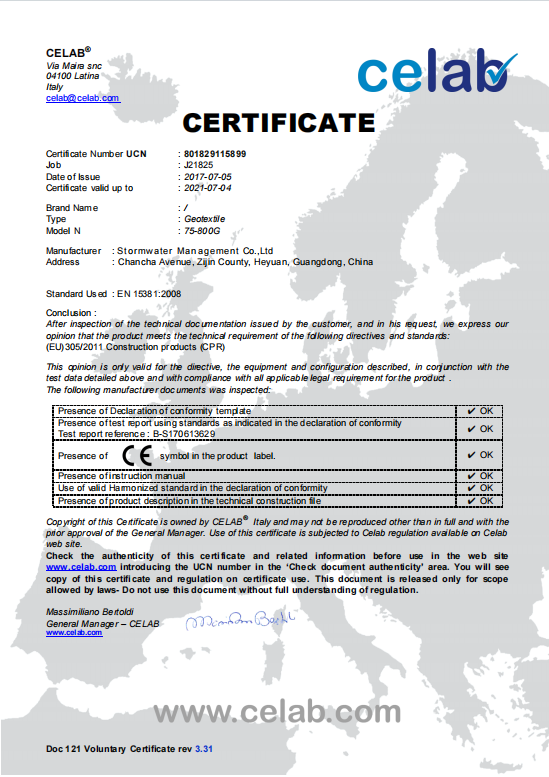
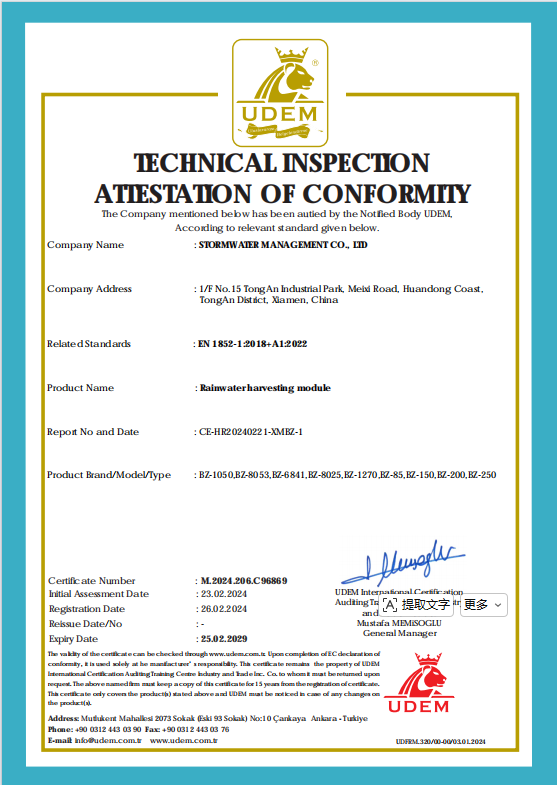
Certification documents need to be linked to a third-party lab that actually performed the test and the date. Storm Manage’s module testing data is supported by reference to specific, named third-party labs, rather than simply abstract standards.

The data covers both the structural performance and relevant material properties (including, but not limited to, food-grade PP resin sourced for components in contact with reused water for water quality certification). The U.S. EPA has also published technical guidance on this category of infrastructure in its underground storage technology fact sheet.

STANDARD UPDATE NOTICE

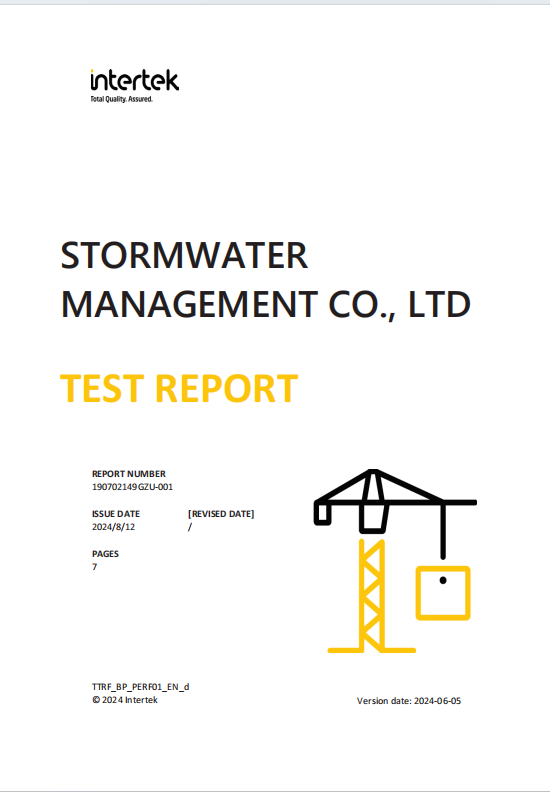
Just to be up front on a standards point, CIRIA’s original C680 guideline on modular geocellular structural design, which was the standard our Intertek vertical load test from 2019 was performed against, has been superseded by CIRIA C737. We supply the test date and standard edition rather than providing a false impression of compliance with a standard we have not individually reassessed.

To provide a single range of certified modules for all environments, our certification needs to reflect the most demanding of the regions that module family serves.

Our ASTM F2418 compression tests, a direct replication of a standard protocol (based on ASTM D2412) which compresses our modules at a rate of 2.0% of chamber height per minute, are an objective, third-party auditable process.

Supply compliance, in export terms, goes beyond that required for local regulations to that the local country actually insists upon. If a UK bound system follows SuDS and British Standards Code of Practice BS 8515 for rainwater harvesting, a system destined for the US will follow local LID guidance and plumbing codes, whereas an Australian installation will follow WSUD. For the Middle East we see more use of Estidama and Saudi Vision 2030 sustainability targets.

Production QC occurs not in the form of sample spots, but by collecting performance and process data from every single batch prior to its loading.

These data points include load class and geometric tolerance, the blend ratio of Virgin and Recycled PP within each module, and the precise weight of each individual unit. By capturing this data uniformly, we ensure zero deviation from expected site performance.

Inexperienced new suppliers often fail on Certification gaps. Providing a CE marked product, but with no lab and date details on a certificate is often an indication of an obsolete safety margin since standards such as CIRIA’s updated its safety factors from C680 to C737.

Storm Manage provide dated lab certification for each and every batch. Check with the labs directly, rather than accept claims.

COMPLIANCE PROTOCOLS

  • CE EN 1852 Rainwater module, UDEM 2024
  • CIRIA C680 Vertical load, Intertek 2019
  • SGS Compression Tested 2024
  • ASTM F2418 PP resin, tested by TRI
  • CE EN 15381 / 15382 Geotextile (CELAB) / geomembrane (SGS 2024)
  • ISO 9001 / 14001 / 45001 Management systems

One-Stop Supply: Sizing Logic, OEM Branding & FOB Delivery

Once catchment and local storm-intensities are known, together with system use case (e.g. a irrigation schedule, flush numbers, or a cooling-tower makeup requirement), sizing the commercial rainwater collection system is then simply a matter of calculation, with a 237.5-litre capacity per module and the collection system’s resilience dependent on an integrated approach between the roof’s capture and collection network and the tank. For a public-sector reference point on sizing methodology, see the Department of Energy’s own rainwater harvesting sizing tool.

Local supply of a reliable municipal water may not always be a given across every global destination of a Storm Manage system and a key additional benefit requested by many procurement teams is resilience, particularly for rain-harvesting systems in regions where public water supply may be unreliable.

Messing up the container math at this juncture – ordering a partial when a full 40HQ would’ve delivered better unit economics, or vice versa – will be a expensive error. Most buyers price by module and don’t look at the math of sharing container space; and an under-sized container will really blow out an already slim 15-30 day lead time. Storm Manage prices against your load plan instead of giving you a fixed card; many suppliers will quote the same price regardless of the container fill (rarely correct when you factor in freight) so ask for a formal FOB estimate before committing to a container number.

The final price is not a simple cost-per-square-metre rate, but is derived from such factors as module load-class, geotextile wrap, and the configuration of any required inlets, outlets and inspection access, all calculated with the total catchment area and intended tank contents and volume in mind.

OEM/ODM orders follow a similar process but take longer, due to the extended mould-development lead time. moulding the client’s logo onto the modules (not a printed sticker that wears away after one year of being in the ground) can take 45-60 days for the moulding alone before any production begins so recurring clients who can predict their volumes generally allow for that time in their schedule rather than adding it in as an after thought.

The team that approved the shop-drawings then handles first response on a problem reported at a site. They cover proven cases of defective material out of pocket; they don’t just give you a “contact your installer” out the door as so many foreign suppliers will, without a written procedure.

All orders ship FOB, we prefer Shenzhen Yantian/Shekou, with Qingdao and Ningbo possible upon request. Our stock configurations ship within 15-30 days of confirmation, while a 45-60 day turnaround for mold development is needed for custom OEM logo moulding. A 40HQ container will fit up to 330 m³ of installed storage, assuming optimal stacking – a buffer of 3,000+ m³ is available at our Shenzhen location to account for fluctuating order timing.

PROJECT SCALE TYPICAL CONTAINER NEED LEAD TIME MOQ
Small commercial site Partial 40HQ (shared load) 15-30 days From 1 m³
Mid-size factory / mall 1 full 40HQ (~330 m³) 15-30 days Standard stock variants
Large logistics park / OEM project Multiple 40HQ, staged shipments 15-30 days stock / 45-60 days OEM mould Up to 100,000+ m³

Commercial & Underground Rainwater Harvesting FAQ

Expert answers regarding performance, sizing, and applications for Storm Manage underground systems and LID compliance.

How do you size a commercial rainwater collection system for large buildings?

Beginning with the catchment area (roof + any paved area that drains to the system), plug in your local design-storm intensity, and the desired non-potable demand (irrigation count, flush count, cooling makeup). Then, from there calculate module count based on your net storage per module (at 95% void ratio – asking for the sizing worksheet is preferable to using rule of thumb). Patent GB2475924A is one example of the documented engineering history behind modern rainwater harvesting system design.

What treatment is required before reusing harvested rainwater for flushing or irrigation?

The required treatment is based on your end use as well as your local plumbing code – you will usually find that flushing and irrigation require a filtration and first-flush diversion, and not a complete treatment system constructed to potable water standards. This will be an issue for local code and will vary; consult with your local plumbing department to finalize the proper using rainwater treatment for your home.

Can the PP modules withstand cold-region winters?

The working temperature for the Virgin / Recycled PP structure is approximately -10°C to +80°C. For sites subject to very low ambient temperatures where significant frost heave can be expected, depth of cover and backfill specification rather than the module material are the parameters which will require the greatest amount of engineering input.

What are the main components of a commercial rainwater harvesting system?

Four common elements comprise most systems: the collection surface (roof/catchment), a first-flush diverter, the underground storage modules, and a pump/distribution system for the non-potable end use. Storm Manage provides the modular storage core and the surrounding geotextile, geomembrane, and connector kit.

Are commercial rainwater harvesting systems eligible for incentives or credits?

Rainwater harvesting can also contribute to green-building certification credits or stormwater-fee reductions in certain municipalities, though these benefits vary.

Precast concrete vault or modular geocellular crate — which costs less installed?

It depends on the backfill and the engineering required, not just the material itself. Concrete has a higher per-cubic-foot material cost, but it often requires less backfill engineering; geocellular crate systems have a lower per-unit material cost, but they typically need more engineering work for backfill and surrounding material.

Can the same underground modules handle both rainwater harvesting and stormwater detention?

Yes, in most cases, the same 95%-void module family can be sized for both reuse and detention. However, whether it makes sense depends on local regulations concerning mixing a reuse system with a regulated detention structure. Confirm this with your civil engineer.

What documentation should I request before specifying a supplier for a tender?

Ask for the actual laboratory test reports on the modules, the version of the test standard used (older vs. current), the manufacturer’s production capacity relative to your order, and the FOB lead time.