We use the details you submit to review and respond to your project enquiry. Entries are handled in this website’s WordPress database using Fluent Forms; our hosting and email providers may process the submitted details. Other technical providers receive only the data described in our Privacy Policy.
Please do not send passwords, payment-card details, government identification numbers, sensitive personal data, or unnecessary confidential third-party information.
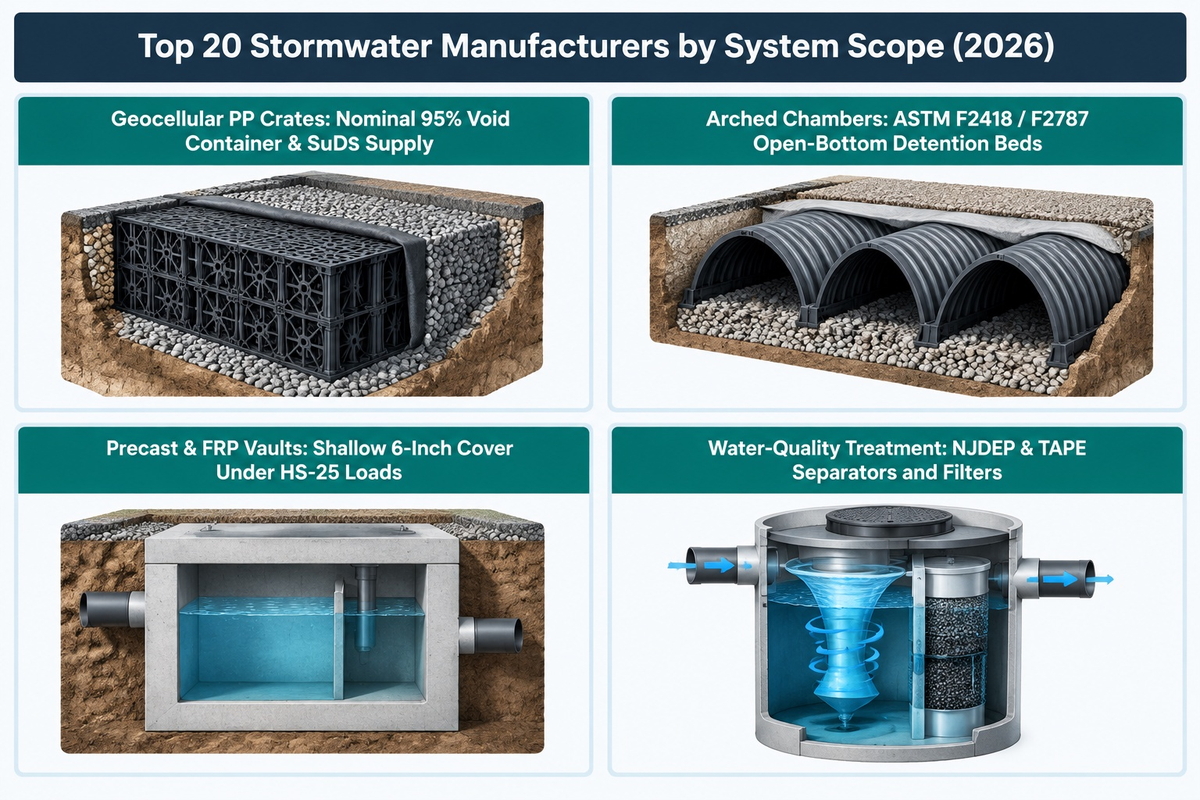
Top 20 stormwater management system manufacturers in 2026 supply three structural storage families and a separate water-quality treatment category. This directory compares direct-factory polypropylene crate exporters like Storm Manage alongside regional chamber, SuDS block, precast concrete vault, and treatment manufacturers including ADS, Contech, ACO, Wavin, and StormTrap.
Commercial civil engineers and drainage contractors match underground storage hardware to soil permeability, groundwater depth, and axle loads. Flat-pack plastic crates, open-bottom chambers, and precast vaults, paired with storm drain pollutant removal treatment units, serve global and regional stormwater solutions and drainage solutions projects.
Quick Picks by Project & Procurement Scenario (2026)
Direct-factory container procurement of modular PP crates and liner kits (no BBA or Kiwa product approval): Storm Manage
North American open-bottom arched chamber detention beds with Isolator Row access: Advanced Drainage Systems (ADS / StormTech)
Integrated North American CMP detention manifolds and certified treatment filters: Contech Engineered Solutions
Brick-bonded and push-fit inspectable European SuDS attenuation tanks: ACO Group and Wavin
Upstream vortex flow controls and oil-grit treatment interceptors: Hydro International and Imbrium Systems
Disclosure: This guide is published by Storm Manage. We list ourselves first because this is our website, not because we claim to be the market leader. The other 19 manufacturers are grouped by what they’re best for, in no particular order within each group.
Quick Comparison Table: Top 20 Stormwater Management System Manufacturers (2026)
Across the manufacturers in this guide, commercial underground stormwater systems fall into three structural storage families and a separate water-quality treatment category. These include modular geocellular polypropylene stormwater management systems, corrugated plastic arched chambers, precast concrete or fiberglass vaults and hydrodynamic or media filtration units. The comparison matrix below provides the information for all 20 companies in these categories.
Prospective buyers of subsurface stormwater detention and retention systems can compare headquarters and founding year in the table below. The table also includes named product lines and inspection channels. Key advantages and procurement limits for each firm are also included.
No.
Company Name
Headquarters
Founded Year
Best For
Brief Introduction
Named systems, materials and inspection route
Key Advantages
Potential Disadvantages
Official Website
1
Storm Manage
Shenzhen, Guangdong, China
2013
Direct-factory container procurement of modular PP crates and liner kits
Direct injection-moulding factory exporting polypropylene soakaway crates and geosynthetic accessories
StormTank H400 and H500 recycled or virgin PP crates (nominal 95% void); upstream silt-trap access
Bundled crate, geotextile, and geomembrane container export supply
4 to 8 weeks ocean freight plus production/customs/inland; no BBA, Kiwa, or WRc product approval
US manufacturer of decentralized inlet filters and replaceable media cartridges
StormBasin, StormPod, StormSack, and FabPhos; grate-level cartridge swap
Tool-free catch-basin retrofits for metals and bacteria
Point-of-entry filters only; no bulk underground tanks
https://fabco-industries.com/
How We Selected and Ranked These 20 Stormwater Management System Manufacturers
We selected these 20 manufacturers and system providers based on publicly available information about subsurface stormwater product lines, provided load ratings, and stated inspection access. We excluded from consideration pure trading companies, general directories, media websites, and used equipment dealers. We compiled and updated this shortlist of manufacturers in October 2026.
Many online directories list a parent company and its product brand as separate entries. This directory groups ADS with StormTech and Ferguson Waterworks with ACF Environmental. It lists Oldcastle Infrastructure and Hydro International separately despite their shared CRH ownership, and includes both manufacturers and system suppliers.
We assessed each stormwater management company according to six engineering dimensions reinforced by hydraulic research and development. These include the structural family, void ratio, material composition, accessibility for CCTV inspection, creep standards, and regional vs. container-direct supply chains.
Geocellular Crates vs Arched Chambers vs Precast Concrete Vaults: Product-Family Boundaries
Subsurface detention and infiltration hardware falls into three primary structural storage families plus a fourth treatment category. Knowing the physical boundaries of these families helps avoid excavation redesign costs for parking lots and industrial yards.
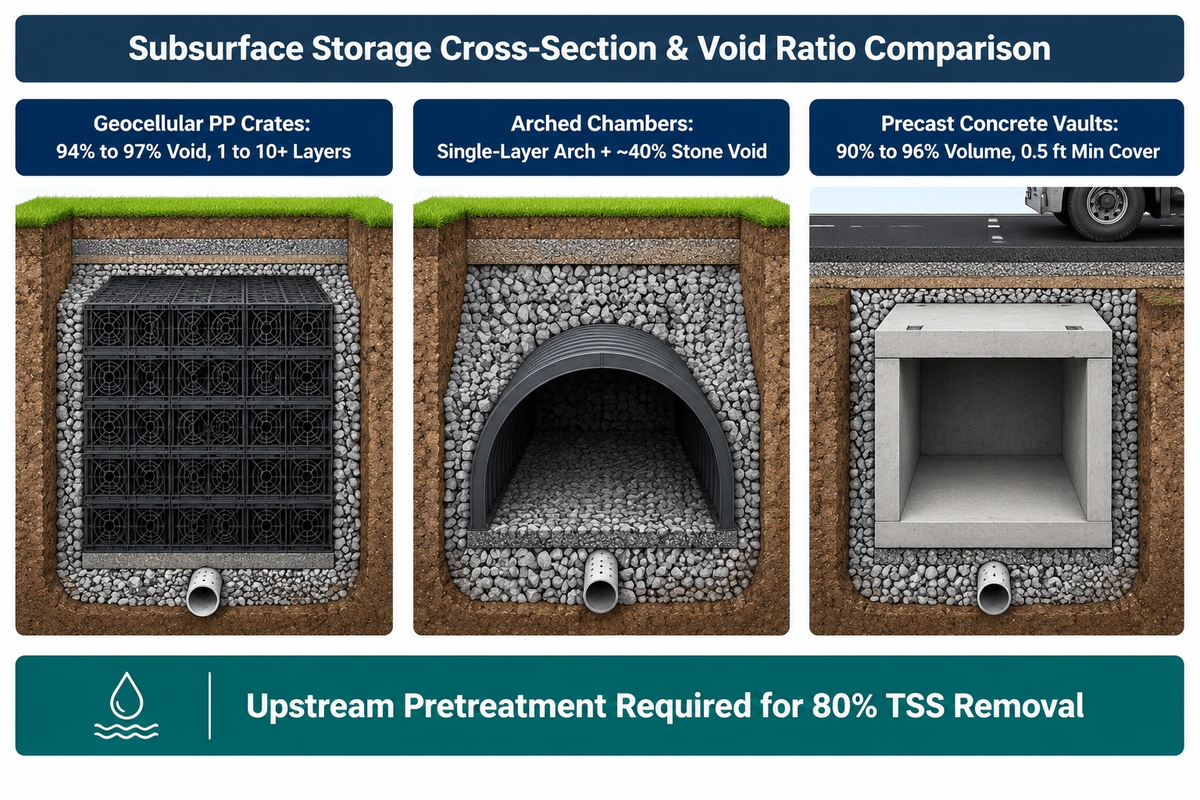
Open-bottom corrugated plastic arched chambers transfer loads laterally to surrounding washed angular crushed stone. Soil-supported thermoplastic corrugated wall arched chambers are described in detail in ASTM F2787-13(2025) Structural Design of Thermoplastic Corrugated Wall Stormwater Collection Chambers (current edition reapproved 2025). The stone envelope has approximately 40% void space, and its contribution to the total system storage is dependent upon the geometry of the chamber and stone envelope.
StormTrap lists HS-20 and HS-25 design-load capacity with minimum cover as shallow as 0.5 feet for its modular precast concrete vaults, while Xerxes lists H-20/HS-20 load ratings for its watertight fiberglass underground tanks used in high-groundwater tables. Concrete vaults handle heavy highway traffic with minimal cover but require crane rigging and regional flatbed trucking.
Underground Storage vs Water-Quality Treatment: System Scope and Pretreatment Rules
A common specification error is assuming an underground attenuation tank automatically satisfies municipal water quality treatment requirements. Storage modules and treatment systems perform two different hydraulic functions. Bare storage crates, chambers, and vaults provide hydraulic volume control only, while specific engineered configurations such as the fabric-wrapped ADS StormTech Isolator Row Plus and evaluated Brentwood StormTank media and bioretention systems provide verified water quality treatment stages.
Geocellular crates, arched chambers, and precast vaults are volume-control structures constructed to store peak stormwater runoff or infiltrate water. As stated in the Philadelphia Water Department Stormwater Plan Review Manual Section 4.8, all subsurface detention basins must have positive overflow pathways and observation ports. Upstream, all detention basins must have pretreatment to prevent sediment from accumulating in the storage bed.
Similarly, the Minnesota Pollution Control Agency Stormwater Infiltration Best Management Practices Guidance mandates pretreating runoff to remove suspended solids before infiltration. When a permit requires 80% Total Suspended Solids (TSS) removal or oil separation, engineers pair storage crates with certified treatment systems. Specialized treatment manufacturers include Contech, Hydro International, Imbrium Systems, and Fabco Industries.
Detailed Profiles of the Top 20 Stormwater Management System Manufacturers
The following engineering profiles are for the 20 selected stormwater management system manufacturers assessed in this 2026 directory. Each profile describes the manufacturer’s primary project application, headquarters, official website, year founded, principal product lines, major structural capabilities, and third party certifications, as well as practical procurement and/or installation limits.
Best for: Direct-factory container procurement of modular polypropylene attenuation and infiltration crates with bundled geotextile and geomembrane kits.
Headquarters: Shenzhen, Guangdong, China · Founded: 2013 (Shenzhen production base) · Company Type: Geocellular Crate Manufacturer & Direct Factory Exporter
Main Products: StormTank H400 and H500 polypropylene geocellular stormwater modules, nonwoven geotextiles, and waterproof geomembranes
Core Capabilities: Injection-moulded recycled and virgin polypropylene production, nominal 95% void ratio storage, 20 to 60 ton/m2 short-term vertical test grades, and full-container export supply
Certifications & Testing: Factory batch compression testing and raw resin verification; no third-party BBA or DIBt product certificate
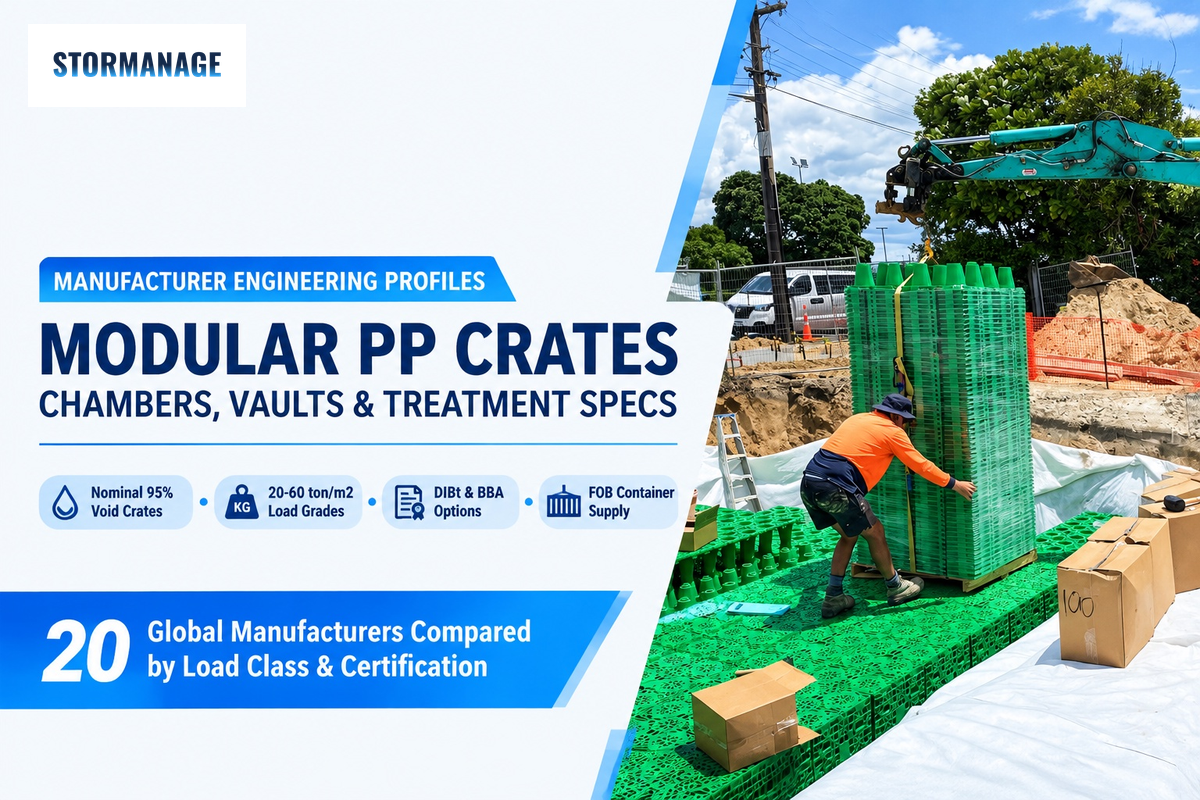
According to its website, Storm Manage operates an injection-moulding factory in Shenzhen producing modular plastic drainage hardware since 2013. The plant manufactures StormTank H400 and H500 modular polypropylene stormwater attenuation crates with a nominal 95% void ratio. It supplies 1000×500×400 mm (190 L) and 1000×500×500 mm (237.5 L) modules alongside matched nonwoven geotextile and geomembrane liners. Buyers specify recycled or virgin polypropylene grades rated from 20 ton/m2 to 60 ton/m2 in short-term vertical testing, backed by factory batch compression testing.
Key procurement limitation: Container-lot FOB Shenzhen factory export model with 4 to 8 weeks of ocean freight plus time for production, customs clearance, and inland delivery; no BBA, Kiwa, or WRc product approval.
Best for: North American commercial and municipal open-bottom arched chamber detention beds with Isolator Row sediment capture.
Headquarters: Hilliard, Ohio, United States · Founded: Founded in 1966 · Company Type: Public Drainage & Stormwater Chamber Manufacturer (NYSE: WMS)
Official Website: https://www.ads-pipe.com/
Main Products: StormTech SC-310, SC-740, DC-780, MC-3500, MC-7200 arched chambers, N-12 HDPE pipe, and Barracuda hydrodynamic separators
Core Capabilities: Thermoformed and injection-molded polypropylene and HDPE arched chambers with StormTech Design Tool CAD layout software
Certifications & Testing: Manufacturer-stated compliance with ASTM F2418-25 and ASTM F2787-13(2025); structural design to AASHTO LRFD Section 12.12; Isolator Row Plus listed as NJCAT Laboratory Verified (verified July 2020, revised February 2025)
Headquartered in Hilliard, Ohio and founded in 1966, Advanced Drainage Systems is a large public thermoplastic drainage manufacturer based in the United States. Through its StormTech division, the company manufactures open-bottom arched chambers including the SC-310, SC-740, DC-780, MC-3500, and MC-7200 series. These chambers meet ASTM F2418 and ASTM F2787 structural standards. Each bed integrates a fabric-wrapped Isolator Row that traps sediment at the inlet manifold for CCTV camera inspection and jetting, though internal inspection access does not replace upstream pretreatment where heavy coarse grit is present.
Key procurement limitation: Open-bottom arched chambers require wide single-layer excavation footprints and washed angular crushed stone backfill for structural support.
Best for: Integrated North American civil site packages combining large-diameter CMP or precast detention with certified water-quality treatment.
Headquarters: West Chester, Ohio, United States · Founded: 1986 (Armco Drainage heritage dates to 1904) · Company Type: Engineered Stormwater Storage & Treatment System Manufacturer
Official Website: https://www.conteches.com/
Main Products: CMP detention pipe, DuroMaxx steel-reinforced polyethylene, ChamberMaxx chambers, CDS and Vortechs separators, and Jellyfish filters
Core Capabilities: Full-spectrum hydraulic storage and stormwater treatment engineering with Design Your Detention online sizing tools
Certifications & Testing: NJDEP certification, Washington Ecology TAPE use-level designations, ASTM A760 and ASTM F2418 product compliance, and structural design to AASHTO LRFD
Operating from West Chester, Ohio with roots dating to 1904 and corporate establishment in 1986, Contech Engineered Solutions is a leader in underground storage across North America. According to its website, Contech supplies corrugated metal pipe, DuroMaxx steel-reinforced polyethylene manifolds, and ChamberMaxx open-bottom chambers. It pairs these storage systems with proprietary CDS, Vortechs, and Jellyfish filtration units. Its treatment systems hold NJDEP certification and Washington Ecology TAPE use-level designations for single-vendor stormwater compliance.
Key procurement limitation: Engineered project-quoted systems manufactured for North American regional specifications rather than flat-pack export crates.
Best for: Brick-bonded geocellular polypropylene attenuation tanks that nest halves for compact transport and full 360-degree CCTV inspection.
Headquarters: Rendsburg / Büdelsdorf, Schleswig-Holstein, Germany · Founded: Founded in 1946 · Company Type: Global Surface Water & Geocellular Attenuation Manufacturer
Official Website: https://www.aco.com/
Main Products: ACO StormBrixx SD and StormBrixx HD geocellular tanks, ACO Qmax slot drains, and oleopator oil-water separators
Core Capabilities: Brick-bonded stackable polypropylene attenuation crates with nominal 95% to 97% void ratio and open pillar channels for CCTV and hydro-jetting
Certifications & Testing: DIBt Z-42.1-528 approval, BS EN 17152-1 structural testing, ISO 9001, and ISO 14001
Founded in 1946 in Rendsburg, Germany, ACO Group manufactures surface drain systems and subsurface geocellular attenuation modules across 40 countries. Its patented StormBrixx and StormBrixx HD polypropylene modules use a brick-bonded half-element architecture that cross-bonds layers for structural stability. According to ACO product literature, the system achieves up to a 97% void ratio with DIBt approval. Because the half-elements nest inside each other on pallets, ACO reduces delivery truck loads and opens internal channels for CCTV inspection.
Key procurement limitation: Premium European system pricing sold through regional ACO sales subsidiaries and civil merchants.
5. Wavin (Orbia Building & Infrastructure), AquaCell & Q-Bic Plus Inspectable Geocellular Systems
Best for: UK and European adoptable SuDS attenuation tanks requiring BBA certification and push-fit bidirectional inspection tunnels.
Headquarters: Zwolle, Overijssel, Netherlands · Founded: Founded in 1955 · Company Type: Multinational Plastic Pipe & Geocellular SuDS Manufacturer
Official Website: https://wavin.com/
Main Products: Wavin Q-Bic Plus, AquaCell, AquaCell NG attenuation and infiltration crates, and AquaGrid roof retention systems
Core Capabilities: Virgin and recycled polypropylene geocellular tank manufacturing with nominal 95% void ratio and tool-free push-fit modular assembly
Certifications & Testing: BBA HAPAS certification, DIBt approval, BS EN 17152-1 product testing, and ISO 9001
Established in 1955 in Zwolle, Netherlands, Wavin serves as the water management division of Orbia across Europe and Latin America. According to Wavin’s product documentation, its Q-Bic Plus and stackable AquaCell NG polypropylene modules feature tool-free push-fit connectors. This design eliminates separate clips and shear pins during trench installation. Both AquaCell and Q-Bic Plus hold BBA HAPAS certification, with Q-Bic Plus providing up to 70% open floor area for bidirectional CCTV access.
Key procurement limitation: Rigid block geometry requires larger truck volume unless nested AquaCell NG formats are selected via authorized European distributors.
Best for: UK deep-burial geocellular Polystorm tanks and shallow podium-deck Permavoid blue-green roof attenuation.
Headquarters: Loughborough / Horncastle, United Kingdom · Founded: Founded in 1980 · Company Type: Public UK Civil Drainage & SuDS Geocellular Manufacturer (LSE: GEN)
Official Website: https://www.polypipe.com/civils
Main Products: Polystorm, Polystorm-R, Polystorm Xtra, Polystorm Inspect geocellular units, Permavoid shallow cells, and Ridgistorm-XL pipes
Core Capabilities: Compressive strength ratings up to 61 to 80 tonnes/m2, nominal 95% void ratio, and dedicated molded Polystorm Inspect tunnels
Certifications & Testing: BBA Agrément Certificates 06/4376 and 10/4791, BS EN 17152-1 testing, and ISO 9001
Headquartered in Loughborough and founded in 1980, Polypipe Civils (part of Genuit Group) manufactures thermoplastic drainage systems and modular geocellular storage. Its Polystorm product family spans recycled-resin Polystorm-R, heavy-duty Polystorm Xtra, and tunnel-equipped Polystorm Inspect blocks. According to Polypipe specifications, these units are tested to BS EN 17152-1:2019 (current edition). For shallow sub-base replacement under sports pitches and podium roofs, the company also supplies 85 mm and 150 mm Permavoid capillary cells.
Key procurement limitation: Primarily engineered and stocked for UK, Ireland, and Middle East civil specifications with rigid non-folding Polystorm blocks.
7. Pipelife International (Wienerberger Group), Stormbox I/II Geocellular Infiltration & Raineo Systems
Best for: European municipal and industrial attenuation basins using multi-zone Stormbox and Stormbox II polypropylene crates.
Headquarters: Vienna, Austria · Founded: Founded in 1989 · Company Type: European Plastic Pipe & Stormwater Crate Manufacturer
Official Website: https://www.pipelife.com/
Main Products: Raineo Stormbox, Stormbox II, Stormbox E geocellular infiltration and attenuation crates, and Pragma structured-wall pipes
Core Capabilities: Nominal 95.5% storage void ratio, bidirectional CCTV inspection channels, and 50-year creep-tested structural design life
Certifications & Testing: KOMO and KIWA product certificates, DIBt approval, EN 17152-1 compliance, and ISO 9001
Based in Vienna, Austria and founded in 1989 within the Wienerberger Group, Pipelife manufactures polymer pipe systems across 24 European countries. According to its website, the Raineo Stormbox and Stormbox II polypropylene crates deliver a nominal 95.5% void ratio. They use a patented base sidewall geometry that channels sediment toward collection sumps during flushing. The modules carry KOMO, KIWA, and DIBt approvals for a 50-year structural design life under trafficked roadways.
Key procurement limitation: Sold through country-specific European Pipelife operating companies rather than direct factory container export to North America.
Best for: Heavy-duty SLW 60 truck-rated geocellular infiltration crates and combined commercial rainwater harvesting tanks.
Headquarters: Teningen, Baden-Württemberg, Germany · Founded: Founded in 1962 · Company Type: German Rainwater Harvesting & Geocellular Tank Manufacturer
Official Website: https://www.graf.info/
Main Products: EcoBloc Inspect, EcoBloc Maxx, EcoBloc Flex geocellular modules, Vario 800 inspection shafts, and Carat XXL underground tanks
Core Capabilities: Pre-assembled stackable polypropylene modules with integrated CCTV inspection channels and up to 5-meter burial depth under SLW 60 loads
Certifications & Testing: DIBt German Institute for Structural Engineering approval, ATV-DVWK-A 127 structural calculation compliance, and ISO 9001
Founded in 1962 and headquartered in Teningen, Germany, OTTO GRAF manufactures injection-moulded rainwater harvesting tanks and subsurface infiltration crates. According to GRAF product documentation, its EcoBloc Inspect and EcoBloc Flex polypropylene blocks achieve a nominal 96% void ratio and support heavy truck loads up to SLW 60. Structural capacity is verified under ATV-DVWK-A 127 calculations and approval from DIBt. Each module integrates a continuous base inspection channel that pairs directly with GRAF Vario 800 access shafts for hydro-jetting.
Key procurement limitation: European metric module dimensions and accessory shafts require metric pipe adapters on North American ASTM pipe sites.
Headquartered in Romeoville, Illinois since 2001, StormTrap engineers modular precast concrete detention and infiltration vaults through NPCA-certified precast plants. Its SingleTrap and two-tier DoubleTrap concrete leg-and-roof modules reach internal heights over 14 feet. StormTrap reports ASTM C890 structural design and HS-25 design-load capacity for its precast vaults, with minimum cover as shallow as 6 inches. StormTrap also manufactures SiteSaver hydrodynamic separators to remove coarse sediment upstream of the concrete vault.
Key procurement limitation: Heavy precast concrete pieces require crane lifting on site and regional precast plant trucking rather than container shipping.
Best for: Turnkey North American civil projects needing either precast concrete StormCapture vaults or injection-molded CUDO plastic cubes.
Headquarters: Atlanta, Georgia, United States · Founded: Founded in 1978 · Company Type: Precast Concrete & Geocellular Stormwater System Manufacturer
Official Website: https://oldcastleinfrastructure.com/
Main Products: StormCapture precast concrete detention vaults, CUDO injection-molded polypropylene modules, PerkFilter media filters, and DualVortex separators
Core Capabilities: Nationwide North American precast concrete plant network combined with nominal 95% void ratio CUDO modular plastic storage and treatment
Certifications & Testing: NPCA Precast Certification, structural design to AASHTO LRFD, Washington Ecology TAPE GULD (PerkFilter), and NJDEP
Headquartered in Atlanta, Georgia and founded in 1978 as part of CRH, Oldcastle Infrastructure is a company based in the US operating NPCA-certified precast plants. The company provides stormwater management using heavy-duty StormCapture precast concrete vaults up to 16 feet in internal height. According to Oldcastle product specifications, it also produces injection-molded CUDO polypropylene geocellular cubes with a nominal 95% void ratio. For strict environmental compliance permits, Oldcastle integrates DualVortex hydrodynamic separators and TAPE-approved PerkFilter media filtration vaults.
Key procurement limitation: Precast StormCapture vaults are constrained by regional plant freight radii; CUDO plastic cubes are primarily stocked for US projects.
11. Brentwood Industries, StormTank Module 25x/20x Series & Subsurface Retention Systems
Best for: US-manufactured high-void polypropylene column-and-plate modules (up to 97% void ratio) with AASHTO LRFD structural ratings.
Headquarters: Reading, Pennsylvania, United States · Founded: Founded in 1965 · Company Type: US Thermoplastic Stormwater Crate Manufacturer
Official Website: https://www.brentwoodindustries.com/
Main Products: StormTank Module 20 Series, Module 25 Series, StormTank Pack flat-pack crates, and StormTank Shield urban tree root modules
Core Capabilities: Up to 97% void ratio column-and-platen polypropylene structure with stackable heights from 18 to 36 inches and HS-20 and HS-25 design-load capacity
Certifications & Testing: AASHTO LRFD Bridge Design Specifications, ASTM D2990 long-term creep testing, and ISO 9001
Founded in 1965 in Reading, Pennsylvania, Brentwood Industries is a US thermoplastic manufacturer specializing in engineered products including stormwater modules. According to Brentwood technical data, its StormTank Module 20 Series and Module 25 Series polypropylene crates use a column-and-platen architecture achieving up to a 97% void ratio. The modules are designed for HS-20 and HS-25 traffic loads, with long-term creep behavior evaluated under ASTM D2990. Each bed incorporates an internal debris row aligned with surface inspection ports for sediment flushing.
Key procurement limitation: Column-and-plate assembly requires manual insertion of internal support columns on site compared with one-piece snap-lock crates.
Best for: Jobsite-bundled R-Tank geocellular crates, geotextiles, and BMP filters delivered through a nationwide US branch network.
Headquarters: Newport News / Richmond, Virginia, United States · Founded: Founded in 1953 (ACF Environmental founded 1982, acquired 2021) · Company Type: Geocellular System Provider & National Waterworks Distributor
Official Website: https://www.ferguson.com/
Main Products: R-Tank LD/SD/HD/XD/UD geocellular polypropylene crates, RainGuardian turret pretreatment, Dirtbag sediment filters, and FocalPoint biofiltration
Core Capabilities: Flat-pack foldable R-Tank modules with nominal 95% void space, HS-20 and HS-25 design-load capacity, and coast-to-coast US warehouse fulfillment
Certifications & Testing: Third-party structural verification for HS-20 and HS-25 design loads, TRI Environmental creep testing, and state DOT geotextile approvals
Based in Virginia and founded in 1953, Ferguson acquired ACF Environmental in 2021 to integrate the R-Tank line into its waterworks network. The R-Tank system spans LD, SD, R-Tank HD, XD, and UD load grades using flat-pack polypropylene pentagon-truss plates. According to R-Tank technical literature, these plates unfold on site to form a nominal 95%-void storage matrix, with long-term creep performance evaluated by TRI Environmental. Ferguson also supplies FocalPoint high-rate biofiltration cells and geotextiles for complete jobsite delivery.
Key procurement limitation: Operates primarily as a North American waterworks supply and engineering partner rather than an overseas export factory.
Best for: Watertight corrosion-proof FRP underground storage tanks, rainwater harvesting cisterns, and HydroChain chambers/crates.
Headquarters: Minneapolis, Minnesota, United States · Founded: Founded in 1979 · Company Type: FRP Underground Tank & HydroChain Stormwater Manufacturer
Official Website: https://xerxes.com/
Main Products: Xerxes FRP underground detention and fire-water cisterns, HydroChain open-bottom chambers, Aquamod polypropylene crates, and vortex separators
Core Capabilities: Factory-tested watertight FRP vessels for high-groundwater sites plus nominal 96% void ratio Aquamod polypropylene geocellular modules
Certifications & Testing: UL 1316 and AWWA D120 (FRP tanks), NSF/ANSI 61, ASTM F2418/F2787 (HydroChain chambers), and AASHTO H-20/HS-20 load ratings
Headquartered in Minneapolis and founded in 1979 as part of Mattr Infratech, Xerxes manufactures corrosion-proof fiberglass reinforced plastic (FRP) underground tanks. Its single-wall and double-wall FRP underground cisterns comply with AWWA D120 and UL 1316 standards. They provide factory-tested watertight storage for rainwater harvesting or high-groundwater detention where liner punctures are unacceptable. According to Xerxes product data, the HydroChain line also supplies ASTM-rated arched chambers and nominal 96% void ratio Aquamod polypropylene crates.
Key procurement limitation: Filament-wound FRP cylindrical tanks require oversized flatbed transport and higher capital cost than flat-pack plastic crates.
Best for: German DIBt-certified inspectable geocellular crates (Rigofill inspect) and DWA-A 138 decentralized urban infiltration.
Headquarters: Königsberg in Bayern, Bavaria, Germany · Founded: Founded in 1906 · Company Type: German Pipe & Geocellular Stormwater System Manufacturer
Official Website: https://www.fraenkische.com/
Main Products: Rigofill inspect and Rigofill ST-B geocellular infiltration blocks, QuadroControl ST inspection shafts, and SediPipe sedimentation systems
Core Capabilities: Palletized half-element stacking, nominal 95% void ratio, bidirectional camera inspection tunnel, and SLW 60 heavy-truck load capacity
Certifications & Testing: DIBt National Technical Approval Z-42.1-404, RAL Gütezeichen GZ 994, DWA-A 138 design compliance, and ISO 9001
Established in 1906 in Königsberg, Bavaria, Fränkische Rohrwerke is a family-owned German manufacturer of drainage pipes and underground stormwater modules. According to its website, Fränkische engineered the Rigofill inspect polypropylene block with a nominal 95% void ratio and 412 L storage volume. Each block features an open crosswise inspection tunnel and pairs with QuadroControl system shafts. The system holds DIBt approval Z-42.1-404 and integrates upstream SediPipe sedimentation tubes to prevent siltation.
Key procurement limitation: European distribution model with metric shaft and pipe connections tailored to German DWA-A 138 and EN standards.
15. REHAU, RAUSIKKO Box Geocellular Storage & Bioretention Trench Systems
Best for: Integrated European civil stormwater networks pairing RAUSIKKO Box geocellular crates with AWADUKT heavy-duty polypropylene pipes.
Headquarters: Rehau, Bavaria, Germany (Muri bei Bern corporate group seat) · Founded: Founded in 1948 · Company Type: Polymer Civil Engineering & Stormwater System Manufacturer
Official Website: https://water.rehau.com/
Main Products: RAUSIKKO Box geocellular attenuation crates, RAUSIKKO HydroClean treatment units, and AWADUKT HPP polypropylene sewer pipes
Core Capabilities: Nominal 95% storage void ratio, integrated floor sediment channel for high-pressure flushing, and SLW 60 heavy-vehicle traffic resistance
Certifications & Testing: DIBt technical approval, DWA-A 138 and DWA-M 153 design compliance, ISO 9001, and ISO 14001
Founded in 1948 in Rehau, Bavaria, REHAU manufactures engineered polymer pipework and underground water management hardware for municipal infrastructure. According to REHAU civil engineering documentation, its RAUSIKKO Box polypropylene crates combine a nominal 95% storage void ratio with an integrated floor cleaning channel. This floor channel captures and flushes fine silt using high-pressure jetting nozzles. REHAU pairs these crates with RAUSIKKO HydroClean treatment filters and heavy-duty AWADUKT polypropylene sewer pipes under DWA-A 138 guidelines.
Key procurement limitation: Sold primarily as part of European civil pipework packages rather than standalone economy crate supply.
Best for: Coupled linear trench drainage channels (FASERFIX / RECYFIX) feeding directly into DRAINFIX BLOC geocellular infiltration tanks.
Headquarters: Rastatt, Baden-Württemberg, Germany · Founded: Founded in 1956 · Company Type: Surface Drainage & Subsurface Infiltration System Manufacturer
Official Website: https://www.hauraton.com/
Main Products: DRAINFIX BLOC 300 and DRAINFIX TWIN infiltration modules, DRAINFIX CLEAN substrate filters, and FASERFIX / RECYFIX drainage channels
Core Capabilities: Nominal 95% void ratio polypropylene block storage, SLW 60 truck load rating, and DIBt-approved heavy-metal adsorption surface filtration
Certifications & Testing: DIBt approval for DRAINFIX CLEAN and EN 1433 load classes A15 to F900
Headquartered in Rastatt, Germany since 1956, HAURATON manufactures linear surface trench drains and subsurface geocellular infiltration blocks for logistics yards and highways. According to its website, the company couples EN 1433 rated channels and DIBt-certified DRAINFIX CLEAN filtration channels with underground storage. Its subsurface options include DRAINFIX BLOC and arched DRAINFIX TWIN polypropylene crates. This integrated layout captures heavy metals and hydrocarbons at the surface grate before runoff enters the nominal 95%-void blocks.
Key procurement limitation: Catalog focuses on surface trench drainage coupled with medium-scale infiltration blocks rather than standalone large-volume underground reservoirs.
17. SDS Limited, GEOlight Geocellular Attenuation Systems & Aqua-Swirl Separators
Best for: UK highways and water-utility adoptable honeycomb PVC/PP geocellular attenuation tanks (GEOlight) and smart rainwater reuse.
Headquarters: Biddisham, Somerset, United Kingdom · Founded: Founded in 1997 · Company Type: UK SuDS Attenuation & Water Reuse System Manufacturer
Official Website: https://www.sdslimited.com/
Main Products: SDS GEOlight geocellular attenuation tanks, Weholite large-diameter HDPE structured-wall tanks, Aqua-Swirl separators, and SYMBiotIC reuse systems
Core Capabilities: Extruded thermoformed honeycomb geocellular structure with BBA HAPAS verification and automated cloud-controlled rainwater release
Certifications & Testing: BBA HAPAS Agrément Certificate, British Water accreditation, and ISO 9001 / ISO 14001
Operating from Somerset, United Kingdom since 1997, SDS Limited engineers sustainable drainage systems for housing developments, highways, and UK water utilities. The company manufactures BBA HAPAS certified GEOlight honeycomb geocellular attenuation blocks. It pairs these tanks with Aqua-Swirl hydrodynamic vortex separators and British Water accredited treatment packages. SDS also offers Intellistorm smart rainwater reuse controls that release stored attenuation volume ahead of incoming storms.
Key procurement limitation: Engineered and delivered primarily for UK infrastructure, housing developments, and water company specifications.
Best for: Vortex flow control valves (Hydro-Brake) and hydrodynamic grit and sediment separators upstream of detention tanks, with NJDEP certification and Washington Ecology TAPE use-level designations.
Headquarters: Clevedon, Somerset, United Kingdom & Portland, Maine, USA · Founded: Founded in 1980 · Company Type: Hydrodynamic Stormwater Treatment & Flow Control Manufacturer
Official Website: https://hydro-int.com/en
Main Products: Downstream Defender, First Defense hydrodynamic separators, Up-Flo Filter media filtration, and Hydro-Brake Optimum vortex flow controls
Core Capabilities: CFD-modeled vortex sediment separation upstream of storage, with passive non-powered head-discharge control at attenuation tank outlets
Certifications & Testing: NJDEP Certified, Washington Ecology TAPE GULD, Canadian ETV (ISO 14034), and BBA HAPAS
Founded in 1980 in Clevedon, UK with North American headquarters in Portland, Maine, Hydro International (part of CRH) is a leader in the design of vortex flow regulators. According to its website, its Downstream Defender and First Defense vortex units remove fine grit, trash, and hydrocarbons without washout. The company also produces the Up-Flo Filter for fluidized bed media filtration. Civil engineers specify its passive Hydro-Brake Optimum vortex valve at tank outfalls to reduce required storage volume by up to 15% where hydraulic head allows.
Key procurement limitation: Specializes in vortex flow regulators, separators, and media filtration rather than commodity plastic soakaway crates.
Best for: Non-scouring Stormceptor hydrodynamic oil-and-grit separators and SorbtiveMEDIA dissolved phosphorus capture upstream of storage.
Headquarters: Whitby / Toronto, Ontario, Canada · Founded: Founded in 2006 (Stormceptor technology commercialized 1993) · Company Type: Engineered Stormwater Treatment System Manufacturer
Official Website: https://www.imbriumsystems.com/
Main Products: Stormceptor EF / STC / MAX oil-grit separators, Jellyfish Filter membrane systems, Filterra bioretention, and SorbtiveMEDIA
Core Capabilities: Patented internal weir and orifice plate preventing sediment scour up to 100-year peak flows, plus cartridge membrane filtration down to 2 microns
Certifications & Testing: NJDEP certification, Washington Ecology TAPE GULD approvals, and ASTM precast concrete structure compliance
Headquartered in Ontario, Canada and established in 2006 around the 1993 Stormceptor technology, Imbrium Systems focuses on engineered water-quality treatment. According to its website, more than 45,000 Stormceptor and Stormceptor EF oil-grit separators have been installed worldwide. These units prevent sediment scour during peak storm flows. The company also manufactures SorbtiveMEDIA oxide-coated filtration media for dissolved phosphorus removal.
Key procurement limitation: Manufactures stormwater quality treatment interceptors and filters only; underground storage crates or vaults must be sourced separately.
20. Fabco Industries, StormBasin, StormPod & Cartridge Media Filtration Systems
Best for: Catch-basin retrofit cartridge inserts (StormBasin / StormPod) and bacteria/heavy-metal media filtration protecting infiltration beds.
Headquarters: Farmingdale, New York, United States · Founded: Founded in 1995 · Company Type: Decentralized Stormwater Filtration & Cartridge Manufacturer
Official Website: https://fabco-industries.com/
Main Products: StormBasin and StormPod catch-basin cartridge filters, StormSack inlet traps, StormSafe vaults, and FabPhos phosphorus media
Core Capabilities: Point-of-entry TSS, hydrocarbon, heavy metal, and bacteria filtration using tool-free replaceable cartridges inside standard catch basins
Founded in 1995 in Farmingdale, New York, Fabco Industries manufactures decentralized inlet filtration hardware that intercepts pollutants at the street grate. Its StormBasin, StormPod, and StormSack catch-basin inserts use replaceable media cartridges, including specialized FabPhos phosphorus media. These cartridges capture sediment, oils, heavy metals, and bacteria before runoff enters underground pipes. Installing point-of-entry cartridge filters at parking lot catch basins extends the service life of downstream geocellular infiltration tanks.
Key procurement limitation: Focused on decentralized inlet filtration and cartridge treatment rather than bulk underground storage modules.
How to Choose a Stormwater Management System Manufacturer for Your Project
Engineers match a vendor’s structural hardware, maintenance architecture, and freight model to site constraints when choosing among global stormwater management system manufacturers. Regional contractors and the best service providers may maintain installed systems, and an environmental services company may monitor compliance, whereas the actual factory molds the load-bearing modules buried under the pavement.
Civil engineers, municipal planners, and drainage contractors consider factors like maintenance access, installed costs and delivery lead times, and load ratings and creep testing instead of relying solely on a software technology company.
Inspection Tunnels, Jetting Channels, and Long-Term Maintenance Access
Multiple-year storm cycles deposit fine silt in all underground detention and infiltration basins. Crate and chamber systems manage sediment through internal CCTV and hydro-jetting, a fabric-wrapped Isolator Row, or upstream silt traps and perforated distribution header pipes.
Manufacturers use three distinct maintenance designs, though internal inspection access never replaces required upstream sediment pretreatment. First, tunnel-molded geocellular crates incorporate open internal channels along the bottom layer. Wavin Q-Bic Plus, OTTO GRAF EcoBloc Inspect, REHAU RAUSIKKO Box, and Brentwood StormTank Module 20 and 25 Series specify both CCTV inspection and flushing access, whereas Polypipe Polystorm Inspect, Fränkische Rigofill inspect, and ACO StormBrixx document dedicated camera inspection channels without claiming full matrix sediment flushing.
Second, open-bottom arched chambers like ADS StormTech route first-flush runoff into a fabric-wrapped Isolator Row connected to entry manholes. Precast concrete vaults such as StormTrap provide top manhole access openings. Third, high-void structural matrix crates like Storm Manage StormTank H400/H500 use external upstream silt traps and perforated distribution header pipes to arrest sediment before water enters the crate matrix.
Installed Cost Breakdown, Container Freight Economics, and Delivery Lead Times
The total installed cost of green stormwater infrastructure depends on excavation volume, aggregate backfill, liner placement, and shipping density. Buyers typically break quotes into regional turnkey delivery and factory-direct container costs.
For urgent municipal utility work requiring immediate dispatch from domestic branch inventory, ordering through a local service provider or national distributor minimizes wait times. Regional distributors like Ferguson Waterworks or ADS ship directly from domestic branch stock, while precast vaults depend on regional plant production slots. For planned retention basins or warehouse stock orders, Storm Manage offers direct-factory underground stormwater management modules with 4 to 8 weeks of ocean freight, plus time for production, customs clearance, and inland delivery.
Bundling modular crates, nonwoven separation geotextiles, and waterproof geomembrane liners from the same factory during installation and maintenance helps to avoid delays in multi-vendor coordination.
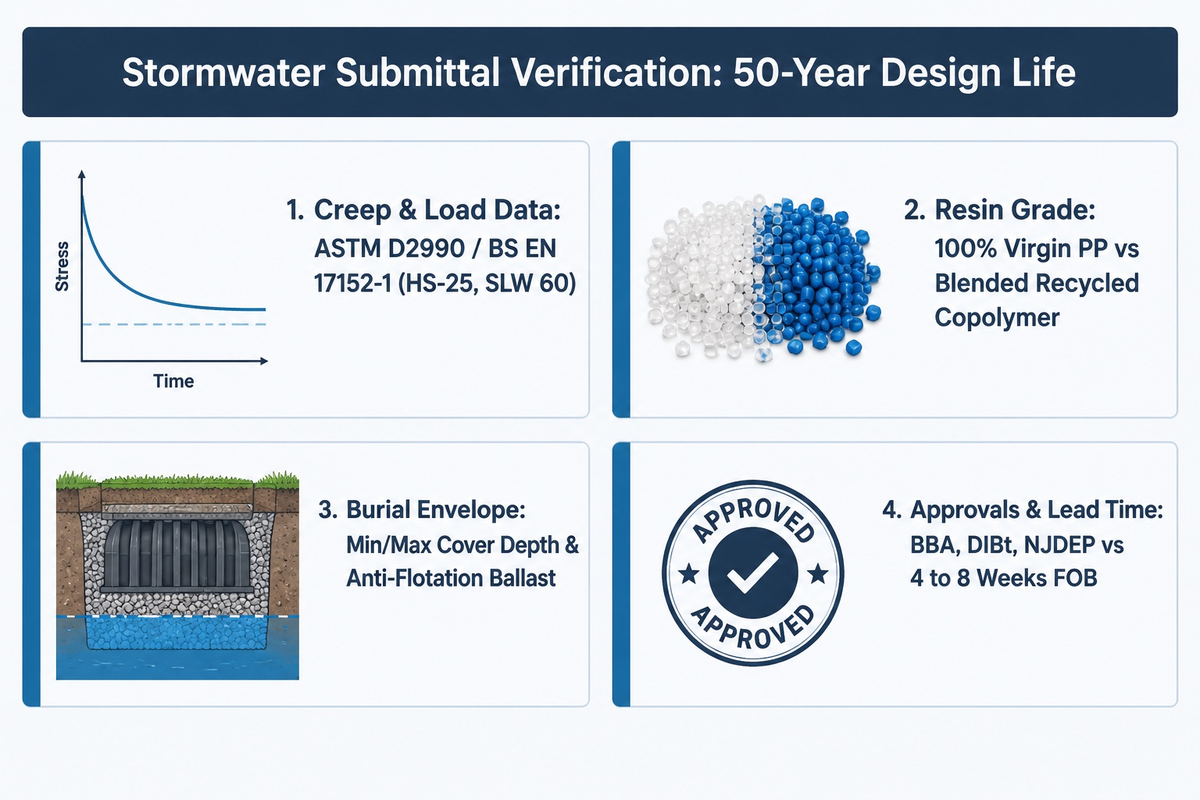
Load Rating Verification (HS-20/HS-25, SLW 60) and Creep Testing (ASTM D2990 / BS EN 17152-1)
Lab press crush tests provide very little information about a thermoplastic polymer’s long-term allowable burial capacity. Creep under constant loads is time-dependent and will continue over the 50-year design life.
When processing a manufacturer’s submittals for storm water compliance or trafficked parking lots, check four engineering documents once during technical review.
✔ Long-Term Creep & Structural Design Data: ASTM D2990 provides test methods for measuring plastic creep, while BS EN 17152-1 specifies requirements for geocellular stormwater units. Confirm how long-term creep reduction factors are applied in structural calculations for the required load class (20 to 60 ton/m2 short-term vertical test classes, HS-20/HS-25, or SLW 60).
✔ Virgin vs Recycled Resin Disclosure: Check whether modules are typically molded from 100% virgin polypropylene (preferred for deep traffic installations) or blended recycled copolymer.
✔ Cover Depth & Groundwater Envelope: Review minimum and maximum burial depth tables, side-fill compaction rules, and anti-flotation ballast requirements where the structure lies below the design groundwater level.
✔ Regulatory Certificate Scope: Where local authorities mandate BBA HAPAS, DIBt, NJDEP, or Washington Ecology TAPE approvals, check the certificate number and covered model series.
Frequently Asked Questions About Stormwater Management System Manufacturers
What is the difference between geocellular stormwater crates and arched chamber systems?
Geocellular crates are stackable modular polypropylene boxes which form more compact multi-layer subsurface detention footprints on commercial sites than single-layer open-bottom corrugated arched chambers.
Modular crates provide a typical 94% to 97% void ratio and stack vertically, while open-bottom arched chambers rely on surrounding washed stone with approximately 40% stone void space.
Which stormwater management system manufacturers offer built-in CCTV inspection and hydro-jetting tunnels?
Manufacturers offering geocellular crates with factory-molded CCTV inspection channels include Wavin (Q-Bic Plus), OTTO GRAF (EcoBloc Inspect), Polypipe (Polystorm Inspect), Fränkische (Rigofill inspect), ACO (StormBrixx), REHAU (RAUSIKKO Box), and Brentwood Industries (StormTank Module 20 and 25 Series).
For open-bottom arched chambers, Advanced Drainage Systems provides the fabric-wrapped StormTech Isolator Row for camera and jetter access. Standard structural matrix crates without internal tunnels, including Storm Manage StormTank H400 and H500 modules, use upstream silt traps and header manifolds to capture sediment before runoff enters the tank.
Do modular underground stormwater storage tanks remove pollutants, or is separate treatment required?
Bare storage tanks control runoff volume; for pollutant removal, integrated or upstream treatment is required.
To control stormwater pollution and improve water quality across paved commercial parking lots and industrial yards, civil engineers specify fabric-wrapped integrated treatment rows or upstream hydrodynamic oil-grit separators combined with replaceable cartridge media filtration solutions before subsurface discharge.
Can underground plastic stormwater modules support heavy fire trucks and commercial parking lot traffic?
ADS describes StormTech chambers as engineered for HS-20 and HS-25 live loads, while OTTO GRAF lists EcoBloc modules rated up to SLW 60 under specified installation conditions.
For heavy traffic-rated surfacing, a high-compressive module grade is required, and the manufacturer’s specified minimum compacted sub-base soil and pavement coverage must be provided. Point-load limits for fire-truck outriggers must also be met. ASTM D2990 provides test methods for plastic creep, and BS EN 17152-1 specifies product requirements for geocellular stormwater units.
When does direct factory container sourcing make more sense than buying from a local stormwater distributor?
Direct factory container sourcing from a manufacturer like Storm Manage fits planned commercial detention basins or warehouse stock orders where the schedule accommodates 4 to 8 weeks of ocean freight plus production, customs clearance, and inland delivery.
Ordering StormTank H400 or H500 polypropylene crates on an FOB Shenzhen container basis with bundled nonwoven geotextile and geomembrane liners eliminates multi-tier distributor markups when local permits do not require BBA, Kiwa, DIBt, or NJDEP product certificates. Buying from a domestic branch or regional precast plant fits urgent utility replacements needing immediate local dispatch.
Why are ADS and StormTech listed together rather than as two separate manufacturers?
StormTech chambers are manufactured by Advanced Drainage Systems.
This directory groups ADS with StormTech and Ferguson with ACF Environmental, lists CRH units Oldcastle and Hydro International separately, and includes system suppliers.
About This Engineering Directory
This comparison of stormwater management system manufacturers was compiled by the Storm Manage engineering and export team using official product datasheets, ASTM and BS EN structural standards, and public certification registries in October 2026. Our Shenzhen plant manufactures modular polypropylene attenuation crates and geosynthetic liners for global container export. We built this guide to clarify the material, inspection, and certification boundaries separating direct-factory crate suppliers, regional chamber brands, precast concrete plants, and treatment specialists.