We use the details you submit to review and respond to your project enquiry. Entries are handled in this website’s WordPress database using Fluent Forms; our hosting and email providers may process the submitted details. Other technical providers receive only the data described in our Privacy Policy.
Please do not send passwords, payment-card details, government identification numbers, sensitive personal data, or unnecessary confidential third-party information.
Highway and car park drainage refers to the whole system of gullies, channels, pipes and underground storage used to convey and control runoff from roads and car parks, keeping them safe to use and compliant with the applicable sustainable drainage standards. Get it wrong, and you get standing water, cracked paving and, increasingly, a planning objection. Get it right and it’s out of sight.
Highway and car park drainage combines two distinct functions, moving water off the surface fast (channels and gullies) and storing it before controlled release (attenuation tanks) — and England currently governs the second function through Defra’s 2025 non-statutory National Standards for Sustainable Drainage Systems, not a single “UK law.” Car parks over 800m² typically need a pollutant interceptor before discharge. Highways managed by National Highways follow a separate standard, DMRB CG501, rather than the Defra standards.
In this guide:
Why “highway drainage” on your water bill and highway drainage the engineering system are two different things
Why a channel drain and an attenuation tank solve different problems – and usually both are needed
Why England’s SuDS standards still aren’t law, while Wales made them mandatory in 2019
What load class and storage volume your car park actually needs, worked through with real numbers
Where an interceptor become a legal requirement, not an optional extra
What Counts as Highway and Car Park Drainage?
Highway and car park drainage covers everything that removes and manages surface water from roads and parking areas: the water bill charge that funds treatment, and the physical network of gullies, pipes, channels, and attenuation storage that actually does the work — this guide separates the two and points to the highway drainage regulations that actually govern each. “Highway drainage” means two different things depending on who says it, and mixing them up wastes a lot of time.
On a water bill, highway drainage is a charge – a line item for treating road and pavement runoff that enters the public sewer.
Highway drainage as an engineering system is the physical network of gullies, pipes, channels, and ( increasingly ) sustainable drainage elements that convey and manage road and pavement runoff.
This guide is about highway drainage the engineering system. But highway drainage on your bill matters for context: Ofwat confirms that water companies charge for treating runoff from roads and footpaths, even though they don’t own or design the physical systems that manage it.
Who Is Responsible for Highway Drainage?
Local highway authorities manage adopted public road gullies and prevent flooding on public roads.
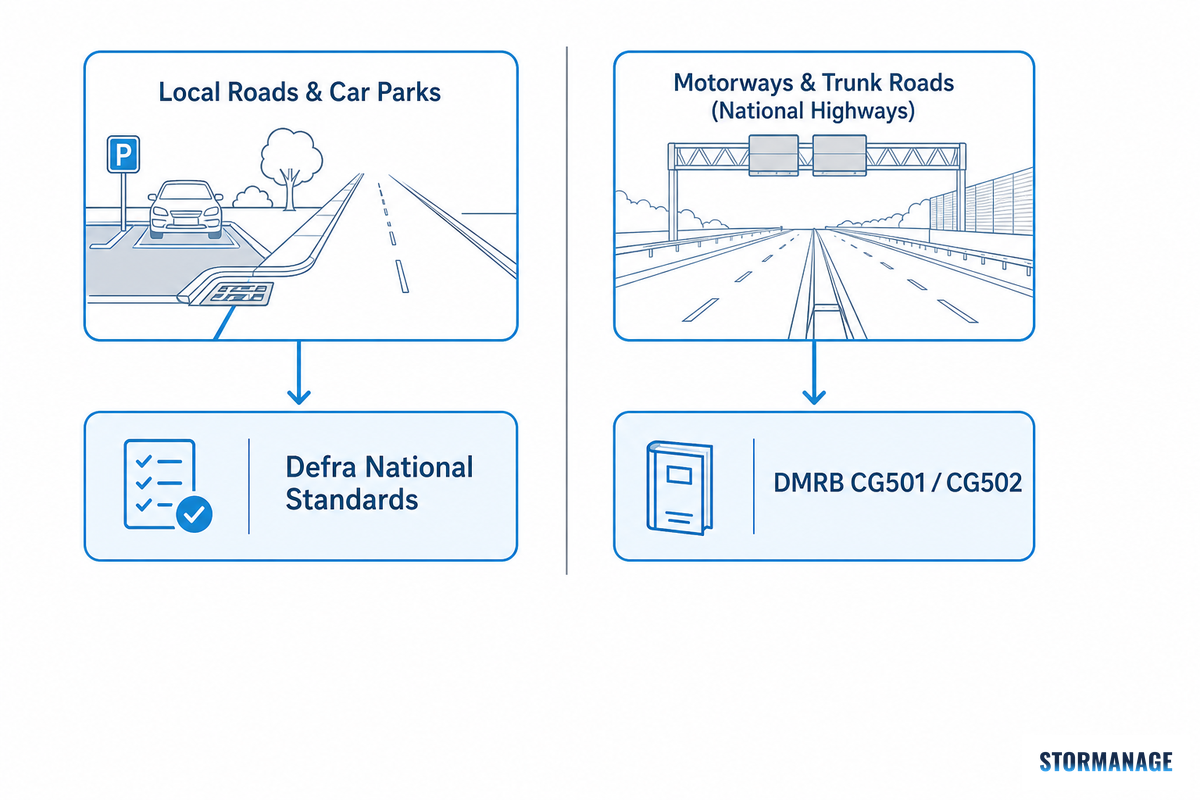
National Highways manages the public motorway and major roads network, with a design process based on its own standards, not local highway authority standards.
The public sewer system is owned by the local water company, which also takes on responsibility for the water and consequently sends the highway drainage charge to you.
Owners of private roads and car parks inherit the responsibility as it would otherwise go unaddressed, and this is precisely why many existing car parks now exist in a state of no one really being responsible for them — the trap a retail park operator falls into after inheriting a 15-year-old surface with no drainage drawings on file.
📐Engineering Note: Highway and car park drainage schemes discharging to a range of application sectors — from local access roads to multi-storey car parks, sit under different regulatory owners even when the physical hardware (gullies, pipes, tanks) is functionally identical. Confirm which authority applies before assuming a “highway drainage” standard covers your car park, or vice versa.
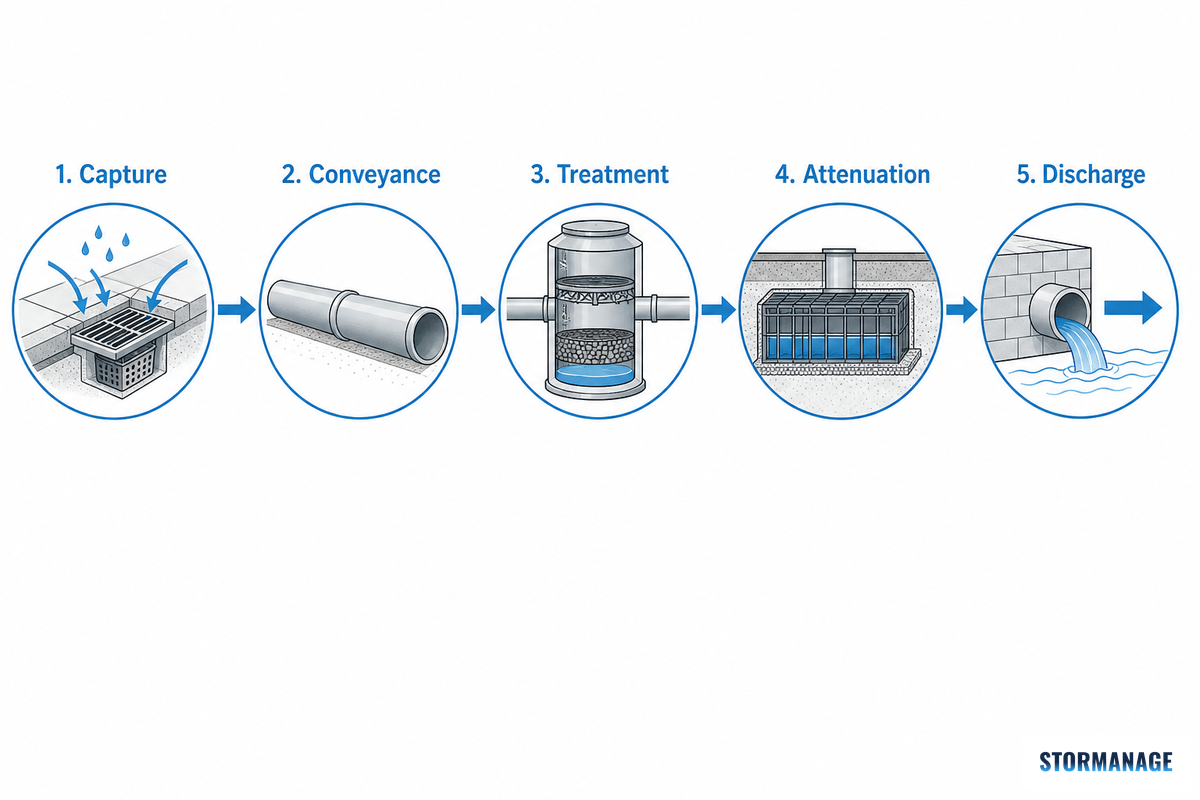
How Surface Water Moves Through a Highway or Car Park: The 5-Stop Water Journey
Rain that falls on a road or car park doesn’t go straight to a river. It moves through five distinct stages, and a drainage scheme that only solves one or two of them fails during the storm it was supposed to handle — an application where this shows up first is a multi-storey car park deck, where every missed stage is immediately visible as a puddle rather than hidden underground.
Capture – gullies, channel gratings, or roadside ditches collect surface water off the trafficked area.
Conveyance – pipes or channels carry captured water away from the trafficked surface.
Treatment – pollutants (oil, silt, heavy metals) are removed before the water go further, where required.
Attenuation – water is stored temporarily so it doesn’t overwhelm the downstream sewer or watercourse during peak flow.
Discharge – water is released at a controlled rate to a sewer, watercourse, or the ground itself.
Most drainage complaints trace back to a gap in one of these five stops, not a total system failure — that single missing stage, not a design failure at every stage, is the mistake worth checking for first, because it is the cheapest one to fix before construction rather than after a 2025-vintage scheme floods in its first winter. A retail car park that floods usually has working gullies (stop 1) and pipework (stop 2) but no attenuation (stop 4), so the moment inflow exceeds the downstream sewer’s capacity, water has nowhere to wait and backs up onto the surface.
“Highway drainage is just about getting the water off the carriageway as quickly as possible” is myth number one. Once the water is in the pipes it still needs to go somewhere, if the downstream system doesn’t have capacity, the highway drainage will be ineffective regardless of how fast it clears the surface.
Gullies themselves are also a narrower tool than most people assume. They’re designed for a 1-in-1-year or 1-in-2-year rainfall event, and they block with debris even when maintained on schedule – which is why swales and filter strips are increasingly specified alongside them on new schemes to slow water flow, and why a genuinely extreme rainfall event needs a separate overland flow route, not just a bigger gully.
This five-stop breakdown is this guide’s own synthesis rather than a direct quote from any single document, but it follows the same underlying order Defra sets out in the National Standards for Sustainable Drainage Systems: work out where the water should go before deciding how big to build the pipe.
Surface Drainage Channels vs Underground Attenuation Storage
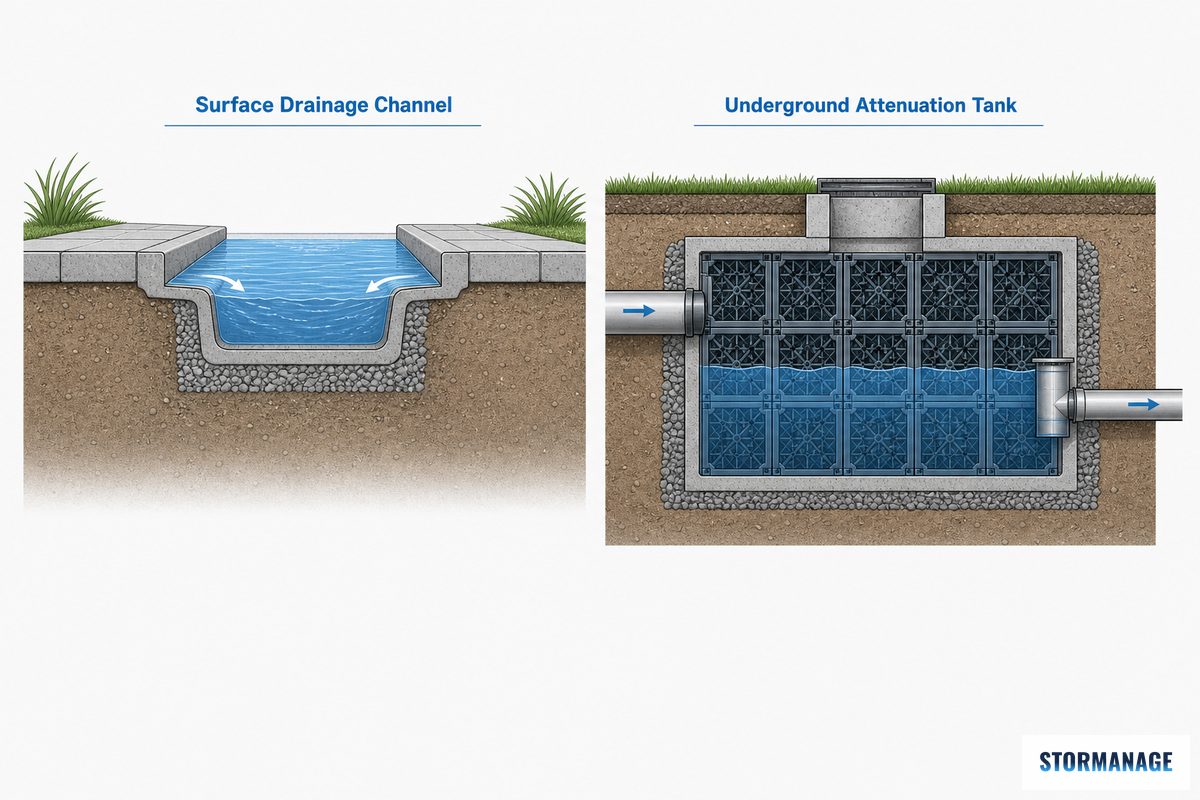
Surface drainage channels and underground attenuation storage solve two different problems, and treating them as interchangeable – or assuming one substitutes for the other – is the single most common design mistake in this guide’s research. A drainage channel move water off the trafficked surface quickly; an attenuation tank stores water so peak flow doesn’t overwhelm the sewer or watercourse downstream.
⚠️Common Misconception: It’s tempting to assume a channel system can simply feed an attenuation tank during an extreme rainfall event. It generally can’t. Gullies and channel gratings are sized for routine flow, not the volume a 1-in-100-year event pushes toward underground storage, the intake path into a tank needs its own dedicated sizing, not a repurposed surface channel.
A big 1,100m channel drainage car park could fully clear surface but overfill site if there’s no space for that drained water to park up during a storm – a real case on a big shopping centre car park.
Channel drainage and attenuation storage solve different stages of the 5-stop water journey — most highway and car park schemes need both, not one or the other.
Factor
Surface Drainage Channel
Underground Attenuation Tank
Primary role
Capture + conveyance (stops 1-2)
Storage + controlled release (stop 4)
Design event
Routine (1-in-1 to 1-in-2 year)
Extreme (1-in-30 to 1-in-100 year, plus climate change allowance)
Installation profile
Surface-level, visible, retrofit-friendly
Below-grade, hidden, needs excavation
When it’s optional
Rarely — every trafficked surface needs capture
Site-dependent — driven by downstream sewer/watercourse capacity
If you’ve space down the sewer and only normal rainfall to deal with then just a well-specified channel system might be all that’s needed.
If down the sewer space is limited or there’s a requirement from the local authority for SuDS-compliant rates, or if it’s just that your peak rainfall is more than average, then you’ll need attenuation storage along with the surface capture, not in lieu of it, that’s the decision framework we’re using for the remainder of this guide.
Channel drainage alone: normal rainfall, space down sewer, no SuDS rate required.
Channel drainage + attenuation: space limited down sewer, SuDS rate required or big, high run-off site.
Sustainable Drainage Systems (SuDS): England’s Standard for These Schemes
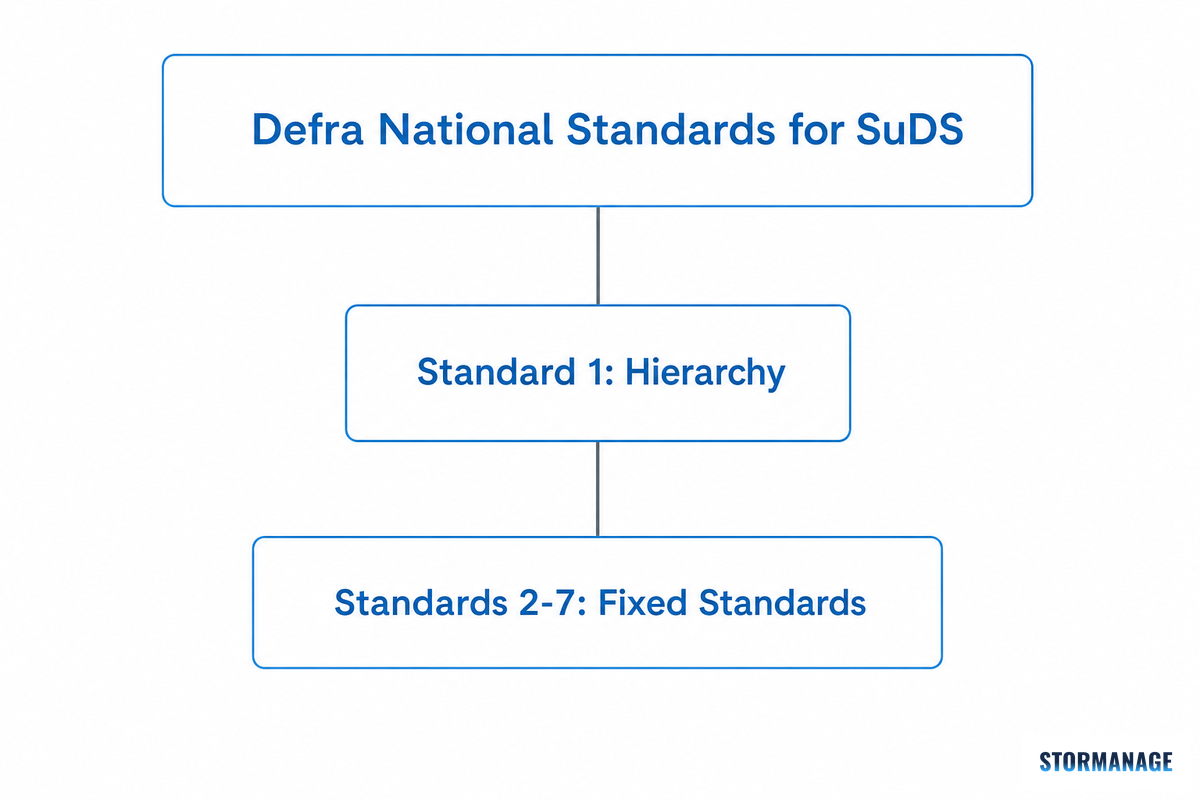
Sustainable drainage systems, known as SuDS, form the current English system for dealing with surface water run-off at source — often by letting it soak away and recharge groundwater — rather than taking it straight to the foul sewer. The National Standards for Sustainable Drainage Systems were published by Defra in June 2025 and cover the whole of England.
Standard 1, the hierarchy standard.
Standards 2-7, the fixed standards.
Here’s the gap many guides get wrong, and the one that trips up developers working across a border: these standards aren’t legislation, they’re advisory to inform policy in the National Planning Policy Framework, and although they would be expected to be referenced, they don’t impose a legal requirement in the same way as building regulations do — a mistake a specifier moving from a Welsh scheme to an English one can easily make by assuming the same statutory footing applies, because Wales made SuDS approval mandatory in 2019 while England, as of 2025, still has not.
Nor do they apply to the National Highways trunk road network (that’s covered by DMRB next). Nor are they intended for retro-fits — in practice, a car park resurfacing project is judged against different criteria than a new-build application on a greenfield site.
England vs Wales: Two Different SuDS Regimes
This surprises most people planning cross-border projects. Under Schedule 3 of the Flood and Water Management Act 2010, Wales became the first country in the world to make SuDS legally mandatory for new developments in 2019, requiring approval from a statutory SuDS Approving Body before construction.
England’s government considered doing the same but decided against it in December 2014, relying on planning policy instead, Defra is still “considering implementation” with no confirmed date. The Welsh government has stated its approach “contributed to England also now preparing for very similar legislation.”
Designing Drainage for a Highway: Standards and Sizing Basics
Highway drainage design in England can be complicated by the divide between the system used on local roads (Defra National Standards above) and the separate system for the motorway and trunk road network managed by National Highways, covered in DMRB CG501: Design of Highway Drainage Systems, v.2.1.0.
CG501 covers principles of drainage design to limit carriageway flooding on National Highways’ roads: calculation of storm flow, Flood Risk assessment, component choice.
CG502 deals with certification of the drainage design itself – in other words, schemes for trunk roads require a formal sign-off, unlike the more typical treatment of local road schemes.
The practical advice: if you’re designing for drainage at a trunk road junction or motorway approach, cite CG501/CG502 rather than the Defra National Standards — citing the wrong document is a common mistake on mixed schemes where a site straddles a slip road and a local access road, because CG501 (version 2.1.0) and the 2025 Defra standards are separate documents with separate sizing tables, not two editions of the same one. If designing for a local access road or for a car park, use the relevant Defra standard (or Schedule 3 for schemes in Wales) instead — the same application, a retail car park resurfacing scheme, can sit under either regime depending on which side of the England-Wales border it falls.
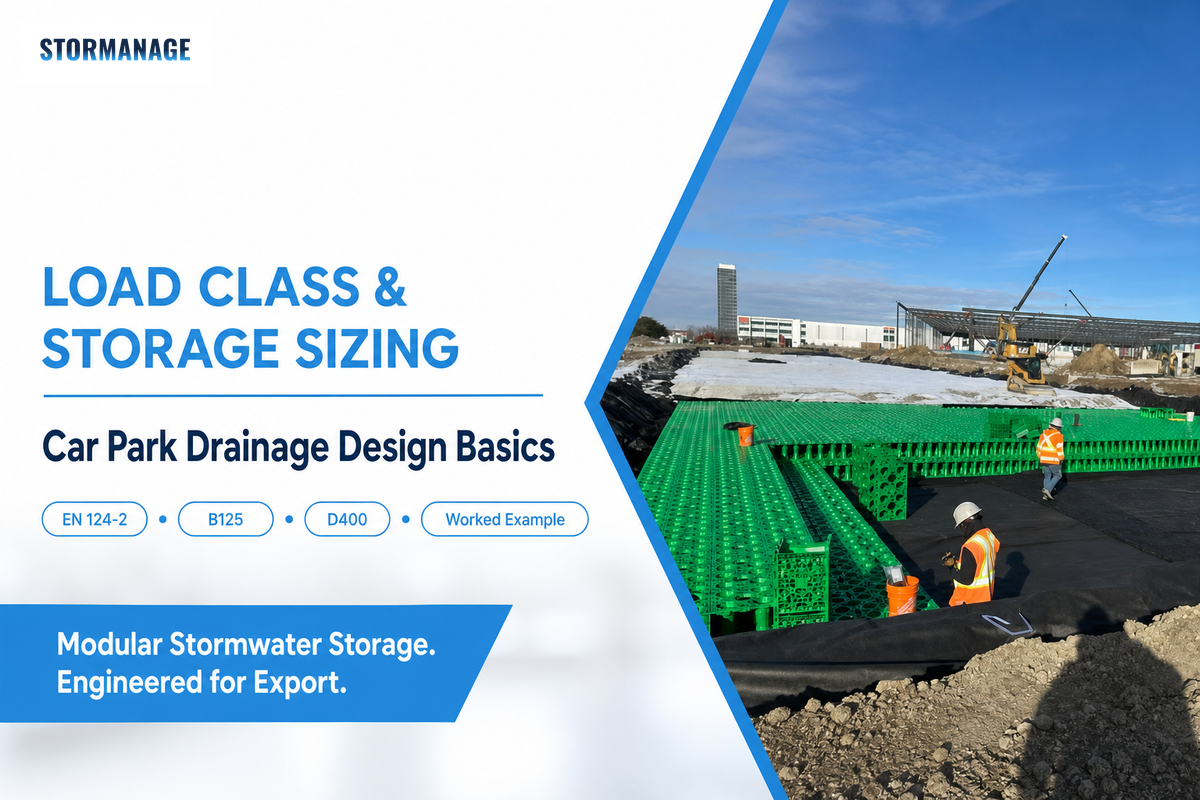
Designing Drainage for a Car Park: Load Class, Layout, and Storage Sizing
A car park drainage design presents two separate sizing questions – the load class required to carry the surface, and the amount of storage volume the site needs. The same two questions apply to smaller parking areas and shared driveways, though a specialist drainage contractor will usually scale a full car park drainage system down rather than reuse the same spec unmodified.
How Do You Drain Water From a Parking Lot?
Design follows a pattern of surface capture — channel drains or point gullies rated for the site’s traffic — discharging to a piped network, with an interceptor ahead of the discharge point on larger or more sensitive sites. Where rainfall can’t be accepted quickly, that network feeds an attenuation tank sized to hold peak flow for controlled release, and the layout usually follows site topography (fall toward a collection point) rather than a fixed design standard.
Highway and Car Park Load Class Reference: EN 124-2/EN 1433 defines six load classes from A15 to F900 — car parks are commonly specified at B125, trafficked carriageways at D400.
Load Class
Minimum Test Load
Typical Application
A15
15 kN (approx. 1.5 tons / 1,500 kg)
Pedestrian and cyclist-only areas, no vehicle access
B125
125 kN (approx. 12.5 tons)
Standard car park bays, footways, pedestrian precincts
B125 (extended)
125 kN (approx. 12.5 tons)
Multi-storey car park decks with slow-moving light vehicles only
C250
250 kN (approx. 25 tons)
Kerbside channels, light-traffic roads, small private car parks
C250 (cross over)
250 kN (approx. 25 tons)
Car park entrance/exit ramps where light vehicles cross the drainage line at low speed
Local highway carriageways and junctions under Defra standards
E600
600 kN (approx. 60 tons)
Ports, industrial yards, areas with solid-tyre or tracked vehicles
F900
900 kN (approx. 90 tons)
Airport aprons and other extreme-load pavement zones
📐Engineering Note, Worked Storage Estimate: A rough first-pass storage estimate: for a 100-space car park with an average bay-plus-access footprint of roughly 25m² per space, the impermeable catchment area is approximately 2,500m². At a typical design storm depth of 20mm (a simplified planning-stage figure, not a substitute for a full hydraulic calculation), that catchment generates roughly 50m³ of runoff to attenuate before controlled discharge, the starting point a drainage engineer would then refine using site-specific rainfall data, permeability, and the applicable climate change allowance from Environment Agency guidance.
Storm Manage’s own container loading data shows one 40-foot high-cube container can carry up to 330m³ of installed geocellular storage volume with optimised stacking, meaning a single container shipment covers approximately 600% of this example car park’s estimated storage need, a useful sanity check when a supplier’s quote looks disproportionate to the site size.
Pollution Control: Interceptors, Silt Traps, and Petrol/Oil Risk in Car Park Runoff
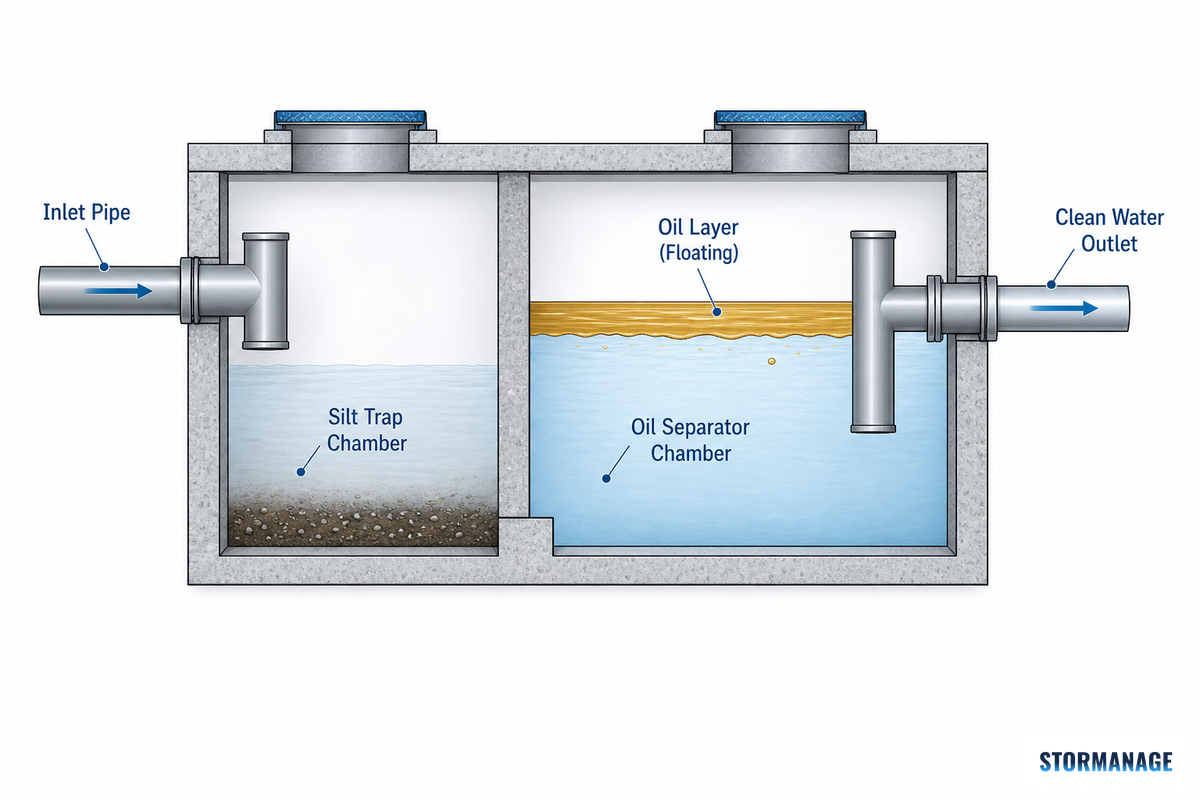
Rainwater runoff from any road surface, or from a car park, is polluted in practice, not just in theory. It will pick up heavy metals, oil and other organic compounds from vehicles, and also the road surface itself — the application that makes this most visible is a fuel-retailer forecourt or a vehicle maintenance yard, where the same rain that would be harmless off a residential driveway becomes a genuine discharge risk — so even a well maintained gully pot offers very limited treatment on its own.
Current GOV.UK pollution prevention guidance sets a specific, checkable threshold: a separator is typically needed for car parks larger than 800m² or with 50 or more parking spaces, plus smaller car parks discharging to a sensitive environment, refuelling areas, and vehicle maintenance sites. Below that threshold, a well-maintained silt trap may be sufficient — but the risk sits right at the boundary, because a retail car park sized at 780m² today that adds 30 more spaces next year crosses the 800m² trigger without anyone necessarily re-checking the pollution control requirement.
💡Pro Tip
Should your site have drainage to a public sewer via a connection on the highway, you will need to be aware that there is no right for highway authorities to connect road surface-water into a sewer, and that permission from the water company is needed. In smaller road-improvement schemes, this may be omitted.
Common Failure Points: Flooding, Standing Water, and Maintenance
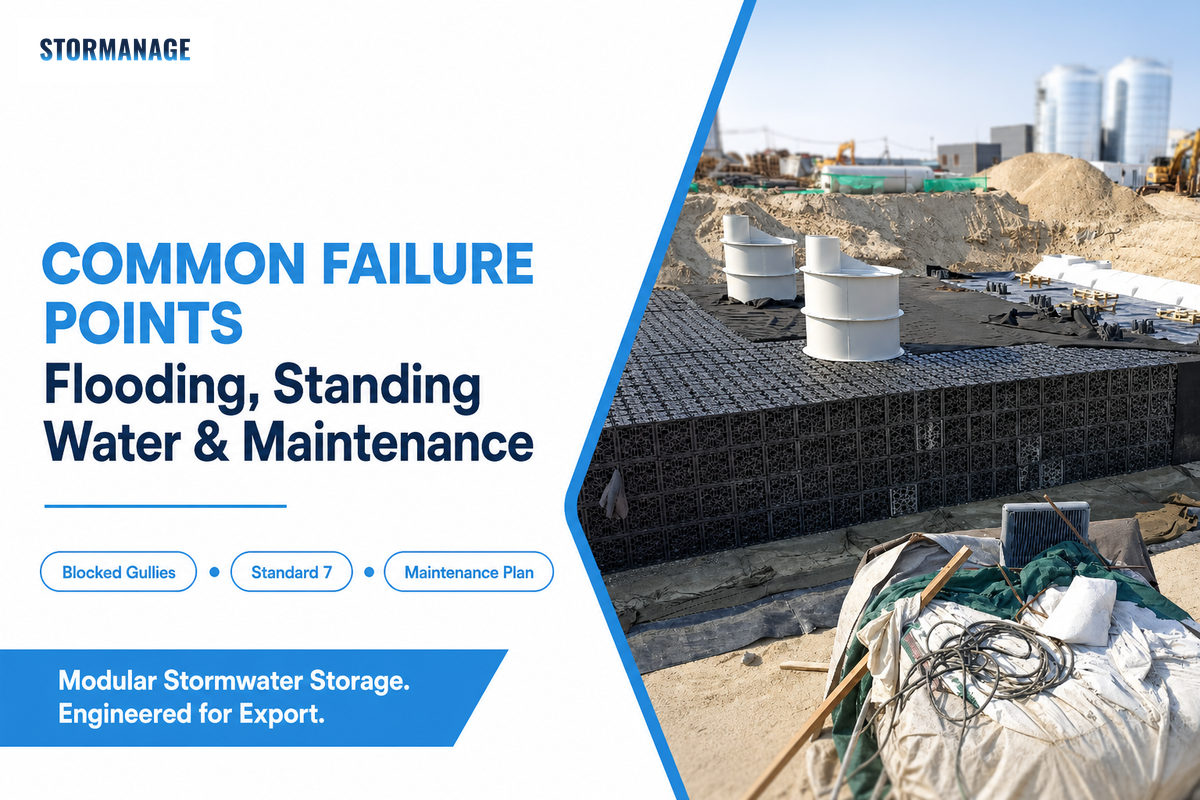
As part of Defra’s National Standards 2025, continuing to maintain drainage isn’t simply a good idea, Standard 7 specifies the requirement for a management and maintenance plan, as well as a review of behaviour in the event of failure. In other words, if your new scheme fails to include a maintenance plan, that’s a compliance issue as well as an operational risk on your existing assets.
Blocked gullies: many highway networks report more than half the gullies to be blocked at any one time, raising the risk of standing water on roads and lowering pedestrian safety as flow spreads across the carriageway. Increased water depth accelerates the formation of a pothole — starting as a small hole in the surface and widening with every heavy rain event — as a result of repeatedly saturating the road surface, sometimes prompting a temporary lane restriction while repairs are carried out — a pattern WRc’s Nick Orman has observed directly because gullies are designed for a 1-in-1-year event, not the debris load a badly-timed maintenance gap allows to build up.
Underground or covered drainage flooding: this application — a basement or multi-storey car park deck — sees several examples of direct discharge to the pavement or basement, without a proper collection system. The result can be the flooding and damaging of parked cars once system capacity is reached, something a collection-stage design review will prevent.
Maintenance Checklist
Keep gullies and channel gratings clear on a regular basis, not just after visible problems
Check interceptors and silt traps for accumulated sediment regularly (in accordance with manufacturer recommendations)
Ensure the inlet and outlet of an attenuation tank is clear of obstructions after any adjacent groundworks
Record all maintenance activities – Standard 7 requires documented procedures, not ad-hoc work
How Underground Attenuation Tanks Fit Into a Highway or Car Park Drainage Design
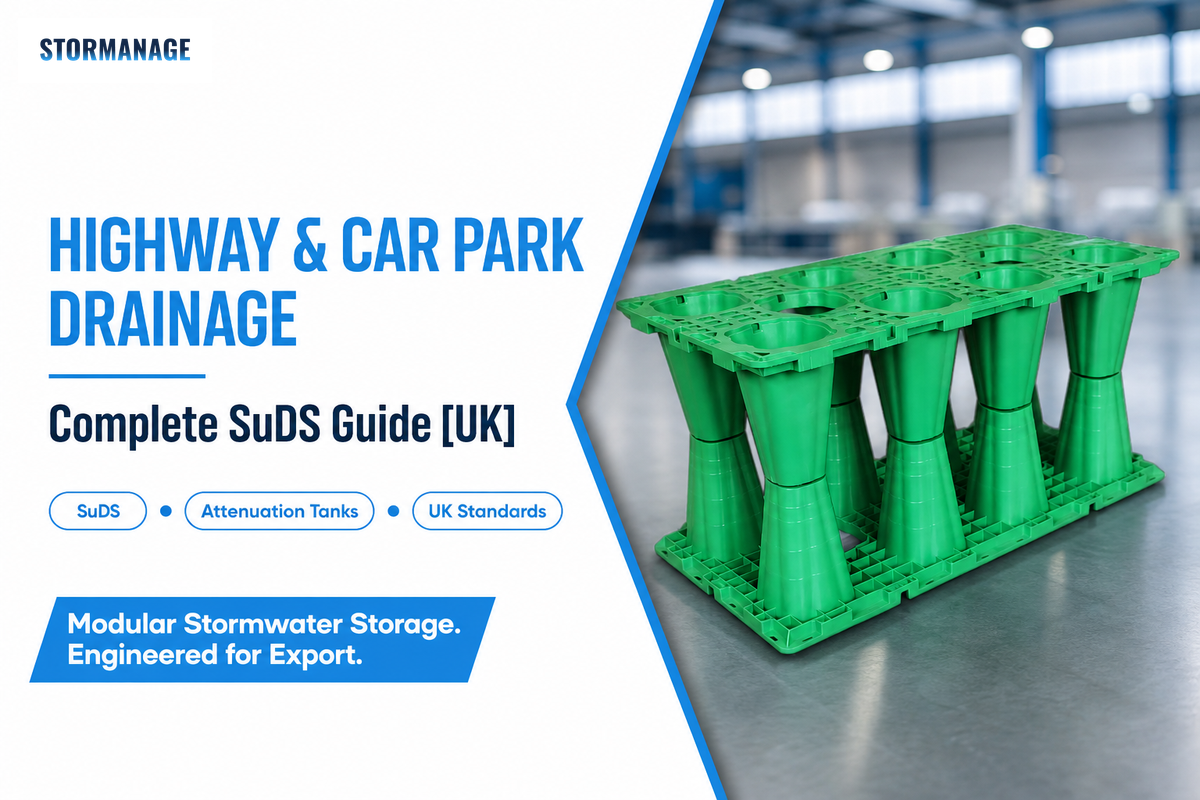
After capture, conveyance and treatment have been designed, the final step of the car park attenuation design process involves adding a store of volume. For most highway schemes or car park sites where above ground space is a luxury that can’t be spared, a geocellular attenuation tank will be installed beneath the ground surface, made from modular crates.
Storm Manage supplies geocellular attenuation crate systems from an injection-moulding production base established in 2014, running 8 high-tonnage moulding machines (1,000-2,000 ton clamping force) across a 8,000m² Shenzhen facility with roughly 5,000m³ of monthly output and 60,000m³ annual capacity, with dedicated compression-performance verification, dimensional tolerance checks, and Virgin PP/Recycled PP material ratio control at batch level, the kind of QC detail that matters for a durable, reliable system once a tank is buried and effectively unreachable for a decade or more. Standard lead time runs 15-30 days after order confirmation, with a 12m (40-foot) high-cube container preferred for FOB Shenzhen/Yantian/Shekou shipping.
Please refer to our highway and car park attenuation tank systems page for a full worked example of highway drainage installation, from initial sizing through to a design a specifier can sign off. This gives a detailed view of the evidence required from the specifier’s perspective for this element of drainage.
Industry Outlook: What UK SuDS Policy Changes Mean for Highway and Car Park Schemes
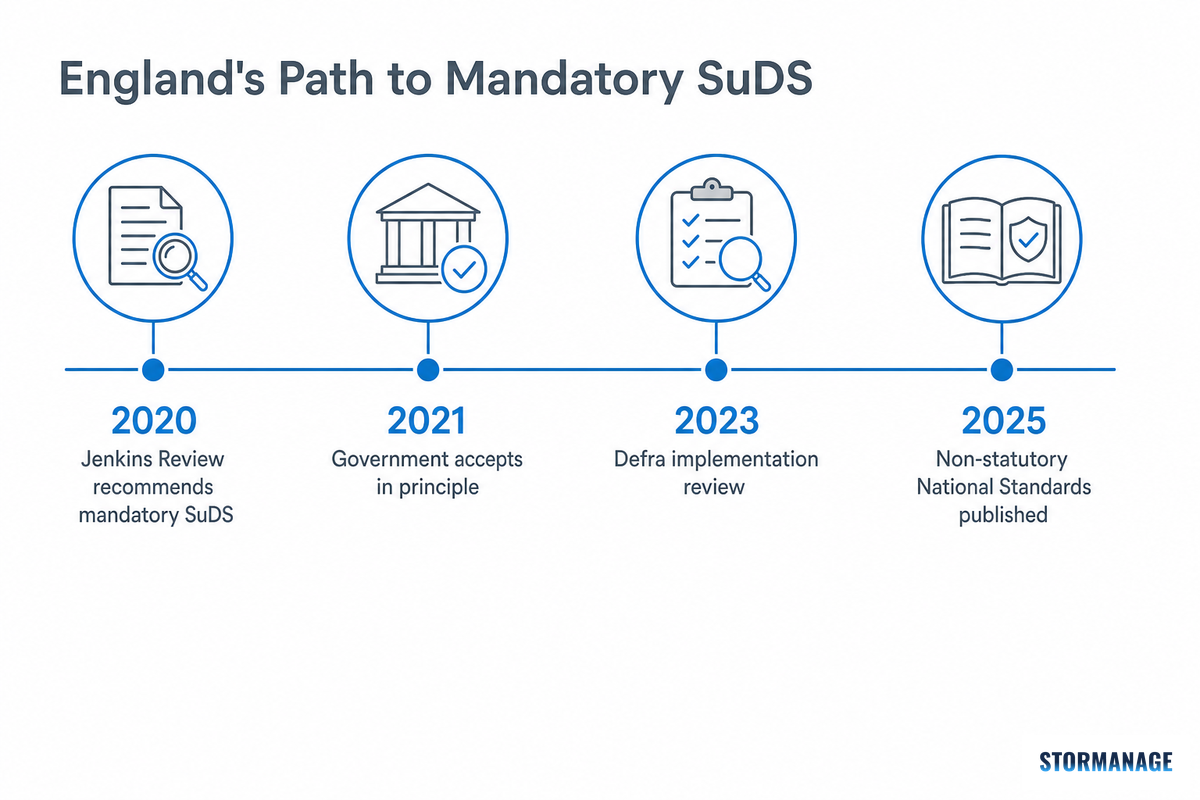
The verdict for any 2026-2027 project: England’s SuDS standards are moving in one direction, towards being mandatory, not away from it, though no-one can put a date on it — the risk for a developer is treating today’s non-statutory guidance as optional and then facing a retrofit bill once Schedule 3 does commence. So if you’re specifying drainage now, the safer trade-off is to assume it’s a requirement and over-spec to current Defra standards, because a scheme built to yesterday’s minimum in 2024 is the one most likely to need expensive retrofitting once the mandate lands rather than a scheme already sized against the 2025 standard — in practice, that’s the difference between a car park resurfacing application that sails through a future SAB review and one that gets sent back for redesign.
2021, Government accepts the recommendation in principle
2023 – Defra publishes an implementation review of Schedule 3.
2025 – Non-statutory National Standards published as an interim step.
What Wales Shows Us
Wales offers a window into what that future regime for England might look like: mandatory SuDS Approving Body sign-off before building work starts, national standards for design and maintenance, and the end of an automatic right to connect to the public sewer. A 2023 review found the process successful enough to extend, not repeal — a developer working both sides of the border already sees two sign-off regimes in one portfolio.
Background context: UK flood cleanup costs have run as high as an estimated £566 million per year in recent reporting, with a majority of councils reporting overwhelmed sewer capacity during peak events, directional context for why regulatory attention on surface water management continues to increase, not a precise annual constant or a planning input on its own.
Frequently Asked Questions
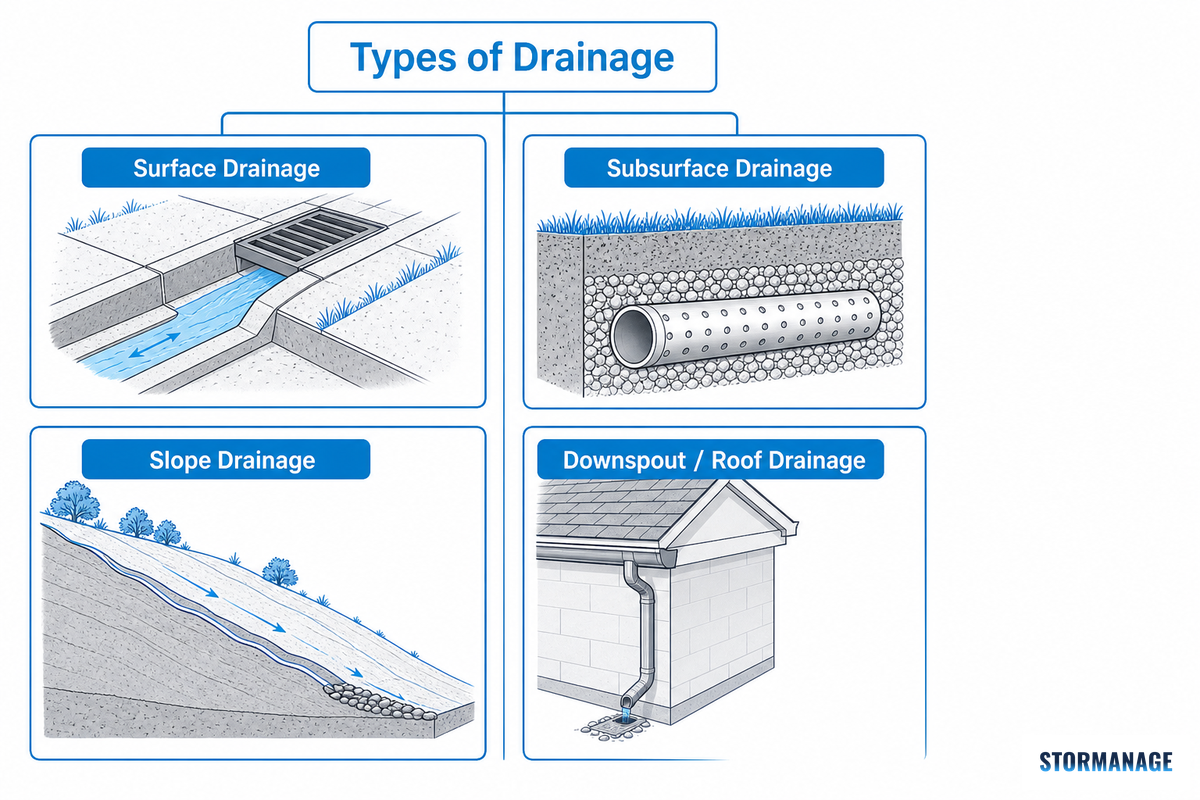
What are the 4 types of drainage?
View Answer
drainage systems are commonly categorised into four groups: surface drainage (water collected from the surface of the land using gullies, channels, and swales), subsurface drainage (subsurface water control using land drains and perforated pipe networks), slope drainage (controlling runoff from sloped land to mitigate erosion) and downspout/roof drainage (handling water run-off from roofs). Primarily used on highways and within car park projects, surface drainage is often coupled with Sustainable drainage approaches which can overlap into subsurface where attenuation storage is involved.
What are the mandatory requirements for a drainage system in England?
View Answer
Because the Defra National Standards in England are not a set of legally enforceable rules, but rather guidance, there is no mandatory check list that developers are required to complete when planning SuDS systems. However, when they are reviewing proposals local authorities will look for a number of criteria to have been met. These criteria range from considering where the runoff from a scheme should go and how extreme weather events should be handled, to how the amount of water that needs to be managed should be reduced, as well as how amenity and biodiversity impacts are considered, and crucially for later maintenance, how construction and management have been detailed in plans. Wales’ regulations, meanwhile, follow a more strict legal process for the signing off of SuDS systems under Schedule 3.
What is a spoon drain in a car park?
View Answer
A spoon drain is a narrow rounded surface channel with the shape of a spoon and placed on the perimeter of car park or access roads to drain water To the collection point, without a grating and depth associated with a full channel drain system. A low-cost solution to the periphery of a drainage, suitable where a surface is unlikely to be driven over.
Who pays for highway drainage vs car park drainage?
View Answer
Costs of Highway drainages is split between highway authorities and water customers. Highway authorities fund capital works while highway drainage charges paid by water customers cover the costs of maintenance of these systems. car park drainages have no public funding stream and so all costs are borne by the developer.
Do I need planning permission to change car park drainage?
View Answer
Sometimes yes, especially for new developments or for a material alteration of a surface – in the first place you’d need to consult with your Local Planning Authority because it’s common for a SuDS requirement to be appended to even the smallest resurfacing application.
How much does an attenuation tank for a car park typically cost?
View Answer
Cost depends more on the storage that is required and the ease of access to the site, so you’d need more specific data for the catchment area and discharge-rate than a space-per-value estimate – for a value specific to your development project use our attenuation storage volume calculator instead of a blanket figure.
As the manufacturers of the geocellular attenuation systems detailed here, it’s unavoidable that we’d have a vested interest in them. That’s why, wherever possible, we’ve tried not to conflate SuDS rules which don’t, in principle, necessarily have to apply, and which aren’t (yet) required, with those that do. For example, load-class and storage figures provided in this document derive from EN 124-2/DMRB documentation and our own production and container-loading data, rather than marketing-orientated statements.