Underground Stormwater Detention Tank Cost & Sizing

Nothing beats a surface pond on construction cost. You are reading this because you cannot have one. This page shows what actually drives the bill once you go underground, how to convert a required storage volume into a module layout, and what the StormTank geocellular tank costs you in excavation rather than in catalogue price.

STRUCTURAL_CORE_V1
95%_VOID_RATIO
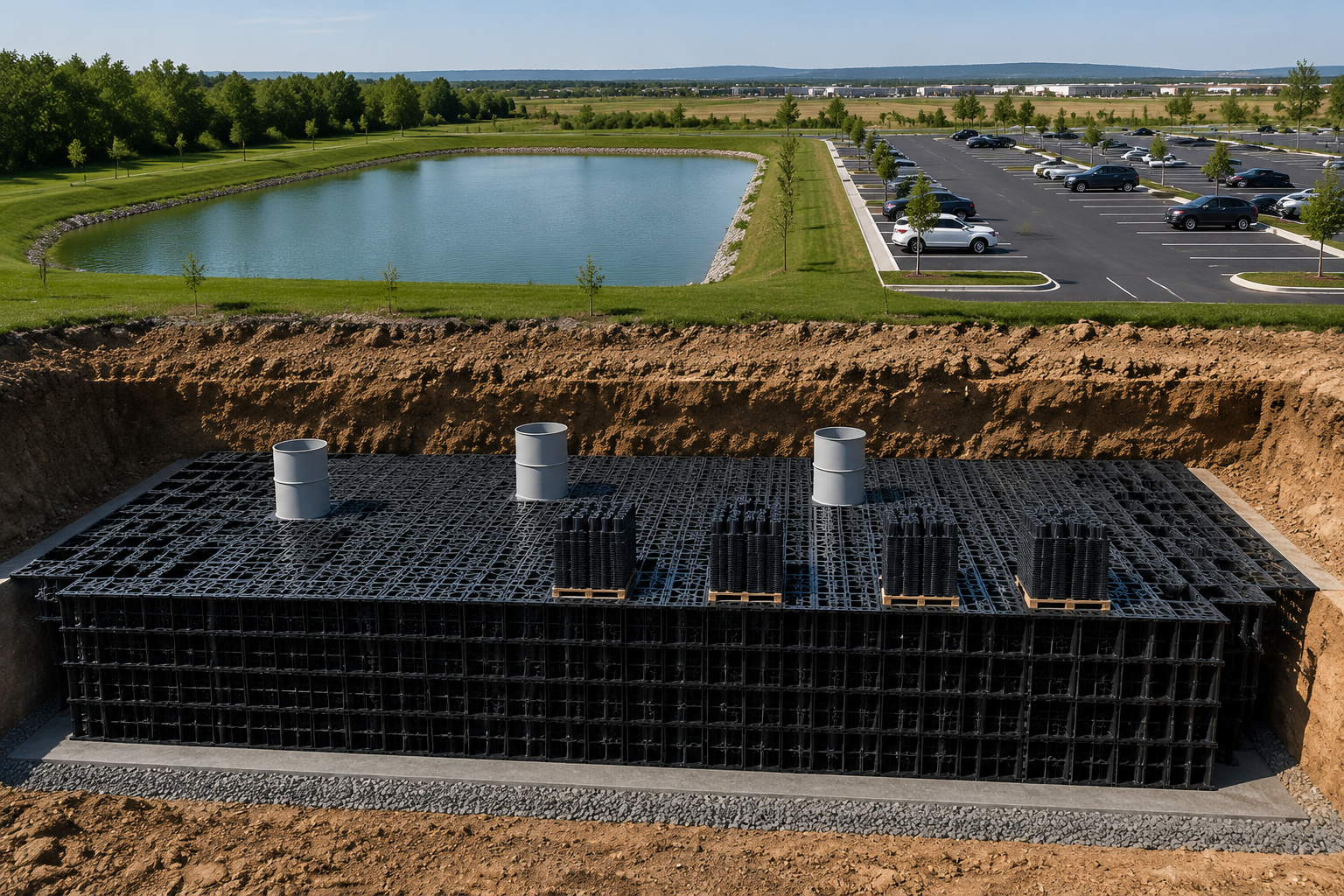
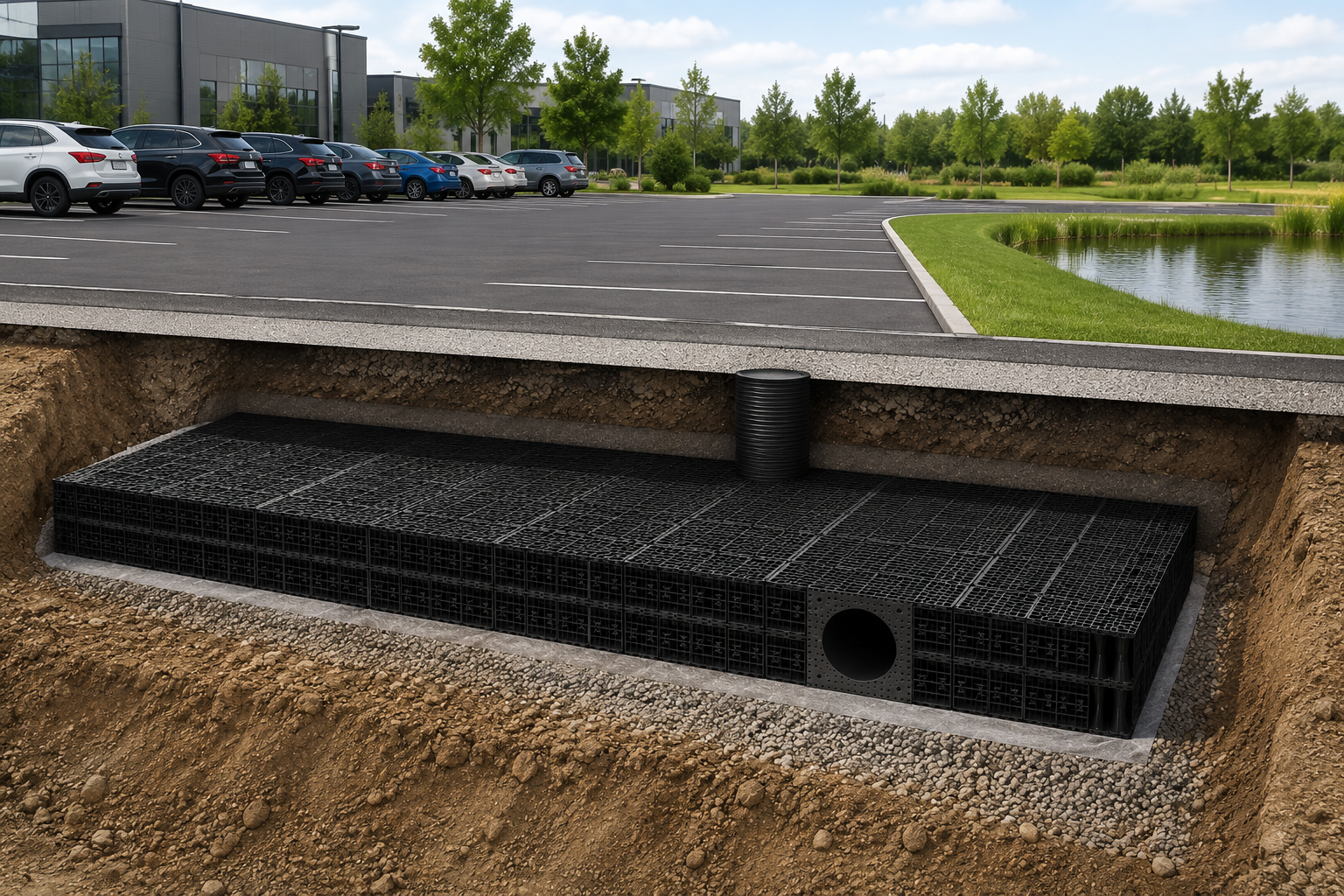
StormTank Geocellular Tank Module Perspective

StormTank Geocellular Stormwater Tank — At a Glance

95% Void ratio — 190 L stored inside a 200 L module envelope
ST-20 to ST-60 Load-class family plus Custom; ST-45 added with SGS failure evidence
6.71 cu ft Storage per H400 module (190 L / 50.2 US gal)
341 cu m Assembled tank envelope shipped in one 40’HQ container
50 years Design life, structural design referenced to CIRIA C737
15–30 days Production lead time after order confirmation

Where the Money Actually Goes in an Underground Detention System

Underground detention system cost is decided in the excavation, not in the catalogue. A stormwater detention tank is an underground structure built to store stormwater runoff during a storm and release it slowly through a restricted outlet, cutting the peak flow that would otherwise flood the storm drain downstream. Every one of them — concrete, arch chamber, gravel trench, or geocellular crate — buys the same cubic metre of storage. What separates them is how much ground you must move to get that cubic metre.
The Cost Reality of Surface Ponds vs Underground

Start with the number nobody selling underground systems likes to lead with: a surface pond is the most cost-effective detention structure you will ever build. U.S. Environmental Protection Agency cost data puts retention and detention basins at $0.50 to $1.00 per cubic foot of storage, with the low end reflecting economies of scale on large basins and dry detention basins ranking as the least expensive design option of the group.

Those are 1999 dollars, they exclude land, and the source itself calls them estimates — a dollar then bought considerably more excavation than a dollar now, so read the figure as a historical benchmark for surface basins rather than as a live quotation. Even carried forward generously, no underground system on the market lands anywhere near it.

The True ROI Justification

Civil engineers who build for developers say the quiet part out loud. Writing for a commercial real estate development association, Chris Strawn, PE and Tom Jansen, PE describe underground detention as carrying “increased capital costs initially compared to a surface solution,” and identify the real justification as “the return on investment on the value of the increased land or building capture.”

An attenuation tank under a car park does not beat a stormwater retention pond on construction cost. It beats it on the acre you get to sell, lease, or build on. So the honest question is not underground or pond. On most constrained parcels that decision is already made by the site plan. What matters is what your cubic metre of underground storage costs once it is in the ground — and that is where the systems separate violently.

Applications Context
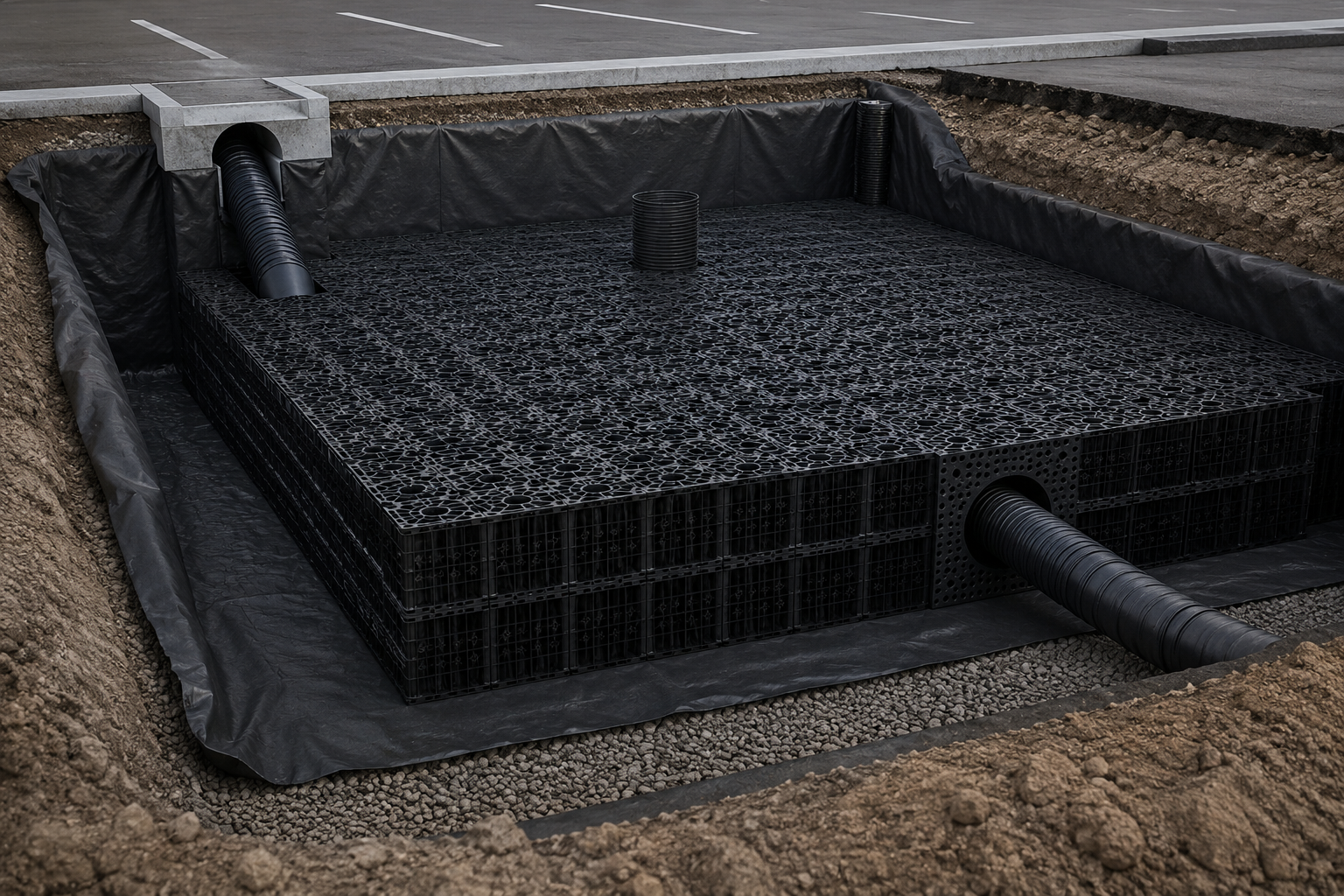
Surface pond vs underground detention layout overlay diagram

An attenuation tank under a car park does not beat a stormwater retention pond on construction cost. It beats it on the acre you get to sell, lease, or build on.

Excavation, and the multiplier hiding inside void ratio

Storage does not exist in the material. It exists in the empty space inside the material. Fill a trench with clean crushed stone and the water occupies only the gaps between the stones — roughly 35 to 40 percent of the trench. To bank one cubic metre of water you must therefore dig, haul, and dispose of about 2.5 to 2.9 cubic metres of ground, then buy stone to fill it back up.
The EPA Reality on Excavation Costs

This isn’t some vendor selling point, it’s exactly what EPA identifies as the primary cost driver: “Volume is one of the biggest cost factors… because significant excavation and earthwork… may be needed to accommodate the entire runoff volume from a design storm… The importance of excavation in cost estimates can result in a wide difference between the cost of implementing… as redevelopment (where soil must be hauled away) versus new development where cut and fill can be balanced on site.”

The Geocellular Module Advantage

A geocellular module inverts the ratio. StormTank modules are injection-moulded polypropylene cells: vertical columns carrying load, open faces letting water through. H400 and H500 are height options, not separate model names. An H400 module measures 1000 by 500 by 400 millimetres – a 200 litre envelope – and stores 190 litres. That is a void ratio of 95 percent, and you can check it with a ruler rather than a brochure. Its H500 sibling does the same thing at 250 litres of envelope and 237.5 litres / 0.2375 m3 of storage.

Divide it out and the storage-zone envelope for one cubic metre of water falls from 2.50–2.86 cubic metres of gravel trench to 1.05 cubic metres of crate. Put another way: for the same stored volume, a gravel trench occupies roughly 2.4 to 2.7 times the storage-zone envelope of a 95 percent void module (0.95 divided by 0.40, and 0.95 divided by 0.35).

What that number is not. It is a ratio of storage-zone envelopes, not of total site excavation. Your dig also includes bedding, cover depth, side batters, and working room, and none of those scale with void ratio. Anyone quoting you a single “percent less digging” figure without stating cover depth and bedding thickness is quoting a brochure, not a section detail.

Specifications Overview

StormTank Modules

StormTank geocellular module component showing 95 percent void structure
  • H400 Dimensions 1000 x 500 x 400 mm
  • H400 Storage 190 L (200 L envelope)
  • Void Ratio 95%
  • Excavation for 1m³ 1.05 m³ crate

From Required Storage Volume to Module Layout

Your required detention volume is not ours to calculate, and any supplier who hands you a universal sizing formula is handing you a liability. Required storage volume comes out of your jurisdiction’s hydrology method — the design storm, the return period, the permitted release rate, and the routing procedure written into the manual your reviewer holds. King County’s Surface Water Design Manual states plainly that detention volume and outflow design shall follow the performance requirements and the hydrologic analysis in that manual. ICC and CSA B805 publish their own tank sizing annex, with calculation methodologies for detention volume. Sydney, Dubai, and Philadelphia will each give you a different answer for the same roof.

What a manufacturer can legitimately own is the next step. Once your model has produced a required volume, making a physical tank out of it – number of modules, number of layers, footprint, depth of cover, configuration of the inlet and outlet – this is engineering we do dozens of times a month. Here is how it is done. Nothing held back.

Start by taking the required storage volume from your AHJ calculation. Call it V, in cubic metres or cubic feet. This is the only input that comes from outside this page. If your reviewer requires MUSIC modeling, an SCS unit hydrograph, or a rational-method routing, that output is V.

Next, convert storage volume into module count. Divide V by the storage per module, not by the module envelope. An H400 module stores 0.190 cubic metres (6.71 cubic feet). An H500 stores 0.2375 cubic metres (8.39 cubic feet). A required volume of 500 cubic metres therefore needs 2,632 H400 modules, or 2,106 H500 modules.

Choose layers before footprint. Module height sets tank depth: layers times 400 mm, or layers times 500 mm, plus bedding and cover. Deeper tanks shrink the footprint but push the invert down, and every extra metre of depth is excavation you pay for twice — once to dig, once to haul. Where the water table, an existing utility, or a rock shelf constrains invert depth, H400 buys you a shallower build-up at the cost of a wider tank.

Now resolve footprint against the module grid. Each module footprint is 1000 by 500 mm. Tank plan dimensions must land on that grid, so the practical footprint is (number of modules per layer) times 0.5 square metres. A 500 cubic metre tank at three H500 layers needs 702 modules per layer, which is 351 square metres of plan area — before you add the perimeter working space the excavation drawing requires.

Fix the wrap, then the outlet. Geotextile-wrapped tanks infiltrate. Geomembrane-lined tanks detain and release through a restricted outlet, which is what a detention or on-site detention system is. Your outlet orifice, not the tank, controls the discharge rate your permit is written against — the tank only holds water while the orifice meters it out.

Finally, add access. An inspection well base with a DN800 adjustable riser gives the vacuum truck a route to the invert. Specify it now; retrofitting access into a buried tank is not a maintenance operation, it is an excavation.

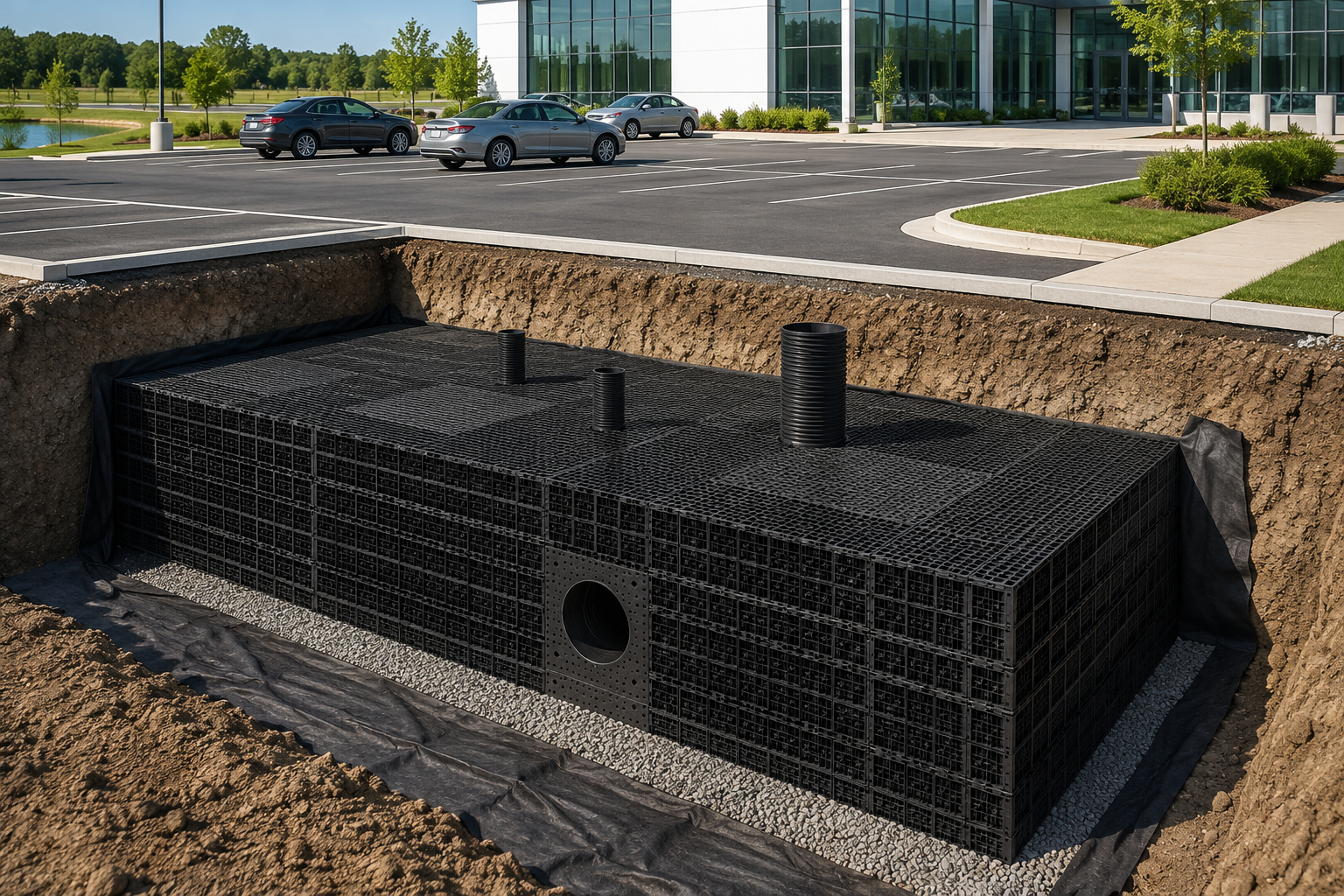
Stormwater Detention Tank Engineering Plan
HYDRAULIC_MODEL VALIDATED
FOOTPRINT_GRID 1000 x 500 MM

Underground Detention System Types Compared — Installed Cost per Cubic Foot and per Cubic Metre

Four underground storage systems compete for the same buried cubic metre. Vendors file them under stormwater management solutions; earthwork contractors file them under holes. They are not priced on the same basis, which is why bid comparisons go wrong. Below, storage volume is held constant at 1,000 cubic metres (35,315 cubic feet), and each column reports the physical quantities that system demands. Every figure is arithmetic on a published void ratio, so you can rebuild it in a spreadsheet.

Quantity per 1,000 cu m (35,315 cu ft) stored Gravel trench Arch chamber + stone Precast concrete vault StormTank geocellular
Void ratio of the storage zone 35–40% 40–55% 90–95% 95%
Storage-zone envelope required 2,500–2,857 cu m 1,818–2,500 cu m 1,053–1,111 cu m 1,053 cu m
Envelope in cubic yards (for excavation pricing) 3,270–3,737 cu yd 2,378–3,270 cu yd 1,377–1,453 cu yd 1,377 cu yd
Solid aggregate to purchase and place 1,500–1,857 cu m 818–1,500 cu m bedding only bedding + perimeter only
Delivered volume per 40’HQ container n/a — local haul chambers nest 1 unit per truck 341 cu m assembled
Structural design reference geotechnical AASHTO H-20 / HS-25 precast standards CIRIA C737 (2016)
Read the second row again. Gravel trench and geocellular tank buy identical storage, and the trench asks you to move roughly 1,450 more cubic metres of ground — about 1,900 cubic yards — to do it. Then it asks you to buy stone to put back in the hole. Neither of those costs appear on a material quotation, and both of them appear on a change order.

Building your own landed-cost stack

Line item How to price it Where the number comes from
Excavation, haul, disposal Envelope (cu yd, from the table above) times your local rate per cubic yard Your earthwork bid. EPA identifies this as the dominant cost factor.
Dewatering Only if the seasonal high water table sits above the invert — check the borings, not the plan Geotechnical report
Bedding and backfill stone Aggregate row above, times delivered price per tonne, divided by bulk density Local quarry quote
Geotextile or geomembrane Wrap area (plan + sides), times unit rate. Non-woven at 300 g/m2, or HDPE liner at 1.0–1.5 mm Storm Manage accessory list
Modules and fittings Module count from the sizing method, plus side plates, top covers, clips, pipe connecting box, inspection well base Storm Manage quotation
Ocean freight and duty Container count from the loading table, times your forwarder’s rate, plus tariff on the HS code Your forwarder
Installation labour Assembly and placement crew days. Modules are hand-portable; placement is machine-assisted. Your installer
Geotechnical borings Do them before the earthwork contractor prices the job, not after Your geotechnical consultant

The last row is where projects come undone. Assume ordinary soils, and then encounter rock or perched water or contaminated fill-every line item above renegotiated at a point of extreme disadvantage. That stack tells you which line item changes, when it does: excavation, scaled by whatever volume-enclosure envelope your selected system requires.

Silver — TCO advantage, not an ROI percentage

What a 95 percent void ratio buys you, stated in quantities

We do not publish an ROI percentage for this product, because we do not hold your site’s cost ledger and inventing one would be dishonest. What we can state, from our own specification and from arithmetic you can verify:

  • Per 1,000 cubic metres stored, the storage-zone envelope is 1,053 cubic metres, against 2,500–2,857 for a gravel trench.
  • Aggregate purchase falls from 1,500–1,857 cubic metres of stone to bedding and perimeter only.
  • One 40’HQ container delivers 341 cubic metres of assembled tank envelope, which is about 324 cubic metres of stored water at 95 percent void.
  • Production lead time is 15 to 30 days after order confirmation, against a monthly output of 5,000 cubic metres of finished modules.

Multiply those quantities by your rates. That is the whole argument, and it does not require you to trust a number we made up. Those same modules are configured as an on-site detention tank for Australian and New Zealand OSD requirements without any change to this arithmetic.

Resource Verification
StormTank geocellular module showing 95 percent void capacity calculation

Multiply those quantities by your local earthwork rates. That is the whole argument, and it does not require you to trust a number we made up.

Choose Your Load Class: StormTank ST-20 to ST-60 + Custom

Every drainage engineer facing a polypropylene tank for the first time asks the same question: will it hold a truck. Field evidence answers a different question than the one being asked. Engineers on installation forums report that the most common deficiency on buried detention systems is inadequate compaction of the fill placed around the system after it is set in the excavation – uneven settlement then loads the structure unevenly, and for modular geocellular systems that can deform or partially fail a module. Those same practitioners note that ground settlement is typically caused by inadequate backfill compaction rather than by crate failure.

That reframes the specification task. Selecting a load class is necessary and it is not sufficient. Load class governs what the module can carry; the bedding and backfill specification governs what the module is actually asked to carry.

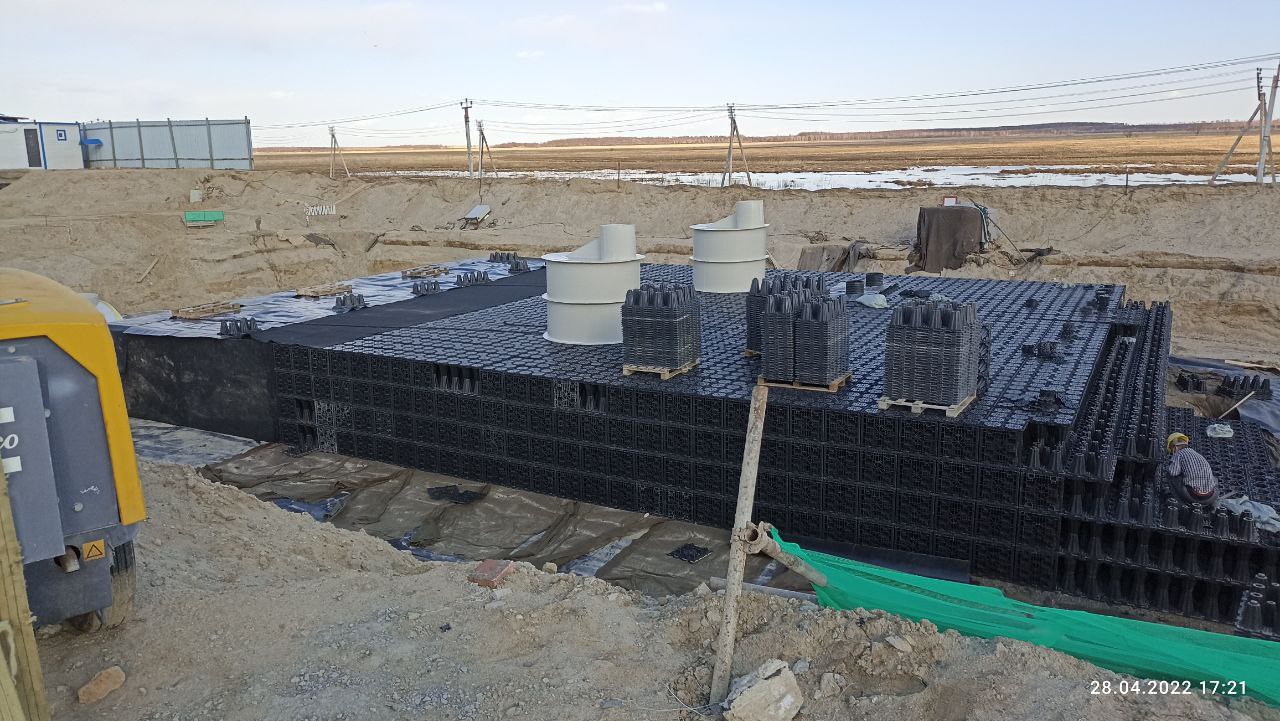
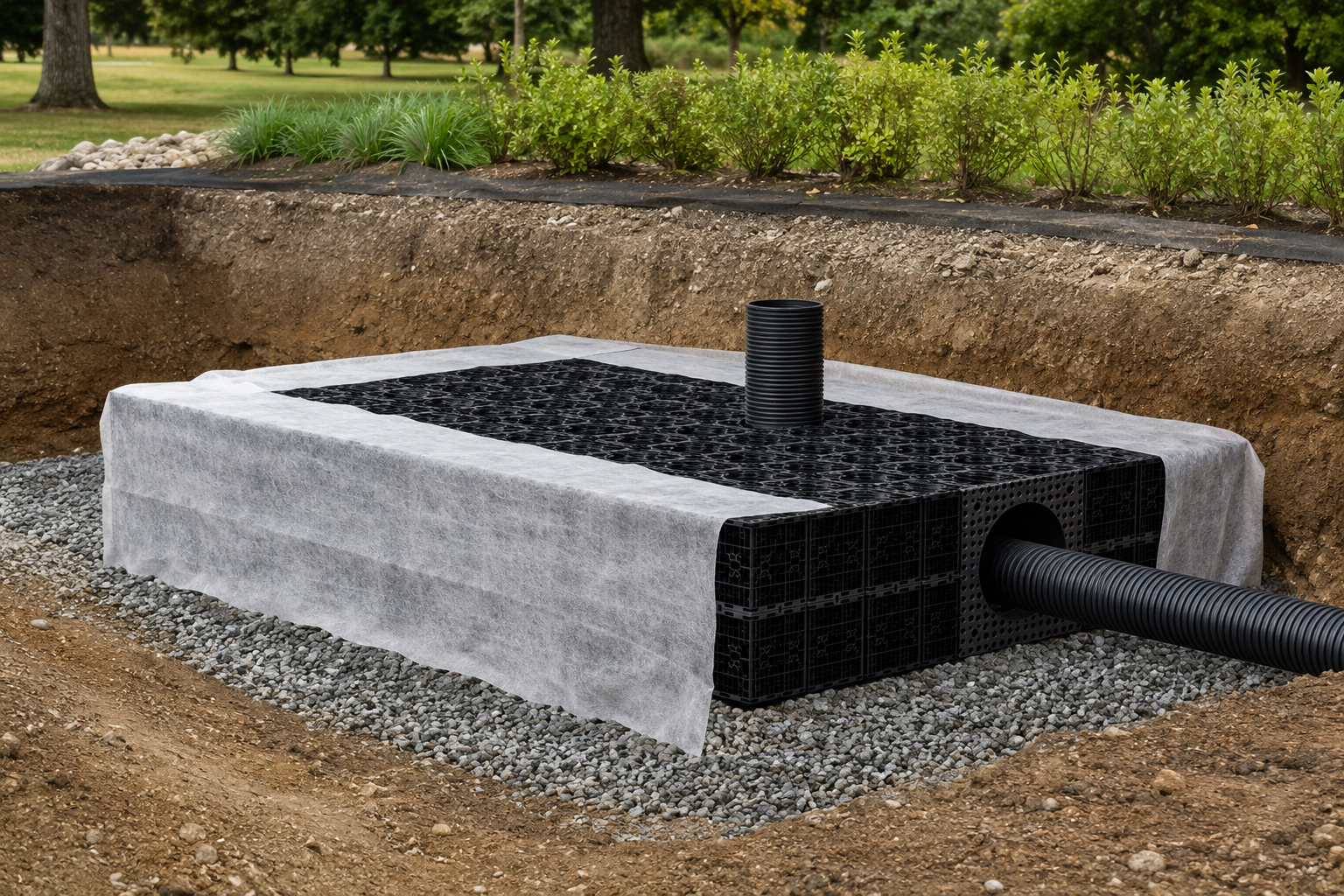
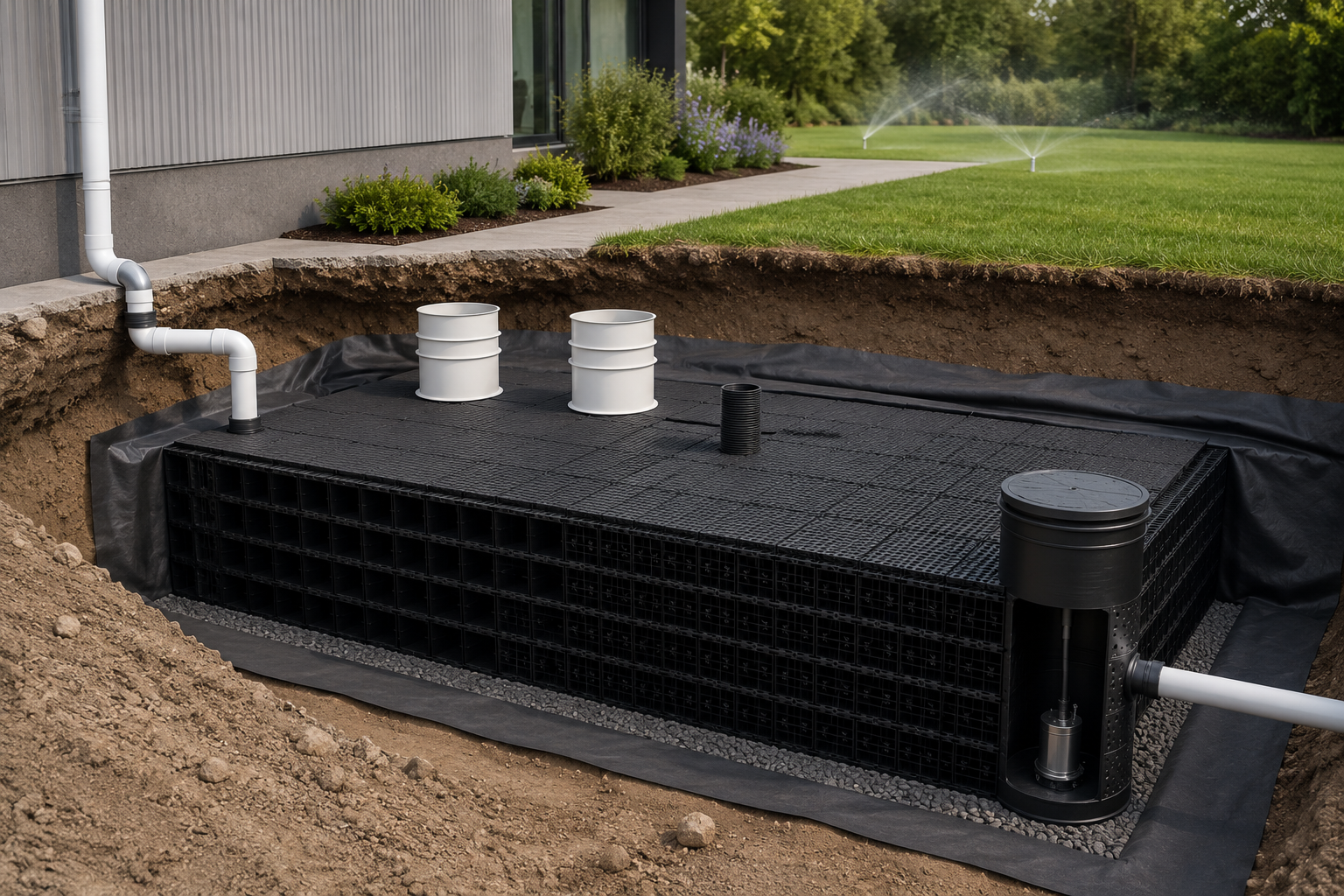
Stormwater Detention Tank Geocellular Installation Scene

Decision matrix: site condition to configuration

Site condition above the tank Load class Nominal load Material Height Wrap
Landscape, garden, non-trafficked green space StormTank ST-20 20 t/m2 · 200 kN/m2 Recycled PP H400 / H500 Geotextile
Footpaths, planted verges, low-load public space StormTank ST-30 30 t/m2 · 300 kN/m2 Recycled PP H400 / H500 Geotextile
Commercial sites, light parking, school and campus grounds StormTank ST-40 40 t/m2 · 400 kN/m2 Recycled PP H400 / H500 Either
Parking lots, factory yards, municipal drainage projects StormTank ST-45 45 t/m2 · 450 kN/m2; SGS failure at 468.5 kN/m2 Recycled PP H400 / H500 Either
Heavy parking, industrial yards, road margins StormTank ST-60 60 t/m2 · >=600 kN/m2 (rig limit, no break) 100% Virgin PP H400 / H500 Either
Airports, ports, special municipal loading Custom Project-specific By design Custom By design

Two selection rules cut through this quickly. Where the site is unclear, StormTank ST-40 is the ordinary commercial starting point, StormTank ST-45 is the first traffic-oriented grade with SGS failure evidence above its 45 t/m2 nameplate rating, and StormTank ST-60 is the 100% virgin PP heavy-duty grade verified at Intertek to the 300 kN rig limit without breaking. H400 and H500 are height configurations, not model names.

“We publish nominal load class, model identity and laboratory result separately on purpose. The SGS 468.5 kN/m2 number belongs to ST-45. The ST-60 value is not a failure number; it reached the Intertek 300 kN rig limit without breaking. Do not compare those as if they are the same test on the same moulding.”
— Storm Manage Engineering Team, product specification review

Module and system specification

H400 Stormwater Detention Module
Structural Specifications
  • Module envelope1000 x 500 x 400 mm
  • Imperial dimensions39.37 x 19.69 x 15.75 in
  • Storage volume190 L · 0.190 cu m
    6.71 cu ft · 50.2 US gal
  • Void ratio95%
  • Best applied whereShallow cover, restricted invert depth, minimal excavation
  • Design life50 years
  • Service temp-30 to 120 °C
H500 Stormwater Detention Module
Structural Specifications
  • Module envelope1000 x 500 x 500 mm
  • Imperial dimensions39.37 x 19.69 x 19.69 in
  • Storage volume237.5 L · 0.2375 cu m
    8.39 cu ft · 62.7 US gal
  • Void ratio95%
  • Best applied whereHigher storage density, constrained plan area
  • Design life50 years
  • Service temp-30 to 120 °C

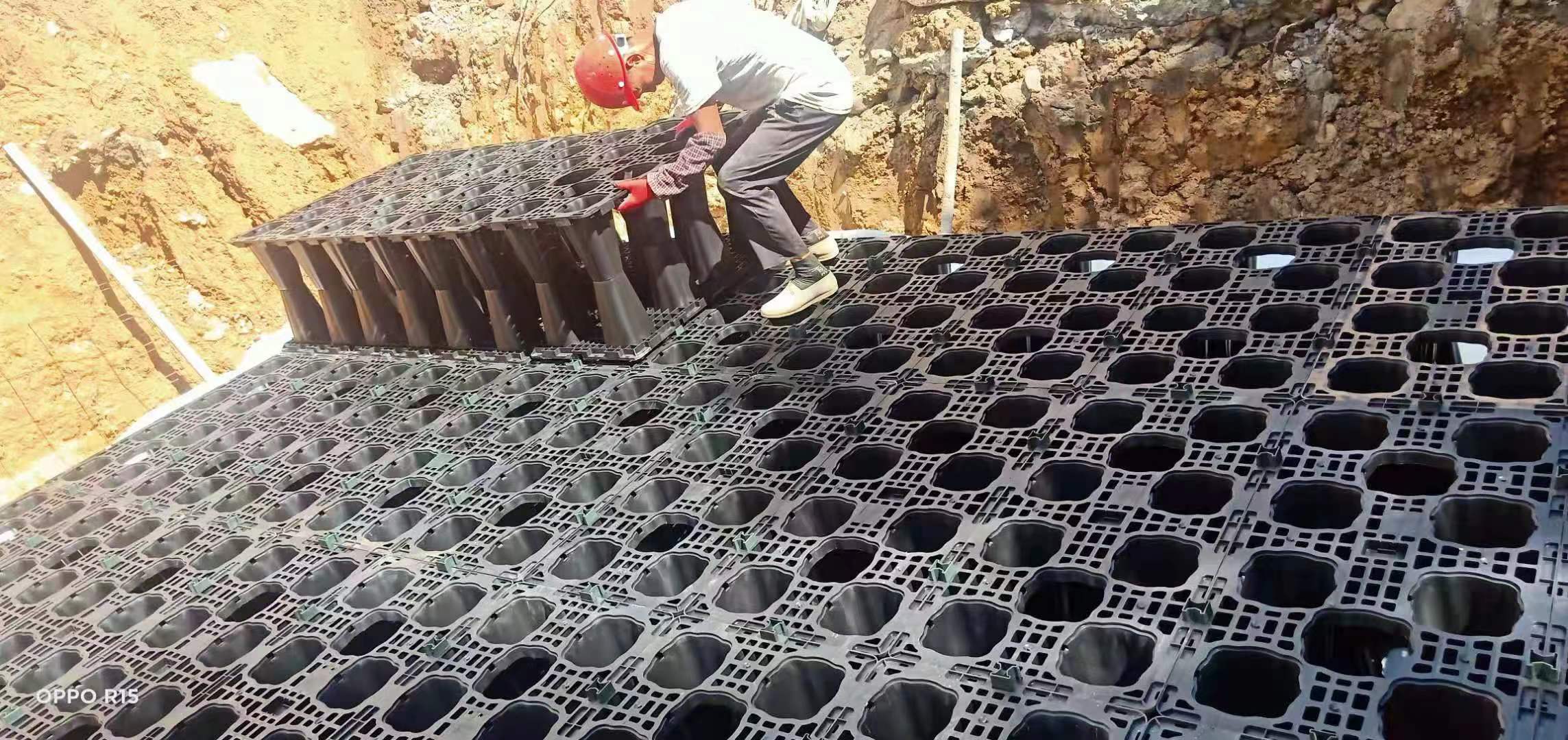
One tank cell assembles from two moulded modules at 4.8 kg each, six side plates at 1.03 kg, ten top covers, and clips that lock layer to layer. Nothing on that list needs a crane. Its structural principle — load-bearing columns between perforated planar members, closed at the perimeter by side plates — is documented in the public patent literature for geocellular water storage, including US7341400B2 for synthetic geocellular water disposal structures. Our full geocellular stormwater tank product page carries the accessory schedule and exploded assembly drawings.

Not sure which grade your cover depth allows?

Download the load class selection chart

Pretreatment, Sediment and Maintenance Access

An underground detention system stores water. It does not clean it. Federal Highway Administration guidance is direct about this: underground detention structures control runoff quantity effectively, but they do not provide significant water quality treatment. Everything that washes off the parking lot upstream — sediment, grit, trash, hydrocarbons — arrives at your tank and settles in it.

Technical Requirements & Maintenance

That is why pretreatment is not an accessory. State manuals require it. Pretreatment structures catch trash, sediment, and other pollutants before runoff can enter the storage zone, and can range from sumped and trapped inlets, sediment or grit chambers, separators, media filters, and inlet inserts. When a underground detention is installed in series with an off-line water quality practice, a separate sediment sump or vault chamber is used at the inlet, sized based on the impervious drainage area contributing to the treatment practice. Manuals suggest other sizing metrics – based on depth of runoff over impervious area, or as a fraction of water quality volume, so use the value from your reviewer’s manual, not necessarily a vendor’s specification sheet (including this one).

The corollary is maintenance. Both subsurface pretreatment and storage elements need regular clean-out of sediment and debris, as well as clogging prevention at the outlet controls-the orifice is the smallest opening in the entire system and is what protects your permit. sediment is vacuumed or flushed. Clogged orifices don’t simply break quietly, they unmetered discharges flow downstream and drive erosion. Pretreatment structures are inspected annually and, when sediment buildup encroaches on the available storage, it must be removed.

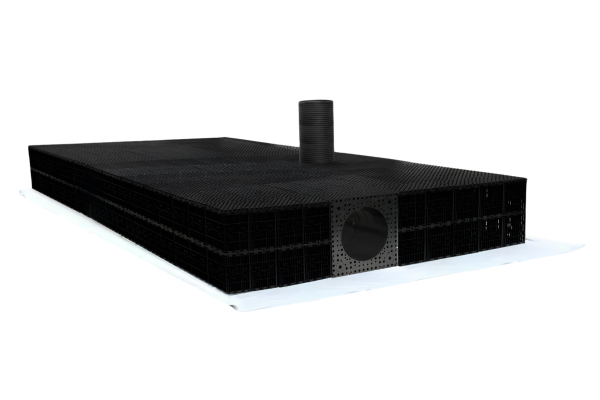
How the wrap decides what the tank is

That is how three different types of structures come out of the same StormTank module – because you wrap the structure differently, giving five product names.

  • Soakaway Infiltration Geotextile Wrap
    01

    Soakaway / Infiltration

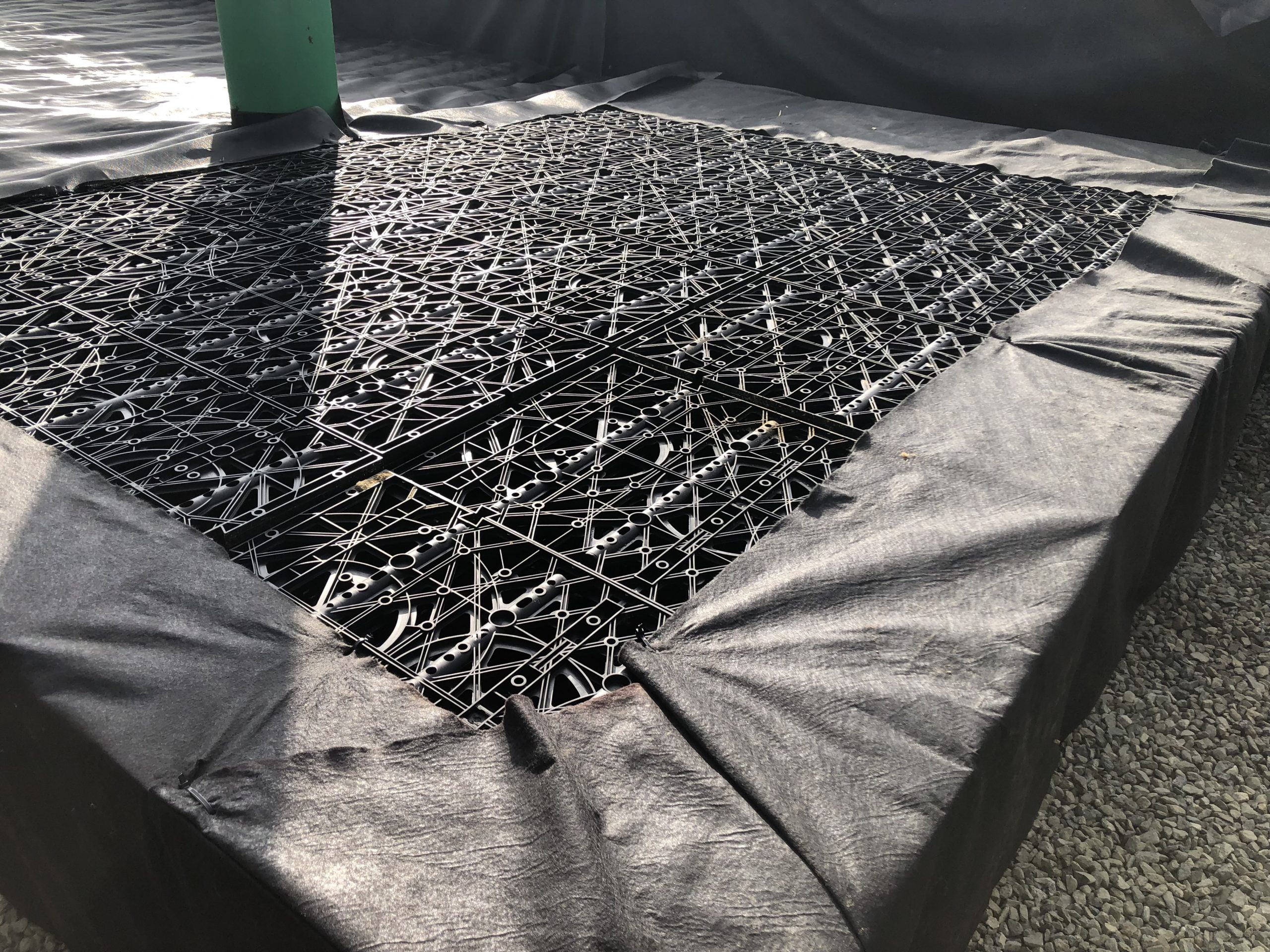
    Wrap in non-woven geotextile, 300 g/m2 or 6–8 oz per square yard. Water passes out through the fabric into the surrounding soil, and on toward groundwater. This is the build-up used for soakaway and infiltration systems, and the fabric’s job is filtration and separation, not containment.

  • Detention Attenuation Geomembrane Liner
    02

    Detention / Attenuation

    Line with HDPE or LLDPE geomembrane, 1.0 to 1.5 mm (60 mil). Water leaves only through the outlet you designed. This is a detention, attenuation, or on-site detention tank, and it is what a permit written against a release rate requires.

  • Rainwater Harvest Sealed System
    03

    Rainwater Harvest

    Seal, line and plumb for a pump. The same tank is used as a rainwater harvest system for irrigation, flush and washdown water storage.

Access hardware is specified at the same time. A pipe connecting box — 500 by 500 by 400 mm for DN200 and DN300, or 1000 by 500 by 1200 mm for DN600 and DN700 — brings the inlet and outlet into the tank body and distributes flow. An inspection well base with a DN800 adjustable riser, typically over a 2000 by 2000 by 1200 mm opening, gives the vacuum truck its route in. Retrofitting either one costs an excavation.

Project Evidence: Cold-Climate, Industrial and Desert Installations

Five built projects, described only as far as our customers have authorised. Where we do not hold order or shipping documents confirming a capacity, we do not print a number.

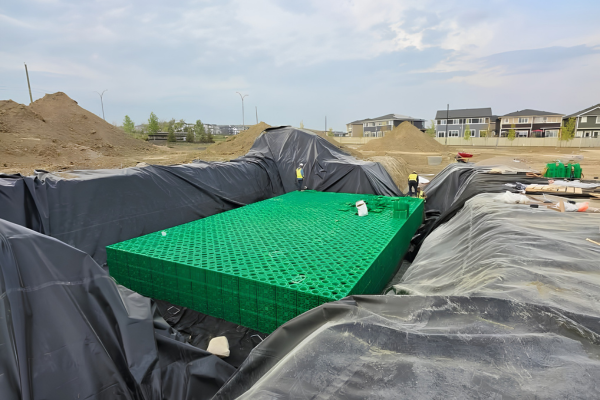
Calgary Community Underground Storm Retention Tank Installation

Calgary, Alberta, Canada

Community development, underground storm retention tank

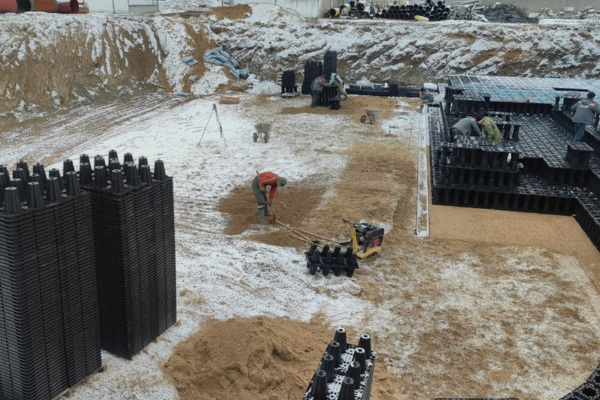
A residential community development in Alberta needed detention volume without giving up surface area to a stormwater retention pond. High-void modules were assembled inside a lined excavation to form a subsurface tank beneath community roads and open space. Modules were lowered in batches with excavator assistance and adjusted by hand — the reason a two-person crew can keep pace with a machine on this product is that no single component weighs more than five kilograms. Runoff from roads and paved parcels enters the tank, is held, and is then infiltrated or released at the permitted rate. Read how the Calgary team staged the installation across the parcel.

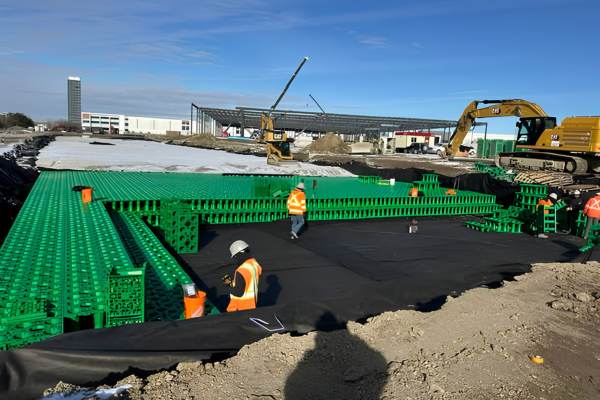
Brampton Ontario Large Road Attenuation Installation

Brampton, Ontario, Canada

Large road and development site attenuation

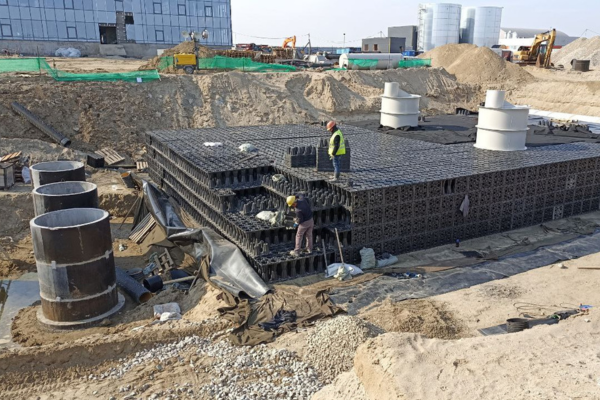
A high-growth corridor in southern Ontario, where roofs, car parks and paved surfaces had lifted peak runoff beyond what the municipal network could take. Modules were laid in zones across a large lined excavation, with crews working directly on the module deck to connect the next bay. Publicly available project information indicates works of this class reach hundred-metre lengths and thousands of cubic metres of storage; we do not publish a figure for this site because we cannot document it. What transfers is the construction logic: standardised module dimensions let the tank be set out from a drawing, and zone-by-zone assembly suits a compressed programme in a cold-climate build season.

Northern Europe Site Infiltration Facility Lightweight Modules

Northern Europe

Site infiltration facility, lightweight modules

A cold-region industrial or public utility site, several hundred cubic metres of underground infiltration space serving paved areas, parking zones and internal roads. This project did not use our heavy-duty grade. It used an economical lightweight module suited to green areas, site edges and zones that never see sustained heavy vehicle traffic — a reminder that specifying ST-60 across an entire site is a way to overpay. Load class should follow the traffic map, not the site boundary.

Russian Far East Composite Collection and Discharge Buffering

Russian Far East

Industrial facility, composite collection and discharge buffering

An oil-processing or large industrial facility near Vladivostok. This installation is neither a textbook infiltration system nor a conventional attenuation-only tank. Site crews excavated a trench beneath the modules, laid gravel, and installed drainage pipe, so runoff enters the module void space, passes through a lower gravel layer, and leaves through pipework in an organised way. Snowmelt and rainfall arrive in concentrated periods at that latitude, and a paved industrial yard has nowhere to put them. We describe it as a composite collection, filtration and discharge-buffering structure, because that is what the site photographs show.

South Al-Mutlaa Desert Residential Stormwater Tank

South Al-Mutlaa, Kuwait

Residential development, geocellular stormwater tank

A desert residential scheme, at the opposite end of the thermal range from the Ontario and Nordic work. Service range of the polypropylene module — minus 30 to 120 degrees Celsius — is the specification line that makes one product family viable across both, and it is the line worth checking against your own ground temperatures before you specify any buried plastic.

Test Reports and Compliance: What We Publish

Public report assets and project-request summaries sit behind this product. We name the laboratory, report context and year, because a certificate without those three is a graphic. The previous geotextile certificate reference has been withdrawn because it is not the correct drainage-geotextile evidence.

Batch Quality Control
Compression verification, dimensional tolerance, virgin/recycled PP ratio, per-unit weight In-house, every batch

A disclosure about the standard on our test report

Our 2024 Intertek vertical load test was executed against CIRIA C680, Structural design of modular geocellular drainage tanks (2008). CIRIA superseded C680 in 2016 with C737, Structural and geotechnical design of modular geocellular drainage systems, and our long-term creep reporting follows CIRIA C680 Clause 3.9 together with CIRIA C737-2016.

We are telling you this rather than letting you find it. Our structural design now references C737.

That 2024 short-term test data remains valid as a record of measured vertical load performance under the protocol it was run against. The 2020 Intertek creep report adds the sustained-load record for StormTank ST-60: 480 kN/m2 held for 200 days with 4.92 mm displacement on a 400 mm sample.

How to read a load rating

AASHTO H-20 and HS-20 are different truck configurations that share a 32,000 pound design axle; HS-20 adds a trailing axle that H-20 does not carry. HS-25 scales the HS-20 design truck by a factor of 1.25 — twenty-five percent above it — and is commonly read against the HL-93 loading used in current AASHTO practice.

Neither is a property of a module. Both are properties of a system — module, bedding, backfill, compaction, cover depth, and the access covers that sit in the traffic surface. A laboratory compression figure on a single module is a necessary input to that assessment and it is not the assessment. Minimum cover in trafficked areas is set by the same standards, and for buried structures in this size range it starts at 300 mm and rises with span.

Which is why our specification sheet gives nominal load class, model identity, material grade, short-term compression data and sustained-load creep data, and then stops. Final structural design and approval by the authority having jurisdiction remain project-specific engineering decisions, and they are not ours to make. For geotextile, the U.S. page uses AASHTO M288 context and TRI ASTM D4632 grab tensile evidence.

StormTank structural and geotechnical design compliance reference

Procurement: Pricing Basis, Container Loading, Lead Time and Submittal Support

This is the part of the transaction which no competitor page touches and the part which will determine if an overseas supplier can be used on a dated construction programme.

What drives your quotation

We quote against project parameters rather than a price list, because the same 1,000 cubic metres of storage carries different cost depending on six things: load class (recycled polypropylene below 50 t/m2, virgin above it), module height, total volume and the container efficiency it achieves, wrap specification (geotextile against geomembrane), accessory schedule (pipe connecting boxes, inspection well bases, clips), and port of loading. Send us those six and you get a number. Contact Storm Manage for a project quotation with your volume, load requirement, invert depth and pipe diameters.

Container loading, derived rather than asserted

We get so many people throwing out container volumes, but they do not specify exactly what they have measured. Below is ours, with the mathematics disclosed.

Geocellular Stormwater Module Container Loading Logistics
0.125 m³ Envelope = 95% Void

A single moulded module occupies 1000 by 500 by 250 mm of assembled envelope. Two of them build one H500 cell — 0.25 cubic metres holding 237.5 litres of water. Arrived at by division, not assertion.

40’HC Pallet = 186 Modules

Carries 23.25 cubic metres of assembled envelope (186 × 0.125). Run the same check on the 400 mm series — 168 modules at 0.1 cubic metres each — achieving exactly 16.8 cubic metres.

40’HQ Container = 341 m³ Envelope

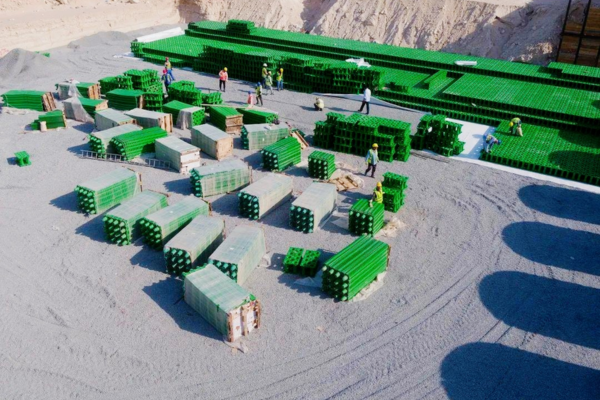
Loaded to option 1, plus two wood cases of fittings. Modules ship flat and nest; the envelope figure is what they build into, not what they occupy in the hold.

Freight Vol. vs Envelope vs Stored Water

At 95 percent void, 341 cubic metres of envelope is about 324 cubic metres of stored water from a single container. A 20′ container carries 132.5 cubic metres of envelope. That difference is a critical economic consideration compared to pre-cast concrete.

Lead time and capacity

Standard production lead time is 15 to 30 days after order confirmation. Our supporting injection-moulding base runs eight high-tonnage machines from 1000 to 2000 tonnes across an 8,000 square metre footprint, producing about 5,000 cubic metres of finished modules monthly and above 60,000 cubic metres annually.

FOB Shenzhen, Yantian or Shekou is preferred; Qingdao and Ningbo can be arranged against project requirements. Batch quality checks cover compression performance, dimensional tolerance, virgin and recycled polypropylene ratio, and per-unit weight consistency.

Submittal and support package

Named practising engineers advising commercial developers list jurisdictional support alongside long-term maintenance as the two challenges that decide an underground detention project, and they are explicit that jurisdictional support “is very important at the start of a project.” An overseas manufacturer that ignores that reality is selling you a schedule risk.

So here is the boundary, drawn honestly.

We provide We do not provide
Product datasheets, dimensional drawings, and assembly details for your submittal A stamped design for your jurisdiction. Final structural design is your engineer’s.
Five third-party test reports, unedited, with laboratory references A statement that our modules are approved by your authority having jurisdiction
Module layout, layer count and footprint against a storage volume you supply Your required detention volume — that is AHJ hydrology, not manufacturer data
Container loading plans, packing lists and FOB port coordination Customs duty and tariff liability on your HS code
OEM and ODM: mould development, project-specific load class, logo, colour, packaging Regulatory compliance responsibility for the completed works

Engineering Tools & Calculators

Frequently Asked Questions

How much does underground stormwater detention cost?

Not as a single number, and anyone who gives you one has not seen your borings. Your controlling variable is the storage-zone envelope you must excavate, which is your required volume divided by the system’s void ratio, priced at your local earthwork rate. For reference at the other end of the scale, EPA cost data for surface retention and detention basins puts them at $0.50 to $1.00 per cubic foot of storage in 1999 dollars, excluding land. Underground carries a capital premium over that; the return comes from the land you keep.

How do I calculate the detention volume my site requires?

From your jurisdiction’s hydrology method, not from us. Design storm, return period, permitted release rate and routing procedure are set by the manual your reviewer uses. Once you have that volume, divide it by 0.190 cubic metres for H400 modules or 0.2375 for H500 to get module count.

What information do you need to size a tank for my site?

Required storage volume, the traffic loading above the tank, available invert depth, plan area constraints, inlet and outlet pipe diameters, and whether the system infiltrates or discharges at a controlled rate. Six inputs, and we return a module layout.

Why does void ratio matter so much for detention system cost?

Because storage lives in the void, and excavation is priced by total volume moved. At 35 percent void you excavate roughly 2.9 cubic metres of ground per cubic metre of water banked. At 95 percent you excavate 1.05. EPA identifies excavation and earthwork as one of the biggest cost factors in this class of stormwater control, which is why the void ratio ends up on the invoice.

Can underground detention be installed under parking lots and roads?

Routinely, at the correct load class and cover depth. StormTank ST-45 is the traffic-oriented recycled PP grade with SGS failure evidence above its 45 t/m2 rating; StormTank ST-60 in virgin polypropylene is the heavy-duty grade verified by Intertek to >=600 kN/m2 at the rig limit without breaking. Load rating belongs to the installed system rather than to the module, so bedding, backfill compaction, cover depth and traffic-rated access covers all form part of it — and the engineer of record, not the manufacturer, signs that off.

Can the modules support AASHTO H-20 or HS-25 loading?

Our module contributes measured compression performance to that assessment; it does not settle it alone. HS-20 is built on a 32,000 pound design axle, and HS-25 scales that design truck by a factor of 1.25. Whether an installed tank satisfies either depends on cover depth, bedding, backfill compaction, safety factors, access covers, and the judgement of your engineer of record against local requirements. We supply tested module data and drawings as inputs to that assessment. We do not supply the assessment.

What maintenance does an underground detention system require?

Regular inspection (at least annually) and the regular cleaning out of any sediment and debris that might accumulate within either your pre-treatment chamber or the storage area itself, or clog the outlet. Clean-out typically involves the removal of sediment using a vacuum, or through the designated inspection well, or by flush out of the storage tank through the inspection well.

What is the difference between a stormwater detention tank and a retention tank?

A detention tank holds runoff temporarily and releases it through a restricted outlet, cutting the peak. A retention system keeps water on site, by infiltration or for reuse. Same modules; the wrap and the outlet decide which one you have built.

Are underground detention systems accepted by municipalities?

Subsurface detention appears as a recognised practice in municipal and state design manuals, including Philadelphia Water’s development manual and the Connecticut stormwater quality manual. Acceptance of a specific product for a specific site is your reviewer’s decision, and we do not represent otherwise.

Do you supply residential stormwater detention systems and on-site detention tanks?

Those same StormTank modules serve a residential stormwater detention system, an onsite detention tank for Australian and New Zealand OSD practice, a soakaway crate, an attenuation tank and a rainwater harvesting tank. One product family, five market names, differing only in load class, height configuration, wrap and outlet.