Sports, Landscape & Podium Deck Drainage Crates

Sports Field Drainage Crates, Underground Storage for Pitches, Greens & Landscape

The sports field drainage directs surface water off the playing surface – it doesn’t store it. StormGrid geocellular crates are the storage layer downstream, sized to the discharge rate your scheme is consented to, and buried below the rootzone where a basin or swale can never go.

Request a Project Quote
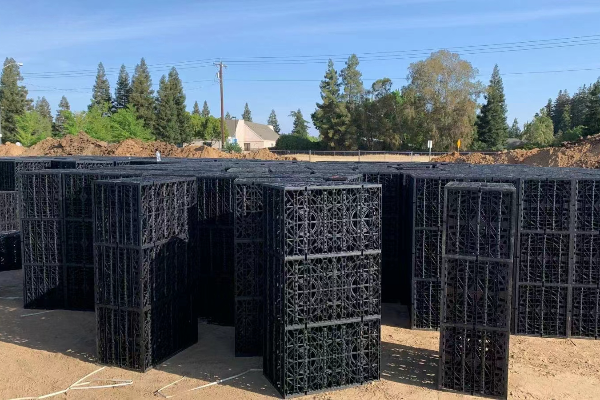
StormGrid geocellular crates for sports field, landscape, and podium deck drainage applications
95% Void ratio (bare module)
237.5 L Storage per H500 crate
190 L Storage per H400 crate
20–60 t/m² Nominal grade range
~170 kN/m² Material-factor value not a design-allowable
50 yr Design life

Pitch Drainage Moves Water. It Doesn’t Store It.

The Two-Layer Rule

Water leaves the surface through the collection layer – lateral pipe drains, slit drains, a sand-based rootzone. It does the job of a playable pitch.

Water is held in the storage layer – geocellular crates, 0.5 to 1.5 m below. It does the job of releasing water at the rate you’re consented to.

Confusing the two is the mistake that cost most on a sports scheme, because a deeper drainage network buys you not one cubic metre of attenuation storage. Storm Manage engineer only the storage layer – the collection layer stays your agronomist’s decision.

That 9.8 l/s number reframes the entire task. Pipe drains and slit drains aren’t wrestling a flood; they’re handing a low, slow trickle over to whatever follows. Unfortunately, in planning terms (if not by any of the lines in the national standards) authorities treat a pitch’s runoff as if the surface were impermeable and add another attenuation capacity.

A monitored natural-turf pitch is already a sponge. Across seven rainfall events on English pitches, field measurements recorded average rainfall attenuation above 90% – worst case 64% – with a peak discharge of just 9.8 litres per second, roughly 5 l/s per hectare. (Fleming, International Turfgrass Society Research Journal, 2017)
Sports Landscape Podium Subsurface Drainage System
Poor drainage, compaction, and what the collection layer actually fixes

The proper drainage of athletic fields involves two systems, two separate tasks. poor drainage on a natural turf pitch is frequently a compaction, rather than a pipe issue, since traffic closes the pores the rootzone need to work, and adding more trench won’t reopen them.

  • surface drainage – falls, slit drains and a sand-heavy rootzone move water off football fields fast enough to keep it playable.
  • Subsurface storage -crates retain the volume delivered by surface drainage and meter it out.
  • synthetic turf – A permeable carpet and shockpad drain, but still regarded by planners as an impermeable surface, so the attenuation obligation remains.

compaction and silt both subtly eat the space you’ve paid for, the first in the rootzone above, the second in the tank below.

Storage is conditional, not automatic

Surface water drainage on new developments in England follows a hierarchy for where the runoff eventually go – for non-potable reuse, then infiltration to ground, then surface water body, then surface water sewer, then combined sewer system. (GOV.UK, National standards for SuDS, 2025)

Peak discharge is limited to the greenfield runoff rate, or 3l/s/ha – whichever is the greater. Get this order wrong and a scheme look compliant but still floods your neighbour.

SPEC-01 Free-draining, permeable subgrade? If infiltration might carry the site, a wrapped soakaway crate might be a way to build.

SPEC-02 Clay, contamination or a high water table? Infiltration is out. You need sealed, lined attenuation storage with a controlled outfall.

Whichever it is, the storage is just one link in a much wider water management chain – it is sized to hold excess rainwater long enough to avoid flooding downstream, not long enough to make it disappear.

Drainage contractors put it more bluntly than we would. Clay, as one described it, “holds water like a ceramic bowl so it doesn’t percolate” — bury an unlined void in it and you’ve built a bathtub. That’s a specification failure, not a product failure.

Why a pitch is not a car park

For many sites an approving authority would prefer to see a visible multi-functional SuDS features, such as a basin, swale or wetland. A basin or swale doesn’t work under a sports pitch where the surface need to stay flat, level, and playable, drained in use – hence subsurface modular storage.

The trade-off with buried storage, in comparison to an above-ground basin or swale, is its single purpose, but it does maintain a level playable pitch. In practice a module of 400mm or 500mm height is installed below the rootzone, not within it. We aren’t claiming that crates outperform all other SuDS features, we’re claiming that they’re the ones which fit under the pitch.

StormGrid Crates for Pitches, Greens and Landscape: Grade, Height and What Sits Above Them

With two module heights and four load grades, the range cover almost all sports pitches and landscape schemes and any type of load. All SG-E20, SG-L30 and SG-M40 grades are manufactured in recycled polypropylene. SG-H60 modules are manufactured from 100% virgin polypropylene.

Decision matrix. Grade names are nominal class labels, not long-term working loads — see the derating in the certification section. Cover depth must be confirmed against the project’s structural calculation, not read off this table.

Grade Material Nominal Label Typical Surface Above Best-Fit Application
SG-E20 Recycled PP 20 t/m² Landscape, pedestrian Parks, planted landscape, golf rough
SG-L30 Recycled PP 30 t/m² Grassed pitch, light traffic Football and rugby pitch, fairway, green surrounds
SG-M40 Recycled PP 40 t/m² Cars, vans, service routes Stadium car park, access road, hardstanding
SG-H60 100% Virgin PP 60 t/m² Heavy trafficked areas Service yards, plant access, deep installations

Height selection should run bottom-up. Find the invert level of the outgoing discharge pipe, add bedding depth, then see how much space remains below the root zone and above the water table.

StormGrid H400 Module Geometry Dimensions and Storage
StormGrid H400
DIMENSIONS1000 × 500 × 400 mm
STORAGE190 L
FOOTPRINT0.5 m²
VOL / M²0.380 m³

Module geometry. Storage volumes are manufactured net figures, not box volumes.

StormGrid H500 Module Geometry Dimensions and Storage
StormGrid H500
DIMENSIONS1000 × 500 × 500 mm
STORAGE237.5 L
FOOTPRINT0.5 m²
VOL / M²0.475 m³

Where available depth is tight, using two H400 layers may provide more capacity than a single H500 plus additional digging because you reduce the height in increments of 400mm, not 500mm. The modules themselves are inexpensive but excavation isn’t.

Pretreatment, inspection and the silt problem

Attenuation and infiltration builds begin from the same module, and both fail the same way: silt. A basic silt trap is of some help, but under high flow it can wash out and take trapped debris with it into the tank. An efficient hydrodynamic vortex separator on the other hand, won’t re-mix anything that it has taken out of the system.

UPSTREAM

The catchpit or vortex separator should be before the tank inlet, and sized appropriately for the catchment.

IN TANK

Impermeable geotextile wrapper on infiltration builds, impermeable welded membrane on attenuation builds.

ABOVE

Ground-level access for inspection. It’s standard industry practice that an inspectable system will also be inspectable from ground-level access.

Connections, cover and dimensions in millimetres

  • Module heights 400mm and 500mm, on a 1000mm x 500mm footprint. Modules are stackable and nest for shipping.
  • Laterals are provided for inlets and outlets in 110mm and 160mm, and the typical main carrier for the pitch is 150mm, or 225mm twinwall on larger catchments.
  • A 450mm inspection chamber keeps the buried system inspectable from the surface, with no excavation and no confined-space entry.
  • Assumptions used for the calculations on this page are for a cover layer of 600mm over the modules, bedded on 150mm.
  • Downstream of the buried tank there’s a flow control chamber containing the orifice or vortex flow device which restricts the outflow rate.

A geotextile alone is not a sediment strategy, and customers know this – their main expressed anxiety is “the very finest of particles will still come out”. Base the tank’s design on BS EN 17152-1:2019 (product standard for stormwater boxes) and on CIRIA C737 (structural and geotechnical design). Ask any supplier – us included – which of these two standards we used to calculate our reported numbers.

Wrapping decides which product this crate becomes: geotextile for a soakaway that infiltrates, welded impermeable membrane for an attenuation crate that stores and releases.

How Much You Store per Cubic Metre Dug, Crates vs Stone-Embedded Chambers, Honestly

Stormwater attenuation crates are generally sold off of a comparison that wouldn’t last five seconds under a set of engineer’s eyeballs: 95 percent void in the crate compared with about 40 percent in the arch chamber. That 40 percent isn't a system void ratio of the chamber, but is the supposed porosity of the crushed rock filled in around the chamber; therefore to compare it with an bare plastic module is an apples to oranges mistake.

Same claim, on bases that actually match

As a form of stormwater storage, geocellular modules are recorded at void ratios up to 96% by the UK SuDS community of practice.(susdrain) Drainage aggregate, meanwhile, is required to hold a minimum of only 30% void space under a 300 psf compressive load, a figure written into US patent literature.(US 6,467,996 B1)

Like-for-like comparison. Chamber figures are as published by Advanced Drainage Systems for its StormTech MC-3500 range, quoted as an attributed competitor benchmark rather than as independent authority. StormGrid figures are calculated by Storm Manage engineers from the module geometry above, against the 50 years of design life the module is built to.

Engineering Schematic for Sports, Landscape and Podium Systems
Basis of comparison StormGrid H500 crate Stone-embedded arch chamber
Bare unit / storage-zone void 95% (module) Chamber void plus stone at ~30–40% porosity
Storage per m² per 100 mm of storage-zone depth 95 L Materially lower — stone occupies the zone
Storage per m² (two layers, 1.0 m of modules) 0.950 m³ Set by chamber height and stone envelope
Excavation-basis void, with 600 mm cover + 150 mm bedding 54.3% 54.5% (MC-3500, as published)
Granular backfill inside the storage zone Bedding only Embedment stone around every chamber

Real-World System Advantage

Our real advantage is narrower, and more useful. For a given storage volume the crate’s storage zone is shallower, because none of it is stone. That matters exactly where sports schemes get difficult: under a rootzone you cannot raise, above a water table you cannot lower.

“Crates are much more space efficient so tend to go in easier with other utilities, and easier to flush. It tends to be cheaper.”

a civil engineer, describing why crates get specified over concrete tanks (r/civilengineering)

The value of scale is well established; Trade press carried an account of an 8,000 m³ geocellular attenuation tank - eight million litres - built under a full-size football pitch and an adjacent junior pitch at Stortford Fields, understood at the time to be the largest such underground surface-water storage facility in the UK.(The Construction Index, 2019) Such large-scale modular attenuation isn't experimental - we cite that installation not because it used our modules, but because it shows that such an application is viable.

Show the arithmetic, excavation basis, StormGrid H500

Two H500 layers store 2 × 0.475 = 0.950 m³ per m².
Excavate 0.15 m bedding + 1.00 m of modules + 0.60 m cover = 1.75 m³ per m².
Void on an excavation basis = 0.950 ÷ 1.75 = 54.3%.

So on an excavation basis, a crate and a stone-embedded chamber land in much the same place, because the structural reason is the stone envelope rather than the plastic. Anyone selling you “twice the water per hole dug” has the basis wrong, measuring a bare module against an installed system. Storm Manage quantifies it the honest way, and loses the easy headline.

Sizing the Tank: Required Volume, Crate Count and Excavation Depth

The amount of attenuation needed depends on two site conditions - the size of the storm you're required to accommodate and the amount of outflow that you're allowed. Typically subsurface storage would be designed to cater for a storm between 10 year and 300 year return periods,(US 11,846,094 B2, 2023) whereas allowed outflow in England is either the greenfield runoff rate or 3 l/s/ha whichever is the greater. Where that calculation results in an orifice that's smaller than 50 mm, the flow control need protection from blockage.

Read this table as a purchasing check

What follows translates a design depth target over standard pitch to the number of modules required and a dig. It means whether heavy rainfall on your catchment is three hundred crates or nine hundred. You read this as design is where you fail consent not a warranty.

Attenuation depth over pitch Storage required H500 crates H400 crates Tank footprint (2 layers H500) Excavation depth (2 layers)
10 mm 71.4 m³ 301 376 76 m² 1.75 m
20 mm 142.8 m³ 602 752 151 m² 1.75 m
30 mm 214.2 m³ 902 1,128 226 m² 1.75 m

Pitch-to-Crate table. Basis: full-size pitch 105 × 68 m = 7,140 m²; H500 = 237.5 L, H400 = 190 L. Excavation depth assumes 150 mm bedding + 600 mm cover. Counts exclude silt allowance, freeboard, connection voids and the designer’s safety margin — CIRIA C737 requires long-term capacity to account for silt, so a built tank is always larger than this table. Figures prepared in-house by Storm Manage engineers.

Storm Manage Sports Landscape Podium Tank Sizing

Golf greens size differently

In practice a USGA green is a drainage structure in its own right: lateral drains at no more than 4.57 m (15 ft) spacing, a continuous fall of at least 0.5%, at least 100mm of gravel and a rootzone about 300mm deep. Unlike a pitch, a green sheds to that pipework within minutes, because the whole profile is engineered to drain vertically. So the attenuation stage downstream is sized on the surrounding catchment rather than the putting surface.

Reuse: an opportunity, not a requirement

Retaining that rainwater for irrigation is near the top of the SuDS hierarchy, and golf authorities support it. No core drainage standard stipulates it, and it requires its own filtration, storage and pumping design. Storm Manage is only suitable as a storage stage, so regard reuse as an enhancement to a planning case in this application, not a shortcut to compliance.

Calculate System Requirements and Get an Instant Quote

Get Instant Quote →

Podium Decks and Roof Gardens: Where These Crates Fit, and Where They Don’t

Here we talk ourselves out of a sale because the alternative is a spec that fail on site.

Public design manuals bound the deck build-up tightly

  • US EPA describes extensive green roofs as carrying only 50–100 mm (2–4 in) of growing medium.(EPA)
  • Philadelphia’s stormwater manual puts extensive green roofs under 150 mm total, requires a minimum 100 mm growing medium, and calls for a 50 mm minimum granular drainage layer on vegetated assemblies 125 mm or thicker.(Philadelphia Water Department)
  • Minnesota’s state manual draws the same line at 150 mm of growing medium.(Minnesota Stormwater Manual)

State the boundary precisely

Deck storage not outlawed. High-level roofs, terraces and podiums are commonplace locations for the ubiquitous blue-roofed storage unit; but this assumes the building fabric is sound and watertight and the services have been suitably resolved. Failure on either of these issues constitutes a specification defect, so deck construction details are reviewed internally with the version of your consenting authority’s manual to hand.

Storm Manage won't claim a bulk module belongs in a 50mm deck drainage layer. Storm Manage engineers this product as bulk storage, and bulk storage on a deck belongs in deep planting zones, tree pits, or a purpose-designed attenuation tank the structure was engineered to carry in this application.

Deck drainage layer versus bulk storage crate

Shallow-cell dimensions are as published by ACO for its RoofBloxx range and quoted as an attributed benchmark. Blue-roof ponding depth is from Philadelphia Water Department guidance.

Layer Typical depth What it is for Right product
Deck drainage / blue-roof storage 20–165 mm; surface ponding 100–150 mm Drain the deck, hold a shallow attenuated film Drainage board or shallow cell — not StormGrid
Deep planting zone, tree pit 600–1,000 mm of soil above Root volume plus storage StormGrid H400 / H500
Dedicated podium attenuation tank Set by structure, not by planting Bulk attenuation for the deck catchment StormGrid H400 / H500

In practice a 400mm or 500mm StormGrid module is several times deeper than the 20mm to 165mm drainage layer a deck build-up allows for. Put it where topsoil should be and the planting fail. The catch on a podium is depth, not weight.

Certified and Load-Tested, and What the Numbers Actually Mean

Ultimate is not allowable, and one divisor is not a design

A compression test reports an ultimate figure: the load at which a module fail. CIRIA C680 (2008) applies a material partial factor of 2.0 to 2.75 to that figure, 2.75 where long-term creep data is thin, which strips roughly 64% off the tested number. Specifying to the ultimate figure is the mistake, and it's a structural risk rather than a paperwork risk.

That material factor is where most datasheets go quiet, and it's also where honest suppliers must stop. C737 (2016), which supersedes C680, applies further partial factors for installation, temperature and design life, so a material-factor value is an upper bound on the allowable, never the allowable itself. Unlike a marketing tonne rating, a derated value survives contact with a design office.

Storm Manage quantifies the divisor alongside the peak, which is the honest way to publish a load number for a 400mm or 500mm module buried under 600mm of cover in this application. Your engineer sets the design-allowable to C737, and it won't be higher than the figure below.

Buyers interrogate the tonne label. Evidence says they're interrogating the wrong number, because per CIRIA C737 geocellular failures are relatively rare across installations dating back to the late 1980s. Most trace to poor installation, temporary works, or a poor understanding of ground and groundwater, with very few attributed to inadequate long-term strength.

What buyers actually say

There are two objections which frequently arise in the engineering forums. Firstly that a void is liable to collapse, particularly when there are changing water levels and, secondly and more baldly; don't just look at the tonne, look at the vertical and lateral strengths. These are fair objections and they're overcome by the divisor and the lateral figure rather than a bigger number on the front page.

“We publish the ultimate figure and the divisor. A 468 kN/m² test result and a 170 kN/m² material-factor value are both true, and neither is a design-allowable until your engineer has applied the rest of C737. If a supplier shows you only the first number, ask which partial factor they applied, and ask for the lateral figure too.”
— Storm Manage Engineering Team

Lateral capacity matters more than most datasheets admit. Modular tanks are built to resist vertical compression and run weaker in the lateral plane, and peer-reviewed work notes that current codes don't specify a combined vertical-plus-lateral load case, recommending both be designed for.(Lee, Lee & Chai, 2025) On deep installs and podium tanks, lateral earth pressure rather than wheel load is what governs.

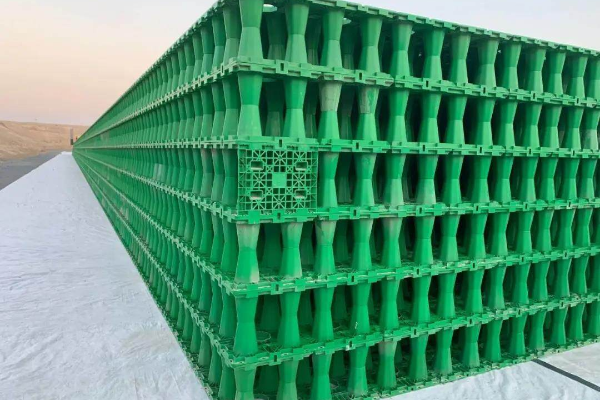
Stormwater management module installed under sports landscape and podium tanks
3D VIEW-PORT. PODIUM TANK WORK

INDEPENDENT TEST RESULTS & DERATING

SOURCERESULTWHAT IT IS
SGS, report XMIN2401000036PL04 (H500, top face)468.52 kN/m²Ultimate compressive strength
SGS, same report (lateral)121.93 kN/m²Ultimate lateral strength
Intertek, report 190702149GZU-001, tested to CIRIA C680:2008>600 kN/m² front face;
no failure at 300 kN head
Ultimate compressive strength
CIRIA C680 material partial factor (Fm)2.0 – 2.75First divisor, material only
Material-factor value (upper bound on allowable)468.52 ÷ 2.75 ≈ 170 kN/m² (~17 t/m²)Where the derating starts, not where it ends
C737 installation, temperature and design-life factorsProject specificApplied by your engineer, after the above

What Drives Cost, Lead Time and Whole-Life Spend

Crates are rarely the expensive line. Installed cost of stormwater attenuation systems is dominated by excavation, cover depth, lining, access chambers, outlet controls, ground conditions and traffic loading. Your storage unit sits underneath all of that.

External price reference, attributed

UK merchants were listing individual soakaway and attenuation crates at roughly £33 to £55 each excluding VAT in July 2026, Naylor, Hydrocell, Brett Martin and EnviroCrate units among them. Cost per cubic metre depends on each module’s volume, so the honest conversion needs that volume stated: on a nominal 190 L module, £33 to £55 works out at roughly £174 to £290 per cubic metre of storage. Those are competitors’ retail listings, quoted for orientation, and they aren't our prices.

~55%

Storage recovered per cubic metre excavated, at 600 mm cover — much the same order as a stone-embedded chamber. Our gain is a shallower storage zone and a smaller dig for equal volume, not more water per hole.

Calculated from StormGrid H500 module geometry; chamber figure as published by Advanced Drainage Systems for MC-3500. Compare attenuation solutions on this excavation basis, never on bare-module void. Whole-life cost is dominated by excavation and silt management, not hardware.

What actually moves your number

the recycled grades of PP vs the premium grade virgin PP, the heavy duty SG-H60.

H400 or H500 determines the number of modules rather than the price per m3 of volume.

Modules are shipped nesting in the containers, the ‘crates per container’ often has more of an impact on transport cost per m3 than the crate price itself.

membranes, geotextiles, silt traps/vortex separators, inspection points and flow controls.

If volume is to be adopted, not all water companies accept modular systems into their network; sort this first.

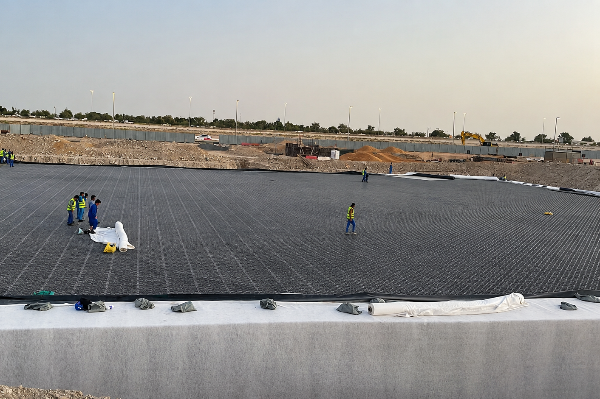
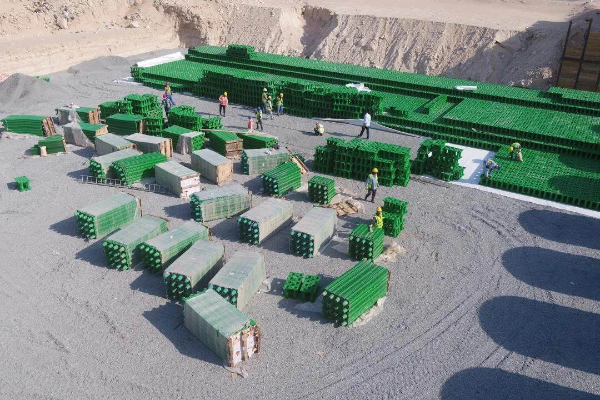
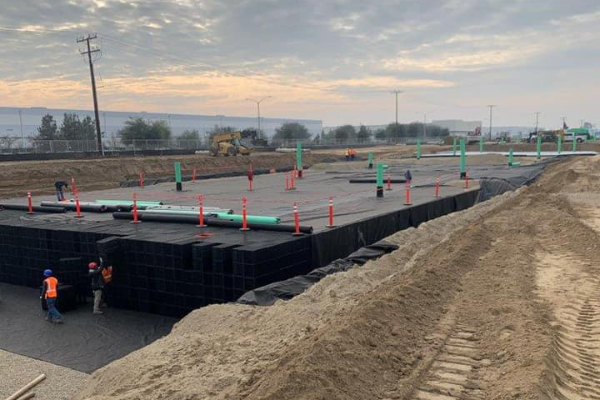
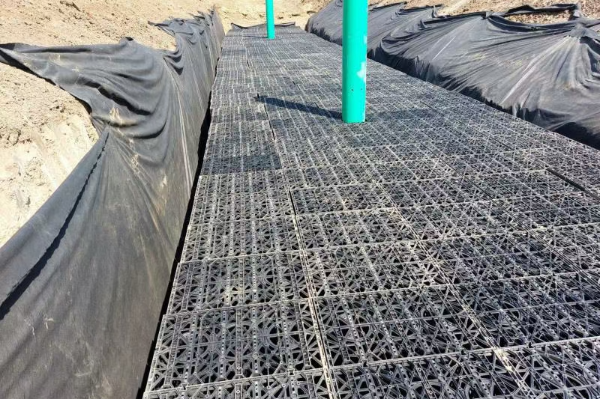
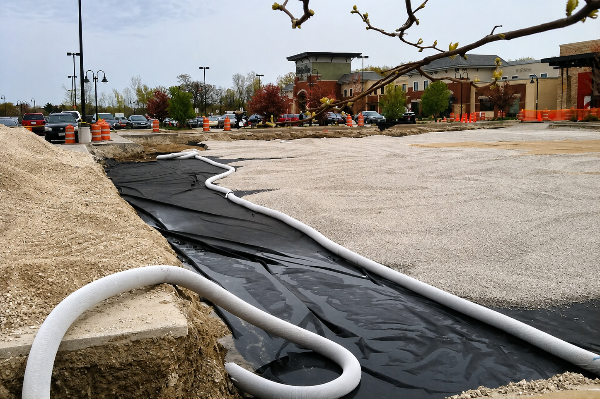
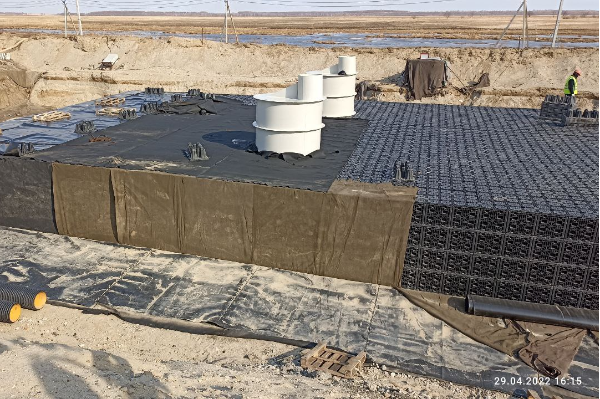
Heavy industrial excavation and underground stormwater attenuation crates installation

Maintenance Specifications

Maintenance regime typical of an adopted UK attenuation scheme, as specified in a local authority planning submission. Budget for this across the design life — CIRIA guidance requires long-term capacity to account for silt.

Task Frequency
Inspect pre-treatment (gullies, sump units, catchpits) for sedimentMonthly in year one, twice yearly thereafter
Remove litter and debris from sumps, chambers and pre-treatment devicesSix monthly, or as required
Jet pipework, using bungs and vacuuming the chamber first so silt is not flushed into the tankTwice yearly
Check that the flow-control manhole empties and the emergency drain-down worksTwice yearly
Inspect the tank itself from above groundEvery 12 months

That regime isn't ours, it's what a planning authority will hold an asset owner to.(Walsall Council planning submission, 2020) Price jetting and silt removal into the whole-life case at tender, because a tank that silts up quietly is the one that fail its consent ten years after handover.

Where we have supplied

Our own delivered reference for this build type is a Northern European site: a light-duty modular underground infiltration facility in the several-hundred-cubic-metre class, supplied against a landscape load case. Our client agreements limit what we publish about location and volume, so we state it at that level rather than dress it up. Ask us for the grade, module height and container loading on that job and we'll share them.

StormGrid ex-works pricing is based on project: module height, grade, volume, and container loading. Storm Manage offers project specific cost drivers rather than an all-singing-all-dancing rate, as a headline figure that isn’t dependent on these 5 variables is a headline figure destined to be wrong, but unlike that rate, our cost driver list should survive any tender - it takes slightly longer.

REQUEST PROJECT QUOTE
Completed sports grounds integrated with modular stormwater retention systems

Drainage System Engineering Tools

[T-01]

Pitch to crate sizing calculator

Accurately determine the optimal drainage crate dimensions based on surface pitch parameters and required attenuation volume.

Initialize
[T-02]

Ultimate vs nominal load reality check

Evaluate structural integrity by comparing theoretical nominal load capacities against real-world ultimate limit states under extreme stress.

Initialize
[T-03]

Excavation basis void comparator

Calculate and benchmark geocellular void ratios to optimize earthwork volumes, minimizing soil displacement and logistical costs.

Initialize
[T-04]

Soakaway or attenuation triage

Analyze geological percolation rates and site restrictions to accurately triage between soakaway infiltration and controlled attenuation.

Initialize
[T-05]

Podium deck depth fit checker

Instantly verify critical vertical spatial compatibility to ensure crate integration within highly restricted podium deck build-up profiles.

Initialize

Send us the constraint, not just the volume

Field Conditions

Just give us your catchment, your consented discharge rate and the depth available to you.

Engineering Deliverables

We'll return your required grade, the modules required, the container load and the test reports behind the numbers.

Frequently
Asked Questions

Technical Inquiry

A modular plastic box, typically around 95% void, buried to build an underground attenuation system. Wrapped in geotextile it becomes a soakaway that infiltrates; wrapped in a welded impermeable membrane it becomes a stormwater attenuation tank that stores water and releases it downstream at a controlled rate. Same box, two jobs.

Your crate can be identical. Wrap and outlet decide the function. As one installer described it, attenuation tanks were "wrapped in thick, durable membrane... welded together to seal it," whereas soakaway tanks were wrapped in geotextile that "stops dirt getting in but allows water to pass through."

soil type settles it, and not as a soakaway: clay won't percolate, and a high water table steals storage volume you paid for. In both cases the correct build is a lined attenuation tank with a controlled outfall, sized to your consented discharge rate rather than to an infiltration rate. England's national standards also require that the base of any infiltration system sits clear of the maximum likely groundwater level, which rules infiltration out on a great many stadium and podium sites before you even reach a percolation test.

Divide required storage volume by net storage per module - 0.2375 m³ for H500, 0.190 m³ for H400 - then add allowances for silt, freeboard, connections and the designer's margin. Undersize that tank and you don't prevent flooding, you postpone it by twenty minutes.

Silt is the failure mode that retires these tanks, and some crate systems are genuinely difficult to clean once sediment is inside. So the sediment strategy belongs upstream: a vortex separator or catchpit before the inlet, plus inspection access from ground level so the tank can be surveyed and jetted without excavation. Design guidance requires long-term capacity to allow for silt, which is why a nominal 237.5 L module doesn't mean 237.5 L of assured storage in year forty - budget for the jetting regime, and specify pre-treatment you can actually reach.

Yes, you can - and you'll store much less. Buyers who’ve run the numbers state it flatly: gravel provides 20-30% of its volume as useable void space compared to the near 95% available with a crate module.

Under grass with no vehicle access, SG-L30 is the usual starting point; stadium car parks and service routes push you to SG-M40 or SG-H60. Remember that a grade name is a nominal label. Ask for the ultimate figure, the material partial factor applied, and the lateral strength; then let your engineer design to the resulting allowable value rather than to the marketing number.

Not if the load case and the cover depth exactly match the test parameters - as risk comes from the wrong load case, not from an under sized module. They aren't commonly deployed under main carriageways.

Through a bespoke inlet fitting into a distribution or inspection chamber, immediately downstream of pre-treatment. Never directly from an unfiltered gully. If your granted discharge rate dictates a control orifice below 50mm diameter, this must be protected against blockage.

Yes, and reuse for non-potable uses lies right at the top of the SuDS hierarchy - it’s for this reason that reuse strengthens planning cases, and it's an explicitly embraced opportunity on golf courses, not an obligation to meet any drainage standard. Build it as a separate system - your filtration, your clean-water store, pumps, and controls, all dimensioned independently of your attenuation requirements. Viewing irrigation reuse as a ‘free by-product’ of the attenuation tank is how schemes come to be pumping silty water onto the village green.