Rainwater Harvesting Systems for Estidama & Vision 2030 Projects

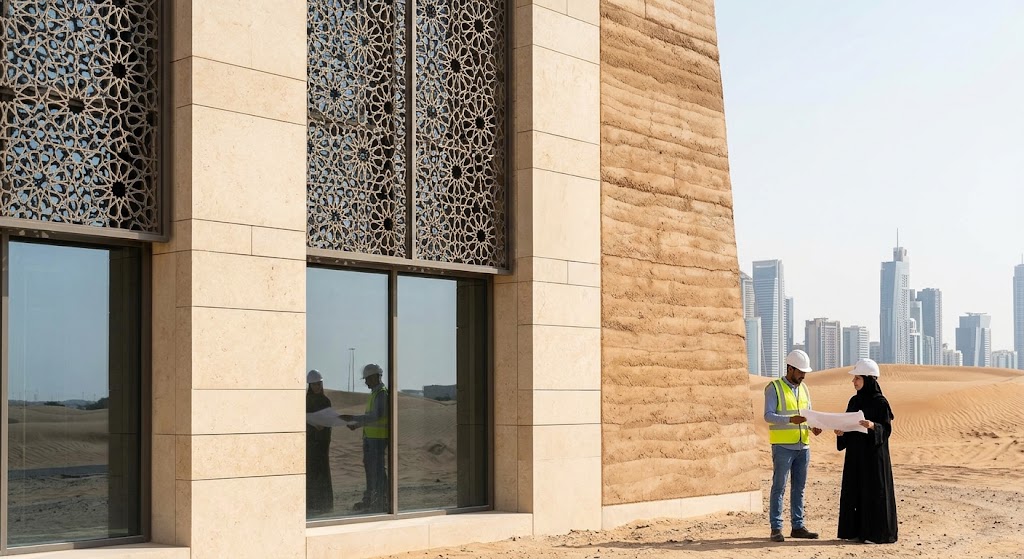
Modular geocellular stormwater storage for engineering teams delivering rainwater harvesting middle east projects under Abu Dhabi’s Estidama Pearl Rating and Saudi Arabia’s Vision 2030 water strategy – one crate system, two regulatory frameworks.

Request a Project Quote
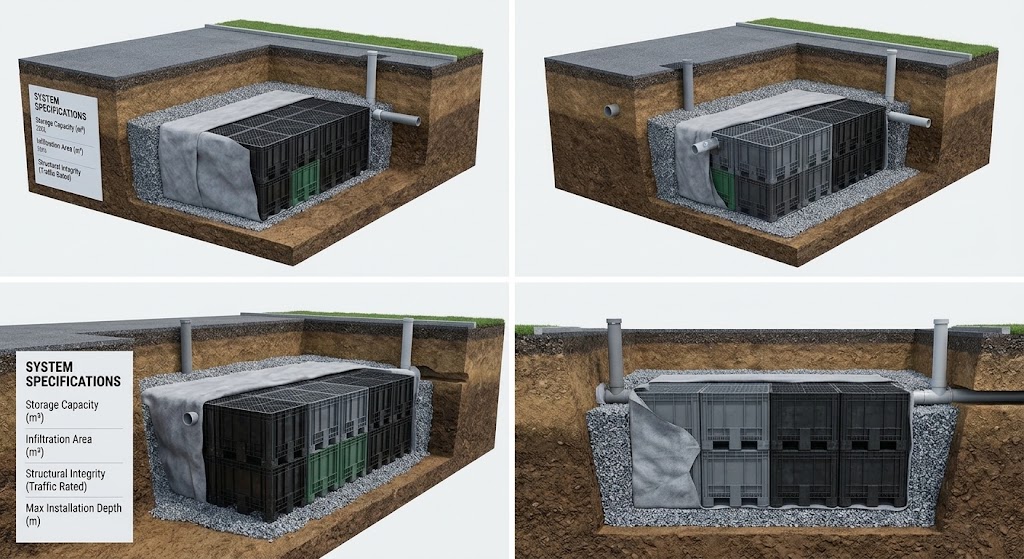
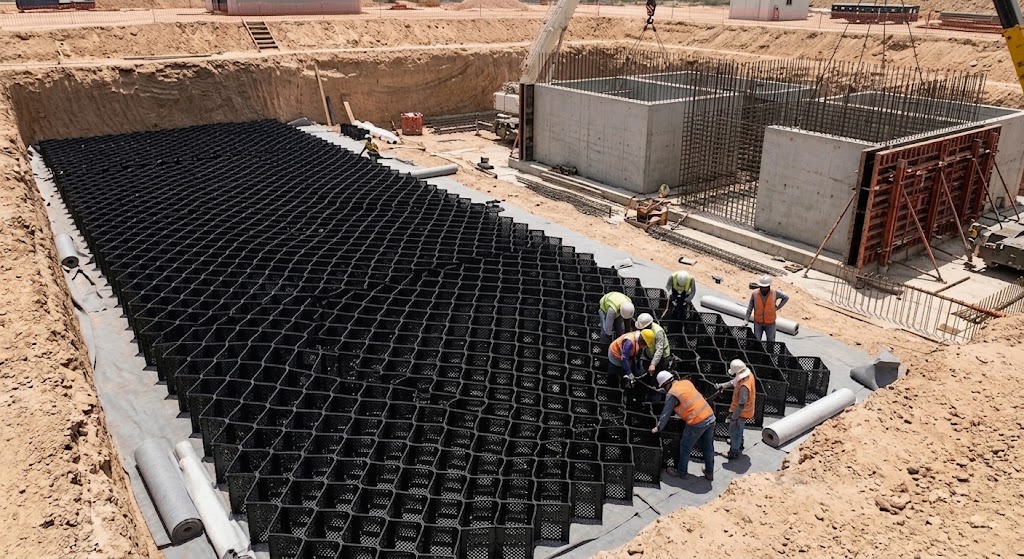
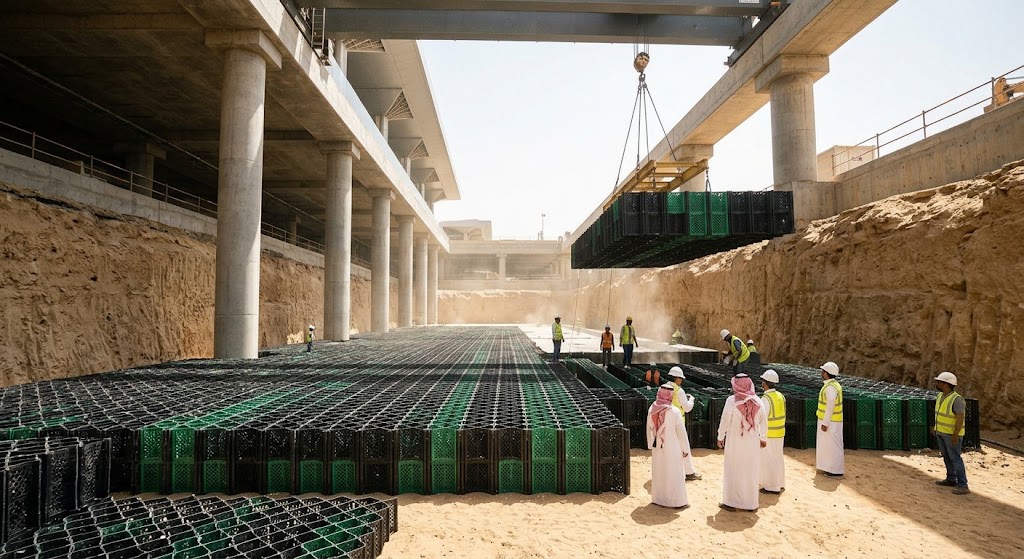
Underground geocellular crate installation for Middle East Vision 2030 projects
  • 95% void ratio per module
  • D400 EN 124 heavy-duty load class
  • 50+ yr underground design life
  • 15-30d standard lead time
  • 330 m³ per 40HQ container
  • 400+ projects, 30+ countries since 2014
INDUSTRY INSIGHT

Water Scarcity Meets Regulatory Mandate, the Middle East’s Storage Gap

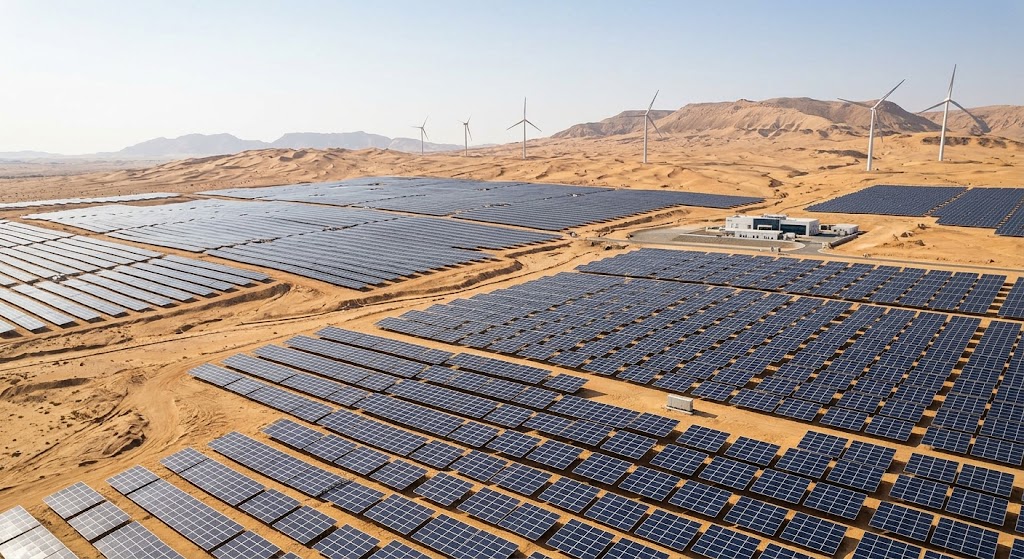
rainwater harvesting middle east projects sit at the intersection of two hard constraints: chronic freshwater scarcity and increasingly strict stormwater regulation. Abu Dhabi’s Estidama framework and Saudi Arabia’s Vision 2030 water strategy both push developers toward on-site stormwater capture, but they’re separate national systems with separate compliance paths.

  • UAE pressure: flash-flood events like Dubai’s April 2024 rainfall episode – a reported 142 mm in 24 hours against an annual average of roughly 78 mm – exposed how fast drainage infrastructure can be overwhelmed, prompting the Dh30 billion Tasreef programme targeting a 700% increase in drainage capacity
  • KSA pressure: desalinated water already supplies roughly half the country’s distributed water, and the National Water Strategy targets 70% reuse of treated wastewater by 2030, rising toward full reuse by 2040

Both pressures point engineering teams toward the same infrastructure decision, even though the underlying driver differ: UAE projects need more stormwater capacity fast, and KSA projects need more reused water fast. A geocellular system engineered for both attenuation and non-potable storage answers either brief without a redesign.

Stormwater Management Context

Underground Modular Storage, in Plain Terms

Underground Modular Storage System

A geocellular stormwater crate system is an injection-moulded polypropylene structure buried below grade, car parks, or landscaping. Its job is to collect and store runoff from the catchment surface, then release it on a controlled basis or hold it for non-potable uses such as irrigation, cooling towers, or toilet flushing. rainwater harvesting – often shortened to RWH in engineering shorthand – and stormwater attenuation both draw from the same water source: roof and surface runoff, before it ever reaches municipal drainage.

Storm Manage builds one product family that covers all three functions
  • Regional naming varies: soakaway crate, attenuation tank, detention system, OSD tank, rainwater harvesting tank
  • All describe the same underlying geocellular module

Some regional planners describe this approach using the “sponge city” concept – a city engineered to absorb, store, and slow-release rainwater rather than shed it – and the framing is a useful shorthand even though the term itself originated outside the Gulf.

The Sourcing Problem

Sourcing Specifications

Most suppliers are built around one national standard, not two. A system specified for UK SuDS or US LID rarely arrives with Estidama Pearl Rating paperwork or Vision 2030 water-reuse framing already attached.

Why the Same Product Has Five Regional Names

Ask a UK consultant for a “soakaway crate,” a US engineer for an “underground detention system,” and an Australian one for an “OSD tank,” and each will describe roughly the same geocellular structure. Void volume, controlled discharge, and structural load path barely change across markets – that functional core is what stays constant.

UK / EU
soakaway crate, attenuation tank (SuDS)
US
underground stormwater detention system (LID)
Australia
OSD (on-site detention) tank (WSUD)
UAE
rainwater harvesting tank, referenced against Estidama credits
KSA
stormwater/water-reuse infrastructure, referenced against Vision 2030 targets

Sourcing separately per region multiplies supplier-qualification work for no engineering benefit. One qualified module family, documented against every regional standard it touches, removes that duplication from a multi-market project pipeline.


Market Momentum Behind This Category

The Middle East and Africa rainwater harvesting systems market was estimated at roughly $16.86 million in 2024 and is predicted to expand at a CAGR of 5.3% to hit $28.1 million by 2031. Saudi Arabia’s water recycle and reuse market alone is calculated at roughly $200 million in 2025 and will grow at a 15.75% CAGR, heading towards $400 million by 2031.

Signals Behind the Numbers

  • Well-established players such as Veolia, SUEZ and Metito already active in Saudi Arabia’s water-reuse market
  • Saudi Arabia now has an annual dedicated stormwater and Wastewater Conference aimed at government decision makers, engineers, and infrastructure developers
  • stormwater infrastructure development is no longer an after-thought but an integral agenda item during planning phase of projects in Gulf countries

For a supplier who’s considering investing in certified market package and stocks specifically for the Gulf market, that combination of a growing market, real pressure for regulation on both ends of the spectrum, is much stronger than either element individually.

“Almost every single GCC tender we support always ends up with us being asked twice the same question-first, the Abu Dhabi credit documents, then, the Saudi water-reuse justifications. It can save both parties in the consultancy an RFI cycle if both documents are bundled as part of one spec sheet.”

Storm Manage Modular Crate System, Models & Specifications

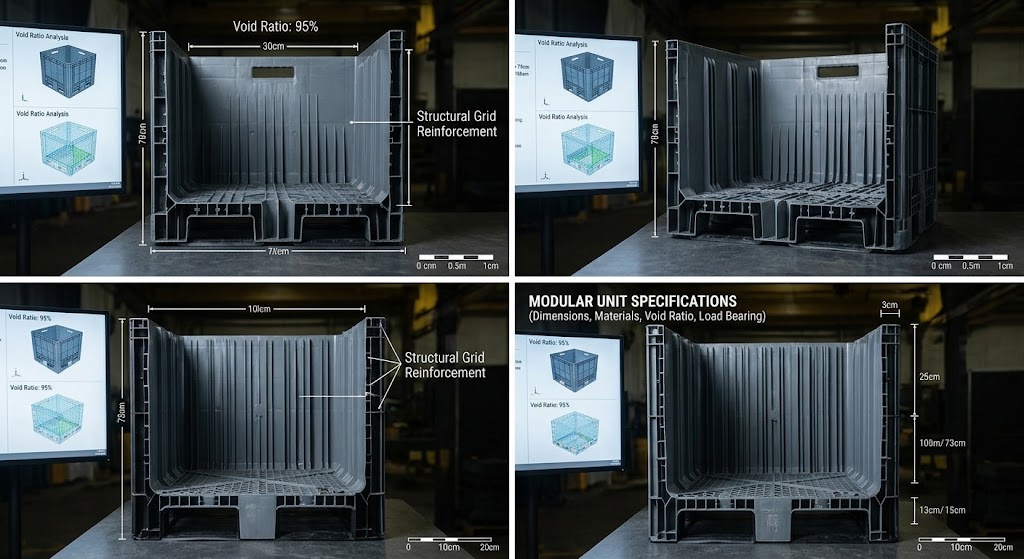
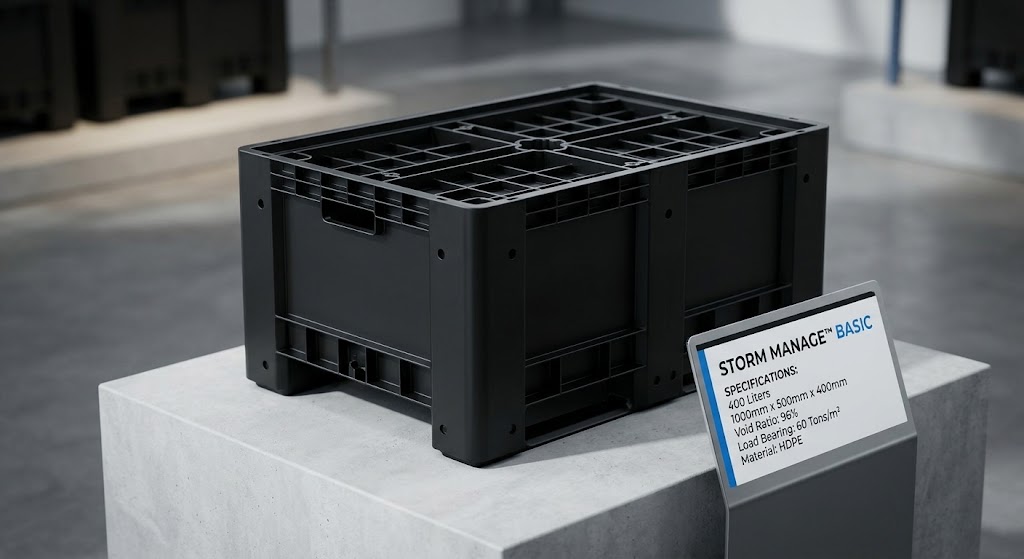
The crates in the line are manufactured from virgin PP or Recycled PP that are injection moulded as a single piece of a structural unit rather than assembling from different parts by welding them. The crate module is designed as standard 1000x500x500mm which are suitable for optimal shipping and crane-free installation by hand.

Working Temperature Range −100°C to +80°C
Life Expectancy > 50 years

(under typical ground conditions and loading)

⟳ Hover to reveal details
Load Class Typical Application Reference Standard Best Fit
HS-20 Landscaping, pedestrian zones, light vehicle access AASHTO HS-20
HS-25 / SLW60 Car parks, service roads, light commercial traffic AASHTO HS-25
EN 124 D400 Highway shoulders, HGV yards, port/logistics pavements BS EN 124 / BS EN 1433 ✓ Gulf infrastructure
✓ Gulf infrastructure

When dealing with Estidama and Vision 2030 projects in particular, the D400 heavy duty variant of the module is what most consultants recommend by default. This is because on a Gulf site it isn’t uncommon to find a parking area loading combined with the HGV construction stage traffic before landscaping works finish and light duty design load becomes effective.

Injection-Moulded One-Piece Construction

Each module is molded as a single integral structural part rather than built from a series of panels, either welded or bolted. A weld seam is a point of high stress, and by eliminating this potential failure point, designers won’t see the differential settlement and crate collapse associated with repetitive loads over the long term.

Production Capacity

  • Eight high tonnage (1000 T -2000 T) injection moulding machines
  • 12+ set mould inventory: standard size, heavy duty D400, shallow profile, connectors, end-caps, etc.
  • Annual production capacity of > 60,000m³, or approximately 5,000m³ of finished modules per month

Mould Variant & Use Case

Mould Variant Use Case
Standard module General attenuation/detention, HS-20/HS-25 loading
Heavy-duty (D400) Gulf car parks, HGV yards, highway-adjacent sites
Shallow crate Sites with limited excavation depth or high water table
Connector / end-cap System sealing and modular expansion joints

Full System Kit

  • Geotextile and geomembrane wrap (CE-certified, see Certifications below)
  • Inlet/outlet connectors and inspection chambers
  • Silt traps and flow-control devices
  • Optional custom-mould accessories via OEM/ODM (see Procurement Guide)

Geotextile & Geomembrane Wrap System

A well-designed crate only accounts for half the function. Geotextile wrapping prevents fine sediments from entering the void and accumulating over time, which can compromise storage capacity, whereas geomembrane offers a liner for cases where complete containment rather than infiltration is desired.

Wrap Selection Rule

Whether a geotextile wrap or geomembrane liner is needed will depend on the project specification, particularly if the design call for the containment and reuse of stormwater (rainwater harvesting) or the infiltration (soakaway) of the same. These are two different systems and selecting the incorrect wrap type is a typical design error which we identify during the shop drawings review process.

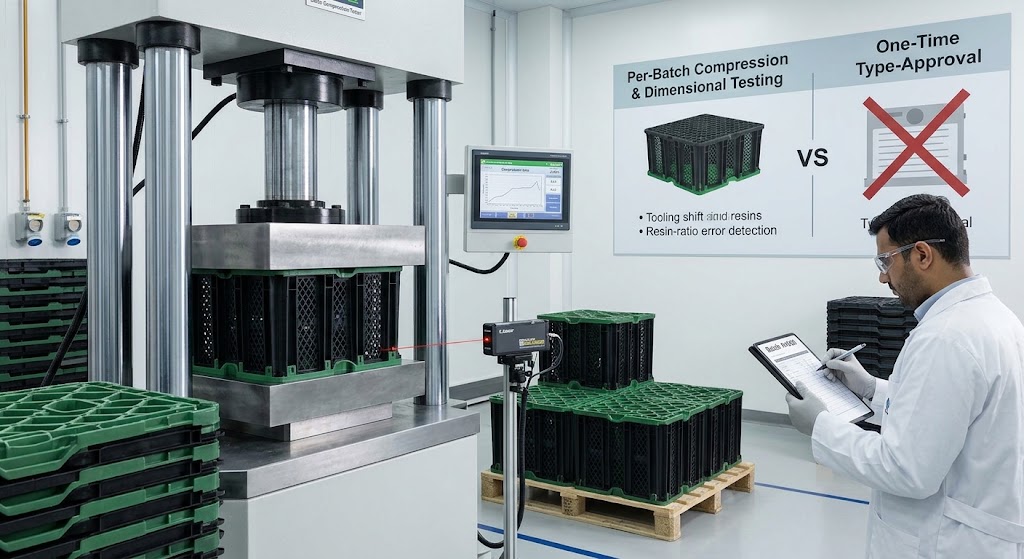
A series of batches of QC will be conducted to check performance such as: compressive strength, dimensional tolerance, the proportion between Virgin and Recycled PP, and consistency in the unit weight before shipment.

  • Too much recycled content: long-term creep resistance drops
  • Virgin Resin too conservative – module costs more than load class requires
  • Per batch ratio control maintains that balance consistency from batch to batch, and not just from first article samples

Installation Considerations

Geocellular crates slot together either manually or with light lifting gear – no crane, no cure time. Once wrap and connect procedures for the geotextile and geomembrane become second nature, it’s generally a matter of the same crew can assemble the following day faster than they can the day before.

Most Common On-Site Mistake

Not specifying the geotextile overlap at panel joints turns out months later in fines migrating into the void and a steady erosion of storage capacity – not a crate failure but a wrap-detail failure. It’s very simple to eliminate with a shop-drawing check.

Modular Geocellular Storage vs Traditional Concrete Tanks, Performance Comparison

It has long been the accepted practice for concrete vaults to continue being default in certain Gulf specifications for no better reason than, ‘this is what we’ve always done,’ rather than due to any inherent advantage. Numbers in the table below illustrate a standard D400 geocell system compared with an in-situ cast concrete stormwater tank.

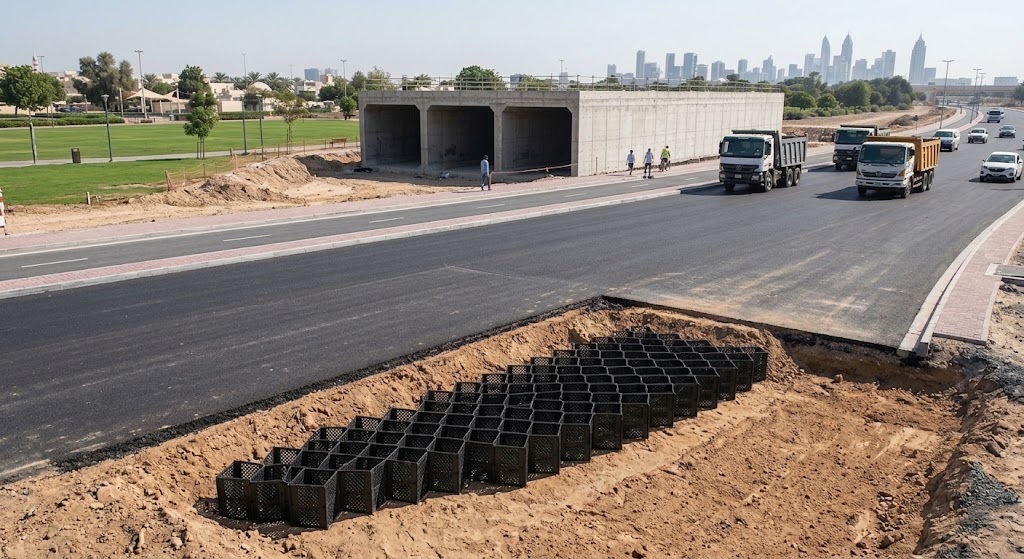
Modular geocellular stormwater storage system installation
Metric Geocellular Crate System Cast Concrete Tank
Void ratio (usable storage)
~95%
~100% void, but self-weight ~2,400 kg/m³
Module self-weight
~30 kg/m³
~2,400 kg/m³
Installed cost per m³ storage
~$8.50–$13.00/CF eq.
Typically >$15.00/CF equivalent
Design life
50+ years
Comparable if reinforcement is corrosion-protected
Cure/wait time before backfill
None — mechanical assembly
7–28 day concrete cure cycle
Typical install rate
300–500 m³/day, 4-person crew
Limited by formwork and cure scheduling

That install time differential is of most importance on a Gulf program as the tank is on the critical path prior to parking structures and landscaping. Taking a several-week curing process routinely salvages actual schedule float not just theoretical savings.

The Land-Value Lever

The underground geocellular system can also “give back” as much as 15 percent of a site footprint that would otherwise be taken up by a surface attenuation pond – giving that land over for leasable or landscape area. In the case of a tight urban site, that footprint give back the equivalent of a significant percentage of the installed tank cost.

Underground stormwater attenuation tank saving land value

Now we don’t claim concrete can never be part of the solution. Extremely shallow sites with high buoyancy risks do require the substantial dead weight of a concrete vault to keep the asset down; and certain authorities demand reinforced concrete be used for certain asset types whether there are geocellular solutions that meet their requirements.

When bouyancy is at play geocell systems still perform and you just need to engineer in an anti-flotation measure such as ballast or anchors – your structural engineer should engineer the size of these.

The first option is a concrete vault, which is one big monolithic chamber. Normally a concrete vault is accessed by workers through a single access point to the vault therefore limiting access to confined-space conditions. The second option is a modular crate system which is designed to accommodate a number of inspection chambers and silt traps at set points, allowing workers to perform inspection and maintenance on these selected zones.

that difference in access to inspection, over a 50-year service life accumulates in hours of labor saved Doesn’t appear on first-pass cost comparison but appears in lifetime operating cost.
50%+

lighter install footprint and faster programme vs. concrete tank of equivalent void volume, based on published weight and installation-rate comparisons for geocellular systems

Source: industry-wide geocellular vs. concrete engineering comparisons — [WEBSEARCH, QUALIFIED range, not a Storm Manage project-specific measurement]

How We Size a System for Your Site

Sizing is based on the catchment and local rainfall intensity, not some obvious multiplier. Please provide us with (if possible) your paved/impervious area, the required discharge rate allowed by your local authority, and the end use Attenuation-Only or non-potable reuse.

  • Module count and load class would fall out of that calculation
  • A irrigation-reuse shallowed crate could visually and in terms of volumetric capacity be indistinguishable from a D400 attenuating facility for an adjacent road

Estidama Pearl Rating & Saudi Vision 2030, Regional Compliance Crosswalk

Primary sources: Abu Dhabi DMT and Saudi Water Authority.

Estidama isn’t Vision 2030 – and the most frequently made mistake we see in Gulf water-management RFPs is the attempt to treat them as interchangeable. Estidama is the Pearl Rating System from the Abu Dhabi Department of Municipalities and Transport – for buildings and communities. Vision 2030 is the Saudi national programme for economic and water strategy and they operate under entirely different regulatory regimes.

Estidama Pearl Rating & Saudi Vision 2030
Dimension UAE — Estidama KSA — Vision 2030
Governing body Abu Dhabi Dept. of Municipalities & Transport (DMT) Saudi Water Authority (SWA) / National Water Strategy
Relevant credit / target Precious Water credit PW-R3: Stormwater Management 70% treated-wastewater reuse by 2030, trending to full reuse by 2040
What our system contributes On-site stormwater attenuation/detention volume toward the required PW credit Non-potable storage & reuse volume supporting site-level water-reuse targets
Note on scope Building/community-level certification — project-specific National strategy — applies at sector and utility level, referenced in project water-management justifications

The relevant reference standard for UAE National water policy (rather than Estidama’s building level rating) is the UAE Water Security Strategy 2036. Abu Dhabi separately has its own “Economic Vision 2030”, a broad economic diversification plan rather than a water-reuse framework, so the water-reuse standard called “Vision 2030” on this page refers specifically to Saudi Arabia’s National Water Strategy. Getting that detail right in the submission package save you a rejected compliance narrative and an extra review.

Hover to Flip

Estidama Pearl Rating,
What Engineering Teams Need

Estidama Pearl Rating Insights

The Pearl Rating System ranks projects 1-5 on the Pearl scale, with several Required (R) credits which are common to all projects at all tiers. stormwater management fits in the Precious Water category, with the water reducing credits. For this reason a rainwater harvesting or attenuation can earn credit across multiple credit categories within a single submission.

What you generally will need:
  • Proof of capacity
  • Discharge rates calculations
  • Certificates of product testing
Every single job receives the same kit no matter where it’s sold in the world

Where Submittals Actually Stall

Generally it’s not the engineering, but the paper trail. When you receive a submittal that’s a one-stop-shop for test reports, discharge calculations and a convincing narrative for credit mapping, it goes through review quicker than the consultant who’s having to coax a few pieces of paper out of a half-dozen vendors.

Hover to Flip

Saudi Vision 2030,
Water Reuse at Project Level

Saudi Vision 2030 Insights

While the goals within Vision 2030 are on a national-strategy basis, developers of commercial and industrial sites are now routinely required to demonstrate the role that their design can play in conserving water resources and meeting water demand reduction. Saudi Arabia’s water sector is under major pressure: it requires enormous amounts of energy for desalination, water demand continues to rise as the urban population increase, and efforts to limit the use of desalinated water wherever possible are policy requirements, not simply engineering concerns.

One of the more easily attributable ways a single project can be said to positively contribute to the country target is via On-site stormwater capture and non-potable reuse – irrigation, cooling makeup water, or landscaping.

The investment can only supplement not substitute the investment in renewable and sustainable development elsewhere in the sector.

Since the underlying storage technology is the same as what’s referenced for the UAE Estidama framework, a developer engaged in both markets can align on a single supplier and one engagement instead of a double qualifying. Only one crate platform need to be validated across two standards since the engineering need remains consistent, proven void volume, managed discharge (or reuse), and third-party test reports.

Sustainability Fit Beyond the Credit Checklist

Estidama’s Pearl Rating is a sustainability assessment; the stormwater line item alone isn’t where our system make an impact. Recycled content in the PP results in less plastic waste, and the one-piece injection molded nature eliminates the adhesives and welds that alternative welded panels will consume.

What This Doesn’t Replace

That none of that, though, can substitute for the actual paperwork required by the Pearl Rating assessor – just that it means that the real product story isn’t hindering the certification objective it’s being called on to facilitate.

Project Track Record and What Buyers Can Expect

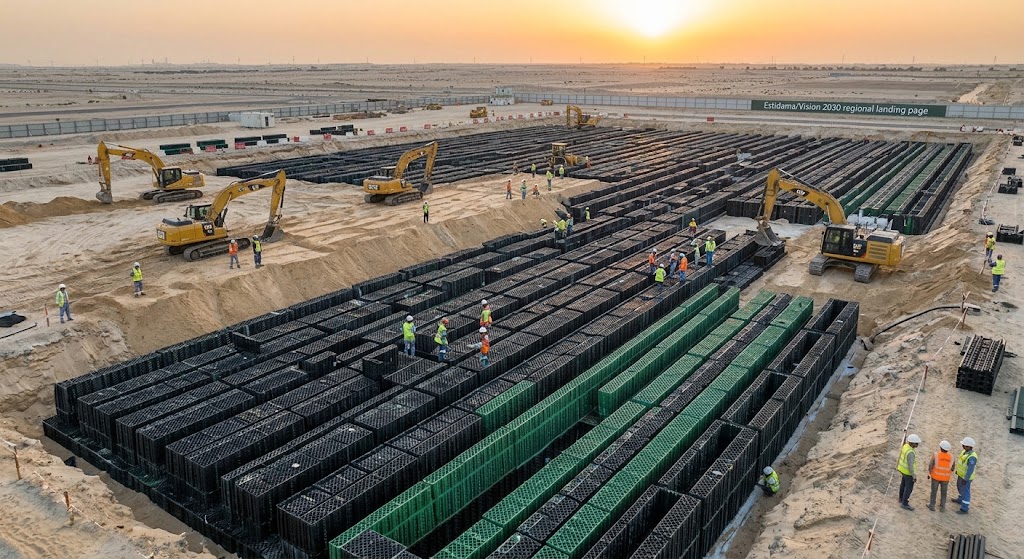
“Have they actually been tested in the real world, or are we the Guinea Pig?” – it’s a tough question every procurement team in the Gulf asks a new supplier, but it’s a perfectly fair one for our stormwater geocellular system. We’ve delivered geocellular stormwater systems on more than 400 projects, in over 30 countries, since 2014 – from the biggest civil engineering contractors and drainage distributors, to the biggest water utility providers and project developers. The product works – it’s just been doing so away from this particular home market, before now with our first dedicated Estidama/Vision 2030 regional landing page.

Regional Market Context

Regional Market Context

Geocellular stormwater is already being implemented at a national infrastructure level in the area. Hydro International was a key supplier of geocellular attenuation storage – providing over 18,000 m³ in seven underground tanks – for Saudi Arabia’s Jeddah and King Abdullah Economic City rail stations. It’s a level of scale that validates the technology’s readiness for the Gulf region’s infrastructure demands.

Applications Across Project Types

Applications Across Project Types

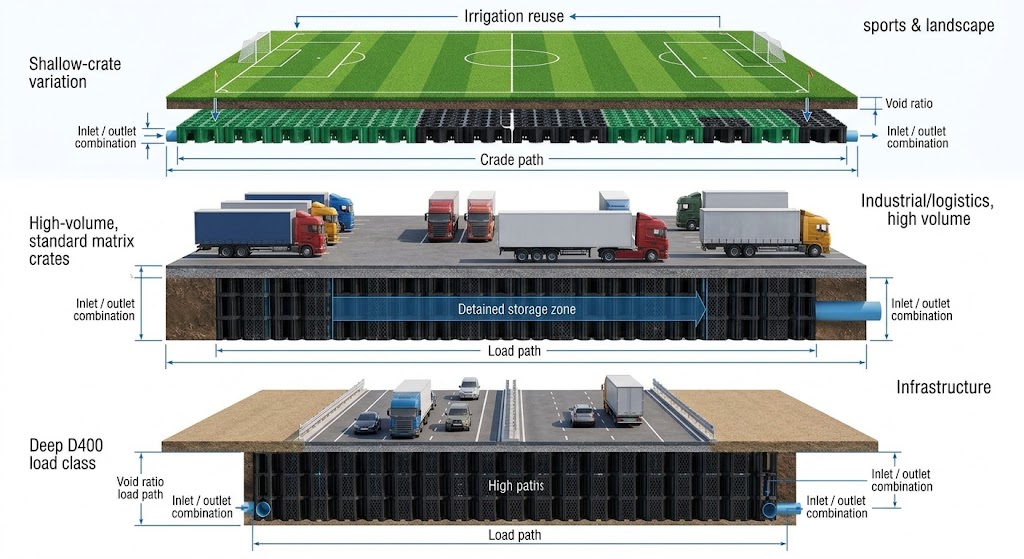
The size of this crate is determined by sector with the same platform, as do the load class and the inlet/outlet combination.

  • Urban commercial: car park attenuation into the municipality’s drainage capacity
  • Industrial / logistics site – High volume, heavy vehicle rated surface loading with detained storage
  • Infrastructure (rail, highway, port): Loading in D400 / Highway class at scale. Replicating the example of Jeddah / KAEC above.
  • Sports & landscape shallow-crate variations for irrigation reuse beneath pitches or plantings
What the Data Supports

What the Data Supports

  • Long 50 year underground design life under normal groundwater and loading conditions
  • HGV yard and highway proximity rated heavy duty load rating of D400
  • Void ratio 95% which allows a lower excavation depth and smaller footprint per m³ of stored required

We either qualify the claim that we can’t prove at a project level or don’t dress the general industry average up as one of our own measured results. If you want a performance figure to suit your own site conditions and have to have one, then ask for a technical submittal. We shall base this on the performance based on your site and catchment data rather than give you a generic value.

Why We Test Every Batch

Why We Test Every Batch, Not Just the Prototype

A certified single prototype shows the design concept work. It doesn’t answer if module #4,000 of a product that was built years ago is still capable of the same compression ratio that your 50-year claim relies on.

Per-Batch vs. One-Time Type-Approval

Per-batch compression and dimensional testing picks up on tooling shift and resin-ratio error at the time the problematic batch is made – not once it’s buried under a car park.

So, for a buyer, the pragmatic answer is obvious – query any supplier: Does their test cert apply to the batch currently going into my project, or a prototype they made some time in the last decade? It tells you a great deal about what quality control actually is day to day.

Certifications & Compliance

The most significant trust issue we’ve encountered in this category isn’t missing standards – it’s standards called out with no test report or standards organization listed. Every certification below has the name of the testing house and year it occurred.

Standard Description / Data
CE EN 1852 Rainwater module, UDEM 2024
CIRIA C680 Vertical load, Intertek 2019
SGS Compression Structural test, SGS 2024
ASTM F2418 PP resin, TRI
Geotextile CE EN 15381 CELAB
Geomembrane CE EN 15382 SGS 2024
ASTM D4632 Geotextile tensile
ISO 9001 / 14001 / 45001 QMS / EMS / OHS

If you’re looking into any crate company anywhere in the world, there are two questions you should ask prior to getting into the cost. First, who was the accredited lab who produced the report? Second, in what year was it produced. A single number alone-no lab, no year-is a marketing claim.

Certification Testing Process
Compliance Assessment Overview

How the Certifications Break Down

structural certificates (CIRIA C680, SGS compression, BS EN 124/1433 load class) prove that the crate can withstand its rated load over its designed lifespan. material certificates (ASTM F2418, ASTM D4632) prove that the PP resin and geotextile meet the durability and tensile specifications expected from 50 years of service underground.

  • Structural: CIRIA C680, SGS compression, BS EN 124/1433 – survives rated load over design life
  • Material: ASTM F2418, ASTM D4632 – resin and geotextile durability/tensile specs
  • System-level: CE EN 1852, EN 15381/15382 – module, geotextile, geomembrane as a system, not the crate alone

What the ISO Triple Certification Predicts

ISO 9001/14001/45001 covers quality management, environmental management, and occupational health and safety across the factory – not the product itself, but the production discipline behind it. For a buyer sourcing from overseas, that’s the certification set that predicts whether batch #200 will match the quality of the sample batch you first approved.

DOC REQUEST ↗
Logistics & OEM Matrix

Procurement Guide, Lead Time, Container Loading & OEM/ODM

Cross-border sourcing is where most Gulf project delays start, and the data backs that up: suppliers with on-time rates below 90%, or response times slower than six hours, correlate strongly with downstream project delays and hidden coordination costs. We built our production and logistics model specifically to close that gap.

Production and Logistics Model
15-30d standard lead time after order confirmation
330 m³ optimized-stack loading per 40HQ container
45-60d custom OEM logo mould development
1m³–100k+ MOQ range, project to bulk volumes

Buyer Advisory: What to Check Before You Order

  • Confirm ISO 9001 certification and request the current certificate – not just a logo on a webpage
  • Ask for the compression test report and the lab name, not just the standard number
  • Get container loading plan confirmed before final payment terms are set – 330 m³ per 40HQ assumes optimized stacking, not loose palletizing
  • For OEM projects, lock the mould-development timeline (45-60 days) into your critical path before committing a delivery date to your client
  • Ask whether shop-drawing support is included pre-order or billed separately – it should be included, and if it isn’t offered, that’s worth noting

Our after-sales process include engineering shop-drawing support and FOB quoting before you commit, paid on-site supervision where projects require it, and first-response investigation with compensation for confirmed material defects. That last point matter more than it sounds: a supplier that only argues about fault after installation is a supplier that hasn’t done this before.

The 330 m³ figure per 40HQ container assumes optimized stacking of nested, disassembled modules – not loose crates thrown in a box. That distinction is worth confirming with any supplier quoting container counts, because loose-palletized loading ships meaningfully less volume per container, quietly inflating your per-m³ landed cost.

Large-Volume Projects

We plan container counts against your bill of quantities before quoting freight, so the number in your budget matches what actually ships.

FOB Shenzhen, Yantian, or Shekou is our preferred shipping arrangement – the factory sit close enough to both ports that container loading and customs handoff happen on the same production cycle, not a separate logistics leg. FOB Qingdao or Ningbo can be coordinated for projects where that routing work better for the receiving port.

Pricing depends on storage volume, load class, resin ratio (Virgin vs. recycled PP) and accessory package – we quote your specific project requirements not the price of a blank-blank entry since a shallow-crate irrigation installation and a D400 highway project are entirely different.

  • Deposit required with order confirmation, balance payment due before shipment. Standard FOB terms.
  • Product warranty is against material defects and based on the manufacturer’s quality control record.
  • Specific project terms will be confirmed based on project scope and destination as part of your purchase order.

Frequently Asked Questions

Technical specifications, regional compliance, and project engineering parameters for our modular stormwater solutions.

Get Site-Specific Quote

Yes – Both the stormwater management element and non-potable water reuse are contributors to the Pearl Rating System’s Precious Water category. More specifically, the PW-R3 stormwater credit is applicable. Check with your Estidama-registered consultant for exact weighting criteria, as these vary with project type and Pearl tier.

Typically, most underground drainage and stormwater installations in Dubai require Dubai Municipality approval as part of the general building permit process. Usually, your MEP consultant submits these drawings for approval as part of the drainage design package and it doesn’t need to be a standalone application.

Yes, providing the crate system has a load capacity that meets the required car park traffic class. D400 modules are specified for these scenarios including car park decking with infrequent HGV use during construction.

installed cost varies by storage volume, load class, site access and ranges between $8.50-$13.00 per cu ft for modular geocellular systems, for the industry at large. Contact us for a site-specific quote, giving us your catchment area and required storage volume, instead of relying on a general range.

Saudi Arabia’s Vision 2030 National Water Strategy targets 70% reuse of treated wastewater by 2030 and plans to extend to 100% reuse of wastewater for larger populations by 2040. With this target in mind, it’s becoming increasingly important for industrial and commercial sites to provide on-site non-potable storage and reuse infrastructure.

Geocellular systems can be broadly classified based on the surface of collection (roof vs. surface runoff), location of storage (above or underground), and end use (non-potable reuse or attenuation). Our system is designed for the underground, non-potable-reuse-or-attenuation, category, most commonly seen in commercial and infrastructure projects across the Gulf, capturing and storing harvested rainwater for reuse instead of just releasing it to a drainage network or watercourse as quickly as possible.

An attenuation tank briefly holds collected stormwater before releasing it at a pre-determined rate into the downstream drainage system or water body. A soakaway or infiltration system allows collected water to seep into the surrounding soil; the system you require depends on the permeability of the soil at your site and the discharge consent awarded for your project.

Yes, this is increasingly common in mixed-use projects in the Gulf region and more popular than single-purpose systems. The split arrangement would use a similar crate family with specific inlets, outlets, and wrap designs to separate the two areas, one being the non-potable reuse compartment and the other the controlled discharge section.

Yes – OEM/ODM development is an available product. Custom logo mould development takes 45 to 60 days. MOQ varies depending on volume of each order and can start with volumes for individual projects up to quantities exceeding 100,000+ m³ for distributors and bulk buyers.

All production batches are provided with compression, weight consistency and dimensionally consistent Quality Control data relating to their specific production batch so any defect can be resolved based on test data rather than subjective dispute. Confirmed defects with the product material itself are addressed by first-response investigation and appropriate remediation as a standard element of our after-sales service package.

Yes – the page specifically mentions Estidama and Vision 2030 due to these being the two most requested guidelines by customers working on projects in the Gulf. The exact same crate platform has however also been supplied to SuDS projects in Europe, LID projects in North America and WSUD projects in Australia as well as adhering to the respective guidelines there. Our Engineering submittal package is designed to fit whichever relevant guide line your project adheres to.