Soakaway Crate

Soakaway Crates, Geocellular Infiltration Modules, Direct From the Factory

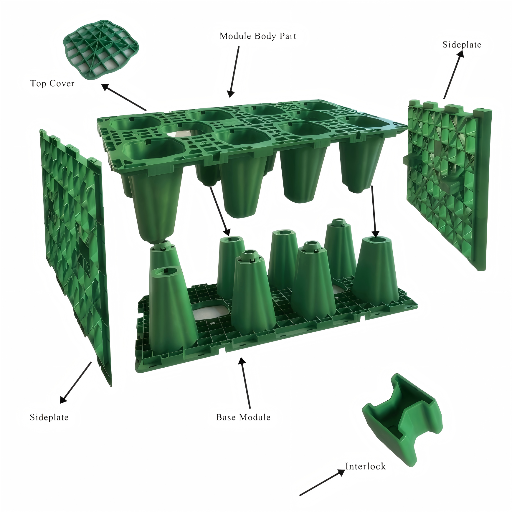
Manufacture of geocellular soakaway crates – 95% void plastic infiltration modules – which store surface water under the ground and allow it to percolate back into soil to avoid surface-water flood. Injection-molded in our Shenzhen plant since 2014, load tested by Intertek and SGS; shipped to civil contractors, developers and distributors by the container.

Application Summary

Bottom line: the 95% void stores roughly three times the water per cubic metre dug compared with gravel, and because a wrapped crate can be jetted through an inspection well it holds that capacity for the design life where an old rubble pit silts shut. Graded SG-E20 to SG-H60, shipped direct from our factory by the container.

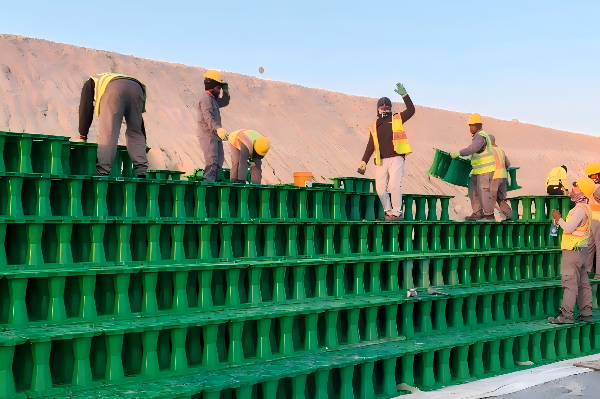
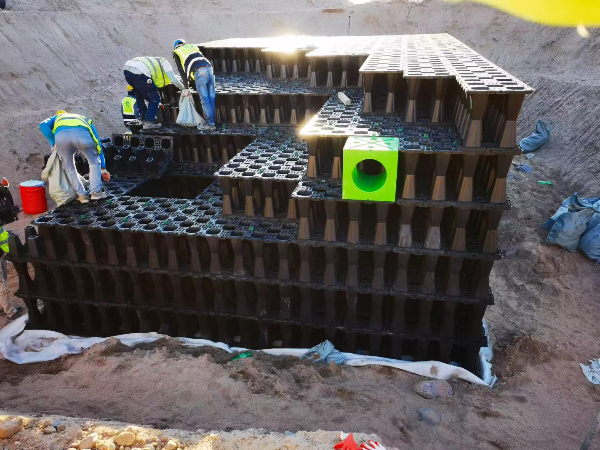
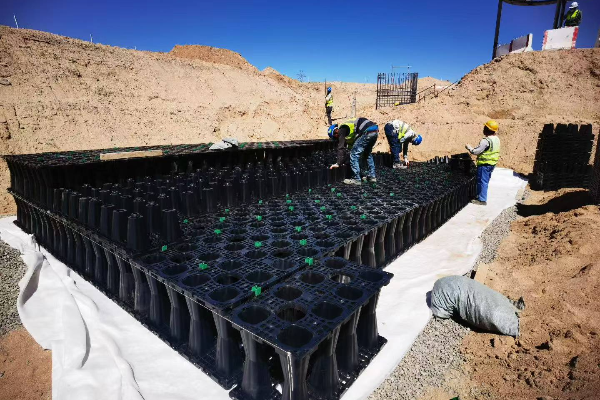
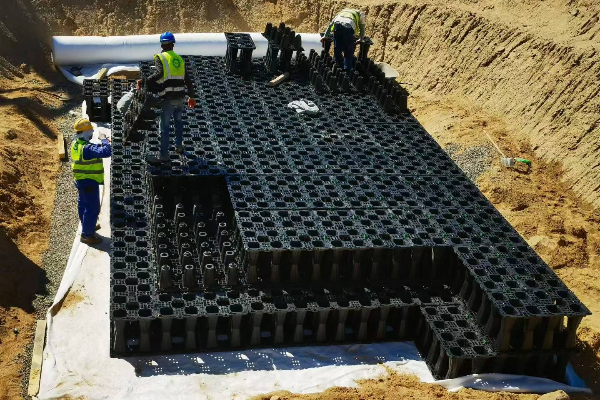
Geocellular soakaway crate infiltration module installation view
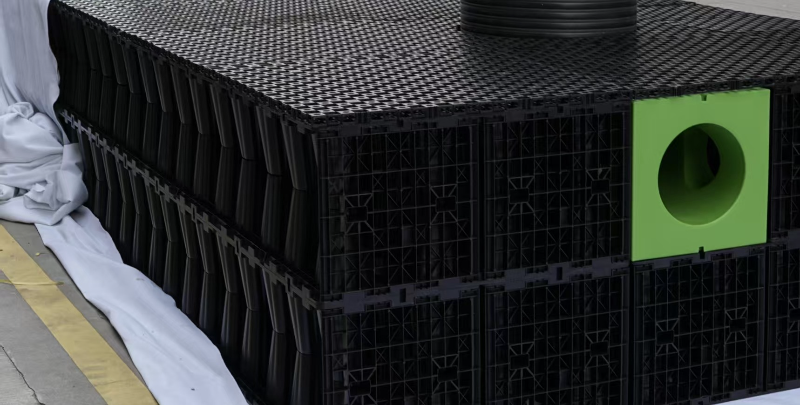
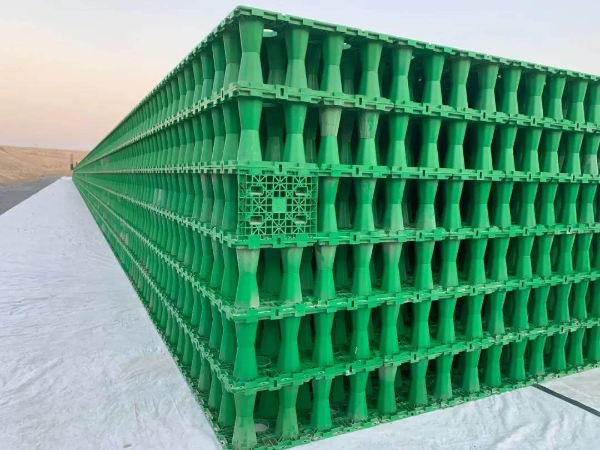
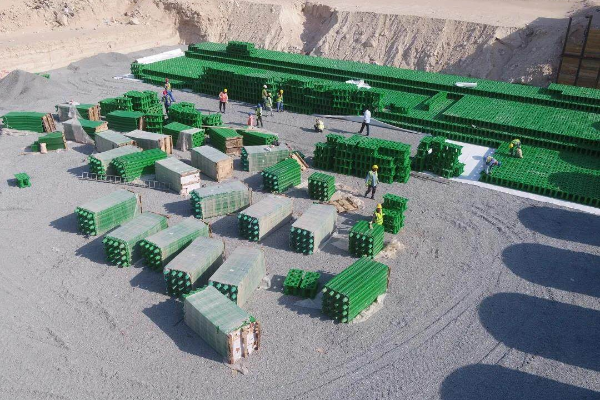
Geocellular infiltration modules wrapped and stacked for surface water storage
  • 95% void ratio
  • ~588 kN/m² short-term (SG-H60)
  • H400/H500 190 / 237.5 L
  • 15–30 day lead time
  • 40HQ up to ~330 CBM
  • FOB Shenzhen

Why a soakaway crate beats a rubble pit, the void-ratio case

When using stone and rubble, most of a cubic metre dug out will be stone – perhaps 300 litres of capacity, whereas you’ll get about 950 litres from a 95% void crate.

Geocellular crate
~950 L · 95%
Clean single-size shingle
~400 L · 40%
Graded gravel
~300 L · 30%
Rubble / hardcore
~300 L · 30%
Usable storage per cubic metre of excavation. Void figures are indicative material properties; crate figure is our own 95% design void — see the References note on why we quote 95%, not a competitor’s 97%.

Another win – service life. Stone is easily blocked by silt and fines as water permeates into it, that’s the typical cause of flooding from a conventional “stone soakaway” some years later; a wrapped crate keeps its capacity and give an access chamber for jetting out the blockage.

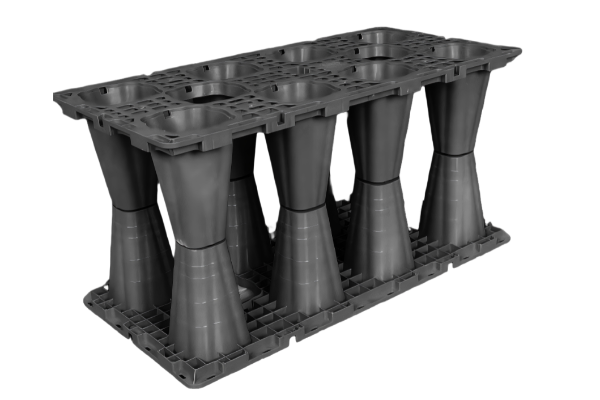
A soakaway crate (or dry well, or soakage pit) works a bit like replacement for the loose stone in a conventional infiltration soakaway. A geocellular crate has a load-bearing frame with 95% void, as opposed to 30% for gravel, making the same trench hold close to three times as much water, and unlike stone it can be jetted for inspection.

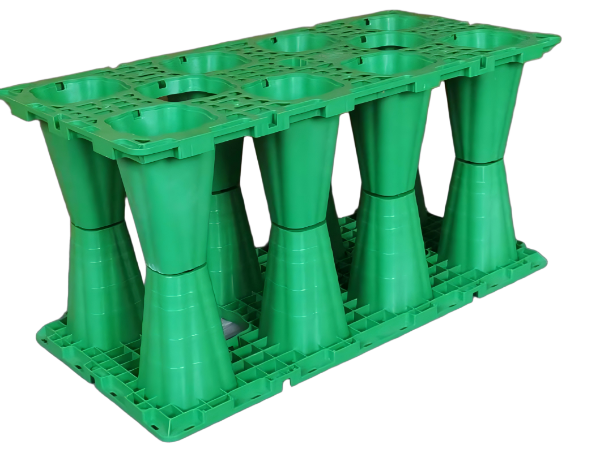
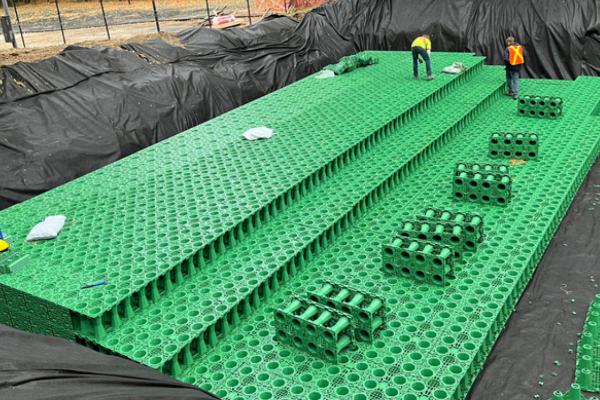
Geocellular soakaway crate structural display

How the infiltration path actually works

  • 01

    Collect & pre-treat

    Run-off enters through a silt trap or catchpit so grit drops out before it reaches the crates. Skipping this is the number-one cause of premature silting.

  • 02

    Store in the void

    Water fills the 95% void modules, wrapped in a non-woven geotextile that lets water pass but holds soil back, the porous fabric keep fines out while the store disperses.

  • 03

    Infiltrate to ground

    Stored water soaks out through the sides and base into the surrounding soil, which only works where the ground drains and the water table sit well below the box.

Soakaway or attenuation?
Match the crate to your ground

A single StormGrid crate can be used in 2 ways. If the site drains well & there is ample depth to the water table below the invert of your site, the crate is wrapped in geotextile membrane and you get a true infiltration soak away, and it infiltrates the stored water back into the ground. If the ground does not readily accept infiltration, the tank is wrapped in a geomembrane and you get an impermeable attenuation tank that retains storm water and discharges it at a controlled slow rate to the nearest sewer outfall. A Vp or percolation test on site confirms which solution is required.

StormGrid Soakaway Crate Hub Configuration

Which mode your site actually needs

Decider Infiltration soakaway Attenuation tank
Ground and water table Free-draining soil, water table at least 1 m below the base Clay or high water table, a slow Vp result
Wrap Non-woven geotextile, water passes through HDPE or LLDPE geomembrane, fully sealed
Where the water goes Soaks out into the surrounding soil Throttled outlet to a sewer or watercourse
ENGINEERING WARNING

Get this fork wrong and it will be either an ever-water-logged clay site which can never drain; or a freely draining site which has never needed lining. Proof depends on taking a Vp percolation test in a trial pit; and slow Vp on a heavy clay require more attenuation than infiltration anyway. It’s just different crates on the same order form – it’s all just different wrapping, and different outlet arrangements.

The Storm Manage soakaway range, the Cover-Load Match

All of our geocellular soakaway crates form part of our modular family sold under the StormGrid brand and are graded by the load above. There are two different module heights, available across all grades – H400 (1000x500x400 mm, 190 L) & H500 (1000x500x500 mm, 237.5 L).

The Cover-Load Match – pick the grade by what runs over the ground above it

The loads – shown in kN/m² below – are from the product test, these aren’t system ratings; a “crate field” system capacity will be dictated by a full CIRIA C737 load design incorporating cover depth, cover material, ground conditions and cover construction rather than any single compression loading.

Grade Short-term vertical (test input) Material Typical duty above Test evidence
SG-E20 ~20 t/m² – ~196 kN/m² Recycled PP Non-trafficked, landscape, gardens Family compression data
SG-L30 ~30 t/m² – ~294 kN/m² Recycled PP Pedestrian, light domestic driveway Family compression data
SG-M40 ~40 t/m² – ~392 kN/m² Recycled PP Car park, light traffic SGS-witnessed: 468.5 top / 121.9 lateral kN/m²
SG-H60 ~60 t/m² – ~588 kN/m² 100% virgin PP HGV yard, heavy traffic (with cover design) Intertek: vertical run-out to 600 kN/m² (not failed)
SG-Custom per project Virgin / Recycled OEM / ODM to your drawing Project-specific

What ships with the crates

Item Spec Role
Crate module 1000x500x(400/500) mm – 190 / 237.5 L – 95% void Storage cell
Geotextile Non-woven, ~300 g/m² typ. Filter / soil separation (wrap)
Geomembrane HDPE / LLDPE 1.0-1.5 mm Impermeable liner (attenuation mode)
Pipe connecting box DN200-DN700 Inlet / outlet to a perforated drainage pipe
Inspection well base DN800 Access for jetting & inspection

Three ways into the range

Heavy-Duty Soakaway Crate D400 Context
[ MOD-01 ]

Heavy-Duty (D400 context)

SG-H60 is manufactured in 100% virgin PP for trafficked areas; its load capacity and sizing are determined by the depth of cover rather than a headline load classification. Where the D400 load category truly applies and where it doesn’t!

Heavy-duty crates
Soakaway Crate Sizes and Ready-Reckoner Kits
[ MOD-02 ]

Soakaway Crate Sizes & Kits

Crate sizes, per-crate volume, ready-reckoner soakaway kits, and a full BRE 365 Soakaway Design Calculator to work out crate quantities.

Sizes & kits
Step-by-step Soakaway Crate Installation Guide
[ MOD-03 ]

Soakaway Crate Installation

Dig, geotextile wrapping, connection and backfill; a step-by-step guide to installation and the common causes of soakaway failure.

Installation guide

What the load numbers really mean, test evidence and standards, decoded

We’ve seen competitors sell crate systems on weight. We don’t sell it on that; we sell it on verifiable data, show you independent test reports, and we’ll leave it to you to spec the system you want. Here’s the honest map:

Which standard proves what

Standard What it governs What it does not Our status
EN 124 Load class (incl. D400) of the surface access cover / gully top Does not rate a buried plastic box below it Applies to the cover, not our crate
EN 17152-1 Geocellular box test methods — short-term compression & creep Not a project sign-off on its own Short-term data held; long-term creep not signed
EN 17150 Determination of short-term compression strength Not a 50-year allowable Covered by our compression tests
EN 17151 Long-term (creep) compressive behaviour No signed report held — see honesty box
CIRIA C737 Structural & hydraulic design of geocellular systems (replaces C680:2008) Not a product certificate The design route we work to

Independent & witnessed load evidence — cited verbatim

Grade Report Result (short-term) Read it honestly as
SG-H60 Intertek 190702149GZU-001 (2019) Vertical run-out to 600 kN/m²; lateral 186 (23°C) / 179 (40°C) kN/m² The rig reached its 300 kN load-cell range — a run-out, not a measured failure load
SG-M40 SGS-witnessed XMIN2401000036PL04_EN (2024) Top 468.5 kN/m² · lateral 121.9 kN/m² Run in our lab, witnessed by SGS — witnessed, not a fully independent-lab test

⚠ The D400 red line

D400 applies to the covers that protect the underground chamber, the crate doesn’t bear the wheel, the cover does, designed to CIRIA C737. We won’t tell you our crates are D400 because they aren’t; the proof path for trafficked areas is short-term EN 17152-1 data used in a CIRIA C737 cover design.

Storm Manage Soakaway Crate Hub product evidence

What we do not hold, stated up front

  • no signed EN 17151 long-term creep certificate for the SG range, and no signed 50-year allowable either.
  • No BBA, Kiwa or WRc product approval.
  • Where there’s a national SuDS standard, the design life should be calculated for each project with a CIRIA C737 assessment and maintenance plan – interpret “50 year design intent” as a specifier act of commission not the acquisition of a badge.

Held certifications: CE marking to EN 1852 (module, UDEM 2024), CE EN 15381 and ASTM D4632 on the geotextile, plus the SGS and Intertek load reports above. That is the real evidence pack – we’d rather you audited it than trusted a logo.

“We publish the run-out framing on purpose. A 600 kN/m² number that is really a load-cell run-out is not a failure load, and pretending otherwise is how specifiers get burned two winters later. Give us the cover depth and ground, and we will run the C737 numbers with you.”

Storm Manage Engineering Team
Senior Application Engineer

Sizing your soakaway, BRE Digest 365 in brief

The storage size follows a simple concept – whatever you store must be able to sit there longer than water drains out of the site through infiltration. In rough terms S = I – O where I is inflow and O is outflow, driven by your soil and infiltration rate measured via percolation (Vp) test in a trial pit or borehole. For a new build in England, size rainfall against the 1-in-100-year storm event plus a climate change allowance, and check discharge/infiltration limits with the Environment Agency or your LLFA.

DAT-01
5 crates / 1 m³
Roughly make up storage
DAT-02
~1m³ per 50 m² roof
(before specific design calculations)
Soakaway Crate Hub showing crate assembly structure

Before you trust that rule

  • Unsaturated zone: To ensure infiltration works there must be at least 1m of dry soil between the bottom of the crates and the highest expected groundwater level, including seasonal high.
  • Infiltration isn’t universal: a high Vp (slow-draining clay) is an indicator in your percolation test, not an absolute barrier to a soakaway; whether ground is suitable for infiltration is a function of hydrology, geology, climate and runoff chemistry.
  • Separation distances: Typically a soakaway sit approximately 5m from a building and 2.5m from a boundary, these are guideline values that may be subject to your Local Authority Planning Department, and aren’t statutory requirements. Building Regulations frameworks throughout the UK vary (England uses Approved Document H; Wales, Scotland and Northern Ireland have specific regulations of their own).

Keeping a soakaway crate working, inspection, jetting and silt over its life

Crate soakaways go wrong for the same reason a rubble-filled soakaway goes wrong – they get filled with silt, not broken crates. You avoid it by keeping grit out and keeping access in: pre-treatment upstream in a pit or other silt trap, a DN800 inspection manhole over the stack of crates, and developing a site-specific maintenance regime for a potentially adoptable infrastructure asset (most involve a CIRIA C737 report).

Above cadences are guidance only – no guarantee in the world – actual maintenance regime dictated by your lead local flood authority and a site-specific CIRIA C737 assessment. It’s the inspect and jet access that’s why a wrapped crate continually passes storm water while a stone soakaway clots and fails.

Soakaway Crate Hub Inspection System

Typical whole-life maintenance regime

Task Indicative cadence Why it matters
Empty the silt trap or catchpit Every 6 to 12 months Stops grit ever reaching the void
Inspect through the DN800 well Annual Reads silt depth and any standing water
Jet the crate field As the inspection shows Clears fines that a rubble pit could never release

Direct-from-factory supply, lead time, full containers, OEM/ODM

Buy from us direct from the manufacturer rather than a stockist and the maths on any crate project shifts dramatically. Module cost is a tiny proportion of the installed total; the big moving numbers are excavation, labor and how the boxes turn up on site.

Supply at a glance

Dimension
Storm Manage (StormGrid)
Lead time
15–30 days
Container load
40HQ up to ~330 CBM installed storage
FOB ports
Shenzhen / Yantian / Shekou
Material options
Recycled PP (<50 t/m²) or 100% virgin PP (≥ 50 t/m²)
Plant
8,000 m² · ~5,000 m³/month · 8 machines 1000–2000 T · since 2014
Customisation
SG-Custom OEM / ODM to your drawing & brand

Importing direct? Storm Manage carries the GB CPR paperwork with the goods

When you buy FOB China you actually are the importer within the UK construction product regulation system, and so you assume responsibility for placing the correctly marked & labelled product with its correct DoP on the market.

We’ve turned that from a risk to a service: the CE/UKCA mark, its declaration of performance and all the associated test reports are included with the order.

Storm Manage Soakaway Crate Hub
ROI · SILVER

Where a direct-supply crate project actually saves

  • 01
    Excavation & spoil: a smaller hole, fewer haulage miles, and less imported aggregate, because the crate stores roughly three times the water per cubic metre dug.
  • 02
    Installation speed: modular boxes clip and stack more rapidly than barrowing stone.
  • 03
    Container economics: a 40HQ spreads freight thin over project volumes. [Request a quote to confirm.]
  • 04
    Silver tier: detailed savings are project-specific, quoted rather than a headline percentage.

Soakaway crate FAQ

For infiltration, usually no, in heavy clay the ground can’t take the water away, so an infiltration soakaway is unlikely to function, and a Vp percolation test will show it. The honest move is to keep the same crate but run it as a sealed attenuation tank: line it with geomembrane, temporarily store the storm, and release it gradually to a controlled outfall or sewer. See our attenuation application pages for that route.

Two reasons: rubble only holds ~30% void to start with, and fines wash in and clog what void there’s, with no way to jet it clean. A 95% void crate wrapped in geotextile, fed through a silt trap, keeps its storage open and gives you a DN800 inspection access to maintain it.

Start from ~5 crates per 1 m³ of required storage, and a first-pass English rule of ~1 m³ per 50 m² of roof, then size it properly with BRE Digest 365 against your percolation rate and design storm. Send us the roof area and we’ll do the take-off free.

Geotextile for a soakaway: it filters and separates soil so the void stays open, but wrapping is isolation, not treatmentit doesn’t clean the water. Commercial run-off still needs upstream silt management and inspection/maintenance. Use an impermeable geomembrane only when you want an attenuation tank, not infiltration.

Typical England guidance is about 5 m from buildings and ~2.5 m from a boundary, but these are typical values, not a fixed national rule, confirm with your local planning authority, and note Wales, Scotland and NI work to different frameworks.

The material is engineered for a 50-year design intent, but we don’t hold a signed EN 17151 long-term creep report or a signed 50-year allowable. Where a national SuDS standard applies, design life should be established per project via a CIRIA C737 assessment plus a maintenance plan.

We stand behind the manufacturing, the material grade, the module dimensions and the injection-moulding quality, and every order ships with its CE declaration and the Intertek and SGS test reports so the performance is auditable. What we deliberately don’t badge is a signed 50-year structural allowable, because buried-life performance is a per-project CIRIA C737 outcome that depends on your cover design and maintenance. We quote the evidence pack rather than a blanket lifetime guarantee.