StormGrid Geocellular Systems · Manufacturer-Direct

Attenuation Tank Systems, Geocellular Attenuation Crates, Built in Our Own Factory

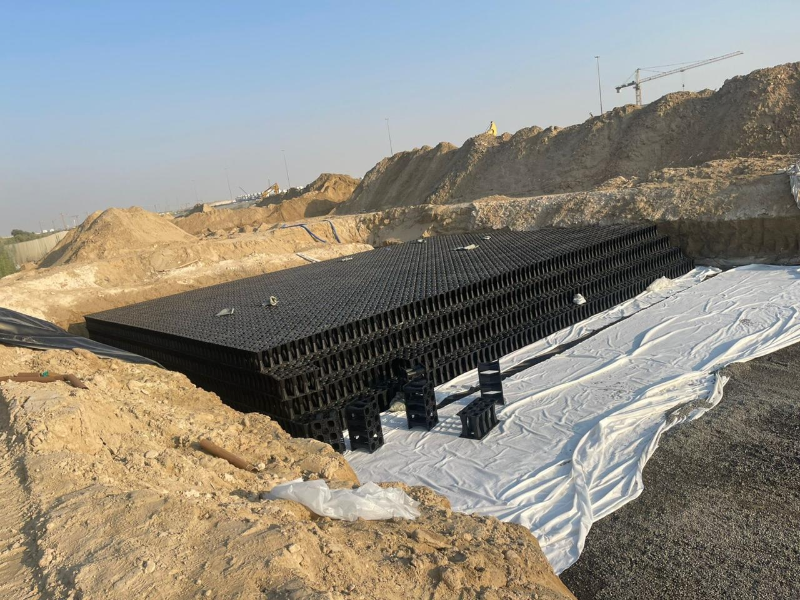
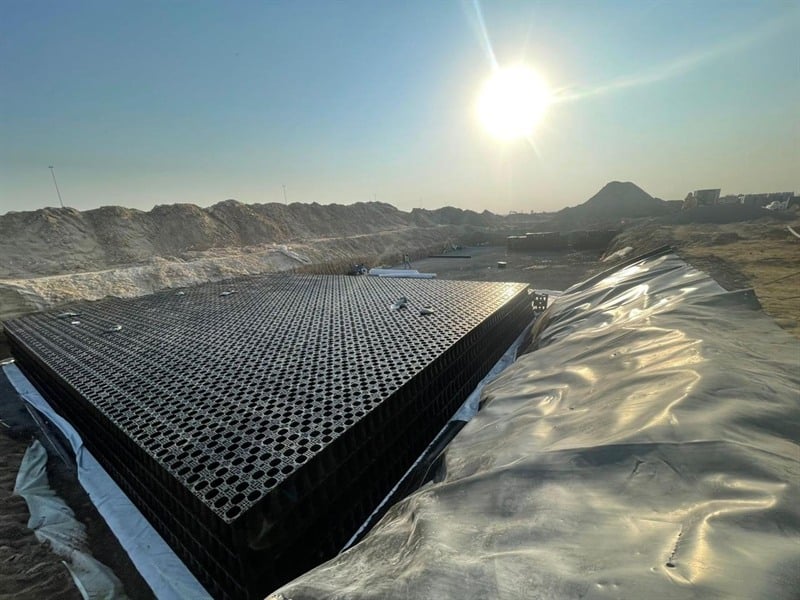
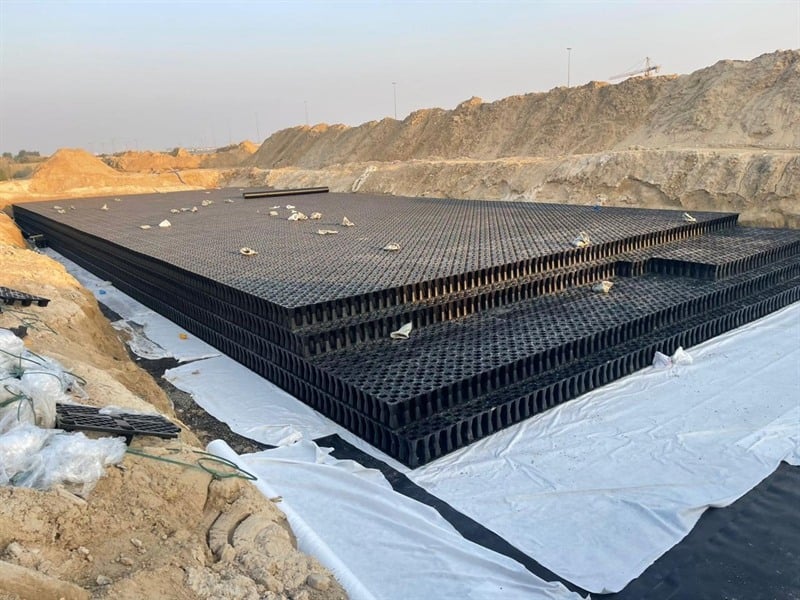
An attenuation tank stores surface water runoff underground during a storm and releases it to the sewer or watercourse at a restricted rate, so the downstream drainage network never sees the peak. We manufacture the geocellular crates that form that storage: injection-moulded in our own plant, supplied with the geotextile, geomembrane, connection and access components that turn a stack of boxes into a working system.

Attenuation Tank Systems, Geocellular Attenuation Crates
20–60 t/m²
Four nominal load grades
H400 / H500
Two module heights
190 / 237.5 L
Storage per module
95%
Void ratio
ISO/IEC 17025
Third-party load test
15–30 days
Typical lead time

When a Site Needs Attenuation Rather Than Infiltration

One major roadblock in obtaining planning consent for new developments is a predicted post-construction runoff rate exceeding the carrying capacity of the existing network. Typically, the solution is to install a storage system: capture the peak event flow underground, then release it at a lower, more manageable flow to the existing network.

Whether storage should be a soakaway and allow infiltration or an attenuation tank that keeps water in the system depends upon the soil conditions at the site, not on personal preference. Dense clay, high water tables or contaminated soils prevent infiltration, leaving an impermeable stormwater attenuation tank as the only feasible solution.

What arrives is roof rainwater and paved-area runoff, moving far faster than the pre-development catchment ever delivered it. Storage buys the network the time that the hard surfaces took away.

Attenuation and Soakaway Geocellular Storage

The same thing, under six different names

Specifiers, merchants and approving bodies rarely agree on terminology, which makes like-for-like comparison harder than it should be. A cellular attenuation tank, a drainage attenuation tank, a set of attenuation crates and a geocellular attenuation tank are the same construction: modular plastic void formers, wrapped, buried and flow-controlled. Where the words genuinely diverge is material class. Precast attenuation tanks are a different product with different plant, different geometry and different standards, covered in the comparison further down. Water attenuation systems built from crates are what this page specifies.

That terminology gap carries real commercial risk. A specification written for one product family and priced against another is a common source of tender inconsistency, and it usually surfaces late, after excavation depth has been fixed at 400 mm module increments and the site has no room to change approach.

SYSTEM SPECIFICATIONS

Attenuation vs Soakaway, the physical difference is the wrap

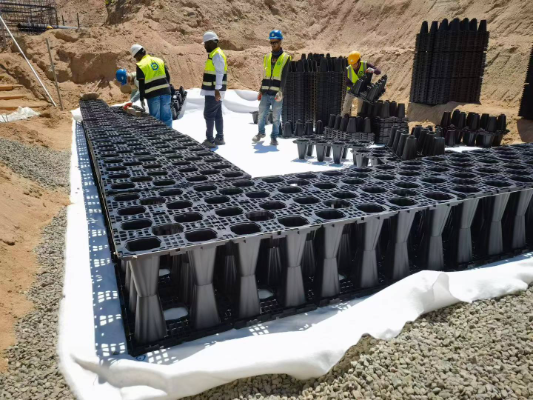
Physically the crate is identical. Wrapped in permeable geotextile, the same modules become a soakaway and water percolates into the surrounding soil. Wrapped in an impermeable geomembrane, they become a sealed attenuation tank and water leaves only through the outlet.

That single decision changes the accessories, not the product. If your ground conditions favour infiltration, our soakaway crate range uses the same StormGrid modules with a geotextile build-up.

Because a sealed tank provides contained, impermeable storage, it works in ground conditions where infiltration cannot, which is why attenuation is the usual route on urban and brownfield sites where surface water runoff has to be controlled irrespective of soil type.

Key Technical Advantages
  • Being sealed, underground attenuation tanks perform independently of soil type, so a failed percolation test does not stop the scheme.
  • Car parks, access roads, landscaped areas and yards can all be built over the storage system.
  • Being modular means the stored volume footprint can match the available site space without being restricted to a rectangular layout.
  • Release rate is controlled by a vortex or orifice flow control device at the tank outlet in accordance with the parameters agreed with the approving authority.
Limits & Cost Considerations

One honest limit is worth stating early. Geocellular storage is a water quantity control; susdrain rates its water quality treatment and amenity potential as poor. It belongs inside a wider management train, not as a substitute for it.

Unlike a soakaway application, an attenuation application is not always the cheaper route on a permeable site — where infiltration genuinely works, it usually wins on both excavation and long-term maintenance. Confirm against your percolation results before committing to a sealed 500 m³ tank.

Not sure which route your ground conditions allow?

Get a free module layout drawing for either build-up →

StormGrid Attenuation Tanks: Grade and Height Selection

Choosing a crate-based attenuation system comes down to a two-stage process. First, choose the load-bearing grade of crate required by the finished surface and, second, select the height which is appropriate for the excavation depth of the trench. Module count, footprint and accessories will be determined by the two preceding choices.

Geocellular attenuation tank sizes are therefore not a catalogue of fixed vessels. Your tank is whatever the module grid adds up to, which is why the useful question is grade and height rather than “what size do you stock”.

Attenuation Tank Installation Grid

Why the height column matters more than it looks

Almost every crate sold into the UK comes in one height: 400 mm. Adding the H500 option changes the arithmetic — the same storage volume needs 4.2 modules per cubic metre instead of 5.3, which is roughly 20% fewer parts to handle, clip and inspect.

Where excavation depth is the binding constraint, H400 still wins. Where footprint is tight and depth is available, H500 buys storage density.

Most specification errors concerning the load-bearing grade fall into two categories. Over-specifying a heavy grade to sit beneath a landscaped area is cost without any corresponding benefit. Under-specifying beneath a service yard is the failure nobody recovers from cheaply.

Whatever sits above the tank, and the vehicles that will use it, decide the grade. In practice that means a landscape application and an industrial yard application rarely share a module, even on the same 3,000 m³ scheme.

Once the grade and height are fixed, the storage volume itself comes from the discharge rate your approving body will accept. That calculation belongs to the design stage, see attenuation tank design and installation for how discharge rate drives the volume you actually need.

The Attenuation Grade & Height Selector

Scope of this table. This is a product pre-selection aid, not a structural design method. Site-specific structural adequacy — cover depth, surround, groundwater, traffic loading — is determined by a CIRIA C737-consistent design carried out by the project’s drainage or civil engineer.

Model Nominal Grade Material Typical Surface Above Height Storage / Module Modules per m³
SG-E20 20 t/m² Recycled PP Landscape, garden, non-trafficked H400 190 L 5.3
SG-E20 20 t/m² Recycled PP Landscape, garden, non-trafficked H500 237.5 L 4.2
SG-L30 30 t/m² Recycled PP Verges, footpaths, low-load public areas H400 190 L 5.3
SG-L30 30 t/m² Recycled PP Verges, footpaths, low-load public areas H500 237.5 L 4.2
SG-M40 40 t/m² Recycled PP Commercial sites, light parking, campus drainage H400 190 L 5.3
SG-M40 40 t/m² Recycled PP Commercial sites, light parking, campus drainage H500 237.5 L 4.2
SG-H60 60 t/m² 100% Virgin PP Heavy parking, industrial yards, road-adjacent H400 190 L 5.3
SG-H60 60 t/m² 100% Virgin PP Heavy parking, industrial yards, road-adjacent H500 237.5 L 4.2
SG-Custom Project-specific Project-specific Non-standard loading or geometry Custom / H400 / H500 By configuration By configuration

What a Load Grade on a Crate Actually Means

Structural performance and loadbearing crate testing

Here’s the uncomfortable part of this market, stated by another manufacturer rather than by us:

“The designer must assume that the structural performance and loadbearing characteristics of the blocks are as stated by the supplier.” — Hydro International, stormwater attenuation technical paper

The designer is rarely in a position to verify those numbers independently. It follows that the provenance of the number — where it comes from, what tests were performed and what assumptions were made — is critical. That information is, however, not typically supplied.

The Nominal-to-Measured Load Band

Our third-party vertical-load testing was carried out by Intertek under an ISO/IEC 17025 accredited laboratory scope, which is what makes the figure auditable rather than asserted. Factory batch values below are a separate, in-house measurement and are labelled as such.

A nominal grade is a design classification, not a measurement of the crate in your hand. Our factory batch testing typically returns values above the nominal grade, and we would rather publish the band than quietly imply the two are the same number.

Model Nominal grade (design value) Typical measured in factory batch testing What the gap is for
SG-E20 20 t/m² Above nominal Manufacturing tolerance and batch variation
SG-L30 30 t/m² Above nominal Manufacturing tolerance and batch variation
SG-M40 40 t/m² approx. 46–47 t/m² Margin between the published design value and a sampled unit
SG-H60 60 t/m² approx. 65 t/m² Margin between the published design value and a sampled unit

Read this correctly. The measured figures are typical values from factory batch testing of sampled units. They are not a certified grade, not a guaranteed minimum, and not a substitute for the nominal design value. Specify against the nominal grade; treat the measured band as evidence of margin, nothing more.

Two further things a load number doesn’t tell you. It’s a vertical figure, while deep installations are governed by lateral earth pressure, and crates are generally weaker in the lateral plane. It also says nothing about the surface cover class above the tank, which is a separate question covered on our heavy-duty D400 page.

“We publish the nominal grade and the measured band separately because they answer different questions. The nominal value is what your designer specifies against. The measured value only tells you how much margin sat in the sample we tested, it is not a promise about the pallet that arrives on your site.” — Storm Manage Engineering Team

This creates a trade-off worth naming. Publishing a measured band invites the question “why is your nominal number lower than your test result”, whereas publishing a single flattering figure never does. We think the first conversation is the one an engineer actually wants to have.

For a production application, the practical check is simple: ask any supplier what the number is, where it was measured, and on how many units. A 60 t/m² claim with no answer to the second and third questions isn’t evidence.

Want the underlying document rather than our summary of it?
Request the Intertek vertical-load test report →

Geocellular, Concrete or GRP: What Actually Drives the Choice

Comparison tables that rank these three materials by cost are common and, as far as we can establish, unsupported. We looked for a defensible quantitative comparison and didn’t find one, so we aren’t going to invent one.

The US Environmental Protection Agency’s underground storage guidance puts it plainly: costs vary greatly with material, excavation, construction, installation and the storage volume required. How far that variation can run is worth absorbing, an EPA Office of Inspector General review of one combined-sewer storage tank recorded a final cost exceeding $1 billion against an original $78 million estimate.

Therefore, the only honest table of comparison isn’t one that ranks these materials but one that details the criteria that will lead you to an answer for your site.

Material Comparison Evaluation
HOVER TO SCAN LAYER
SYSTEM ANALYSIS
  • STRUCTURAL: TARGET LOAD EVALUATION
  • EXCAVATION: DEPTH & FOOTPRINT ANALYSIS
  • MAINTENANCE: INSPECTION ACCESSIBILITY
  • LOGISTICS: SITE HANDLING & PLANT
Decision criterion Geocellular crates Precast concrete GRP tank
Storage per excavated volume 95% void ratio Reduced by wall thickness Reduced by wall thickness
Product standard covering it BS EN 17152-1:2019 Precast concrete standards GRP vessel standards
Shape adaptability Follows irregular footprints module by module Fixed unit geometry Fixed vessel geometry
Site handling Man-portable parts, 4.8 kg per module Lifting plant required Lifting plant required
Internal inspection access Depends on the crate’s internal geometry Generally walk-through or camera Generally accessible
Delivered volume per container Ships flat-packed, assembled on site Ships as finished volume Ships as finished volume

Notice which row we didn’t fill in with a winner. Cleaning access is the criterion the technical literature flags hardest, and it varies by crate design rather than by material class, which is why it sits in the maintenance section below rather than in a marketing comparison.

Three-material comparisons carry a trap: they compare products while projects buy outcomes. A concrete solution that needs a crane, a road closure and a 6 m excavation isn’t always more expensive than crates on paper, but it’s a different construction risk profile, and that’s where budgets actually move.

For a heavily trafficked 6 m deep tank with walk-through inspection on a constrained footprint, we often don’t win, whereas for a deep, regular, heavily trafficked chamber with walk-through inspection requirements, it often does not.

Working through a material decision for a live scheme?
Get a free module layout drawing for your target storage volume →

The Complete Attenuation System, and How It Stays Serviceable

At its heart, a tank is simply a stack of crates plus the various parts required to make it watertight, connectable and cleanable. Supplying only crates means that it falls to the customer to source those extra parts from three separate suppliers.

Component Function in an attenuation build-up
Geomembrane Impermeable liner — this is what makes it an attenuation tank rather than a soakaway
Geotextile Protection and separation layer around the membrane and modules
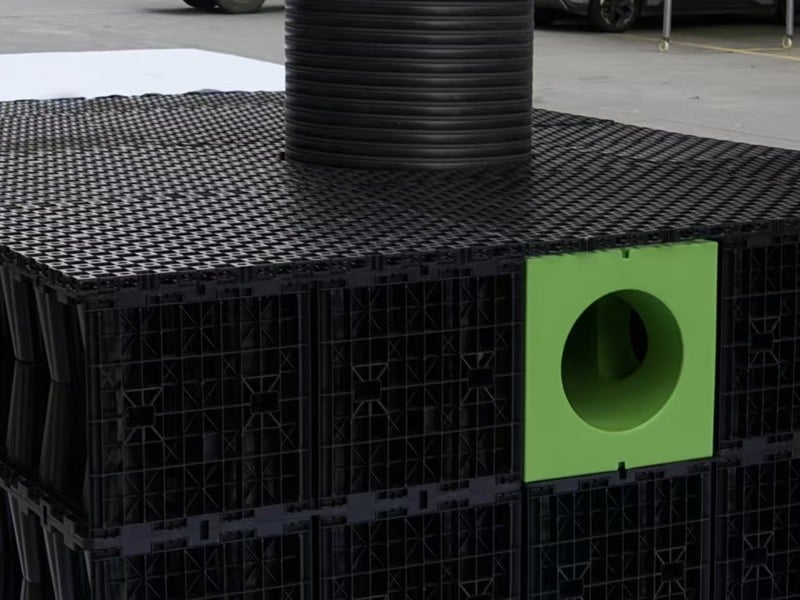
Pipe connecting box Brings inlet and outlet pipework into the module block and distributes flow to the flow control chamber
Inspection well base Creates the access route for inspection, jetting and silt removal
Side plates and top covers Close the perimeter and cap the stack — 6 side plates and 10 top covers per module set
Big and small clips Lock modules to each other vertically and cap the top layer

Every component above is produced under the same ISO 9001 quality management system as the modules themselves — a system certification, not a performance rating for any single part.

Access, Silt Management and Long-Term Maintainability

Attenuation tank maintenance is the failure mode with the most consistent evidence behind it, and the one buyers ask about most:

“Loss of effective storage volume (siltation) – this is an ever-present threat to buried tanks.” — Hydro International, stormwater attenuation technical paper

Silt doesn’t arrive by accident. It arrives because upstream pre-treatment was undersized, skipped, or never maintained, and the industry is blunt about the consequence: “Some crate systems are recognised to be difficult to clean out once silt has entered the tank.”

Remediation economics are worse than prevention economics by a wide margin. As one technical paper puts it, “If a modular tank fails due to poor installation, expect high costs to remediate.”, a 500 m³ tank under a live car park isn’t a cheap thing to reopen.

  1. A silt trap or catchpit upstream of the inlet is the cheapest way you will ever protect storage volume.
  2. Inspection well bases belong in the design stage, not retrofitted after adoption is refused.
  3. Technical literature points to roughly annual inspection for buried tanks.
  4. Flotation of an empty tank is a real failure mode wherever the water table can sit above the tank base.
Attenuation system components and maintainability

Engineering note, membrane specification against groundwater

Where site investigation shows groundwater can rise above the base of the tank, a lapped-and-taped membrane is the wrong specification. The Hydro International technical paper calls for a heavy-duty membrane with heat-welded watertight joints, because groundwater entering the block occupies the attenuation volume you were paid to provide.

One boundary we hold to: the flow control device that sets your discharge rate is specified by the project’s drainage engineer, not by us. We supply the tank, the wrap and the connections it fits into.

Unlike buying crates on their own, a full component set removes the interface risk of sourcing membrane from one merchant, connectors from another and access chambers from a third. For an OEM or repeat-scheme application, it also means the build-up is identical from site to site.

Working through a material decision for a live scheme?
Get a free module layout drawing for either build-up →

Certification and Test Evidence, and What Each One Does Not Cover

Certification badges are worth exactly as much as their scope, and scope is the thing nobody prints. So here’s ours, with the limits attached.

SCOPE 01
BS EN 17152-1:2019
HOVER TO DECRYPT

The current product standard for thermoplastic boxes used in underground infiltration, attenuation and storage of non-potable water.

SCOPE 02
ISO/IEC 17025 load test
HOVER TO DECRYPT

Third-party vertical-load testing carried out by Intertek under an ISO/IEC 17025 accredited laboratory scope.

SCOPE 03
ISO 9001
HOVER TO DECRYPT

A quality management system certification — it certifies how we run the factory, not the performance of a crate.

SCOPE 04
BBA — not held
HOVER TO DECRYPT

We do not hold a BBA certificate and do not imply one. Third-party approval of this type is generally advised where a product is not already covered by a standard.

Three scope limits we would rather you heard from us

That last one is the mistake we see most often, and it’s easy to get wrong in good faith. A supplier holds a genuine certificate, the certificate genuinely covers something, and the gap between what it covers and what the buyer assumed goes unexamined until an approving body asks. Confirm against the scope statement, not the badge.

  • 1.
    Product conformity is not system safety. BS EN 17152-1 specifies the box, materials, geometry, mechanical and physical characteristics. Its published scope, as catalogued by the standards bodies, notes that specifications and design rules for systems are to be described in Part 2 of EN 17152. A supplier telling you a crate is standard-compliant has therefore told you nothing about whether the tank design is adequate. Read the standard itself before relying on this point in a submission.
  • 2.
    Our load report references a superseded design guide. The Intertek vertical-load testing was performed to the CIRIA C680 method. CIRIA is explicit that C737 supersedes C680 and that designs should now be based on C737, with the former guidance no longer used for that purpose. We treat the report as load evidence, not as a current compliance credential, and your structural design should follow C737.
  • 3.
    A pipe standard isn’t a crate standard. On its published scope, EN 1852-1 (2018 edition, confirm the current edition before citing it in a submission) covers polypropylene non-pressure underground drainage and sewerage pipes, fittings and piping systems. Where a CE marking references it, that marking relates to pipework components rather than to the structural performance of a storage box, so we don’t present EN 1852 as crate load evidence.

Manufacturing, Container Loading and Lead Times

Capacity questions are usually a proxy for a different question: can you actually deliver a scheme this size, on time, more than once. Everything below is our own operating data.

What a contractor is really pricing here is a programme delay, not a unit rate. A drainage package that slips three weeks because the supplier couldn’t mould 3,000 m³ inside the window is a problem that no discount repairs, which is why capacity and lead time belong on the page rather than in a follow-up email.

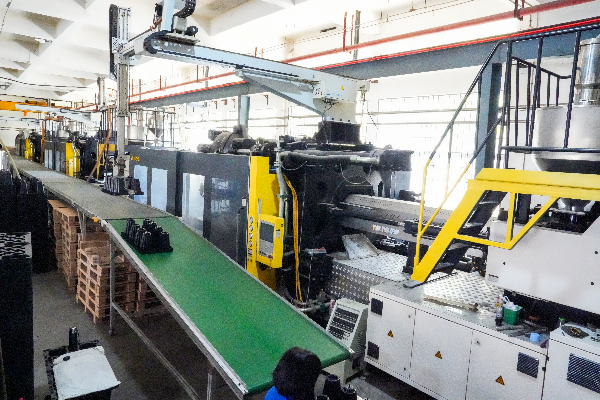
Storm Manage engineers and moulds every component in-house, because an OEM supply chain that subcontracts the moulding is the root cause of most capacity surprises. It’s this approach that provides real certainty in lead time for a production-quantity order in an industrial or infrastructure environment.

Item Figure
Factory footprint 8,000 m², Shenzhen, Guangdong
Injection moulding machines 8 sets, 1000T to 2000T
Mould sets 12+ across modules, side plates, top covers, clips and accessories
Monthly output approx. 5,000 m³ of finished modular storage
Annual capacity 60,000+ m³
Typical lead time 15–30 days after order confirmation
Loading ports FOB Shenzhen / Yantian / Shekou; Qingdao and Ningbo by arrangement

Container economics, stated precisely

A 40HQ container carries enough flat-packed module parts to assemble into up to approximately 330 m³ of installed storage volume with optimised stacking. That figure is the assembled storage the shipment yields on site, it is not the container’s internal volume, which under ISO 668 is far smaller. Shipping void formers flat rather than shipping finished volume is the whole point.

Lead time is quoted from order confirmation and is confirmed per order rather than promised generically. Unlike a merchant quoting from stock, we’re quoting from a production slot, which is slower for a 20 m³ order and considerably more predictable for a 2,000 m³ one.

Container loading=
Sizing a container load or a phased delivery?
Request a quote with a loading and delivery schedule →
For pricing structure and the landed-cost picture, see attenuation tank cost.

Attenuation Tank FAQ

Same crate, different wrap. A soakaway is wrapped in permeable geotextile so water percolates into the ground, while an attenuation tank is sealed in an impermeable geomembrane so water leaves only through a flow-controlled outlet.

Ground conditions decide which one your site can use, not preference.

Siltation is the most consistently reported problem — silt entering the block reduces effective storage volume, and some crate designs are recognised as difficult to clean once it does. Flotation of an empty tank where groundwater rises above the base is the second, and it’s a design-stage question rather than a maintenance one, because anti-flotation measures can’t be retrofitted to a buried tank without reopening it.

Both are design and maintenance problems rather than product-strength problems. Industry engineering commentary citing CIRIA C737 reports that very few crate failures are attributed to inadequate long-term strength, which is why an installation method statement and a maintenance plan protect a scheme far more effectively than paying a premium for a familiar crate brand.

StormGrid modules are specified to a 50-year design life. Actual service life depends on installation quality, ground conditions and whether upstream pre-treatment is maintained — a well-built tank that’s never desilted will lose effective volume long before the plastic reaches its design life.

Yes, with the grade matched to the traffic and a cover depth and surround designed for it. SG-M40 covers light parking duty and SG-H60 covers heavy parking and industrial yards.

Cover depth and load distribution are a structural design question for your engineer, working to CIRIA C737.

Not necessarily. Third-party approval of that type is generally advised where a product is not already covered by a standard, and geocellular boxes are covered by BS EN 17152-1:2019.

We do not hold BBA certification. We do hold third-party ISO/IEC 17025 vertical-load test evidence and ISO 9001 quality-system certification.

It depends on the company and the scheme. A September 2025 New Civil Engineer survey of the nine England water and sewerage companies found only United Utilities explicitly refusing to adopt geocellular storage, with none of the nine categorically ruling out SuDS adoption.

Confirm the water company’s adoption position early, because it changes where liability sits rather than which product you select.

5.3 modules at H400, or 4.2 at H500.