Infrastructure / Airport / Industrial Drainage System Crates

Geocellular Drainage Tanks for Airport, Port & Industrial Sites

Storm Manage offers modular geocellular tanks designed for stormwater attenuation and infiltration underground in high-load hardstanding, runway apron, container port and heavy-duty industrial paved areas, where a datasheet tonnage alone is insufficient and the load-at-depth case must be demonstrated.

600 kN/m² SG-H60 recorded vertical strength without failure, Intertek third-party test (short-term)
~95% nominal void ratio, 100% virgin PP at the SG-H60 grade
341–356.5 m³ tank volume shipped per 40’HQ container, H500 series
Request a Spec
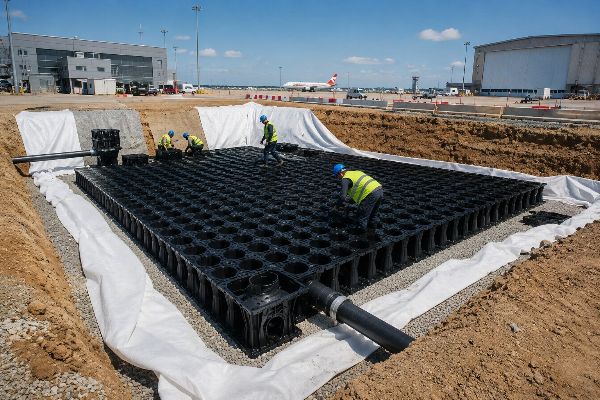
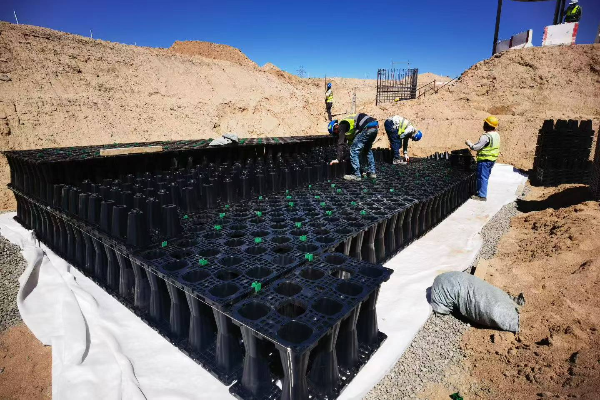
Industrial Drainage System Crates under high load
SG-E20 – SG-H60
load grades, 20–60 t/m² nominal
1000 × 500 mm
module footprint, H400 / H500 heights
190 / 237.5 L
water storage per module
CIRIA C680 + SGS
two independent lab reports
CE EN 1852-1
material conformity (UDEM notified body)
15–30 days
production lead time, FOB Shenzhen

Where High-Capacity Geocellular Tanks Belong

Airport aprons, taxiway shoulders, port terminals and heavy industrial pavements all run into one surface water management issue. Impermeable catchments cause runoff coefficients to exceed 90%, so water arrives more rapidly than the drainage network can remove it during periods of heavy rainfall, when permeable pavement by itself can’t accommodate the volume. In such circumstances a flood risk becomes operational rather than contractual, and the sustainable drainage system must carry the deficit underground.

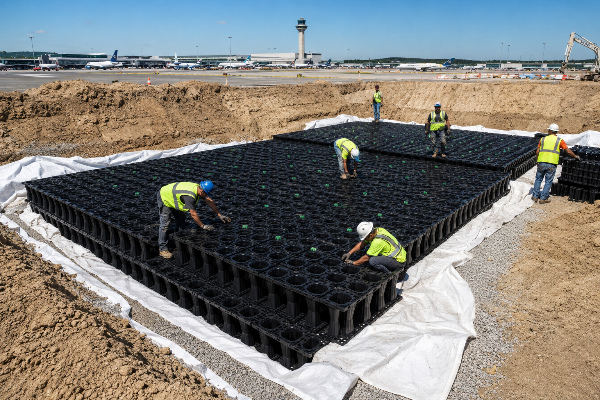
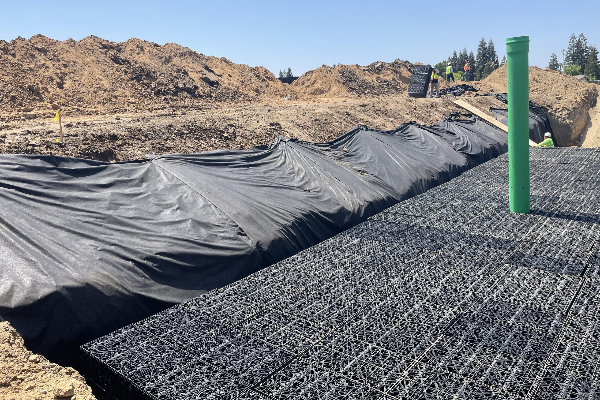
A geocellular tank is a modular buried tank of interlocked polypropylene cells, approximately 95% open, containing surface water runoff for attenuation, detention or infiltration in a site context. For airport, port and industrial hardstanding Storm Manage manufactures these geocellular attenuation tanks up to the SG-H60 rating, which withstood a 600 kN/m² load in a third-party Intertek test, because trafficked cover is the area in which the load-at-depth issue, not the headline tonnage, determines the specification.

A buried geocellular attenuation tank stores the excess surface water and releases it through a flow control at a rate determined by the authority, which is the only water control to influence the entire scheme. Attenuation measures on high-load sites are designed for storm water volume plus vehicle loading, cover depth and long-term creep. Storm Manage designers each rate that buried load case, because a module designed to 600 kN/m² in the lab still deforms when covered for decades, and the test standards call for failure at a strain threshold of 6%.

  • Sub-surface stormwater storage installation below airport pavements
    Airport pavements

    Sub-surface stormwater storage below aprons, taxiways and airside roads. Pavement structural design remains with the project engineer per FAA Advisory Circular 150/5320-5; our tank is rated for its buried load case, encountered at 800-1000 mm of cover, and isn’t certified as a pavement.

  • Water attenuation tanks beneath heavy port and container-terminal hardstanding
    Port and container-terminal hardstanding

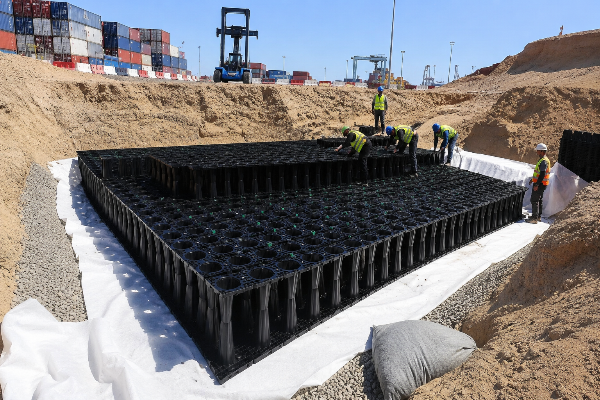
    Requires water attenuation beneath trafficked yards, where straddle-carrier and stacker loads specify the SG-H60 or SG-Custom grade.

  • Virgin polypropylene geocellular modules for heavy industrial sites
    Heavy industrial sites

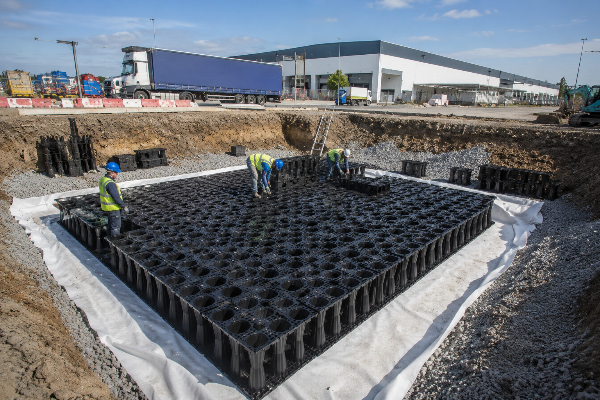
    Including warehouse yards, logistics parks and roadside hardstanding, have regular and heavy traffic loadings from cars and HGVs, so they use 100% virgin polypropylene modules, moulded in-house at 1000 × 500 mm.

  • Geocellular stormwater system for roof and hardstanding catchments
    Roof and hardstanding catchments

    Use the same modular geocellular stormwater system for rainwater management and rainwater harvesting when lined with a membrane rather than wrapped for infiltration, so one product line can manage stormwater across an entire estate.

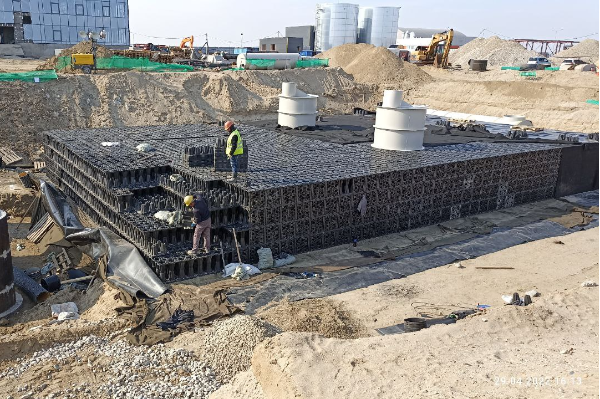
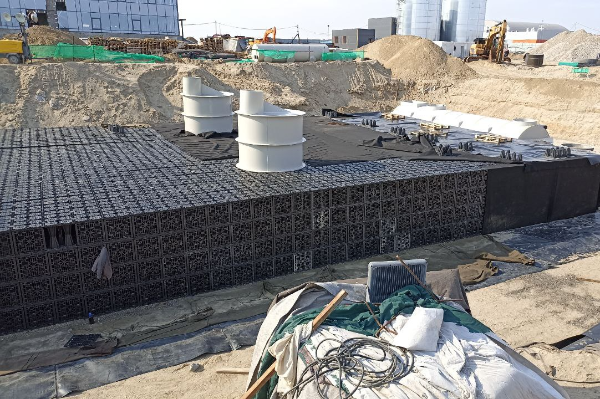
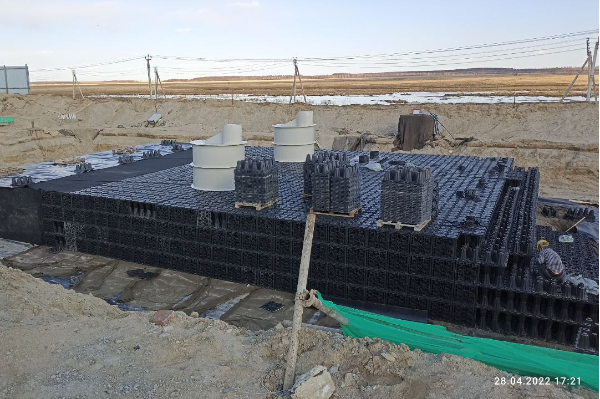
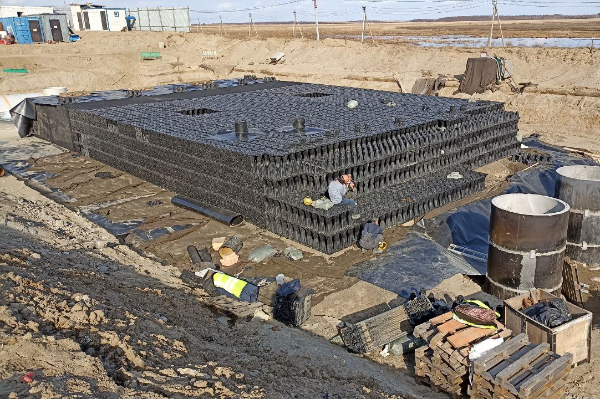
  • Geocellular systems deployed in a composite structure at a Russian Far East industrial facility
    Russian Far East · industrial facility

    A composite structure, not a bare tank

    Collected, filtered and buffered prior to discharge, runoff from an industrial yard means the local geocellular systems carry the storage role as well as the interface to upstream filtration. The grade specification was dictated by trafficked cover, with a silt trap up-stream protecting the void from the sediment load that yard traffic generates.

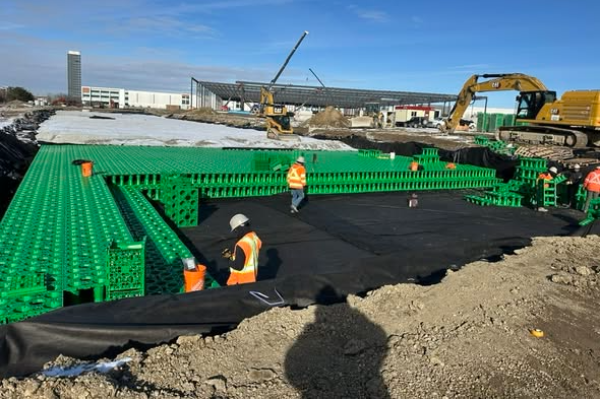
  • Underground stormwater management tank under Highway 50 corridor in Brampton, Ontario
    Brampton, Ontario · Highway 50 corridor

    Attenuation under a road corridor

    An underground stormwater management under a highway corridor places the tank under repeated vehicle load with limited cover, which isn’t the design condition for a car-park grade. It’s schemes of this type on roads where the grade choice becomes much more significant than just a difference in catalog depth for a light duty and a heavy duty module.

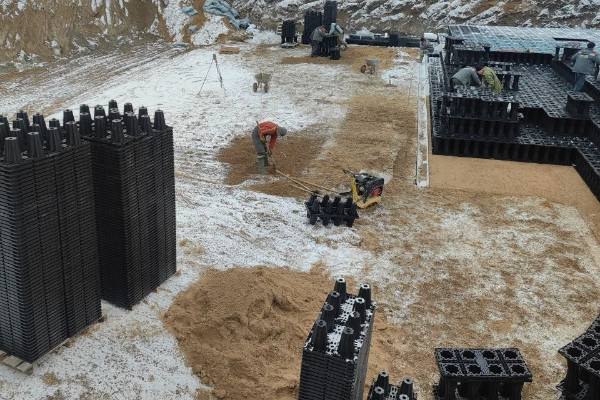
  • Economy light grade geocellular tank specified for an infiltration facility in Northern Europe
    Northern Europe · infiltration facility

    When the light grade is the right call

    Not all sites demand SG-H60. In infiltration, this non-trafficked area simply meant we were able to specify the economy light grade which cost less without a compromise to actual capacity, and that the value of heavy-duty modules wouldn’t have been used.

In contrast to most of this market Storm Manage will not claim an airport reference project; it’s the truthful position that none of the providers we’ve audited publish an independently verified apron case study either. However we can demonstrate how the grade decision differed on three actual schemes.

Request the Cover-Depth Grade Guide →

The Load Question Every Geocellular Tank Spec Sheet Dodges

Many geocellular tank makers specify just one number: ‘60 Tonnes/m²’ without mentioning depth, standard or even providing a test report. This is a costly mistake, since this figure represents the ultimate short term strength, and engineers rarely specify from it; Polypropylene creeps under static load and the 50 year design strength of the product will be considerably less than this ultimate value, which could result in an under specified project with a deformation risk you haven’t factored in to your budget.

Cover-Depth-to-Grade Ladder

Think of this as an initial estimate, and not a definitive specification. All final grade selection must be calculated per project using the load data, specified cover, and structural design calculations performed in accordance with CIRIA C737:2016.

Site & Traffic
Typical Cover
Starting Grade
Why
Landscape, non-trafficked areas
from ~250 mm
SG-E20 / SG-L30
foot and amenity loading only
Car parks, light commercial
0.8–1.5 m
SG-M40
measured typical ~46–47 t/m²
HGV yard, heavy industrial
0.8–1.0 m minimum
SG-H60
100% virgin PP; construction loading is often the worst case
Airport / port hardstanding
project-specific
SG-H60 / SG-Custom
per-project C737 calculation, minimum & maximum cover checked

One published certificate is instructive; a UK BBA certified alternative recycled-PP crate quotes a short-term strength of 363 kN/m² that comes down to a 50-year design value of only 72.4 kN/m² (with characteristic strength quoted at a 6% strain limit), and their approval only extends to car parks and road traffic up to 15mph (which excludes trafficked yard conditions). Storm Manage use the 50-year creep-reduced value (e.g., 800-1000mm of cover for heavily trafficked paving) not a catalog tonnage.

“We size the tank from the creep-reduced design strength and the worst cover case, never the headline crush figure. On a container yard that usually means the SG-H60 grade with a granular surround, and a signed C737 calculation on file before a single module goes in.”
Storm Manage Application Engineering Team
Industrial Drainage System Crates heavy duty construction load
[ SYS.RDY // 90.04 ]
+

Why the module is rarely what fails

While stacked, load-bearing cell geometries have been documented in the patent literature, this alone doesn’t determine trafficked design success. In practice, construction plant tracking over shallow cover during installation is a common cause of failure before the pavement is laid, so Storm Manage requests this temporary work condition in all enquiries.

Geocellular Tank Load Ratings: Independently Tested, Not Self-Rated

Storm Manage publishes two distinct laboratory reports for the StormGrid module rather than one catalog ton capacity; one third-party laboratory-tested (including a 40°C conditioned run) and the other, tested in-house by us, under our specifications (the third-party test was run under an ISO/IEC 17025 process, ours to a method we specified rather than an accredited standard), so the specifying engineer knows which is which.

Source (report) Vertical Lateral / section Basis and its limits
Intertek, third-party, ISO/IEC 17025 (190702149GZU-001) 600 kN/m² (≈61 t/m²) 186 kN/m² run-out: 300 kN cell reached capacity, specimen did not break — a lower bound, short-term only
Intertek, after 40°C conditioning 600 kN/m² 179 kN/m² short-term; method cited as CIRIA C680:2008, superseded by C737:2016
SGS, witnessed at our laboratory (XMIN2401000036PL04) 468.5 kN/m² 121.9 kN/m² SG-M40 module; method = client requirement, not a published standard — a supplier test, not third-party accreditation
Market reference: BBA-certified PP crates 363–439 kN/m² short-term independently resolved to 72–76 kN/m² design strength at 50 years
Industrial Drainage System Crates module structure

Why the biggest number is not the useful number

Our SG-H60 short-term result is the highest in that group, yet every crate's tonnage collapses once the partial safety factor and 50-year creep are applied. That is the structural reason a strong laboratory value can still be the wrong specification, and it is where most import risk stays hidden. One of those certificates describes it explicitly: an ultimate strength must not be used to derive a design strength directly.

What we do not yet hold

Storm Manage issues no independently derived 50-year design strength, as since no competent authority has run the BS EN 17151 long-term compression programme on our module, we do not have one. We have a 60-ton creep test record, and issue it on request, and the values above are short term. Any bidder who quotes you a design strength should be able to name the certifying body which derived it; if we cannot, we prefer to say so than borrow someone else's number.

Material grade rule

Grades below 50 t/m² use recycled polypropylene, the SG-H60 heavy duty grade is 100% virgin polypropylene. That fixes an online statement that geocellular attenuation crates are "100% recycled"- at the heavy duty end they aren't. Our in-house production line tests the virgin-to-recycled ratio and the weight in grams for each batch as we go, because material substitution is the problem no-one sees until the tank deforms.

How Much Geocellular Tank Storage Ships in One Container

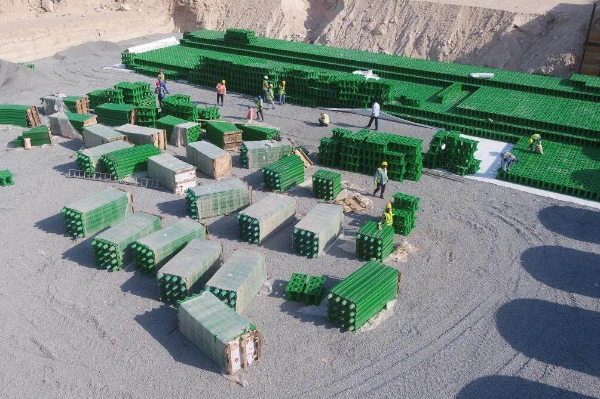
As modules stack flat and re-assemble on site, delivered stormwater store per container is a real buying factor- and one no rival publishes. Each 1000 × 500 mm module holds 190 L in the H400 height, so freight, not the moulding, is where an imported tank becomes costly. Our 40-Foot Attenuation Yield Index below draws on in-house data from the Storm Manage packing specification.

Industrial Geocellular Tank Storage Containers

Size on net volume, not the headline void

That ~95% void is a nominal geometrical figure, and using it as spare storage space is a typical sizing error in stormwater management. susdrain records gross void ratios of up to 96% for geocellular systems, along with the proviso that trafficked use requires proven structural performance. What the gross figure lacks is structural displacement, and silt.

Where the gross void goes

UK supplier guidance puts effective stored water at more like 82-87% of the gross figure, once column displacement and a silt allowance are included; that range is trade guidance, not a certified value, and your own designer should set it. Trade commentary citing CIRIA C753, the SuDS Manual, recommends adding around 10% for sediment to the design volume of hard-to-clean storage — a routine allowance in attenuation tank design. Public sizing advice such as the Connecticut Stormwater Quality Manual adopts the same net-volume approach.

Why flat-pack delivery decides installed cost

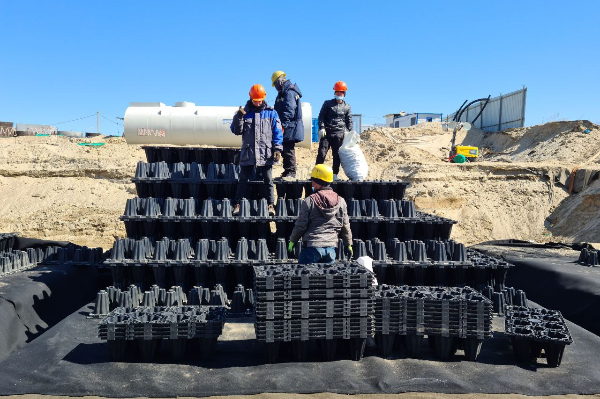
Flat-packed delivery is where the cost-effective case actually sits, because a project that needs 300 m³ of geocellular storage will dispatch in one 40'HQ container rather than the multiple loads a precast concrete storage tank would need. Unlike precast, our production is designed for nesting: excavation, transport and lifting- rather than unit cost- are the major installed cost drivers, and unaccounted for freight is where an imported scheme becomes costly. Storm Manage provides the module count, pallet split and container plan with every quote.

40-Foot Attenuation Yield Index

Container H500 series (237.5 L / module) H400 series (190 L / module)
20' standard 132.5 m³ 112 m³
40' standard 291.5 m³ 246.4 m³
40'HQ 341 – 356.5 m³ 281.6 – 294.4 m³

Storage Method Comparison (300 m³ Scheme)

Storage method Deliveries to site Usable storage Heavy load, shallow cover Installed cost, published ranges
Geocellular modules 1 × 40'HQ container, no lifting plant gross void up to 96%; nets to 82–87% needs 0.8–1.0 m cover and a C737 calc £200–350 / m³
Precast concrete tank multiple flat-bed loads, craneage close to gross internal volume copes with cover under 500 mm and severe point loads £400–600 / m³
Oversized pipe storage pipe lengths plus bedding stone gross pipe volume; bedding adds excavation depth limited by pipe stiffness class £300–500 / m³
SYS.YIELD.01

1 × 40' HQ

One high-cube container delivers the 300 m³ scheme above, against the multiple flat-bed loads and craneage a precast tank needs. That is our own packing data, and freight, excavation and craneage — not the module price — are what move an installed cost. Precast still wins on shallow cover and severe point loads, which is a trade-off worth pricing before the scheme is fixed.

!

Market Commentary

Cost ranges in the table are published by UK drainage suppliers (2025–2026) and disagree with each other — one puts attenuation tanks at £200–500 / m³ regardless of type. Treat them as indicative market commentary, not as a quotation. Storm Manage holds no first-party cost data and prices against your volume, grade and cover depth.

Need the module count for your storage volume?

Geocellular Tank Specification: Module, Accessories & Component System

A geocellular tank is an infiltration system or an attenuation system built from the same 1000 × 500 mm StormGrid module: geotextile-wrapped where water soaks away, geomembrane-lined where it is held and released under flow control. Silt traps and inspection access sit upstream, because the crates give you water storage rather than water quality treatment, and a silted tank quietly bleeds the volume you paid for. Unlike a sealed vessel this is not a fit-and-forget asset, and in practice the maintenance regime is what protects the design life.

Attenuation tanks and soakaways configurations

Attenuation tanks or soakaways: one module, two systems

Choosing attenuation or infiltration is a site decision rather than a product one. Where the ground percolates and the water table sits at least a metre below the base, a soakaway crate configuration lets water flow into the sub-soil; where it does not, a lined tank buffers excess water and protects the network. Attenuation tanks and soakaways therefore share one module across our water management solutions, and either attenuation or soakaway build-up counts as sustainable drainage on the specific site while helping reduce flood risk.

StormGrid crate structural components and details

What is actually in a StormGrid crate

A StormGrid crate can be disassembled into two 4.8 kg (2 modules combined) load-bearing components, ten 0.065 kg top covers and six 1.03 kg side plates, secured by means of a large-and-small clip mechanism instead of welded joints or adhesive. Thus if one plate breaks down it's easy to replace on-site without having to destroy the entire crate. This structure relies on the clip-and-plate mechanism to transmit load path as detailed in the patent literature on stacked interlocking cell geometry.

Around the centre structure there's a geotextile infiltration construction weighing 300 g/m² wrapped around an HDPE/LLDPE geomembrane 1.0–1.5 mm liner (60 mil), providing an attenuation construction, linked by pipe boxes DN200/300 and DN600/700 and a DN800 inspection well base to other silt traps and access points.

Need the accessory list for your build-up?

Request the full spec sheet and test reports →

Procurement: Ordering, Installation Practice & Factory Capacity

What a UK specifier actually needs from us

A crate does not need to carry a BBA, Kiwa or WRc certificate for specification but without a structural engineer’s signature, the submission document won’t get out of the in-tray. The actual approval process depends on the CIRIA C737 classification of a project combined with product conformance to BS EN 17152-1. These are all subject to agreement with the Water Company and Lead Local Flood Authority in accordance with the Schedule 3 Flood and Water Management Act 2010. We provide all supporting Independent Intertek/SGS reports, creep records and per-project calculation for these solutions to minimize delays caused by late information not the design module itself.

Granular surround, not as-dug clay

Granular surround, not as-dug clay, is what holds tank shape under load. Industry case reports describe one commercial car park where clay sidefill left 40 mm of surface sag within three months, and remediation cost several times the module spend; backfill instead in 150 mm layers of Type 1 or Type 2 sub-base, keep compaction plant within the roller limit, and protect the wrap with a sand blinding. Not every water company adopts modular systems into its network either, so confirm acceptance with the adopting authority before you specify.

Factory capacity behind the lead time

Storm Manage makes every one of its modules at an in-house 8,000 m² facility that it has operated since 2014 and runs eight injection machines, 1000 to 2000 tonnes apiece, across twelve plus mould sets for a monthly throughput of some 5,000 m³ of products and upwards of 60,000 m³ a year. It's this scale that enables that 15-30-day lead-time even on a bespoke SG-Custom, as a mould change doesn't necessitate waiting in a third party's order queue.

Industrial drainage system crates manufacturing and storage facility

Ordering item Commitment

  • Design life 50-year design intent, supported by a 60-ton creep test report; adoptable drainage design lives run 50–120 years, so creep evidence carries the argument
  • Lead time 15–30 days after order confirmation
  • Shipping terms FOB Shenzhen, Yantian or Shekou preferred; Qingdao or Ningbo negotiable
  • Batch quality control compression performance, dimensional tolerance, virgin-to-recycled PP ratio, per-unit weight — every production batch
  • OEM / ODM custom load class, mould development, logo and packaging for distributors and project developers with specific requirements

Compliance & Standards

  • Intertek CIRIA C680, ISO 17025 process
    Report 190702149GZU-001
  • SGS Witnessed compression
    XMIN2401000036PL04
  • CE / EN 1852-1 UDEM notified body
    M.2024.206.C96869
  • BS EN 17152-1 stormwater box product standard
    design to CIRIA C737

A modular stormwater storage system, manufactured from inter-connecting polypropylene cells which offer approx. 95% void content, the cells can be installed to suit an attenuation or infiltration system and provide effective containment of surface water run-off from roofs, car parks and hardstandings, whilst controlling release under flow control, or infiltrating to ground if so designed. Design depends on required volume, traffic and prevailing ground conditions and can be assembled to suit these specific needs and any site build up is considered appropriate for the specific circumstances.