We use the details you submit to review and respond to your project enquiry. Entries are handled in this website’s WordPress database using Fluent Forms; our hosting and email providers may process the submitted details. Other technical providers receive only the data described in our Privacy Policy.
Please do not send passwords, payment-card details, government identification numbers, sensitive personal data, or unnecessary confidential third-party information.
Commercial rainwater harvesting system costs should cover the installed, commissioned water system and its operating costs. A storage-kit price leaves several large costs outside the order. For a facility manager, a better comparison is the additional cash needed to deliver the required amount of non-potable water at the specified pressure.
Updated October 2026 | US Commercial Non-potable Applications | Currency: USD
Budget basis
Boundary: roof collection through the end-use connection and commissioning.
Time horizon: initial capital plus five years of operation and replacements.
Financial benefit: purchased water displaced at eligible variable charges.
Design output: useful reused gallons, required flow and delivered pressure.
Commercial rainwater harvesting system cost combines equipment, civil works, treatment, distribution and commissioning. Build the installed budget first, then add five-year operating costs. Compare that total with eligible avoided water charges.
Key budget decisions
A larger rainwater tank can collect more water while producing a worse financial result.
Excavation, reinstatement and a separate distribution network belong in the installed price.
Detection, testing, reporting and replacement costs belong in the operating budget where required.
Fixed water charges remain payable unless the utility explicitly removes them.
Commercial rainwater harvesting system cost starts with scope
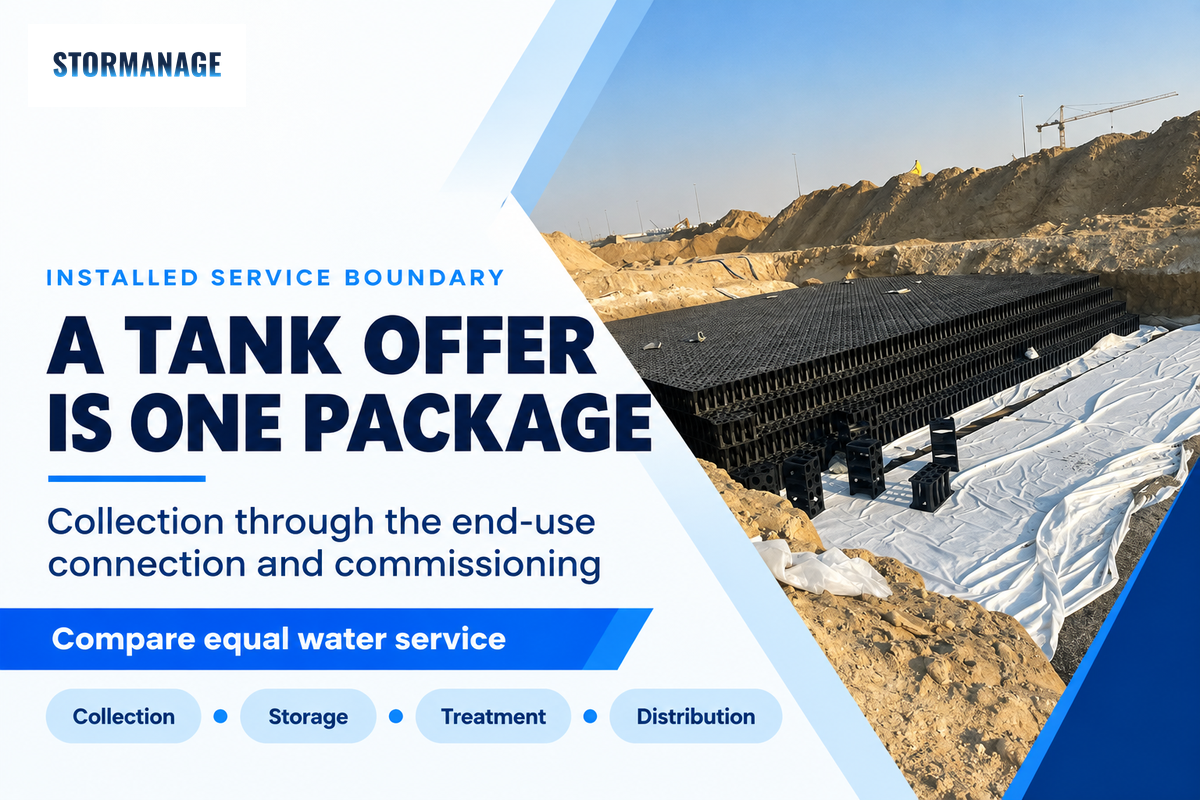
Price the complete service boundary when considering commercial rainwater collection systems. Collection, storage, pumping, water treatment and distribution are all the responsibilities of an owner. A tank-only offer can be suitable for a supply contract, but a facility budgeting for toilet flushing needs the additional installed equipment and connections that deliver usable water.
The US Department of Energy technology review describes system components including pretreatment, storage, pumps, treatment, controls and makeup water. Existing gutters or an available plant room can reduce new work. A retrofit that needs new underground pipes and a separate toilet supply network starts from a different construction baseline. Installing a rainwater system therefore involves more than adding a tank to the municipal water supply.
How much does it cost to install a rainwater harvesting system?
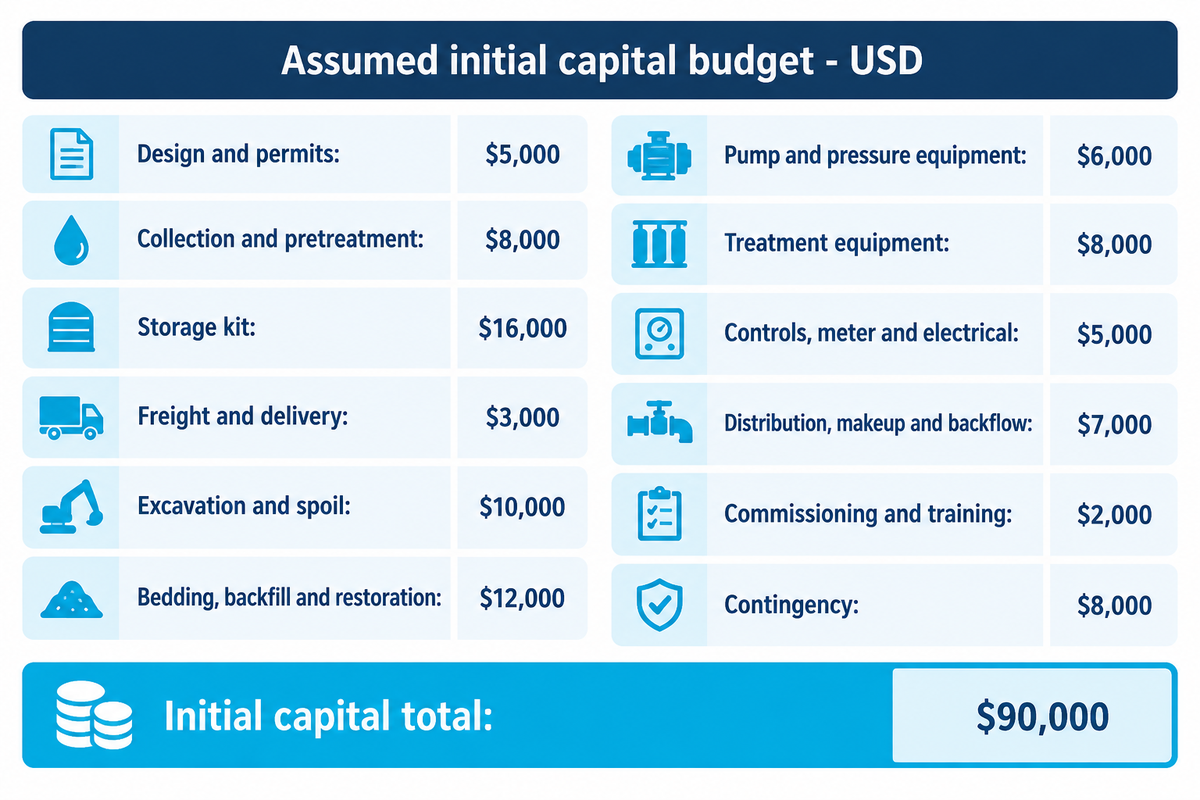
Budget every installed work package, then add contingency to that defined scope. The worked commercial retrofit below totals $90,000 in initial capital and $105,500 over five years before avoided water purchases. Use its line items to price a site; the assumed amounts aren’t a national commercial installation range.
Assumed inputs: the linked worked examples use October 2026 USD, a hypothetical existing-building retrofit, $90,000 initial capital, $2,500 annual operation and a $3,000 replacement in year four. No tax, financing, land acquisition, grant, approved capacity-charge credit or avoided baseline construction is included. Supply is rainwater for non-potable uses. Dollar inputs are planning assumptions throughout, rather than supplier quotations or measured project results.
A homeowner guide about rain barrels or residential rainwater can help explain the water collection principles. Its price denominator usually serves a different building, demand and installation scope. Commercial rainwater harvesting systems are designed around the facility’s water needs, operating responsibility and local water requirements. Even when both projects hold the water in a 10,000-gallon tank, their installed services can be very different. Water harvesting at a commercial facility joins rainwater storage and distribution into an operating service.
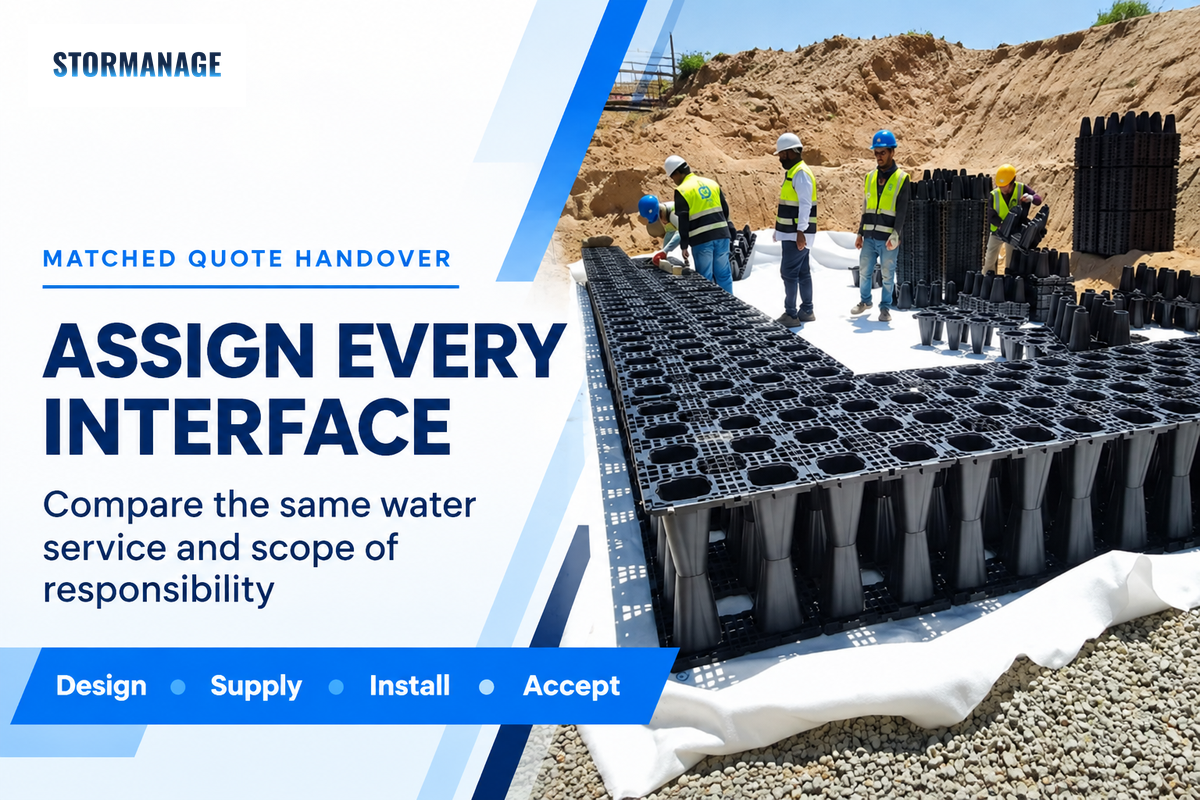
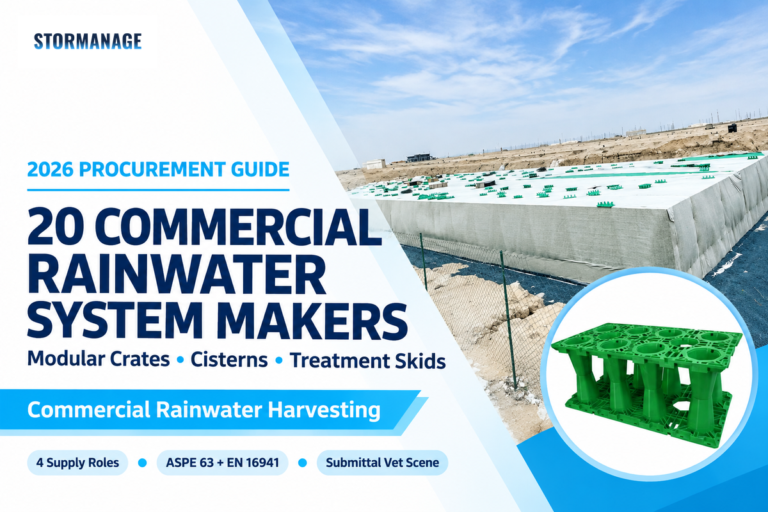
Storm Manage provides rainwater harvesting systems with modular underground storage. The scope of work differentiates the storage package from the site work required to put it into service.
Budget boundary: a $16,000 storage package in the worked example accounts for 17.8% of $90,000 initial capital. The remaining $74,000 covers other equipment, construction, professional work and contingency. Comparing the storage price with a complete installation offer would therefore conceal most of this example’s capital requirement.
12-Line Installed-Cost Bridge
The 12-Line Installed-Cost Bridge reconciles storage supply offers with a complete installed capital budget. Assign each work package a quantity, unit rate, and responsible party before adding its allowance. The example totals $90,000; consistent inclusions and exclusions reveal missing work and double counting before purchase orders divide responsibility.
Worked retrofit capital budget: 12 lines, USD
Work package
Allowance
Pricing boundary
1. Design and permits
$5,000
Design coordination and initial applications
2. Collection and pretreatment
$8,000
Roof conveyance, debris separation and first-flush arrangements
3. Storage kit
$16,000
Storage components and specified containment accessories
4. Freight and delivery
$3,000
Shipment and agreed delivery point
5. Excavation and spoil
$10,000
Excavation, handling and disposal allowance
6. Bedding, backfill and restoration
$12,000
Specified formation, fill and surface reinstatement
7. Pump and pressure equipment
$6,000
Duty equipment and agreed pressure control
8. Treatment equipment
$8,000
Process selected for source water and end use
9. Controls, meter and electrical
$5,000
Power connection, monitoring and controls
10. Distribution, makeup and backflow
$7,000
Separate service network and approved supply interface
11. Commissioning and training
$2,000
Acceptance tests, documentation and handover
12. Contingency
$8,000
Unallocated budget reserve; no duplicate measured work
Initial capital total
$90,000
Sum of the 12 allowances
The Minnesota Pollution Control Agency cost framework separates collection, storage, treatment and distribution, with detailed component units. This structure is useful when a supplier quotes each tank and a contractor prices excavation by volume. Price per stored gallon is relevant only when the respective scopes are aligned.
Consider a purchaser comparing a $16,000 storage offer with the example’s $90,000 installed allowance. The purchasing team initially treats the $74,000 difference as a possible saving. An interface review assigns the pump, treatment, electrical connection and separate distribution pipework to other orders. Next, the ground works contractor adds excavation, bedding and reinstatement. Freight and commissioning remain outside the storage scope. Once the same work is counted once in each alternative, the apparent savings potential disappears. The lower storage offer may be the best, but a budget should consider a defined supply package. A cheaper storage tank may improve the budget; the missing installation work cannot.
Scope comparison: The total $90,000 capital in the example includes $8,000 contingency. To compare a supplier’s delivered equipment price and a contractor’s installed-system price, they must be handed over at a matched point. Another party having priced and accepted that work does not save project money; removing a line only saves money when the project actually bypasses that work or its price falls.
Roof yield, water use and tank size
Size storage around useful demand and the timing of rainfall, rather than annual roof yield in itself. The Rainwater capture storage system is limited by the collection area and losses. Reuse is limited by demand, storage volume and tank outages. Extra collected water that overflows can’t reduce water bills, even if the annual rainfall total looks generous.
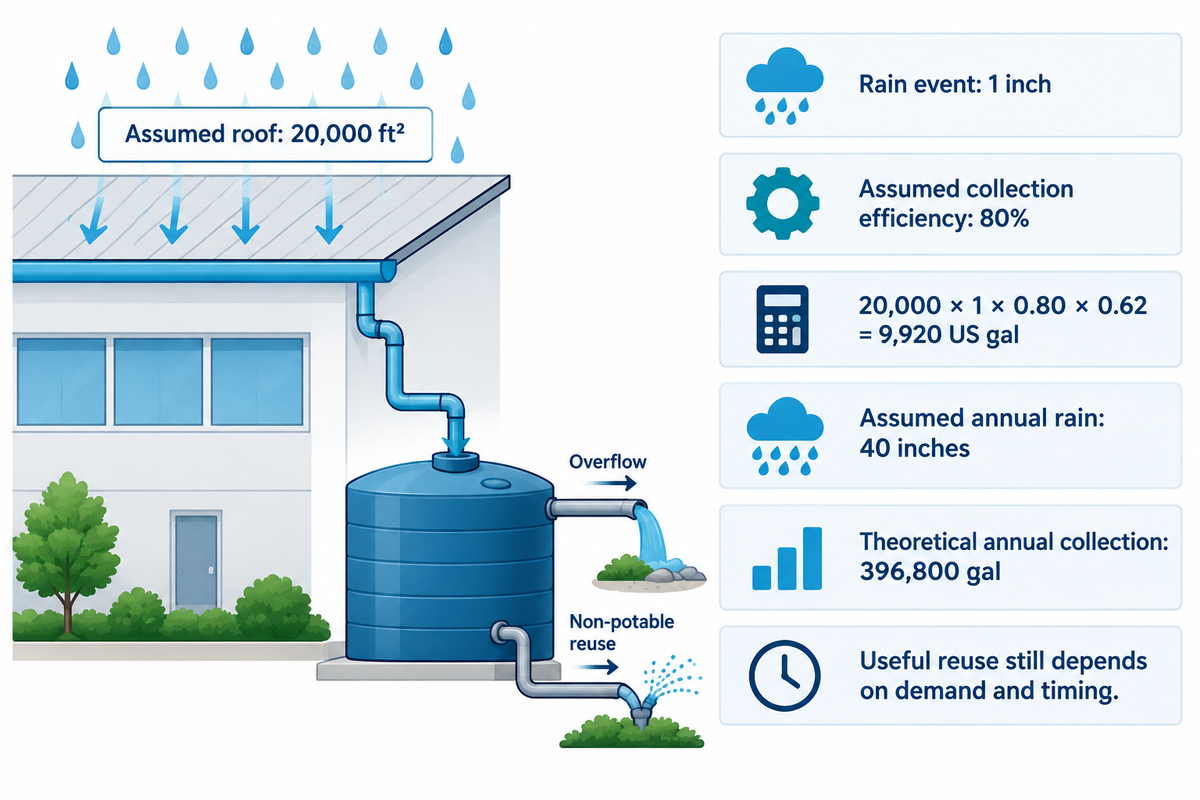
The Department of Energy uses approximately 0.62 US gallons per square foot of catchment per inch of rainfall. A screening calculation is collected gallons = roof area × rainfall × collection efficiency × 0.62. Roof drainage losses, debris diversion and treatment losses affect the usable water supply. Tank size then determines how much collected water can remain available between rain events. To harvest rainwater economically, the facility needs a demand schedule as well as a roof that can capture rainwater.
For a 20,000 ft² roof, 1 inch of rainfall, and an assumed 80% collection efficiency, the calculation is 20,000 × 1 × 0.80 × 0.62 = 9,920 gallons. At an assumed 40 inches per year, theoretical annual collection is 396,800 gallons of water. Neither calculation includes the daily demand sequence, overflow or unavailable storage. It’s an input to sizing, not an annual water saving prediction.
A warehouse uses only 100,000 gallons each year for landscape irrigation while its roof has the example’s 396,800-gallon collection potential. Buying a larger rainwater tank won’t create more irrigation demand. Even if all that demand were met by rainwater, a $0.02-per-gallon avoided charge would save $2,000 annually. The example’s $2,500 annual operating allowance would exceed that savings by $500, before capital or the year-four replacement. The manager could look for a smaller collection system or a lower operating requirement. The manager could also look for a more compatible additional end use. The decision solely to capture more runoff rainwater would leave this financial problem unresolved. The decision starts with how much water the building can use.
A 2020 study by Zhang and colleagues in Seattle showed daily results closely resembled hourly results, while monthly results yielded inaccurate results for the cases studied. Use a daily water balance and test shorter time steps where storage or demand timing is sensitive. In a separate 2023 household model in Brazil by Castier and Barreto, the tank with the highest average of yield to demand didn’t give the highest financial return. The commercial implication is to test useful yield and economics together, without transferring that household model’s prices.
Sizing decision: a 20,000 ft² roof at 40 inches annually and 80% collection efficiency has 396,800 gallons of theoretical supply. A proposed 600,000-gallon annual reuse target needs a different supply basis. Daily or hourly modeling must then account for demand, overflow and operating losses before the target enters a financial forecast.
Above-ground tanks, concrete cisterns and lined modular storage
Storage alternatives (i.e. above-ground or underground) should be evaluated with respect to useful volume, site loading, and maintenance. Above-ground tanks occupy surface space and don’t require buried excavation, whereas buried concrete cisterns or lined modular storage require below-ground construction and placement. Cost is determined by the construction and containment interfaces as well as the purchase price.
What is a 10,000 gallon water catchment tank?
A 10,000-gallon water catchment tank has a stated capacity of about 37.9 m³ when the label means US gallons. Based on the label, it assumes US gallons. It stores water between supply and demand. The actual usable operating capacity is less due to design factors that account for sediment, pump protection and/or overflow. The design can’t be properly sized based on the capacity label alone.
Above-ground steel, polyethylene or fiberglass tanks can suit accessible service areas. A concrete cistern can be cast in place, or delivered as a precast unit. Modular storage, like tanks, can be assembled to meet a given storage volume. A water tank filled with water imposes a different load condition compared to an empty buried tank exposed to groundwater. Both conditions should be evaluated in the design. The system depends on the ground conditions and the storage material, which should be evaluated.
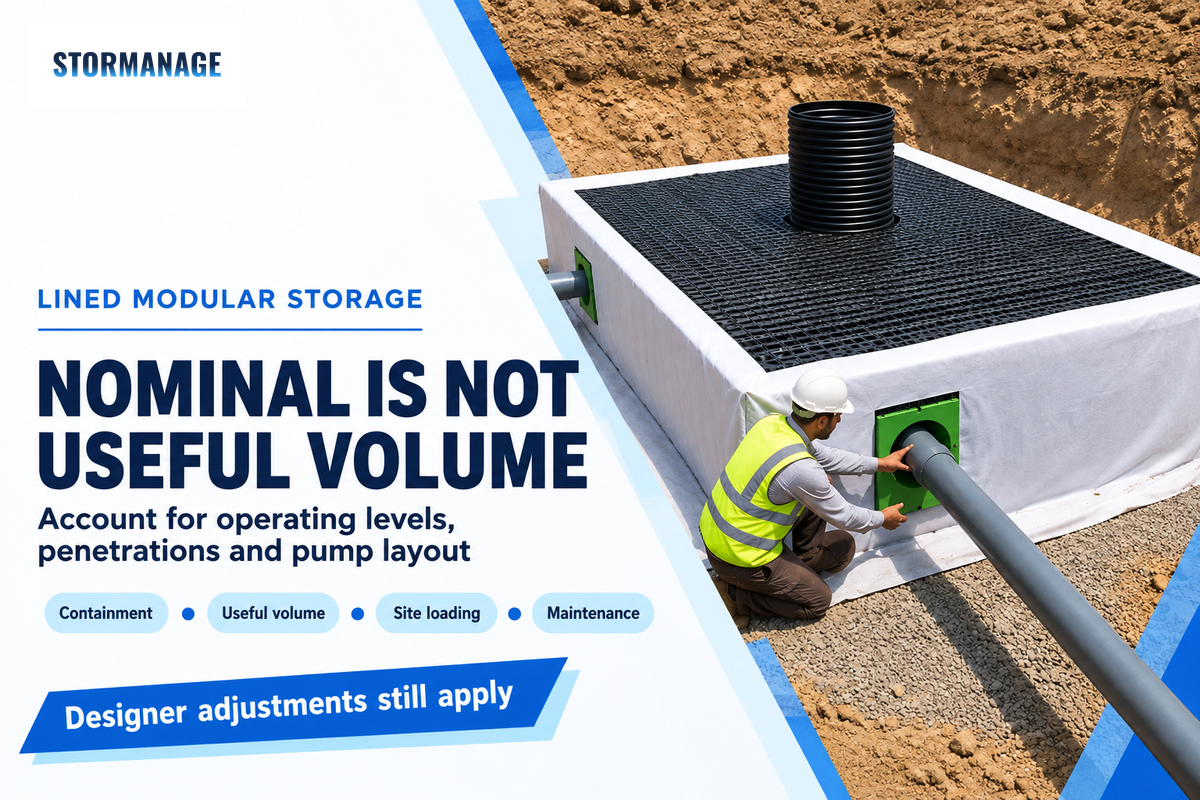
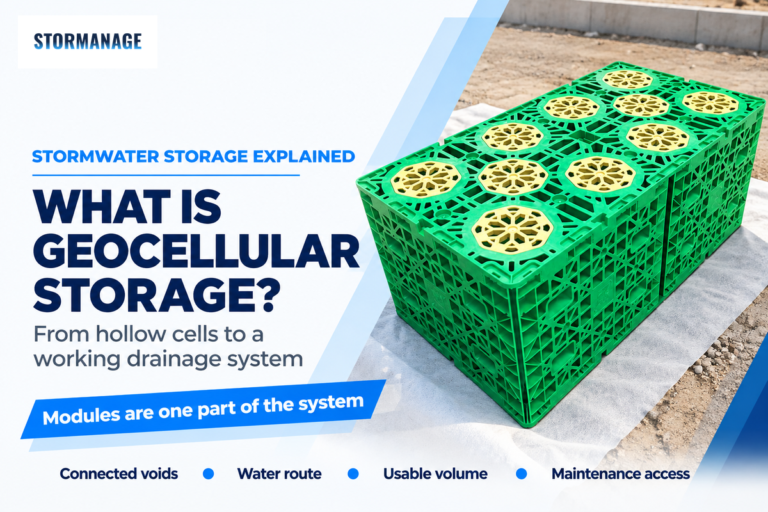
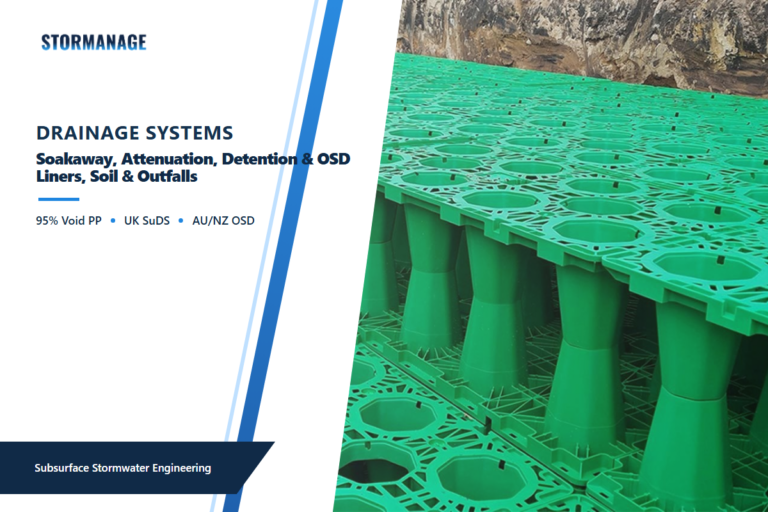
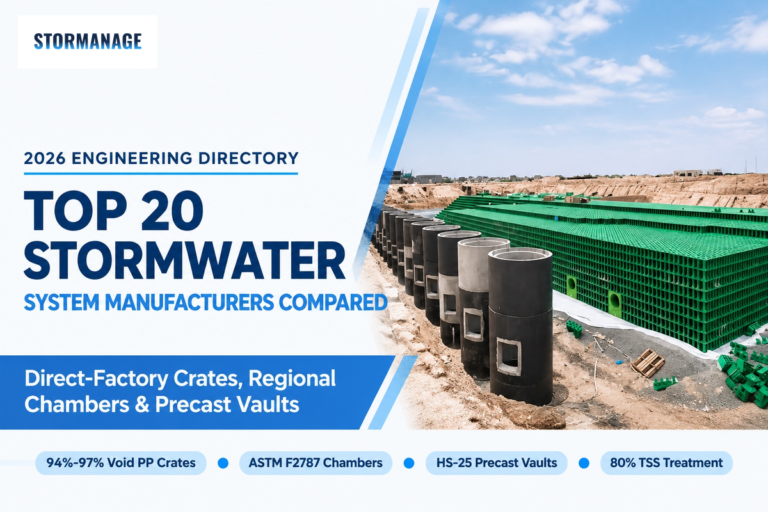
Storm Manage’s commercial underground rainwater harvesting package uses polypropylene modules with geotextile, geomembrane, and connectors. Their 1000 × 500 × 500 mm module has a 95% void ratio and a nominal water volume of 237.5 L. Geometrically, this becomes 1 × 0.5 × 0.5 × 1,000 × 0.95 = 237.5 L. Useful storage will depend on the level, penetrations, and the layout of the system for the pump.
A permeable infiltration assembly provides water to the surrounding soil; lined rainwater harvesting storage instead retains water for later demand. Combining rainwater harvesting with detention requires an explicit operating strategy. Risk mitigation requires an operational strategy. Reuse storage and the empty volume needed ahead of a storm compete for the same space unless the design coordinates them. The hydraulic question itself isn’t resolved by storage material.
Capacity comparison: 100 modules with a 237.5 L nominal volume provide 23,750 L of storage, prior to designer’s operating adjustments. Supplier comparisons should use the designer’s useful storage target and equal loading conditions. Nominal price per liter of storage can be offset with larger excavation, a larger footprint, and inaccessible maintenance space.
Civil works and the hidden installation bottlenecks
Ground conditions and construction access can impact the installed budget even when storage capacity remains constant. Site quantities drive excavation and restoration costs, while groundwater control adds to the scope. A buried system also requires checks for buoyancy and a buried system’s structural capacity. These costs are best controlled before construction routes and pipe placement become fixed.
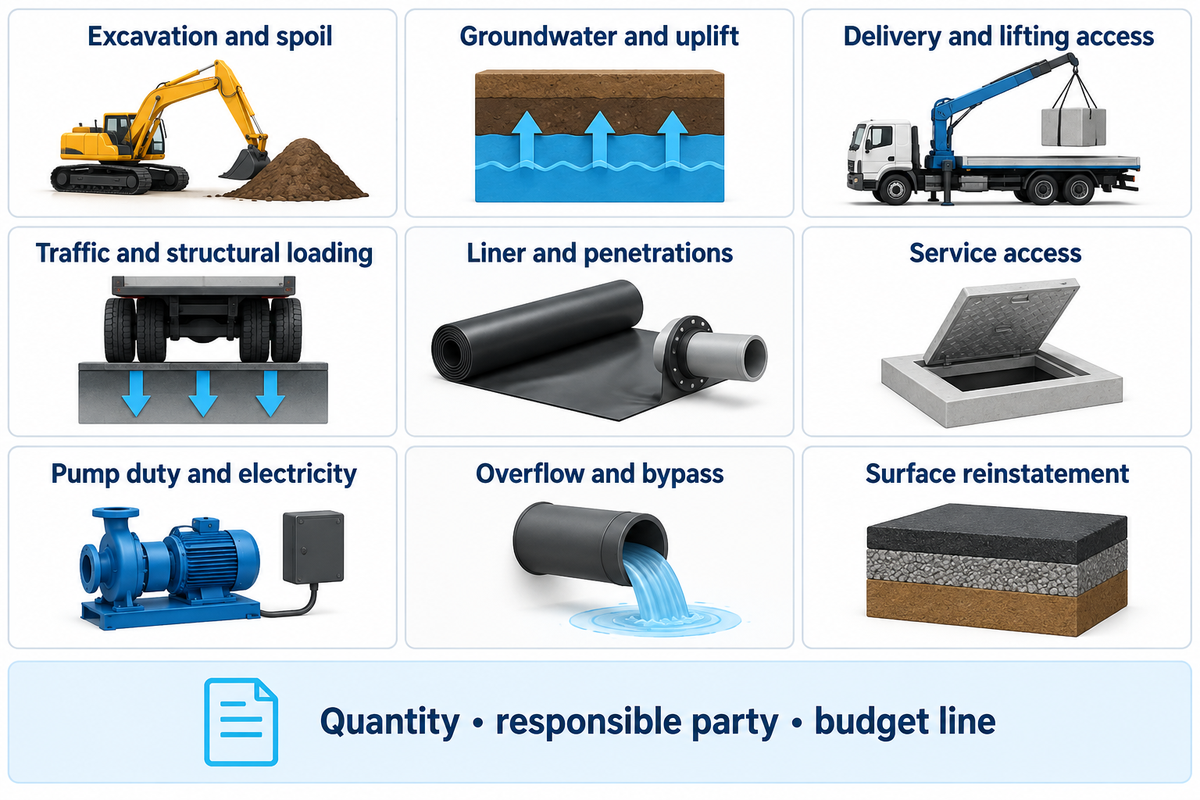
Nine installation interfaces: assign each cost once
Installation cost category
Quantity or decision needed
Responsible scope
Budget connection
Excavation and spoil
Excavated volume and disposal route
Civil contractor
Line 5
Groundwater and uplift
Design water level and empty-tank case
Geotechnical/civil designer
Lines 1, 5 and 6
Delivery and lifting access
Access route and lifting method
Supplier and contractor interface
Lines 4 and 5
Traffic and structural loading
Surface use and approved load case
Structural designer
Lines 1 and 6
Liner and penetrations
Containment details and acceptance method
Containment installer
Lines 3 and 11
Service access
Inspection and cleaning route
Designer and operator
Lines 3 and 6
Pump duty and electricity
Required flow, head and power route
Mechanical/electrical contractor
Lines 7 and 9
Overflow and bypass
Levels and accepted discharge route
Drainage designer
Lines 2 and 10
Surface reinstatement
Area and pavement or landscape build-up
Civil contractor
Line 6
The Minnesota design guidance discusses footing and buoyancy, as well as access for maintenance and overflow, and groundwater. An empty buried tank can experience uplift due to groundwater displacement and create a positive buoyant force. For the actual site conditions, an engineer should make calculations to determine resistance, and a generic load rating doesn’t replace this calculation.
Rainwater gathering pipework also impacts excavation schedules. In a dry system, collection pipes drain between events. A wet system retains water in pipe sections between events and can help route pipe collection systems below ground, however, this creates a retained water system and requires maintenance. Wet rainwater harvesting and dry rainwater collection describe pipe arrangements, rather than water-quality grades. The appropriate wet or dry layout still needs drainage levels and a maintenance route.
A contractor installing a water storage system beneath a finished yard may need to remove and rebuild pavement that a new-build project has not yet installed. Reusing water may therefore have a lower incremental construction cost when coordinated with other planned work. The comparison may subtract only work genuinely avoided. A shared excavation can’t be charged in full to both systems. Buried systems are also constrained by the maintenance access left available after reinstatement.
Construction allowance: lines 5 and 6 contribute $22,000 to the worked budget, before design, freight or equipment. A quoted reduction of $2,000 in storage supply would be outweighed by $4,000 of additional groundworks. Comparing equal useful volume with site quantities exposes that trade before a tank order fixes the layout.
Pumps, filtration and non-potable water treatment
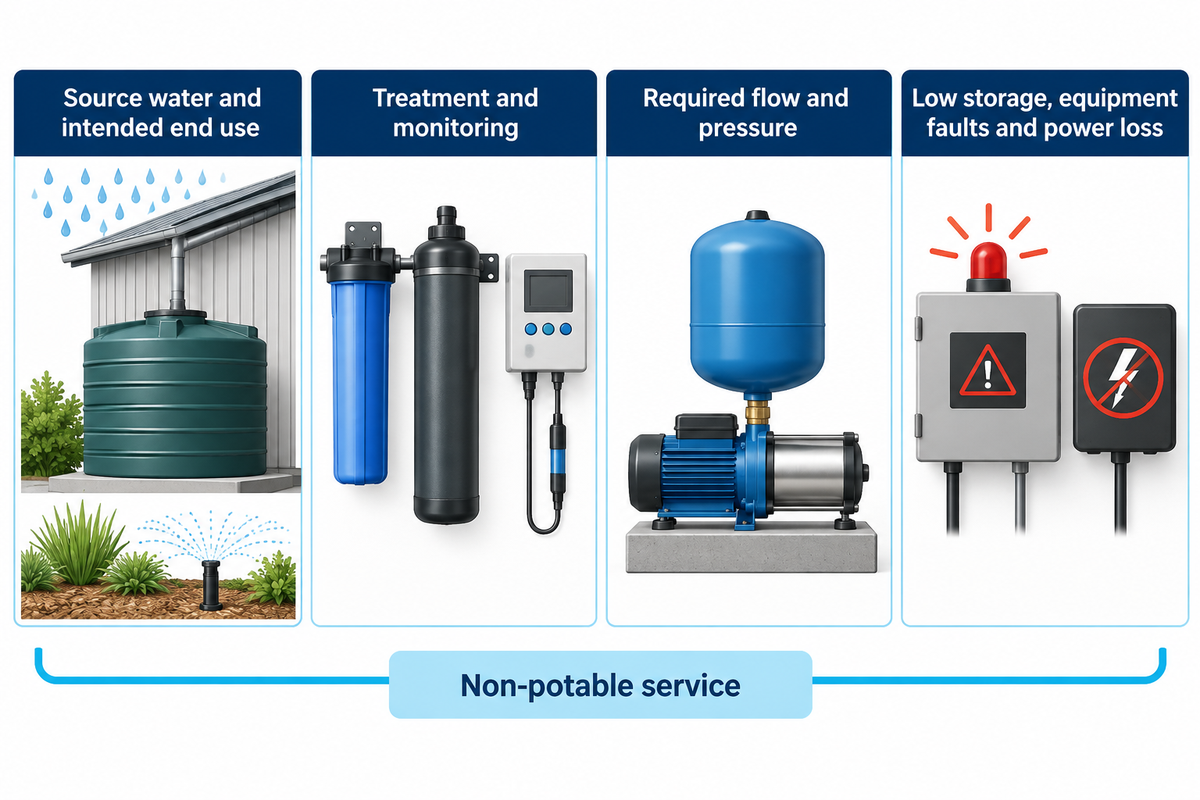
Select the treatment for the source water, its intended use and the mode of delivery. For irrigation and cooling services, the water quality and the operating conditions of the equipment may differ. Filtration removes targeted contaminants; disinfection and monitoring address other risks. A reliable rainwater service also needs a defined response to low storage, equipment faults and power loss.
Do I need a pump for a rainwater system?
Use a pump when available gravity head can’t provide the required flow and pressure at the end use. A buried tank supplying building fixtures normally needs pumping. The equipment duty includes elevation and pipe losses. Tank capacity alone doesn’t determine pump size or the electrical cost to install.
The US Environmental Protection Agency’s onsite reuse research links treatment performance to water source and end use and examines monitoring and lifecycle cost. A leaf screen does not make collected water suitable for every indoor application. The materials used on a roof, the contaminants deposited on it and the storage conditions influence the treatment train to filter rainwater and achieve water quality. Rain water collected on a roof can pick up contaminants before entering storage. Treatment must filter the water to the selected process requirements, with disinfection where the design requires it.
Mike Warren’s 2013 WaterWorld article, “Commercial Complexities,” uses an illustrative 2,000-student school where backup water enters the storage tank. That arrangement can restore stored water, but a pump failure could still interrupt delivery to the fixtures. A facility team reviewing that same arrangement must distinguish a water-source shortage from a delivery-pressure failure. Makeup water addresses the first problem; the backup delivery architecture determines whether it addresses the second. The focus is on failure response and connection location, rather than just storing more water. A commissioning test that exercises low tank level, pump failure and power loss gives the operator a clearer handover than a demonstration with every component running normally. Warren was writing from the perspective of a commercial pump supplier.
Non-potable rainwater for reuse must remain separated from the public water supply through the arrangement approved for the project. Potable rainwater harvesting is a different treatment and approval task. Supplying water for drinking can’t be accomplished by renaming the non-potable distribution pipe or adding a generic filter. The treatment system varies with source quality and end use. Routing rainwater directly to an indoor fixture bypasses those design decisions.
Equipment comparison: the worked budget assigns $6,000 to pumping, $8,000 to treatment and $5,000 to controls, metering and electrical work. Their combined $19,000 buys different functions. A lower pump price is useful only when the specified water flow, pressure, fault response and treatment operating conditions remain matched between offers.
Five-year operating cost and the 3-Tariff Break-Even Grid
The 3-Tariff Break-Even Grid compares five-year net cash costs for three avoided-water rates and three reuse volumes. For five-year additional cash cost, add initial capital, five years of operating costs and the replacement costs, then subtract avoided purchases: multiply useful reuse volumes times the eligible billable rate that disappears over five years. Fixed water charges, which don’t vary with reuse, are excluded from savings. Separate the new-build gross cost from the conventional-service baseline to get an investment view.
The worked retrofit’s annual $2,500 allowance comprises $500 energy, $900 maintenance and consumables, $500 testing, and $600 permit administration and reporting labor. A further $3,000 replacement occurs in year four. Those categories need local pricing: San Francisco’s permit process, for example, includes annual license fees, annual backflow testing and regular reports. The requirements in San Francisco are local, not part of a nationwide operating schedule.
5-year total cost of ownership:
Worked retrofit: added costs relative to retaining existing municipal service, USD
Cost item
Harvesting retrofit
Existing municipal service
Purchase price
$43,000
$0 additional equipment
Installation & commissioning
$47,000
$0 additional work
Energy (5-yr)
$2,500
$0 additional onsite energy
Maintenance & spares (5-yr)
$13,000 including testing, administration and replacement
$0 additional reuse-system costs
Downtime risk (5-yr)
Unpriced; evaluate continuity and backup
Unpriced; existing service baseline
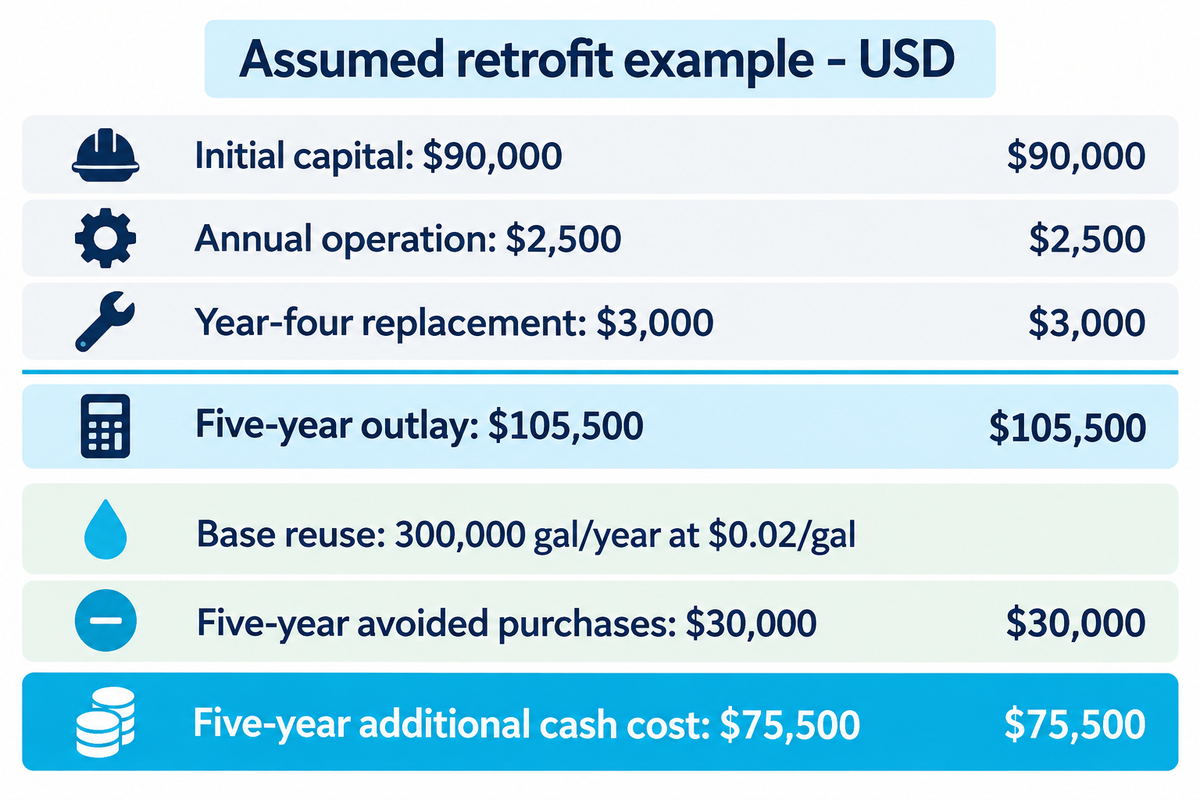
Payback example: 300,000 reused gallons/year × $0.02/gallon = $6,000/year avoided purchases. Subtract $2,500/year operation to obtain $3,500/year net operating saving. Initial $90,000 ÷ $3,500/year = 25.7 years simple payback, before replacement, discounting or finance. This screening ratio is not a service-life or payback forecast.
The five-year outlay is $90,000 + (5 × $2,500) + $3,000 = $105,500. At 300,000 useful gallons a year and $0.02 per gallon, avoided purchases total $30,000 over five years. The retrofit therefore costs $75,500 more than the existing-service baseline during that period. A five-year water bill only investment test would reject this assumed case.
Worked 3-Tariff Break-Even Grid: five-year additional cash cost, USD
Useful reuse per year
Eligible avoided rate
Annual gross saving
Annual saving after $2,500 operation
Five-year additional cash cost
100,000 gal
$0.01/gal
$1,000
−$1,500
$100,500
100,000 gal
$0.02/gal
$2,000
−$500
$95,500
100,000 gal
$0.04/gal
$4,000
$1,500
$85,500
300,000 gal
$0.01/gal
$3,000
$500
$90,500
300,000 gal
$0.02/gal
$6,000
$3,500
$75,500
300,000 gal
$0.04/gal
$12,000
$9,500
$45,500
600,000 gal
$0.01/gal
$6,000
$3,500
$75,500
600,000 gal
$0.02/gal
$12,000
$9,500
$45,500
600,000 gal
$0.04/gal
$24,000
$21,500
−$14,500
Five-year additional cash cost equals $105,500 minus five years of avoided purchases. A negative result means there is a net financial benefit. The 600,000-gallon cases require a separate site with enough supply and demand; they can’t use the earlier 396,800-gallon roof yield. The grid isolates variability in tariffs and reuse, while holding capital and operating costs constant. A larger project can change those inputs too.
Is rainwater harvesting worth it?
It passes a financial test when eligible avoided charges and approved credits exceed the additional capital, operating and replacement costs over the chosen horizon. The worked 300,000-gallon case fails a five-year water-only test by $75,500. A project can still pursue water conservation or resilience, but those objectives need their own stated value and acceptance criteria.
For new construction, incremental capital equals the harvesting option’s installed cost minus conventional work genuinely avoided and approved capital credits. SFPUC’s onsite reuse program provides for an adjusted water and wastewater capacity charge for eligible customers. Budgeting this adjustment requires project eligibility and a definite amount. No credit is assumed here. Wastewater or stormwater fees count as savings only when the relevant billing program reduces them. The benefits of rainwater harvesting can include a reduction in demand for municipal water and water conservation, and the associated economic impact.
Key takeaway
At 300,000 reused gallons/year and $0.02/gallon avoided purchases, the worked retrofit saves $6,000/year gross but still has a $75,500 five-year additional cash cost after capital, operation and replacement.
A supplier quote the facility can actually compare
Supply the same schedule of supplies and acceptance to all bidders. State the useful storage target, source water, end use and delivery duty, and then allocate each interface. Equipment supply, civil installation, and integrated commissioning are different services. A comparable quote identifies who designs, supplies, installs and accepts each element before a price comparison is made.
Freeze the service requirement: specify modeled useful reuse, end uses, required pressure and operating constraints.
Obtain matched offers: price the same installed boundary, delivery basis and handover obligations.
Reconcile the budget: allocate exclusions, remove duplicate work and update contingency.
Accept the operating system: complete the agreed commissioning tests, operator training and documentation.
In the procurement package, review the records for the collection area and rainfall, the daily demand profile, the design level for groundwater, surface loading, and usable volume. Have bidders identify pump duty, treatment basis, arrangement for makeup water, metering, and access for maintenance. Verify the basis for freight, who will be responsible for unloading, exclusions, the initial obligations and requirements for permits, and recurring testing in the same schedule. These questions define “complete system” for pricing purposes. Rainwater management requires the operator’s maintenance plan be included in the handover.
For modular storage, Storm Manage can provide a quote based on the given module and containment package against project drawings. The engineer provides site loading, hydraulic conditions, and groundwater situation; the installing team implements and tests the approved details. A supplier may cost less for one package while a system integrator accepts more interfaces. A price-per-gallon column obscures those scope differences. A fair comparison keeps those differences and shows how the supplier prices its product differently.
The FOB container and lead-time estimator supports shipment planning for the storage package. Inland delivery, unloading, site installation and commissioning still need their assigned budget lines. The planning of transportation should happen prior to a committed excavation date, which sets an arrival assumption for the project.
Quote handover: the worked bridge has 12 capital lines and four annual operating categories. Each bidder is required to submit either a clear price or an exclusion for each of the above lines. A $90,000 comparison is relevant only if both alternatives provide the same water service and keep the same construction and operating responsibilities.
Industry Outlook: Treatment and Operating Budgets
Currently, onsite reuse resources focus primarily on treatment and operator training. The National Blue Ribbon Commission’s 2025 pathogen-reduction guidance and 2026 operations training manual give commercial buyers reasons to budget beyond storage. Their effect is project-specific treatment, monitoring and operating scope, rather than an automatic increase in every rainwater harvesting system price.
The WateReuse resource library describes both publications for onsite non-potable programs. Its 2026 manual covers multifamily, commercial, mixed-use and district-scale systems. An owner planning rainwater harvesting across several buildings needs an operating organization as well as installed equipment. Staff time, consumables and reporting arrangements affect the overall water budget after construction finishes. For an organization managing several water resources, a reuse system might also require coordination between facility and utility billing teams.
“It is a voluntary standard that provides an alternate compliance path to existing codes.”
The adopted requirements for the project are determined by the applicable authority. An adopted construction rule and a new resource publication affect the specification differently. For the worked budget, $1,100 of the $2,500 annual allowance is allocated to testing plus permit administration and reporting labor. Actual operating requirements can affect that allocation even if the storage kit is the same.
Frequently Asked Questions
Are all rainwater collection systems above ground?
No. Commercial systems can store water above or below ground.
Buried concrete cisterns and lined modular tanks preserve surface space, while above-ground tanks can simplify physical access. Underground storage adds excavation, groundwater and structural design work. The useful comparison is equal operating capacity with the required access and loading conditions, rather than equal tank labels. Maintenance routes and surface reinstatement also belong in the installed budget.
What states allow rainwater harvesting?
Permission must be established for the state, locality and intended commercial use.
There’s no single permission answer that covers every commercial water system. Texas provides rainwater harvesting guidance, while San Francisco operates a local permitting process for alternate water sources. Collection rights, plumbing connections and indoor reuse approval are separate questions. A project seeking to reduce water purchases needs the applicable collection and end-use requirements in its design brief before procurement begins.
Is a non-potable rainwater system suitable for drinking water?
No. A non-potable system supplies uses other than drinking.
Water for drinking needs a potable treatment and approval basis appropriate to the source and public-health requirements. Roof collection can introduce microbial and chemical contaminants, and a non-potable installation may use components or operating controls selected for another purpose. Boiling advice doesn’t resolve that complete system design. Keep drinking-water provision within a separately approved potable supply arrangement.
Are rainwater harvesting systems used on flat roofs?
Yes, when roof drainage can route water to the collection system.
Flat-roof drainage, catchment materials and maintenance influence collection quality and losses. The Texas Water Development Board identifies a roof drain that channels water from the roof as the basic collection condition.
How can I mitigate costs associated with my rainwater harvesting system?
Match storage to useful demand and coordinate installation with planned building work.
Start with the end use that has a dependable demand profile. Water used for irrigation may be seasonal, whereas a compatible indoor use can draw from storage on a different schedule. A lawn or garden demand profile therefore needs its own schedule. Modeling that pattern helps determine how much storage earns its place in the budget. Coordinate excavation and reinstatement with other scheduled works, and compare the same delivery and commissioning boundary.
A smaller tank can reduce capital, but more frequent makeup water can reduce the benefit. A simpler gravity-fed arrangement can reduce pumping costs where the available head meets the duty. Cutting required treatment, backflow protection or acceptance testing changes the delivered service rather than improving its price. A system can help conserve water without paying back quickly; keep that objective visible alongside the financial test.
Can rainwater harvesting reduce stormwater charges?
Yes, where an applicable billing program awards a project-specific reduction.
Credit eligibility and the billable reduction determine the saving. Captured storm water runoff doesn’t automatically remove a stormwater fee. Enter the approved annual amount separately from avoided purchased-water charges, and retain zero in the budget until an eligible reduction is established.
For a storage package quote provide the modeled useful volume, layout, loading condition, groundwater basis and delivery condition to Storm Manage through the project inquiry. A definable scope of work will allow Storm Manage to price the commercial package and allow your design and construction team to complete the work scope definition for the other lines of the installed cost.
This article separates that supply role from site engineering, treatment integration, installation and operation. Worked dollar inputs give a hypothetical example of a retrofit; the product geometry is attributed to Storm Manage’s current commercial package.