We use the details you submit to review and respond to your project enquiry. Entries are handled in this website’s WordPress database using Fluent Forms; our hosting and email providers may process the submitted details. Other technical providers receive only the data described in our Privacy Policy.
Please do not send passwords, payment-card details, government identification numbers, sensitive personal data, or unnecessary confidential third-party information.
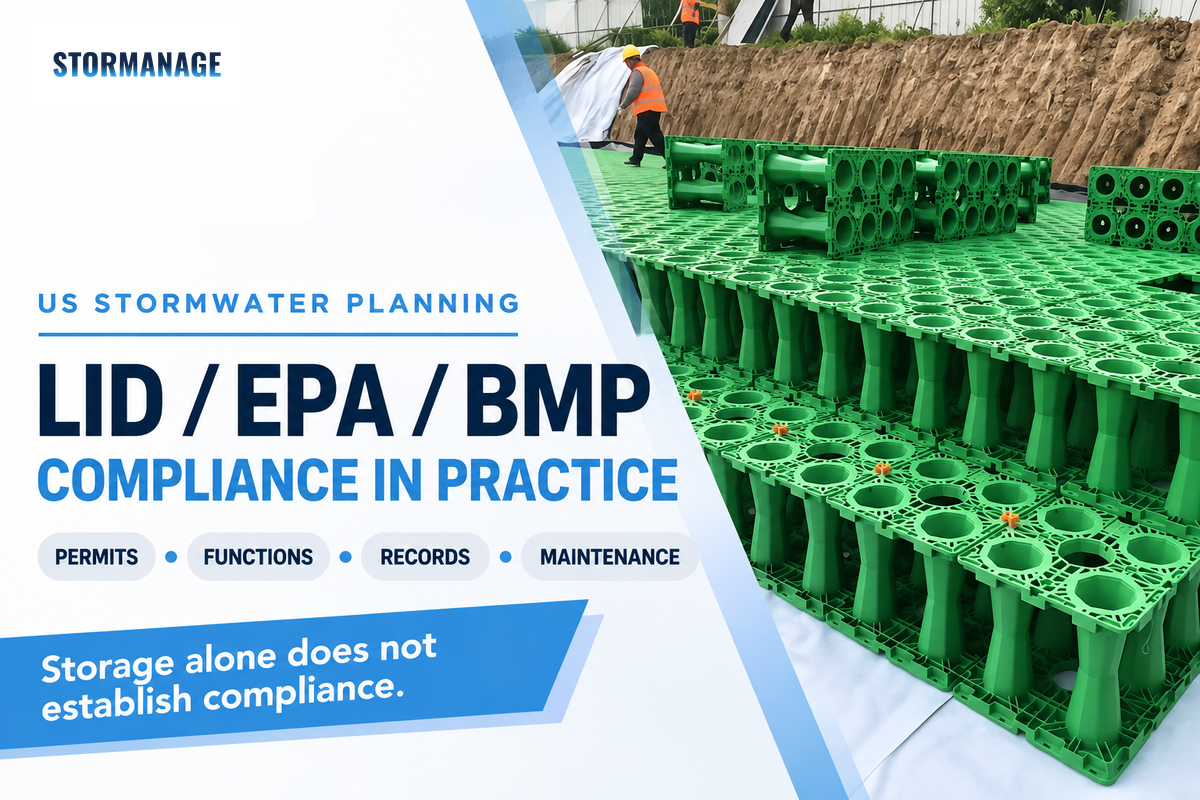
LID / EPA / BMP compliance means identifying what’s required of the site for discharge and connecting the drainage design, construction controls and long-term maintenance. In that system, a tank can be a valuable component. Its capacity alone does not establish water-quality treatment, runoff reduction or permission to discharge.
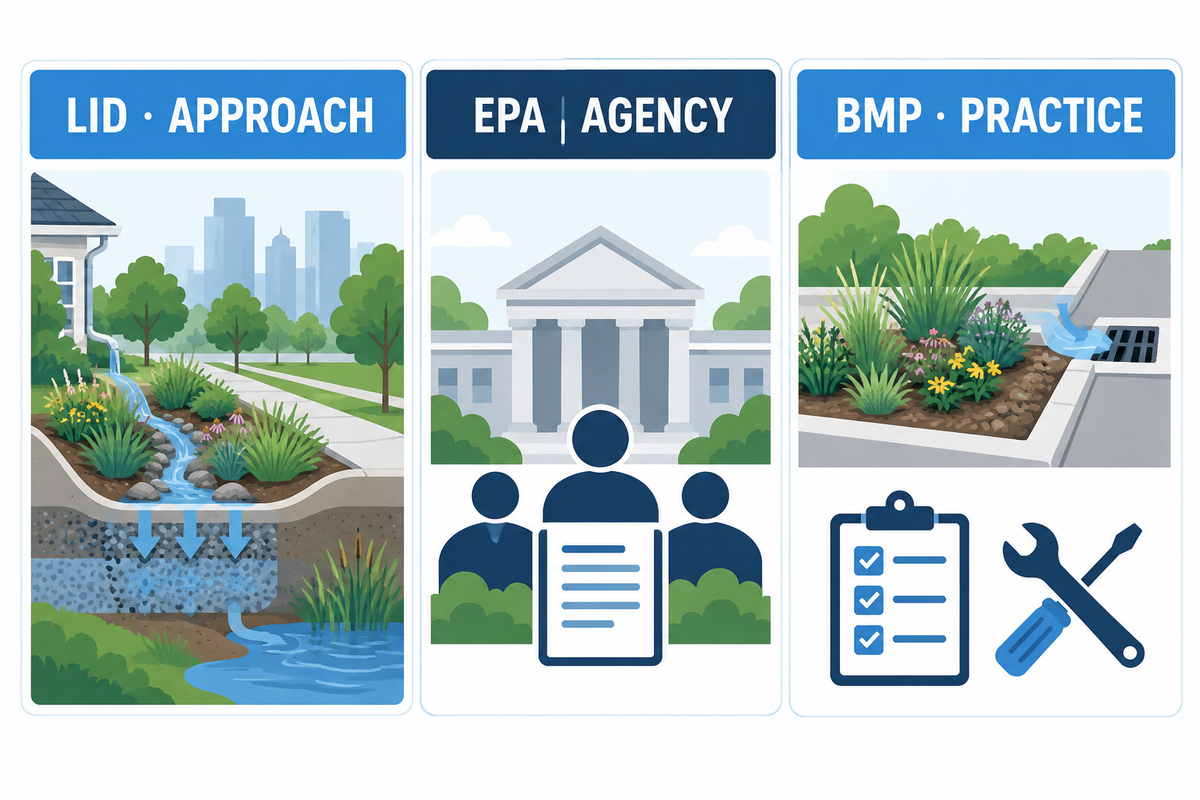
Low impact development is the design approach. Best management practices are the measures used to control stormwater runoff and prevent water pollution. The US Environmental Protection Agency and other permitting authorities administer the programs that define applicable requirements. Understanding the different roles makes a stormwater specification easier to write and a completed asset easier to maintain.
Updated October 2026. This guide focuses on United States stormwater planning; local examples retain their own jurisdiction.
At a glance: identify the governing authority; separate construction and permanent requirements; match each control to its actual function; assign the design, installation and maintenance records to a responsible party.
For underground storage: Distinguish a lined detention system from an infiltration installation or a harvesting tank. Each follows a different water pathway and needs a different design justification.
What LID, EPA and BMP compliance actually mean
LID, EPA and BMP describe various aspects of stormwater management: an approach, an agency and a practice. Compliance means meeting requirements applicable to the project and discharge. The practical starting point is to connect the required outcome to the measure that provides it, rather than interpreting them as synonymous.
EPA’s explanation of low impact development emphasizes natural processes: infiltration, evapotranspiration and stormwater use near its source. Preserving vegetation, reducing effective impervious cover and collecting rainwater can change how rainfall moves through urban areas. Green infrastructure brings those processes into the developed landscape. A conventional detention outlet mainly changes when water leaves.
What is a BMP in stormwater management?
A stormwater BMP is a best management practice used to prevent or reduce pollution and/or runoff. It can be a physical facility, or an operating practice. A suitable combination addresses the site’s runoff pathway, pollutant sources and applicable requirements, with maintenance that keeps the measures working.
Stormwater best management practices are typically grouped as structural or non-structural. Storage, infiltration and filtration describe its function. A structural practice may perform several functions; a non-structural practice can reduce the pollution reaching a physical system. An informed and balanced combination should be based on what a site requires to achieve an acceptable design.
The US EPA National Menu of BMPs for stormwater provides practice guidance for municipal programs. Its list of BMPs is not exhaustive. For an owner, BMP compliance therefore involves the accepted design and its ongoing implementation, rather than selecting an item from a menu and assuming the project is finished.
Which stormwater rules apply to your development?
Start with the discharge location, construction disturbance and permitting authority. Then identify the permanent drainage requirements imposed by the local program. Construction stormwater covers the work phase; permanent controls address the developed site. A project may require both, and qualified industrial operations may raise a further operating phase permit question.
EPA’s construction guidance identifies stormwater discharges caused by the disturbance of 1 acre or more, including smaller sites in a common plan of development or sale which, when fully developed and/or completed, will ultimately disturb 1 acre or more. The relevant area is the land disturbance in the project environment, and not the advertised acreage of the site.
Below that acreage threshold, don’t presume an automatic exemption. 40 CFR 122.26 authorizes the designation of other construction discharges and includes conditional waiver provisions. State and local requirements also apply. A waiver is only available to be used when its actual conditions and approval process are satisfied.
For a Stormwater Phase II municipal program, distinguish the post-construction minimum measure from the developer’s construction permit coverage. If runoff flows through a sewer prior to reaching a stream, that route should be shown in the site description. It helps the project team manage stormwater along the actual discharge pathway and identify the water resources the controls are intended to protect.
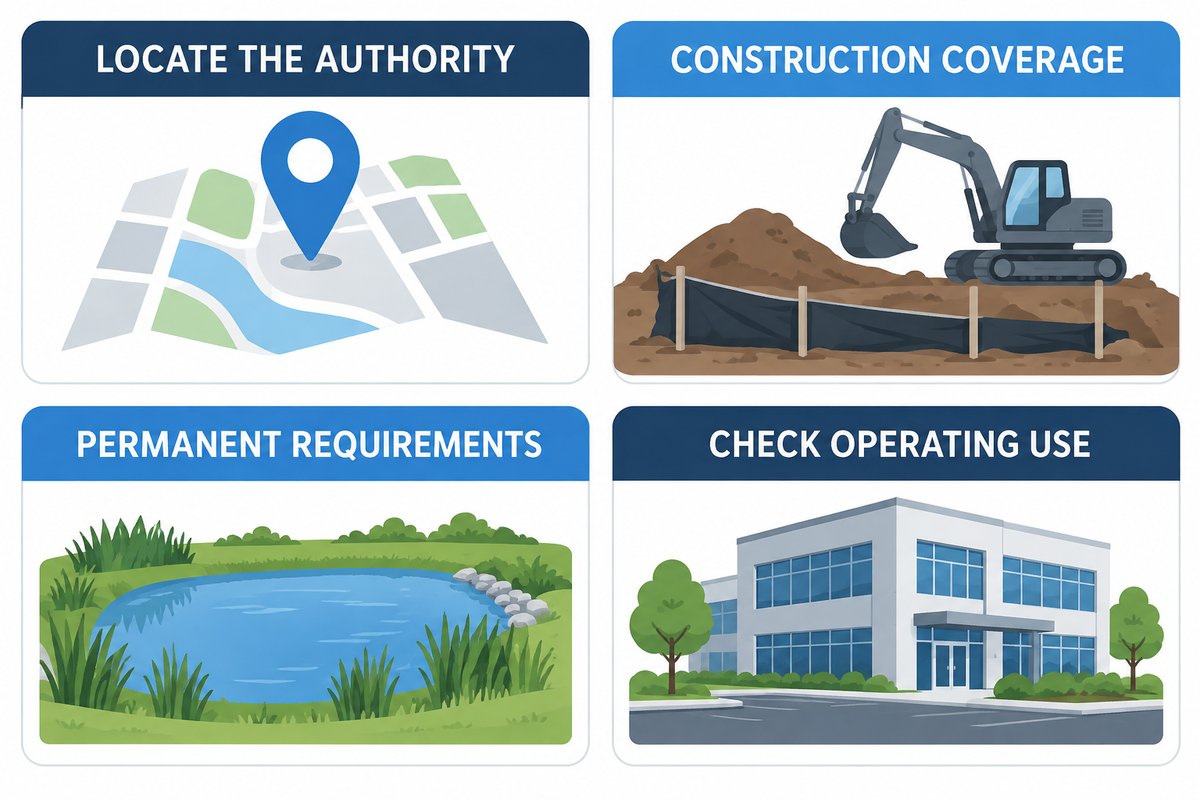
Locate the authority: EPA or an authorized state agency, and appropriate municipal reviewers.
Identify construction coverage: discharge, disturbance, common plan, eligibility, and any applicable designations or waivers.
Identify permanent requirements: runoff volume, discharge rate, water quality and the accepted long-term owner arrangements.
Check operating use: industrial stormwater requirements apply to qualifying activities and discharges, not automatically to every commercial building.
Which three elements are part of a SWPPP?
Three elements of a Stormwater Pollution Prevention Plan are the site and pollution source description, the selected control measures, and the inspection and corrective action procedures. They link the work sequence to practical pollution prevention. They’re a basic structure and not a legally complete three-item plan. The required contents are determined by the permit.
Those current SWPPP resources contain the EPA’s 2022 Construction General Permit templates. A site’s plan must describe its actual conditions and follow the governing state or EPA permit. A plan copied from another development may miss a discharge point, a changed construction sequence or the responsible operator.
Can underground storage meet LID and water-quality goals?
Underground storage can form part of an accepted stormwater design when its function matches the required outcome. Lined detention controls storage and release; infiltration sends water to suitable ground; and harvesting provides water for use. Water-quality goals may require additional treatment. A combination of measures may address more than one goal, where a single storage structure can’t.
Think of detention as a waiting room for runoff: holding water back can reduce the peak flow through an outlet without reducing the total runoff volume eventually discharged. Infiltration and use change the destination of some water. Pollutant removal is a separate question involving the contaminant, treatment process and accepted performance evidence.
Is underground modular storage considered a low impact development (LID) practice?
Underground modular storage can support a LID design when configured for an accepted function, such as infiltration or stormwater use, or combined with other practices. A sealed detention design, by definition, stores and releases water. Whether a particular system counts toward a local LID requirement depends on its design, site conditions and the governing approval criteria.
Philadelphia’s subsurface detention manual provides a useful local example: detention can serve constrained sites where infiltration is infeasible, while other practices may be needed for water quality. Other practices may need to be incorporated to address water quality. This is more of a design tradeoff with constraints than a national hard and fast rule for every underground storage tank.
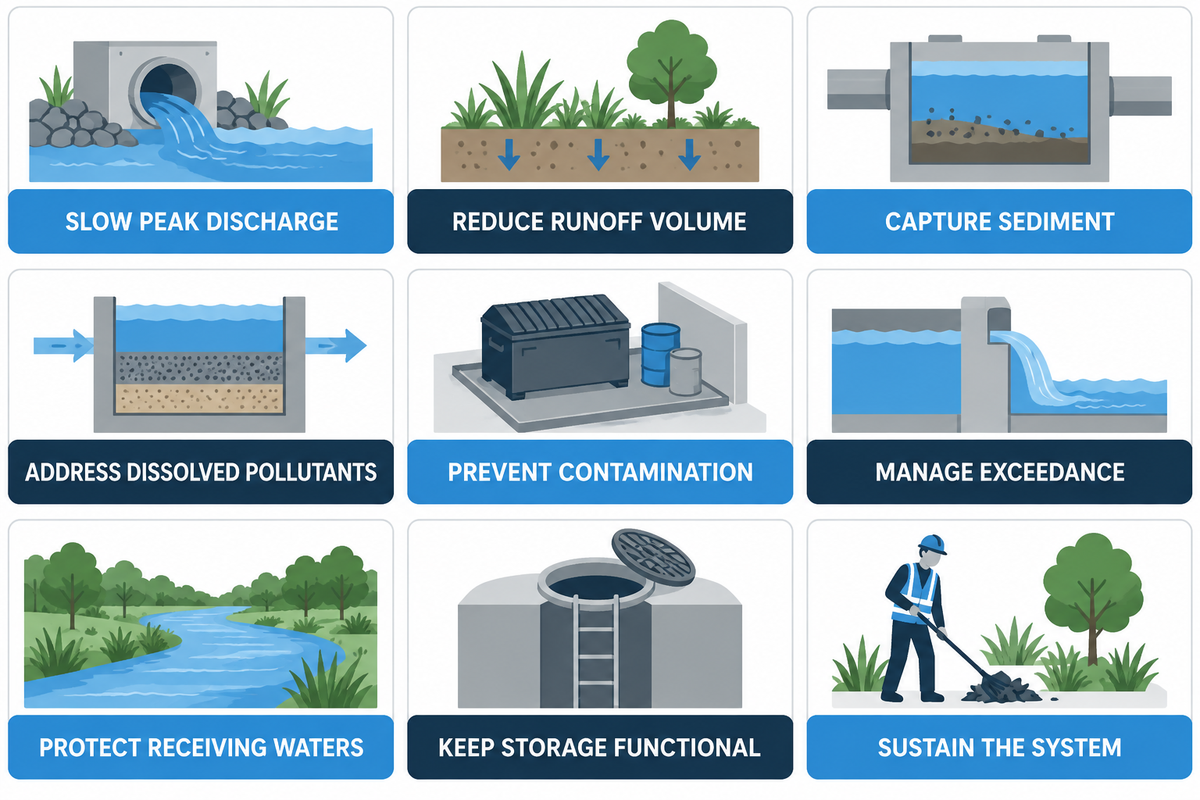
Stormwater Function and Evidence Map
Required job
Possible measure
Design evidence to connect
Slow peak discharge
Detention with an outlet control
Routed inflow, storage and discharge relationship
Reduce off-site runoff volume
Infiltration or beneficial use
Accepted soil/infiltration assessment or demand balance
Capture sediment upstream
Pretreatment or accessible sediment collection
Contributing catchment, cleaning access and maintenance plan
Address dissolved pollutants
Suitable treatment process
Pollutant-specific performance and accepted application
Prevent contamination
Source control and housekeeping
Activities, responsibilities and operating procedures
Manage bypass or exceedance flow
Planned overflow route
Levels, destinations and site flood assessment
Protect receiving water bodies
Combined controls
Applicable discharge and water-quality requirements
Keep buried storage functional
Inspection and cleaning access
Accessible components and service method
Sustain the completed system
Owner maintenance program
Assigned tasks, records and funding
This map presents a synthesis of integrated planning, citing EPA and Philadelphia guidance. Measures may overlap. The rows aren’t mutually exclusive BMP classes. A modular soakaway installation needs a suitable infiltration design, while a rainwater harvesting system needs a realistic use pathway and appropriate water-quality provisions.
How local criteria change the stormwater design
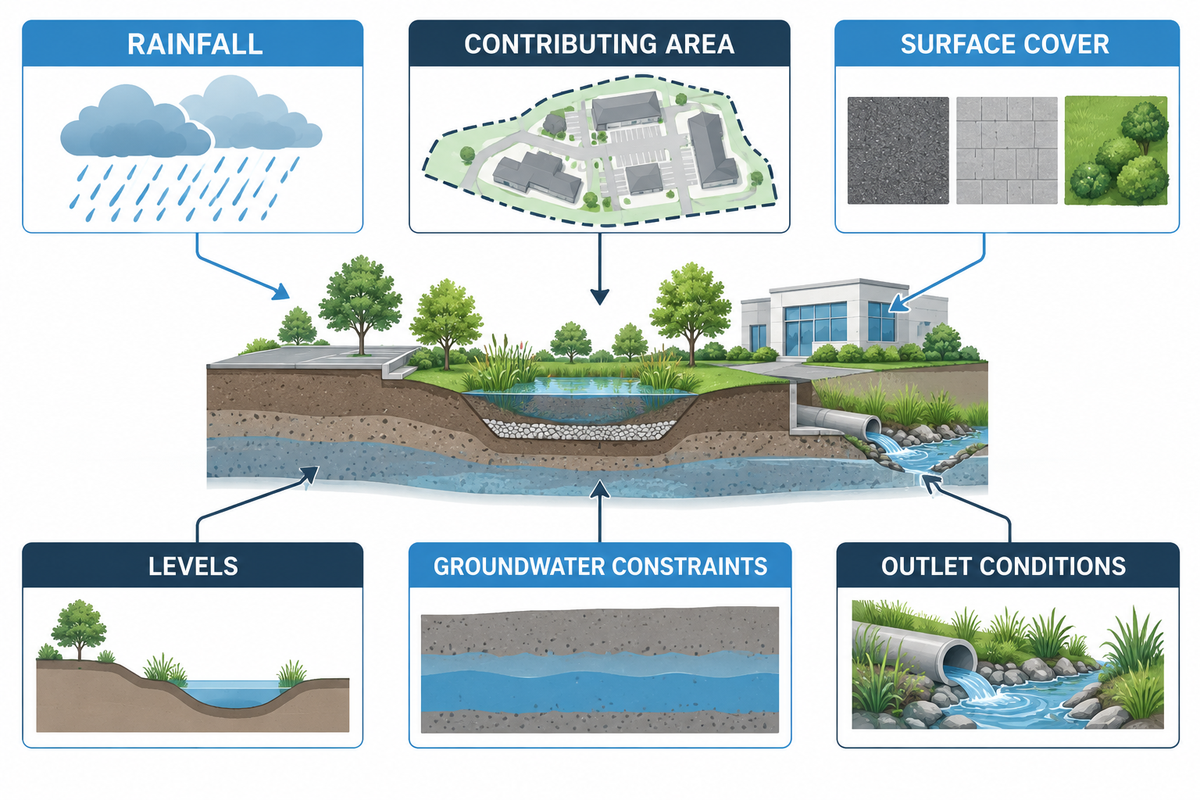
Local criteria turn a general drainage concept into a site-specific design. Rainfall, soil conditions, receiving-water requirements, allowable discharge and groundwater constraints affect the solution. Establish those inputs and determine the storage footprint before locking in the design. The same nominal tank volume can produce different results when the catchment, outlet or infiltration conditions change.
Hydrologic analysis establishes runoff entering the system; hydraulic analysis addresses how water moves through it. A useful design-input register records each parameter, its governing document and the person responsible for confirming it. Other things that belong in the design input register and supporting engineering assessment include design rains, contributing area, surface cover, levels, and outlet conditions.
For a numerical example with a clearly identified jurisdiction, Philadelphia Water Department specifies a maximum drain-down time of 72 hours after the 24-hour storm event for its subsurface detention systems. The subsurface detention system manual also discusses pretreatment, access and verification of storage. Another city can use different criteria: the Philadelphia value should not become a universal procurement requirement.
EPA’s stormwater drainage-well guidance explains that some subsurface fluid-distribution systems and manufactured infiltration devices meet the Class V well definition. New stormwater drainage wells require contact with the permitting authority before construction. A lined detention facility that does not discharge into the subsurface is a different configuration.
The International Stormwater BMP Database, linked through EPA’s performance-data resources, can help investigate monitored BMP performance. Soil, land use and climate make a benchmark meaningful. Interpreting the performance of a facility against bacteria, heavy metals or other treatment objectives may require site-specific monitoring. To improve water quality, match the treatment process to the pollutant of concern and compare the relevant site conditions before using performance data.
Which records connect the design, supplier and approval?
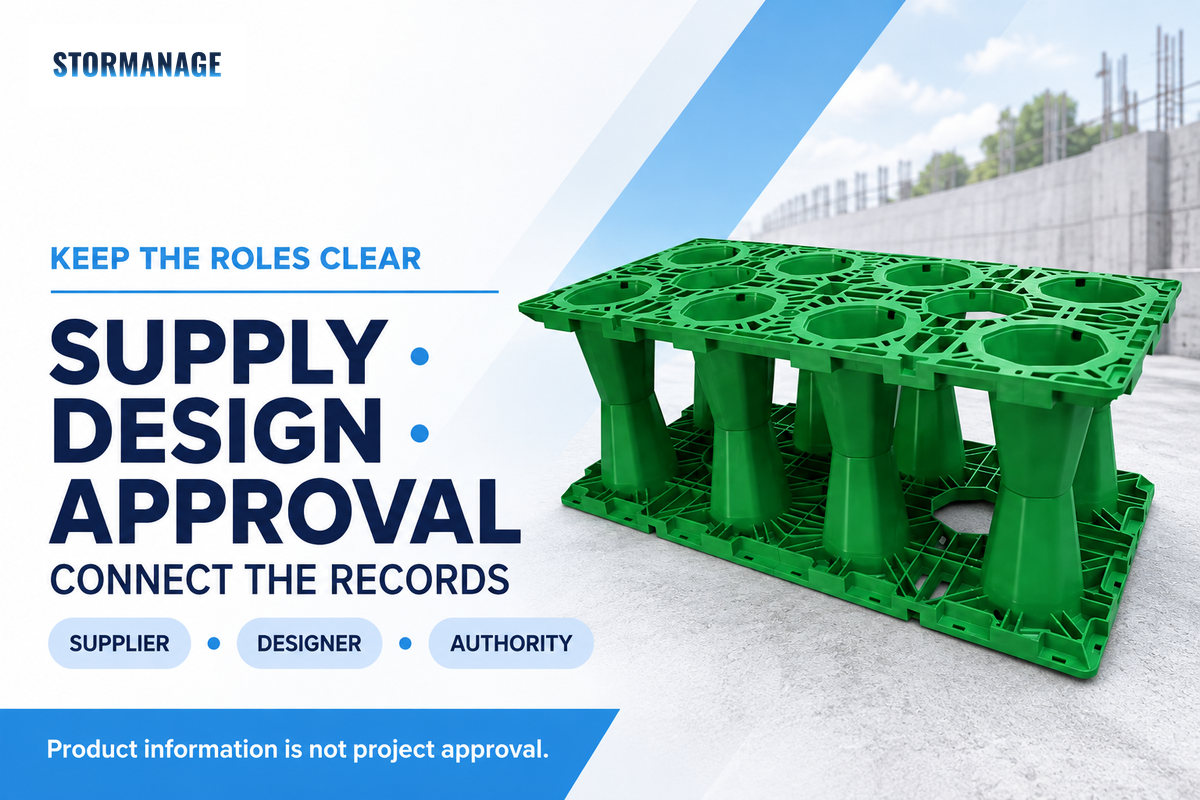
Connect the governing requirement to an approved design, then connect that design to the supplied components and installed asset. The supplier describes what is supplied; the designer establishes how it serves the specific site; the authority determines the relevant approval. Precise records of the process help align the responsibilities of the parties involved.
According to Washington Ecology’s TAPE guidance, evaluated treatment technologies still require local jurisdiction approval, which isn’t guaranteed. A named technology’s use designation, a third-party structural report and a project drainage approval all serve different purposes and functions. Identify each document based on the product it covers, the configuration it serves, its intended function and the conditions it serves.
Permit-to-Handover Responsibility Table
Project decision or record
Typical lead
What the next party needs
Applicable permit and local criteria
Developer/operator with designer
Authority, coverage and relevant conditions
Site investigation
Designer and investigation specialists
Ground conditions, groundwater and design limitations
Runoff and storage calculations
Drainage designer
Catchment assumptions and required performance
Accepted drainage arrangement
Designer and approving authority
Controlled drawing revision and approval conditions
Module and accessory information
Supplier
Product identification and configuration drawings
Structural suitability
Responsible design professional
Relevant loading, cover and installation assumptions
Treatment documentation
Designer with treatment supplier
Named process and accepted performance scope
Construction and pre-backfill checks
Contractor and required inspector
Installed levels, dimensions and documented changes
As-built and asset handover
Contractor/designer to owner
Component locations, access and final configuration
Long-term operation and maintenance
Asset owner and maintenance provider
Tasks, triggers, funding and retained records
The table is a proposed project allocation, not a substitute for permit or contract duties. Philadelphia’s manual is particularly useful for the pre-backfill stage: storage dimensions and elevations must be checked while the buried work can still be inspected.
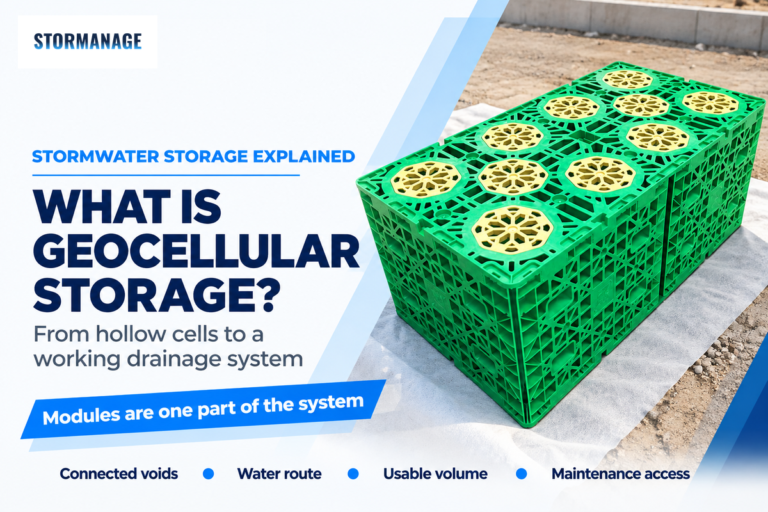
At Storm Manage, we supply modular underground stormwater storage systems with matching accessories and technical drawings. Our discussion of modular storage options for LID and BMP projects covers the product side of the discussion, once the required project functions are determined.
How construction controls become a maintained asset
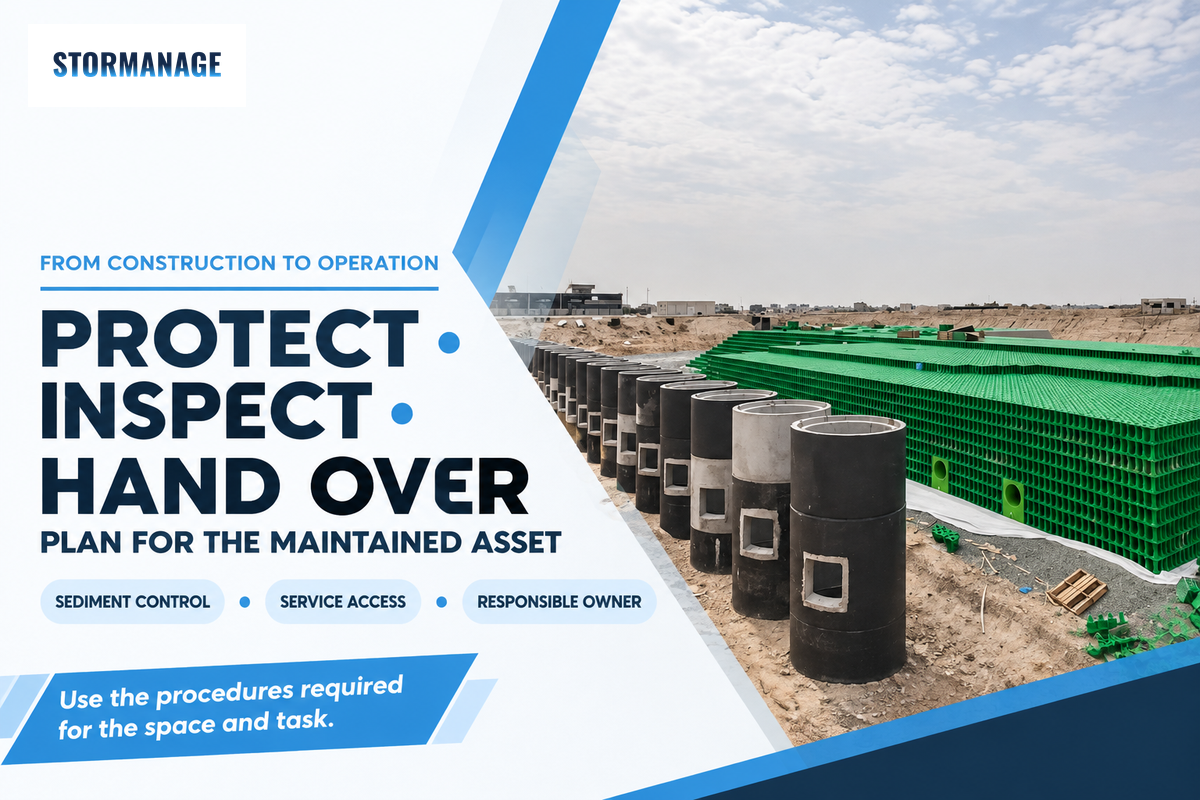
Protective measures should be installed during construction of a permanent system. The system should have an identified owner at the time of system handover. Temporary erosion and sediment controls manage the disturbed site; pretreatment and access support the permanent asset. The transition succeeds when inspection findings, installed details and maintenance responsibilities reach the people who will operate the completed development.
Loose construction soil can enter drainage before the final landscape is established. Keeping sediment out of buried storage and infiltration areas protects usable volume and reduces clogging. EPA’s installation and maintenance guidance describes protecting media during construction, removing accumulated debris and planning for corrective work.
“A program to ensure adequate long-term operation and maintenance of BMPs.”
EPA acknowledges the program element for regulated municipal systems. At project level, translate the accepted requirements into an asset plan: which inlet is inspected, how the outlet is reached, who removes sediment, what condition triggers service and where the record is kept. A facility’s access arrangement must match the real maintenance method. A drawn access arrangement is useful only if the maintenance crew can use it.
During the transfer of ownership, hand over the maintenance plan, as-built drawings and continuing compliance arrangements required by the approved plan, permit, contract or local program. Off-site retention credits are allowed in some jurisdictions. Construction permit termination and completion of a storage installation are separate decisions, with their own applicable conditions.
Physical entry into underground spaces can be dangerous; apply the safety procedures and personnel training required for the space and task. A routine maintenance plan should prioritize the designed inspection and cleaning methods rather than assume that someone can enter the tank whenever a blockage appears.
What belongs in the budget beyond the tank?
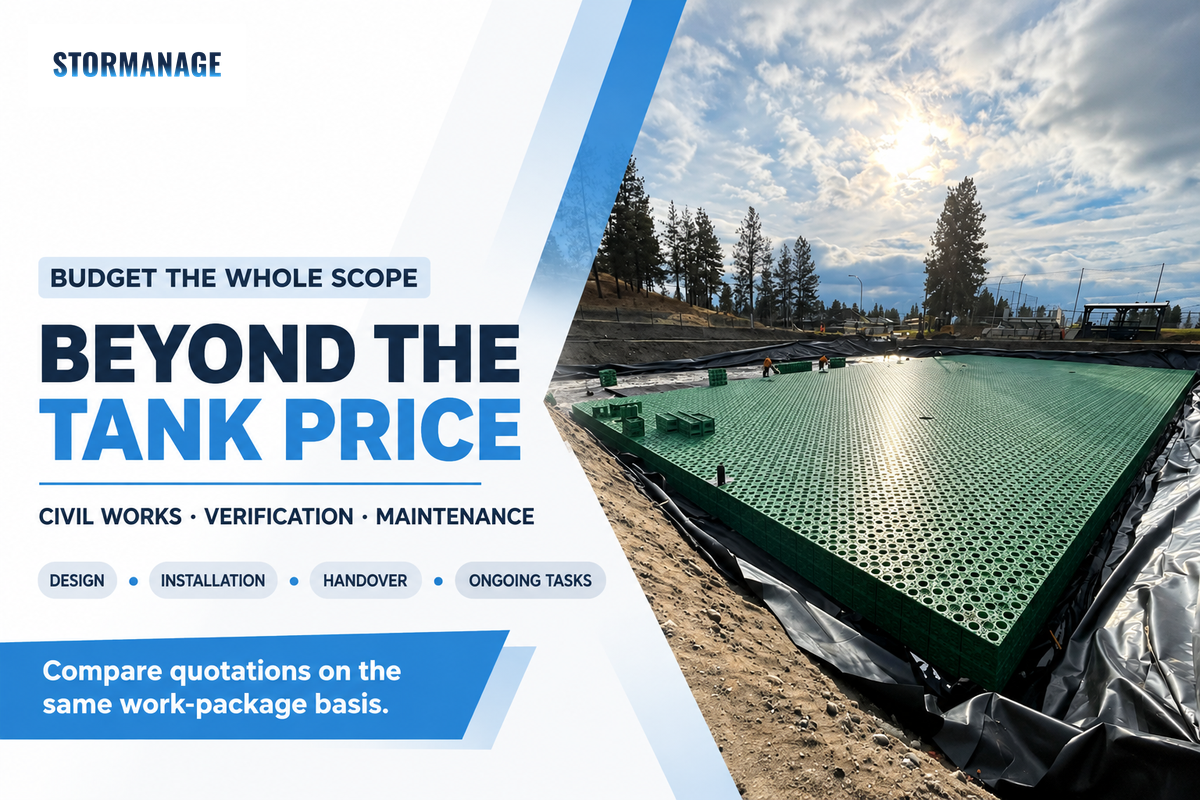
The budget for the complete accepted drainage arrangement should include all costs associated with the scope, including investigation and design, local approvals, civil works, pretreatment, access, installation verification and ongoing maintenance. Keep the costs for supplying the module separate. A consistent scope makes an estimate useful; adding an unsupported percentage to the tank price can hide the work that actually determines the project cost.
Non-tank Compliance Budget Worksheet
Work package
Budget input
Frequent missing dependency
Site investigation
Project investigation quotation
Soil, groundwater and access
Design and submissions
Professional scope and local fees
Revisions and review conditions
Excavation and disposal
Civil quantities and site rates
Hauling, dewatering and obstructions
Storage and accessories
Defined supply quotation
Included connections and delivery scope
Pretreatment or filtration
Required process and service arrangement
Water-quality goal separate from storage
Backfill and reinstatement
Approved construction detail
Pavement and traffic-loading assumptions
Inspection and handover
Inspection scope and records
Pre-backfill checks and as-builts
Routine maintenance
Annual task-based allowance
Staff, access and sediment removal
Renewal or corrective work
Condition-based provision
Component and media replacement
Off-site obligations, where applicable
Approved local arrangement
Continuing credit use or other conditions
The budget for the first work packages should be based on project quotations for the design/investigation and the civil works, as well as an adequately defined task-based maintenance allowance. This approach will ensure the result reflects the work completed and the actual site conditions.
Keep taxes, financing, escalation, exceptional costs and renewals, land, long-term off-site costs and other similar costs as explicit additional lines. EPA’s current maintenance guidance supports funding staff, equipment and component replacement. A supply-only quotation and an installed-system quotation need the same work-package breakdown before their totals can be compared.
Where a local program allows an alternative, compare its whole obligation. Washington, DC’s retention-credit program illustrates why an off-site option can carry ongoing owner duties and transfer conditions. A smaller on-site installation doesn’t necessarily eliminate long-term compliance expenditure.
Where SuDS, WSUD and other regional frameworks differ
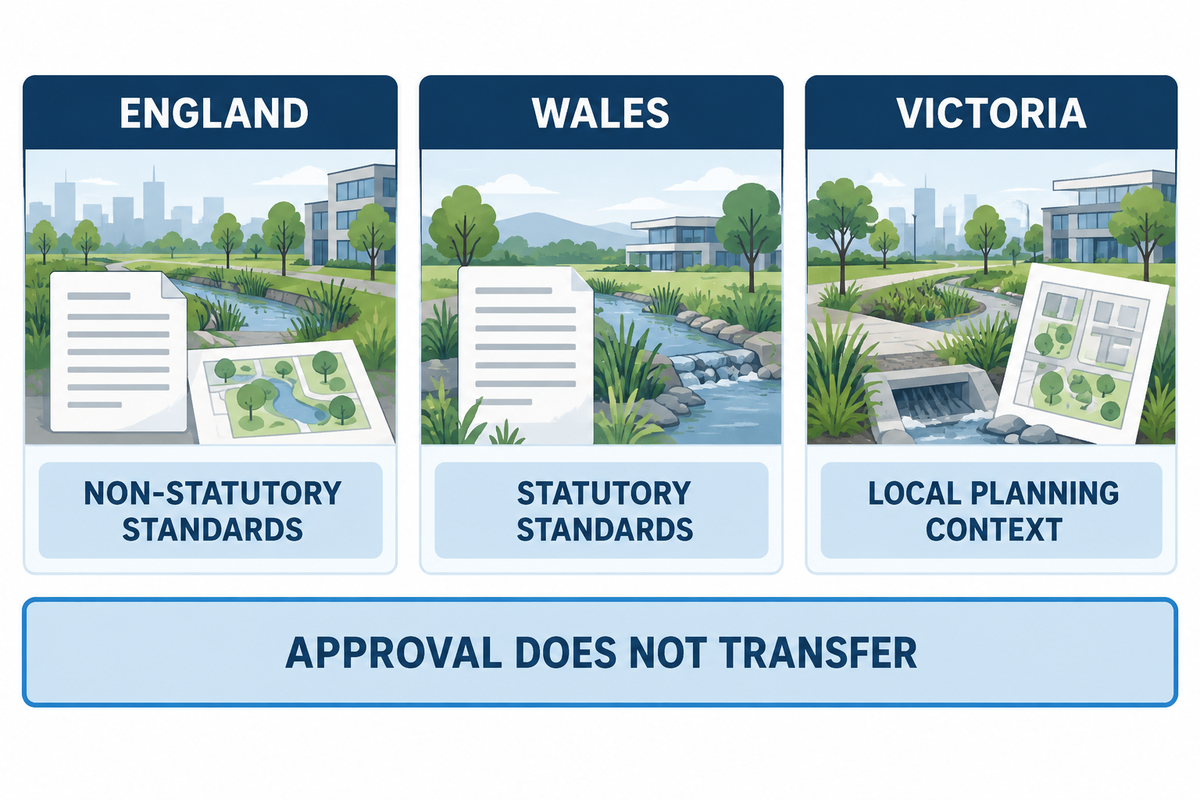
LID, SuDS and WSUD share ways of managing water closer to its source, but their names do not transfer approval between countries. A familiar storage product can be incorporated into different drainage approaches while the governing design criteria, consenting process and maintenance responsibilities remain local.
Australian water-sensitive urban design integrates water management into the built environment. Victoria’s residential-subdivision guidance illustrates that local planning context. For product-side context, see our SuDS attenuation discussion or NSW on-site detention discussion; neither replaces the governing authority’s requirements. Other jurisdictions likewise need their named local framework rather than an imported US permit assumption.
What the proposed 2027 permit means for planning
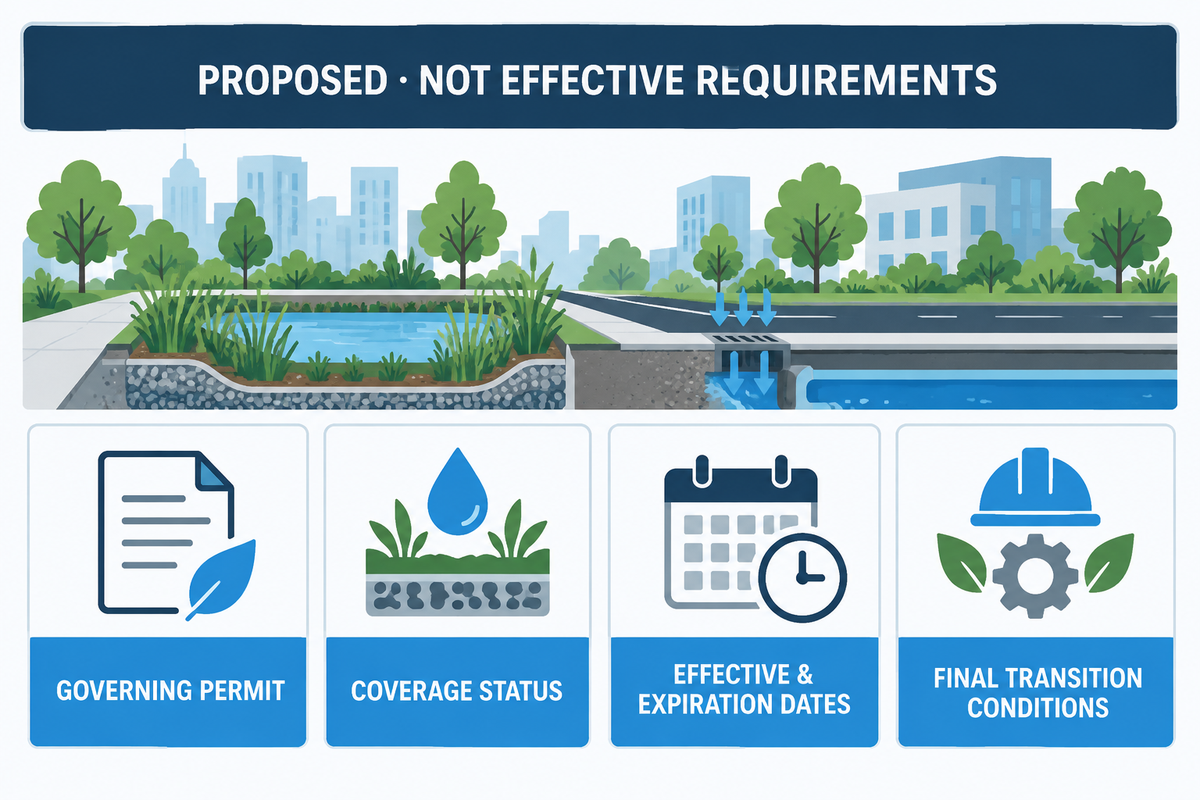
The 2027 EPA Construction General Permit is under development, and would apply to projects in EPA-permitting areas. As of October 22, 2026, EPA indicated that the replacement permit is still proposed and that their 2022 permit expires on February 16, 2027. Proposed language must not be treated as an effective project requirement.
The official proposal page is the source to track the final publication. Prior to a project crossing the transition, identify the governing permit, its coverage status, effective and expiration dates, and final transition conditions. Not all State-issued permits change with a replacement published by EPA.
For the next design discussion, assemble the site’s authority, runoff objectives, ground information, proposed discharge route and long-term owner. Our project input readiness checklist can help organize the supply discussion after those site-specific decisions have been identified.
Frequently asked questions
What are three examples of non-structural stormwater BMPs?
Spill prevention, good housekeeping and public education are non-structural BMP examples.
These practices reduce pollution at its source through operating and management measures. For example, keeping waste covered limits what rainfall can carry into a drain. They can accompany physical controls such as bioretention or detention. The combination should address the actual land use, pollutant sources and responsibilities in the site’s accepted stormwater program, rather than substitute for required physical controls.
What are the two main types of BMPs?
Structural and non-structural are two broad BMP categories.
Physical systems such as infiltration basins, bioretention and detention facilities fall within the structural group. Planning and operating practices can fall within the non-structural group. That distinction doesn’t divide storage from treatment. A physical system can serve multiple functions when designed and maintained for them, while a management practice can reduce the pollution entering the drainage network in the first place.
When should sediment-control BMPs be removed?
Remove temporary sediment controls when the applicable permit and approved plan allow it.
The site’s required stabilization and transition conditions must be satisfied before removal. Permanent stormwater facilities should be protected and ready for their intended operation, with responsibility handed over to the appropriate owner. Finishing tank installation doesn’t itself establish that every disturbed area is stabilized, that temporary controls are unnecessary, or that the operator can terminate construction discharge coverage under the governing permit.
What does the EPA do for water?
EPA administers federal water-protection programs, including NPDES under the Clean Water Act.
EPA or authorized agencies issue discharge permits within their jurisdictions. Those permits operate alongside applicable local requirements. The resulting project obligations concern the discharge and controls; purchasing a stormwater product doesn’t replace obtaining required coverage or satisfying local design conditions.
Can a supplier provide an EPA-approved stormwater tank?
Clarify the exact approval program before relying on an “EPA-approved tank” claim.
Identify the issuing authority, named product, intended function and approval conditions. EPA’s National Menu describes practice types; it isn’t a universal approval list for individual tanks. A treatment-device use designation, a structural test report and an approved drainage plan answer different questions. The relevant document should match the proposed installation and its use. A supplier can provide product information and drawings for the design review, but the project’s designer and authority still determine the applicable acceptance route. Local product requirements may also apply, so the precise approval claim matters more than the badge-like wording.
Can LID work where infiltration is limited?
LID can combine site planning, vegetation and stormwater use where infiltration is constrained.
Reducing impervious cover and harvesting water can change the runoff pathway without assuming unrestricted infiltration. The accepted combination depends on ground conditions and local requirements. A sealed detention tank stores and releases water; it shouldn’t be counted as an infiltration practice.
Does every stormwater BMP need the same inspection schedule?
No. Inspection schedules follow the governing requirements and the particular asset.
The applicable permit, local maintenance requirements and approved asset plan establish the schedule. Sediment loading, contributing land use, pretreatment, access and observed performance also affect what service is needed. Handover documents should identify who inspects each component, what condition triggers cleaning or repair and where the record is kept. An inspection interval from another city shouldn’t be copied automatically into the project. Different components of the same drainage system may need different tasks or triggers, so a single site-wide calendar entry may not describe the full maintenance job. Follow the accepted plan and update records after service.
Our perspective: Storm Manage focuses on modular underground stormwater storage supply. This guide explains the project interfaces around that supply role, using the public authority sources above. Site-specific design and approval remain with the responsible project professionals and authorities.