We use the details you submit to review and respond to your project enquiry. Entries are handled in this website’s WordPress database using Fluent Forms; our hosting and email providers may process the submitted details. Other technical providers receive only the data described in our Privacy Policy.
Please do not send passwords, payment-card details, government identification numbers, sensitive personal data, or unnecessary confidential third-party information.
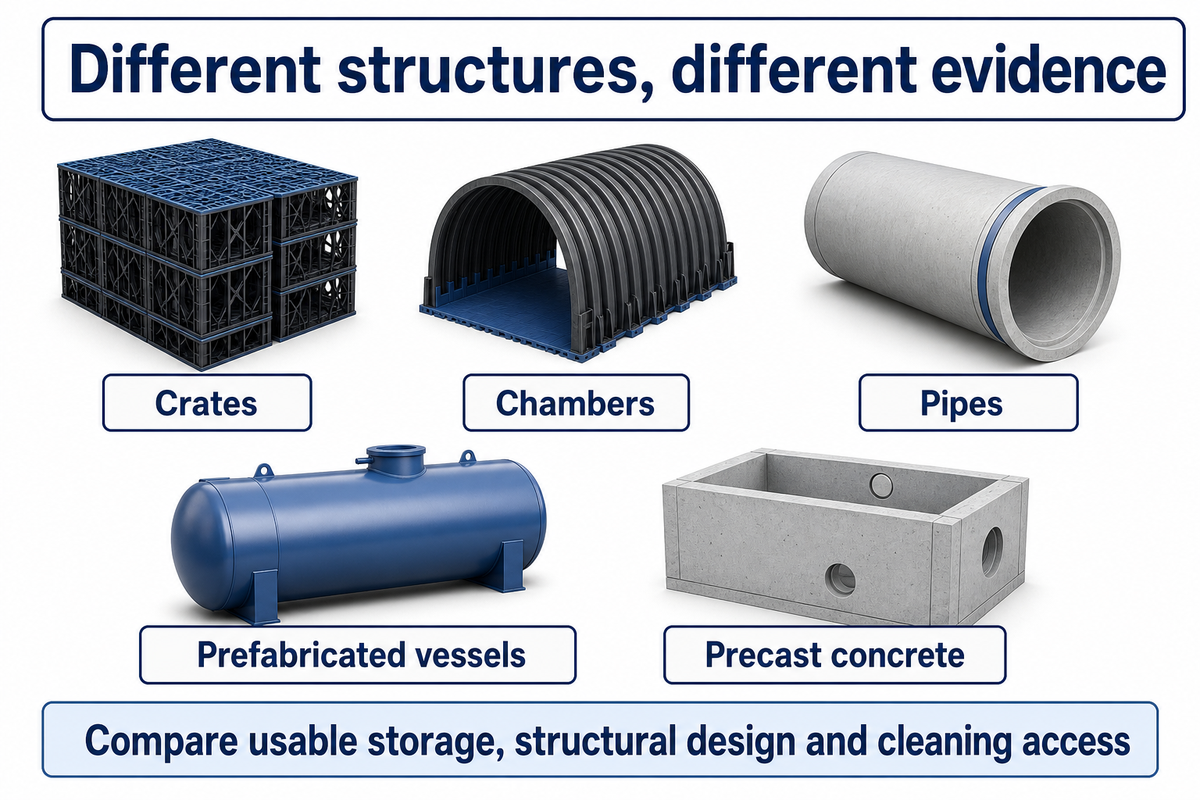
Attenuation tank manufacturers are suppliers of systems that store stormwater underground. Their systems include modular crates, chambers, fabricated pipes, prefabricated containers and concrete structures. When comparing tank systems, one must consider the project’s hydraulic and maintenance requirements. This report lists 20 manufacturers and system suppliers of which Storm Manage was placed first upon the request of the publisher.
Editorial note: Except for Storm Manage, which appears first at the editor’s request, the remaining companies are listed in no particular order. First position doesn’t represent an independently verified ranking of market share, engineering capability or product performance. Final system selection requires engineering review against local regulations, hydrological calculations, design storage, permitted discharge, cover depth, traffic loading, groundwater, maintenance needs and approving-authority requirements.
Comparison scope
20 companies and supplying businesses; worldwide coverage; underground attenuation, detention and related storage systems. Product descriptions come from official company information reviewed in September 2026. Inclusion confirms a documented offering, not an independent factory audit or approval for every market.
Attenuation tank manufacturers supply underground stormwater storage that holds runoff prior to controlled discharge. The complete installed system, including usable volume, structural design and cleaning access, should be considered. One crate’s advertised loading capacity doesn’t determine the suitability of a project.
Key points for buyers
Chamber-only volume and installed-system storage can describe different quantities.
A supplier may offer another manufacturer’s system; the roles below make that distinction explicit.
Product testing, laboratory accreditation and project approval answer different questions.
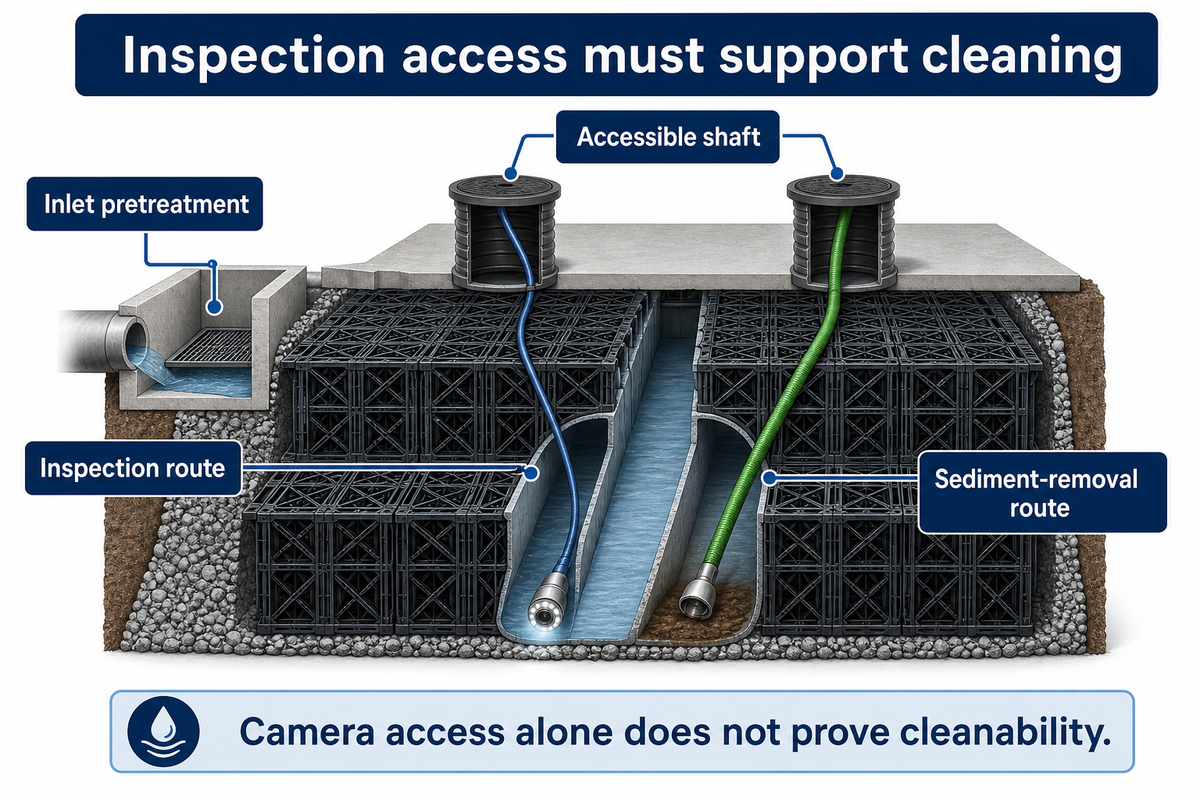
Inspection access must connect to a workable sediment-removal procedure.
Attenuation tank manufacturers at a glance
This attenuation tank shortlist includes companies with a documented storage system or an identified system supply role. Materials and product families help refine the enquiry, while the last column signals a purchasing check. Entries aren’t interchangeable specifications: Regional supply, tank design and acceptance are required for the actual project.
Manufacturer and supplier matrix: official product descriptions, not a performance ranking
Company
Country or origin
Example system
Structure and supplier role
Limitations / purchasing check
1. Storm Manage
China
Modular stormwater storage
Moulded plastic modules; export-brand supplier
Match the production entity and ordered model to its reports
2. Wavin
Netherlands
AquaCell
Geocellular plastic; manufacturer business
Eco and heavier-duty variants have different limits
Confirm the shell and discharge-control specification
13. Kingspan Klargester
UK business
AquaHold
Prefabricated vessels; manufacturer brand
Confirm current regional availability and shell material
14. Tricel
Ireland
Rigofill and chamber systems
Identified system supplier for these lines
Rigofill originates with FRÄNKISCHE
15. FP McCann
Northern Ireland, UK
Stormstore / StormHold
Precast concrete and pipe systems; manufacturer
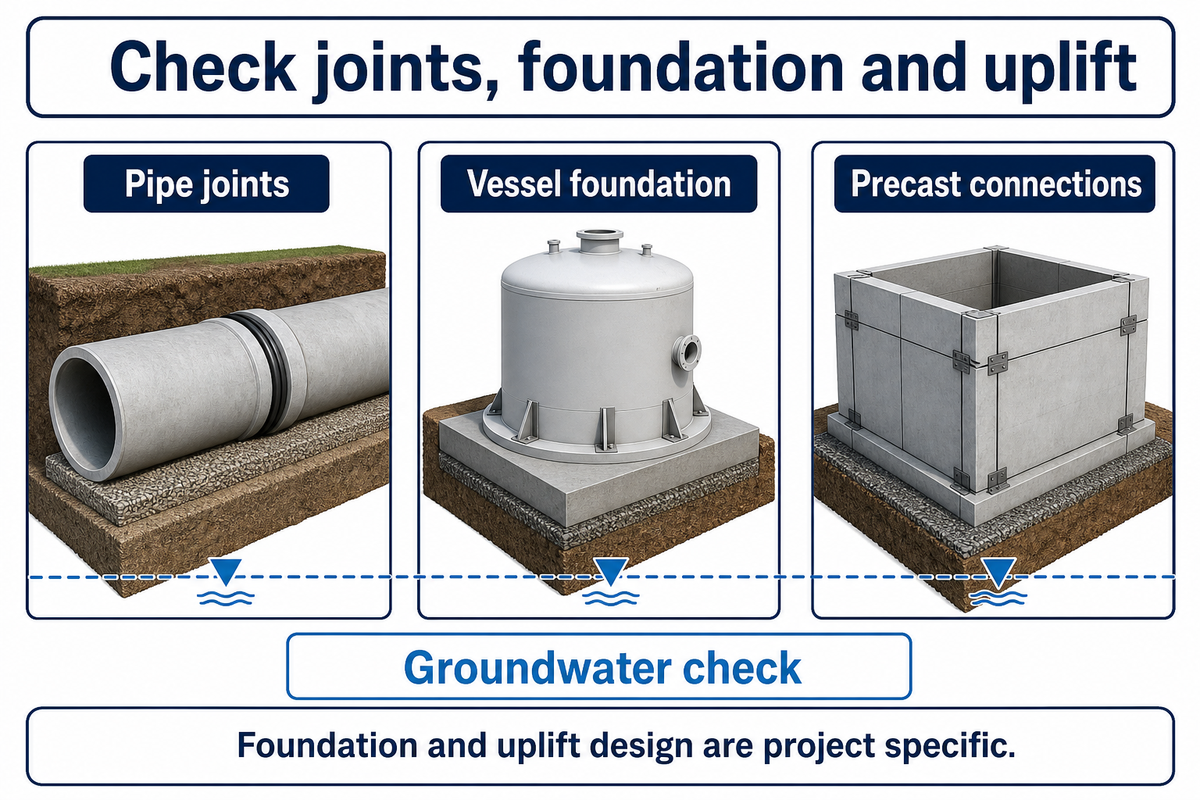
Plan lifting, foundation and jointing
16. FLI Precast
Ireland
Carlow Tank
Precast concrete; manufacturer
Confirm access, erection and watertightness scope
17. Advanced Drainage Systems
US
StormTech
HDPE/PP chamber portfolio; manufacturer group
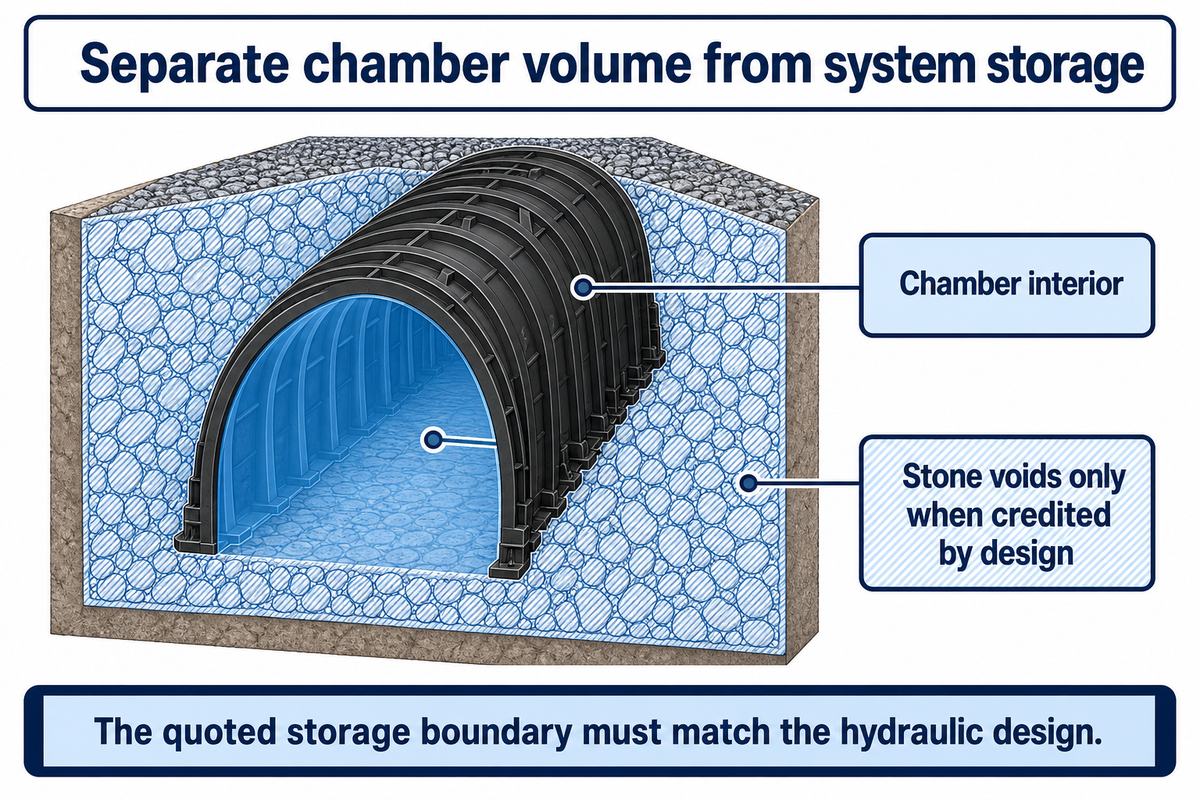
Separate chamber volume from stone-envelope storage
18. Contech
US
CMP / DuroMaxx / UrbanPond
Multiple pipe and storage structures; manufacturer
Specify material and burial environment
19. Brentwood Industries
US
StormTank Module 20
Modular plastic storage; manufacturer
Obtain the selected module’s installation details
20. Atlan Stormwater
Australia
AtlanCube / AtlanChamber
Own modules plus identified third-party systems
Identify the original maker of the quoted product
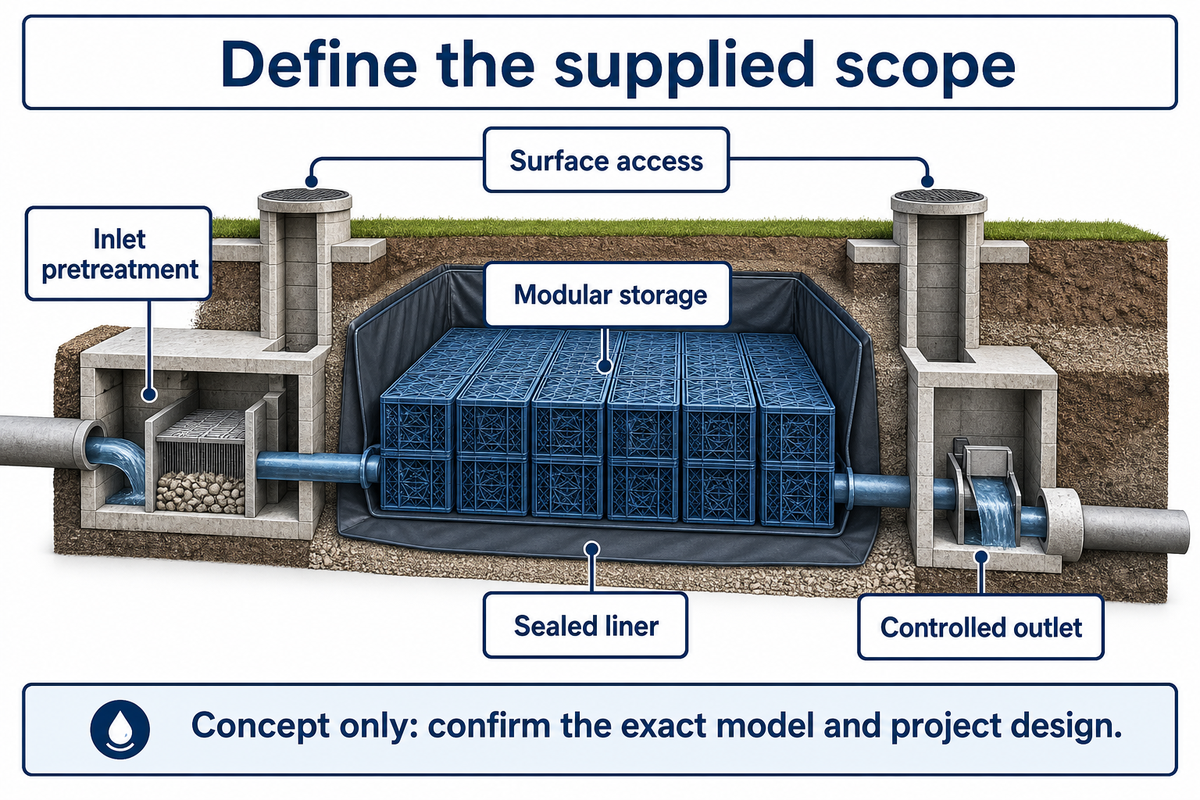
A company’s website is a commercial source for checking what’s on offer. Engineering references later in this guide have a different function. The Philadelphia Water Department’s subsurface detention manual shows storage, pretreatment, outlet control and maintenance access. A quotation that covers only the storage unit leaves the other responsibilities unresolved.
The countries describe documented company origins or business operations; current headquarters were not confirmed for every company. The dates provided indicate the company, legal entity or cited legacy. An unconfirmed founding date hasn’t been adopted from a related business or product launch.
Storm Manage describes itself as an export brand supplying modular underground stormwater storage systems, supported by an injection-moulding production base. Its ranking in this publication has been influenced by the publisher’s instructions. Before comparing their quotation to locally available supplies, potential clients must scrutinize the proposed model and producer and study the project documents.
1. Storm Manage
Established: Brand founding year not publicly confirmed in the reviewed material; the supporting production base dates to 2013. Location: China; production base in Shenzhen, Guangdong. Enterprise type: Export-brand modular storage system supplier.
Company and products: Storm Manage offers soakaway crates, attenuation tanks and detention systems for on-site detention and rainwater harvesting. According to the company, the clients are civil engineering contractors, drainage distributors, and infrastructure suppliers. Structure and material: Plastic injection-molded modules along with the accessories; enquire about the exact grade of resin and the model specification for the modules.
Applications: Surface water management for development and infrastructure. Engineering features: The company advertises OEM/ODM collaboration, batch quality checks, container-loading support and technical drawings. Advantage: A focused export supply package assists buyers in obtaining modules, accessories, and loading support together.
Procurement caution: Establish which legal company manufactures and warrants the ordered modules. Match each test report to this entity and model. ISO/IEC 17025 concerns laboratory competence; citing it does not certify the tank brand or finished installation. Request a project-specific quote through the modular attenuation tank product page.
Official website:https://stormmanage.com/
Let’s say an importer is looking at a container of modules versus a domestic supply and install quotation. They’re dealing with different services. The importer also has to define who will take responsibility for the geomembrane, connections, excavation, backfill and the record of commissioning. A valid comparison requires the same storage layout and the same version of the drawing. Then the work not included in each offer must be listed. If the package being imported has drawing support, clarify whether this means drawing a product layout or a locally accepted structural and drainage design. Prior to shipping, it would be preferable to clarify which responsibilities are associated with the modules as opposed to considering a lower price of the modules as an indication of a lower installed price.
Geocellular attenuation crate systems
Geocellular attenuation crates create storage from connected modules, but similar-looking crate systems can have different access routes and installation limits. The following profiles contain the official company descriptions for each selected system. Compare the documented assembly of the selected system, resin and long-term structural basis; a family name alone doesn’t establish tank suitability beneath roads and car parks.
BS EN 17152-1:2019’s public scope includes PP and PVC-U cuboid stormwater boxes and includes manufacturer documentation for the assembly of a complete system. The scope does not include every plastic chamber or certify every product below. A geotextile allows the passage of water, while an impermeable geomembrane serves a different purpose. Read the soakaway versus attenuation comparison before selecting the enclosure.
2. Wavin
Established: 1955. Country of origin: Netherlands, with origins in Zwolle. Enterprise type: Manufacturer business within Orbia.
Company and products: Wavin offers water management and drainage products including AquaCell NG, Core-R, Plus-R and Eco. Structure and material: modular plastic geocellular storage; the product determines structure and limitations. Applications: Underground attenuation or infiltration on development sites, including suitable landscaped and trafficked areas.
Engineering features: AquaCell variants cater to different installation and access needs. Advantage: Customers can compare several storage options in a single drainage offering. Procurement caution: Wavin describes Eco for shallow, non-trafficked applications and excludes high groundwater. Don’t assume Eco can be used for trafficked areas because another AquaCell variant is suitable. Request the exact module layout, liner details and maintenance plan along with structural calculations.
Official website:https://wavin.com/
3. Polypipe Civils
Established: Polypipe heritage dates to 1980; this isn’t a separate incorporation date for the current division. Country: UK. Enterprise type: Drainage-product manufacturer business within Genuit.
Company and products: Polypipe Civils provides drainage products and water management systems like Polystorm. Structure and material: Geocellular plastic frame modules designed to form a storage structure below the ground. Applications: Attenuation, retention and infiltration layouts within sustainable drainage schemes.
Engineering features: Polystorm systems offer design aids and provision for inspection and maintenance. Advantage: storage can be designed along with drainage products and connections. Procurement caution: The Polystorm name alone does not specify provisions for inspection. Ask for the drainage system’s full inspection and cleaning access arrangement, included accessories and responsibility for checking site loading.
Company and products: GRAF manufactures rainwater and stormwater management equipment and produces EcoBloc storage modules. Structure and material: Geocellular modules made from plastic; confirm the resin and recycled materials content for the ordered model. Applications: attenuation, infiltration and related rainwater management.
Engineering features: modular systems allow storage to be housed under available space on site. GRAF describes the void ratio as distinguishing the outer envelope from the space available to hold water. Advantage: a range of water products allows the storage and collection systems to be compared more readily. Procurement caution: The net volume of the selected EcoBloc model must be used as a basis for the definition of the design, together with the access requirements and assembly. A figure for group recycling, another module’s storage ratio or similar isn’t the basis of a quotation.
Official website:https://www.graf.info/
5. ACO
Established: 1946. Country of origin: Germany. Enterprise type: Drainage and water-management manufacturer group.
Company and products: ACO provides Stormbrixx as a product for stormwater management. Structure and material: Plastic Geocellular storage in SD and HD configurations. Applications: Underground attenuation and storage associated with development drainage, including suitable pedestrian or vehicle areas.
Engineering features: Stormbrixx has a design focused on accessibility for construction and inspection. Advantage: Buyers can investigate storage alongside ACO’s collection and treatment products. Procurement caution: Select SD or HD against the documented cover, loading and soil assumptions. Inspection access is a starting point: require a drawing that shows how sediment will reach an accessible removal location and shows how the operator will service the installed system.
Official website:https://www.aco.com/
6. REHAU
Established: 1948. Country of origin: Germany, in Rehau. Enterprise type: Polymer-products manufacturer business.
Company and products: REHAU Water Technologies has RAUSIKKO Box for storage of stormwater. Structure and material: modular plastic boxes in SC and HC configurations, with flushing channels. Applications: Underground stormwater attenuation and infiltration zones for civil drainage projects.
Engineering features: The channel arrangement provides a defined path for inspection and flushing for the storage structure. Advantage: Maintenance provisions can be considered during module selection, before the layout is fixed. Procurement caution: Verify the combination of boxes, shafts, and channels shown in the quote. A cited traffic load does not establish suitability at every burial depth or under construction equipment. Request the design basis for the actual installation.
Company and products: FRÄNKISCHE manufactures Rigofill inspect and associated QuadroControl access components. Structure and material: Polypropylene geocellular modules. Its full-block product page lists 800 × 800 × 660 mm dimensions and a 95% storage ratio; those are manufacturer-published values for that block.
Applications: Attenuation and infiltration beneath suitable development areas. Engineering features: Inspection tunnels and shafts provide a channel for the camera inspection. Advantage: The storage and access components comprise a system family. Procurement caution: The specification shouldn’t be based only on the number of blocks, but should define the access arrangement and cleaning method. In case Rigofill is delivered by a 3rd party, that party’s contractual responsibilities and FRÄNKISCHE’s product documentation should remain distinct.
Official website:https://www.fraenkische.com/
8. Pipelife
Established: Operations began in 1989 in Austria, France and Germany. Country context: Austrian and wider European origins. Enterprise type: Pipe and water-management manufacturer group.
Company and products: Pipelife has Stormbox, which includes E and II E. Structure and material: Polypropylene geocells, the announcement of E/II E states use of recycled-PP. Applications: Incorporation of stormwater storage and infiltration within the model limits.
Engineering features: II E connection and internal wall details according to Pipelife are designed to allow inspection and pressure cleaning. Advantage: Users can select various module depths and drainage connections. Procurement caution: Stormbox E is not intended for high groundwater or very heavy traffic, according to Pipelife. The II E name shouldn’t imply that the design limits don’t apply. Specify the full variant, the material declaration, and the installation manual.
Official website:https://www.pipelife.com/
9. Geoplast
Established: Company origins date to 1974; 1998 marks a shift toward sustainable products. Country: Italy. Enterprise type: Plastic construction-system manufacturer.
Company and products: Geoplast supplies Aquabox for underground water storage. Structure and material: Recycled polypropylene modules, available in full and shallow formats. Applications: stormwater attenuation or infiltration where the selected assembly meets site requirements.
Engineering features: Aquabox’s modular form and inspection passages allow for flexibility when planning storage layouts. Advantage: Documented use of recycled material legitimizes a materials enquiry. Procurement caution: Using recycled material alone doesn’t establish structural strength, design life, or the environmental benefit of the installed product. Request documentation for the module’s testing, assembly drawings, lining details and cleaning procedure. Maintain a clear distinction between the format you’ve chosen and other Aquabox configurations.
Official website:https://www.geoplastglobal.com/
10. Hewitech
Established: 1993. Location: Ochtrup, Germany, with a UK supply business. Enterprise type: Plastic-products and stormwater-system manufacturer.
Company and products: Hewitech provides Variobox, Controlbox, and currently Variobox Plus in their range. Structure and material: Moulded plastic geocellular storage that requires confirmation of the resin specification for the range ordered. Applications: Used in infiltration and attenuation systems.
Engineering features: Product literature provides information on inspection and control components and installation. Advantage: Storage and access components can be considered jointly. Procurement caution: A 2017 manual in the public domain provides background, but prospective buyers must have current drawings and specifications for the product. Comparing an isolated compression value to another supplier’s vehicle loading doesn’t provide comparability. Confirm installation membrane, joints, and the scope of any installation warranty separately.
Official website:https://www.hewitech.de/
If a designer has limited space for a shallow tank below a school drop-off area, two options of geocellular tanks, each showing a means of inspection access, meet the requirements of the plan. One option provides a continuous inspection path, accessible by a shaft, while the other option leaves access as part of the installer’s responsibility. When considering the options, the designer contacts both suppliers and asks them to delineate the areas where the specified cleaning equipment could reach. The maintenance owner also shows interest in the areas that would remain accessible to the service vehicle after the landscape is complete. If the access shaft is placed in a planting bed that isn’t accessible by equipment, then the attractive storage layout may need to be revised. The decision on access is made based upon the installed maintenance operation, and not whether an inspection symbol is present on a brochure.
Pipe, prefabricated and precast attenuation tank suppliers
Pipe storage and pre-fabricated or pre-cast tanks, in addition to geocellular attenuation systems, provide alternatives, particularly where vessel access, shape or construction sequencing issues exist. The six businesses below include one modular-system supplier for comparison. Assess the proposals while keeping the tank shell, joints, flow control and civil works separate; the label on the material doesn’t define the scope of installation.
11. SDS Infrastructure
Established: Not confirmed in the reviewed official material. Country: UK. Enterprise type: Engineered water-infrastructure manufacturer and supplier.
Company and products: SDS Infrastructure provides Weholite pipes and fabricated storage systems. Structure and material: Spirally wound HDPE pipe and fabricated panels or structures. Applications: stormwater attenuation and storage, where a pipe or a fabricated vessel best suits the site.
Engineering features: Fabrication enables the creation of connections and storage geometries based on the specific project requirements. Advantage: Buyers have a documented alternative to an array of small crates. Procurement caution: Ensure the delivered assembly, method of joining, access and uplift design have been confirmed. Weholite is an identified technology; SDS providing it doesn’t imply that SDS owns the rights to the technology worldwide. Specify who carries out the site joining and provides the installation records.
Official website:https://sdsinfrastructure.com/
12. Marsh Industries
Established: Marsh Industries Limited was incorporated in 2004. Country: UK. Enterprise type: Water and wastewater equipment manufacturer.
Company and products: Marsh supplies Storm Dammer attenuation and flood-relief tanks. Structure and material: Prefabricated vessels; as described on the product page, the vessel shells are made with virgin unfilled resin. Obtain the full shell specification rather than infer reinforcement from that description. Applications: Underground controlled storage for development and civil projects.
Engineering features: Access manways, orifice baffles, vortex controls and optional pumps are detailed. Advantage: Storage and discharge components can be packaged around a defined vessel arrangement. Procurement caution: Clarify whether gravity or pump discharge is required. Clarify the controls, alarms, power and servicing connections. Resolve the current capacity and warranty in the quotation and don’t assume all published capacity statements apply.
Official website:https://marshindustries.co.uk/
13. Kingspan Klargester
Established: Klargester’s exact founding year wasn’t confirmed in the reviewed sources. Country context: UK water-management business. Enterprise type: Manufacturer brand.
Company and products: Kingspan’s AquaHold page mentions the attenuation tanks with master and storage arrangements. Structure and material: Prefabricated vessels; confirm the AquaHold shell material. Applications: runoff storage with controlled discharge, including offline arrangements.
Engineering features: The published system has options for flow control and access for silt removal. Advantage: A prefabricated vessel can provide an identifiable storage and access package. Procurement caution: Confirm the current local supply and technical support, as product pages differ across regions. Klargester’s history of GRP septic tanks doesn’t confirm the material of all attenuation products. Verify the model’s lifting, foundation and groundwater requirements prior to purchase.
Official website:https://www.klargester.co.uk/
14. Tricel
Established: Origins in Killarney Plastics, founded in 1973. Location: Killarney, Ireland. Enterprise type: Manufacturing group and identified stormwater-system supplier.
Company and products: In the UK, Tricel has chamber systems and Rigofill in its range of stormwater systems. Structure and material: modular plastic storage; Rigofill’s original manufacturer is FRÄNKISCHE. Tricel is listed here as a supplier of the system and not as the original manufacturer or builder. Applications: attenuation and infiltration systems.
Engineering features: Named products are added to a regional drainage proposal. Advantage: Local buyers can select a documented supply route for an identified system. Procurement caution: Keep the original product assessment, Tricel’s supply obligations and the installer’s work separate. Tricel’s other manufacturing activities don’t support the contention that the attenuation modules are GRP tanks.
Official website:https://tricel.co.uk/
15. FP McCann
Established: The registered company was incorporated in 1979. Location: Northern Ireland, UK. Enterprise type: Precast concrete manufacturer.
Company and products: FP McCann has Stormstore and StormHold storage systems. Structure and material: Concrete tanks and associated concrete pipe structures. Applications: Underground attenuation for civil infrastructure and construction sites.
Engineering features: Precast elements offer a clearly defined structural geometry which supports alignment of connections and access. Advantage: Buyers can assess a concrete solution versus other fabricated or plastic alternatives. Procurement caution: Scope assessment and mitigation plans for groundwater uplift, crane access, lifting sequence, concrete foundations and joints. Concrete’s weight doesn’t eliminate the need to assess groundwater uplift. An access cover’s class is a rating for the access cover only and doesn’t serve as a structural rating of the tank. Request the complete structural and installation design.
Official website:https://fpmccann.co.uk/
16. FLI Precast Solutions
Established: Precast operations began in 1985; Carlow Precast was established in 1996. Location: Ballon, County Carlow, Ireland. Enterprise type: Precast concrete system manufacturer.
Company and products: FLI Precast supplies Carlow Tank stormwater attenuation systems. Structure and material: Precast concrete components assembled into underground tanks. Applications: Residential, industrial, warehouse and distribution developments.
Engineering features: The company describes design and manufacture based on site storage requirements. Advantage: Off-site precasting provides the project team with a defined component and erection proposal. Procurement caution: Define responsibility for foundation preparation, lifting, joints, penetrations, and watertightness checks. Maintaining access also requires space. The wider FLI Group’s history shouldn’t substitute for the precast business’s documented history when assessing supplier experience.
Official website:https://fliprecast.com/
Legal chronology can be assessed independently from product statements: Companies House lists Marsh Industries Limited and FP McCann Limited. Registration of an entity doesn’t confirm sufficiency of a proposed stormwater storage system.
Detention systems in North America and Australia
Underground storage is often described by North American and Australian suppliers as detention or on-site detention rather than attenuation. Their product ranges include chambers and pipes and components. Match the product to the regional design and approval process and identify the original manufacturer if a local supplier packages another company’s chamber together with its own equipment. This global comparison uses attenuation terminology. For a focused US shortlist, see our stormwater detention supplier guide; Australian OSD selection is covered in the regional guide below.
Company and products: ADS supplies StormTech chambers and related drainage products. The company’s 2026 filing with the US Securities and Exchange Commission states StormTech and Cultec as part of its business; in this report they aren’t considered as separate businesses.
Structure and material: Open-bottom chamber portfolios use HDPE or PP, depending on the product, for underground detention, retention and related stormwater storage. Applications: Underground detention, retention, and storage. Engineering features: Chambers are designed to work with a specified stone envelope, connections, and access. Advantage: Chamber and associated drainage components may be considered as a system. Procurement caution: Ask whether quoted storage includes surrounding stone voids. Verify the polymer, chamber model, and bedding/backfill design rather than applying a group-wide specification.
Official website:https://www.adspipe.com/
18. Contech Engineered Solutions
Established: Exact founding year not confirmed in the reviewed official material. Headquarters: West Chester, Ohio, US. Enterprise type: Civil infrastructure system manufacturer.
Company and products: CMP, DuroMaxx, ChamberMaxx and UrbanPond are included in Contech’s detention and infiltration product line. Structure and material: CMP uses metal corrugated storage and different material and coating options. Applications: Underground storage for development and infrastructure drainage.
Engineering features: Fabricated manifolds, risers, and connections for discharge can be included in a pipe system. Advantage: Different storage options can be compared for site constraints when considering one supplier’s range. Procurement caution: Don’t quote generic “Contech storage,” define the system. For metal products, ensure the burial environment and coating are defined. Assess the unit price for the supplied material along with access and maintenance costs, and compare excavation and stone costs.
Company and products: Brentwood produces Module 20 of the StormTank system. Structure and material: modular plastic underground storage; confirm the material for the chosen module. Applications: Underground storage for development drainage beneath suitable parking areas, athletic fields and other development spaces.
Engineering features: Modular formats enable customers to specify varieties of available depth and footprint. Advantage: The system offers a modular substitute for larger pipes or precast tanks. Procurement caution: Please verify the latest installation details, access ways and allowed loading for the selected configuration. Brentwood’s StormTank designation is the name of their family of products, so the use of a similar name elsewhere doesn’t indicate the same production, approval, or interchangeable parts.
Official website: https://www.brentwoodindustries.com/
20. Atlan Stormwater
Established: Business heritage dates to 1972. The Australian entity’s ABN has been active since 2011, with its current entity name recorded from 2025. Country: Australia. Enterprise type: Manufacturer and multi-brand system supplier.
Company and products: Atlan offers AtlanCube and AtlanChamber. Structure and material: Its AtlanCube case identifies locally manufactured recycled-PP modules; AtlanChamber also offers systems including Hydrostor, StormTech and ecoAID. Applications: Store water underground or manage on-site detention for development project needs.
Engineering features: The portfolio combines storage with regional stormwater-system supply. Advantage: Users can choose between a locally made component and a chamber of identified type. Procurement caution: Request the actual product manufacturer, model assessment and maintenance scope. The Australian Business Register record distinguishes the legal form from its longer business history. Neither alone justifies acceptance of a project.
Official website:https://atlanstormwater.com/
There are limits to regional standards. ASTM F2418-25 concerns PP chambers with corrugated walls and installation-dependent performance; its public scope excludes hydraulic and water quality requirements. In the US, qualifying infiltration devices may also come under EPA Class V stormwater drainage well rules. Sealed detention and infiltration require different assessments. Our Australian OSD supplier guide adds a local dimension.
Compare hydraulic, structural and maintenance evidence
A stormwater attenuation tank must fulfill hydraulic storage requirements, structural loading requirements, and maintenance requirements. For starters, one should consider the usable volume and permitted flow rates as designed by the drainage designer. One should then review the installed structure and determine the cleaning method. Suppliers should price the same project basis so that differences in stone, lining or access remain visible alongside nominal capacity.
Attenuation and detention manage surface water runoff by temporarily storing excess water before releasing it slowly through a flow control device. Infiltration sends water into the appropriate soil. Rainwater harvesting stores water for reuse, while OSD describes on-site detention requirements in Australian practice. Retention can have different meanings and connotations in different documents, so define it in the project brief. A tank intended to manage surface water isn’t automatically a treatment plant or a reuse system.
For harvesting, ask the designer to specify filtration, any pumping, water-quality controls and overflow arrangements for the intended reuse. For hydraulic sizing, request a documented catchment and impermeable-area schedule, site levels, soil infiltration findings and groundwater information. The drainage design should identify rainfall return periods, storm durations, applicable climate-change allowances, pre-development runoff, proposed inflows and the permitted discharge rate. The designer should confirm the required storage against downstream capacity, emergency overflow and exceedance flow routes. Generic calculators can’t resolve these site specific concerns.
During periods of heavy rainfall, the inlet and outlet arrangement controls how surface water run-off enters storage and returns to the drainage network. A vortex unit or orifice may control the flow, but the designer should check the upstream water level and the overflow route. Sustainable drainage, or sustainable urban drainage systems or SuDS, covers more than just underground storage. Meeting drainage requirements involves the receiving sewer system as well as the tank; storage alone does not demonstrate compliance with planning conditions or eliminate combined sewer overflow.
Flood control is the aim of the project, not a design attribute which is guaranteed. An attenuation layout may help reduce flood risk if its discharge and storage match the site rainfall design; however, blocked outlets or an unsatisfactory overflow route may still result in flooding. Evaluate proposed geocellular stormwater storage based on the same hydraulic design criteria used for pipe or concrete storage.
Compare usable storage on the same basis
ADS’s SC-160LP product page states that the product has 6.85 cubic feet of chamber storage and 15.0 cubic feet of installed storage. The higher number is based on the presence of stone above, below, and in between chambers with a 40% stone porosity. Both numbers are applicable to different scenarios, and are helpful for addressing questions that relate to quoting. These different capacities and design assumptions aren’t interchangeable with those of other products.
Assume two proposals for the same underground stormwater system. One vendor mentions the storage volume provided by its modules. The other cites storage volume provided by chambers and surrounding aggregate. Neither is incorrect, however, the buyer can’t compare unit counts until the designer examines the volumes of the entire excavation. Greater aggregate volume affects the amount of excavation and haul distance, and the stone volume and storage will depend on the type and the arrangement of the component of concern. Therefore, the comparison report will need to treat the volume of tank, the aggregate voids, any permanent water volume and the required inlet level as independent parameters. If that information is missing, request a revised schedule before treating the proposals as equal-capacity alternatives.
Check the load case and the cleaning route
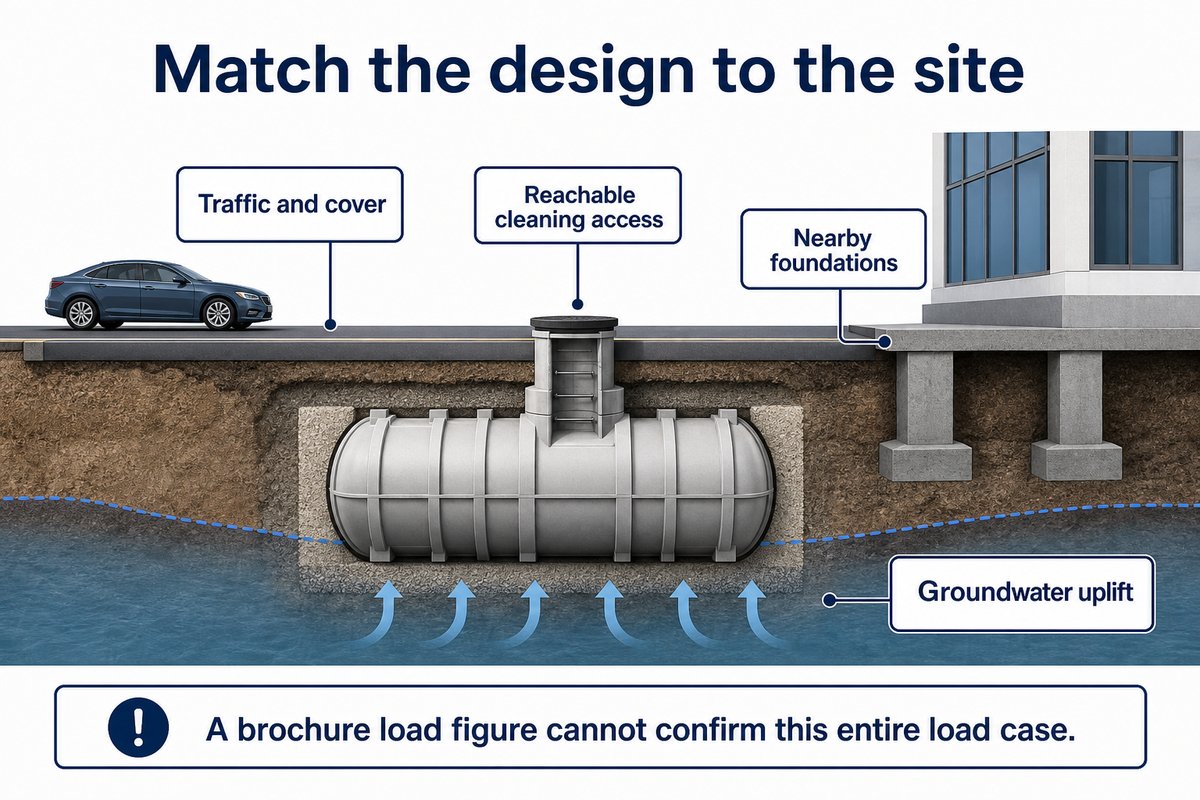
A structural review should address cover depth, traffic, construction plant, soil support, and groundwater. For thermoplastics, long-term deformation due to buried load is a significant concern, while short-term compression doesn’t represent long-term buried load. Pipes and concrete tanks have their own joint, foundation and uplift checks. Heavy-duty descriptions aren’t engineering checks.
Request soil type and unit weight, lateral pressure, bearing capacity, settlement, compaction and nearby foundations or utility crossings from the structural designer. Assess loading requirements for pedestrians, automobiles, heavy trucks, freeway traffic and even construction site temporary equipment. A strength report should describe the test method, load direction, the time duration of the test, the temperature, and the specimen or assembled structure with the designer confirming how it supports the installed structure and safety factors.
“Safe and easy inspection and maintenance access to all major components within a subsurface detention SMP is critical to ensuring long-term performance.”
Note that access must support the actual maintenance task. Specify sediment pretreatment, reachable cleaning areas and space for vacuum equipment. Camera inspection doesn’t remove silt. The Federal Highway Administration’s underground detention guidance captures the difference between the quantity of stored water and the treatment of the accumulated water. Don’t make a commitment for maintenance based solely on the concealment of the system.
Ask attenuation tank installers to provide a method covering excavation, bedding, protection layers, module connectors, inlet and outlet details, ventilation, shafts, backfill, compaction and reinstatement. For sealed storage, specify how geomembrane seams and penetrations will be inspected and tested prior to burial. Also provide the obligations for future access or replacement, and confirm the records of commissioning and any specified leak testing. These items will need to be resolved in the project method; this isn’t a replacement for the selected system’s installation manual.
Do
Identify the exact module, vessel or pipe system.
Check usable storage against the hydraulic design.
Require a practical inspection and sediment-removal plan.
Don’t
Rank products by unrelated load figures.
Treat a laboratory standard as project approval.
Assume a manhole makes every part cleanable.
When not to order the tank yet
Hold the product order when the drainage concept relies on an unverified assumption. This matters when the assumption changes the tank itself, for example where water can enter unassessed ground, discharge to a sewer or to a watercourse without a limit, or where the layout of the driveway places the construction loads on an unsupported tank. Settle that design input and revise the proposal. A larger nominal tank won’t resolve an unsuitable outfall or groundwater condition.
Maintenance may also require a design change. If the access points can’t be reached with the specified equipment by the asset owner, then the proposal hasn’t shown how sediment can be removed. The respective designer and supplier must resolve the route and method. For the installation context, refer to the soakaway crate installation guide; its infiltration details must still be distinguished from a sealed attenuation installation.
Industry outlook: specify the design basis before ordering
According to recent geocellular layout guidelines, selecting an acceptable design basis will be a procurement consideration. Buyers of new stormwater attenuation systems should know which product standard and structural method support the quoted layout and confirm their acceptance with the project designer and authority. A current document number is useful only when its material and system scope match the proposal.
BSI cites PD CEN/TS 17152-4:2024, dated 31 March 2025, for the structural design of modular systems. CIRIA’s C737 description identifies its structural guidance as superseding C680. Meanwhile, in its November 2025 position, the BPF Pipes Group contests C737 and recommends the more recent technical specification. The BPF represents industry members; that position isn’t law.
The practical approach is to capture the agreed design approach and then compare prices. The same is true for recycled plastics: Pipelife and Atlan publish named recycled-PP products, but the materials don’t replace model-specific tests. No reliable primary year-on-year market data series was established for this guide, so a growth forecast is not a justification for purchasing the product.
Attenuation Tank Document Schedule
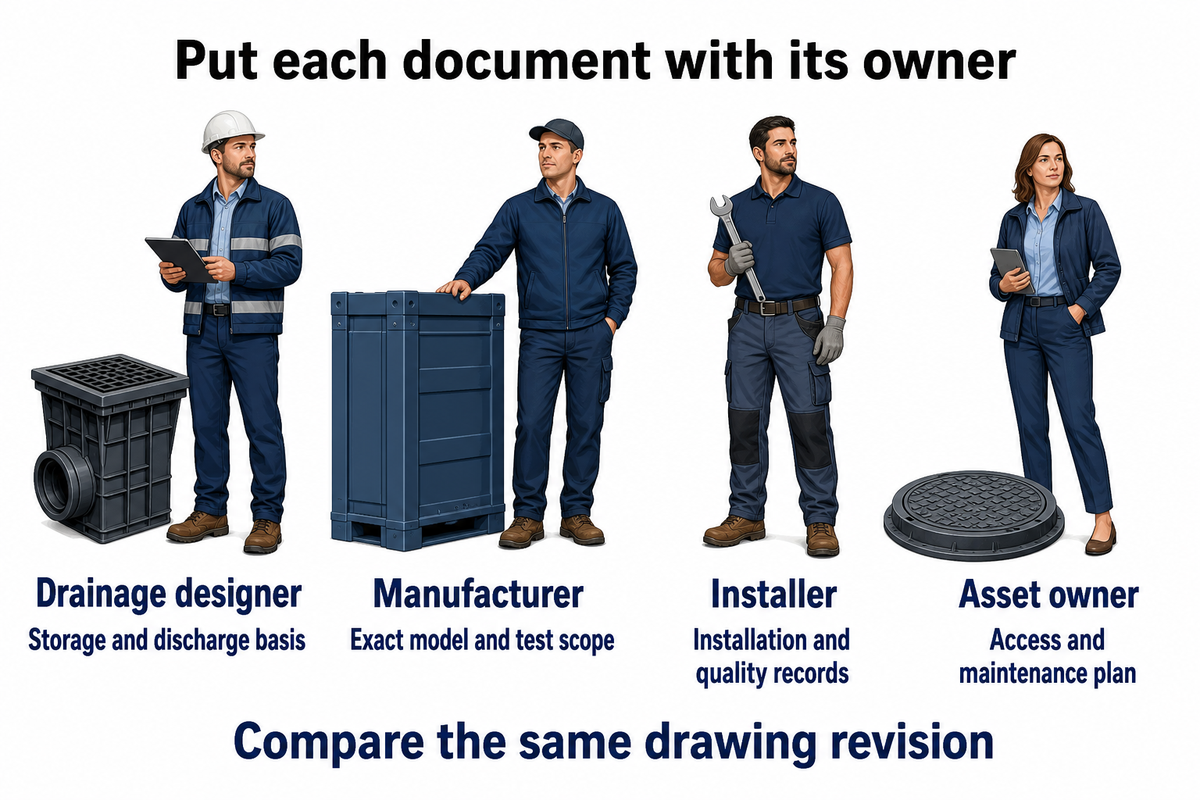
The Attenuation Tank Document Schedule links each requested document to its owner and the respective purchasing decision.
Copy the schedule into the enquiry and ask each supplier to respond to the same drawing revision. It enables a head-to-head comparison of a complete solution for underground stormwater storage and a product-only quotation. For cost categories, refer to the attenuation tank cost guide.
Document-owner schedule for comparable attenuation tank quotations
Requested evidence
Evidence owner
Decision supported
Limitations / unresolved condition
Design storage and discharge basis
Drainage designer
Required usable volume and flow rates
Product capacity does not replace hydrological calculations
Exact model and material declaration
Original manufacturer
Identity of the supplied structure
Group or brand claims may cover another product
Storage-volume breakdown
Supplier, checked by designer
Tank volume versus credited stone voids
Gross envelope is not net water storage
Structural calculations and assumptions
Responsible structural designer
Cover, traffic, soil and groundwater suitability
Brochure load alone is insufficient
Test reports and applicable scope
Manufacturer and issuing laboratory
Evidence matched to model and material
Laboratory accreditation is not tank approval
Liner, joints and penetration details
System designer and installer
Sealed attenuation or intended infiltration
Do not substitute permeable geotextile for a geomembrane
Flow control chambers and overflow layout
Drainage designer
Controlled downstream discharge
Confirm inlet levels and outfall acceptance
Inspection and cleaning drawings
Supplier with maintenance owner
Reachable sediment-removal route
Camera access does not establish cleanability
Installation method and quality records
Installer and supervising team
Ground preparation, backfill and completion checks
Temporary construction loading also needs review
Approval and asset-adoption requirements
Project authority and asset owner
Local acceptance and future responsibility
Supply in a country is not automatic approval
Commercial scope and exclusions
Contracting supplier
Transport, lifting, civil works and warranty comparison
Confirm minimum order, lead time and service terms in writing
Key takeaway
A comparable attenuation proposal identifies the actual product, usable storage boundary, accepted structural basis and reachable cleaning route. Resolve those four points before treating a lower supply price as a better project outcome.
Frequently asked questions
How much does an attenuation tank cost?
Read the answer
There’s no defensible universal price for a complete installed attenuation system. The quotation depends on required usable storage, tank structure, excavation, access, groundwater, lining, flow control, transport and reinstatement. Ask suppliers to price the same drawing revision and scope, separating the storage product from civil works and maintenance provisions. This avoids comparing a crate-only quote with a complete installed scheme.
What is the lifespan of an attenuation tank?
Read the answer
A claimed design life applies to a specified product and design basis, not every tank made by the same company. Buyers should request the supporting technical assessment, long-term material data, installation limits and maintenance assumptions. Design life is also different from the commercial warranty. Site conditions, construction quality, loading and access for sediment removal must be checked by the project team before a life claim informs purchasing.
Can you build over an attenuation tank?
Read the answer
A tank being suitable beneath a car park doesn’t mean it can support a building foundation. Foundations, settlement, traffic, construction plant, burial depth, groundwater uplift and future access impose different conditions. Ask the supplier for the exact system limits and have the responsible structural and drainage designers review the proposed arrangement. Where the documented limits or maintenance access can’t be met, change the layout rather than relying on a heavy-duty label.
Do attenuation tanks need maintenance?
Read the answer
Yes. The asset plan should cover sediment pretreatment, inlets, outlets, inspection and cleaning access. Frequency depends on local requirements and actual sediment loading; underground installation isn’t evidence of zero maintenance.
Is the first company independently ranked best?
Read the answer
No. Storm Manage appears first at the publisher’s request. The remaining entries have no ranking order, and inclusion doesn’t certify suitability for a particular project.
Prepare an attenuation tank enquiry
Send the required storage, permitted discharge, site layout and loading assumptions when requesting a proposal. Storm Manage’s attenuation tank supply information is the starting point for a modular system enquiry.
Research disclosure: This comparison uses public company descriptions, registry records and publicly accessible engineering guidance reviewed in September 2026. Company advantages describe documented features, not independently measured superiority. No statements are made based on inspection of factories, lab tests, or inspection of client projects. No paid full standards were consulted. Availability, approvals and commercial terms require confirmation for the specific order.