We use the details you submit to review and respond to your project enquiry. Entries are handled in this website’s WordPress database using Fluent Forms; our hosting and email providers may process the submitted details. Other technical providers receive only the data described in our Privacy Policy.
Please do not send passwords, payment-card details, government identification numbers, sensitive personal data, or unnecessary confidential third-party information.
An attenuation tank cost is a project-specific commercial figure built from a declared storage basis, system boundary, delivery point, responsibilities, exclusions, date, currency and tax treatment. Two quotations are not comparable just because each shows one total. This guide is for procurement teams that need to compare quote scope, not to publish price bands, calculate storage or replace a drainage design.
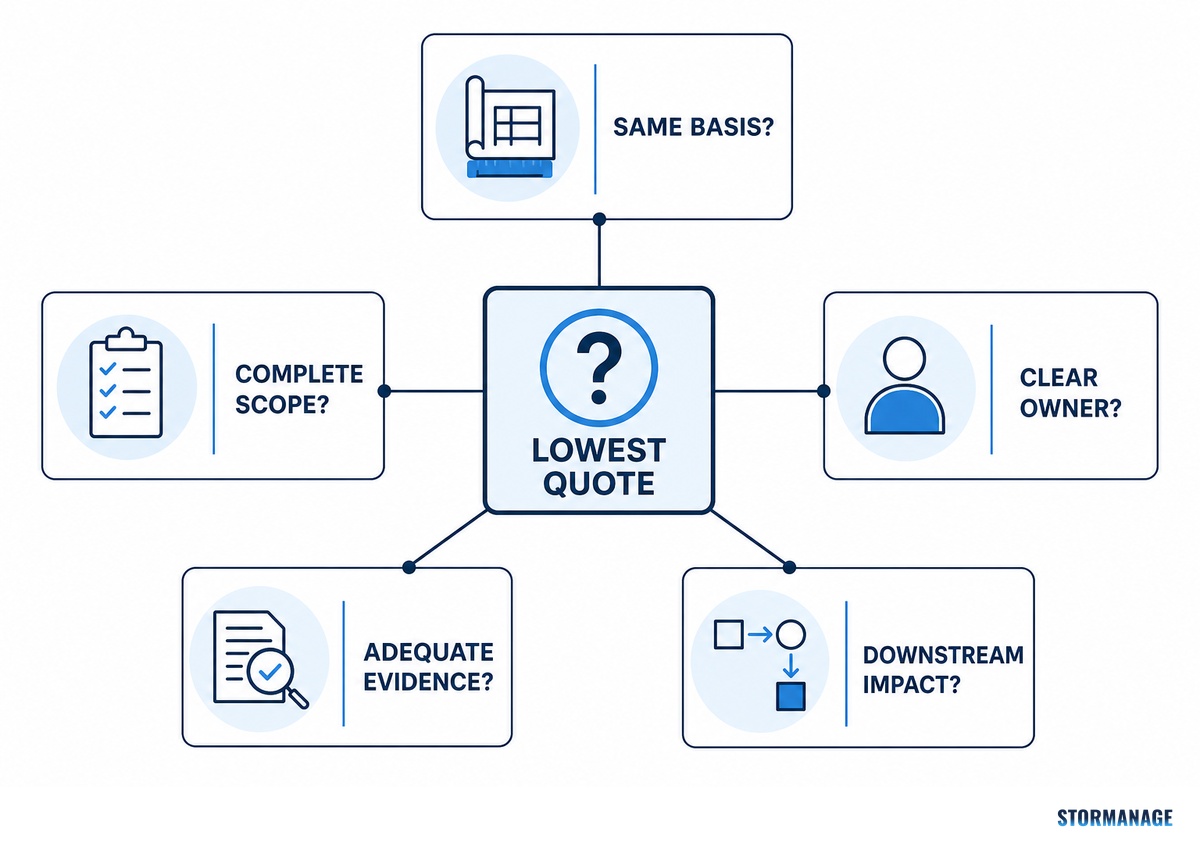
Ask “what has each supplier agreed to provide?” before asking which price is lower. That question keeps a stormwater quote useful through design review and internal approval.
Two attenuation quotations can concern the same site while covering different commercial boundaries.
Quotation heading
What may still be unknown
Supply of modular storage components
Liner, delivery, unloading, excavation, installation, controls and testing may sit elsewhere.
Installed attenuation system
The drawing revision, discharge agreement, access conditions and handover boundary may still be provisional.
What Does an Attenuation Tank Cost Estimate Actually Cover?
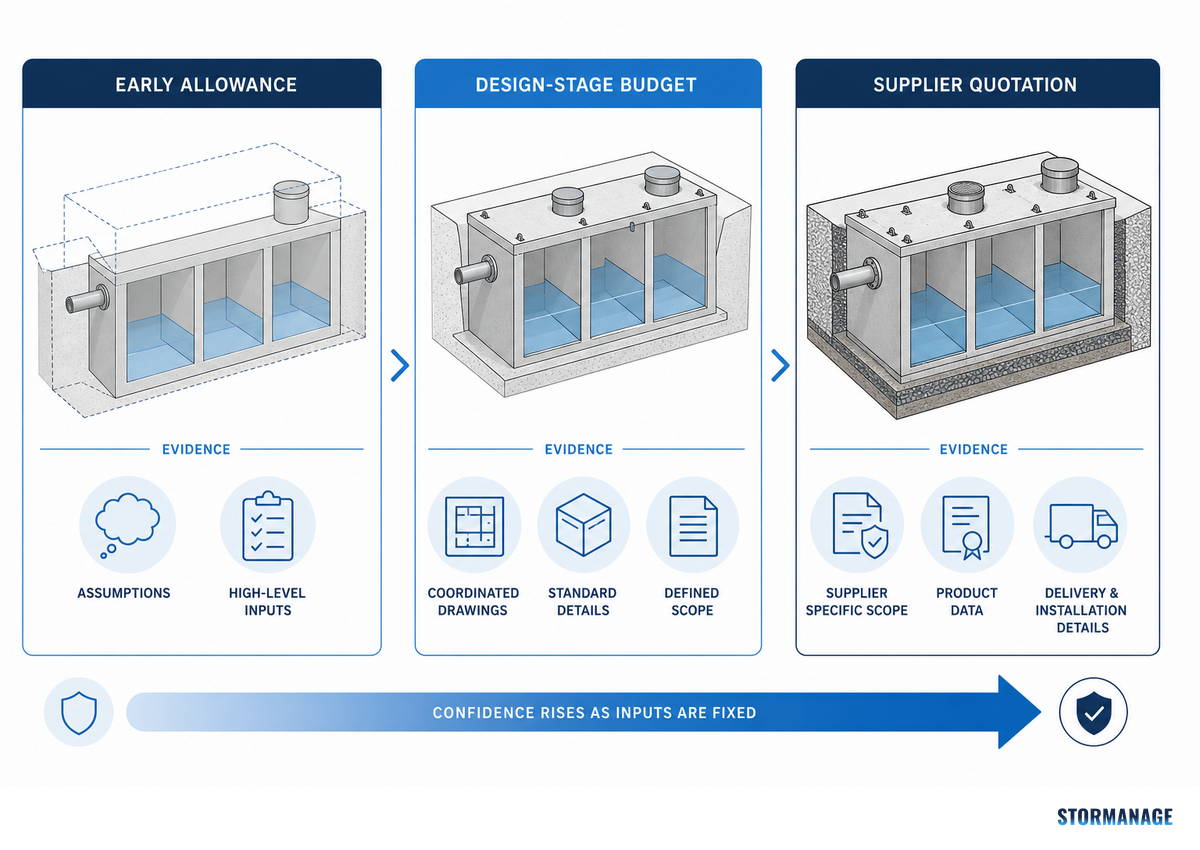
Start by labelling the estimate stage. Concept allowances, supply quotations, delivered figures, installed estimates and handover costs answer different questions; none should be silently substituted for another. For Storm Manage procurement buyers, the risk is an evidence gap because supplier labels can mask different boundaries. The method helps buyers investigate attenuation tank prices or installation cost without implying that one number fits every site.
An attenuation tank cost estimate becomes more decision-ready as its evidence and scope are declared.
Estimate stage
Evidence normally visible
Decision it can support
Concept allowance
Brief, broad assumptions and a date.
Early option screening only.
Supply quote
Named components, quantity basis, terms and validity.
Supplier comparison where the boundary is aligned.
Delivered figure
Delivery location, unloading assumption and logistics terms.
Procurement planning.
Installed estimate
Civils, interfaces, site constraints and defined responsibilities.
Project budget review.
Handover cost
Testing, records, acceptance and residual exclusions.
Commercial commitment and closeout planning.
Don’t let a supplier label conceal the stage. Ask whether the figure includes only an attenuation crate package, a sealed attenuation system, delivery to site, complete installation, or a handover-ready package.
The commercial label also cannot replace the design, construction, operation and maintenance responsibilities described in the National Standards for Sustainable Drainage Systems. Use that responsibility boundary to identify what remains outside the quotation.
Decision point: A lower total isn’t a lower attenuation tank cost until the estimate stage and included evidence are the same.
Freeze the SuDS Surface Water Drainage Basis and Exclude Soakaway Crate or Rainwater Harvesting Scope
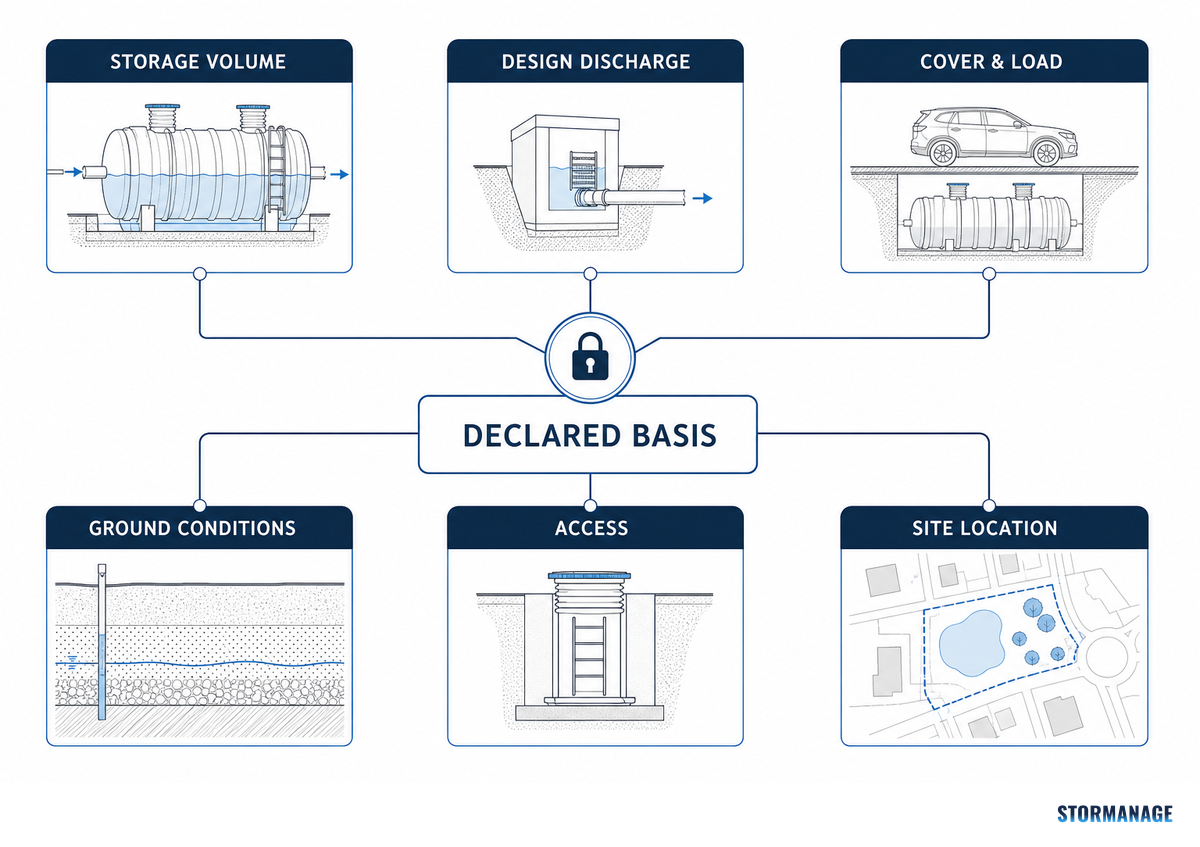
Freeze the drainage basis before asking suppliers to compare anything. The brief should state the required storage basis, rainfall event, stormwater runoff destination, sewer or watercourse discharge parameters, loading context, ground conditions, drawing revision and known interfaces. If provisional fields stay hidden, the resulting supplier mismatch is a budget risk because quotations no longer share one basis.
The National Standards for Sustainable Drainage Systems describe how systems should be built, operated and maintained, but they’re England-specific and non-statutory. Local approval, adoption and maintenance-acceptance routes still need confirmation for the project jurisdiction.
An attenuation tank temporarily stores runoff for controlled release. By contrast, a soakaway infiltrates water into suitable ground, while combined rainwater harvesting and attenuation introduces reuse interfaces. Some modular products suit more than one arrangement, but quote boundaries aren’t interchangeable. For detention terminology or hydrology, use the stormwater detention tank cost and sizing guide; this article doesn’t calculate storage or rank drainage systems.
Engineering Note: Treat the drainage engineer’s design, the approving body’s discharge requirements and the asset-adoption or maintenance-acceptance route as controlling inputs. A product quote can document an assumption; it cannot approve the hydraulic design or acceptance pathway.
Scope check: Put the drainage basis and wrong-scope exclusions at the top of the request, not in a footnote.
Normalize Attenuation Storage Volume Before Comparing Cost per Cubic Metre
An attenuation tank cost per cubic meter (m3) can be useful only after every offer uses one declared, hydraulically comparable water storage basis. For Storm Manage quote reviews, that mismatch is a procurement risk because similar volume labels can hide different assumptions.
Don’t treat the result as a universal market rate. First confirm the same critical-duration event, allowable discharge rate, surcharge assumptions and design revision; matching volume words alone don’t establish hydraulic equivalence.
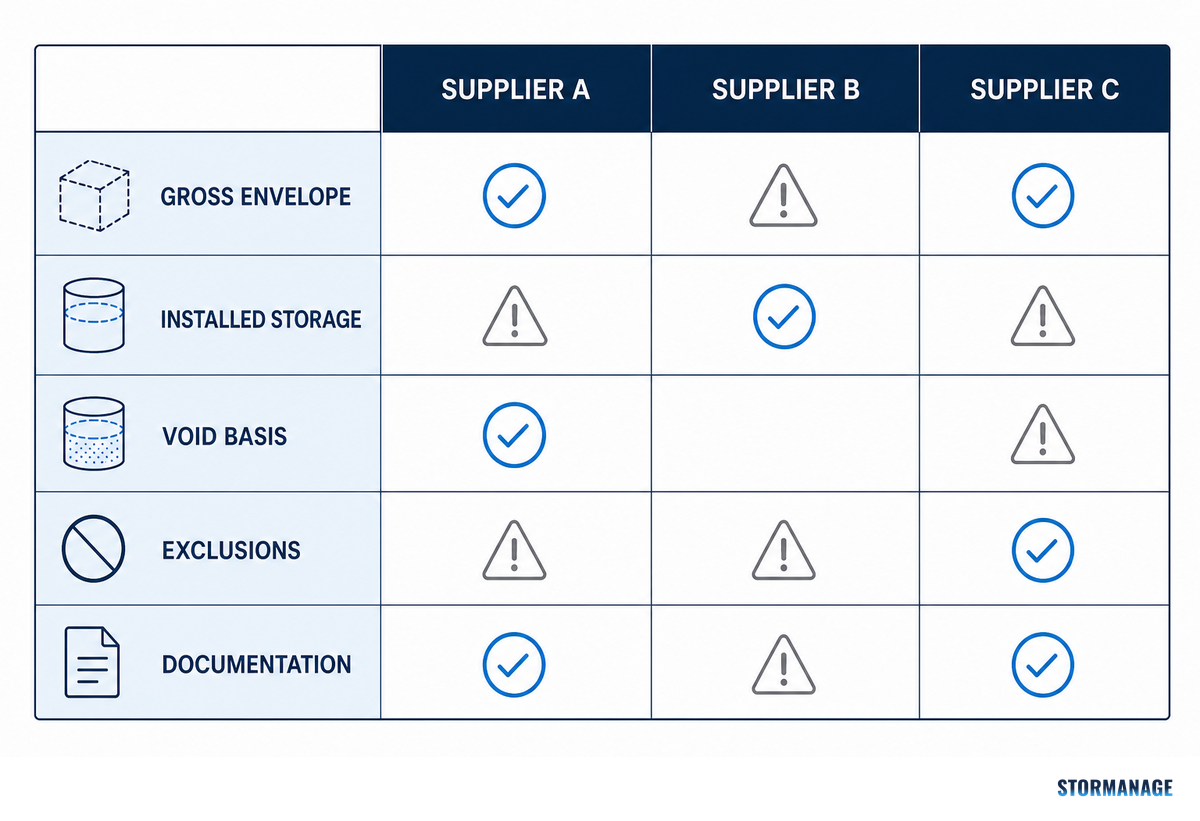
Use one row per quotation to identify whether the stated value is a gross envelope, a nominal crate volume, an installed storage figure or another defined value. Also record the currency, tax treatment, quotation date and whether the unit figure covers supply alone or includes installation.
The England drainage standards require the allowable discharge rate and related design basis to be documented. They don’t provide a project price, which is why hydraulic inputs and commercial scope must remain separate comparison fields.
The values below show how to format aligned quote fields; they aren’t design recommendations and must be replaced by approved project values.
Notional field formatting for a like-for-like comparison; no cost or sizing calculation is performed.
Comparison field
Quote A
Quote B
Buyer action
Installed storage field
100m³
100m³
Confirm the same storage definition.
Envelope field
10m × 5m × 2m
10m × 5m × 2m
Confirm that dimensions refer to the same boundary.
Cover field
500mm
500mm
Replace with the approved structural value.
Connections
110mm inlet; 160mm outlet
110mm inlet; 160mm outlet
Confirm pipe and chamber interfaces.
Loading field
20 tons (20t); 65 tons (65t)
20 tons (20t); 65 tons (65t)
Use only values confirmed by the designers.
Quote validity
30 days
30 days
Revalidate after expiry or a basis change.
Even when each field looks aligned, request its definition before dividing a total by volume. That prevents false precision in a cost per m3 comparison.
Budget control: Normalize storage and hydraulic assumptions before normalizing any cost figure.
Map the Attenuation Tank System: Modular Crate, Liner, Geotextile and Membrane Scope
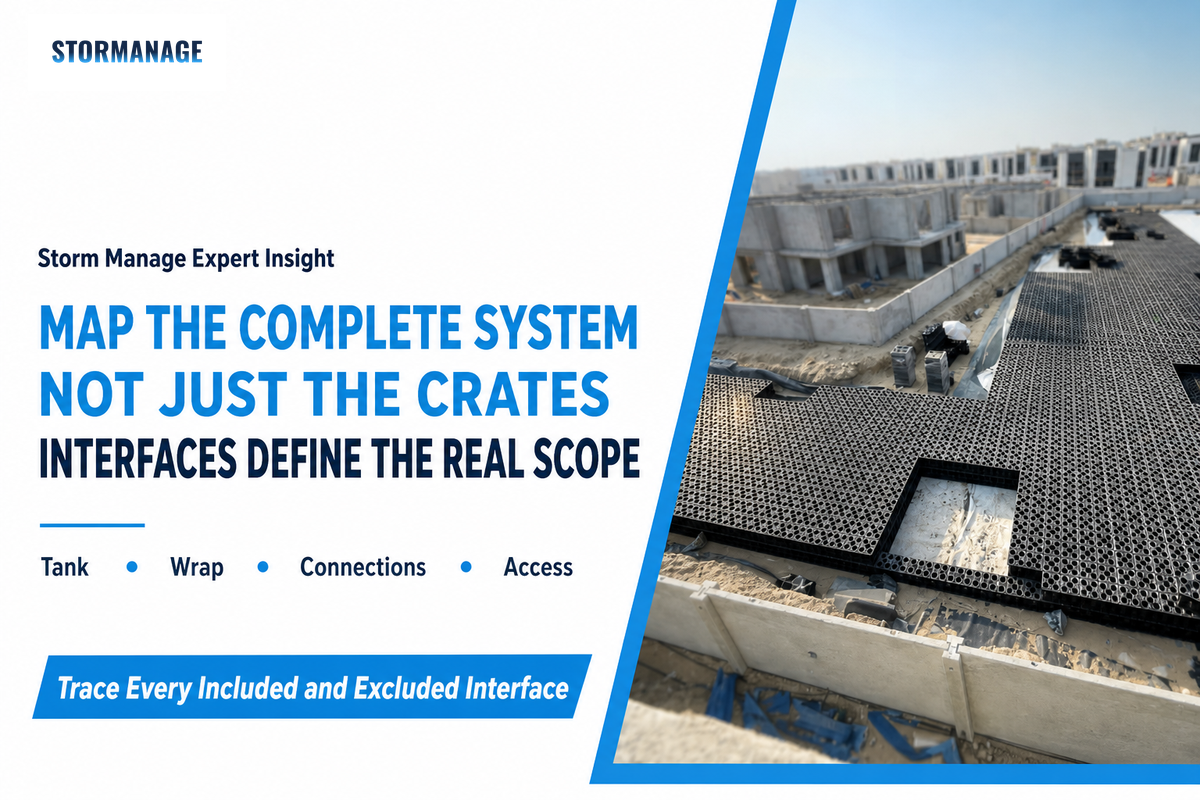
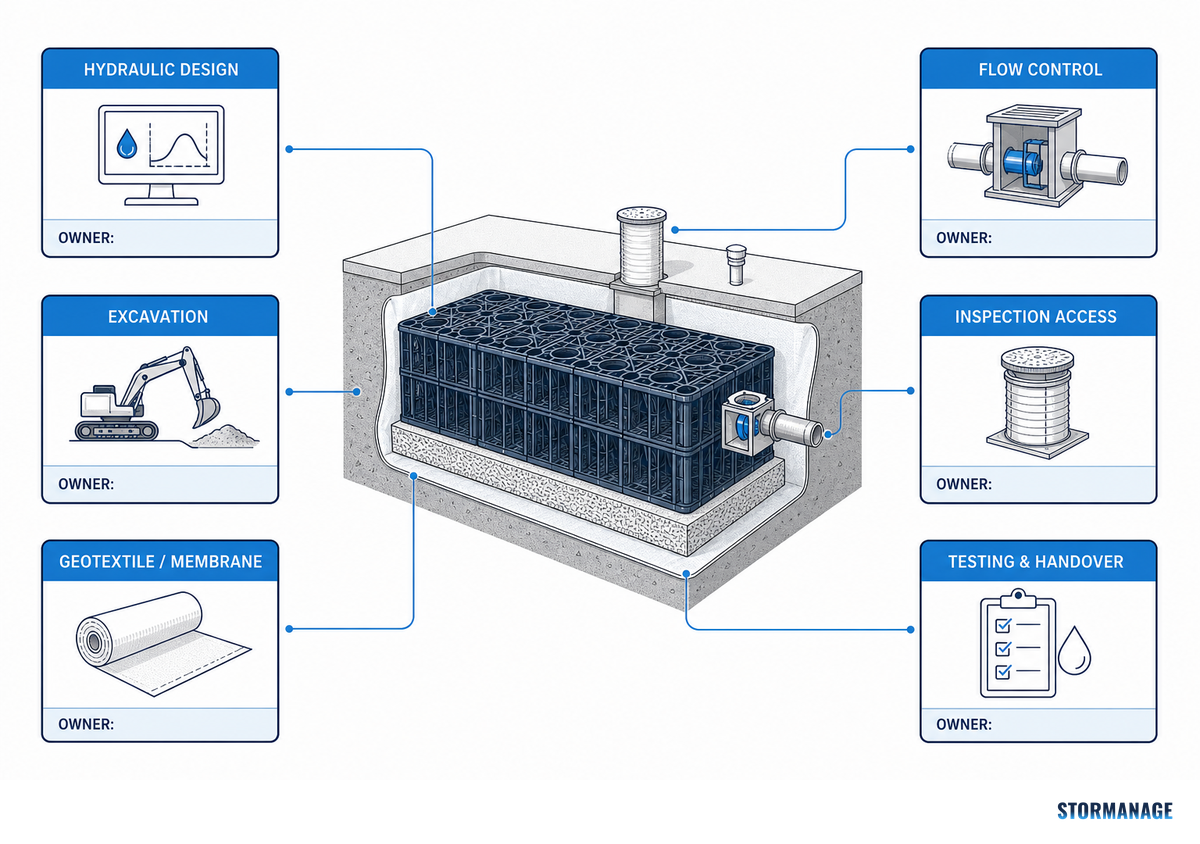
Map every physical component and its owner before comparing an attenuation tank system quotation. For a Storm Manage supplier review, a hidden component gap creates rework risk because one package can omit a critical interface.
Modular crate systems are only one part of the package; an impermeable liner or geomembrane, geotextile, connectors, access points and drawings may be included, excluded or provisional. Buyers should also distinguish sealed attenuation from infiltration-led scope.
Advantages and limitations of a component-led scope matrix: it exposes boundaries but does not replace design approval.
Useful for
Limitations to record
Showing whether crates, liner, geotextile and accessories are included.
It does not confirm suitability for loading, cover depth, ground conditions or local acceptance.
Assigning supply, installation and verification ownership.
It does not turn a supplier’s product information into a drainage or structural design.
Terminology check: Suppliers may describe similar boundaries differently, so retain their wording in a quote appendix and ask the designer to confirm equivalence before scoring price.
Catchment and storage basis: record the catchment area, roof contribution, local rainfall data, storage capacity and volume of water; these fields describe surface water runoff and whether the design intends to temporarily store stormwater runoff.
System type: distinguish stormwater attenuation crates, geocellular attenuation and underground stormwater storage from concrete tanks; none of those labels by itself proves a complete attenuation or storm attenuation package.
Discharge: identify whether the design names a flow control chamber, vortex flow control, water discharge path and controlled rate, then specify whether the connection is 110mm or 160mm.
Approvals and delivery: identify building control or its local equivalent, sustainable urban drainage systems requirements, commercial and industrial loading, installation time, and any quotation expressed per cubic metre of storage.
Dimensions and materials: treat 700mm and 1000mm dimensions, tonne-based load statements and HDPE material descriptions as project-specific inputs, not defaults; a quote for water management, stormwater management, surface water management or drainage solutions still needs the same boundary checks.
Storm Manage describes an 200,000 m²+ production base, about 50,000m³ monthly output and more than 600,000m³ annual capacity, plus accessories, drawings and container-loading support. These are first-party capacity and supply-boundary statements, not project-performance guarantees. Use its attenuation tank system overview and design information to prepare questions, then obtain project confirmation.
Procurement note: A component list becomes useful only when every line says included, excluded, provisional or by others.
Assign Flow Control Systems, Orifice Plate, Inlet and Silt Trap Responsibilities
Assign responsibility for flow control, inlet, outlet, silt management, testing and handover in writing. For Storm Manage supplier reviews, this gap matters because the quotation may be complete for crates yet leave the hydraulic interface unresolved. The England standards connect design with construction, operation and maintenance; local guidance also stresses defined management responsibilities.
Use plain labels rather than unexplained abbreviations: responsible for design, supplies, installs and verifies or hands over. Apply them to the orifice plate or other flow-control arrangement, inlet and outlet connections, drainage pipe interfaces, silt trap provision, access chambers, testing and record information. Project drawings and the drainage engineer remain controlling.
Where site teams need a prompt for the interface conversation, Storm Manage’s flow-control interface guide can be used as a question list, not as a replacement for the approved design.
Key takeaway: A quote isn’t fully comparable while a flow-control or handover responsibility is unnamed.
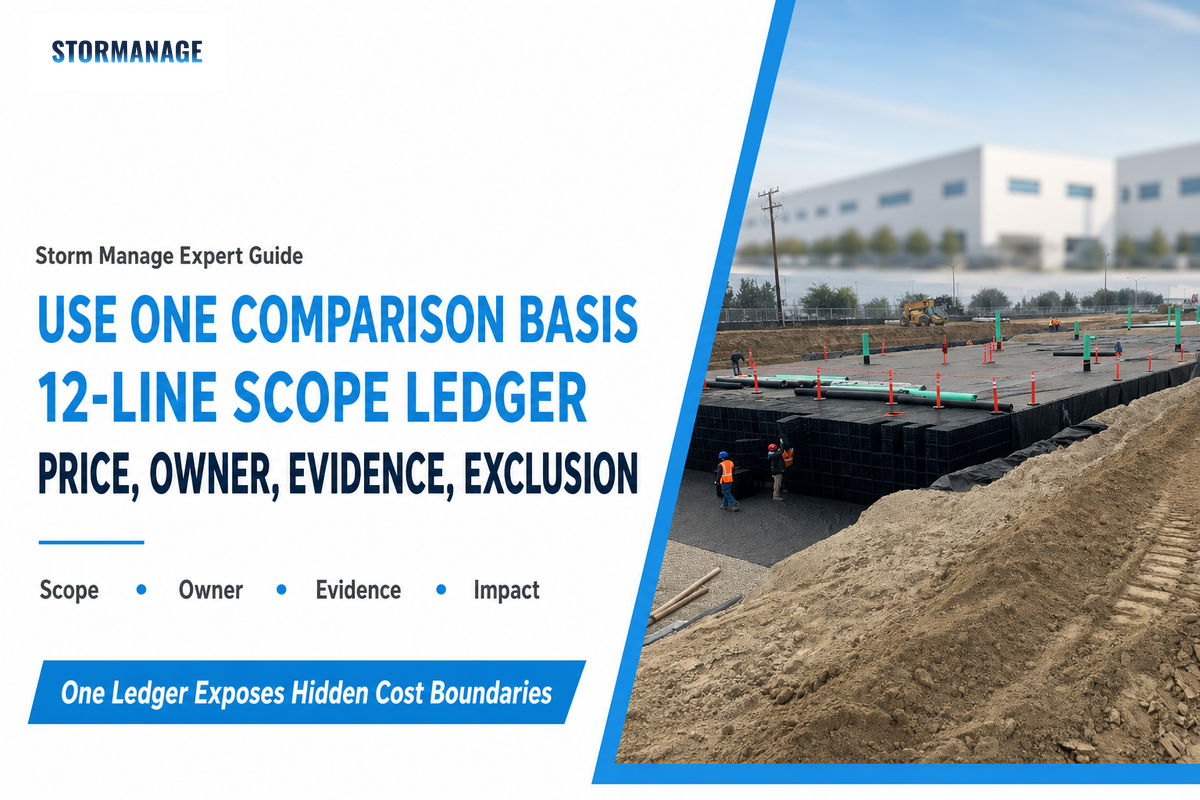
Use the 12-Line Scope-to-Cost Boundary Ledger
The 12-Line Scope-to-Cost Boundary Ledger is a short procurement record for explaining why quotations differ. Complete it before negotiating totals. It works because it separates physical components from approval, logistics and acceptance dependencies that can otherwise be hidden inside a single line item.
The 12-Line Scope-to-Cost Boundary Ledger makes attenuation tank quote differences traceable without publishing a price band.
Boundary category
Record before comparison
1. Design basis
Drawing revision, storage definition and discharge assumptions.
2. System boundary
Sealed attenuation, infiltration exclusion and rainwater-harvesting exclusion.
3. Components
Crates, connectors, liner, geotextile, membrane and access items.
4. Delivery point
Site address, timing, access and unloading responsibility.
5. Installation
Excavation, bedding, assembly, backfill and reinstatement boundary.
6. Civils interfaces
Pipework, chambers, pumps, traffic management and temporary works.
7. Flow control
Design, supply, installation and verification owner.
8. Silt and access
Pre-treatment, inspection, access and protection responsibilities.
9. Testing and records
Testing scope, drawings, certificates and handover information.
10. Approval and adoption
Discharge agreement, local approval and future asset-owner acceptance.
11. Commercial basis
Currency, tax, quotation date, validity and payment assumptions.
12. Exclusions
Named gaps, provisional sums and the party required to close each gap.
For supply planning, Storm Manage’s current public planner displays 3–5 production weeks, with lead time confirmed per order, and up to approximately 330 m³ of installed storage per 40HQ with optimised stacking. These are current first-party planning indicators, not industry benchmarks or a guarantee for every configuration; customs, inland haulage and project-specific logistics remain separate considerations.
Key takeaway: If a difference can’t be placed on one of the twelve lines, its cost responsibility isn’t ready to be negotiated.
Run a Like-for-Like Attenuation Tank Supplier Quote Comparison
Run the comparison in six steps: qualify the source, normalize the storage and commercial basis, mark scope gaps, price only known gaps, tag uncertainty, then document the decision. This turns an attenuation tank supplier quote review into a controlled procurement exercise rather than a spreadsheet race to the lowest total.
Set aside quotations from like-for-like ranking when they omit the drawing revision, storage definition or validity period.
Check hydraulic equivalence before comparing nominal capacity or cost per m3.
Transfer every inclusion and exclusion into the twelve-line ledger.
Mark missing information as unresolved rather than estimating it from a competing quote.
Ask the supplier or responsible project party to close the material gaps.
Record the chosen basis, residual risk and next revalidation date.
For example, a non-priced Offer A may include delivery but exclude unloading and flow-control verification. Offer B may include installation but be silent on the drawing revision and acceptance records. Neither is complete until omissions are assigned. Useful comparators reserve green for a defined, evidenced inclusion.
Storm Manage teams working on a traffic-heavy supplier comparison can use the highway and car-park drainage application page to frame loading and access questions; it isn’t evidence that a particular site is approved for a given load.
Comparison rule: Compare documented scope gaps first, then commercial totals.
Choose the Right Cost Evidence: Guide, Calculator, Budget Quote or Installed Estimate
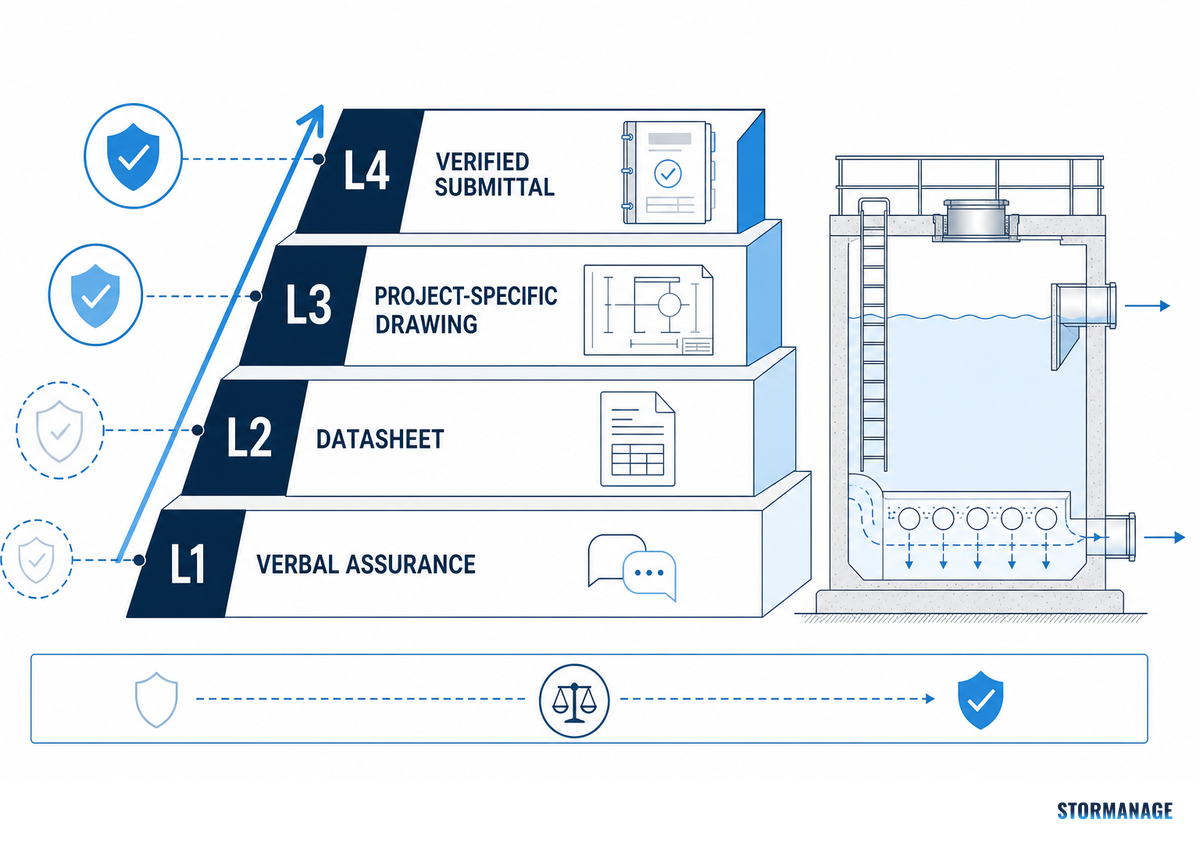
Use the least intensive evidence that’s fit for the next decision, then escalate as design uncertainty, interface risk, procurement commitment or contract exposure rises. This 4-Level Cost Evidence Ladder helps a buyer use guidance and online tools without mistaking them for an installed project estimate.
The 4-Level Cost Evidence Ladder selects an attenuation tank cost source by decision risk, not by the apparent precision of a number.
Evidence level
Use when
Do not use when
Next step
Published guide
Framing early questions and scope fields.
Approving a project budget.
Declare the design basis.
Calculator
Testing a recorded early allowance.
Groundworks, contractual risk or site interfaces are unknown.
Request a budget quote tied to inputs.
Supplier budget quote
Comparing a named supply boundary and date.
Installation and responsibilities remain unassigned.
Close the ledger gaps.
Installed/project estimate
Civils and handover scope are defined.
Design or approval inputs are still changing materially.
Set revalidation triggers.
For current commercial support, use Storm Manage’s project-specific attenuation tank cost estimate and calculators. Record the input version, date and whether the output covers supply alone, delivery, installation or handover. That tool can structure an allowance, but can’t own an exclusion or confirm an approval route.
Evidence rule: Move up the ladder when uncertainty or commitment increases; don’t demand certainty from an early-stage tool.
2026 Revalidation: When an Older Quote Needs Rechecking
In 2026, Storm Manage supplier and procurement reviews should record quote age as a budget risk because commercial inputs are time-bound, not because a generic index predicts an attenuation tank price. The UK’s all-work construction-material index increased 2.1% in February 2026 compared with February 2025, but it’s an aggregate measure and can’t forecast an individual tank, crate package or installed system cost.
Use three simple revalidation triggers: the quotation validity date expires; the drawing, discharge or adoption basis changes; or logistics, programme or installation responsibility changes. The same principle applies to regulatory timing: the cited England standards are a design and management reference, not a statutory price list, and local requirements may differ. For a compliance-oriented input checklist, see SuDS compliance information.
Key takeaway: Date every commercial input and revalidate its scope when the design, approval route or logistics assumptions change.
FAQ: Frequently Asked Questions
These answers apply the same declared-basis principle. Questions such as “What are the common problems with attenuation tanks?” and “What’s the lifespan of an attenuation tank?” require project-specific design and maintenance evidence; they aren’t answered by an isolated supply price.
How much does an attenuation tank cost per cubic metre?
Figures expressed per cubic metre are comparable only when both quotations use the same water storage definition, hydraulic assumptions, system boundary, delivery point, date, currency, tax treatment and installation scope. Module supply figures aren’t installed project costs. Use the result as a controlled comparison field, not a universal market price, and record any basis still awaiting confirmation.
What should an attenuation tank quote include?
Usable quotes identify the design revision, required storage and discharge basis, proposed system, accessories, containment scope, inlet and outlet interfaces, delivery term, unloading, installation boundary, testing, documents, exclusions, validity period, currency and tax basis. They should distinguish confirmed, provisional and excluded responsibilities; for each provisional field, record who must confirm it, the evidence required, the deadline for confirmation, and what change in scope or budget the answer could trigger before commercial ranking begins.
Can you build over an attenuation tank?
Building over an attenuation tank may be possible only where the system, cover depth, pavement build-up, access and loading are designed for the intended use. Product ratings alone aren’t approval for a building or traffic area. Put the proposed use into the input pack and obtain written confirmation from the drainage and structural designers before treating it as an accepted quotation basis.
Can an online attenuation tank cost calculator set my final budget?
No. A calculator can support an early allowance when its assumptions match the project, but it can’t confirm groundworks, access, temporary works, local labour, interfaces, taxes or contractual risk. Record the inputs and drawing revision. Check whether the result covers supply alone, delivery or installation and whether storage is nominal or usable. Replace that allowance with a supplier budget quote once the system boundary is named, then with an installed estimate when civil works and contractual responsibilities are defined.
Is an attenuation tank a soakaway?
An attenuation tank is not a soakaway. Attenuation stores runoff within a controlled-release system, while a soakaway infiltrates water into suitable ground. Their containment, discharge route and approval basis differ, so buyers should not treat the two quotations as interchangeable.
What information does a supplier need for a budget quote?
A supplier needs the site and delivery location, drawing revision, storage and discharge basis, footprint and depth constraints, loading context, connections, containment, accessories, programme, delivery term, unloading plan and required documents. Mark unknowns so assumptions stay visible inside the quotation.
FAQ rule: Common questions usually require a declared basis and accountable scope, not an isolated price.
Conclusion: Record the Boundary Before You Record the Cost
Defensible budgets follow one sequence: label the estimate stage, freeze the drainage basis, normalize storage, map scope, choose evidence and record uncertainty. Storm Manage’s commercial page can support a project-specific attenuation tank cost discussion once the input pack is ready.
This guide uses current public first-party supply-planning information where stated, together with external technical sources; it doesn’t offer a price forecast, approval, sizing calculation or performance guarantee.
Key takeaway: Record the scope boundary first; only then can a cost become a defensible project input.
Related Articles and Tools
These pages extend the procurement questions without repeating this guide.