We use the details you submit to review and respond to your project enquiry. Entries are handled in this website’s WordPress database using Fluent Forms; our hosting and email providers may process the submitted details. Other technical providers receive only the data described in our Privacy Policy.
Please do not send passwords, payment-card details, government identification numbers, sensitive personal data, or unnecessary confidential third-party information.
NSW council OSD compliance means designing and documenting an on-site detention (OSD) system against the applicable local Development Control Plan (DCP), project consent conditions, AS/NZS 3500.3 where relevant, and any required title instrument such as a Section 88E positive covenant. Exact requirements vary by council and project. Common steps are design and sizing, engineering certification, legal registration, construction sign-off, Occupation Certificate deliverables, and ongoing maintenance. In operation, the system temporarily stores runoff on site and releases it at the approved rate instead of sending a sudden peak into the downstream drainage network.
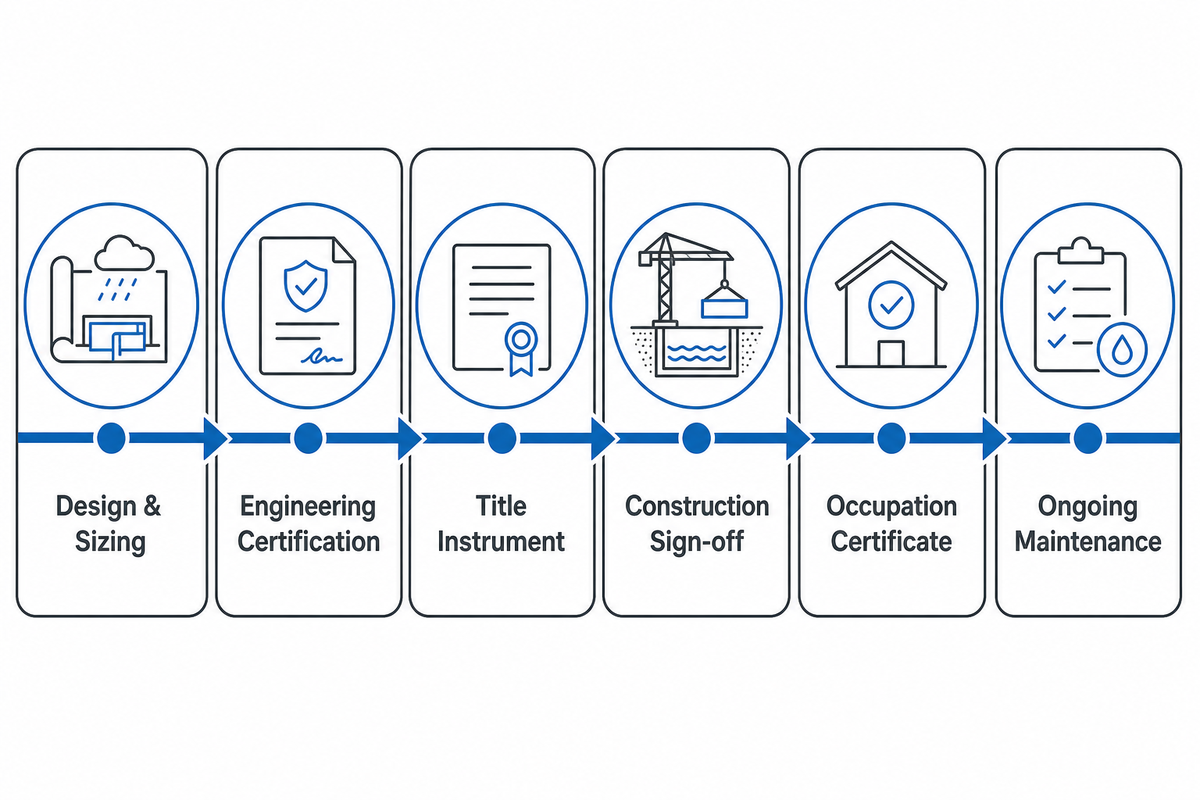
While many resources simply say “get council approval”, this usually leaves out the hardest part of the process: the compliance journey isn’t a single approval, but a sequence of 6 separate tasks, a number of which don’t happen until after you’ve been issued your Occupation Certificate. Let’s walk through this OSD sequence in chronological order: design & sizing, engineering certification, legal instrument, construction sign-off, Occupation Certificate issuance, and ongoing maintenance.
What NSW Council OSD Compliance Actually Requires: Six Stages From Design to Ongoing Compliance
NSW council OSD compliance isn’t one job but six: design & sizing, engineering certification, legal instrument (Section 88E covenant and restriction), construction sign-off, Occupation Certificate issuance, and ongoing maintenance.
This guide groups the process into five functional areas — design and sizing, engineering certification, legal instruments, Occupation Certificate deliverables and ongoing maintenance — while tracking six distinct tasks.
How much detail and council investigation this sequence demands varies by site. Where a flood, overland-flow, heritage or contamination control applies, or the proposed discharge reaches Sydney Water’s network rather than council’s, the application may require specialist review or input from a second authority. Applicable planning controls, the consent authority and the network owner determine that pathway and the required signatories. Build time for possible council delays into the programme when extra review is required. Across projects, the goal remains the same: stopping the additional runoff a new development generates from causing downstream flooding or nuisance discharge onto neighbouring properties.
Whether OSD is required depends on the applicable planning controls and consent conditions. Changes in impervious area are commonly a key design input, so a renovation or granny flat can still require a stormwater review, but the threshold and exemptions must be checked with the relevant council for the property.
Requirements vary by local government area (LGA). Homeowners comparing new builds or a duplex on an already-buildable lot should ask the relevant council whether the controls require OSD or another stormwater compliance response. That applies in Western Sydney and across Sydney, but the answer comes from site-specific controls, not a regional shortcut. Apply the same verification rule to councils across New South Wales.
Factor
Standard Case
Referral Case
Limitations / Watch-Outs
Site constraints
No flood, bushfire, heritage or contamination overlay
One or more overlays apply
Overlay status is set by the LEP/DCP map, not by visual inspection — always confirm on council’s own planning portal
Discharge authority
Discharges to council’s stormwater system
Discharges into Sydney Water’s network or a shared easement
Some sites need sign-off from both council and Sydney Water — confirm early, not at lodgement
Dwelling type
Single dwelling / minor renovation
Multi-dwelling, subdivision, or commercial
Building class and development type can change the design, declaration and approval requirements
Construction material
Product matches the certified design
A project-specific condition or specification applies
Confirm material, load and installation requirements before selecting a tank system
Assessment pathway
Standard DA/CDC assessment
Integrated development requiring referral to a concurrence authority
A referral may extend the assessment; confirm the pathway before setting a programme
Because the applicable pathway is set by planning controls and the project’s circumstances rather than a visual site check alone, the applicant or consultant should confirm it before lodgement. For regulated building work, verify the professional and design-practitioner registrations that apply to the project; for other work, confirm the engineer qualifications and certification wording required by the relevant council or authority. If the discharge authority is unclear, use Storm Manager’s NSW discharge authority finder as a starting point, then confirm the result with the relevant authority.
Stage 1, OSD Design & Sizing: DRAINS Software, SSR and PSD Explained
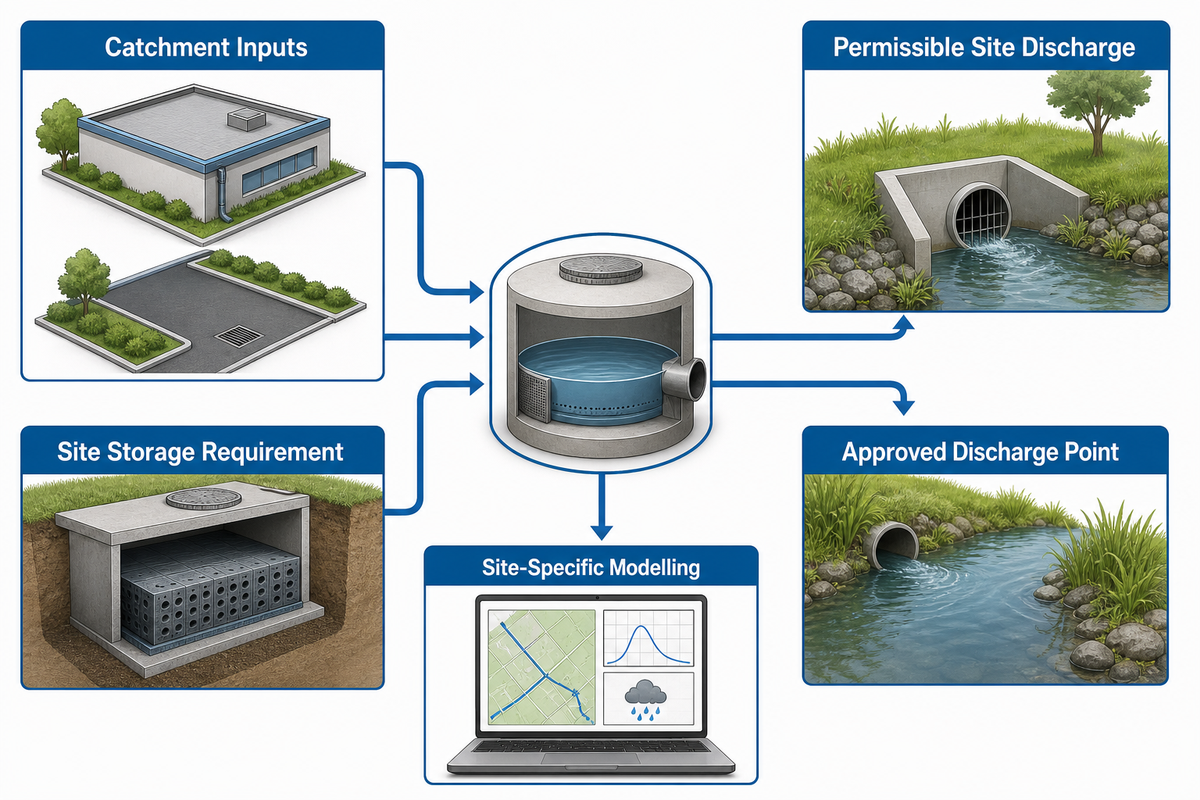
Permissible Site Discharge (PSD) and Site Storage Requirement (SSR) are not statewide constants. PSD is the rate at which runoff from a site may leave for the approved drainage system, while SSR is the storage volume the design must provide. Your engineer must use the value or calculation method required for the site, not a generic online range. For example, Mid-Coast Council’s published guideline adopts 75 L/s/ha in its stated context; that council-specific figure should not be treated as a NSW-wide default.
A NSW property’s Permissible Site Discharge (PSD) is the maximum amount of stormwater that may be discharged into the public drainage system for a given design storm, in litres per second. For each project, the approved design then sets the outlet-control arrangement used to limit discharge.
Your engineer will usually model the site’s stormwater behaviour with specialist hydrology software such as DRAINS rather than relying on a simple manual rule. Inputs can include impervious area, catchment characteristics, site levels and the approved discharge point. These are site-specific inputs for assessment by a suitably qualified civil or hydraulic engineer: how much runoff the catchment generates and how to control its release before it reaches the downstream network.
Since what DRAINS actually spits out for your specific catchment is highly site dependent, view the following as simply working our way through the possibilities as opposed to a mathematical calculation you can conduct.
Sizing needs drainage design as well as hydraulic design inputs – your site’s contour, hard surfaces (roof and driveways), soil type and catchment data all feed into the same DRAINS model your engineer builds. So why size it so accurately?
In simple terms, capturing stormwater on site and releasing it at the approved rate avoids sending a sudden runoff peak into existing drainage infrastructure. That is the condition OSD is intended to control because unmanaged peaks can contribute to downstream erosion and flooding.
Good stormwater design coordinates roof, driveway and landscape runoff with the on-site detention system and its approved discharge point. Where the design connects to council drainage or another public network, effective stormwater management limits the peak stormwater runoff that can overload downstream assets; it is not a substitute for the local DCP or Water Sensitive Urban Design (WSUD) requirements.
For a 600 m² suburban block, a statewide rule of thumb is not a safe sizing method. Site-specific modelling must apply the actual roof and paved areas, levels, catchment assumptions, discharge point and current council requirements. Two similar-looking blocks can therefore produce different approved discharge rates and storage volumes.
What Your Engineer Needs From You
Why It Matters
Roof area (m²) and driveway/paved area (m²)
Impervious surface drives runoff volume into the DRAINS model
Site plan showing the downstream waterway or drainage connection point
Documents the proposed downstream connection for authority review
Your council’s current DCP stormwater chapter (and any published PSD/SSR method)
Council-specific values or calculation methods must replace generic assumptions
Any known site constraints (flooding, contamination, easements)
Feeds directly into the Standard Case vs. Referral Case triage above
Stage 2, Engineering Certification for Council OSD Approval
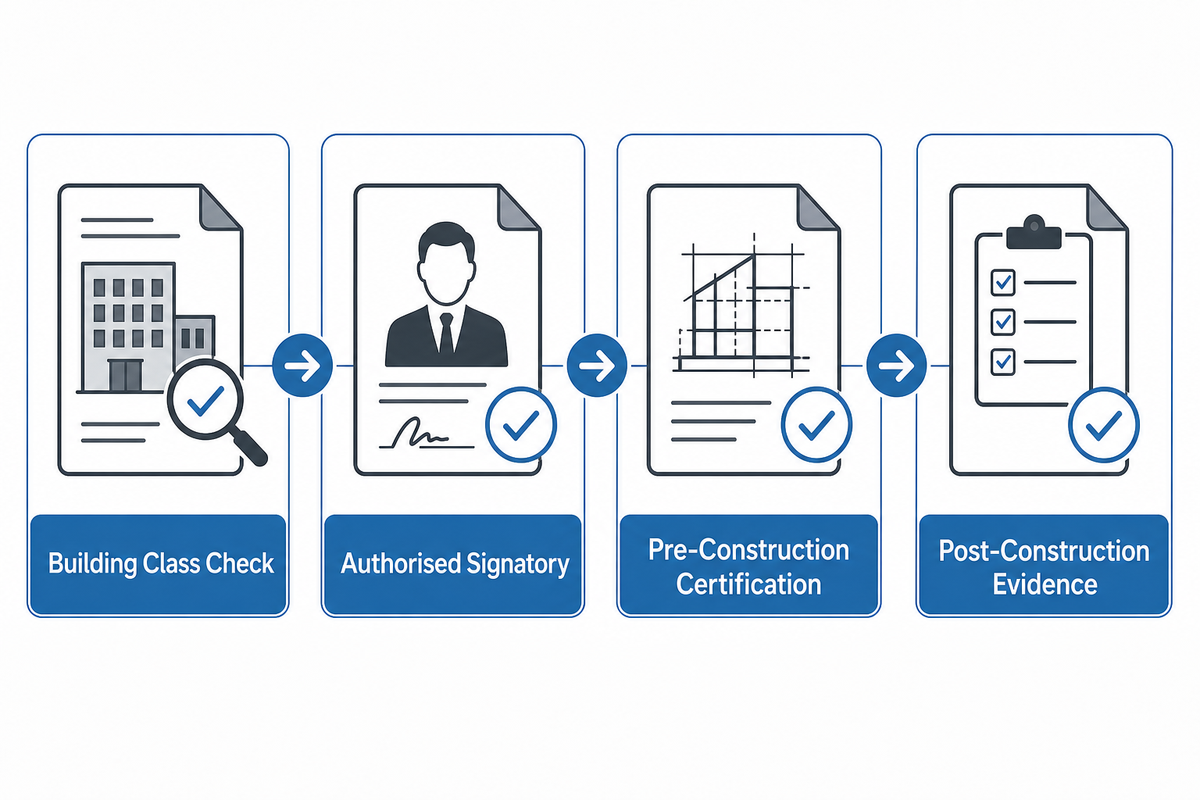
Once your engineer has provided a sizing figure, the next step is to confirm who is authorised to certify or declare the relevant work. The Design and Building Practitioners (DBP) scheme applies to professional engineering work on regulated building classes, currently Class 2, certain Class 3 and Class 9c buildings. A professional engineer may also need the relevant design-practitioner registration to prepare regulated designs or make compliance declarations. Other projects remain subject to the qualifications and certification requirements specified by the council, certifier or approval authority. Before lodgement, confirm the project’s building class, the required registration or accreditation, and the exact person authorised to sign each document.
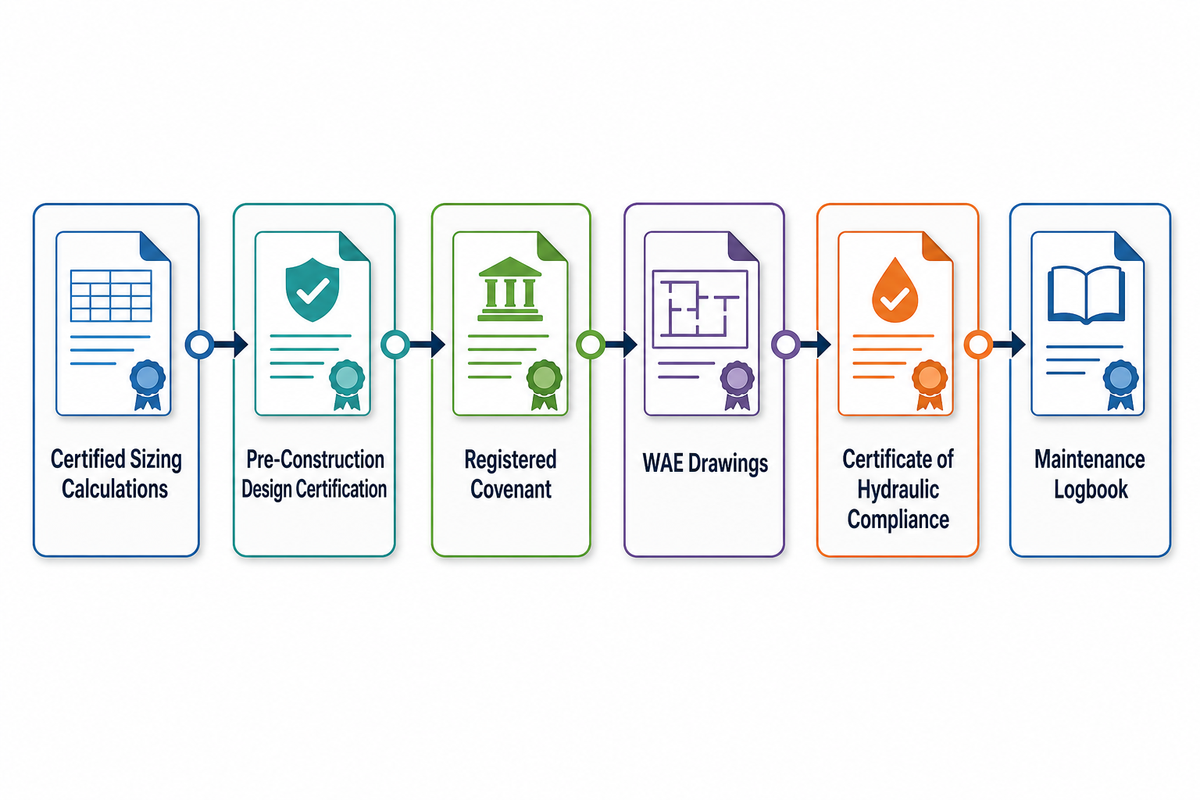
Certification commonly has pre- and post-construction stages. Before construction, the applicable approval pathway may require a chartered civil engineer to certify that the design meets the calculated PSD and SSR requirements. After construction, it may require signed Work-As-Executed (WAE) plans from a registered surveyor and a Certificate of Hydraulic Compliance. Submit the documents to the council, certifier or water authority identified in the project’s approval conditions.
Which authority reviews a particular part of the project depends on the discharge location and approval pathway. Confirm that point early rather than assuming; Storm Manager’s Approval Pathway Matrix provides a starting point, but the council and relevant water authority remain the controlling sources for the site.
Stage 3, Registering Your Section 88E Positive Covenant
One concept that often receives only brief treatment in online OSD guides is Section 88E. A missing or delayed title instrument can stall an otherwise compliant project before an Occupation Certificate. A Section 88E positive covenant is recorded against the title of a property in NSW under the Conveyancing Act 1919 and can place an ongoing maintenance obligation on the owner and subsequent owners. Unlike an informal assurance, the registered covenant remains attached to the title when ownership changes.
What Is a Positive Covenant and Restriction for a Stormwater OSD System?
In NSW, a restriction or positive covenant for a stormwater OSD system is registered on a property’s title, restricts use of the affected land and positively requires the land owner to upkeep the facility. Cumberland Council’s standard template says the covenant covers “all ancillary gutters, pipes, drains, walls, kerbs, pits, grates, tanks, chambers, basins and works ancillary thereto” and, once lodged through NSW Land Registry Services, remains on the title when ownership changes.
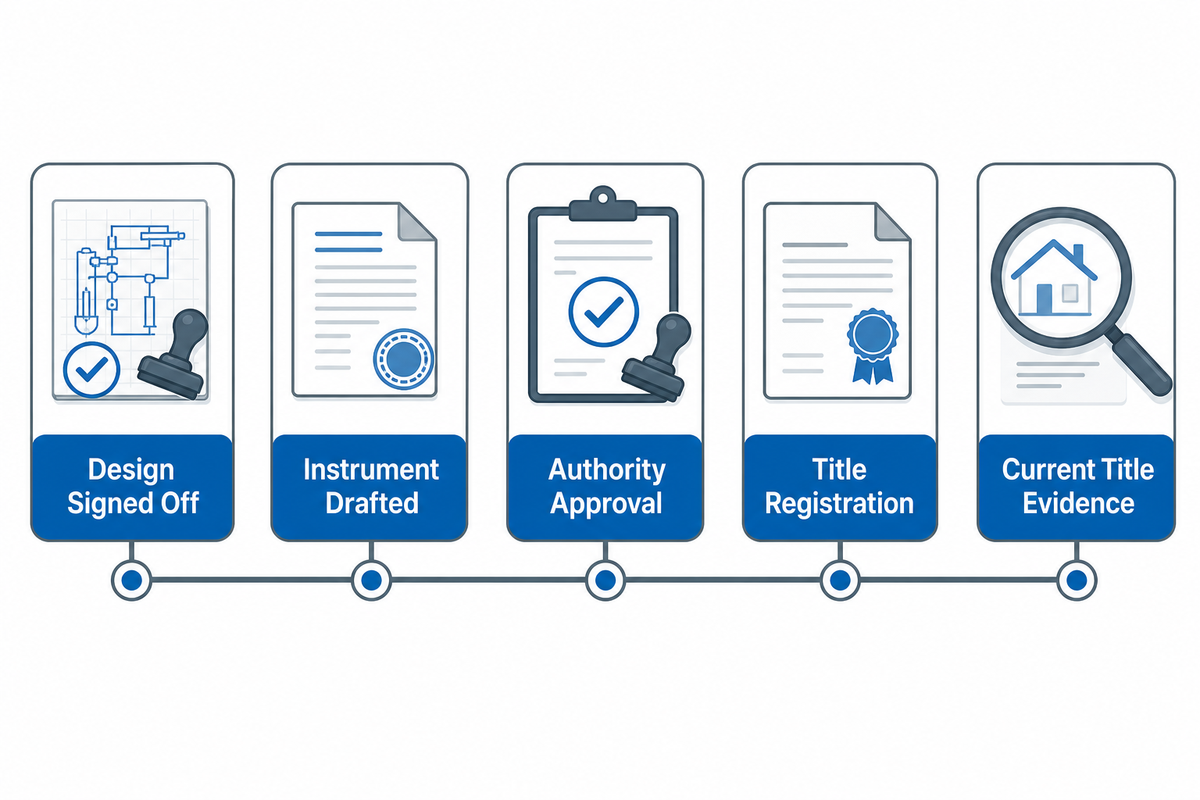
Section 88E Title-Registration Trail: 5 Steps. Where the approval conditions require a covenant, the usual sequence is: 1. the engineer’s design and hydraulic calculations are signed off; 2. the positive covenant and restriction-on-use instrument is drafted against the approved design; 3. the relevant authority approves the instrument where required; 4. the instrument is registered on the property title through NSW Land Registry Services; and 5. current title evidence is submitted to the authority or certifier as required for the next approval stage.
If the instrument is not approved and registered, the legal maintenance obligation has not been placed on the title, even if the physical OSD system has already been built.
For systems within its approval scope, Sydney Water’s OSD guidance says storage must accommodate runoff up to a 100-year Average Recurrence Interval (ARI) event. It also specifies a flat stainless-steel orifice plate at least 200mm by 200mm and 3mm thick, with an orifice diameter of 40mm or more, and requires the covenant agreement to be registered on the title so the obligation is not lost when ownership changes. If title registration is a consent requirement, missing evidence can prevent the relevant approval stage from being completed.
Stage 4, Construction and Occupation Certificate Compliance Deliverables
Before an Occupation Certificate can be issued, the approval conditions may require three related deliverables: Work-As-Executed (WAE) drawings prepared and signed by a registered surveyor to show what was actually built; a Certificate of Hydraulic Compliance confirming that the constructed system conforms to the certified design; and evidence that any required Section 88E positive covenant has been registered on the title, usually shown by a current title search. Check the project’s consent conditions for the exact documents and signatories.
Work-As-Executed (WAE) drawings — prepared and signed by a registered surveyor to show the as-built system
Certificate of Hydraulic Compliance – the build conforms to original design PSD’s / SSR’s
Confirmation of registered Section 88E covenants – extract from title search to show the instrument is in force not just drafted
Costs at this stage depend on the council and the current fee schedule. For example, The Hills Shire Council’s published 2025–26 fees and charges lists $50,000 for an OSD Compliance Certificate for design and construction including two inspections, $664 for amended plans or modification of an application, and $454 for each additional inspection. These are council- and year-specific figures, not a statewide price guide.
Stage 5, Ongoing OSD Maintenance Obligations After Occupation
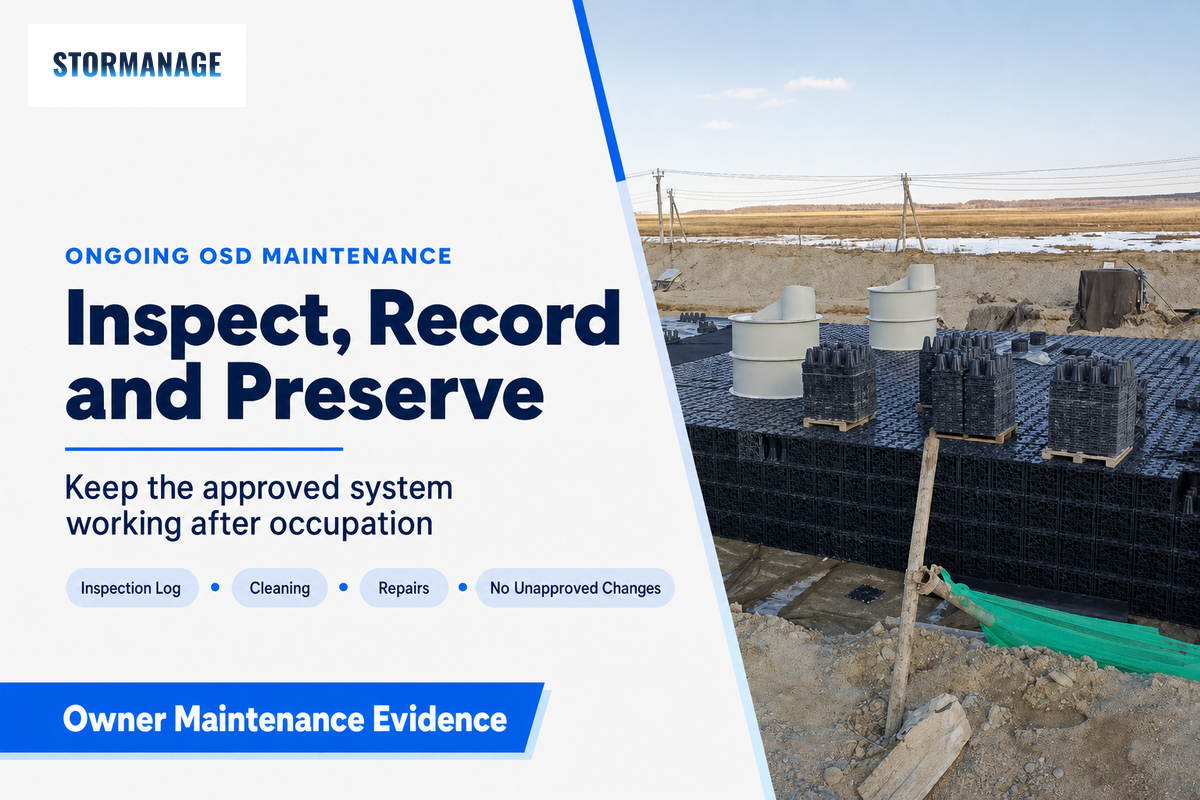
OSD duties continue after occupation. Council material references the UPRCT Handbook for the Management and Inspection of On-site Storm Water Detention as a practical maintenance framework. Keeping a simple management plan and dated log helps owners and contractors protect access points and record inspections. The handbook schedule calls for residential systems to be inspected every six months and after heavy rainfall, commercial and industrial systems every three months and after heavy rainfall, and cleaning at least annually or every six months depending on use.
Penrith City Council publishes an OSD inspection and maintenance sheet with dated fields, condition checks and post-heavy-rainfall items. Canada Bay Council states that owners of private detention and storage tanks are responsible for their management and maintenance to keep the system compliant with council requirements.
Who Is Responsible for Maintaining an OSD System After Occupation?
Property owners have an ongoing obligation to keep the OSD system in working order. Where a Section 88E positive covenant is registered, that obligation remains attached to the property and does not expire or transfer away automatically when ownership changes. Council requirements differ, but maintaining a dated record of inspections, cleaning and repairs provides practical evidence that the system has been managed.
Record all your service inspection dates, discoveries, repairs performed in a dated inspection logbook
Review of the UPRCT cadence – every 6 months residential, every 3 months commercial/industrial, and after every large rain event
Clean at least once a year – more frequently if a site has heavy leaf litter, is near construction activities or is in a large catchment
Don’t change the system without checking the approval conditions — an altered orifice, storage volume or layout may require engineer and authority sign-off
Neglected maintenance can allow sediment, debris or damaged components to reduce system performance. It can also make it harder to demonstrate compliance during a council inspection or later building work. During a sale or later approval, a solicitor or certifier can see the registered title restriction and may ask how the obligation has been managed, so keeping records is prudent even where a specific logbook format is not prescribed.
Why OSD Compliance Requirements Differ Between NSW Councils
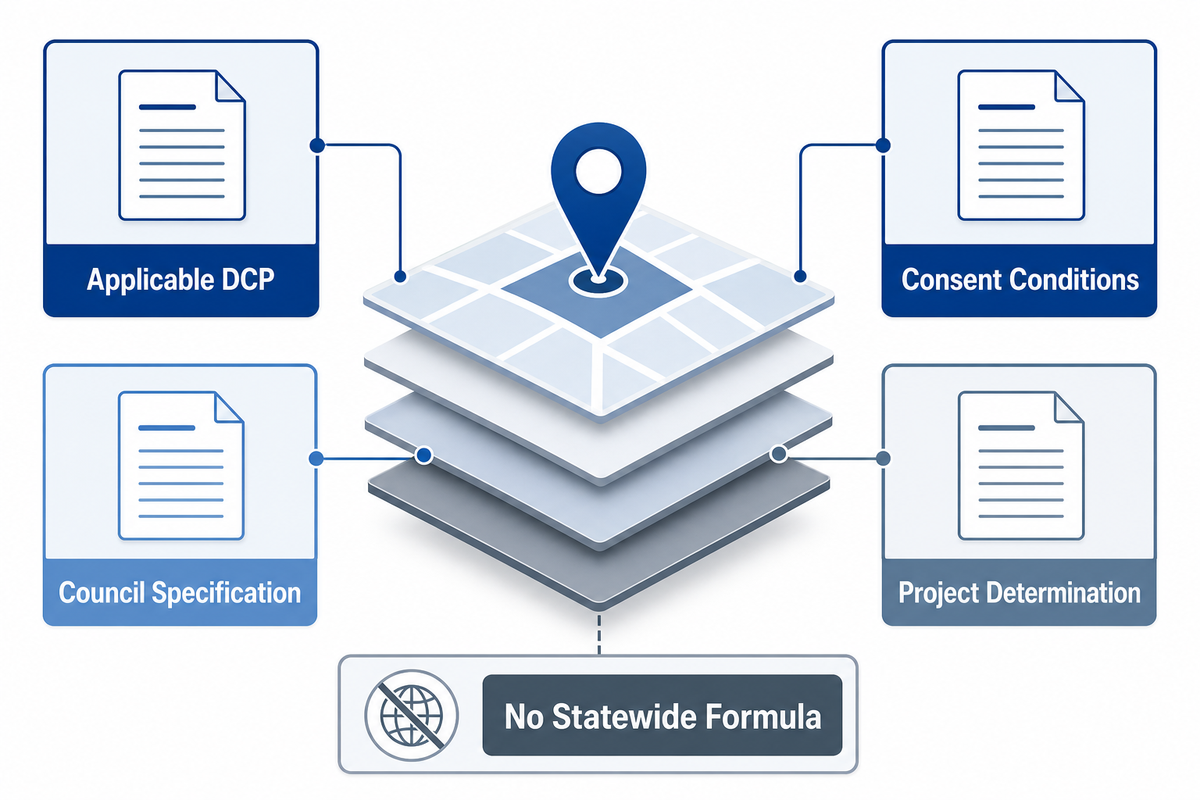
OSD compliance requirements differ between NSW councils because planning controls are local rather than one statewide formula. Even neighbouring councils can specify materially different PSD methods for similar blocks; the difference reflects their adopted controls and drainage context, not a value that can be transferred from one site to another.
Each NSW council applies its own stormwater planning controls alongside state and national requirements, so PSD, SSR and construction conditions can vary. In one cited Georges River Local Planning Panel determination, the conditions used a project-specific peak-discharge formula and required childproof fencing for open above-ground storage where peak design depth exceeded 300mm. A cited Hornsby Local Planning Panel determination used storage capacity sized to a 50-year ARI storm, restricted discharge to the five-year pre-development value, and added a 50 L/s limit per gutter discharge point. These are examples from individual determinations, not universal council policy values.
A council-hosted copy of the Upper Parramatta River Catchment Trust On-site Detention Handbook provides technical background for some Sydney-area OSD practice. Treat it as background, not as a substitute for the current controls, consent conditions and specifications that apply to the site.
Stormwater on-site detention is the underlying subject, but the controlling requirements still depend on the project. They may appear in the applicable DCP, a council specification or project-specific consent conditions. In practice, locate the controlling document for the property and use its PSD/SSR method rather than borrowing a value from another council or development.
The Practical NSW Council OSD Compliance Checklist (Stage by Stage)
Breaking OSD compliance into a submission-ready checklist makes it easier to track the certification, plan and PSD/SSR items shown on council on-site detention requirements pages. The table below turns each stage into practical sub-steps.
Stage
What Happens
Who’s Responsible
Deliverable Type
Typical Pitfall
1 — Design & Sizing
Engineer models site with DRAINS software against PSD/SSR
Hydraulic/civil engineer
Certified sizing calculations
Using a generic PSD range instead of the council’s site-specific value or method
1b — Engaging Your Engineer
Confirm the qualification and registration required for the project
Property owner / builder
Current registration or accreditation verified
Assuming one credential covers every building class and approval pathway
2 — Engineering Certification
Design certified against council or Sydney Water requirements
Suitably qualified engineer; DBP registration where the scheme applies
Pre-construction design certification or declaration
Not confirming which authority and practitioner registration apply
3 — Positive Covenant Registration
Required Section 88E instrument drafted, approved and registered on title
Solicitor / conveyancer + NSW Land Registry Services
Registered covenant, confirmed by title extract
Leaving a required covenant until the Occupation Certificate stage
3b — If Skipped
No durable record of the OSD obligation exists
—
—
Occupation Certificate is held up at the final stage, after construction is already complete
4 — Construction
System built to the certified design, including orifice plate specification
Builder / installer assigned to the project
Built system matching certified plans
Field variations not captured for the WAE plans
4b — WAE & Compliance Certs
As-built plans and hydraulic compliance certified post-construction
Registered surveyor + certifying engineer
WAE drawings + Certificate of Hydraulic Compliance
Not establishing maintenance records when the system enters service
5b — Ongoing Inspections
6-monthly (residential) / 3-monthly (commercial) inspections plus post-storm checks
Property owner
Inspection + cleaning records
Skipping records after a sale, leaving the new owner unable to prove compliance history
For quick reference: Mid-Coast Council’s cited guideline uses 75 L/s/ha in its stated context; Sydney Water’s cited guide specifies a flat stainless-steel orifice plate at least 200mm by 200mm and 3mm thick, with an orifice diameter of at least 40mm; the UPRCT handbook schedule calls for six-monthly residential and three-monthly commercial or industrial inspections; the cited Hornsby determination limits gutter discharge to 50 L/s per outlet point; and the 2025 revision to AS/NZS 3500.3 raised the Clause 3.6.2 valley-gutter catchment limit from 20 m² to 40 m². In the cited Georges River determination, the 300mm fencing threshold applies to that project-specific condition only.
Sourcing a Council-Compliant OSD Tank: What to Confirm Before You Order
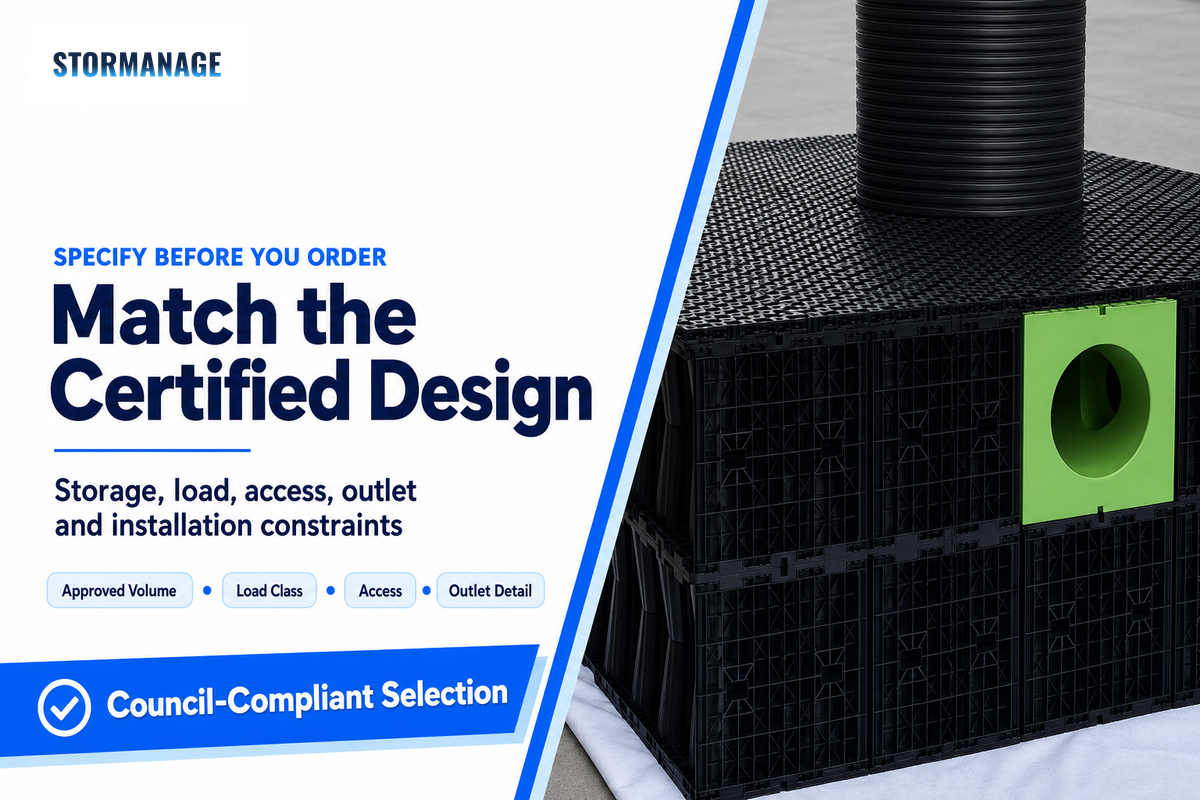
Once your compliance parameters are locked in, choosing among the available OSD solutions is a matching exercise. Start with the certified design, then compare Storm Manager’s OSD tank range against the required storage volume, load class, access and maintenance provisions, outlet arrangement and installation constraints. Where Sydney Water’s specification applies, confirm that the outlet assembly meets its stainless-steel orifice-plate requirements. Also check every project-specific material or construction condition with the engineer and approval authority. Do not order from a generic capacity estimate: obtain engineer sign-off on the PSD/SSR design and confirm the applicable DCP and consent conditions first.
According to Storm Manager’s company materials, the business has operated since 2013, works from an 200,000 m²+ facility in Shenzhen, and holds ISO 9001:2015, ISO 14001:2015 and ISO 45001:2018 certifications. Those materials also report more than 20,000 m³ of tank capacity delivered across Australia and Oceania and more than 1,000 projects across 30-plus countries.
For a starting-point comparison of possible approval routes, consult the Authority Approval Pathway Matrix and review the product-level details in Storm Manager’s NSW council compliance hub. Final acceptance depends on the certified design and the relevant authority; company history is available on the Storm Manager profile.
2025-2026 Regulatory Currents: What’s Changing for NSW OSD Compliance
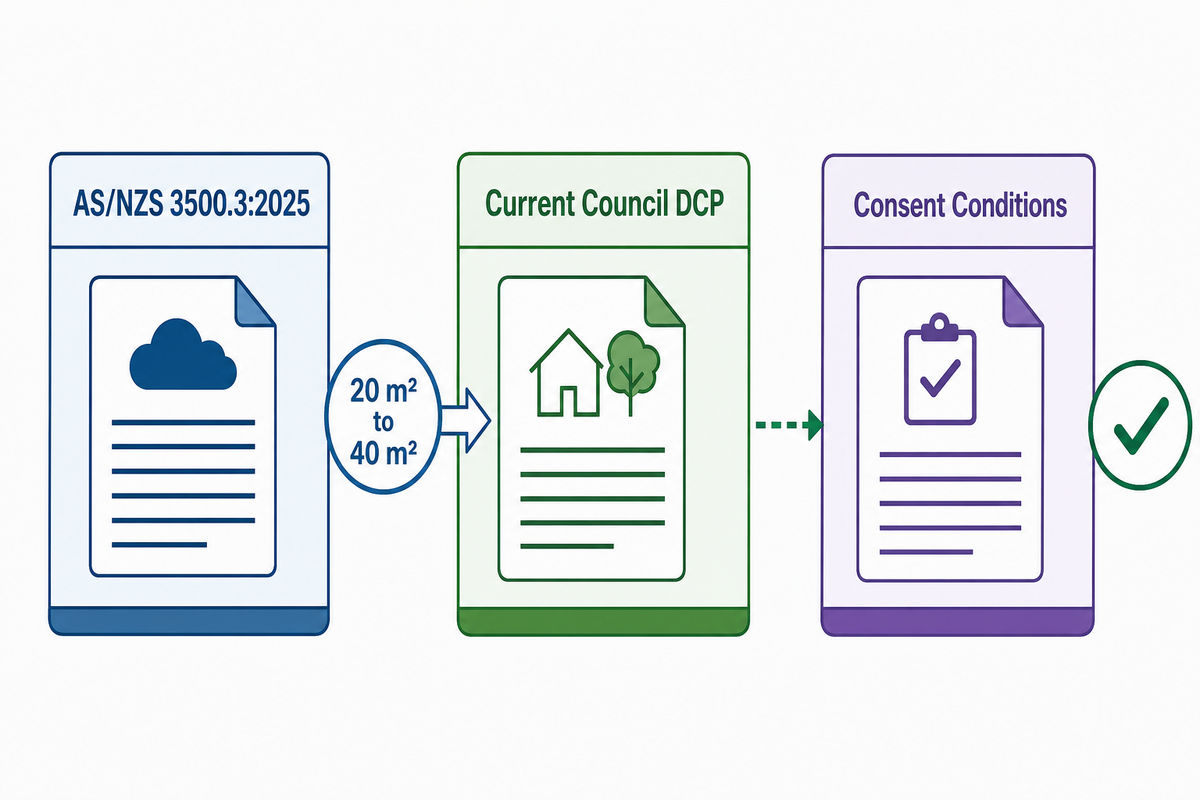
AS/NZS 3500.3:2025 updates stormwater-drainage clauses in the plumbing and drainage standards series. One published change to Clause 3.6.2 doubles the permissible valley-gutter catchment area from 20 m² to 40 m². At council level, Ballina Shire Council endorsed amendments across four DCP chapters on 27 November 2025. That example is evidence of DCP change activity, not proof of a particular OSD clause change.
Online tracking through the NSW Planning Portal’s DA Application Tracker makes application progress visible. These developments do not create one new statewide OSD formula, but they reinforce a practical control: verify the edition of every cited standard, the current council DCP and the project’s consent conditions before finalising design and submission documents. Current-document checks are a basic part of sustainable stormwater planning.
That valley-gutter catchment limit has doubled from 20 m² to 40 m². The change does not automatically invalidate an existing design, but it is a clear reason to confirm which edition of the standard applies before lodgement or revision. Council DCP chapters move on their own schedules, so standards checking should be a standing item on the compliance checklist rather than a one-off task.
Frequently Asked Questions
What does OSD stand for in construction?
OSD stands for on-site detention: underground tanks or basins that temporarily hold rainwater runoff from a property’s roof and paved areas, then release it to the approved downstream drainage system or lawful discharge point at the approved Permissible Site Discharge rate rather than as an uncontrolled flow.
What is an OSD basin?
An OSD basin is a landscaped or constructed storage area that temporarily holds runoff on site and releases it slowly through a metered outlet at the approved Permissible Site Discharge rate, reducing the peak flow sent downstream during the design storm.
Can a neighbor drain water onto your property in NSW?
Whether neighbouring drainage is lawful depends on the approved drainage arrangement, easements and the facts of the site. Do not redirect concentrated runoff across a boundary without professional and council advice. If a neighbour’s drainage is affecting your land, document the location and conditions and raise the property-specific issue with the local council’s drainage or compliance team.
Do downpipes have to be connected to stormwater in NSW?
Downpipes should connect to the property’s approved stormwater drainage system rather than discharge onto neighbouring land. Depending on the site, that system may route roof runoff through an OSD tank, lawful point of discharge or another designed component before it ultimately reaches the downstream network. Follow the approved drainage plan.
How often should an OSD system be serviced?
The Upper Parramatta River Catchment Trust’s On-site Stormwater Detention Handbook schedules inspections every six months for residential systems and every three months for commercial and industrial systems, with additional checks after heavy rainfall. Use the frequency in the project’s covenant, maintenance plan or council conditions where it differs. Before adopting that cadence, confirm who must inspect the system, which components are covered and what evidence the approval documents require. Record the inspection date, findings, cleaning and repairs after each visit.
Tanks should be cleaned at least annually, or every six months where leaf litter is heavy or the catchment is large. Penrith Council publishes an OSD inspection and maintenance sheet with dated fields and post-heavy-rainfall checks; use the project’s own conditions and maintenance plan to determine whether that format applies.
Does my council require an annual OSD inspection report?
Council requirements vary. Penrith Council publishes a maintenance sheet with dated entries and condition checks, while Canada Bay Council places ongoing management and maintenance responsibility on the property owner. Check the consent conditions, covenant and council guidance for the record format and reporting frequency that apply to the site.
Because the Section 88E positive covenant on your title makes maintenance an ongoing condition of land ownership, keep your own records even if your council doesn’t ask to see them.
What happens if I don’t maintain my OSD?
Failure to maintain an OSD system can reduce its capacity or restrict its outlet, increasing the risk of local flooding and property damage. It may also breach the Section 88E covenant and create issues during a council inspection, later building approval or property transaction. The registered covenant is recorded on the title; the owner’s private maintenance history is not automatically a public record. In practical terms, a blocked inlet or outlet can stop the designed storage from emptying between storms.
Record inspections, clear accessible debris safely, and have structural damage or hydraulic faults assessed by an appropriate contractor or engineer. Do not change the orifice or storage layout without checking the approved design and covenant.
This guidance draws on publicly available material from Mid-Coast Council, Penrith Council and Canada Bay Council. The Georges River and Hornsby examples come from published Local Planning Panel business papers, not standalone council policy documents. Councils update their DCPs on independent schedules, so determine the requirements for your property before preparing a development application instead of treating the examples above as a generic standard. This article accompanies Storm Manager’s OSD Tank Compliance Guide, which adds product-selection detail and an authority pathway matrix.
References & Sources
NSW Government, Design and Building Practitioners professional engineer registration: nsw.gov.au/business-and-economy/licences-and-credentials/building-and-trade-licences-and-registrations/register/professional-engineers
NSW Government, Appointing a certifier: nsw.gov.au/housing-and-construction/appointing-a-certifier/finding-and-appointing
Cumberland Council, Standard Terms for Restriction on Use of Land and Positive Covenant (OSD): cumberland.nsw.gov.au
Sydney Water, On-Site Stormwater Detention guide (PDF): sydneywater.com.au
Blacktown City Council, Upper Parramatta River Catchment Trust On-site Stormwater Detention Handbook v4.0 (2005): blacktown.nsw.gov.au
Blacktown City Council, OSD sample maintenance schedule (PDF): blacktown.nsw.gov.au
Penrith City Council, OSD maintenance sheet (PDF): penrithcity.nsw.gov.au