We use the details you submit to review and respond to your project enquiry. Entries are handled in this website’s WordPress database using Fluent Forms; our hosting and email providers may process the submitted details. Other technical providers receive only the data described in our Privacy Policy.
Please do not send passwords, payment-card details, government identification numbers, sensitive personal data, or unnecessary confidential third-party information.
Stormwater harvesting is the collection, treatment, storage and reuse of urban runoff for a useful demand, not a tank catalogue. A workable scheme has to collect urban runoff, manage its changing quality, store a justified volume and deliver treated water to a defined end use. The storage product is derived from those decisions.
Across stormwater harvesting projects, water sensitive urban design connects planning at the urban water level and on-site controls. Design teams use stormwater as an alternative water source only after defining the demand. Treated stormwater can then serve specified non-potable applications rather than an undefined list of uses.
Urban development in urban areas can affect both the peak flow and the runoff available for reuse. An on-site stormwater treatment train is part of a wider water management plan. Urban growth also puts pressure on water resources, so the water utility and other asset owners need an agreed operating boundary.
Urban stormwater harvesting can be used to support local communities and the sustainability of green spaces. That support, however, relies on the reliability of a supply-demand model, particularly where scarcity alters the value of stored water.
Direct answer
Stormwater harvesting collects urban runoff for fit-for-purpose reuse. Australian projects should define the catchment, reuse demand, treatment duty, storage balance, discharge controls and operating owner before selecting equipment. A time-series water balance then tests whether the chosen usable volume can meet demand without excessive overflow or idle capacity.
Quick specs
6 decisions: source, reuse, water quality, inflow, storage and distribution/control.
1 sizing rule: balance inflow and demand through time; annual rainfall alone isn’t a final volume.
Evidence boundary: public examples show what one scheme achieved, not what another site should copy.
Key points
A larger storage volume can add cost after the site runs out of usable demand.
A sealed vessel doesn’t make harvested water suitable for every end use.
Detention volume and harvesting volume may share a structure, but they can’t be counted twice without operating controls.
Supplier product evidence doesn’t replace hydraulic design, structural checks, approvals or an O&M plan.
Stormwater Harvesting Means More Than Storing Runoff
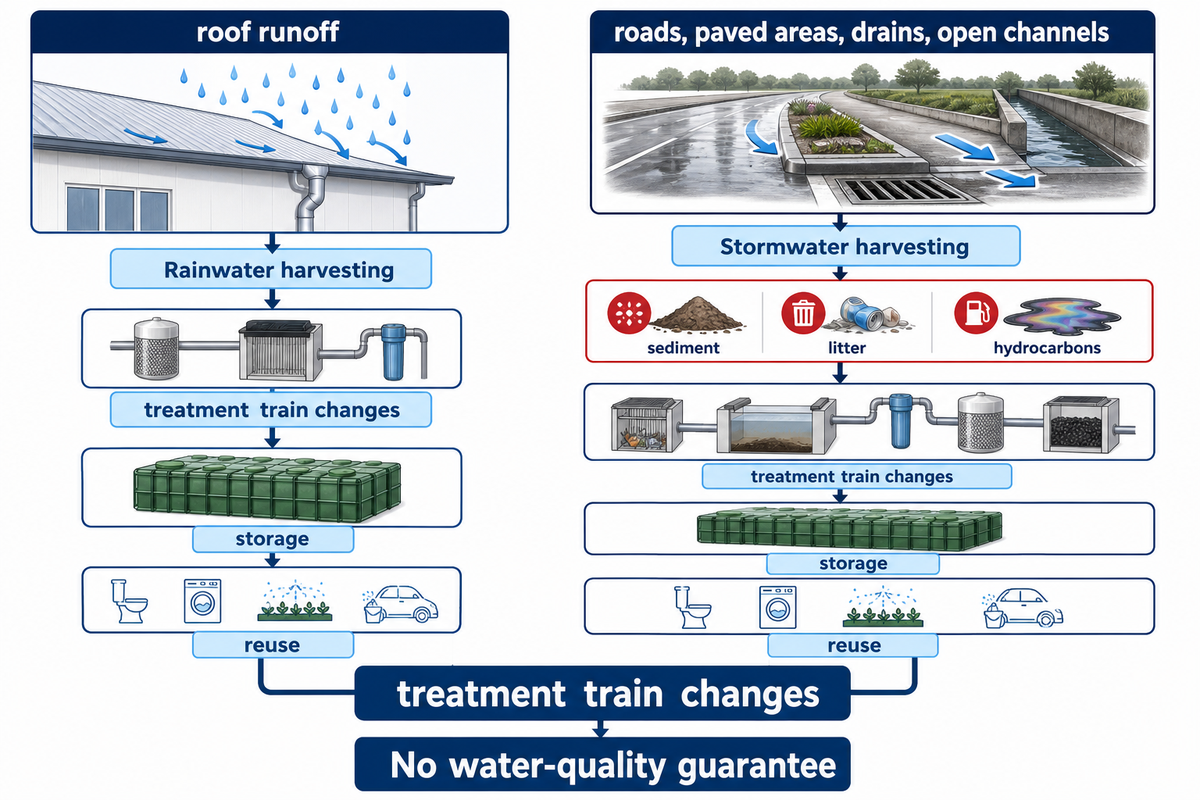
Stormwater harvesting is the collection, treatment, storage, and reuse of urban runoff. It can include flows from roads, paved areas, drains, open channels and other impervious surfaces, while rainwater harvesting usually refers to roof runoff. Generally, however, rainwater harvesting refers to roof runoff. Depending on the source boundary, the quality of the water and the treatment train changes.
Melbourne Water’s stormwater harvesting guidance outlines the process from collection to reuse. The Australian guidance for the treatment of recycled water sets the health and environmental risk barrier. Runoff that crosses a trafficked surface can carry sediment, litter, hydrocarbons and other pollutants that do not belong in a roof-only assumption.
Stormwater runoff from urban areas may reach a wetland or waterway if it isn’t captured. A separate stream of recycled stormwater may be adequate for reuse, but Melbourne’s project conditions control the case for treatment and monitoring. A rooftop source shouldn’t be considered a proxy for a mixed road and paved catchment.
Do
Map every contributing surface.
Define the intended reuse.
Assign treatment and monitoring ownership.
Don’t
Treat all runoff like clean roof water.
Assume storage equals treatment.
Use one water-quality claim for every end use.
Boundary check: if the source includes roads or public drainage, name the pollutants and exposure routes before asking for a tank price. A buyer who has only a nominal volume can’t compare treatment and monitoring scope.
A Stormwater Harvesting System Starts With Six Decisions
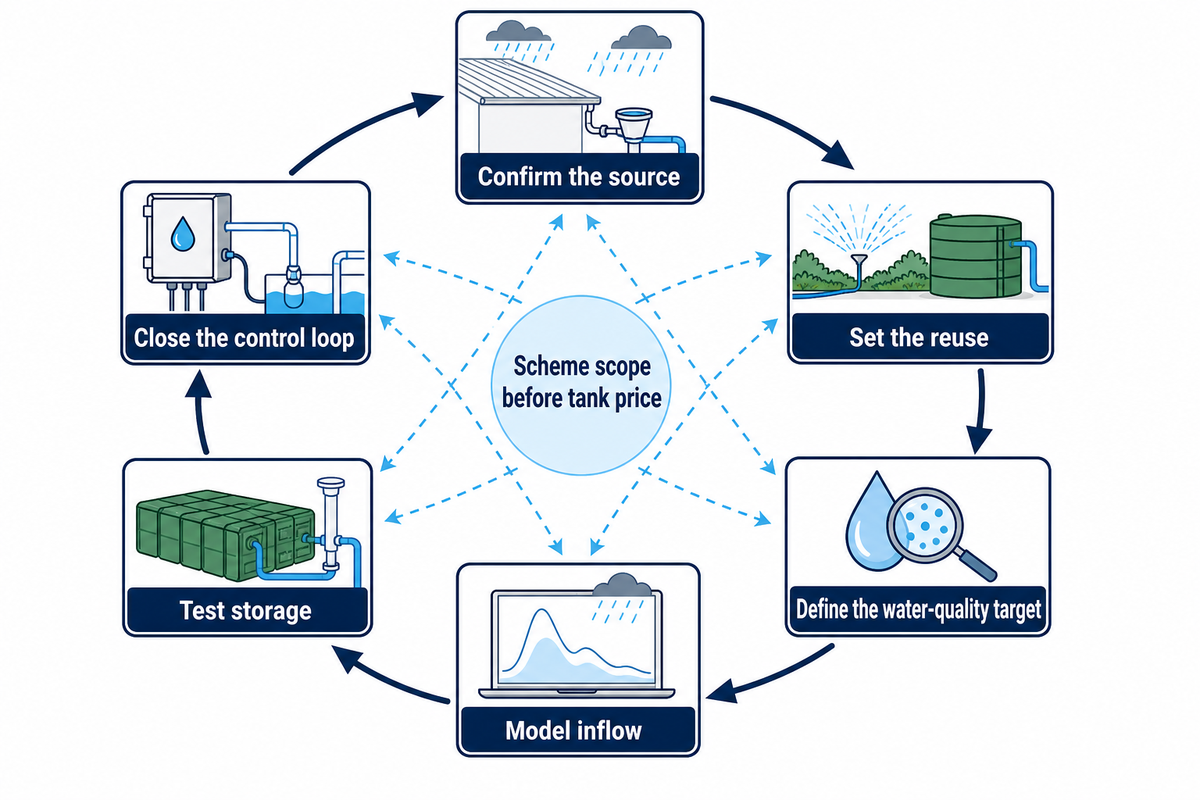
A stormwater harvesting system should be framed through six linked decisions before storage is selected. The first is deciding on the source access, the second is the targeted reuse, the third is the water quality duty, the fourth is the available inflow, the fifth is the behavior of storage, and the sixth is the route of distribution/overflow. Changing any one of the decisions impacts the others.
Confirm the source — map ownership, drainage access and any jurisdiction-specific licence or supply duty.
Set the reuse — quantify when irrigation, toilet flushing, process water or another non-potable demand occurs.
Define the water-quality target — connect source hazards and exposure pathways to treatment and monitoring.
Model inflow — use catchment area, surface response, rainfall series, diversion limits and first-flush or bypass logic.
Test storage — model drawdown, overflow, minimum operating level and reliability through time.
Close the control loop — allocate pumps, outlets, overflow, backup supply, alarms and the operating owner.
The NSW harvesting and reuse guidance takes a systems approach to planning, designing, treating, operating and monitoring. Victoria’s current stormwater management review also shows why source access and supply responsibility need a jurisdiction check rather than a generic national answer.
Demand may incorporate water for irrigation at public parks or golf courses. Local councils may assess recreation. The exact quality boundary must be defined by the operator. The storage system must be integrated with flood mitigation and any bioretention.
Constructed wetlands may be part of a treatment train and open space irrigation may create a seasonal demand. Neither eliminates the need to manage pollution at the source. A filter or another water treatment barrier must be selected for the actual hazards and the intended end use, especially where potable water systems are nearby.
Procurement objection: a supplier can review storage formats early, but a quote should mark any unresolved source right, treatment duty or operating rule as an assumption. Otherwise, bidders price different projects under the same heading.
Size Storage From Both Inflow and Reuse Demand
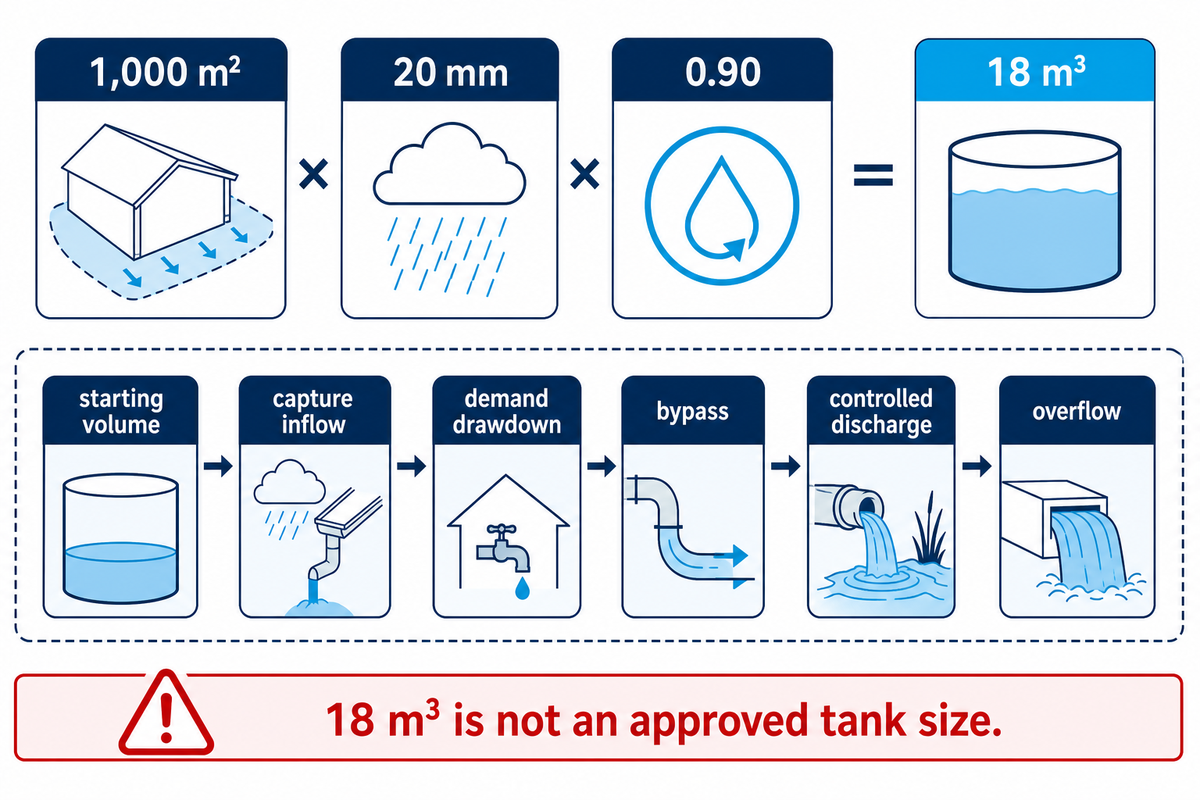
Storage size should be compared to the runoff entering the scheme and water leaving for reuse at each time step. The model represents starting volume and capture inflow, demand drawdown, bypass, controlled discharge, and overflow. Annual rainfall multiplied by the catchment area is a screening quantity and not a final volume for a water tank.
How should a project size stormwater harvesting storage?
Establish a daily or sub-daily water balance using typical or representative rainfall, the actual limits of the catchment, diversion and treatment, the reuse profile, and the required operating levels. Run several candidate volumes. The useful choice is the smallest volume that reaches the project’s reliability and stormwater objectives without creating unacceptable overflow or prolonged empty periods.
Dry periods and seasonal demand should also be tested against the operating rule that triggers top-up or bypass. Those cases demonstrate if a larger nominal capacity improves service or if it increases maintenance costs.
A simple worked example demonstrates the boundary. A hypothetical 1,000 m² impervious catchment receiving 20 mm of rain with a runoff coefficient of 0.90 produces a theoretical 18 m³ before first-flush diversion, conveyance loss, treatment limits or concurrent demand. The calculation is 1,000 m² x 0.020 m x 0.90 = 18 m³. It doesn’t mean that an 18 m³ tank is acceptable.
An early-stage capture check can use the preliminary rainwater capture estimator to define area and rainfall inputs. A stormwater harvesting design still needs time-series demand, water-quality controls and overflow logic. Public storage design guidance describes sizing as an iterative water-balance process because oversizing can add cost after demand is saturated.
Engineering note: test dry, average and wet sequences rather than one annual total. Report the time step, rainfall period, usable volume, starting level, demand profile, bypass rule and overflow destination with every result.
Storage Options: Tank, Modular Vault, Pond or Basin
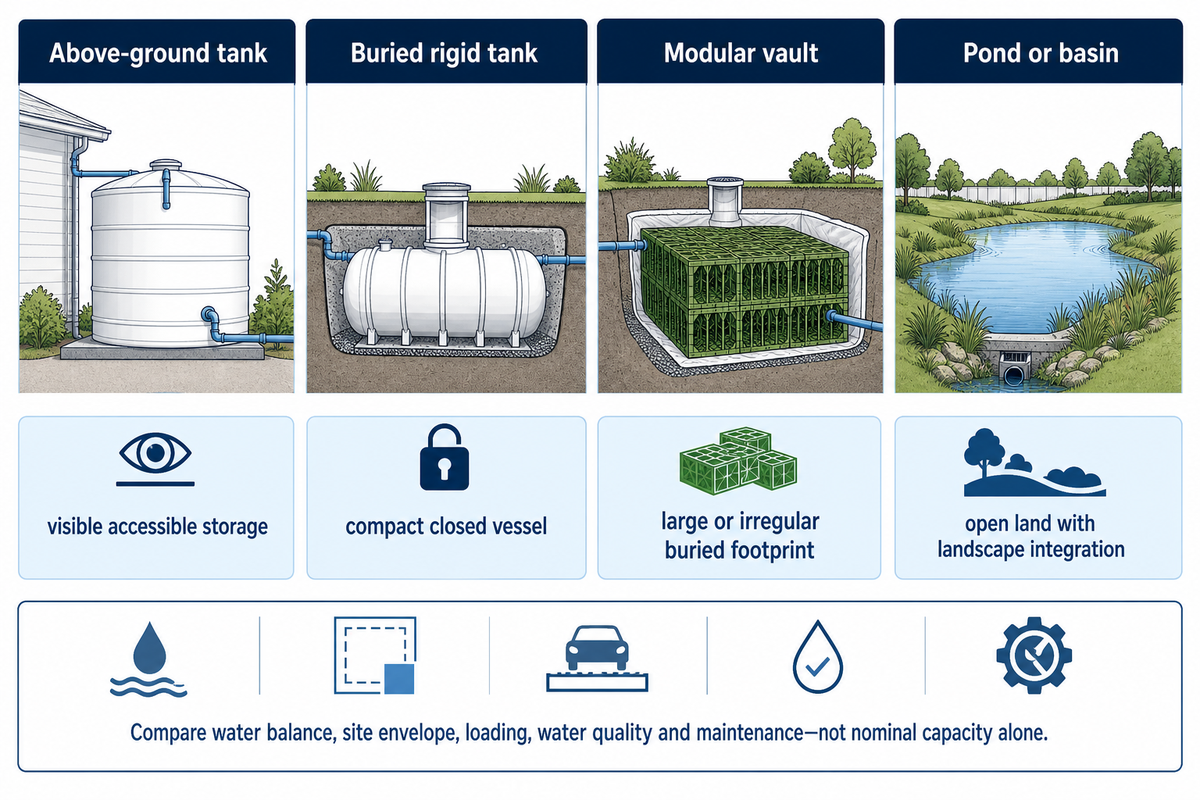
The best storage form is the one that fits the water balance, site envelope, loading, and water quality and interface concerns as well as the maintenance plan. Above-ground tanks simplify access, buried rigid tanks package a closed volume, modular vaults use irregular underground footprints, and ponds or basins provide open storage where land and public-safety controls allow.
Inflow-Demand-Storage-Control Matrix
The Inflow-Demand-Storage-Control Matrix compares four storage forms against ten decisions, and prevents a focus on nominal capacity.
Four stormwater storage forms across ten project decisions
Decision
Above-ground tank
Buried rigid tank
Modular vault
Pond or basin
Best fit
Visible, accessible storage
Compact closed vessel
Large or irregular buried footprint
Open land with landscape integration
Primary constraint
Surface space and visual impact
Transport, lifting and excavation
Structural envelope and installation quality
Land, safety and evaporation
Footprint
Directly visible
Fixed vessel geometry
Configurable plan shape
Largest surface area
Structural input
Base, wind and restraint
Cover, traffic and buoyancy
Cover, load path and surrounding material
Embankment and geotechnical stability
Groundwater
Usually separate from vessel
Buoyancy and waterproofing check
Liner and buoyancy strategy
Seepage and seasonal level check
Pretreatment
Upstream screening and sediment control
Protect vessel and pump intake
Protect modules and inspection route
Forebay or inlet treatment zone
Inspection access
External visual access
Defined openings and confined-space plan
Manholes, sumps and jetting route
Safe edge and maintenance access
Water-quality interface
Closed storage, treatment still separate
Closed storage, sediment management required
Liner, sediment and cleaning method
Open-water exposure and treatment ecology
Control need
Pump, overflow and backup supply
Level, pump and overflow controls
Distribution, drawdown and access controls
Water level, outlet and public-safety controls
Quote input
Volume, base and connections
Levels, loads, groundwater and lift
Envelope, loads, liner and maintenance layout
Landform, geotechnics and operating levels
Managed aquifer recharge is a separate Australian storage and recovery route, and isn’t a fifth tank type. The managed aquifer recharge guidance from South Australia shows that consideration for hydrogeology, source water quality, recovery and the regulatory assessment are part of this pathway.
Key takeaway
Choose storage by comparing all 10 project decisions in the matrix. Nominal volume without footprint, load, groundwater, treatment and maintenance inputs is not a comparable offer.
Choose Underground Storage Around Site Constraints
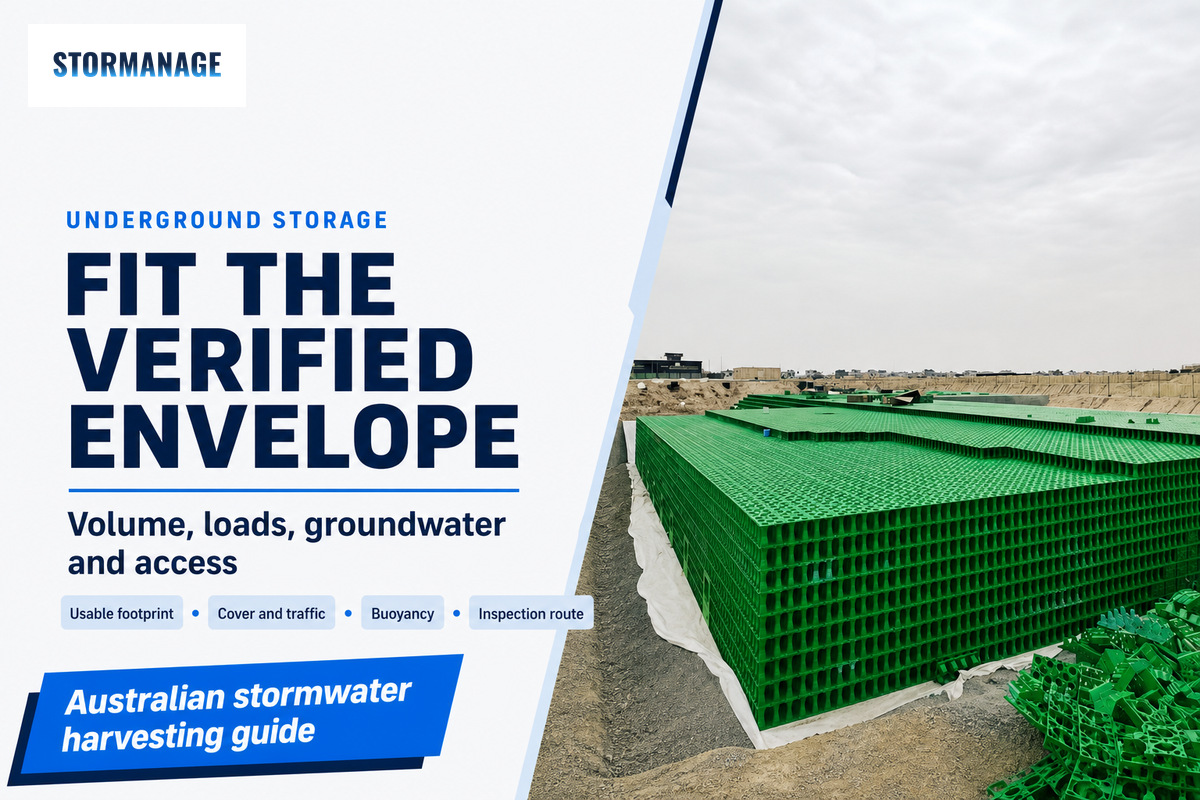
The required usable volume of a storage form can fit within a verified excavation and structural envelope, where site conditions, cover and traffic loading are deemed acceptable. Volume alone isn’t enough.
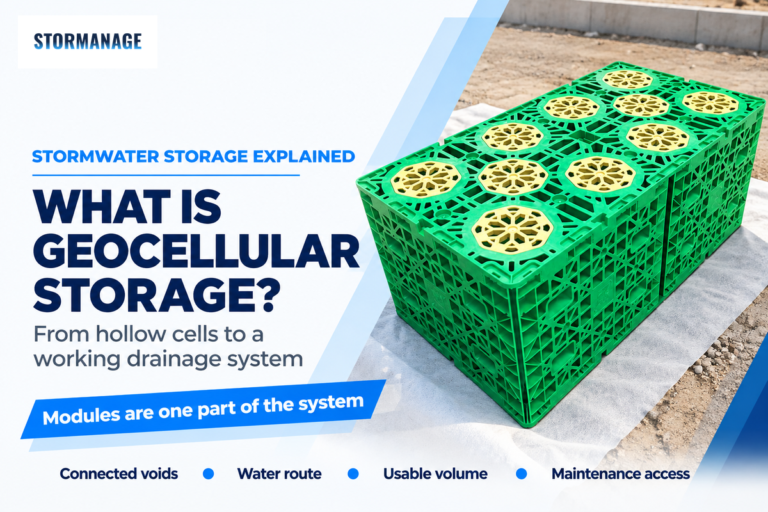
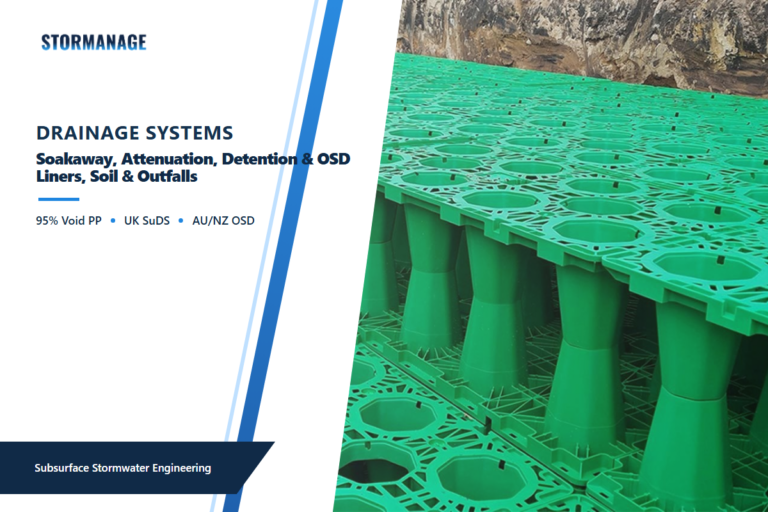
Rigid tanks and modular systems solve different geometry problems. A rigid vessel arrives with a defined shape; a modular system can fit around columns or use a broad shallow footprint. Both still need project-specific checks for loads, buoyancy, settlement, waterproofing, pipe interfaces and safe access. The site’s modular rainwater harvesting storage options provide product context, while the project engineer owns the final design basis.
A car-park scenario makes the boundary clear. If the available space is 24 m × 10 m but utilities remove a 4 m corridor, then the gross plan area isn’t usable module area. Cover, fire-truck routes, groundwater and inspection manholes can shrink the space even further. An early quote based only on cubic meters can mask these constraints and lead to an unproductive redesign.
Maintenance objection: The layout is required to include a pretreatment sump and inspection access as well as a route for cleaning. A system that can’t be inspected or flushed transfers a predictable operating problem to the owner.
Treatment Depends on Catchment and End Use
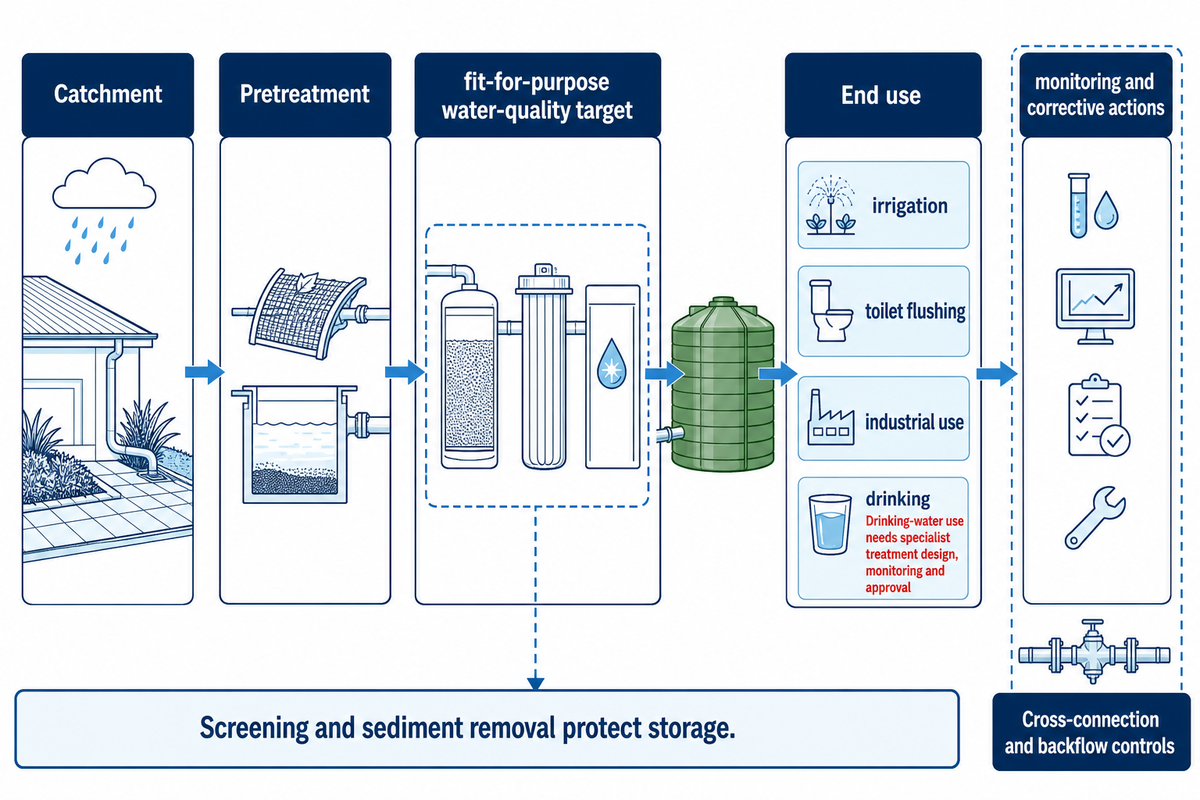
Treatment must be commensurate to the hazards in source water and the exposure pathway of concern. Screening and sediment removal protect storage, but they do not by themselves make harvested stormwater suitable for irrigation, toilet flushing, industrial use or drinking. The hazard for each of these uses must be assessed and a fit-for-purpose water-quality target defined.
The Australian Guidelines for Water Recycling use a risk-management approach for stormwater reuse. A project should identify hazards on contributing surfaces, choose barriers such as gross-pollutant removal, sedimentation, filtration or disinfection, then assign monitoring and corrective actions. Cross-connection and backflow controls are outside the tank itself.
Treatment questions by scheme boundary
Boundary
Question to resolve
Evidence owner
Catchment
Which surfaces and activities can add hazards?
Project team and site operator
Pretreatment
How are litter, sediment and coarse pollutants intercepted?
Hydraulic and treatment designer
End use
Who can contact the water and by which route?
Water-quality designer and authority
Operation
Which limits trigger alarms, shutdown or corrective action?
Operator under the approved plan
Potable-use boundary: don’t assume drinking-water suitability from a sealed tank or clear appearance. Proposals for drinking water require the relevant Australian and state or territory health requirements, specialist design and approval.
Harvesting Storage Is Not Just a Detention Tank
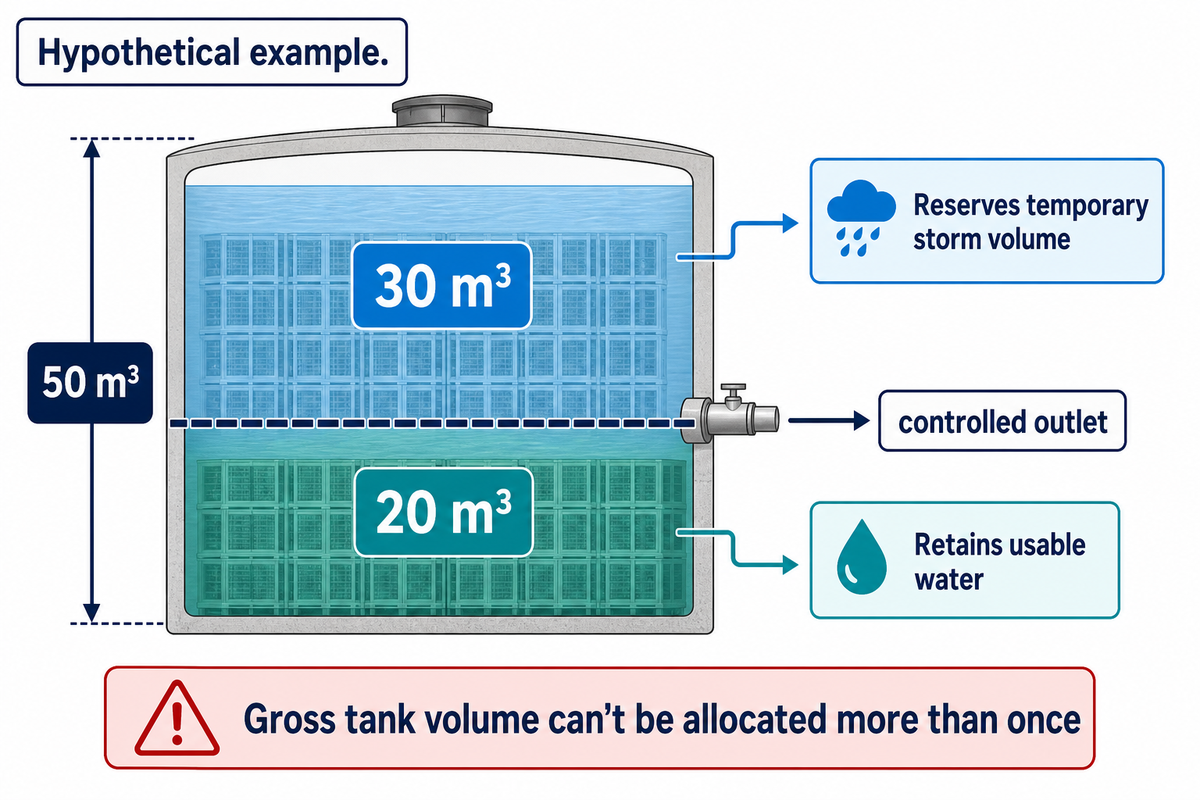
Harvesting storage retains water for reuse, while detention storage holds water for temporary storage and controlled release. A combined structure can perform both functions only when its operating levels, reuse drawdown, outlet controls and required empty volume are modelled together. Gross tank volume can’t be allocated more than once.
Harvesting function
Retains usable water.
Relies on demand drawdown.
Protects treatment and pump operating levels.
Measures reuse reliability.
Detention function
Reserves temporary storm volume.
Uses controlled discharge.
Protects downstream flow objectives.
Measures peak or discharge performance.
Consider a hypothetical 50 m³ vessel with 20 m³ below a controlled outlet and 30 m³ above it. The lower zone could support reuse and the upper zone could support detention, if the controls and starting levels are met. Calling all 50 m³ both reuse storage and detention storage would double-count the same space.
The Australian OSD tank owner’s guide describes the responsibilities associated with detention. For an in-depth functional comparison of retention and detention systems, refer to Retention and Detention Systems. An integrated system needs a specific control logic, not a label change.
An Australian Scheme Example: What 30 ML a Year Actually Tells You
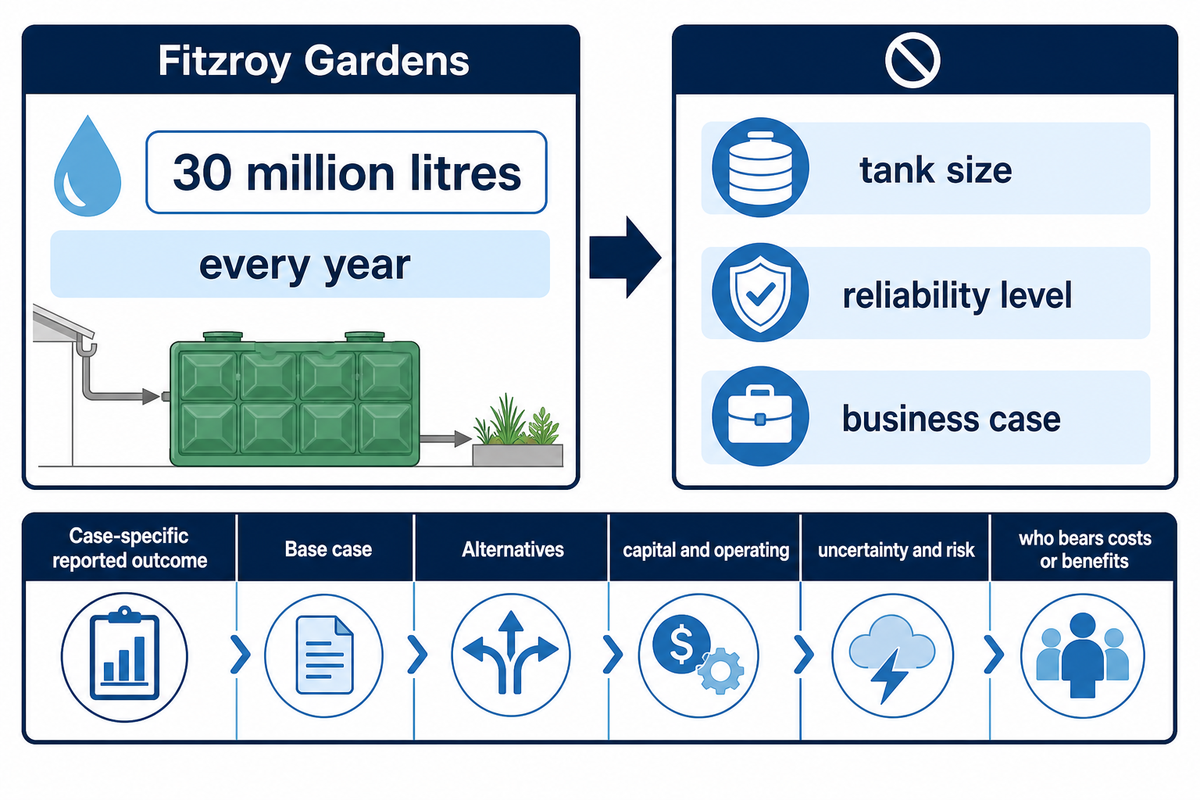
The Fitzroy Gardens scheme shows that treated urban stormwater can support a large irrigation demand, but its annual reuse figure is specific to that catchment and operating system. It doesn’t determine tank size, reliability level or business case for another site.
30 ML/yearreported Fitzroy Gardens water supply
1 schemecase-specific evidence boundary
“The stormwater harvesting system at Fitzroy Gardens provides 30 million litres of water every year.”
That figure confirms a reported annual outcome. It does not reveal the volume another catchment needs. A business case should compare the base case with alternatives, and assess the costs (capital and operating) over the modeling period, and consider uncertainty and risk, as well as who bears the costs or benefits. The NSW water-conservation CBA guidance defines these requirements.
Choose a Storage Supplier Without Outsourcing the Design Duty
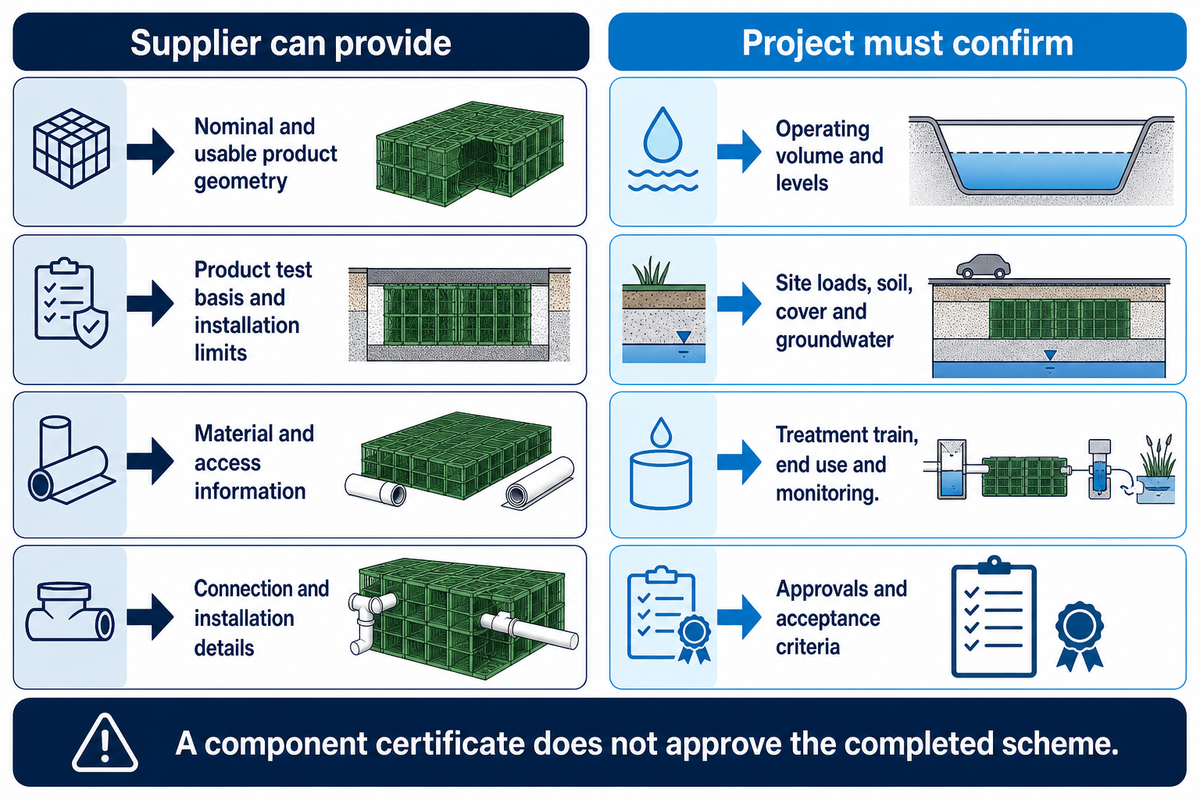
To prove product capacity and the basis for its material and structural components, and connection and installation details, a storage supplier should be referred to. However, NSW stormwater harvesting guidance keeps planning, design, treatment, operation and monitoring within the scheme scope, so the project team remains responsible for catchment modelling, water-quality design, approvals, ground conditions, system controls and acceptance criteria unless those services are explicitly included in the contract.
Request evidence on two levels. Product evidence should include an identification of the tested item and its configuration, limits and source. Project evidence should show how loads, cover, groundwater, backfill, liner, pipe openings and maintenance access have been addressed at the site. A certificate of a component doesn’t approve the completed stormwater harvesting scheme.
Responsibility split for supplier review
Evidence
Supplier can provide
Project must confirm
Capacity
Nominal and usable product geometry
Required operating volume and levels
Structure
Product test basis and installation limits
Site loads, soil, cover and groundwater
Water quality
Material and access information
Treatment train, end use and monitoring
Installation
Assembly method and product requirements
Excavation, dewatering, temporary works and QA
Operation
Product inspection and cleaning guidance
Whole-system O&M plan and responsible operator
Jurisdiction objection: confirm access and supply responsibility with the relevant authority before contract award. Victorian active licensing review shows why a supplier’s product scope can’t settle the duty nationally.
Prepare a Quote-Ready Stormwater Harvesting Brief
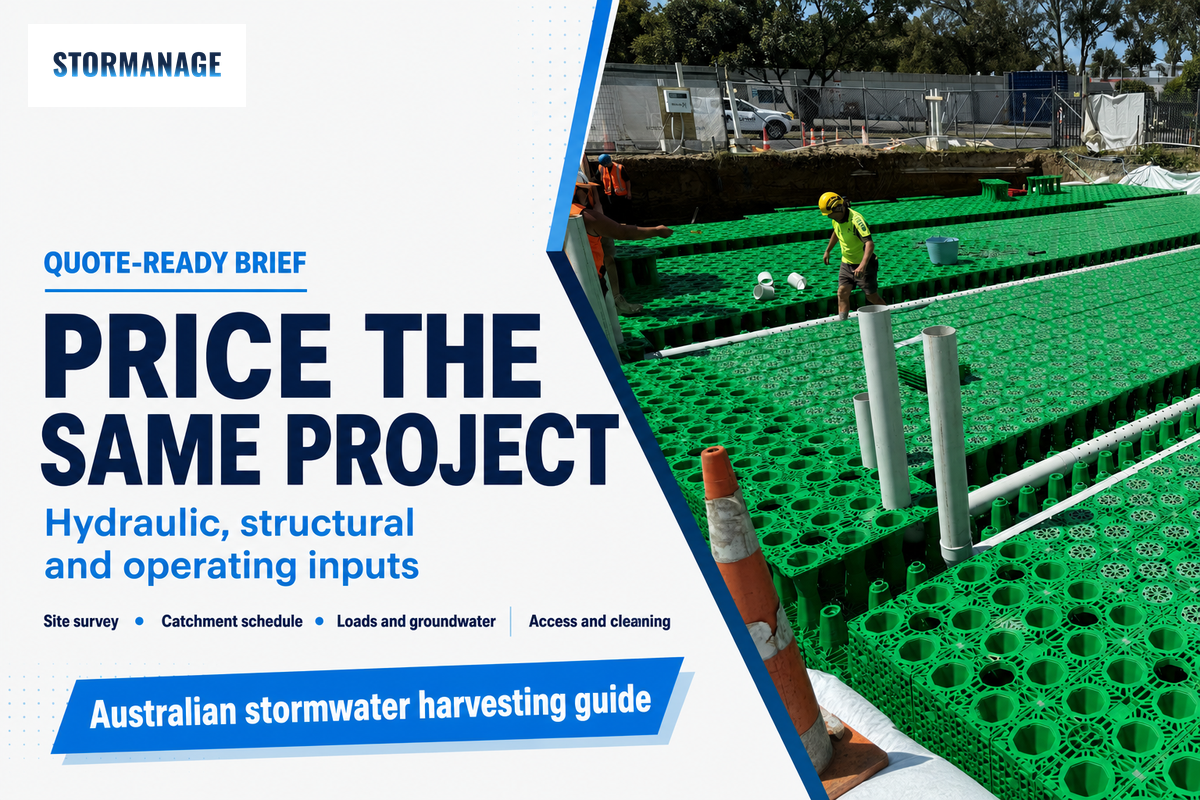
A quote-ready brief gives every supplier the same hydraulic, structural, installation and operational basis. Label preliminary assumptions, identify missing design inputs and assign treatment-selection owner. Depending on their scope, similar bids can be priced differently.
RFQ checklist: copy these fields into the request.
Final quote test: if two bidders use different rainfall periods, usable volumes, load cases or treatment scopes, their prices are not yet comparable. Re-clarify and issue the basis for comparison before ranking the bids.
Frequently Asked Questions
What does stormwater harvesting include?
Short answer
Stormwater harvesting includes runoff collection, diversion, pretreatment, storage, fit-for-purpose treatment, distribution, overflow and ongoing monitoring. The catchment may include roads, paved areas and public drainage rather than only roofs. The project should also define source access, the intended end use and the person responsible for operating each control throughout the asset’s service life.
How does stormwater harvesting work?
Short answer
A diversion captures suitable runoff and sends it through pretreatment into storage. A treatment train then prepares water for the intended reuse, while pumps or gravity supply the demand. High flows bypass or overflow safely. Sensors, alarms and an O&M plan keep the system inside its approved operating and water-quality limits.
Is stormwater harvesting the same as rainwater harvesting?
Short answer
No. Rainwater harvesting commonly refers to water collected from roofs. Stormwater harvesting can include runoff from a wider urban catchment, including paved and trafficked surfaces. The broader source can change pollutant risks, pretreatment, monitoring and approvals, even when both schemes use a tank and supply a non-potable demand under an approved operating plan.
Can harvested stormwater be used for drinking?
Short answer
Don’t assume so. Drinking-water use needs specialist treatment design, monitoring and approval under the relevant health and water requirements. A sealed storage tank alone doesn’t establish potable quality.
What information is needed before selecting underground storage?
Short answer
Provide the modelled usable volume, site plan, available footprint and depth, survey levels, inlet and outlet inverts, cover, traffic loads, geotechnical findings, seasonal groundwater, liner intent, pipe connections, treatment boundary, access openings and cleaning route. State which inputs are preliminary. Those facts let the engineer and supplier test whether a rigid tank, modular vault or another form fits the site.
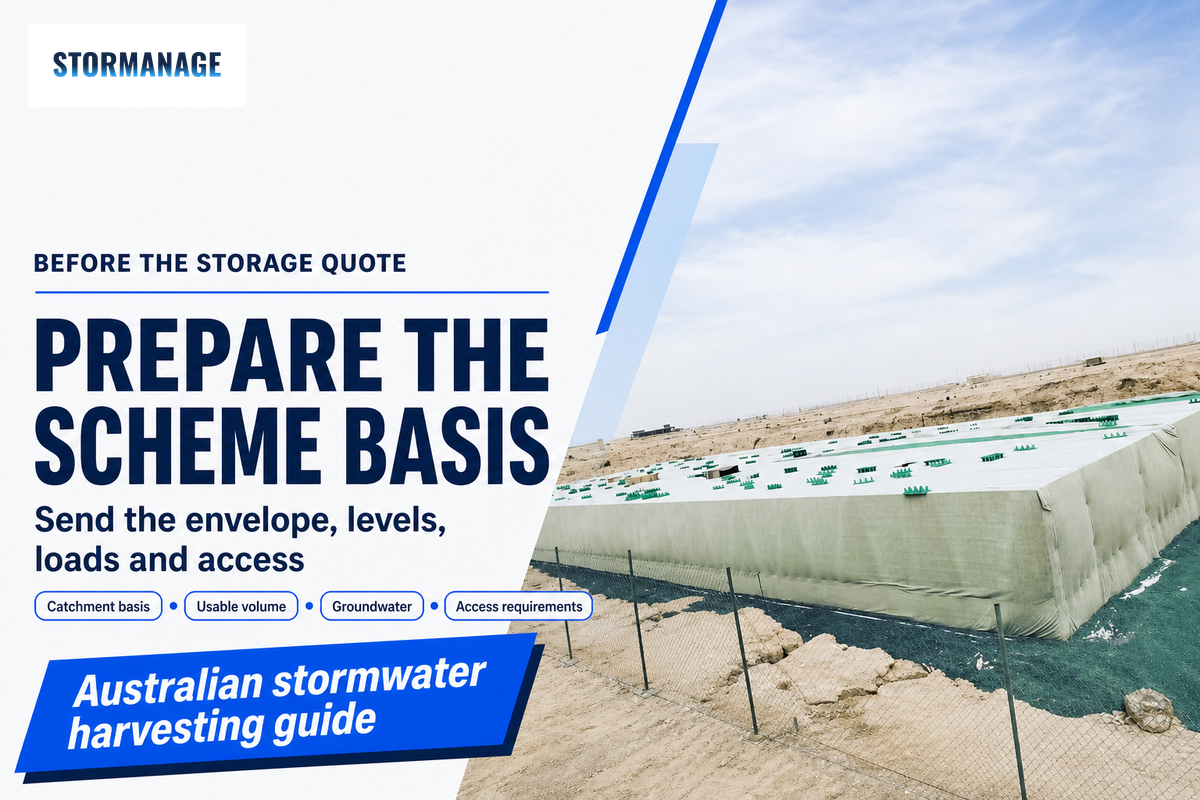
Prepare the scheme before the storage quote
Storm Manage can review modular storage geometry against a defined site envelope and project brief. Send the catchment basis, target usable volume, levels, loads, groundwater information and access requirements so the technical discussion starts from a shared scope.
Method Note: This guide synthesizes public Australian Government and water authority guidelines. It doesn’t provide project engineering, regulatory approvals, water quality certifications and/or a universal storage size. Public case figures remain tied to the named scheme.