Modular Geocellular OSD Systems — Manufacturer & Exporter

OSD Tanks — Council-Compliant On-Site Detention Systems

An OSD (on-site detention tank) temporarily holds stormwater from rain run-off on site, then releases it at the council-permitted discharge rate. Storm Manage supplies load-rated modular geocellular systems and exports to Australian distributors and civil contractors. These stormwater detention tanks safeguard the downstream drainage system and mitigate floods.

On-site detention controls the discharge of rainfall that has fallen on hard surfaces — roofs, driveways and car parks — using a control orifice that regulates the release rate so the whole-site discharge does not overwhelm the capacity of downstream drainage during an intense rainfall event. It is mandated in most new developments, which significantly increase runoff generation. We provide the detention hardware, load-report and engineer-ready documentation, while final design is by your project engineer, based upon our engineering report and assessment against the subject site.

Modular Geocellular OSD Systems Hub OSD Tanks On-Site Detention System Installation

Independent load evidence — Intertek third-party vertical-load report (190702149GZU-001), 600 kN/m² front-surface at 23°C and 40°C (indicative, short-term)

Void ratio ≥95% — geocellular modules (industry benchmark ~96%)

40HQ container yield ≈ 330 m³ installed detention storage (flat-packed components)

Council documentation pack — PSD/SSR mapping inputs, AS 3996 access-cover references, maintenance schedule template

Why Councils Mandate On-Site Detention — and Where OSD Tanks Fail Certification

Wherever a development replaces grass and soil with hard surfaces, the runoff that the soil once absorbed now flows off site rapidly. On-site detention (OSD) is how a local council limits this peak: the tank fills during a storm, then is released gradually back into the site at the authorised discharge rate via an access-control orifice.

OSD tank vs retention tank vs rainwater tank

Buyers often see these three tank types as one in search results, but the difference between them is the key to council approval. Which type of tank you need depends on your local authority.

Retention and detention tanks address different storm water issues, so selecting the incorrect type is one of many common reasons for a council failure prior to construction commencing. For projects using UK-style flow-control terminology, compare the separate geocellular attenuation tank systems before choosing the applicable route.

OSD tank vs retention tank systems
SYSTEM / DIAGNOSTICS
  • FLOW RATE CONTROL: ORIFICE REGULATED
  • VOLUME STATUS: TEMPORARY HOLD
  • COUNCIL APPROVAL: MANDATORY
Tank type Purpose Behaviour
OSD / detention tank Temporarily store stormwater runoff and meter peak flow to the council rate Should remain empty between rain events; slowly releases at a controlled rate through an orifice
Retention tank Hold water on site (stormwater retention) as part of broader stormwater management Retains volume rather than releasing it; a different council requirement
Rainwater tank Capture roof water for reuse — a harvesting system focused on water quality and filtration Stores water for later use, not detention; the retention or detention question does not apply

A near-universal requirement — with a catch

In NSW, and more recently in QLD and VIC, new commercial and residential projects generally require on-site detention — a council such as the City of Boroondara requires an OSD application wherever hard surfaces replace soil, and charges a re-inspection fee when a built system fails sign-off. What buyers don’t consider is that the physical tank itself is only a small part of what is required to gain approval: without the paperwork, projects are unlikely to proceed.

OSD Council compliance and inspection
RESOURCES / COMPLIANCE
  • NSW / QLD / VIC: OSD MANDATED
  • INSPECTION: FEE APPLICABLE
  • PAPERWORK: REQUIRED FOR SIGN-OFF

The three failure modes we see most

Each of these has a paperwork issue as much as a hardware issue, and the error most buyers make is assuming the tank itself is the deliverable. Unlike a bare tank shipped without proof, our detention modules include independent load evidence and are compatible with the council inputs your engineer will require.

OSD failure modes and load evidence
SPECIFICATIONS / LOAD RATINGS
  • WATERPROOFING: INTEGRATED JOINT CHECK
  • VOLUME SSR: ENGINEER MAPPED
  • LOAD CLASS: INDEPENDENT TESTED
Failure mode Why it fails council sign-off
Waterproofing / leakage Cracks or joint leaks mean the tank cannot prove it detains the required volume — a common re-inspection trigger and re-pay loop
Under-sized storage (SSR) Volume doesn’t meet the council’s Site Storage Requirement, so the controlled release can’t hold peak flow
Wrong load class A module rated for landscaped areas placed under a driveway or car park has no defensible trafficable load evidence

Not sure which failure mode is your risk?

Request a spec sheet

and we’ll pre-check your council inputs against it.

Storm Manage StormGrid Geocellular OSD Systems — Modules, Void Ratio & Load Classes

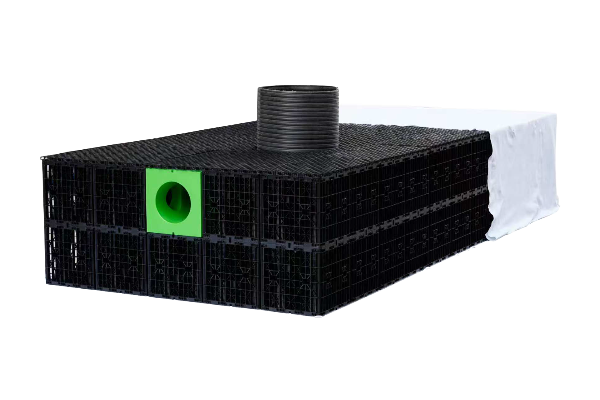
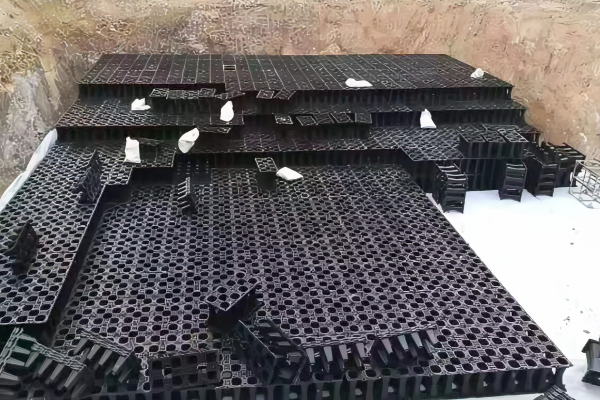
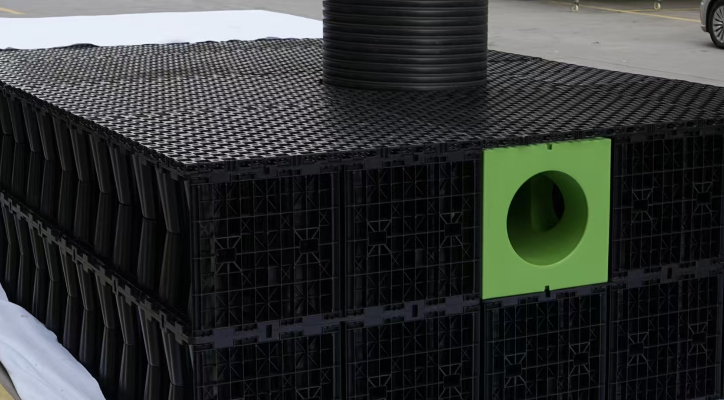
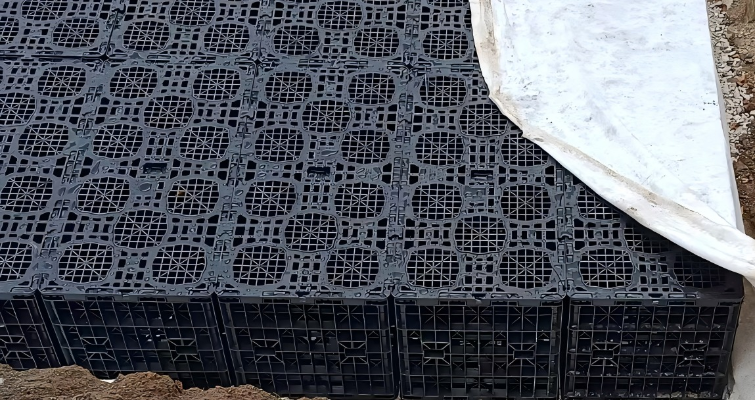
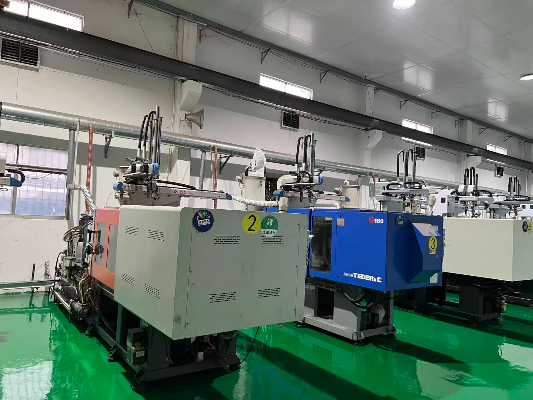
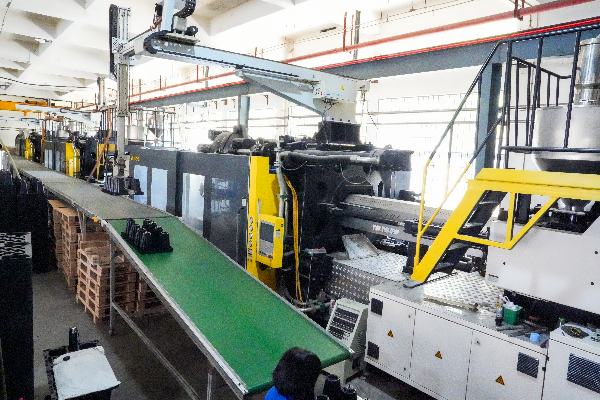
StormGrid modular cells are injection-moulded polypropylene components that interlock to build an engineered underground storage chamber — a cross-stacked geocellular structural module of the kind documented in patents such as CN103946465A, where the cells are engineered to carry vertical load without deforming.

Flat-packed for freight, they assemble on site into a detention block wrapped in an impermeable geomembrane for OSD (or a permeable geotextile for infiltration). It is engineered infrastructure built to your specification; the impermeable wrap sets the chamber’s permeability profile.

StormGrid Geocellular OSD Systems Module
SYSTEM SCHEMATIC // 3D VIEW

Module and system specification

Attribute StormGrid module Geocellular market baseline
Nominal module size 1000 × 500 × 500 mm (~0.25 m³) Comparable 0.2–0.4 m³ modules
Void ratio ≥95% ~96% (e.g. GS Tanks M2016S)
Vertical load (indicative) Tested 600 kN/m² front-surface (per Intertek report) ~65 T/m² vertical, ~12 T/m² lateral
Module weight ~15 kg Similar lightweight PP
Configuration Customisable depth & footprint per SSR Modular / stackable

How to read the load figures: The 600 kN/m² number is short-term vertical-load evidence from an independent lab test (per the Intertek report), while current structural and creep design for geocellular tanks is governed by CIRIA C737:2018, with BS EN 17152-1:2019 the current product standard for plastic storage boxes used in vehicular-traffic areas. For driveway, car-park or under-road installations, your engineer should design to these current standards using the load evidence we supply — not to a single test figure alone. Unlike suppliers who quote one headline load number, we hand your engineer the underlying test data; the trade-off we state plainly is that under-road use still needs site-specific design.

Request the StormGrid spec pack — module drawings, void ratio and the load report your engineer designs from.

Decision matrix — matching module build-up to the site

Specify the wrong load class and the module is at risk of failure under traffic or cracking when inspected by council – a very costly error to correct after installation. This matrix works out the build-up of cover applied over the module so that risk is designed out before it reaches the site.

Site condition Cover / load context Typical StormGrid build-up
Landscaped / garden Non-trafficable Shallow single-layer, minimum cover
Residential driveway Light vehicle (trafficable) Load-rated build-up, engineered cover depth, AS 3996 access covers
Commercial car park Heavy vehicle / repeated loading Deeper cover, site-specific structural design to CIRIA C737

The OSD Compliance Envelope — Matching Council PSD/SSR to Crate Spec

Most buyers don’t struggle with the tank; they struggle to prove the tank fits their council’s rules. Our OSD Compliance Envelope is a structure for gathering the right inputs and mapping them to a StormGrid specification — not a universal lookup table.
OSD Compliance Envelope mapping to StormGrid
SYSTEM / COMPLIANCE

Built around what actually varies

It works because it is honest about what varies. Council policies for on-site detention differ substantially — peer-reviewed research on Greater Western Sydney councils has documented significant inconsistency in OSD requirements between neighbouring areas. The Envelope walks you input-by-input so nothing is assumed across a council boundary.

The Envelope — from council requirement to documented spec

Step Input to gather What it drives
1. Permitted Site Discharge (PSD) Council DCP / Sydney Water policy — the council requirements Control orifice size and flow rate to meter peak flow
2. Site Storage Requirement (SSR) Council rate (Sydney commonly ~300–500 m³/ha; council- and site-specific — confirm your council’s current DCP) Total detention volume and tank requirements
3. Detention volume → modules SSR ÷ module storage (void-adjusted) Module count & footprint to meet council requirements
4. Load class Cover use — garden / driveway / car park Build-up depth & access-cover standard (AS 3996, Australian Standards)
5. Documentation pack Load report, layout, maintenance schedule Inputs your engineer certifies

Where the Envelope stops — and your engineer starts: Final council approval depends on site-specific certification by a chartered civil engineer: orifice and control-pit design, the subject-site PSD and SSR, a maintenance schedule and an OSD identification plaque. Storm Manage supplies the product-side evidence that supports that submission. We provide engineer-ready supplier documentation — not council approval in a box.

Geocellular vs Concrete vs Poly OSD Tanks — Material Scorecard

All three OSD tank materials on the Australian market pass certification when specified correctly. Comparing them on marketing adjectives helps no one, so the Scorecard uses numbers a procurement or engineering buyer can check.

Material Scorecard

SYSTEM DIAGNOSTICS // COMPARISON
Factor Geocellular (modular) Precast concrete Poly / PE tank
Void ratio ≥95% ~100% (open chamber) ~100% (open tank)
Install weight ~15 kg/module (hand-placed) Heavy — crane required Light–moderate
40HQ freight yield High (flat-packed ≈ 330 m³ installed) Low (bulky, often local cast) Moderate (nested)
Load evidence type Independent lab load report Structural certification by cast design Product rating; check trafficable class
Durability Durable polypropylene; high void density, corrosion-free High-density precast concrete tank Polyethylene (PE) poly tank, UV-stable
Indicative supply cost $400–1,000 / 1,000 L $800–2,500 / 1,000 L Mid-range

Two honest caveats sit under this table. A ≥95% void ratio is table-stakes across geocellular suppliers and not a Storm Manage advantage — unlike independent load evidence and container economics, which genuinely differ between suppliers. Whereas a plastic osd tank wins on freight, some councils (for example Hills Shire in NSW) specify a precast osd tank or concrete osd tank and reject plastic modular OSD, so material choice must follow the council’s OSD design assessment, not the cheapest freight.

Comparing a plastic osd tank with pre-cast?

Request a quote

using the Material Scorecard and your council’s rule.

Independent Load Evidence — Intertek Third-Party Vertical-Load Report

Overseas manufacturers earn or lose trust on one question: can a council engineer defend your tank’s load capacity? Councils such as Hornsby Shire require certification of the OSD design by a chartered civil engineer, so Storm Manage answers with third-party load data rather than a self-declared rating.

What the report shows — and what it doesn’t

Evidence layer What Storm Manage holds Status
Short-term vertical load Intertek report 190702149GZU-001 — 600 kN/m² front-surface at 23°C and 40°C, ISO/IEC 17025-accredited laboratory Independent test data
Current structural design Designed to CIRIA C737:2018 (the current guide superseding C680) Current standard
Long-term creep / deformation Thermoplastic creep is the real long-term failure mode (addressed in C737) Site-specific engineering

Read the report for what it is: an independent lab’s vertical-load test result, not a blanket “C680 compliant” or “council approved” claim. That 40°C result matters in Australian ground conditions, where temperature accelerates thermoplastic creep — the genuine long-term concern that CIRIA C737 exists to manage.

“When a distributor asks why we lead with an Intertek report instead of a compliance logo, the answer is that a load figure a council engineer can independently verify travels further than a badge. We hold ISO 9001, 14001 and 45001 management-system certification — but those are management systems, not a product approval, and we don’t have a BBA certificate. We’d rather say that plainly than let a buyer discover it at certification.”

— Storm Manage engineering & export team

Unlike a compliance badge, a load figure a council engineer can independently verify is the tell that survives scrutiny.

Request a copy of the full Intertek load report
(test data and spec sheet) for your engineer’s review before you commit to a supplier.
Intertek Laboratory Vertical Load Test Evidence
EVIDENCE / INTERTEK

Where StormGrid OSD Systems Are Installed — Driveways, Car Parks & Commercial Sites

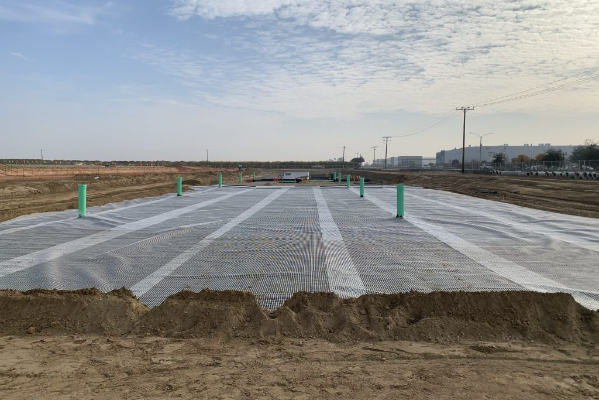
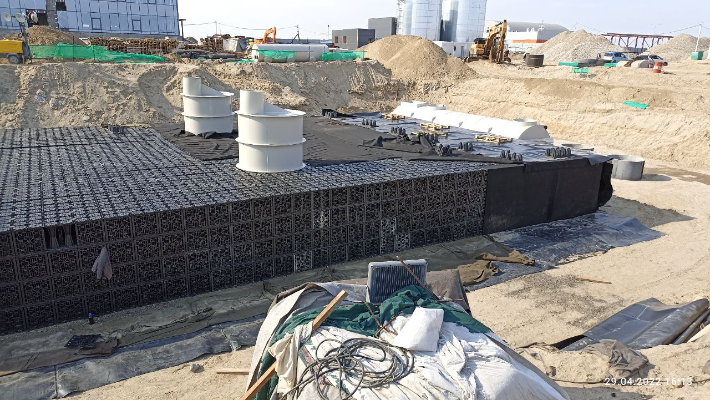
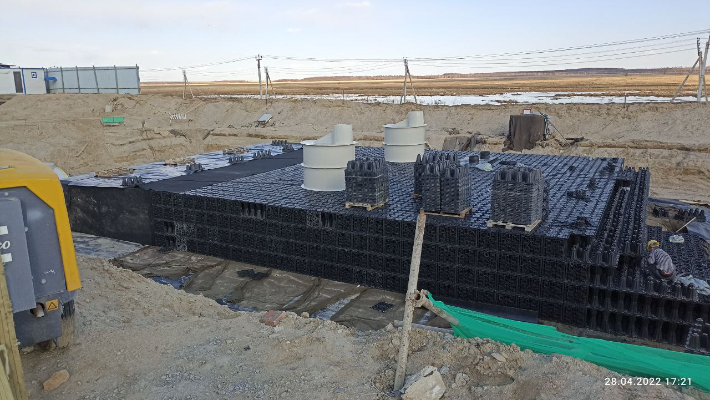
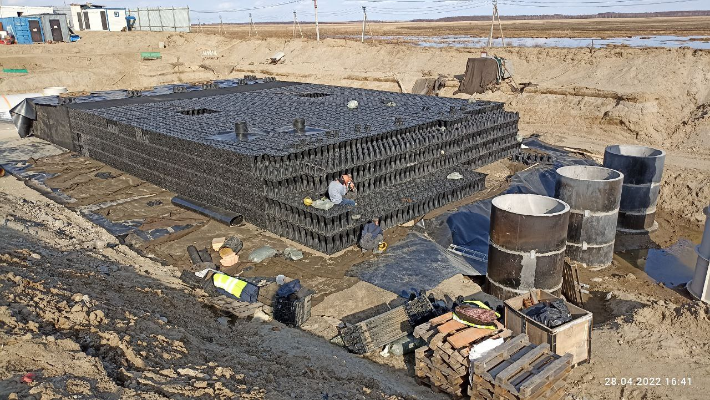
Underground modular geocellular is our primary system because it recovers usable land: the detention void sits beneath a driveway, car park or landscaped area rather than occupying the surface. That suits the sites most OSD projects involve. Installed as stormwater infrastructure, these systems control runoff and manage the slow release of water so it drains back to the network, lowering flood risk.

StormGrid OSD System Installation Contexts
SITE CONTEXT // 3D MAP

Typical installation contexts

  • Residential driveways and new homes use underground detention tanks with a load-rated build-up under light-vehicle trafficable areas, with AS 3996 access covers and access points sized for the heavy rainfall of local storm events — onsite stormwater detention that helps prevent flooding for downstream property owners.
  • Commercial car parks and applications need deeper cover and site-specific structural design across hard surfaces and impermeable surfaces for repeated heavy loading; a common commercial application.
  • Large-scale infrastructure projects link underground tanks and multiple cells to manage urban stormwater across impervious catchment and impervious surfaces in urban areas, supporting sustainable urban drainage and urban development water management in new developments, where onsite detention tanks — from a single litre tank to large arrays — control water runoff, water flow and run-off while managing stormwater across the catchment.
Project teams comparing land uses can use the stormwater applications by sector hub to screen site context before the engineer confirms hydraulic duty and structural loading.

Supplying OSD Tanks to Australia — Freight, Lead Time & Council Documentation

For a distributor or civil contractor, the buying question isn’t a homeowner’s install quote — it’s landed cost, container yield and how fast the council documentation moves. This section is written from that supply-side view. As an exporter of on-site stormwater detention systems, we supply stormwater detention solutions — tank systems and tank solutions that manage stormwater runoff and control the release of peak water flow.

OSD Tank Container Loading and Logistics
LOGISTICS / 40HQ YIELD

40HQ container yield — the arithmetic, honestly

A 40-foot high-cube container has roughly 76 m³ of internal loading space — so no container physically holds 330 m³. StormGrid modules ship flat-packed and nested to fit that space; the ≈ 330 m³ figure is the assembled, installed detention void they build into once expanded on site. Treat 330 m³ as a supplier installed-yield estimate to confirm against your final module schedule — not as container capacity.

Supply and cost reference

Item Reference Basis
End-market install cost ~$6,000–25,000 per full residential system Australian end-market install range (not a Storm Manage supply price)
Per-volume (geocellular) $400–1,000 / 1,000 L supplied Market reference for modular plastic
Engineer certification ~$3,000 for drawings + report Separate professional cost, paid to your engineer
Container yield 40HQ ≈ 330 m³ installed void Supplier estimate — verify vs module schedule

Detailed cost and sizing sit on our dedicated cost-and-sizing resource; the figures here are a supply-side band, not a fixed quote. What we hold to on the supply side is transparent FOB-to-landed material cost and a documented container yield your procurement team can model. Supply is often quoted per litre of storage, so a larger storage system lowers the cost per litre of water detained.

SYSTEM DIAGNOSTICS // KNOWLEDGE BASE

FAQ — OSD Tank Questions (Australia)

Yes. A detention tank must hold its full design volume, so geocellular systems use an impermeable geomembrane wrap sealed at every joint and penetration. A leak means the tank fails to prove it detains the required storage.

It depends on the cover use, and your engineer sets it against current standards — unlike a one-size load rating. A garden install is non-trafficable; a residential driveway needs a light-vehicle build-up; a commercial car park needs site-specific structural design to CIRIA C737 with AS 3996 access covers. We supply the independent load report your engineer designs from, so confirm the class against your subject site.

Councils publish a Site Storage Requirement, often expressed per hectare of site area — around 300–500 m³/ha across parts of Sydney, though the exact rate varies by council. Your engineer applies the council’s method to the subject site’s impervious area and permitted site discharge to fix the detention volume, which sets the module count, so the mistake buyers make is guessing it from a neighbouring project. Confirm the figure against your own council’s DCP, using the OSD Compliance Envelope above to gather every input before sizing.

Both pass when specified to the council’s rule, so the deciding factor is the council, not the material. Whereas some councils (such as Hills Shire, NSW) require concrete and reject plastic modular, others accept geocellular with load evidence. Confirm the material requirement in your council’s DCP before you specify — we’ll tell you honestly if geocellular isn’t accepted.

We export StormGrid systems to distributors and civil contractors Australia-wide, matched to each council’s PSD/SSR and material rules. Send the council and the site’s storage requirement, and we’ll confirm whether geocellular is accepted and return a mapped spec — or say plainly where concrete is mandated.