Applications by Sector

Underground Stormwater Storage Systems for Highway, Sports, Development and Industrial Sites

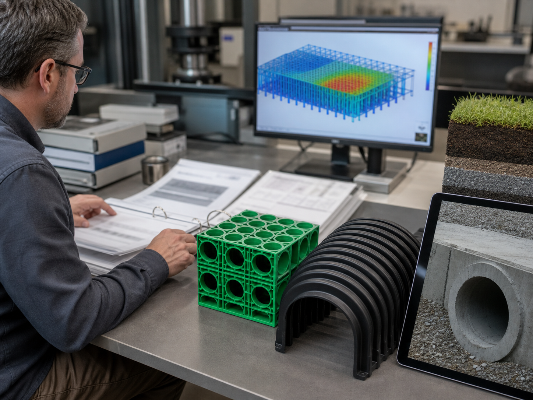
Underground stormwater storage systems all look the same on a datasheet, but work very differently once you add a surface, a cover depth and an adoption route. Storm Manage builds a single, modular geocellular tank, and can configure it in four ways. This page directs you to the appropriate configuration.

Select your site type from the menu below, or consider where the water has to go – those are distinct, and often competing, considerations, and putting the former before the latter has caused more than one scheme to be sent back. Unlike most stormwater solutions in this sector, which are presented as a list of products, this one is presented as a decision-tree.

Underground Stormwater Storage Systems Applications by Sector Hub
95%
Void ratio, module — the figure a regulator credits only when manufacturer documentation supports it
SG-E20 → SG-H60
Five load grades, short-term compression basis
190 L / 237.5 L
Storage per module, H400 and H500
−30 °C to 120 °C
Working temperature range of the moulded component
15–30 days
Production lead time after order confirmation
356.5 m³
Maximum storage volume shipped in one 40’HQ, H500 series
Site type

Four Site Types, One Underground Stormwater Storage System

The plastic boxes we supply are the same – the moulded shape doesn’t change, whether the system sits under a school pitch, or an HGV yard – but everything else that matters for an underground system, from the load above the system, through its wrap, to the depth of soil over it and the body accepting it, is completely different.

Storm Manage supply modular geocellular tanks: interconnecting polypropylene boxes creating underground storage that holds back stormwater, releasing it at a controlled rate, under a completed surface. Everything below is about choosing between the four ways we deploy them.

Underground stormwater storage system configuration overview

Two axes, not one

We select load grades by site type and system type by water outlet. This table settles the first selection, and the second part of this page settles the second. Condensing these distinct choices into a single question is where this category gets presented in a misleadingly simplified way – in our review of competitor systems, each organised by material or by part number – and none differentiated the two issues.

Site type What sits above the tank Governing load case Grade shortlist Approval / adoption route Go deeper
Highway & car park Carriageway, parking bays, HGV yards Dynamic wheel load at shallow cover SG-M40 / SG-H60 Highway authority; departure from standard where no product listing exists Heavy duty attenuation crates
Sports, landscape & podium Playing surfaces, soft landscape, planted decks Static load with a constrained vertical zone SG-E20 / SG-L30 Usually owner-maintained, outside adoption Sports field drainage crates
Commercial & residential development Estate roads, parking courts, shared open space Mixed traffic across one site SG-L30 / SG-M40 Adopting body review — the constraint that outranks everything else Residential SuDS drainage
Infrastructure, airport & industrial Hardstanding, aprons, plant yards Heavy load plus high-rate inflow SG-H60 / SG-Custom Site owner or operator, self-managed Geocellular tanks for airport & industrial sites

Why any of this goes underground in the first place

Surface-based systems can be effective and are typically easier where land availability is generous. Burying storage is ultimately an argument over space, and in urban areas where space is limited and land values are high, a surface-water pond occupies space that could have been used for buildings, parking, or public open space.

In short, an underground storage system reclaims valuable land for above-ground use while still doing the hydraulic job — holding back peak flow to prevent flooding downstream. That argument loses traction rapidly in rural areas with large amounts of land available – which is why the same drainage design lands differently in two different postcodes.

  • Under a car park, underground storage buys back the space for parking a basin would consume.
  • Under a football pitch or a vegetated deck, the void below can temporarily store runoff water while the finished surface above stays usable.
  • Under a yard or apron, the surface stays in use while the system detains peak flow from the drainage areas upstream.
Underground void space vs surface basin comparison

Why the approval column is first among equals

On a development site, the adoption route can matter as much as, or more than, the technical detail. If the adopting body won’t accept ownership, the system’s load rating, its void ratio and its cost quickly become irrelevant. The consideration has been placed at the front of the decision-making process — not tucked away as an afterthought — because that’s where it matters in a real-world programme.

Open size calculator for your site type →
Project approval route and planning process flow

One Module, Five System Names, Soakaway, Attenuation, Detention, OSD and Harvesting

The same StormGrid module is specified under five different names depending on the country the drawing was produced in. A buyer sourcing for three markets is reading three vocabularies for one product.

What actually changes between them isn’t the box. It’s what the water is doing afterwards and therefore what you wrap the box in.

Ordered by runoff destination, not by market

UK’s national sustainable drainage guidelines contain a priority list for what runoff goes where finally. Matching the names against that hierarchy turns the glossary into a decision tree.

The hierarchy, as published in England’s national standards

Runoff “shall be discharged to the following final destinations, to the maximum extent practicable”: priority 1 collected for non-potable use; priority 2 infiltrated to ground; priority 3 discharged to an above ground surface water body; priority 4 discharged to a surface water sewer, or another piped surface water drainage system; priority 5 discharged to a combined sewer.

Two qualifiers that matter and are usually dropped when this list gets quoted: 1 this applies to England; 2 “shall” but subject to “to the maximum extent practicable”, with lower priority allowed on the basis higher priority was “exhausted to the maximum extent practicable” and higher cost alone isn’t a reason.

Runoff destination hierarchy diagram
Priority Runoff destination Name on your drawing Main markets Wrap decides it Go deeper
1 Collected for non-potable use Rainwater harvesting tank Global Sealed geomembrane lining Product page
2 Infiltrated to ground Soakaway crate UK / EU Geotextile wrap, water leaves through the sides and base Soakaway crate hub
3–5 Released at a controlled rate Attenuation tank UK / EU / Middle East Geomembrane lining, flow control on the outlet Attenuation tank hub
3–5 Released at a controlled rate Stormwater detention tank North America Geomembrane lining, peak flow control Detention tank hub
3–5 Released at a controlled rate OSD tank Australia / New Zealand Geomembrane lining, council-set discharge rate OSD tank hub

Detention, retention, infiltration, the words are not interchangeable

North America splits two concepts often collapsed into one term in Europe: “Detention” retains storm water volume temporarily and discharges it slowly to a downstream receiving water. “Retention” stores storm water volume semi-permanently where most leaves by evapotranspiration and infiltration.

Therefore, underground stormwater retention devices don’t function the same as underground storm water detention devices even when hardware looks identical. That matters to volume storage capacity design and more to what an engineer who’s reviewing drawings will ask about which stormwater volumes for a drainage area were simulated.

Stormwater detention vs retention, in one line

Detention releases the volume downstream slowly; retention keeps part of it. Buyers searching for stormwater volume control treat detention and retention as the same thing; a drainage reviewer doesn’t. That’s how a tank comes back with the volume right and the mechanism classified wrongly.

An underground storm water device designed to achieve one, but specified to achieve the other is a quiet failure mode for storm water infrastructure of this category. It’s why the wrap column above isn’t decorative — it’s the whole mechanism.

Vendors market all four behaviours as stormwater detention solutions and leave the buyer to work out which one they’re actually buying. Labelling an underground system as detention is easy and misspecifying it is expensive; managing stormwater runoff well starts with a drawing that names the mechanism correctly.

Detention vs retention mechanism comparison
Behaviour What leaves the tank Where it goes Typical driver
Infiltration All of it, through the base and sides Groundwater, via the surrounding soil Permeable ground; recharge policy
Detention All of it, slowly Sewer systems or surface waters, at a rate the watershed can take Peak stormwater flows during heavy rainfall
Retention Part of it stays Evaporation, plant uptake, slow infiltration Water quality treatment and amenity
Harvesting Pumped out for use Irrigation, flushing, wash-down Water resources value on site

Our own product sits at priority 2 to 5, and we will say so

If we read the list carefully we see a modular tank isn’t necessarily the first solution: “to the maximum extent practicable”. If we can capture the water to store for non potable use, we don’t need one. If the ground will take it, infiltration comes first.

Rather than writing a page telling everyone that underground is the only answer, we would rather route a buyer up the hierarchy and lose the lined-tank order. Every competitive range we read starts by explaining why underground storage should be preferred, without one mentioning that the national standard puts two options above it.

The adoption finding most suppliers don’t publish

In guidance on adoptability issued in January 2024, one UK water company places geocellular tanks for attenuation only in a list of systems that it won’t adopt. Yet, the company says that geocellular products will be adopted as part of an infiltration solution.

That’s a ruling on configuration, not product. Lined or geotextile wrap, that’s the difference between being on the adoptable or the non-adoptable list. Those who have been told “the water companies don’t adopt crates” have only been told half the story.

There are two limits on taking this argument too far. The policy on adoptability varies from one company to another, and from time to time, so always refer to the current policy for the undertaker responsible for your scheme, not this document. What travels from company to company, however, is the general principle that the configuration of a tank, not necessarily what type it is, often determines whether or not it can be adopted.

System adoption and policy planning
What it doesn’t do

Pretreatment, Sediment and Water Quality, What a Storage Tank Does Not Do

The purpose of a storage module is simply to contain a void. It holds stormwater runoff, but does nothing to alter its quality.

Managing stormwater quantity is one job and treating stormwater quality is another, and a modular tank is built for the first only. That single distinction decides more failed installations than any load rating does, because it makes upstream pretreatment part of the system rather than a fitting bolted to it.

Both halves of the void-ratio argument come from a regulator

Storm water management guidelines for the city of Philadelphia report that stone storage beds offer “the least amount of storage volume per unit area among the subsurface detention types,” whereas underground plastic grid storage “can provide as much as 95% void space for storage of stormwater.” They assign a 0.40 porosity to stone for volume calculations.

And the half that suppliers leave out

In that same document, the same regulator writes that “long-term maintenance should also be carefully considered”, because “it is much more difficult to remove accumulated sediment from stone storage and grid storage systems” than from subsurface vaults, which can be cleaned by vacuum.

A 95% void ratio and the challenge of cleaning up 5% are the same problem viewed from two ends. The reason we’ve included both points in our guidelines is that regardless of what we tell you, a designer will encounter one problem or the other in the life cycle of their project.

Void ratio vs sediment accumulation analysis

Everything that has to sit upstream

  • A silt trap or hydrodynamic separator ahead of the inlet to prevent sediment from entering the module storage. Once sediment gets into a module it’s going to be tough to get out.
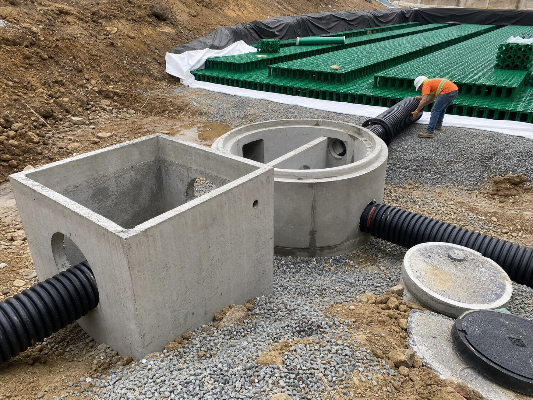
  • An inspection well base and access points, so there is access for inspection and maintenance from the finished surface without excavating it.
  • Storage volume designed to incorporate an allowance for accumulated sediment over the asset’s service life. While it’s the norm to build in this allowance, the size of this accommodation should be determined by the drainage engineer on a site specific basis.
  • A pretreatment stage sized for the catchment, not for the tank. Impervious surfaces such as parking lots and paved areas deliver a pollutant and particulate load beyond the capacity of a bare void.
Upstream silt trap and hydrodynamic separator schematic

What pretreatment is actually for

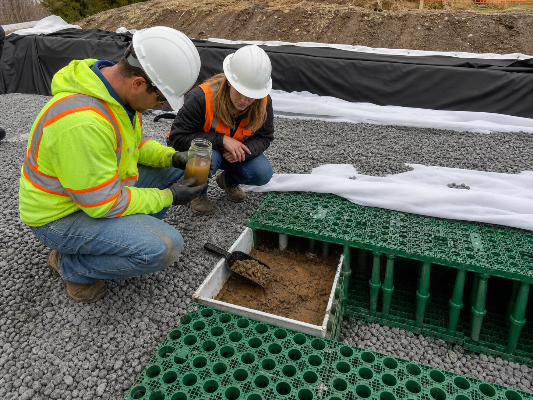
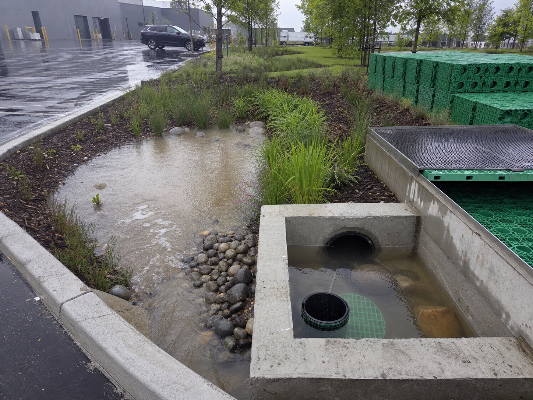
Pretreat the flow and you protect two things at once – both the void that you paid for, and the downstream water into which it goes. There’s normally a silt trap or separator before the tank, there to remove sediment and to remove pollutants before either reaches a place you can’t reach back into.

Skip it and the failure is gradual rather than dramatic. Fines migrate into the module field, the base layer begins to clog, effective storage falls below the design figure, and nobody notices until a severe weather event finds the shortfall.

What a treatment stage adds

A storage void does nothing for water quality on its own. A tank handles quantity; stormwater treatment upstream — a separator, a filter or a vegetated stage — is what actually helps improve water quality before the flow reaches it.

How it protects downstream

All sediment and particulate material that moves past a void ends up in the same surface waters the scheme was designed to protect. Since the regulatory system views these areas as part of the same whole, a storage box usually can’t solve a stormwater management issue in isolation.

Pretreatment water quality protection process

Access is a siting constraint, not a maintenance note

Before the volumes are settled, pose the uncomfortable question: if in twenty years’ time the tank has to be opened up or replaced, can it be? A crate field under a live carriageway and one under a landscaped verge are different assets on that question alone.

Philadelphia’s manual isn’t shy about the cost of operating, outlining that the systems are prone to require “strict adherence to regularly scheduled inspections because the maintenance needs are not easily visible” and involve extra cost for reasons “due to access limitations and Occupational Safety and Health Administration (OSHA) requirements.”

Owner-side paperwork nobody sells you

In the United States, the operation and maintenance (O&M) file is another deliverable apart from the tank and belongs to the owner, not the vendor. EPA lists elements an operation and maintenance plan may include: identification of the parties responsible for maintenance, maintenance schedules, inspection requirements, frequency of inspections, easements or covenants for maintenance, and identification of a funding source.

We supply the tank, the wrap, the connections and the test evidence. Owners aren’t absolved of their own compliance duties, and a supplier who offers to carry them is promising something it cannot deliver.

O&M compliance and owner paperwork breakdown

The Evidence We Can Hand You, With Report Numbers

In September 2024 the American Society of Civil Engineers published a case study about a failed plastic underground detention system installation. This product group, by our read, is probably the most valuable reading published in years and the report is certainly not kind.

What the ASCE case actually found

Just shy of 26,000 cubic feet of storage lay buried under a 94,500-square-foot parking lot, within polypropylene boxes several feet underground (as deep as 9.5 feet of soil was observed, “which was within the upper range of the burial depth reported in the manufacturer’s literature”). Sinking was noticed about four months after the overburden was installed.

Creep reducing buckling resistance over time was the mechanism, the familiar P-delta effect. The result that should alter the way you interpret every crate datasheet, including our own, is this:

“A tank loaded for four months under field conditions is not as strong as a tank loaded for minutes or hours under ideal conditions in a laboratory.”
— ASCE Committee on Claims Reduction and Management, September 2024
Structural analysis of geocellular buckling resistance

So read our own grades correctly

The SG-E20 to SG-H60 grades are all short-term compression grades and not permitted for use as design loads.

As a point of reference, a third party certificate we examined for a similar geocellular product made by another manufacturer gives a short-term vertical value of 340 kN/m², but only allows it to be used for long-term design up to 78.1 kN/m², less than a quarter of the headline value. The certificate states plainly that short-term compression results aren’t to be used to derive design strength directly. It’s no different in our case.

One reservation on our own illustration, however, as we do expect you to measure us against our own yardstick. Our own long-term values were generated by CIRIA C680:2008 – the procedure CIRIA has subsequently advised the industry not to use. Consider the ratio as evidence of how much the headline value drops when you account for creep, not as a procedure to replicate; you still need a C737 calc to find the actual design value against your cover depth.

What we hold, with the report number attached

Test Result Lab / report number What it proves — and what it does not
Vertical compression, SG-H60 No failure at 600 kN/m² Intertek 190702149GZU-001 A high short-term ceiling. A 300 kN load cell reached its limit before the module broke, so this is a sensor-limited run-out, not a failure load. Short-term only.
Lateral compression 186 kN/m² at 23 °C; 179 kN/m² after 40 °C conditioning Intertek, same report Lateral capacity — the plane where geocellular modules are typically weakest.
Top / lateral, SG-M40 468.5 kN/m² top; 121.9 kN/m² lateral SGS-witnessed, XMIN2401000036PL04_EN Independent oversight of a test run at our own laboratory. Witnessed, not an independent lab test — the distinction matters and we make it.
Module, CE marking EN 1852-1 UDEM M.2024.206.C96869 Product conformity for the moulded component.
Geotextile, CE marking EN 15381 CELAB, 2017 Conformity of the wrap, not of the tank.
Geotextile tensile ASTM D4632 TRI Grab tensile performance of the geotextile.

What we do not hold, in the same breath as what we do

  • There is no BS EN 17151 long-term creep report, and without this report we will not provide a signed 50-year allowable design load and will not make a representation to this effect. The 50-year design life we mention in our product data sheets is simply a specification from our product design – it is not an actual or verified life.
  • No BBA, Kiwa or WRc certification.
  • Our vertical figure was calculated using the CIRIA C680:2008 method. This approach is also deprecated by CIRIA themselves; their advice on the former method states “designs should now be based on C737, and the former guidance should no longer be used for this purpose.”

The part that’s true of everyone

The typical life expectancy for adoptable drainage assets ranges from 50 to 120 years and as yet no below-ground modular storage asset has been in the ground long enough to establish it empirically for this purpose. No supplier in this sector, of any nationality — European, North American or Chinese — is able to support that claim based on empirical data. Evidence comes from test method and calculation, or it doesn’t exist at all.

Asset design life calculation and empirical data limitations

How a reviewer checks your submission

Stormwater requirements are set locally even where the test standards are international, so local regulations decide the outcome. A product that meets the requirements of one local authority can still fail the next.

Philadelphia Water, to take one published example, sets a maximum drawdown of 72 hours after the 24-hour storm event, requires positive overflow up to the 100-year, 24-hour storm, and holds subsurface storage ten feet clear of a building or property line. Those are inputs to the stormwater design, not features of the product, and are typical local specifications which will dictate whether a tank can even be considered before the grade is mentioned.

  • A structural best management practice – a structural BMP in US permitting terminology – has to meet stringent structural checks at its installed cover depth, not at a generic one. Selection and monitoring of that practice are the permit holder’s ongoing duty.
  • The asset has to meet environmental conditions set by the permit — drawdown, overflow route, pretreatment — before it counts toward a stormwater management plan.
  • Expectations for the service life of the asset are driven by the adopting authority, not by the supplier. An authority expecting 50-120 year asset life can have that expectation irrespective of the brand of the molded product.
Local stormwater management review process

A gap in the American standards that is worth knowing about

ASTM F2787, F2418 and F2922 define standards for corrugated thermoplastic chambers, and the US Federal Highway Administration still frames underground detention around concrete and corrugated metal pipe. EN 17152-1 covers boxes but belongs to the European system. There is no American standard specific to the testing of moulded cuboid geocellular modules.

Consequently, we don’t claim ASTM compliance for our modules. The honest American route is to provide a structural analysis based on AASHTO LRFD Section 12.12 with project-specific testing, which the evidence pack above is there to support.

American standard testing gap analysis

Where these numbers get used, and where they get misused

The reality is that the reviewing engineer takes the evidence from the report and applies it to a specific case scenario; the first case may be for a car park at 600mm of cover, the second for an HGV yard at 900mm and the third for a landscape bed at ~250mm of cover. Each is a unique case which can’t use the same generic grade number.

Our figures for the lateral compression were tested at 23 °C and again after 40 °C conditioning, as tanks below an industrial yard in the Gulf Coast region don’t experience the same duty as tanks under an industrial yard in the Nordic region. Unlike a headline tonnage, a figure tied to a temperature, an orientation and a report number survives a technical query.

Counter-intuitive, and worth saying plainly

A field of tanks can often fail not because of the strength of the individual boxes, but because of issues with the installation and temporary works, or a misunderstanding of the site ground and ground water conditions according to a recent CIRIA review of geocellular modular systems, which identifies few failures associated with the long term structural integrity of the product.

So the common assumption — that a cheaper module is the risk — points at the wrong thing. A crate field is not always brought down by a weak box. Installation of the module in the trench, backfill and compaction have a higher potential to be the cause of failure than the molded product itself.

Installation and ground condition structural impact

Where These Underground Detention Systems Are Actually Installed

Five reference deployments by site type. All are anonymised at the client’s request and described at class level – we don’t publish project capacities that our own order documents don’t support.

Site type Reference deployment Constraint that drove the design How it was resolved
Industrial / infrastructure Industrial facility, Russian Far East Neither pure infiltration nor pure attenuation; cold-region snowmelt peaks Composite build-up — module void over a stone trench with underdrain, giving collection, filtration and buffering in one structure
Industrial / utility, light duty Northern European site infiltration facility, several-hundred-cubic-metre class Budget-sensitive, low load, moderate burial depth Economy light grade, geotextile wrapped, infiltrating through a granular surround
Commercial & residential Community development, Calgary, Canada Land value — a surface pond consumed developable area and cut across the community layout; long winters High-void modules assembled in a lined excavation as subsurface storage beneath usable ground
Commercial & residential Development site, Brampton, Ontario Constrained footprint against a large required storage volume Modules layered and connected into one continuous subsurface tank, built in zones to hold the programme
New-town infrastructure New town, Middle East — selected packages only Multi-package parallel delivery straining material arrival and installation sequencing Zoned supply and assembly against the package programme, with staged handover

Two things this table doesn’t say

On the Middle East project Storm Manage was one of the subcontracting implementation parties on selected packages. We didn’t deliver that scheme, and any capacity figure published for it belongs to the whole development, not to our scope.

We hold no publishable own-reference project for the highway and car park sector, or for the sports and landscape sector. Both are within our supply range and neither has a reference we can show you today. Filling those two rows with a project from another sector would be the easiest thing on this page to do and the least defensible.

What the spread does evidence

Vladivostok, the Nordics, Alberta and the Gulf are a wide thermal envelope for one moulded component. Our stated working range of −30 °C to 120 °C is consistent with where these underground stormwater tanks have actually been installed and assembled, including through freezing-temperature construction windows.

What that doesn’t prove

A material working range isn’t a cold-climate design. State stormwater guidance for cold regions lists frost depth, frost heave, pipe freezing at the inlet and outlet, reduced infiltration rates, concentrated snowmelt volume and road-salt loading as separate problems, and a module rated to −30 °C solves none of them.

What the deployment spread evidences is that the component survives assembly and service across those temperatures. The cold-climate design work still belongs to your engineer.

Each deployment, and the constraint it had to solve

  • Cold-region industrial application. Snowmelt arrives as a concentrated peak, so the design problem was inflow distribution rather than volume. A stone trench with distribution pipework under the module block did the work a plain crate base couldn’t.
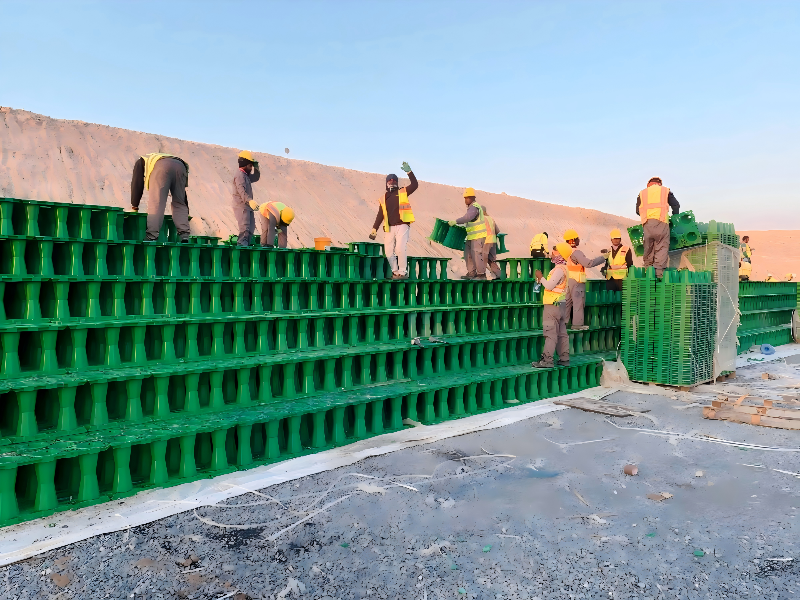
  • Constrained development sites. Where the footprint is fixed and the required storage isn’t, modules were layered and connected into one continuous tank rather than split into separate cells.
  • Freezing construction windows. Assembly in layers let the tank be built in short weather windows, which is a programme risk before it’s a technical one.
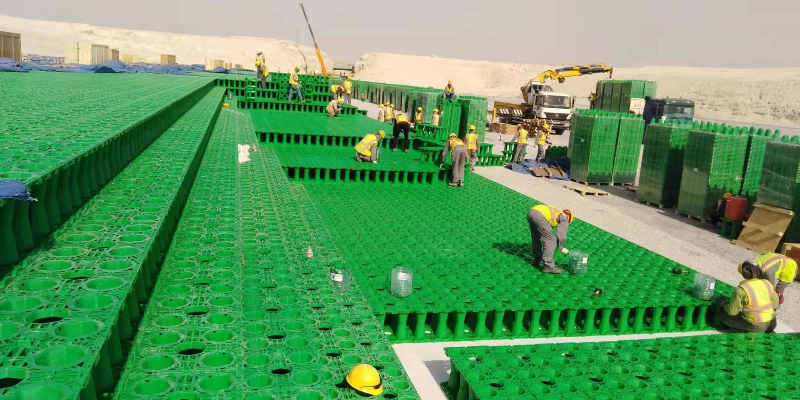
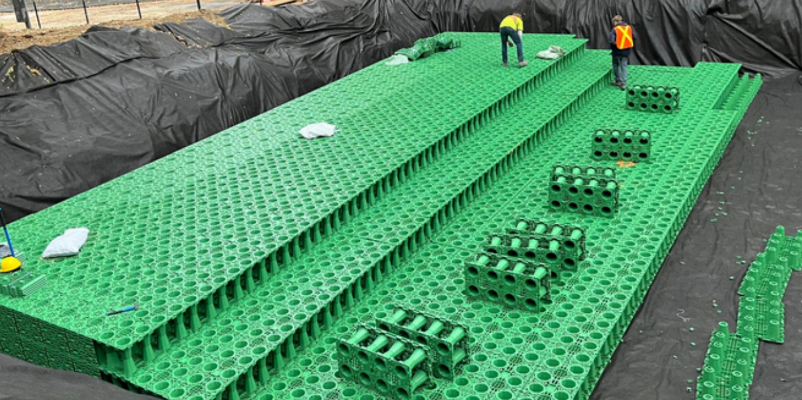
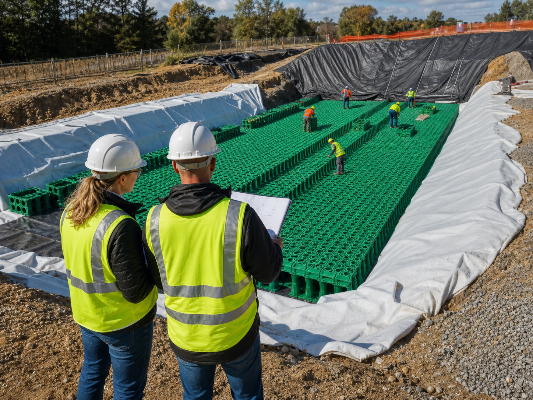
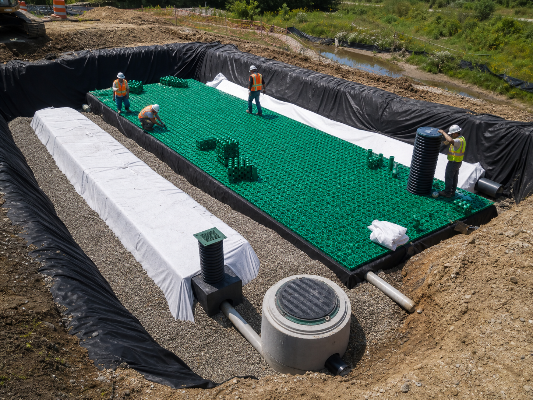
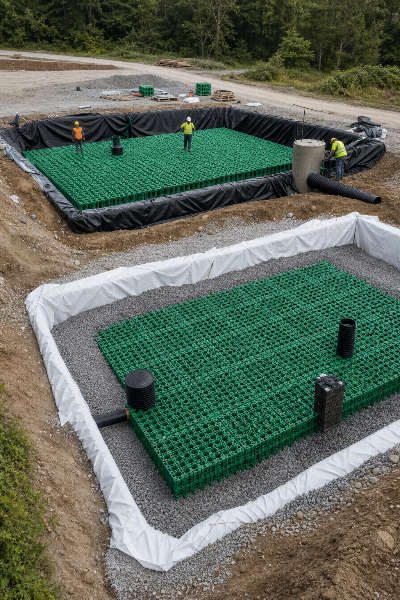
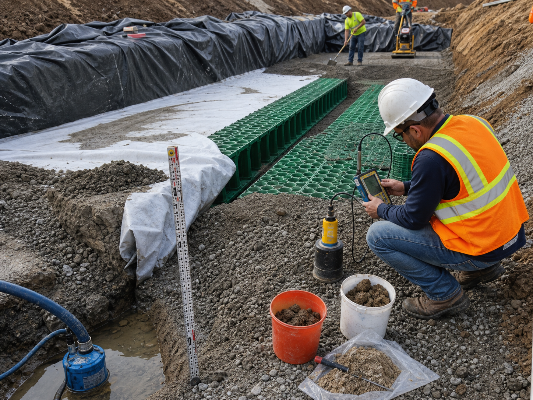
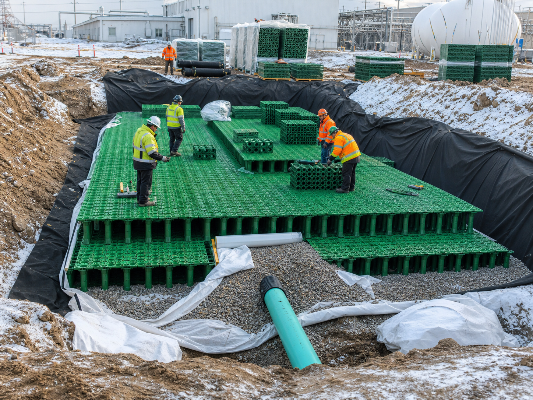
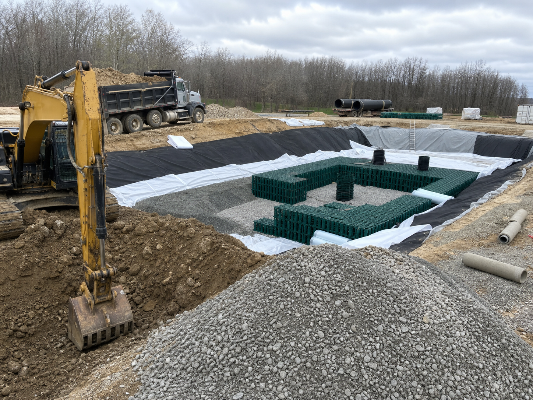
Underground stormwater detention system installation site
Hover to View constraints data

Supply From the Factory: Lead Time, Container Yield, Custom Grades

Storm Manage moulds these modules in its own injection-moulding base in Shenzhen, operating since 2014. Selling factory-direct removes a distributor margin, but the more useful thing it changes is what you can check.

Plant

8,000 m² footprint. Eight injection moulding machines from 1000 T to 2000 T, plus 12 or more mould sets covering the standard, heavy-duty and shallow module variants along with connectors and end caps.

Output

About 5,000 m³ of finished modules per month, and more than 60,000 m³ a year. Production lead time runs 15-30 days after order confirmation, set by grade mix and volume.

Terms

FOB Shenzhen, Yantian or Shekou preferred; Qingdao or Ningbo by project arrangement. OEM and ODM run as SG-Custom – structure, height, plan dimensions, colour, logo and packaging.

Container yield, because storage volume ships as air

Container H500 series H400 series
20′ 132.5 m³ 112 m³
40′ 291.5 m³ 246.4 m³
40’HQ 341 m³ to 356.5 m³ 281.6 m³ to 294.4 m³

What direct supply actually changes

A grade silently substituted after the design was signed is what turns a lead time into a delay on site, and a structural review into a redesign. Buying from the plant that moulds the module doesn’t by itself remove that risk, no trade term does. Incoterms allocate tasks, costs and risks between buyer and seller, and as the International Trade Administration sets out, they don’t address liability for the failure to provide goods in conformity with the contract of sale.

What direct supply does is make the substitution checkable rather than deniable. Ask for the grade and material stated on the packing list and the commercial invoice, ask for a pre-shipment inspection against the specified grade, and ask for the moulding batch to be identified. Those are documents you can hold, which a verbal assurance isn’t.

Direct supply chain documentation and compliance check

On cost, an honest correction to the category’s opening argument

Every competing range in this market opens by arguing that going underground turns land back into developable area. This isn’t always the case and not the only way for this to happen.

Where the money actually goes

“Just the soil haul-off alone added hundreds of thousands of dollars — a cost that was not fully reflected in the original preliminary estimate”, one contractor noted in a cost analysis of an underground detention scheme. In one published US case study a 95% void crate system cost virtually the same as the concrete basin it replaced, for the same basin area.

Modules are rarely the largest line item; the largest cost will typically be the excavation volume, spoil haulage, granular surround and number of truck movements. That’s why we publish cost drivers here and point to where that cost can be properly addressed.

Underground stormwater tank true cost distribution breakdown

Where a modular tank is genuinely the cost-effective option

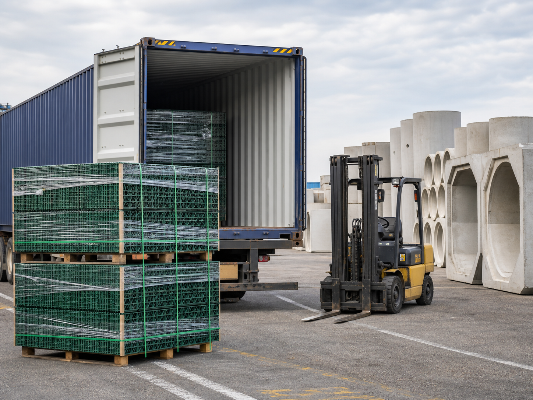
Shipped volume is the real advantage of the modules: they nest and stack, so large storage volumes travel in fewer loads, which matters most where site access is tight or the delivery window is short. Against precast, underground systems of this type are simply cheaper to move.

Against precast concrete the difference in truck movements is substantial; against corrugated steel pipe and other pipe systems the comparison turns on how much granular surround each build-up needs. Underground stormwater detention isn’t automatically cheaper than a surface basin, but a modular tank is usually the cheapest way to get a given void underground.

Give us your required volume, cover depth and traffic class, and we’ll return a load-class specification sheet and an FOB quotation built against those parameters. For a worked cost breakdown, the attenuation tank cost page carries published rate bands and a landed-cost stack.

Cost effective modular tank transport vs precast concrete
Application Hub

System Configuration Tools

Select the appropriate configuration, grade, and terminology for your underground stormwater storage project.

Runoff Destination Router

Route stormwater runoff to the appropriate final destination based on site requirements.

Open Tool

Site Type to Grade & Wrap Selector

Select the correct load grade and wrap configuration for your specific site type.

Open Tool

Market Terminology Translator

Translate and match underground stormwater storage terminology across different regional markets.

Open Tool
System Configuration

Send the volume, the surface and the destination

The costly mistake on a modular storage project isn’t the module price. It’s a grade number that can’t withstand a technical query, or a configuration the adopting authority was never prepared to accept. Both failures happen after the order, and both are avoidable before it.

Send three things, the storage volume, what’s built above the tank, and where the runoff finally goes (that third input follows the destination hierarchy if the scheme is in England) — and you get back a specification written against those parameters rather than a generic datasheet. Production runs 15–30 days after order confirmation, and a 40’HQ carries up to 356.5 m³ of H500 storage, so the same reply also tells you how many containers your volume becomes.

For a car park application that means an SG-M40 or SG-H60 grade against your cover depth; for a landscaped or pitch application, SG-E20 or SG-L30 with the wrap set by your discharge route. Engineering answers change with the site, which is why we would rather quote against your parameters than against a price list.

Specification

A load-class specification sheet written against your cover depth, traffic class and wrap configuration.

Test reports

Intertek and SGS reports, with short-term and long-term values kept apart.

Stated openly

FOB price quote, plus two documents we do not have: A BS EN 17151 long-term creep report, and a BBA, Kiwa or WRc certificate.

Request a Project Spec Sheet & FOB Quote →
Knowledge Base

Frequently Asked Questions