We use the details you submit to review and respond to your project enquiry. Entries are handled in this website’s WordPress database using Fluent Forms; our hosting and email providers may process the submitted details. Other technical providers receive only the data described in our Privacy Policy.
Please do not send passwords, payment-card details, government identification numbers, sensitive personal data, or unnecessary confidential third-party information.
Stormwater detention tank manufacturers are the companies that own the moulds, run the production line and can answer a specification question from their own records, as distinct from the resellers, importers and catalogue sites that use the same word. Vetting them is a documents problem before it is a price problem. Two companies can quote the same storage volume, both call themselves manufacturers, and only one can produce the test data, the drawings and the delivery commitment that a buried asset with a design life of 50 years needs. This guide shows which evidence separates them.
Nothing here ranks brands. We build modular stormwater storage ourselves, so a vendor-authored vendor ranking would be worth nothing to you. What follows instead is the buyer-side screen: the questions, the standard numbers and the paperwork that any supplier can either answer on the spot or cannot answer at all.
Detention, retention or infiltration: what you are actually buying
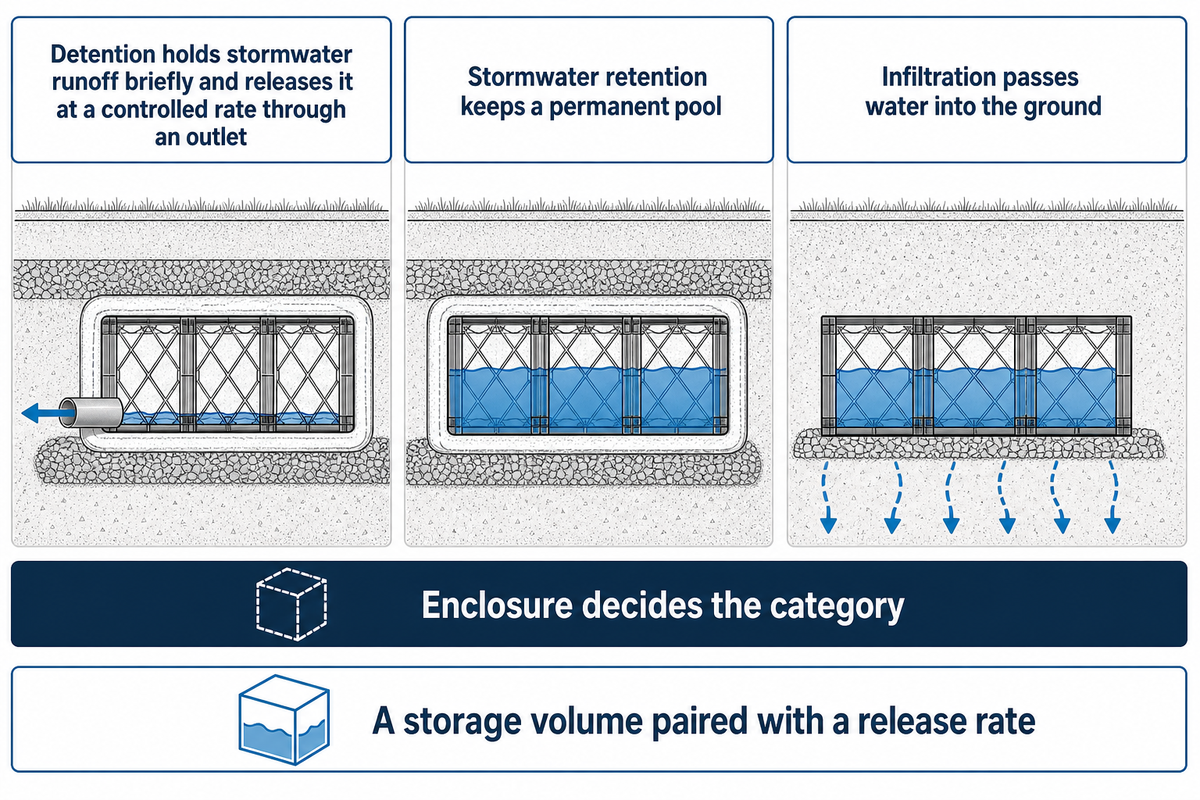
Detention holds stormwater runoff briefly and releases it at a controlled rate through an outlet. Stormwater retention keeps a permanent pool. Infiltration passes water into the ground. Your drainage report has already decided which one you need, and the word it uses is not always the word your supplier uses.
The line between the first and the third is physical, not commercial. Connecticut’s state stormwater manual puts it plainly: underground structures may be used as detention facilities if they are fully enclosed or used with a liner to prevent infiltration or interaction with groundwater, while open-bottom structures or perforated pipe should be designed as underground infiltration systems. Enclosure decides the category. Detention and infiltration systems are not separated by catalogue heading; the same crate becomes one or the other according to whether it is wrapped in an impermeable membrane or in a permeable geotextile.
That distinction governs the stormwater management system scope on your project. If your permit requires you to slowly release a computed volume at a computed rate, you are buying detention and the outlet control is the regulated component. England’s national standards for sustainable drainage put a number on the same idea, requiring that systems half empty their runoff volume within a maximum of 24 hours after a 3% annual exceedance probability event. US practice varies by jurisdiction, and your own local regulations set the equivalent drain-down requirement, but the shape of the constraint is the same everywhere: a storage volume paired with a release rate.
Read your own report for three phrases before you contact anyone. “Attenuation” and “detention” mean the same control function for managing stormwater. “Retention” sometimes means a permanent pool and sometimes, confusingly, means volume removed from the system entirely. “Infiltration” means the surrounding soils take the water, which turns the soil report into a governing document. Getting this wrong costs weeks, because a supplier will quote what you ask for. Start at the stormwater detention tank hub if you need the category map, or at soakaway crate infiltration systems if your report calls for infiltration rather than detention.
Vault, pipe, chamber or crate: four underground stormwater storage types manufacturers sell
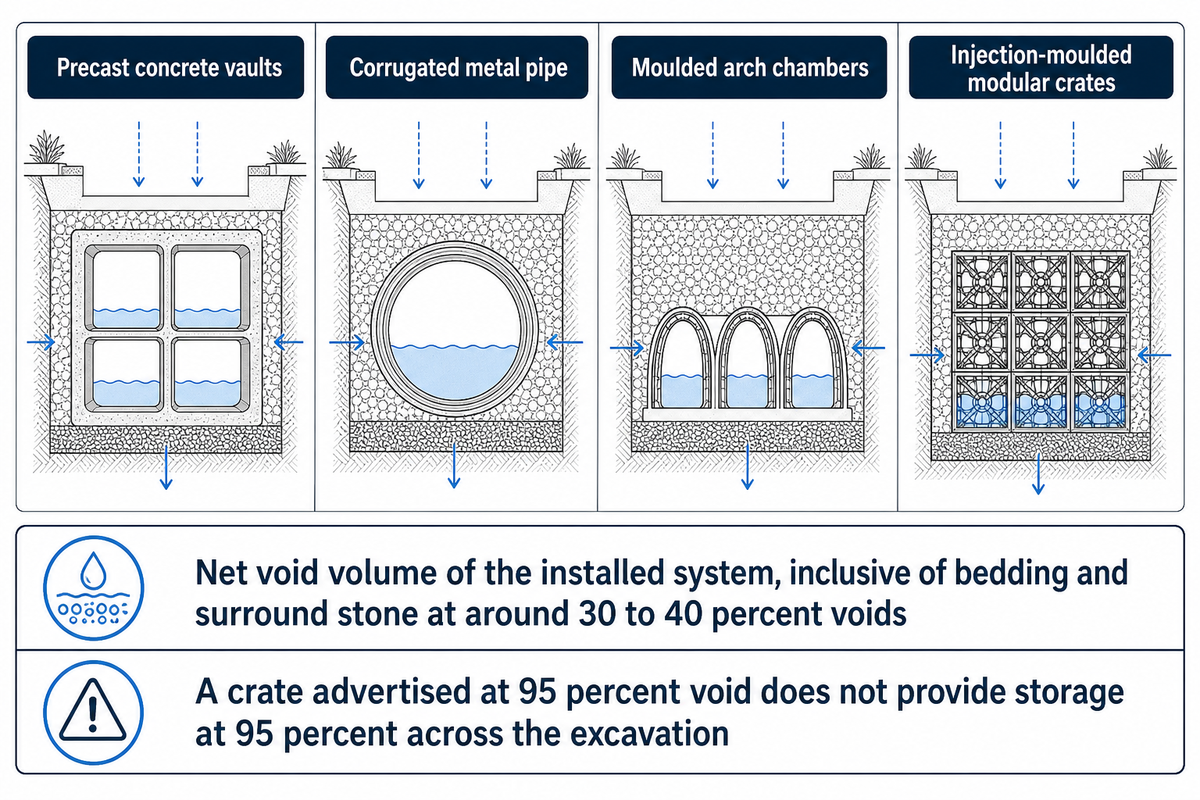
Four construction families dominate underground stormwater storage in the US. They are precast concrete vaults, corrugated metal pipe, moulded arch chambers and injection-moulded modular crates. Buyers call all four stormwater tanks; the trade calls them storage tanks, vaults, chambers or crates depending on who wrote the datasheet. Site depth, cover requirements and excavation footprint usually eliminate two of them before you speak to a single supplier, which also limits who can quote.
Void ratio is the figure people compare, and it is the one most often misinterpreted. Storage volume is not the void of the unit alone. The Federal Highway Administration’s ultra-urban BMP report notes that storage volume for underground detention is controlled by the net void volume of the installed system, inclusive of bedding and surround stone at around 30 to 40 percent voids. A crate advertised at 95 percent void does not provide storage at 95 percent across the excavation, because the stone jacket around it does not share that figure. Ask any supplier to state which of the two numbers their sizing uses.
Material family carries its own service life question. Corrosion behaviour splits the four types sharply, and practising engineers are blunt about it.
Practising engineers in r/civilengineering describe the same split in their own terms: corrugated metal pipe corrodes in coastal soils, arch chambers win on cost in flat coastal areas, and the same pipe is less efficient on storage volume against system footprint, harder to install, and in some cases made to order only against an upfront deposit.
Note the last clause, because it is a procurement condition worth asking about, hiding inside a technical opinion: some build types are made to order against a deposit, so the supplier’s tooling position changes your programme, not only your unit price. Galvanized steel systems bring a zinc-loss calculation. Polyethylene and polypropylene units require a creep calculation. Precast units need crane access and a lifting plan. None of these is a flaw; each is a different question you must ask.
Water storage terminology shifts by market, and the same product answers to several names. The UK term, attenuation tank, and the Australian term, on-site detention (OSD) tank, describe the identical control function.
Residential and above-ground detention: when a smaller system is the right call
Not every site needs a buried system. Aboveground storage on a residential or light commercial plot is cheaper to inspect, cheaper to clean and easier to modify later. Underground storage earns its cost when land values make the surface footprint the binding constraint — which is precisely the trade-off behind the demand shift covered further down. For plot-scale work, see commercial and residential development drainage.
The Detention Supplier Type Map: ten kinds of company that call themselves a manufacturer
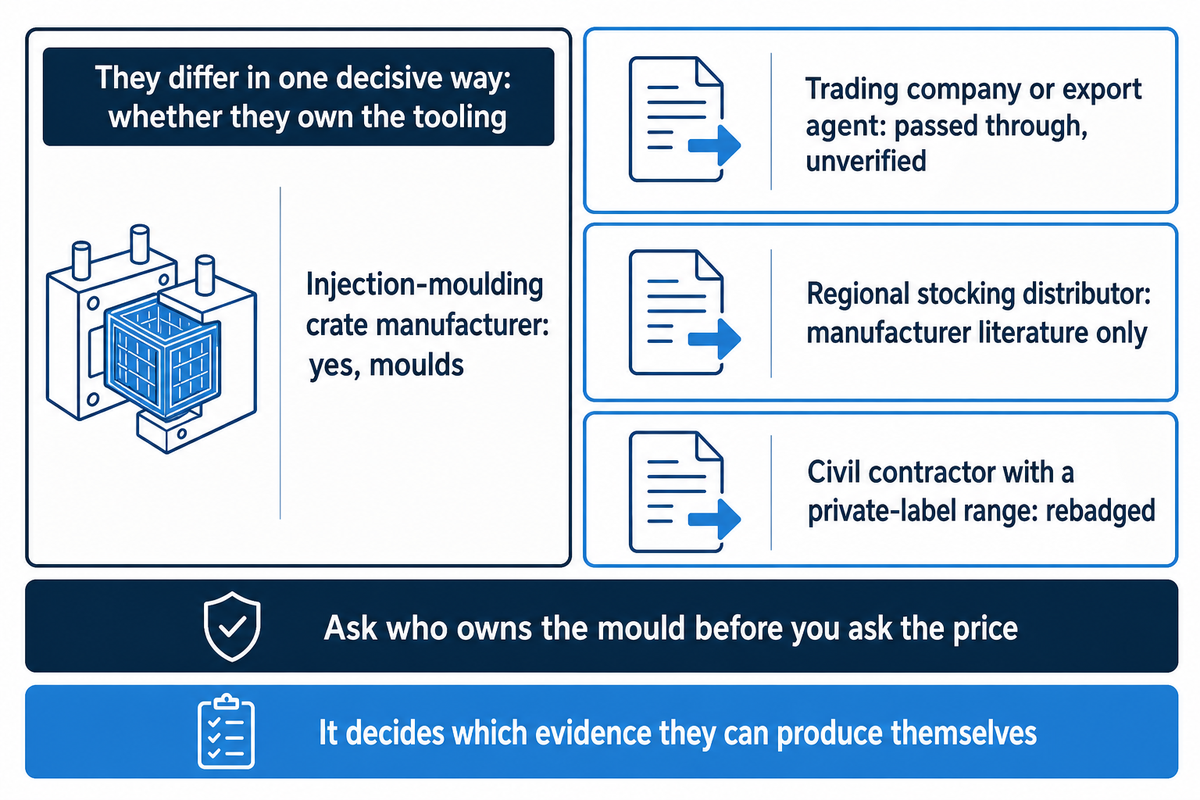
Ten different company types answer to the word “manufacturer” in this category, and they differ in one decisive way: whether they own the tooling. All of them market stormwater management solutions; only some of them make anything. A company that owns moulds can answer a weight-tolerance or material-ratio question from its own records. A company that does not must ask someone else, or guess.
This isn’t a slur on resellers. Federal contracting rules expressly contemplate a qualifying nonmanufacturer supplying another firm’s end product, and distributors that stock stormwater products carry real value in availability, local knowledge and service. Supplier type doesn’t decide whether you may buy from someone. It decides which evidence they can produce themselves, and therefore how long your answer takes and how much of it is second-hand.
The industry’s own equipment association draws that line in its membership rather than in its marketing: its published member directory carries stormwater equipment manufacturers as a membership class of their own. Whether a supplier belongs in that class is a question you can put to it directly, and the answer is checkable.
The Detention Supplier Type Map — what each supplier type can answer from its own records
Supplier type
Owns tooling?
Own test data?
Project drawings?
Cannot produce
Precast concrete vault fabricator
Yes (forms)
Mix designs, cylinder breaks
Yes, shop drawings
Void ratios competitive with modular systems
Corrugated metal pipe fabricator
Yes (mill and roll)
Coating and gauge certificates
Yes
Corrosion life in aggressive soils without a site-specific study
Enclosed detention performance without a separate liner system
HDPE / PP pipe extruder
Yes (dies)
Pipe stiffness and material data
Partial
Modular geometry and stackable storage applications
Trading company or export agent
No
Passed through, unverified
Requested from the factory
Any answer on weight tolerance or resin ratio from its own records
Regional stocking distributor
No
Manufacturer literature only
Vendor-supplied
Change to the product, the tooling or the lead time
Civil contractor with a private-label range
No
Rebadged
Yes, install-focused
Traceability to the moulder behind the label
Used or refurbished equipment reseller
No
None current
No
Any statement of remaining service life
EPC integrator specifying a third party
No
Whatever the vendor gives
Yes, system-level
Control of a product change mid-project
Run any quoting company through the first column and the last. If “who owns the mould making this part?” gets more than one back-and-forth, you’re talking to a reseller, and every technical answer you get thereafter will arrive on someone else’s schedule. Customizable variants — heavy-duty, shallow, connectors, end caps — only exist where tooling exists to make them.
Key takeaway
Ask who owns the mould before you ask the price: only a tooling owner can answer a per-unit weight tolerance or a virgin-versus-recycled resin ratio question from its own records rather than from a supplier’s brochure.
The Supplier Proof Stack: product evidence, project evidence, supply evidence
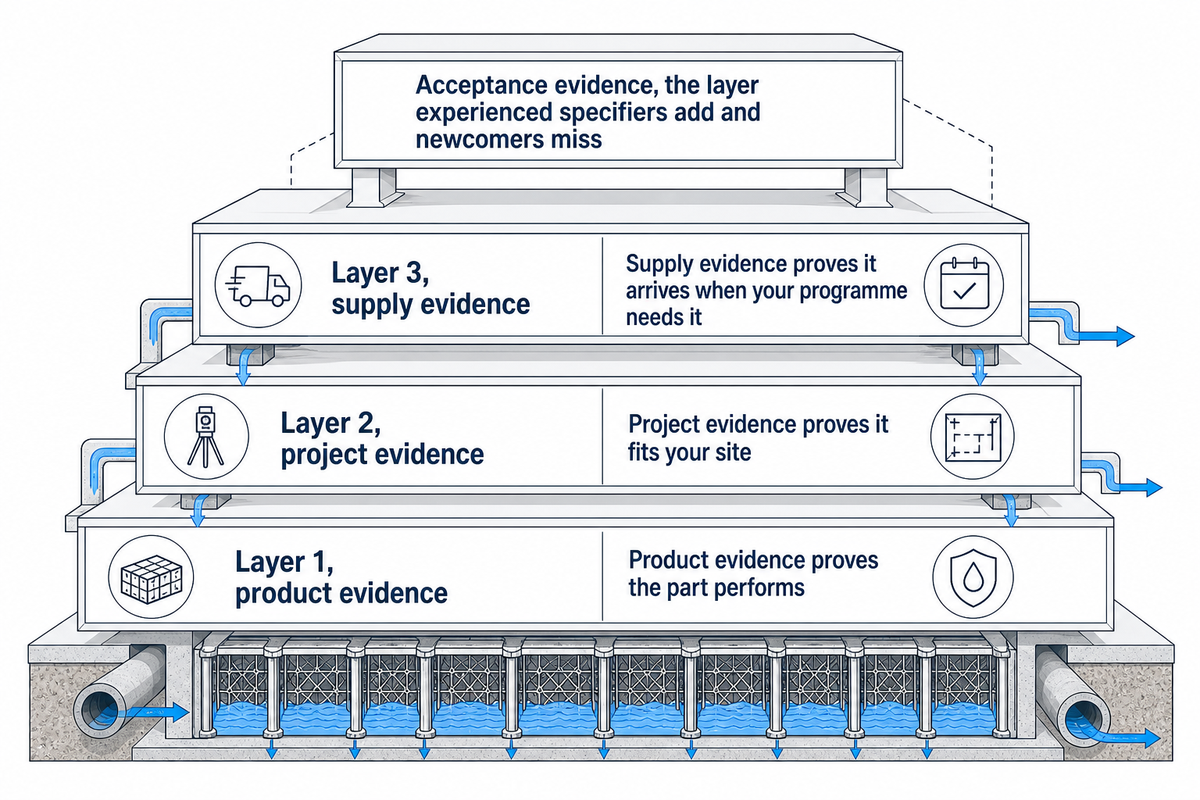
The minimum evidence set has three layers, and most buyers request only the first. Product evidence proves the part performs. Project evidence proves it fits your site. Supply evidence proves it arrives when your programme needs it. A supplier strong in one layer and silent in another is a predictable source of delay.
Layer 1, product evidence. A named compression test standard, a long-term creep figure, a material declaration stating virgin or recycled polypropylene, and a per-unit weight tolerance. The weight tolerance matters more than it looks: for a moulded part, mass is the cheapest available proxy for wall thickness, and wall thickness is what carries load.
Layer 2, project evidence. A stage-storage table, a load-class calculation stated at your cover depth, a layout drawing to your excavation shape, and a connection detail for your inlet and outlet. Generic literature doesn’t satisfy this layer; the deliverable is project-specific by definition.
Layer 3, supply evidence. A stated lead time, container yield, port options, and a written description of the quality control regime. On an imported system this layer decides your programme.
There is a fourth layer, one experienced specifiers add and newcomers miss: acceptance evidence. Many state and municipal agencies maintain approved-product lists or local certification routes, and a product that cannot enter that channel cannot go on that project, however good its test data. Some state agencies run a formal technology evaluation programme with independent reviewers, a quality assurance project plan and a technical evaluation report, which is what regulator-run acceptance looks like at its most structured, though those programmes typically govern treatment technologies rather than detention storage. Find out early which acceptance route applies where you’re building; it has a lead time of its own. Our stormwater project input readiness checklist sets out what to have in hand before the first supplier call.
RFQ checklist — copy these into your quote request:
Parameter
What to ask for
Why it matters
How to verify
Compression strength
Value plus the test standard that produced it
A number with no test named is not a specification
Standard number must appear on the report
Long-term behaviour
Creep figure over the design life, not 90 days
Short-term crush data does not predict 50 years
Extrapolation basis stated
Material declaration
Virgin or recycled polypropylene, with ratio
Resin ratio changes creep and service life
Batch records, not marketing copy
Per-unit weight
Nominal mass and tolerance band
Proxy for wall thickness and load path
Weigh a sample against the stated band
Load class
Rating stated at your cover depth
A rating without a depth is unusable
Calculation shows the depth assumed
Stage-storage
Table for the proposed layout
Your engineer’s model needs it as input
Volumes reconcile with module count
Lead time
Days after order confirmation
Programme input, not a sales estimate
Written into the quotation
Container yield
Installed volume per 40HQ
Dominant delivered-cost driver on imports
Loading plan supports the figure
Decision point: if a supplier answers Layer 1 fully and can’t produce Layer 2 for your specific excavation shape, you’ve found a catalogue seller, not a project partner, and the gap will surface at the worst moment, when the layout is already frozen.
Detention load ratings: a compression number with no test named is not a specification
A datasheet that says 400 kN/m² tells you almost nothing on its own. The question that separates a real specification from a marketing figure is which test produced the number and over what duration, because short-term crush strength and long-term design strength are different measurements taken under different standards.
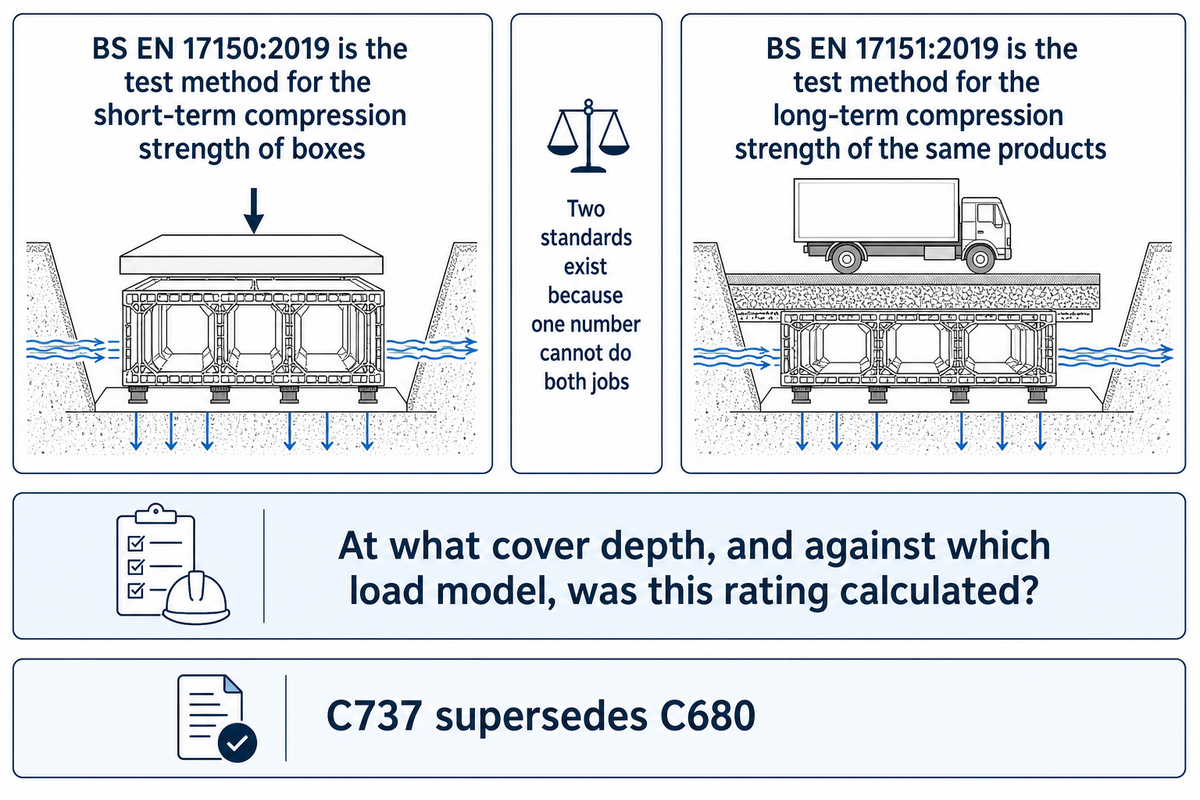
European practice splits them explicitly into two documents. BS EN 17150:2019 is the test method for the short-term compression strength of boxes; BS EN 17151:2019 is the test method for the long-term compression strength of the same products. Two standards exist because one number cannot do both jobs. If a supplier quotes a compression figure and cannot say which of the two produced it, the figure cannot be checked against a 50-year design life.
The consequences are documented. ASCE’s Civil Engineering Source reported a failure investigation in which the manufacturer’s literature gave 0.40% creep at 90 days and nothing at all on long-duration buckling resistance. In that case the installation deviations, including compaction plant far heavier than the stated limit, were held immaterial, and the conclusion that carried was that an unsuitable product had been specified on the strength of short-term laboratory compression data. ASCE also records that the experts disagreed: the claimant’s causation expert considered the construction deviations contributory, while two others held that a correctly installed system should not have failed. That disagreement is the argument for collecting the documents up front. You cannot know in advance which reading of your own failure would prevail.
Industry standards are versioned, and the version matters as much as the test number. With no US standard covering open-cell modular crates, the UK’s CIRIA guidance is the default design method for this product family: C737, Structural and geotechnical design of modular geocellular drainage systems, supersedes C680, and C753, the SuDS Manual, covers the surrounding drainage design. C680 certificates are still in circulation across this category, ours included, which is why the question to ask any supplier — and to ask us — is which edition the certificate was issued against, and whether the test has been re-run to C737. A test performed to C680 is a real test to a real method; what changes is which document your reviewer expects to see named. Separately, ASTM F2418, currently F2418-25, active as of 24 March 2025, is a specification for polypropylene corrugated wall stormwater collection chambers, meaning arch-shaped units. It does not govern open-cell modular crates, so a crate supplier citing it is citing the wrong standard for the product in the box.
Can modular detention tanks carry AASHTO HS-20 and HS-25 traffic loads?
Usually yes, at a stated cover depth, and that qualifier is the whole answer. Every load badge in this category quotes the HS-20 or HS-25 designation, and buyers sometimes hear that as outdated shorthand. It is not, and the reason is historical.
AASHTO replaced the older H-20 S16 designation with HS-20 in 1965, and HS-20 remains in use for load-factor rating of existing structures. The HL-93 model adopted in the 1994 AASHTO LRFD specifications uses that same design truck, axle loads of 8, 32 and 32 kips, roughly 36, 142 and 142 kN, combined with a 0.64 klf design lane load. Keep that separate from the federal gross vehicle weight ceiling of 80 kips, or 40 tons, which limits what a truck may legally weigh rather than what your tank is designed against.
So the badge is not the problem. What the badge does not tell you is the load model applied, whether a lane load was included, and the cover depth the rating was computed at. Ask the supplier: at what cover depth, and against which load model, was this rating calculated? If your site has shallow zones as well as deep ones, ask for the same rating restated at 300 mm and at 600 mm.
Worked example. Say a fire lane crosses your tank and your civil drawing gives 900 mm of cover over the crate. You ask for the load class at 900 mm, not the headline rating. The supplier returns a calculation showing HS-20 wheel loads distributed through 900 mm of compacted fill plus the lane load, with the governing compression figure taken from the long-term standard rather than the short-term one. You now have three checkable things: the depth matches your drawing, the load model matches your traffic case, and the strength figure matches the design life. If any one of the three is absent, the rating is not yet a specification for your site. For load-class context see highway and car park drainage load classes or work through the US load class model selector.
What detention suppliers publish — and what they leave out
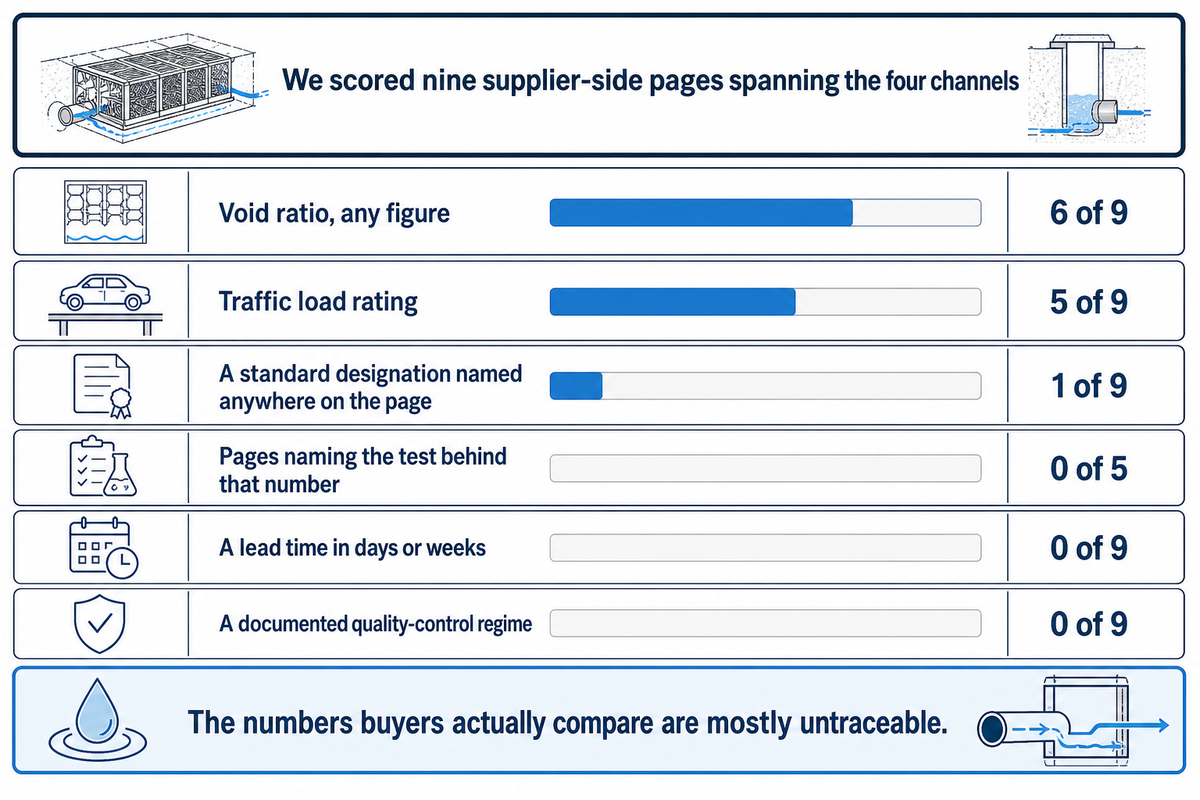
We audited what supplier-side pages in this category actually disclose. On the measurement date we scored nine supplier-side pages spanning the four channels a US specifier meets — national manufacturer, distributor, regional installer and specifier-facing catalogue — plus our own page, against one identical list of evidence items. This is a census of nine named pages, not a sample of the industry.
No vendor is named, linked or cited here and the counts are anonymised. One of the nine is our own page. It’s counted in every column below, and we say plainly where it’s the exception rather than quietly lifting it out of the frame.
The Vendor Disclosure Audit — nine supplier-side pages scored 2026-08-21, our own page included in the totals
Evidence item
Pages publishing it
What to ask when it is missing
Void ratio, any figure
6 of 9
Net installed void including the stone surround, not unit void
Traffic load rating
5 of 9
The rating restated at your cover depth
A void ratio, a load rating, or both
6 of 9
Both, since they answer different questions
A standard designation named anywhere on the page
1 of 9
Which standard, by number and edition
Of the five non-client pages carrying a load or void number: pages naming the test behind that number
0 of 5
Which test produced this specific figure
A design-life figure
4 of 9
The basis for the figure, not the figure alone
A design life tied to a named long-term test method
1 of 9
The long-term standard, not the short-term one
Material declaration
5 of 9
Resin ratio as a percentage, virgin against recycled
A lead time in days or weeks
0 of 9
Days after order confirmation, written into the quote
A documented quality-control regime
0 of 9
What is measured per batch, and against what tolerance
Warranty terms
1 of 9, scope not published
What the warranty covers and what voids it
Two different void figures for one product on one page
2 of 9
Which of the two the sizing calculation used
Read rows four and five together, and do not let anyone merge them into a single number. At page level, one page in nine names a standard designation anywhere — and that page is ours. At claim level, of the five other pages that publish a load rating or a void ratio, not one names the test that produced that particular figure. The first count says designations are rare. The second says the numbers buyers actually compare are mostly untraceable. Neither count says manufacturers hold no test data.
That distinction carries the whole section. This audit measures what’s published on a public product page, not what sits in a supplier’s files. A company may hold excellent long-term test data and never post a line of it, which is why the question belongs in your RFQ rather than in your browser. Several of the gaps are industry-wide rather than red flags: no page in the sample published a lead time, and none published a quality-control regime. Treat a missing figure as a question to ask, and treat an evasive answer to that question as the signal.
Second finding: the same product, two answers, depending on which seller you read. A national distributor’s page publishes one crate line at 12 in to 10 ft of cover, about 300 mm to 3.0 m; a regional installer’s page publishes the same line at 6 in to 16 ft, about 150 mm to 4.9 m. Void ratio diverges the same way: the same line appears at 95% on one page and at 90% on the other, and one of the two publishes both figures for that line on the same page. Neither seller is lying. Both are publishing their own summary of one manufacturer’s data, and underground chamber lines move through regional representatives rather than direct sale, so the summary you read depends on who typed it. Normalising the numbers is a buyer task, and it can’t be delegated to whichever page ranked first.
Decision point: ask which test produced the number, then ask at what cover depth it holds. A supplier who answers both from their own records is a different counterparty from one who forwards a brochure.
Storage capacity, catchment and hydraulics: what the manufacturer owes your engineer
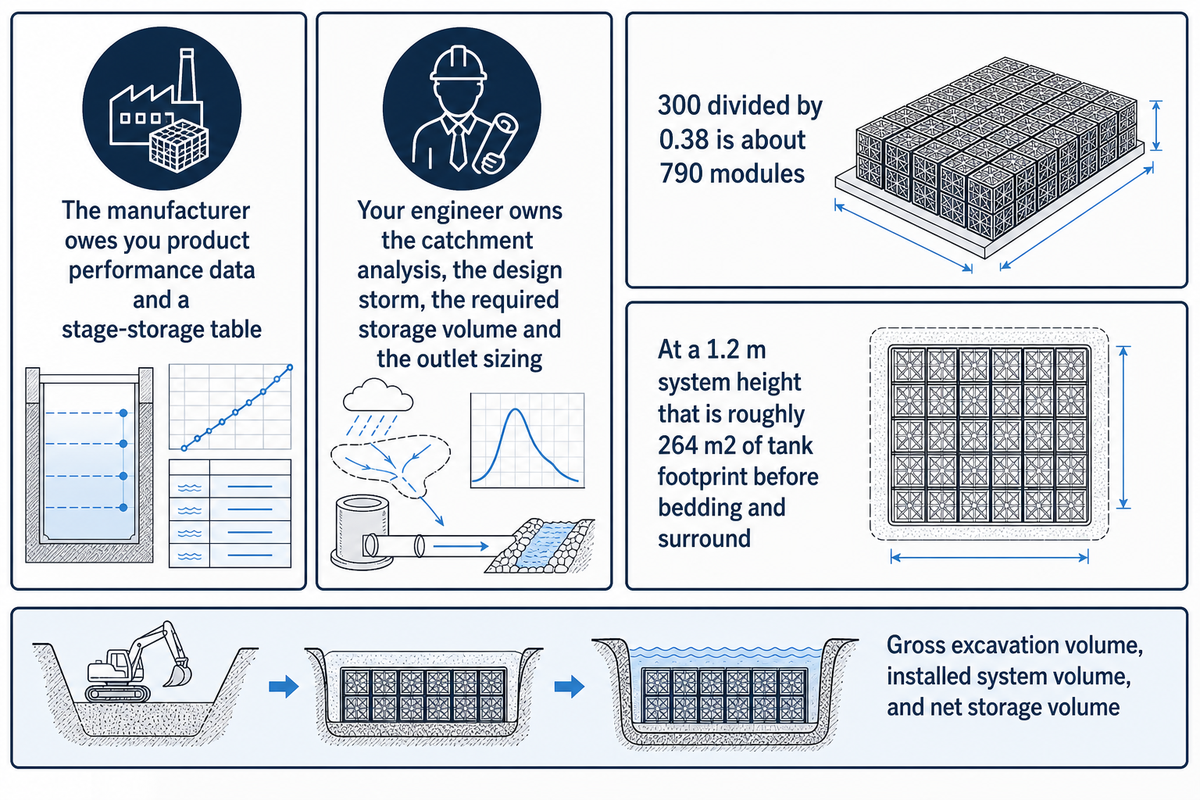
The manufacturer owes you product performance data and a stage-storage table showing how the units store stormwater runoff in the proposed layout. Your engineer owns the catchment analysis, the design storm, the required storage volume and the outlet sizing. Confusing the two is the most common scope gap in an underground stormwater storage RFQ.
Three volumes get used interchangeably and aren’t the same: gross excavation volume, installed system volume, and net storage volume. Outlet control is where the regulated performance lives; Philadelphia’s stormwater manual lists meeting drain-down time requirements and controlling the discharge rate among the functions of outlet controls within a subsurface detention system. Local ordinances set the numbers, keyed to a design rainfall event, and plenty of them are more stringent than the state minimum. Heyworth, Illinois, for instance, requires 9,100 cubic feet of detention storage per acre, about 258 m³, at a release rate of 0.90 cfs per acre for tributary areas up to 2 acres, reducing to 6,200 cubic feet per acre, about 176 m³, at 0.60 cfs per acre at 5 acres. Those figures are that municipality’s, not a national rule, and yours will differ, but they show the form the requirement takes.
Worked example. Your engineer computes 300 m³ of required storage. A crate module of 0.4 m³ gross at 95 percent void gives 0.38 m³ of storage each, so 300 ÷ 0.38 ≈ 790 modules. At a 1.2 m system height that’s roughly 264 m² of tank footprint before bedding and surround. Now apply the caution from the build-type section: if your sizing must use net installed void including the stone jacket rather than unit void, the module count and the footprint both rise. Ask which basis the supplier’s number uses, then substitute your own volume and module size. The footprint arithmetic itself lives in the void ratio footprint comparator, and full sizing methodology and budget modelling sit in the stormwater detention tank cost and sizing guide; this section defines only who owes what.
Do manufacturers provide stage-storage tables with detention designs?
Reputable ones do, per project, once the layout is fixed. What they can’t provide is the design storm or the catchment areas; those come from your engineer’s hydrological model, whether that runs in HydroCAD stormwater modeling system or another package, and the manufacturer’s table is an input to it rather than a substitute for it. Ask for the table in CAD as well as PDF so your engineer can place it.
Groundwater, buoyant forces and backfill: the site conditions that disqualify a supplier
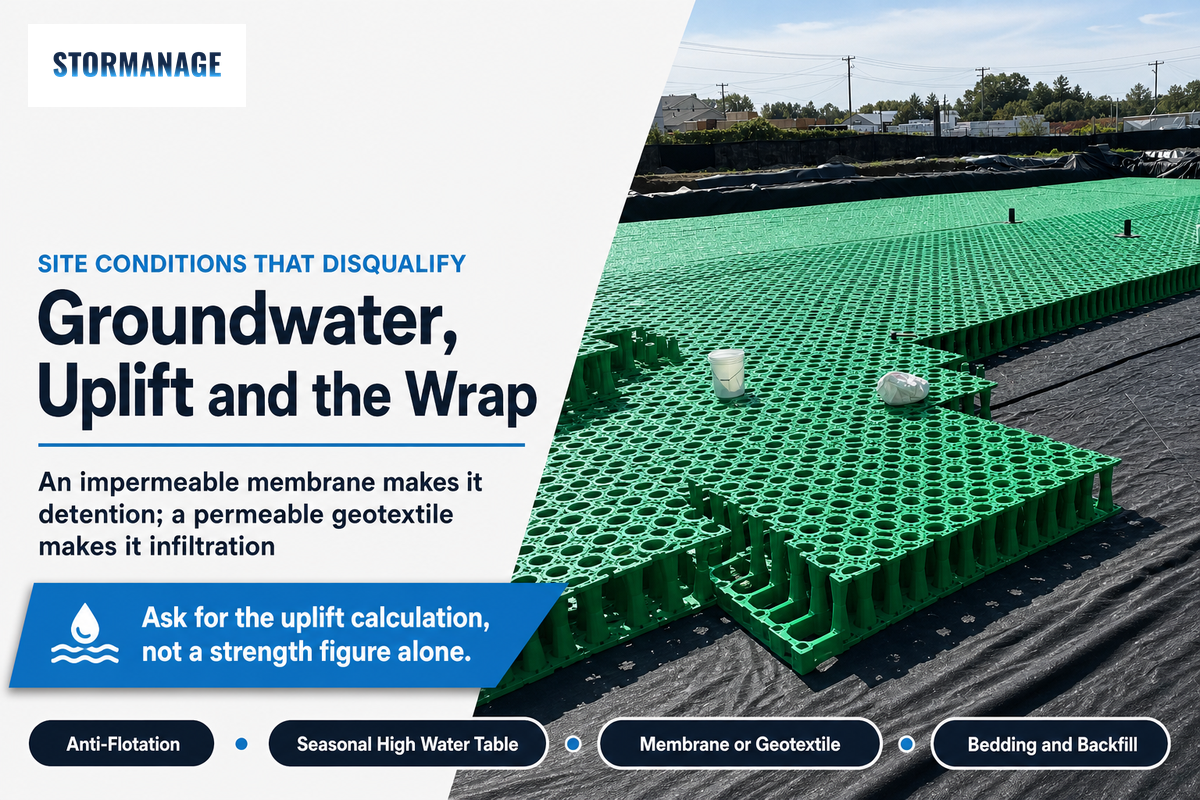
A high ground water table turns an empty tank into a buoyant body. If groundwater can reach the system, the supplier must produce an uplift calculation and a wrap specification for your ground conditions, not a strength figure alone. Suppliers who cannot do this are not wrong for every site; they are wrong for yours.
Some jurisdictions prescribe the calculation. Delaware’s post-construction standards require, for watertight underground detention facilities, an anti-flotation analysis in high water table areas, and state that anchors shall be designed to counter the pipe and structure buoyancy by at least a 1.2 factor of safety. That safety factor is Delaware law, not a national norm — do not carry the number to another state — but it shows that resisting buoyant forces can be a regulated computation rather than a supplier preference. Delaware also separates the two design cases directly: non-watertight facilities must sit no lower than the seasonal high water table, while watertight ones get the anchor calculation.
The wrap choice follows the same logic as the category decision in the first section. Impermeable geomembranes make the unit detention and keep groundwater out; permeable geotextile makes it infiltration and lets the surrounding soils participate. Backfill materials and compaction are specification lines, not site preferences; regional standard details govern bedding, backfill and minimum cover under vehicular loading. Contaminated ground and karst geology each add a screening step before any product is selected.
What separation is required between groundwater and the tank invert?
The required separation is set locally and is a permit condition, not a product property. Delaware’s rule for non-watertight facilities is the seasonal high water table itself, and two feet, about 600 mm, above bedrock. Your local regulatory manual will state the equivalent figure.
Get it before your engineer draws the layout, because raising a tank late in design usually costs storage volume you then have to find elsewhere on the site.
Cost, container yield and lead time: normalising two quotes that look nothing alike
Two quotes for the same storage volume differ mostly because they include different things. Normalise both to cost per cubic metre of installed storage, then list what sits outside the tank price: wrap, connectors, freight, excavation, backfill and install labour. Only then are you comparing suppliers rather than comparing scopes.
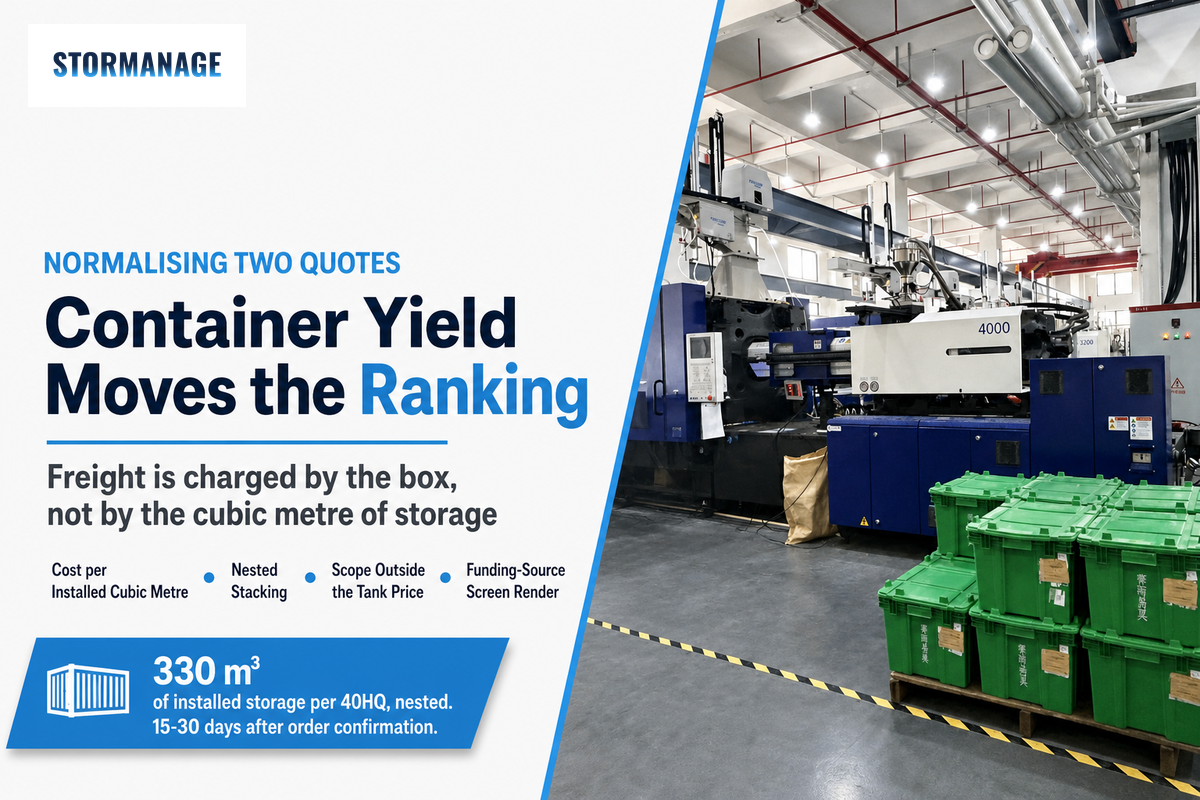
On an imported modular system, container yield is the dominant delivered-cost driver, more than unit price, because freight is charged by the box and not by the cubic metre of storage. Nested stacking is what converts one into the other.
330 m³our installed storage per 40HQ, nested
15–30 daysour lead time after order confirmation
Worked example. Take the 300 m³ requirement from the previous section. At 330 m³ of installed storage per 40HQ container, that project ships in a single container. Halve that yield — an illustrative figure for a non-nesting product, not a measured one — and the same project needs two containers, so the freight line doubles while the storage delivered stays identical. Run your own volume against each supplier’s stated yield before comparing unit prices; on export projects this single division changes the ranking more often than the price per module does.
Price bands published by suppliers themselves circulate widely for this category, generally in the region of $8.50 to $17.00 per cubic foot installed. Treat them as directional only: no public authority publishes installed-cost data for this category, and the sources quoting these bands largely cite one another rather than an independent survey, so the range indicates order of magnitude and nothing finer. A cost-effective outcome comes from normalising the scope, not from the lowest headline number.
One procurement screen belongs at the front of this section rather than the back. If any part of your project is federally assisted — for example through a state revolving fund — federal domestic-sourcing conditions may apply to the materials you install, and that can constrain your supplier list before any technical criterion does. Privately funded commercial and residential development is generally unaffected. Establish which category your funding falls into before you shortlist, because discovering it later invalidates the shortlist rather than adjusting it.
Decision point: normalise to installed cubic metres, then divide by container yield. On imported systems the second division moves the ranking more often than the first.
Maintenance and access: the ten-year question nobody asks at RFQ
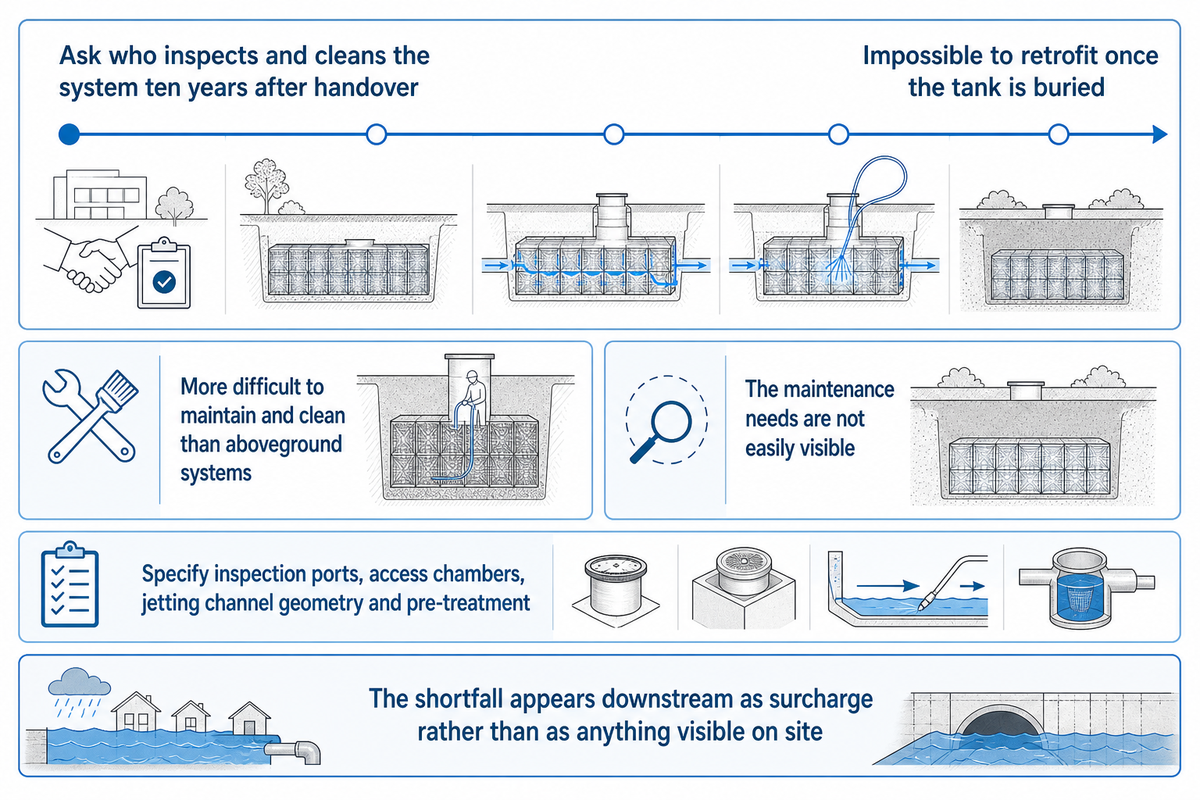
Ask who inspects and cleans the system ten years after handover, and whether the layout allows it. Access provisions cost almost nothing to add while the drawing is open and are impossible to retrofit once the tank is buried. This is the criterion that most reliably separates suppliers, and it is the one least often raised at quotation stage.
The difficulty is well documented and it is structural, not a product defect. The US EPA’s storm water technology fact sheet on on-site underground retention and detention (EPA 832-F-01-005, published 2001) states flatly that these systems are more difficult to maintain and clean than aboveground systems. That document is a quarter of a century old, so treat it as the origin of the observation rather than as current guidance. The current-practice weight sits on Philadelphia’s manual, which explains why in operating terms: subsurface practices require strict adherence to regularly scheduled inspections because the maintenance needs are not easily visible, and they carry additional maintenance costs due to access limitations and Occupational Safety and Health Administration requirements. The same manual notes that vaults can be periodically cleaned by vacuum, whereas removing accumulated sediment from stone and grid storage systems is much more difficult.
Neglect has a specific failure signature. Sediment and debris accumulate until available storage no longer meets the permitted detention volume, and the shortfall appears downstream as surcharge rather than as anything visible on site, so the system is out of compliance long before anyone notices. In the worst cases the first visible sign is structural: a stormwater maintenance contractor’s published case account from Springfield, Virginia describes a parking lot sinkhole that ended in full reconstruction of the detention system rather than a local repair.
Do not assume newer approaches are cheaper to keep. A master’s thesis on low impact development maintenance costs reports that the common assumption that these systems cost less to maintain than conventional stormwater systems had not been demonstrated across the installations observed. Specify inspection ports, access chambers, jetting channel geometry and pre-treatment, and ask the supplier to mark them on the layout. Where reuse is part of the brief, a rainwater harvesting system reuse options arrangement changes the pre-treatment requirement rather than removing it, because harvesting for non-potable water supply adds filtration duties of its own.
What is changing in US stormwater storage procurement
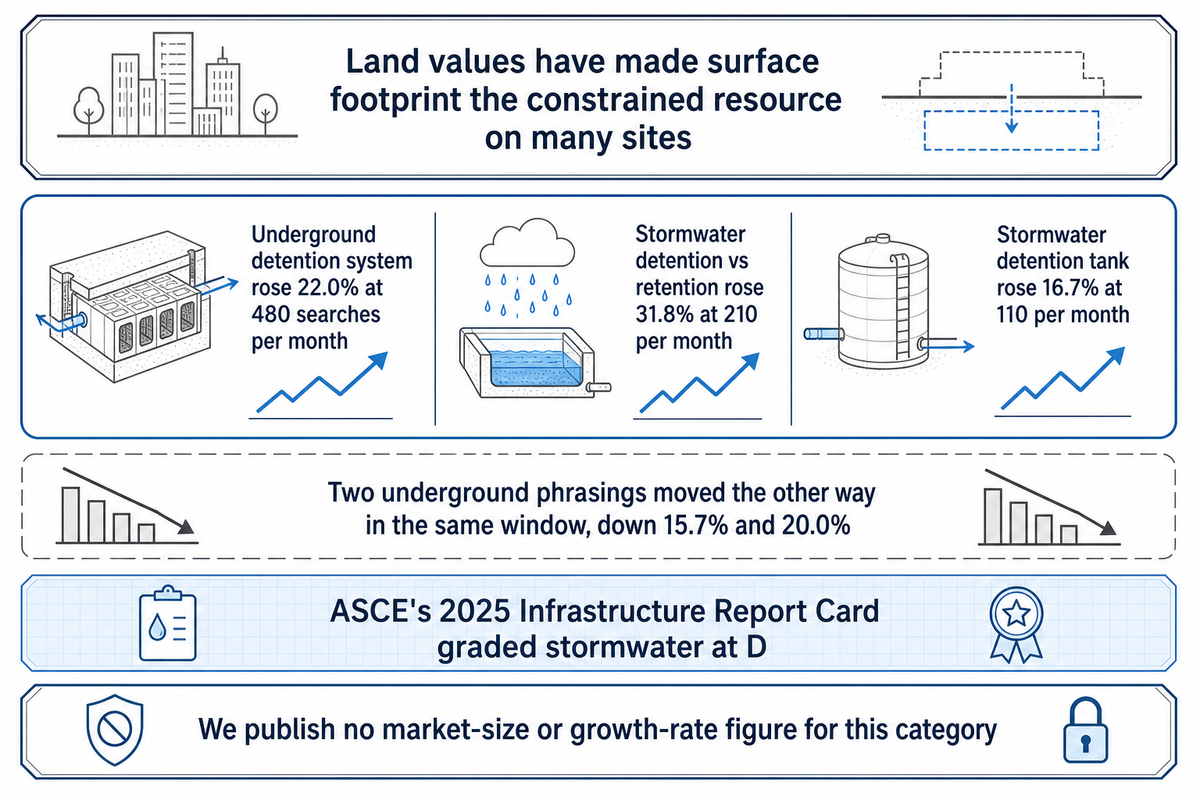
The change that matters to a buyer is not volume growth; it is that land values have made surface footprint the constrained resource on many sites, which pushes storage underground. That shift changes what you must verify, because a pond has no manufacturer to audit while an underground system does. Selecting the supplier becomes part of the design risk.
Regulatory calendars, being redrawn around more severe weather, are pushing the same way. New Jersey required municipalities to update local stormwater control ordinances by 16 July 2024, with modeling criteria that result in smaller stormwater BMPs and therefore maximise developable area on a site. At the federal level, EPA has proposed the 2026 Multi-Sector General Permit to replace the 2021 MSGP for industrial stormwater discharges, a permit cycle worth tracking if your site falls under it. Condition data points the same direction: ASCE’s 2025 Infrastructure Report Card graded stormwater at D, and reports that the 20-year need for large stormwater systems in EPA’s 2022 Clean Watersheds Needs Survey rose to $115.3 billion from $23.8 billion in 2012. Manual editions move on a calendar of their own as well: King County’s Surface Water Design Manual, for instance, runs on the 2021 edition as amended in 2024, so confirm which edition governs the review where you are building before you order, because the acceptance route rather than the datasheet decides what a reviewer will sign.
Our own demand measurement covers the underground half of that picture, and it is rising. Comparing the 6 months to July 2026 against the prior 6 months, measured 21 August 2026: underground detention system rose 22.0% at 480 searches per month; three phrasings in the underground storage and detention cluster rose 49.1% each at 210 per month; stormwater detention vs retention rose 31.8% at 210 per month; stormwater detention tank rose 16.7% at 110 per month. Two underground phrasings moved the other way in the same window, down 15.7% and 20.0%, so the cluster is not uniformly rising. The series measures the underground cluster only and says nothing about ponds. We publish no market-size or growth-rate figure for this category: the available reports disagree by more than an order of magnitude, and a number we can’t stand behind is worse than no number.
What to do differently at shortlist stage: add the acceptance route and the funding-source check to your first screening call, alongside the technical questions. Both can eliminate a supplier for reasons no datasheet reveals, and both take weeks to resolve if you find them late. Where the site must also meet low impact development targets, see LID and EPA BMP compliance requirements for the regulatory framing.
Frequently asked questions (FAQs)
What is the difference between a stormwater detention tank and a retention tank?
A detention tank holds runoff temporarily and releases it at a controlled rate, ending empty between storms. A retention tank holds a permanent volume of water. Detention is defined by its release rate and drain-down time, while retention is defined by the volume it keeps.
The practical consequence is at the outlet: on a detention system the outlet control is the regulated component. Detention and retention are sometimes combined in one facility, but they remain separate functions with separate outlets, and your drainage report decides which one your permit requires.
What are stormwater detention tanks made of?
Four material families dominate: precast concrete for vaults, galvanized or coated steel for corrugated metal pipe, and polypropylene or polyethylene for moulded arch chambers and modular crates. Plastic systems are specified in virgin or recycled resin, and the ratio matters because it affects creep behaviour over the design life.
Ask for the material declaration as a percentage rather than as a description, and treat the unit as a structural water tank carrying soil and traffic load rather than as a plumbing vessel.
How do I verify a stormwater detention tank manufacturer’s load rating?
Ask for the rating restated at your cover depth, together with the load model used and the compression figure it relies on. An HS-20 or HS-25 designation names the AASHTO truck configuration assumed; it does not tell you the cover depth or whether a lane load was included. Then check that the governing strength figure comes from a long-term compression standard rather than a short-term crush test, since only the former speaks to a service life of 50 years.
Is geotextile fabric required around a detention tank?
Usually yes for permeable wraps, but the wrap type is the real decision: geotextile lets water pass into surrounding soils, while an impermeable geomembrane keeps it in and keeps groundwater out. Which one you need follows from the drainage report, not from the catalogue.
Infiltration needs the permeable wrap; a detention system that has to stay watertight needs the membrane, and the supplier should state which one is on the layout drawing.
Can a detention system be installed under a fire lane or crane path?
Yes, if the supplier produces a load calculation at the cover depth you actually have and the design accounts for the specific loading case. Fire lanes and crane paths are governed by different load patterns than car parks — a crane outrigger applies a concentrated point load that no highway truck designation covers. If the answer arrives as a datasheet rather than a calculation, it has not answered the question.
Give the supplier the loading case in writing rather than asking whether the product is rated for traffic, and require the calculation showing how the load distributes through your cover depth to the units below.
Do detention tanks need washing out twice a year?
Frequency depends on the sediment load reaching the system and on what pre-treatment is installed, so no universal interval applies. Inspection, however, should be scheduled regardless, because sediment accumulation reduces storage capacity invisibly and the shortfall shows up downstream rather than on site.
How long does manufacturing and delivery take for an imported modular detention system?
Our standard lead time is 15 to 30 days after order confirmation, plus sea freight to your port. Container yield governs how many boxes ship: a 40HQ, roughly 12 m of internal length, carries up to 330 m³ of installed storage volume when the modules nest.
Ask any importing supplier for the lead time and the container yield in writing, because together they determine your programme far more than the unit price does.
Conclusion: where to go next
Run your shortlist through the three-layer Proof Stack and the tooling question from the Type Map. If a supplier answers all three layers for your specific site — lead time and container yield included — you have a manufacturer. If they answer only the first, you have a catalogue.
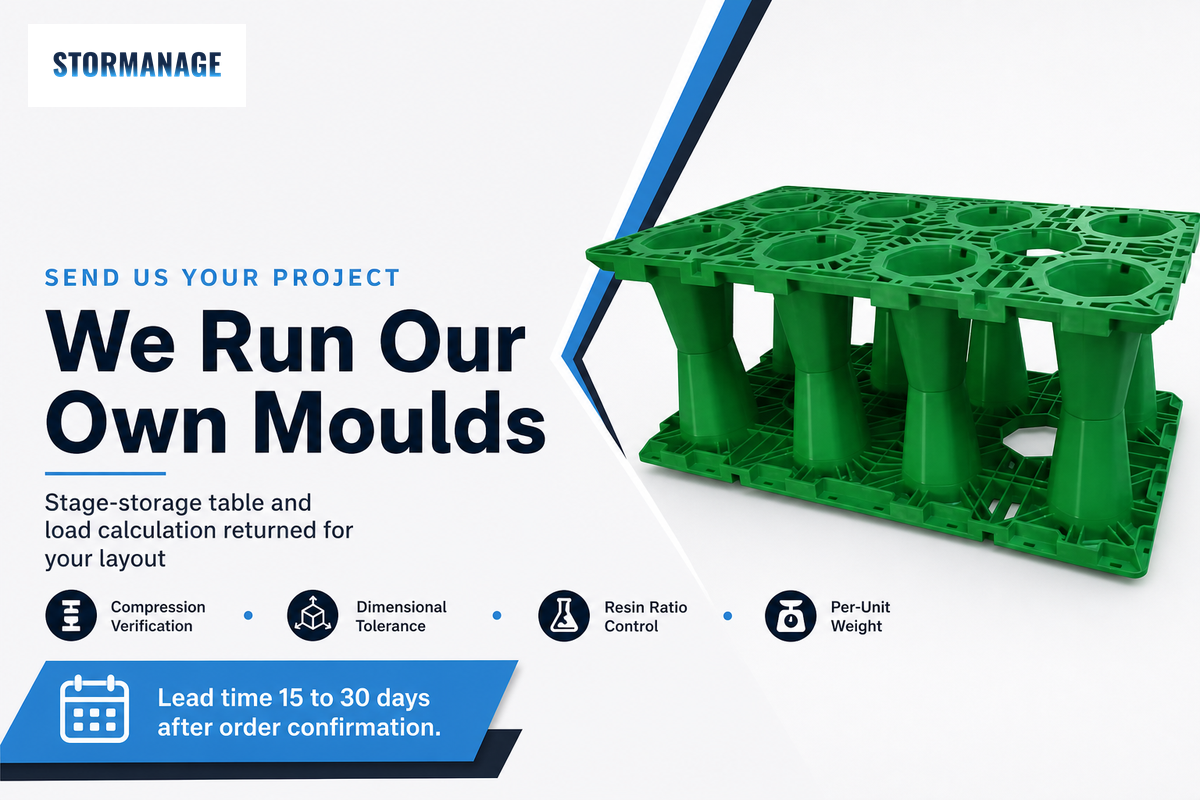
The two columns where no page in the sample scores — a lead time and a documented quality-control regime — are the two we are publishing here: compression performance verification, dimensional tolerance checks, virgin and recycled polypropylene ratio control and per-unit weight consistency, with a lead time of 15 to 30 days after order confirmation. We run our own moulds, in standard, heavy-duty, shallow-crate, connector, end-cap and accessory tooling, so the answers come from our records rather than from someone else’s brochure. Send us your stormwater management needs — required storage volume, cover depth and traffic case — and we will return the stage-storage table and load calculation for your layout: request your stage-storage table and load calculation.
Prepared by the Storm Manage technical team from our own production records and the public sources listed above. Production, quality control and logistics figures are our own first-party data and are labelled as such. Demand figures are our own measurement, with the window and measurement date stated in text.


![Stormwater Detention Tank Manufacturers [2026 Vetting Guide]](https://stormmanage.com/wp-content/uploads/2026/08/stormwater-detention-tank-manufacturers-featured.png)




![Stormwater Detention Tank Manufacturers [2026 Vetting Guide]](https://stormmanage.com/wp-content/uploads/2026/08/stormwater-detention-tank-manufacturers-featured-150x150.png)