We use the details you submit to review and respond to your project enquiry. Entries are handled in this website’s WordPress database using Fluent Forms; our hosting and email providers may process the submitted details. Other technical providers receive only the data described in our Privacy Policy.
Please do not send passwords, payment-card details, government identification numbers, sensitive personal data, or unnecessary confidential third-party information.
Harris County Stormwater Detention Requirements: 3 Checks
Harris County stormwater detention requirements begin with a parcel’s permitting jurisdiction and receiving drainage system. Identify the applicable calculation method, the required live storage and allowable release prior to selecting a tank. An oversized subsurface system can quickly consume the construction budget and leave the original outfall problem unresolved.
By XCX · Updated October 2026
Design-to-order inputs
Area basis: acres · Detention storage: acre-feet or ft³ · Discharge: ft³/s · Surveyed elevations: one common datum · Product capacity: litres per module.
Harris County detention requirements incorporate the jurisdiction, storage and discharge. County review-form options, at various outfall-based rates, exist; final design volume also needs to meet the requirements of the applicable hydraulic analysis.
Key takeaways
A minimum-volume calculation can be smaller than the storage needed to satisfy allowable discharge.
Water-quality acreage thresholds and drawdown criteria belong to separate checks.
A module’s catalogue capacity becomes useful live storage only within the designed operating levels.
Which Harris County Stormwater Detention Requirements Apply?
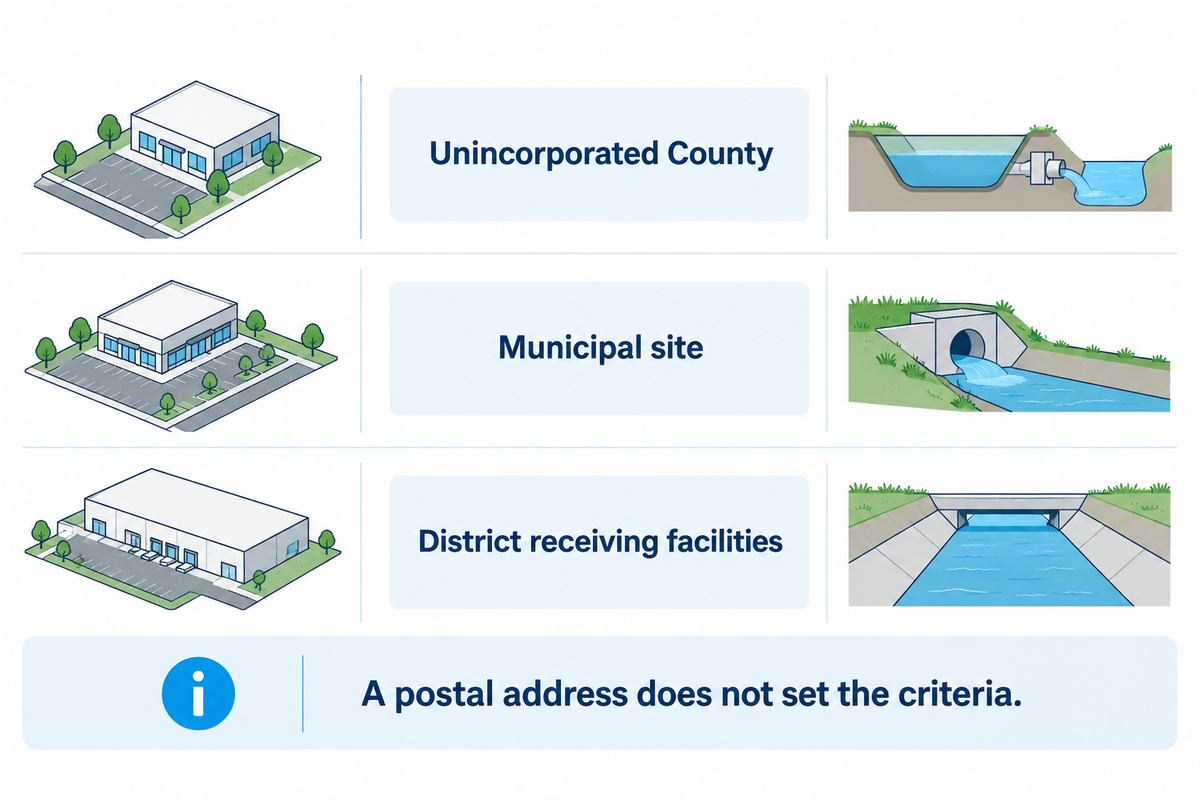
Harris County detention requirements extend to the jurisdiction responsible for the parcel and the drainage system which receives the parcel’s runoff. Development within the Unincorporated County, a municipal site and a connection affecting District facilities, can all take different review paths. A Houston postal address doesn’t, by itself, identify the governing drainage criteria.
In its Harris County Flood Control District FAQ, the District assigns development regulation to municipalities and County permitting programs. County Commercial Site Development guidance also includes District participation among review departments. Keep permitting for development separate from channel, easement or receiving-facility coordination.
Jurisdiction matters during redevelopment. Houston’s City Engineer May 2025 detention supplement FAQ provides credit rules and construction stage restrictions for qualifying City projects. Apply those provisions within the City pathway rather than transferring them to an unincorporated tract. A site in the Addicks Reservoir watershed or Barker Reservoir watershed requires an assessment of its own receiving system.
What is stormwater detention?
Stormwater detention is a temporary runoff storage facility with a controlled outlet. A stormwater detention basin fills when inflow exceeds the permitted release and drains as receiving conditions allow. Retention, then, holds water for more extended periods of time, or for other purposes. The hydraulic distinction, then, pertains to the facility’s available storage and discharge, and not whether it’s above or below ground.
A dry detention basin, buried tank and oversized pipe can perform the storage role. Each needs an inlet, outlet and an overflow in accordance with the site conditions. The public basins can serve multiple areas, but a nearby public project doesn’t necessarily allocate capacity to a private property. Keep broad layout options in the stormwater detention system planning hub; settle the parcel’s criteria before assessing the alternatives.
Detention Volume: Match the Rate to the Receiving System
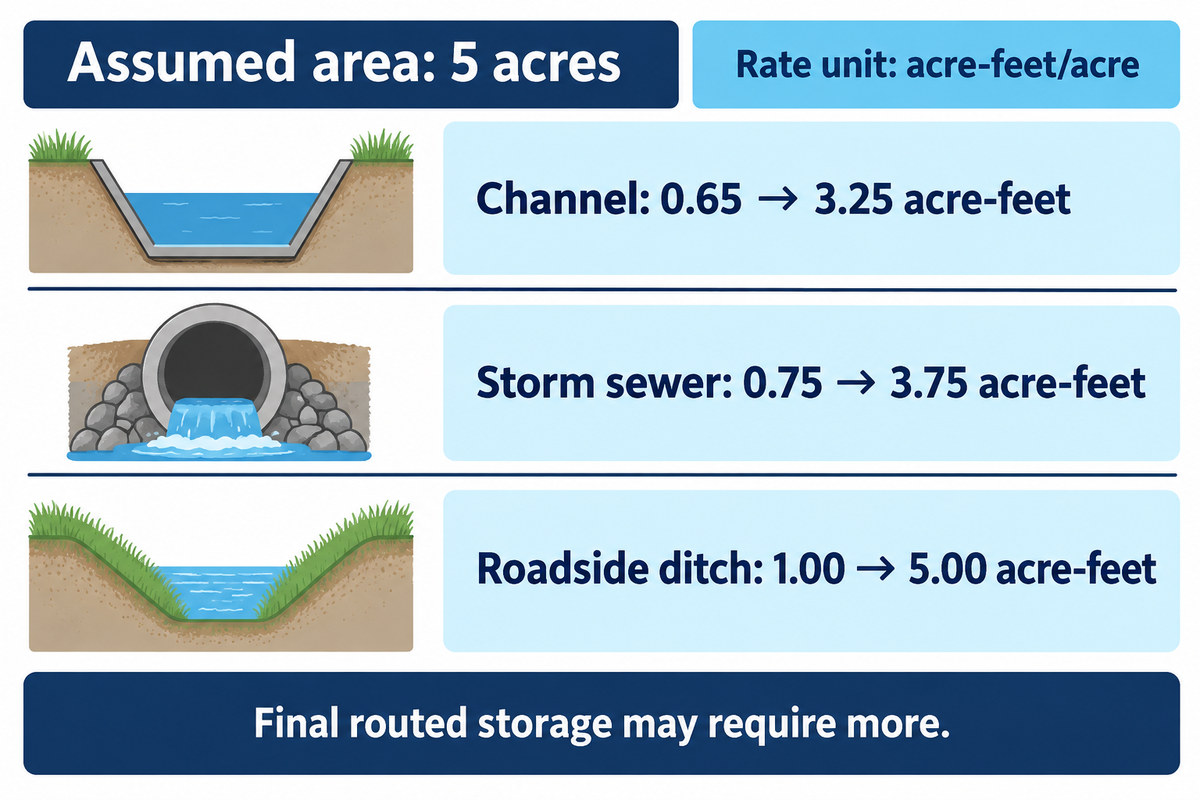
Detention volume begins with the accepted area basis and applicable rate and must satisfy the governing calculation method and permitted discharge. County review-sheet choices cover channel, storm-sewer and roadside ditch choices. Treat that multiplication as a single design input; the final routed storage may require more.
Harris County stormwater detention requirements: 3 review-form selections applied to an assumed 5-acre basis
Form selection
Rate, acre-feet/acre
5 acres × rate
Equivalent volume
Channel
0.65
3.25 acre-feet
141,570 ft³
Storm sewer
0.75
3.75 acre-feet
163,350 ft³
Roadside ditch
1.00
5.00 acre-feet
217,800 ft³
Source: Section 5 II of the County Review Sheet; derived arithmetic uses 1 acre-foot = 43,560 ft³. Designers select the applicable basis and method.
Worked example: Five-Acre Commercial Site. A developer’s accepted new-area basis is 5 acres. At an assigned 0.75 acre-feet/acre, the form calculation gives 3.75 acre-feet, or 163,350 ft³ (4,625.56 m³). Procurement could obtain a preliminary storage quotation at that quantity. However, routing at the allowable discharge may require additional storage, and a different outfall classification may change the initial calculation. Releasing an order before those two decisions freezes the wrong quantity. Therefore, design engineers include the accepted acreage and calculation method and routed result in the purchase order. A change in impervious cover or discharge arrangement returns to design review before the vendor revises the module count.
In the District’s July 2019 Atlas 14 memorandum, page 3, minimum volumes and storage to satisfy allowable discharge are differentiated. That memorandum describes revision to the 2018 manual and adoption by Harris County Commissioners Court, different calculation methods and project sizes. Its historical method table should not replace the applicable current project criteria.
For a 5-acre accepted area, changing the assigned rate from 0.65 to 1.00 acre-feet/acre changes the calculation from 3.25 to 5.00 acre-feet, for a difference of 76,230 ft³. Final detention sizing also has to meet the applicable discharge constraint; purchasing against the smaller multiplication alone can lead to a capacity shortfall.
Outlet Capacity: Prove the Storage Can Drain
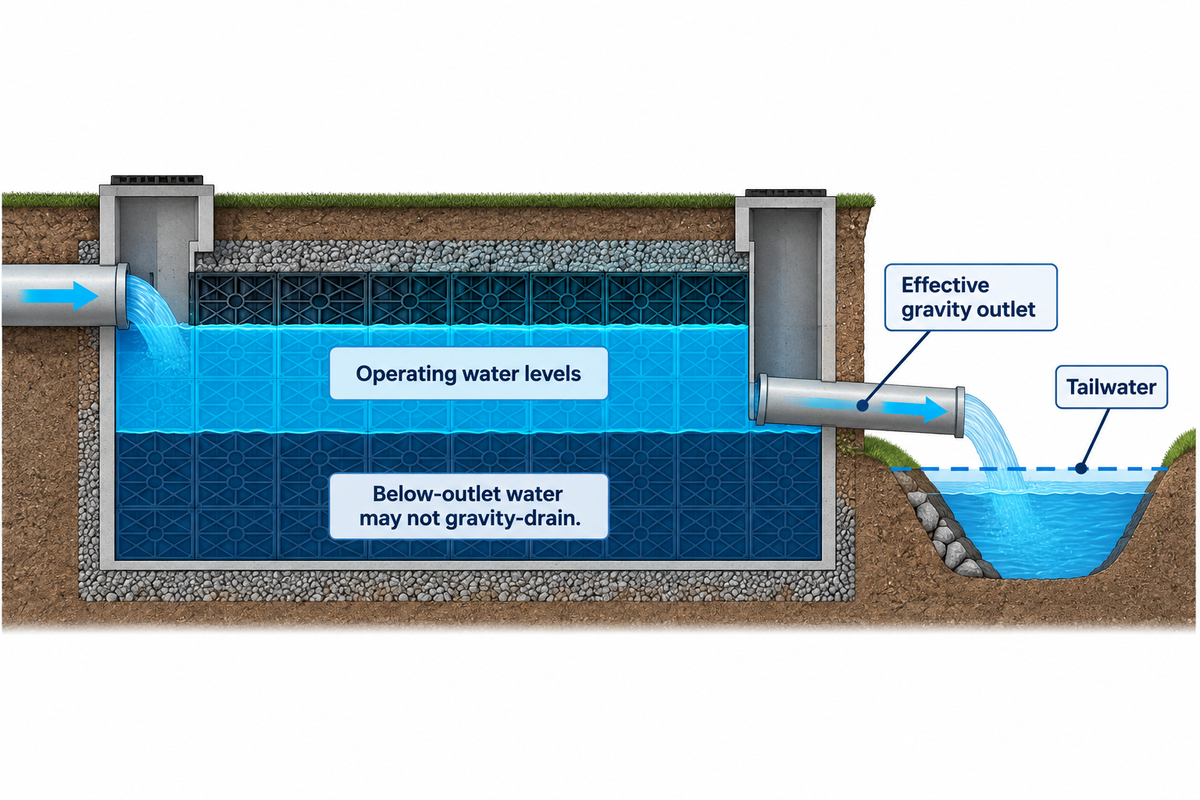
The capacity of the outlet determines how much stored runoff can leave the site during and after a storm. Hydraulic design must connect the tank’s operating levels to receiving capacity, tailwater and outlet controls. Additional depths provide little benefit when water below the effective gravity outlet can’t drain through the designed outlet.
County review fields differentiate the actual and allowable flows, the allocated capacity of the storm sewer, size of the restrictor, and gravity vs. pumped detention. According to the District’s detention Explanation , channel levels influence gravity drainage. Locate surveyed pipe inverts and channel levels beside the stage-storage and stage-discharge calculations.
Worked example: Five-Acre Commercial Site. The commercial parking layout has room for a deeper underground detention system, but the receiving storm drain system is shallow. Its initial 163,350 ft³ (4,625.56 m³) storage allowance therefore needs an operating-level check. Adding another storage layer increases the supplier’s catalogue volume while placing more water below the workable gravity outlet. Design teams have to balance live storage and outlet elevation. A pumped alternative introduces controls, power and failure-response duties into the owner’s scope. Procurement compares complete gravity and pumped arrangements, including access and commissioning. Making the first purchase a deep storage tank makes later choices difficult since the excavation and the geometry of the inlet follow the purchase.
A 0.75 acre-feet/acre form selection on 5 acres gives 3.75 acre-feet before routing. Water space available to the next storm still follows the operating water levels and discharge path. If the outlet is submerged, blocked or elevated then full recovery can’t be guaranteed.
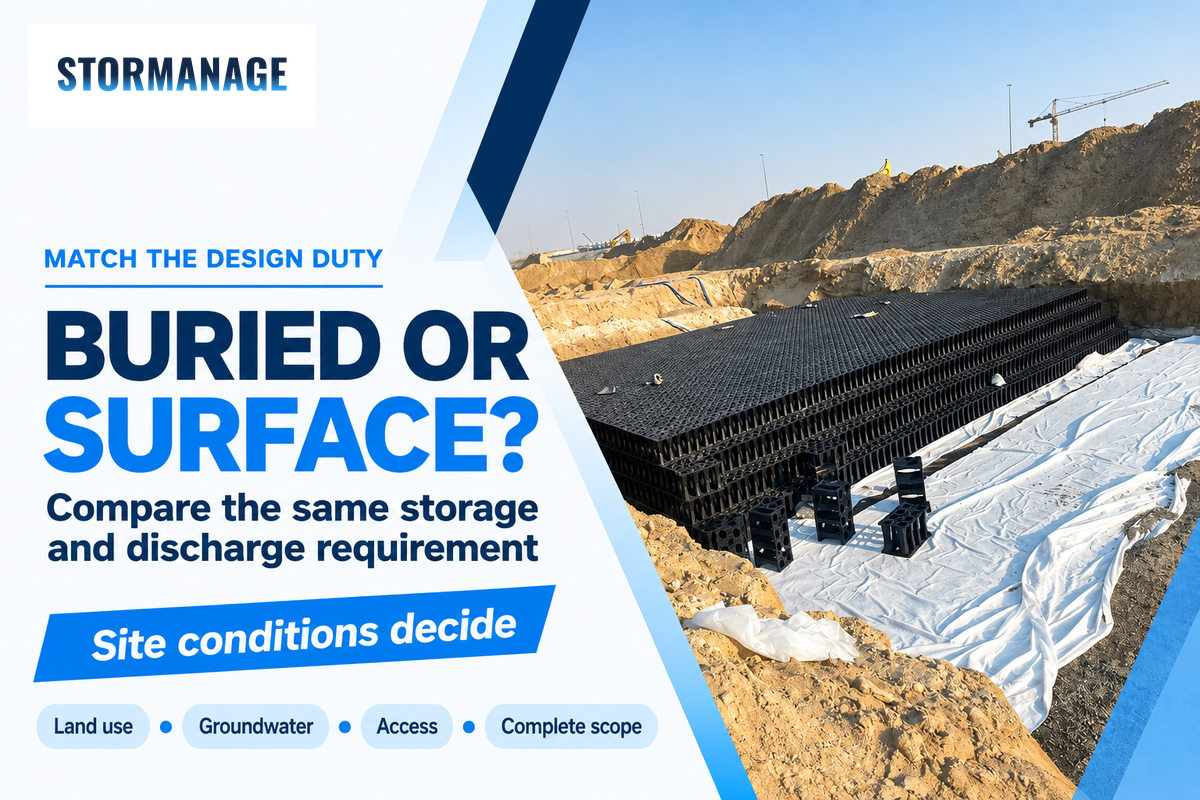
Underground Detention vs a Surface Basin
The usable surface area can be retained if the hydraulic grades, sub-grades and design support it. A surface basin provides easier access for inspection and maintenance; however, it takes up more surface area. Both systems should be evaluated based on the storage and discharge duty prior to evaluating the recovered parking/construction footprint.
Land allocation, groundwater, traffic loading, pretreatment and cleanout access also apply to the comparison. Philadelphia Water’s subsurface detention guidance explains those engineering considerations. Local numerical design criteria remain Philadelphia requirements. Assess a wetland or floodplain constraint; moving storage underground doesn’t address that.
Where are we going to store all of this water on such a small site?
Use underground storage under planned pavement if the section provides the required live storage, structural cover and accessible maintenance points. Keep a surface basin in the comparison where land is available or groundwater and outlet levels restrict burial. On a small site, reserve inlet, outlet and inspection space before filling the remaining footprint with storage modules.
The availability of a parking bay can be lost if maintenance equipment can’t reach an access chamber. Buried systems also need coordinated utility crossings and a defined overflow route. Conversely, an accessible surface basin can reduce the complexity of inspection while occupying land the owner intended for operations. A complete storage scope comparison can help define procurement boundaries for industrial, commercial and residential layouts.
For two different systems delivering the same 3.75 acre-feet design storage, a useful comparison is the complete installed arrangement; excavation, groundwater control, outlet and treatment, access and surface reinstatement. Land has value only after those interfaces are addressed. A tank only price and a complete basin price represent different purchases.
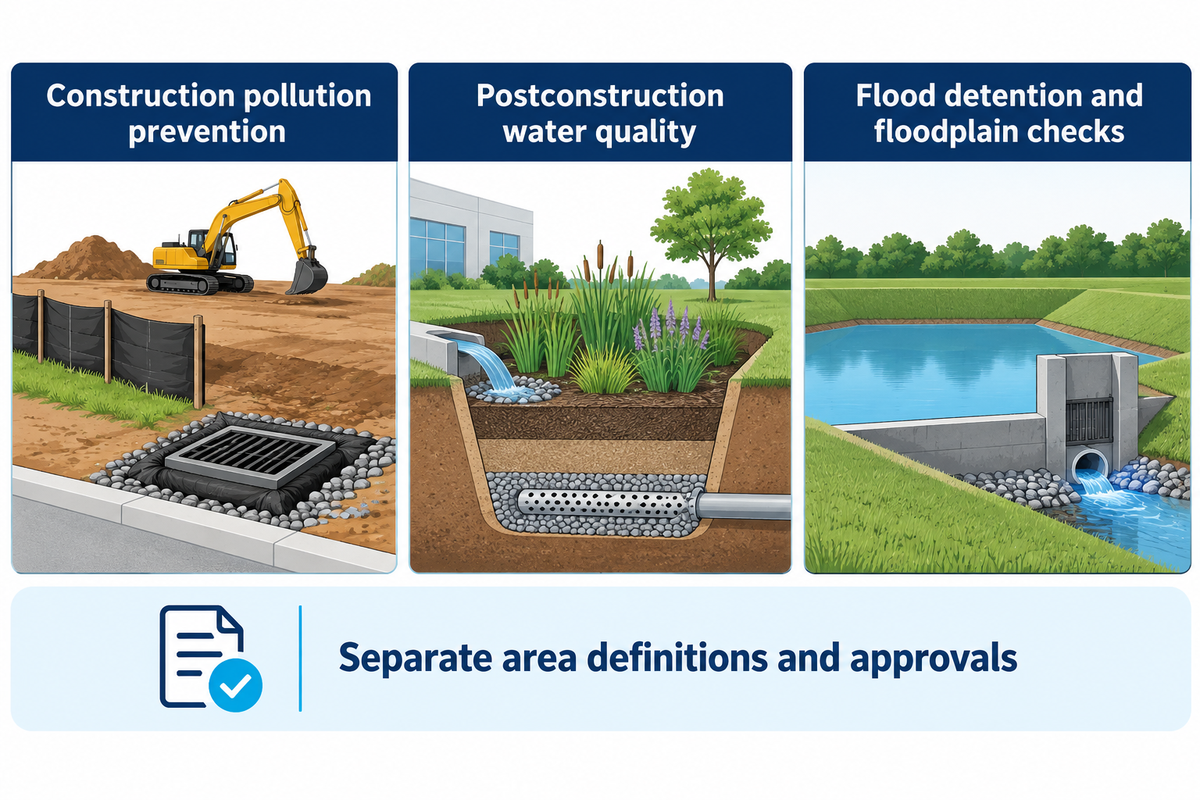
Stormwater Quality and Floodplain Storage Are Separate Checks
Stormwater quality controls pollution; detention controls the timing and quantity of runoff; floodplain mitigation is another set of flood-storage obligations and impacts. A project can trigger multiple controls. County water-quality thresholds can’t be relied on to determine the absence of a detention requirement.
In the County Stormwater Quality FAQ, construction guidance separates the construction Stormwater Pollution Prevention Plan from the postconstruction Stormwater Quality Management Plan. The Texas Commission on Environmental Quality (TCEQ) construction guidance applies the 2023 Construction General Permit to qualifying disturbance of 1 acre or more, including acreage within a larger common plan.
Phasing requires consideration. Three disturbance areas of 0.4 acre each total 1.2 acres within one common plan; treating each phase as an isolated sub-acre project can miss construction coverage. Prevention, long-term treatment and the detention outlet need design entries. Those design entries assist in avoiding confusion between a water quality permit and flood protection.
A common plan with three 0.4-acre disturbance phases contains 1.2 acres of disturbance. Construction coverage considers a combined area. A generally 5-acre post-construction water quality threshold is of a different concern, and neither threshold determines the flood-detention storage volume. Keep acreage definitions with each separate requirement to prevent cross-use.
Civil Submittals: Build a Reviewable Drainage Package
A reviewable drainage package includes site plan, grading, detention details, and outlet calculations, under the responsibility of the design engineer. Following this package, supplier quotes are sought. Acreage alone, however, leaves the operating levels, usable storage and supplied scope, open, thus allowing apparently comparable bids to describe materially different systems.
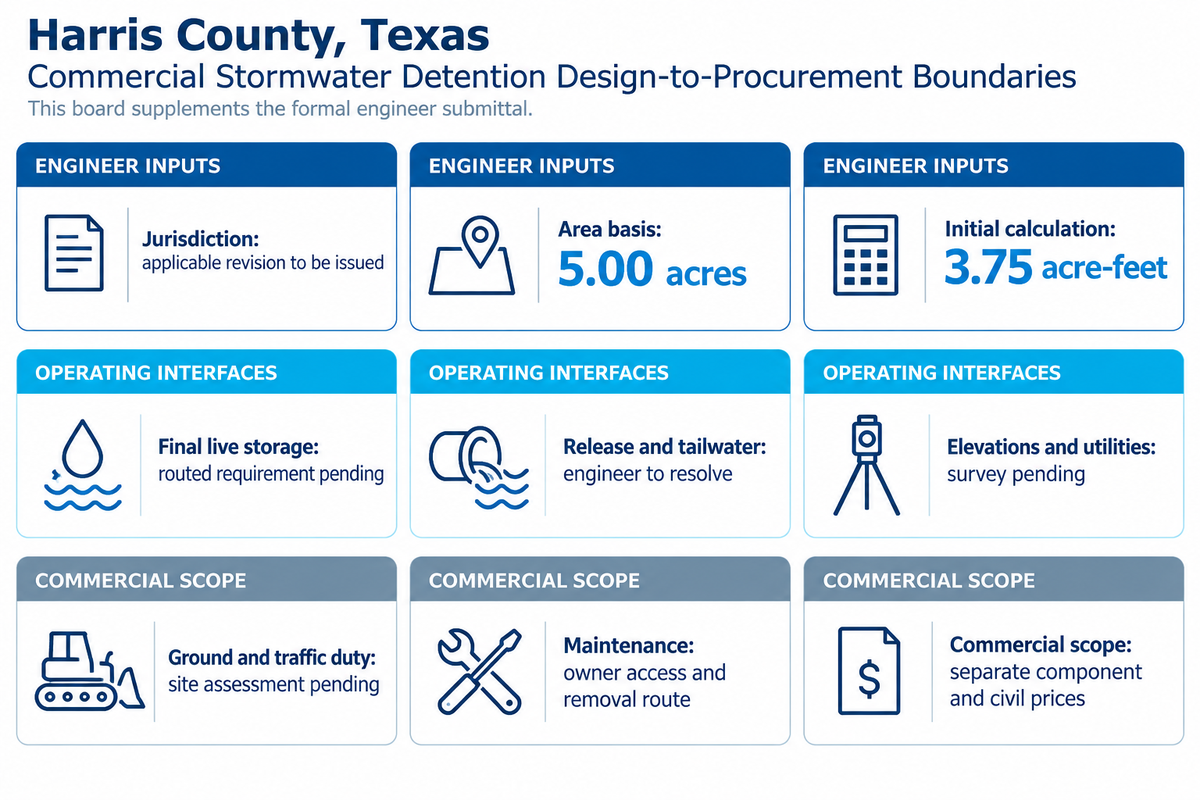
9-Field Quote Baseline
9-Field Quote Baseline assigns one owner and one measurable design input to each quotation interface.
Assumed inputs: Our example of 5 acres is at the Preliminary Enquiry stage. Survey-dependent values remain open until the engineer issues them; procurement can price a specified allowance rather than estimate an elevation.
Nine design inputs connect the detention submittal to a comparable supplier quotation.
Input
Example entry or unit
Owner / release item
Jurisdiction and criteria
Unincorporated County, applicable revision to be issued
Engineer / criteria schedule
Area basis
5.00 acres of accepted new area
Engineer / drainage-area plan
Initial rate calculation
0.75 acre-feet/acre; 3.75 acre-feet
Engineer / receiving-system assignment
Final live storage
Routed requirement in ft³, pending
Engineer / signed calculation
Release and tailwater
Allowable ft³/s and receiving water levels, pending
Engineer / outfall coordination
Elevations and utilities
Inverts, cover and conflicts in feet, pending survey
Survey/design / coordinated section
Ground and traffic duty
Groundwater and vehicle load case, pending
Geotechnical/structural designer / site assessment
Maintenance arrangement
Owner access and sediment-removal route
Operator / reachable inspection points
Commercial scope
Modules, controls, lining, excavation and reinstatement priced separately
Procurement/finance / exclusions schedule
Editorial procurement framework, derived from County review fields and subsurface design guidance; it supplements the engineer’s formal submittal.
County commercial applications also include grading, drainage, paving, utilities and other discipline reviews. Subdivisions and right-of-way work contain separate pathways. Set the tender deadline after the coordinated section is posted, or define the provisional quantities in each bid. Use the detention tank cost and sizing inputs to separate equipment costs from construction scope.
Maintenance: Keep Storage and Access Available
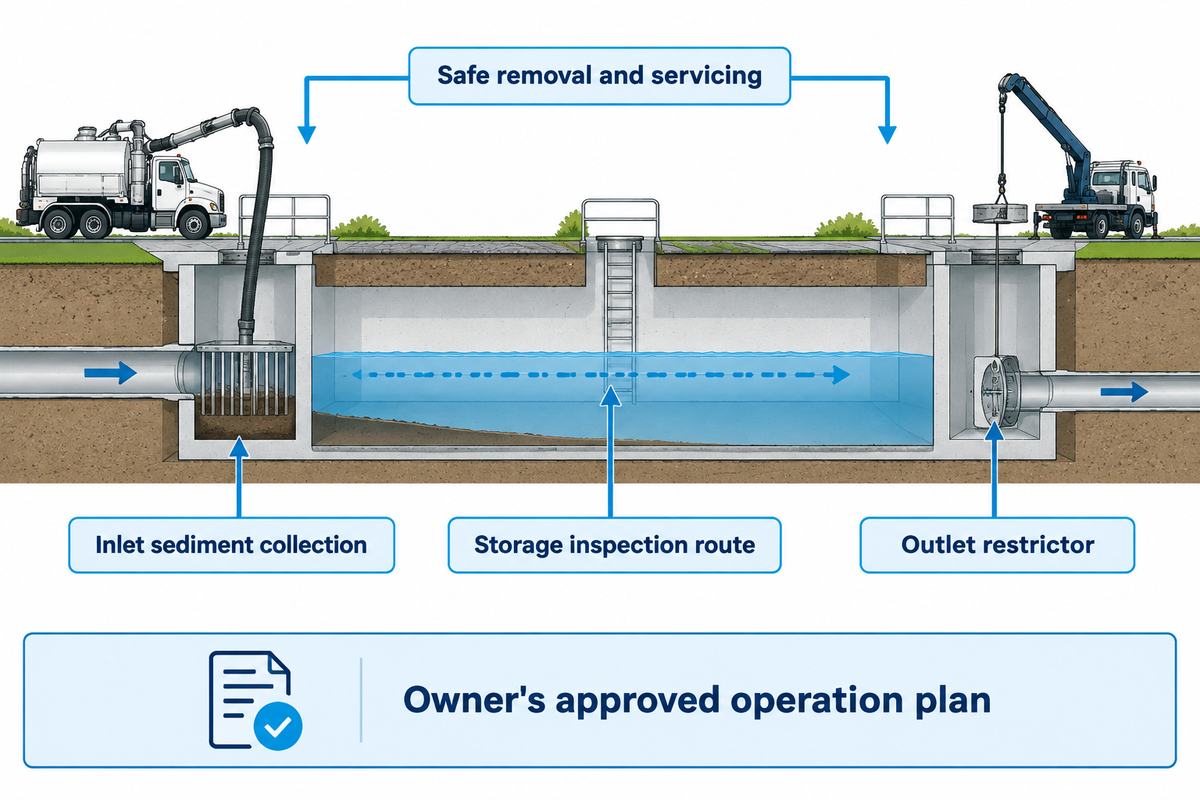
Detention tanks require an owner and accessible inspection, sediment-removal and outlet control points. Buried storage should remain serviceable after the completion of landscaping, parking and utility work. An inaccessible chamber can turn a routine inspection into excavation, while accumulated sediment reduces the water space available for stormwater runoff.
“The owner is responsible for the proper operation and maintenance of the detention facility in perpetuity.”
The notice also requires an as-built certificate upon completion. Assign the inspection and the maintenance agreement before the facility is put into routine operation. Access planning should cover the inlet sediment collection point, storage inspection route and restrictor, with a safe method for removal and servicing. The frequency of inspection should be aligned with the approved operation plan and respond to site conditions.
Example: The warehouse owner keeps the parking surface above the buried tank, and gives out the landscape maintenance to another contractor. The final plan places the outlet chamber along the access aisle, and a later planting revision covers the approach. Operations can no longer access the restrictor from the intended position. Keeping the access route on the plan retains the intended position before teams construct the final paved surface. Operators can implement a clear work order, and procurement can retain the access components. Finance can distinguish between routine and disruptive operations. A potential improvement along the maintenance route can therefore be more useful than additional catalog storage that the owner can’t keep clear.
Supplier Evidence: Reconcile Catalogue Volume with Design Storage
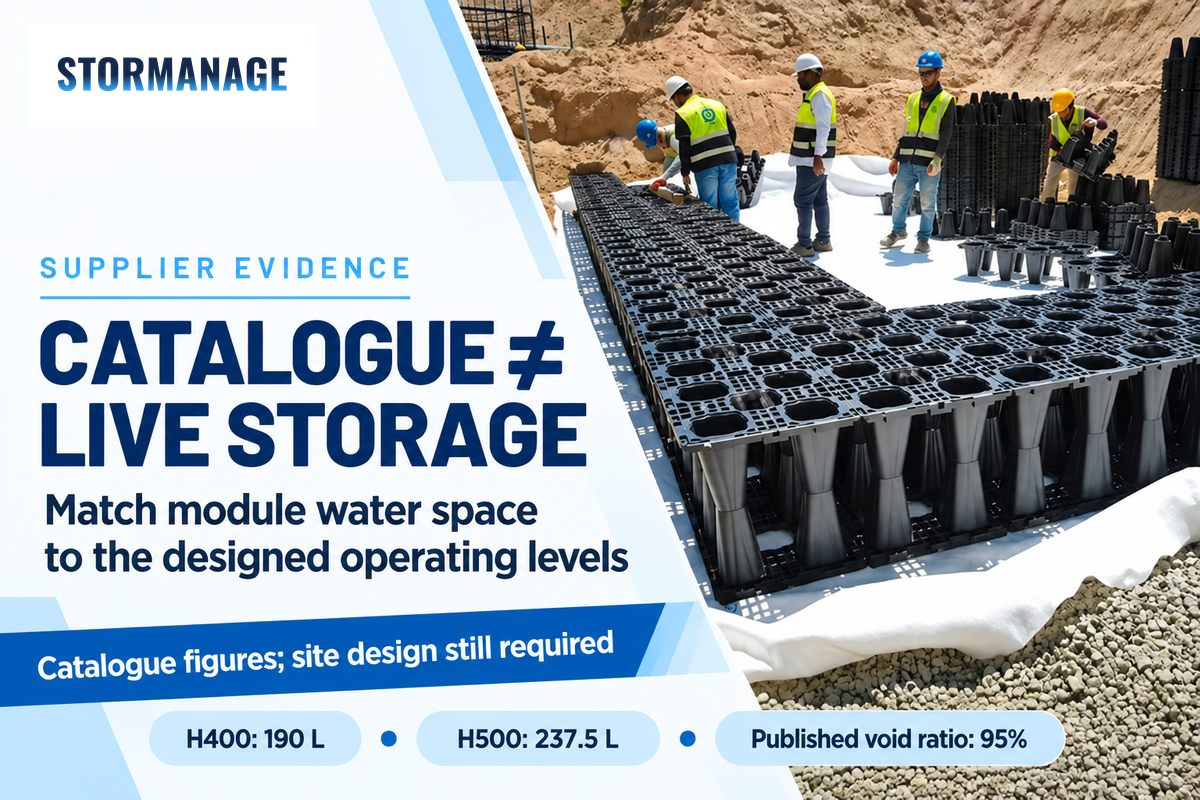
Supplier capacity should be balanced with the engineer’s required live storage using module water volume, arrangement and operating elevations. StormManage lists H400 modules at 190 L and H500 modules at 237.5 L with a 95% void ratio. Finalize the arrangement after the hydraulic and site-load duties are defined.
190 LH400 catalogue water space
237.5 LH500 catalogue water space
95%Published void ratio
Our modular attenuation tank configurations provide the catalog starting point. Avoid using the 95% factor twice if listed capacity already represents the module’s water space. Keep designed void volume, connection geometry and permanent water level consistent with the storage calculation. In Philadelphia’s subsurface guidance, useful operating volume is differentiated from permanent water space.
Example: 100 m³ catalog water space allows for 100,000 L. Dividing this by 237.5 L/module (H500) yields 421.05 modules or 422 modules with 100,225 L catalog water space. Live volume follows the project’s geometry and usable levels. A preliminary module estimate supports that product comparison after the designer sets the volume.
Design of traffic loading and covers is in the structure design schedule; allowable discharges are in the hydraulic design schedule. Harris County Flood Control District’s receiving-facility coordination remains separate from the model selection of a supplier.
At 237.5 L per H500 module, 422 units provide 100.225 m³ of catalogue water space. Reconciling the connection volume and operating level will determine the availability of a 100 m³ live storage volume. Separating these two quantities on different lines prevents a nominal module count from replacing the hydraulic capacity required for drainage design.
Before Ordering: Complete the 3-Boundary Detention Ledger
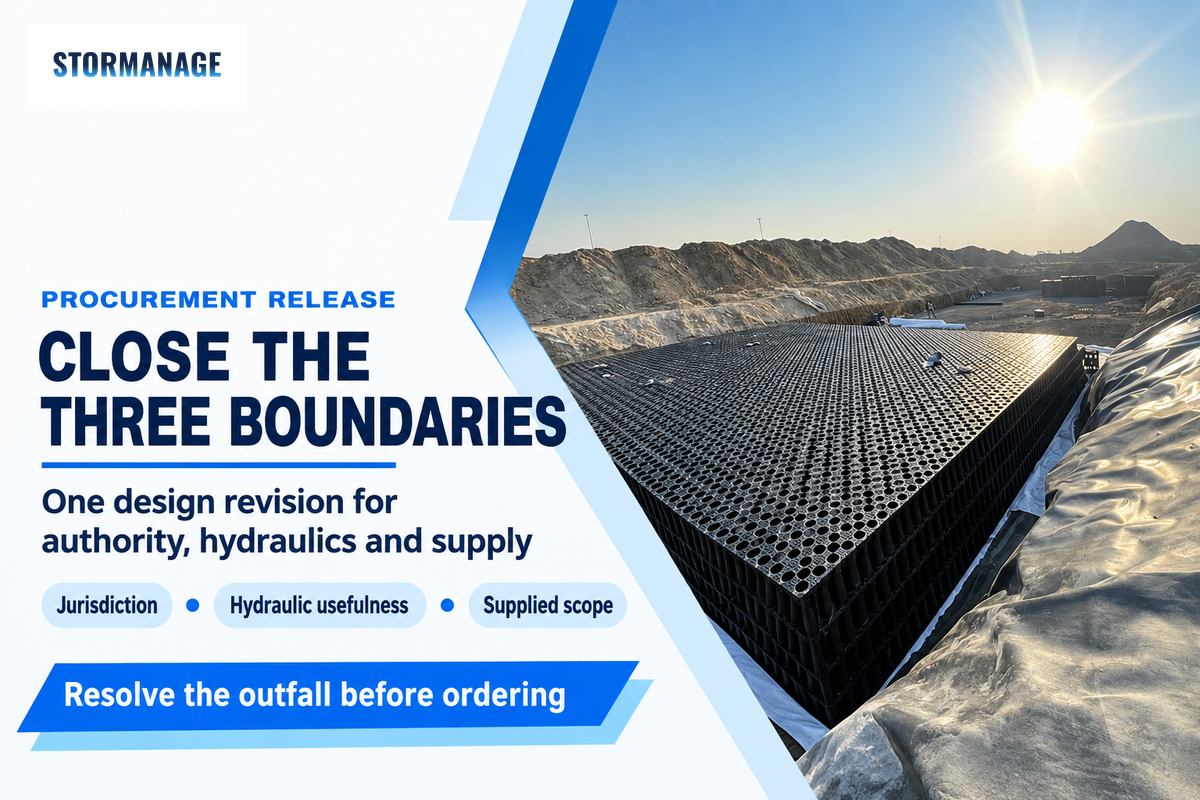
A detention order can be released when the three conditions of hydraulic performance, supply and jurisdiction reach an agreement for the same design. Each of these conditions separates unresolved design decisions from vendor exclusions. Procurement can compare prices without transferring an outfall or maintenance problem into a seemingly less expensive tank package.
3-Boundary Detention Ledger
The 3-Boundary Detention Ledger clusters nine purchasing risks based on review authority, hydraulic usefulness, and supplied scope.
Three boundaries and nine release decisions keep a storage purchase aligned with the drainage design.
Risk category / boundary
Release condition
Owner and consequence
Authority / jurisdiction
Parcel and permitting authority agree
Developer: wrong review pathway
Authority / criteria version
Applicable version and transition status recorded
Engineer: calculation revision
Authority / receiving facility
Outfall coordination and allocation resolved
Developer: connection redesign
Hydraulic / storage basis
Final routed live volume replaces preliminary multiplication
Engineer: quantity change
Hydraulic / usable depth
Operating levels and tailwater fit the section
Engineer: stranded buried capacity
Hydraulic / recovery
Controls, overflow and recovery assessed
Operator: reduced next-storm capacity
Supply / installed interfaces
Lining, treatment, controls and access priced
Procurement: excluded components
Supply / civil works
Excavation, groundwater and reinstatement assigned
Finance: unpriced construction
Supply / operation
Handover, access and maintenance responsibility agreed
Owner: disruptive future servicing
Editorial synthesis of County review sections, District drainage principles and subsurface design practices; ancillary treatment and maintenance scope also appear in New Civil Engineer’s historical 2009 comparison. Current Texas design criteria come from the applicable authorities.
Enquiry handoff
Confirm the applicable criteria and accepted area. Attach the routed storage, discharge and surveyed section. Identify the structural duty and inspection access. Ask each bidder to list supplied components, civil-work allowances and exclusions against the same revision.
For the Five Acre Commercial Site illustrative example, a 3.75 acre-feet quote equals 163,350 ft³ (4,625.56 m³). The quantity line should specify preliminary arithmetic or final live storage. Nine release decisions connect review criteria to hydraulic performance and supplied scope, and unresolved outfall allocation is settled before storage procurement freezes.
Key takeaway
Release the storage order against the engineer’s final live-volume target and matched installation scope after the outfall and criteria are settled.
Frequently Asked Questions
Why are Harris County stormwater detention requirements important?
Detention requirements manage the rate and volume of runoff reaching downstream drainage systems.
Development changes how rainfall reaches channels and public infrastructure. Detention stores runoff temporarily while its outlet limits release to the design allowance. That relationship helps reduce adverse drainage impacts on neighbouring property and reduce flooding risks and damages in local communities. A complete project also addresses conveyance, overflow and maintenance, because storage alone can’t ensure that water reaches a usable outlet or that capacity remains available.
Why are detention requirements different across the Houston area?
Different permitting jurisdictions and receiving systems create different design and review requirements.
Harris County contains municipalities as well as unincorporated land, so a shared postal description doesn’t identify one rulebook. Each receiving channel, storm sewer or roadside ditch adds another design interface. Houston’s May 2025 redevelopment supplement illustrates a City-specific provision. Its eligibility and construction-stage conditions should remain with the City project pathway rather than become assumptions for neighbouring County sites.
Can Harris County stormwater detention requirements be waived?
A waiver or alternative requires the applicable authority’s accepted basis; it is not an automatic acreage allowance.
County Notice of Detention Requirements provisions include an alternative route when the County Engineer is satisfied with another arrangement and the relevant release is recorded. That process differs from a buyer deciding that a nearby basin will serve the property. Until the project has the applicable acceptance, carry the reviewed detention requirement into the design and procurement schedule.
When is a Stormwater Pollution Prevention Plan required?
Qualifying construction disturbance of 1 acre or more generally triggers Texas construction stormwater coverage and pollution-prevention planning.
Include disturbance within a larger common plan of development or sale. Phasing the work into smaller areas doesn’t by itself remove the aggregate acreage from the coverage assessment. Applicable permit pathways govern the documents and notices.
When is a Stormwater Quality Management Plan required?
The County generally requires a postconstruction Stormwater Quality Management Plan for new development on parcels of 5 acres or more.
For redevelopment, the County FAQ identifies parcels of 5 acres or more that add at least 1 acre of impervious cover. Long-term plans address the long-term management of pollutants after construction, while the construction pollution-prevention plan addresses the work period. Use the parcel area and added impervious area in their respective fields rather than switching between them.
Project boundaries, redevelopment history and the common plan should therefore be settled in the drainage package. A quality treatment feature may sit within the same overall drainage scheme as detention, but the designer still has to allocate its operating volume and discharge arrangement. A 5-acre quality threshold isn’t a general exemption for smaller sites from flood-detention review. Keep the quality approval, detention calculation and any floodplain impact assessment as separate entries in the project compliance schedule.
Does a stormwater-quality basin need 24 or 48 hours of drawdown?
The County quality FAQ describes an average 24-hour drawdown, with the last drop draining within 48 hours.
Initial water can leave immediately. That answer concerns stormwater-quality basin design. Flood-detention recovery requires its own hydraulic assessment; avoid applying the quality-basin duration as a universal detention-tank drain-down rule.
How can a project be grandfathered?
Grandfathering or transition eligibility follows the applicable rule and the project’s documented approval history.
County quality grandfathering and District detention transition provisions concern different obligations. District transition provisions in the 2019 memorandum address qualifying applications and reports, substantial modifications and dormant projects. A change of applicable version also differs from a complete detention exemption. Retain the authority’s accepted project basis with the design record.
Scope and method
This guide focuses on commercial procurement in Harris County, Texas. XCX compared current County public forms and guidance with District drainage explanations and attributed supplier data in October 2026. Worked examples use stated assumptions. The project engineer establishes the applicable criteria, hydraulic design and sealed submittal.