Heavy Duty Soakaway Crate — EN 124 D400 / SLW60 for Trafficked & HGV Areas

Factory direct geocellular crates for car parks, access roads and industrial yards – with the load class facts that most suppliers get wrong.

95% Void ratio
D400 400 kN test-load context
1000×500×500 Module (mm), PP
50-yr Design life*
330 m³ Per 40HQ container
1–100,000+ m³ MOQ, FOB Shenzhen
Request a D400 Soakaway Spec & FOB Quote
Heavy Duty Soakaway Crate D400
Heavy Duty Soakaway Crate System
SYSTEM SPECIFICATIONS

When You Need a Heavy Duty Soakaway Crate — Trafficked & HGV Loading

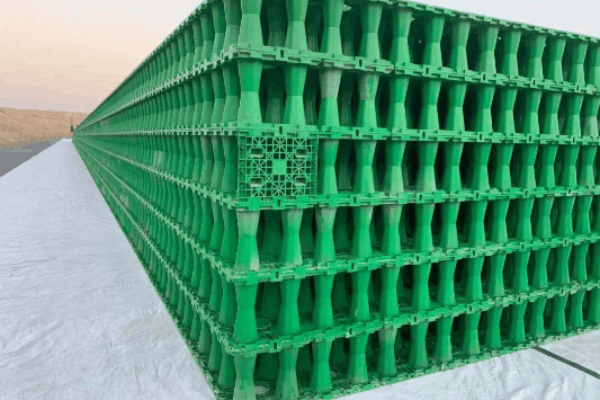
A heavy duty soakaway crate is what you specify when a soakaway crate system sits under wheels, not lawn – a car-park bay, an access road or an industrial yard where vehicle loads press on the geocellular crate. These are a high void ratio modular geocellular unit designed to store water underground, and to disperse it through into the ground at a rate dictated by soil type (infiltration soakaway), or to store it in a large volume to allow it to be released over a controlled period (attenuation tank).

For car parks and sites with vehicle movements, it’s essential to choose the right crate to handle vehicle loading and to correctly calculate the required depth of the cover material to provide a strong protective layer above the crate. Standard 20-tonne garden crate can cope with a single wheel load of approximately one quarter of the overall total weight being applied at that time (as only one wheel will apply pressure to the crate). Heavy duty soakaway crates and tanks used on trafficked applications are typically manufactured with additional ribs or structure, and are supplied for use with a calculated depth of cover to give appropriate resistance. When purchasing geocellular crates, especially for car parks and roads, care must be taken with the loading of these crates. Often a load class is quoted, and suppliers incorrectly interpret this in their ordering.

These identical crate modules provide both soakaway and attenuation. On a pervious soil bed, they allow water to infiltrate into the sub grade creating an infiltration soakaway, whilst on impermeable soil beds, the modules act to attenuate the storm flow. That is the split between an infiltration soakaway and water attenuation: both manage the same surface water and stormwater drainage, but one disperses it into the ground and the other buffers it for controlled release. Whether this application be a large attenuation system, or a smaller infiltration soakaway system the basic modular geocellular crate module remains the same, the key differentiators for a soakaway application would be the geotextile wrap, and for a road or parking solution the depth of cover required to withstand loads.

APPLICATIONS & PROCESS

A heavy duty crate application in areas of traffic require a geocellular unit capable of withstanding not just a vertical compressive load but to be placed within an appropriate depth of cover, surrounded by a suitable fill material which will spread loads applied above the crate system. Failure of the crate system due to incorrectly specified or installed materials could result in expensive excavation and repair to the site. This page looks to identify the issues that need to be addressed to correctly size a heavy duty soakaway crate, taking account of cover depths and crate type to prevent failures and costly rework. UK best practice is to treat any buried drainage installation as a designed structure with an element of factor of safety (Defra, National Standards for Sustainable Drainage Systems).

A trafficked soakaway system, whether a drainage tank for attenuation or infiltration system, needs to be designed to carry load. This is different to a simple garden soakaway that simply needs to cope with a garden patio load. As mentioned, a incorrectly specified or sized crate system for car parks or areas with HGV traffic could fail. Here we look to identify how the loading on a geocellular crate can be quantified and then used to determine the correct depth of cover.

Where This Page Fits — and Where It Doesn’t

We help you select the right crate load-class for your car park, access road or industrial yard – and avoid the most expensive ordering mistake in the drainage industry. Here, we explain the key variables: the geocellular crate itself (vertical load capacity); how the depth and material of cover above it affect this; and the properties of the surrounding backfill. Site suitability — the percolation test, water table and distance rules — sits in our burial-depth guide and the parent soakaway crate hub.

New to load classes for trafficked ground?

Use the soakaway crate calculator and request a spec
Installation Depth and Fill Material for HGV Load
REAL-WORLD LOAD MODELLING

The class for 60-tonnes heavy duty sites and docks is E600 (600 kN). 400 kN is a test force, not real-world weight, so you cannot assume “it can take a 40-tonne lorry”.

SLW60, another number that sometimes appears, is a totally different standard – the German DIN 1072 “bridge design” vehicle, which represents a heavy-goods vehicle in traffic load modelling.

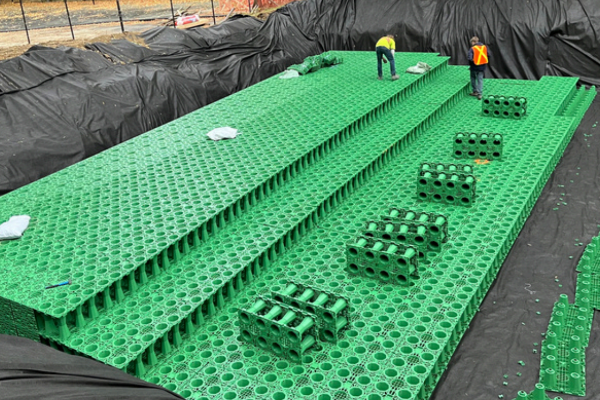
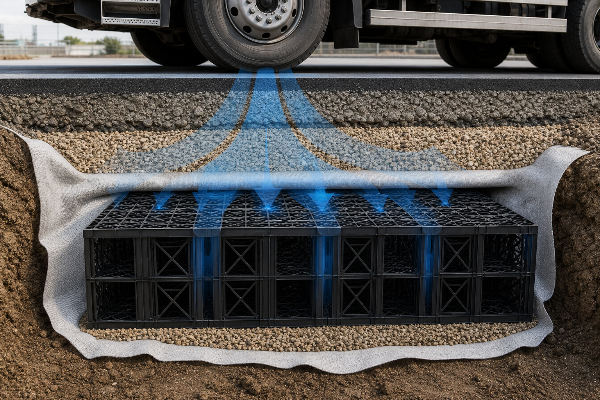
Heavy Duty Soakaway Crate underground installation visualization
EXPAND FOR E600 & SLW60 FACTS

Understanding Load Classes: EN 124, D400, SLW60 & What Actually Rates a Crate

This is a fact you should know when you buy: EN 124 does not class soakaway crates. BS EN 124 relates to gully tops and manhole tops-those things at ground level. Class D400 means that the cover or grating has been tested for 400 kN test load in road areas (ISO 15398 is in the same family for thermoplastic covers).

The crate below the ground is a different structure. It has no class of its own and should carry a manufacturer-approved rating. If you see “D400 crate”, you are reading a borrowed cover-class label applied to a structure that the standard never addressed.

Don’t use the number, either. Under EN 124, D400 is a 400 kN test load, equivalent to 40 tonnes. Not 60 tonnes.

Do not treat D400 and SLW60 as identical load ratings or your crates will be under-specified. Storm Manage uses both labels where they apply, and bases its own crate load rating on its proven vertical compressive strength and the required surface build-up for traffic above it.

Borrowing a cover-class label to signify a buried-crate capability is a structural error because EN 124 did not test the crate itself. Storm Manage bases its quotes on the actual tested capacity of the crate.

!

Under-specification from the order onwards follows if you get this wrong. Each manufacturer uses a different specification for crush ratings – long-term versus short-term, vertical versus lateral – so only the figure in the load table is verifiable with test reports and a structural design.

The D400 Load-Class & Cover-Depth Matrix

You can use this to convert the needs of a trafficked environment into the two key components you really need: the class of surface cover or grating, and the design load rating of the buried crate. Cover-depths in a load table are a guideline not a rule; the final depth will be adjusted to suit the crush rating of the crate (see next section).

EN 124 surface class Test load Traffic context Design vehicle ref Buried-crate duty Typical cover depth*
A15 15 kN Pedestrian, gardens Foot traffic Light Landscape min
B125 125 kN Footways, cyclists, car parks (cars only) Passenger car Light–standard ~500–800 mm
C250 250 kN Channel edges, slow-moving light commercial Light van Standard ~500–800 mm
D400 400 kN (≈40 t) Carriageways, car parks, HGV access, industrial yards HGV wheel load Heavy-duty crate ~800–1200 mm
E600 600 kN (≈60 t) Docks, aircraft pavements, heavy plant Very high wheel load Heavy-duty + engineered surround Project-specific
F900 900 kN Aircraft taxiways, extreme point loads Aircraft Engineered scheme Project-specific

Heavy Duty Soakaway Crate Spec Comparison: What the Numbers Really Say

The real figures are what count for a heavy-duty soakaway. Trafficked crates across the UK market cluster around 40-65 tonne vertical ratings on modules of roughly 0.2-0.4 m³. The differences that matter for a heavy duty soakaway are the verified vertical strength, the void ratio, the module geometry (which drives dig volume and crate count), and whether a load figure comes with a test basis. The table below uses published market figures against Storm Manage’s own module data; note that a headline “62 tonne” or “up to 80 ton” claim means little without the test method and cover condition behind it.

That gap is not cosmetic. Because crush ratings are quoted on different bases, a bigger headline tonne figure can hide a weaker crate, and the risk lands on the buyer who compared “60 tonne soakaway crates” on the number alone. Storm Manage provides the compression and vertical-load test report behind every rating, certified to ISO 9001, so the datasheet figure is one a designer can build around. Unlike resale listings of plastic soakaway crates, the spec – module, D400 soakaway crate dimensions and soakaway crates sizes – is tied to a production batch, not a catalogue reprint.

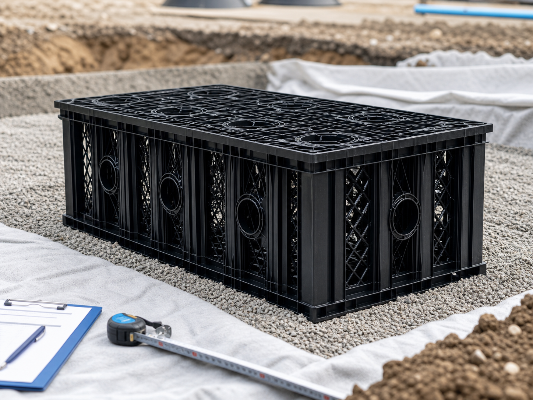
Heavy Duty Soakaway Crate Specification and Module
LOAD-CLASS VERIFIED
Attribute Storm Manage HD Typical UK 62 t crate Typical 40 t “heavy” crate
Vertical rating Heavy-duty, test-report backed† 62 t (basis often unstated) 40 t
Void ratio 95% ~95–97% ~95%
Module (mm) 1000×500×500 1000×500×400 1000×1000×400
Module volume 0.25 m³ 0.20 m³ 0.40 m³
Material Virgin / Recycled PP PP PP
Load-class framing EN 124 vs crate rating stated separately Labelled “D400” (mislabel) Labelled “D400 20–40 t”
Supply model Manufacturer-direct, FOB UK merchant resale UK merchant resale

Third-party test reports for compression, vertical load and PP material properties are provided per project on request.

Matching a crate to a wheel-load class for your site? Request a spec comparison for your load case

Cover Depth, Reinforced Surround & Load Distribution for D400 Areas

Cover depth is where the “500 mm” myth does the most damage. A single 500 mm figure gets quoted for HGV soakaways, but 500 mm is closer to a construction and compaction minimum than a structural depth for heavy traffic. Real cover depth is engineered to the crate’s crush rating and the wheel loads above it: for a car driveway that is often 500-800 mm, while HGV and heavy trafficked areas typically need materially more – commonly in the 800-1200 mm range, with some crate systems specifying a minimum around 1.2 m for heavier vehicles.

These are indicative design-practice ranges, not depths fixed by any single standard – the structural design method for modular geocellular tanks is set out in CIRIA C737:2018, which superseded the older C680 many datasheets still reference, and the depth for your scheme is the number that method returns for your crate and vehicle.

Two loads act on a buried crate and they pull in opposite directions: too little cover and traffic point-loads reach the crate; too much cover and dead-load plus surcharge can exceed its crush rating. That tension is why depth is a calculation, not a default. Above the crate, a granular surround and a properly compacted sub-base spread wheel loads so no single cell takes a concentrated hit; the crates are wrapped in a non-woven geotextile so water enters while silt stays out. Design to a recognised structural method rather than a catalogue number (Building Regulations, Approved Document H).

Reinforced surround and load distribution for D400 soakaway crates
HOVER TO EXPLORE DYNAMICS

Here’s the design mistake that causes crates to be crushed: choosing the wrong strength, or looking at a “tonne” rating without the cover-depth condition it rests on. Get that wrong, and you’re buried – undersizing the void is a costly mistake that risks downstream flooding, potentially adding £1,000s to the cost of a retrofit dig.

Storm Manage links every crate’s test crush rating to the intended cover depth and surround, and in-house test reports show the basis for each figure – no need for your engineer to guess. Unlike a merchant’s 500mm and done guess, depth is engineered to your vehicle class.

Field check before you backfill

3 things to confirm in your design pack:

  1. 01. Crate’s vertical rating and its test basis.
  2. 02. Cover depth linked to your vehicle class (not generic).
  3. 03. Surrounding soil and base materials spec.

Any supplier who gives a ‘tonne’ value but not its condition-based cover depth is incomplete. Our cover-depth by load class guide shows the sequence.

Designing a trafficked build-up?

Get a cover-depth & load-distribution spec
CERTIFICATION & COMPLIANCE

Certified & Tested: Structural Basis, Factory Systems & Design Life

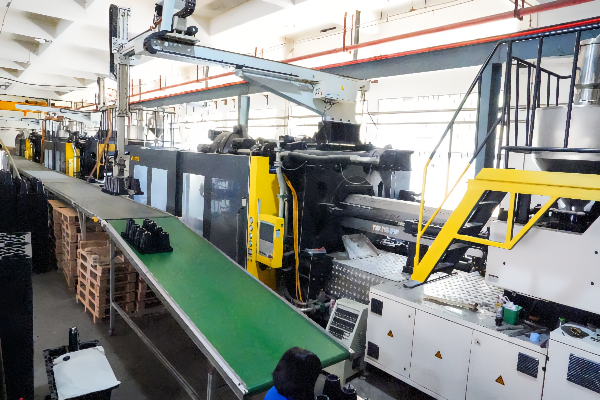
With trafficked soakaways, you must ensure ‘certified’ has tangible proof. Storm Manage makes crates to CIRIA C737:2018 for use as the structural frame for modular geocellular tanks and can produce a compression, vertical load and PP material property test report for each project – instead of relying on generic ‘certification’. Our PP crates are injection moulded, designed for 50 year performance when installed to specification and at a working temperature range of -40C to +80C. A 50-year life depends on correct installation and maintenance as well as cover depth and surrounds.

For car parks or industrial yards, certificates are worthless if they can’t be checked. Our products can be verified at audit, unlike those bearing ‘standard’ badges – our crates, which operate from -40C to +80C and are designed to last 50 years, each have a factory-traceable test report linked to its standardisation.

“We separate two numbers on every enquiry: the surface EN 124 class the client’s engineer needs for the cover, and the crate’s own vertical rating from our compression report. When a drawing just says ‘D400 crate’, we send both back — because that label is describing the lid, not the box underneath it.”

— Storm Manage Engineering Team

Our manufacturing quality is backed by the factory management standards above (ISO 45001), and our factory issues specific batch test reports upon request. The reports should not be relied on as the sole basis of site-specific engineering designs.

ISO 9001:2015 Quality mgmt system
ISO 14001:2015 Environmental mgmt
ISO 45001:2018 OH&S mgmt
CIRIA C737 Structural design ref
Test reports Per project, on request
APPLICATION SCENARIOS

Heavy Duty Soakaway Applications: Car Parks, Access Roads & Industrial Yards

Heavy duty crates are the place where you’d want to have some sort of storage solution situated beneath an area with surface traffic – driveway soakaway crates and access roads, parking spaces, HGV loading yards, plant hardstanding and forecourts. It does what you need it to do for the site where it is used – it stores the rainwater and lets it percolate into the ground (soakaway) or holds and releases it (attenuation), while the cover build-up above carries the wheel loads.

It is the same soakaway crate at heart, whether a driveway or HGV loading yard soakaway – all working on the same principle of a 95% void cell, but the strength of the crate in vertical load is different, as is the depth of cover and surround. As with everything location is key – Environment Agency guidelines advise you do not build rain gardens or soakaways close to building foundations – so keep these soakaway systems well away from any structures and survey the site.

! CRITICAL SITE CAVEAT

There is one caveat, a big caveat: soakaway crates don’t clean the water – they just store and drain it. If there’s a risk of oil-spillage in the area the water runs off – for example if there is a parking or fueling area – that run-off should be pre-treated up-stream of the crate – using a silt filter or silt trap to catch the grit and if there’s a petrol risk, a petrol interceptor – which is piped into the crate inlet from the yard’s surface channel drains – so the crate doesn’t get fed run-off contaminated with petrol.

The UK standards (Approved Document H) are clear: oil-risk areas require an interceptor and there must be no risk to groundwater from the soakaway.

Heavy Duty Soakaway Application for Trafficked Sites
Sizing storage for a trafficked site? Get a shop-drawing & container-loading plan

Procurement: Cost Factors, MOQ, Container Loading & Shop-Drawings

Switching to the factory-direct removes where some of the money goes, so it’s useful to think of the entire cost, not just the crate. Installed cost for geocellular storage on UK projects (in broadly agreed but unofficial third-party ranges) lands around £200-350 per m³ – of which the crate component is usually a minority, with labour, freight, membranes, granular fill and excavation contributing much of the whole-life total.

Factory-direct supply mainly shifts the hardware line, not the excavation work – so a cheap crate is just one part of the total cost.

SUPPLY & LOGISTICS FRAMEWORK

Storm Manage’s supplies are on flexible terms, including:

01

MOQ from 1 m³ to 100,000+ m³

02

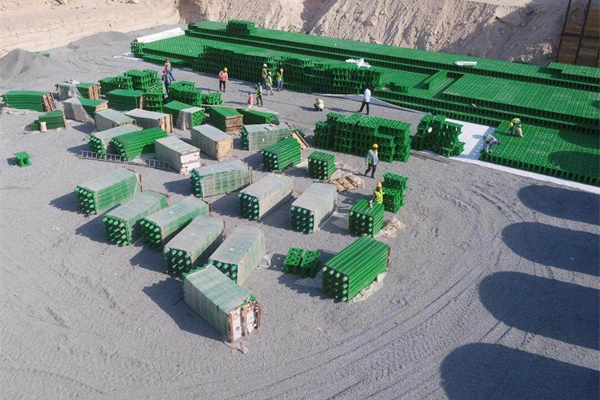
a 40HQ container loaded with up to 330 m³ of installed storage, optimising stack space

03

a typical 15-30 day lead time following confirmation of order

04 INCOTERMS & RISK

The term we are best able to supply on is FOB Shenzhen / Yantian / Shekou. Please be aware that FOB is an Incoterms term of risk and cost, and for containerised cargo many of our UK based clients will purchase on a FCA basis – the overall delivered cost to your UK port/warehouse will be dependent on your shipping and insurance arrangements to the UK

05

We can provide complimentary shop-drawing and container-loading support with all project enquiries.

06

OEM / ODM services are available to distributors.

Importing drainage crates — the real checklist

Trade-forum fear about overseas supply is real -untraceable vendors, variable batches, and delivery delays. Use paperwork to manage risk, not cost – request the compression/vertical-load test report linked to the batch, ISO system certs, a stamped shop-drawing, and a written lead-time in your contract. A manufacturer of substance answers these four without hesitation.

For unit pricing and lead time on your volume,

Request a project quote
ENGINEERING RESOURCES

Heavy Duty Soakaway Design Tools & Calculators

Essential tools and checklists for specifying heavy-duty trafficked soakaways. Select a tool below to configure your site requirements.

SPECIFICATION INQUIRY

Get the Right Heavy Duty Soakaway Spec’d for Your Site

Just tell us your storage volume and your load class and we will get back to you with an FOB price, the shop-drawing and the design specification including a separate and distinct crate rating and cover rating.

FAQ: Heavy Duty Soakaway Crates

No, not as implied. D400 EN 124 is a test rating for a surface cover and frame against a 400kN load and is not an assessment of buried crates. A crate has its own compression test rating from its manufacturer for its vertical load, and is buried under cover sufficient to support the intended traffic loading.

Ordering on the wrong number is an expensive mistake because the D400 label describes the lid, not the box underneath – so ask for two figures: the crate’s tested vertical rating (Storm Manage sends it from the compression test report) and the cover’s EN 124 class.

No, 60 tonnes means 600kN (Class E600) while D400 means 400kN. Don’t accept a quote that says ‘60 tonne D400’ as they are combining the two. Check the compression rating on the manufacturer’s test report.

Deeper than the 500mm we often see. A driveway will generally be 500mm to 800mm. HGV’s and heavily trafficked areas will need significantly more – typically 800mm to 1.2 metres designed specifically to the load requirements.

No – usually a compacted granular surround with the crates wrapped in geotextile. Only very specific designs will have a slab on top or concrete encasement. This will depend on the site design and calculations.

Yes, if the right product rating and installation depth are selected. In a car park situation the stormwater runoff will have oil residue so needs to go through a silt trap, and where applicable an oil separator before the crates as they are not a water treatment product.

All our Storm Manage crates have a 50 year life design expectation (PP). This depends on the crates being installed as designed and to specification.