We use the details you submit to review and respond to your project enquiry. Entries are handled in this website’s WordPress database using Fluent Forms; our hosting and email providers may process the submitted details. Other technical providers receive only the data described in our Privacy Policy.
Please do not send passwords, payment-card details, government identification numbers, sensitive personal data, or unnecessary confidential third-party information.
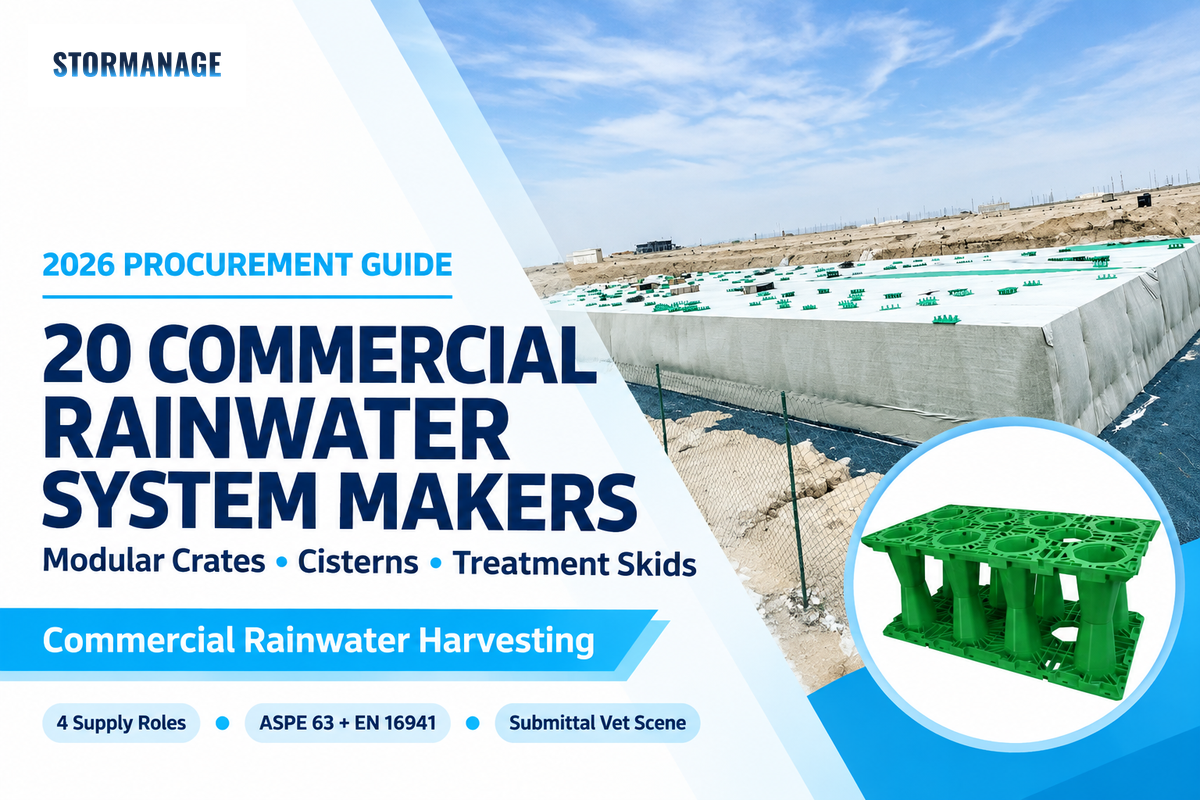
The top 20 commercial rainwater harvesting system manufacturers include modular polypropylene underground crate molders, monolithic cistern fabricators, and indoor treatment skid builders. Together they cover buried tanks from 600 gallons up, above-ground steel reservoirs over 5 million gallons, and pump skids rated from 15 to 300+ GPM. Storm Manage, Otto Graf GmbH, and Wavin mold modular underground storage crates. Watts Water Technologies, Wahaso, Rainwater Management Solutions, and Stormsaver build turnkey pump and disinfection skids. Contech, ADS StormTech, and Xerxes fabricate large subsurface cisterns, while WISY AG produces stainless-steel vortex pre-filtration hardware.
Commercial properties and agriculture estates rely on harvesting rainwater from rooftops to reduce municipal water usage and improve corporate sustainability. Engineers capture rain from commercial properties’ and agriculture estates’ rain gutters to supply cooling tower make-up water, industrial process water, and toilet flushing while lessening the effects of peak runoff. Engineered collection solutions help conserve water and reduce water bills while protecting fresh water, domestic water, municipal water supplies, and the regional supply of water.
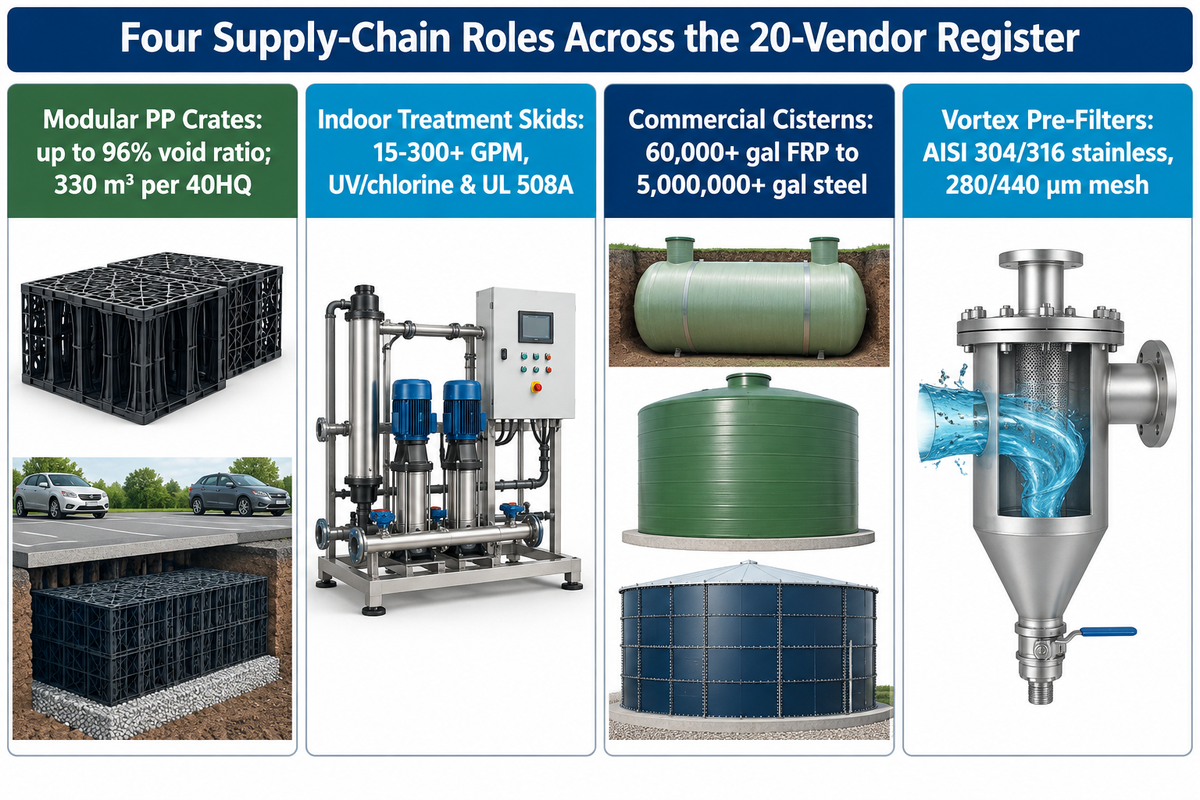
Separating four distinct supply-chain roles is a prerequisite to requesting a quotation from a commercial vendor. Geocellular crate makers that use a modular approach fabricate subsurface storage matrices that are placed beneath commercial car parks and loading bays. Skid integrators assemble duplex indoor booster pumps with micron filters and UV reactors. Monolithic cistern fabricators wind fiberglass cylinders or roll corrugated metal pipes, while hydraulic specialists build self-cleaning vortex pre-filters.
Quick Picks: Who Are the Leading Commercial Rainwater Harvesting System Manufacturers for Large Commercial and Industrial Buildings?
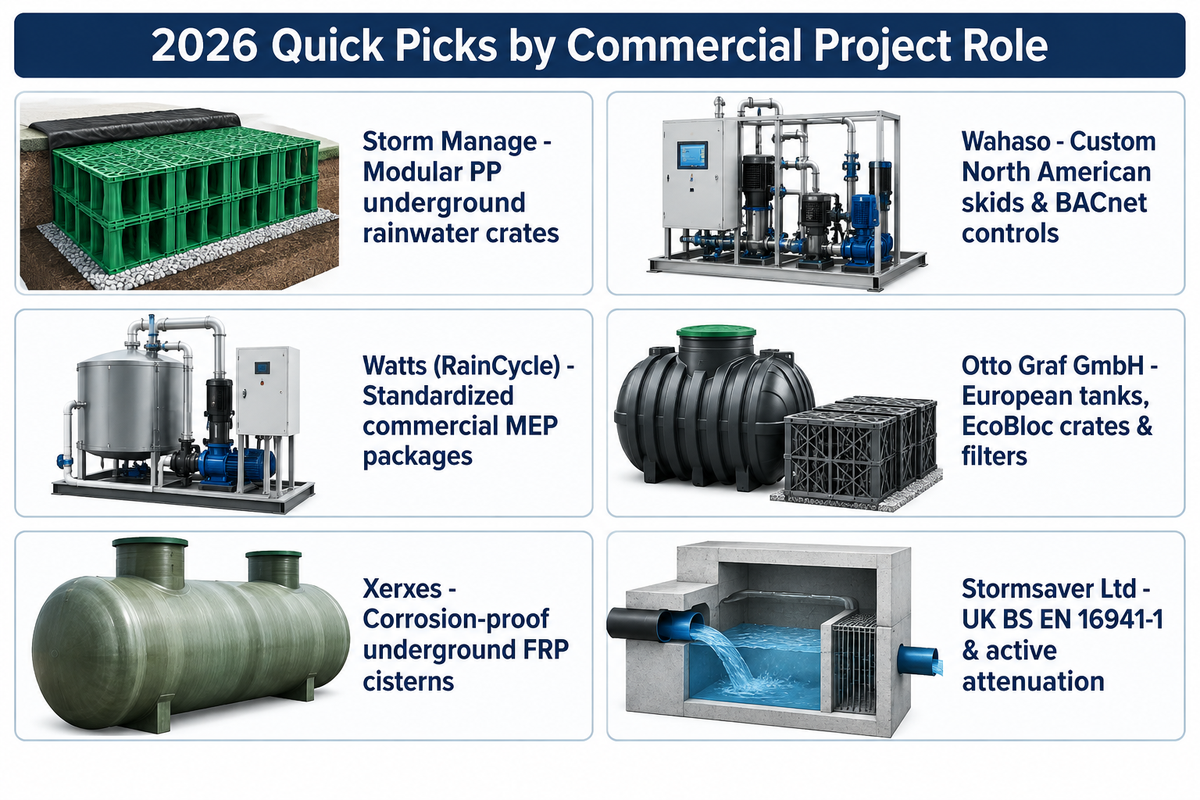
Storm Manage, Wahaso, Watts Water Technologies, Otto Graf GmbH, Xerxes, and Stormsaver are six notable commercial rainwater harvesting system manufacturers across key project roles in 2026. These six producers cover subsurface stormwater harvesting crates, buried cisterns, and factory-tested indoor skids that operate as an integrated system.
UK BS EN 16941-1 commercial rainwater recycling and active stormwater attenuation: Stormsaver Ltd
Disclosure: This guide is published by Storm Manage. We list ourselves first because this is our website, not because we claim to be the market leader. The other 19 manufacturers are grouped by what they’re best for, in no particular order within each group.
How We Selected These Commercial Rainwater Harvesting System Manufacturers
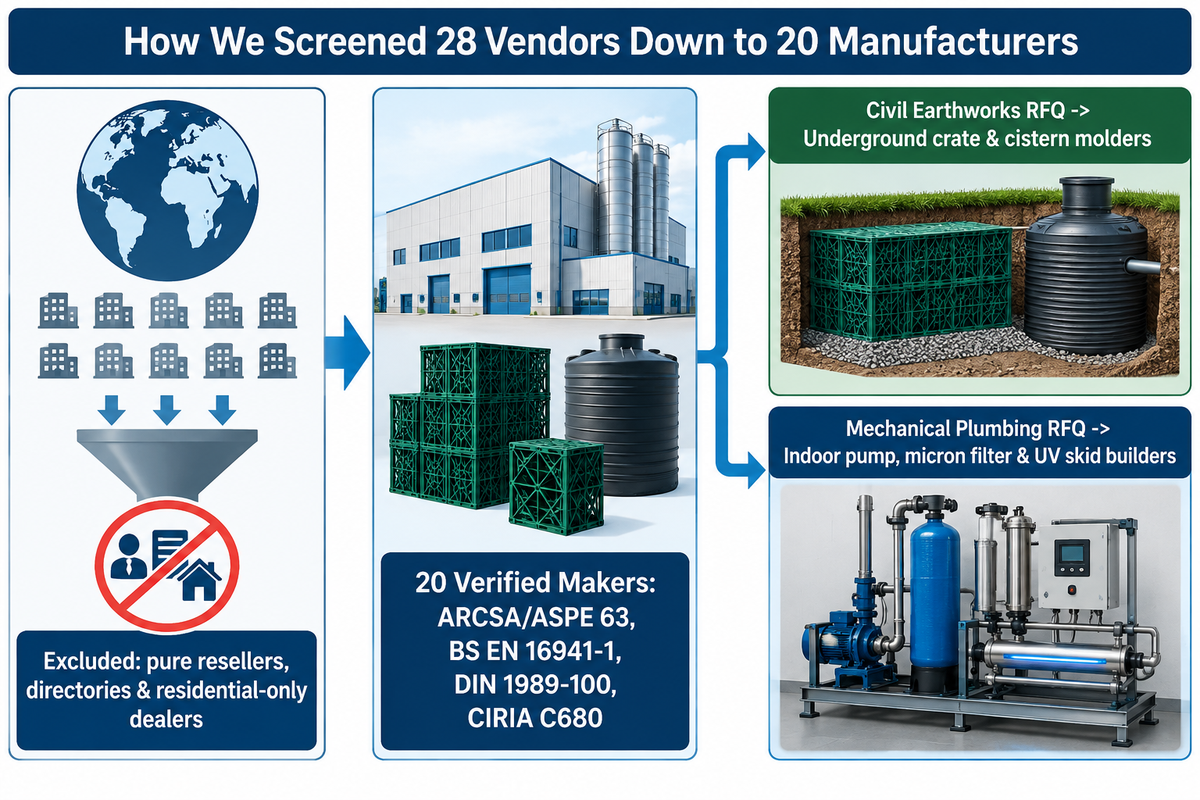
In this study, we assessed 28 global rainwater harvesting companies and manufacturers and identified 20 commercial rainwater harvesting system manufacturers with documented molding or skid-integration facilities. All manufacturers on our shortlist support large commercial projects with published storage capacities and engineering submittals.
Where published on the manufacturers’ websites, referenced product lines mention standards or design guides such as ARCSA/ASPE/ANSI 63, BS EN 16941-1, DIN 1989-100, CIRIA C680/C737, or AASHTO HS-20. We excluded pure resellers without a dedicated production base, distributors, sourcing platforms, directories, media websites, and used-equipment dealers. We excluded residential rainwater collection dealers and local tank installers who only serve a single region, such as Central Texas. In October 2026, we checked company information and published standard references against official websites and public documentation.
Commercial rainwater harvesting projects integrate civil earthworks with mechanical plumbing. There’s no single factory that integrates the entire system by molding an underground tank, welding stainless steel filters, and wiring a programmable logic controller (PLC). We evaluate manufacturers based on what they physically make. This clear demarcation doesn’t allow civil contractors to submit an underground crate request to an indoor pump-skid integrator. It doesn’t allow mechanical engineers to send a tank molder a request for a factory-wired ultraviolet (UV) sanitation panel.
Summary Comparison Table of the 20 Commercial Rainwater Harvesting System Manufacturers
The side-by-side matrix below shows headquarters, founded years, supply-chain roles, storage or treatment architectures, and procurement limits for all 20 manufacturers. Civil engineers can identify which factories mold sub-surface chambers for stormwater runoff. Mechanical engineers can compare indoor water treatment systems, greywater systems, and automated control system panels to simplify system design.
20-Vendor Procurement Role & Subsurface Architecture Register
No.
Company Name
Headquarters
Founded Year
Best For
Brief Introduction
System Architecture & Storage Type
Key Advantages
Potential Disadvantages
Official Website
1
Storm Manage
Shenzhen, Guangdong, China
2013
Modular PP underground rainwater storage and attenuation crates
Export brand of geocellular polypropylene rainwater and stormwater storage systems backed by an injection-molding base.
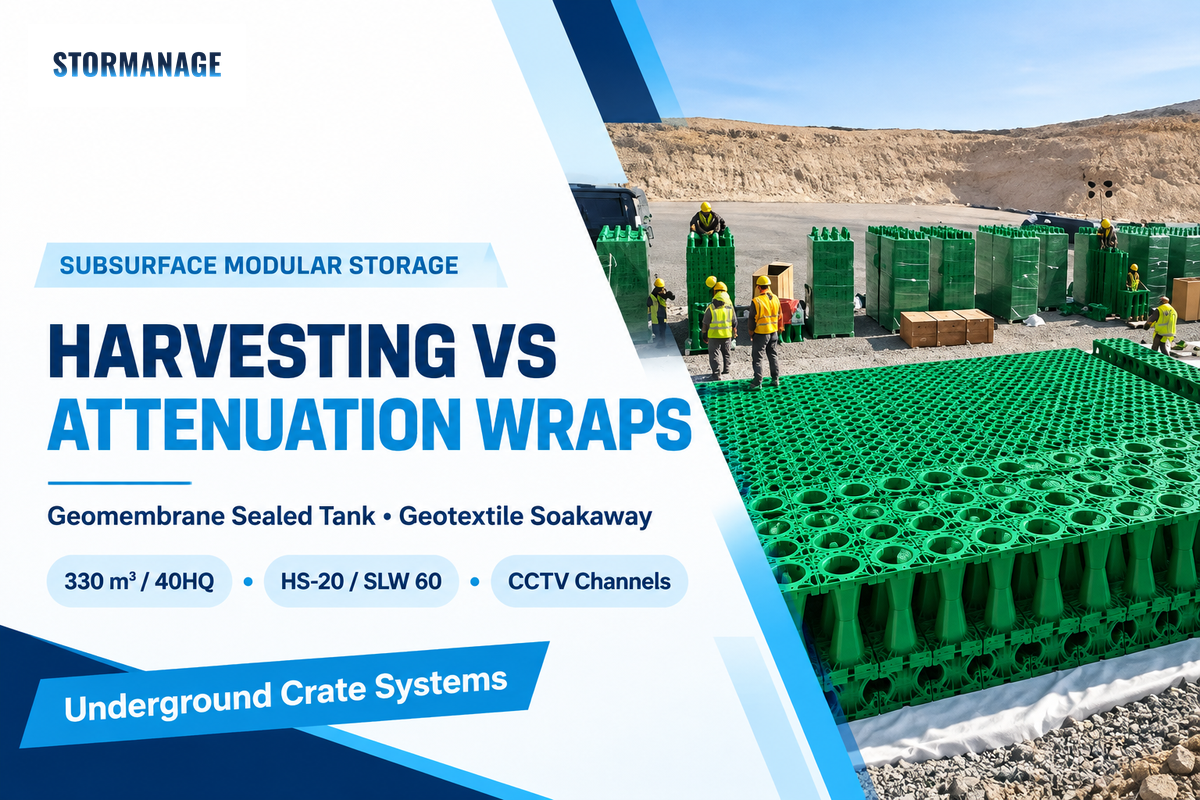
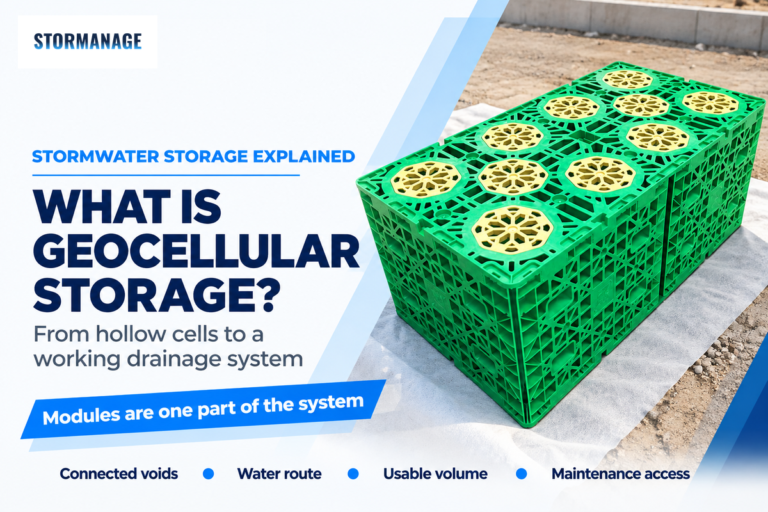
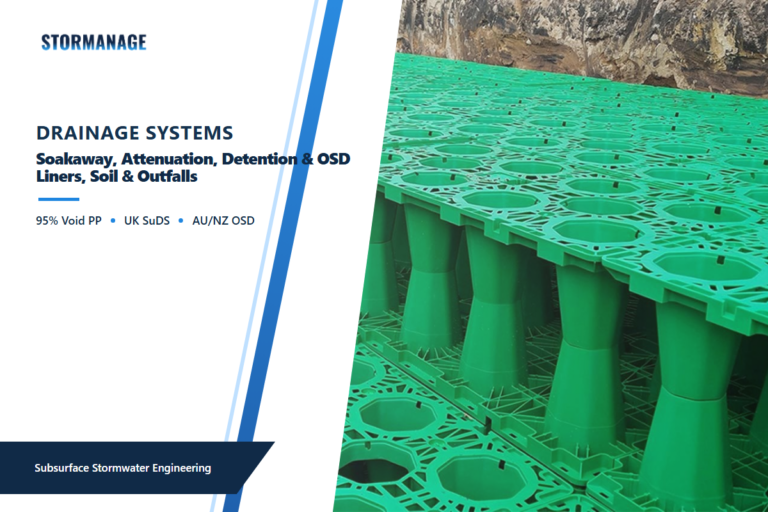
Commercial building footprints rarely leave open ground for surface water tanks. Civil engineers therefore place the storage volume beneath parking lots, fire lanes, or landscaped plazas. Storm Manage ships flat-packed polypropylene crates up to 330 m³ per 40HQ container, while ACO Stormbrixx half-elements nest on pallets for compact transport. Wrapping the crate matrix in an impermeable geomembrane creates a sealed rainwater tank that supplies water for irrigation and indoor reuse. Wrapping the same matrix in non-woven geotextile creates a stormwater infiltration soakaway for full-service water management.
1. Storm Manage: Best for Modular Polypropylene Underground Rainwater Storage and Attenuation Crates
Storm Manage is an export brand for modular underground stormwater and rainwater storage crates backed by a Shenzhen production base. That injection-molding production base was established in 2013 with 200+ molding machines and 600,000 m³/year capacity. The factory ships container-ready packages that load up to 330 m³ of installed storage volume into a single 40HQ container. Review full crate specs on our commercial rainwater harvesting system page, inspect our Shenzhen injection-molding production base, or explore our modular underground stormwater storage systems.
Headquarters: Shenzhen, Guangdong, China.
Founded: 2013 (injection-molding production base established).
Type: Export brand and supplier of modular underground stormwater and rainwater storage systems backed by an injection-molding production base.
Main Products: Polypropylene soakaway crates, modular attenuation and detention tanks, rainwater harvesting storage modules, geotextiles, and impermeable geomembranes.
Manufacturing Capabilities: 600,000 m³/year production capacity across 12+ mould sets, 3–10 days standard lead time, Susdrain-cited up to 96% void ratio context, and CIRIA C680 load test reports (with CIRIA C737 design-guide context).
Certifications: ISO 9001:2015, ISO 14001:2015, and ISO 45001:2018 management-system certifications.
Notable Work: Backed by a Shenzhen injection-molding base with 200+ machines, 600,000 m³/year capacity, and up to 330 m³ installed storage volume per 40HQ container.
Best For: Container-ready modular polypropylene underground rainwater harvesting and stormwater attenuation crate systems for commercial developments.
Buying Limitation: Focuses exclusively on underground modular polypropylene storage crates and geosynthetic accessories rather than factory-assembled indoor UV or chlorination pump skids.
Website: stormmanage.com.
2. Otto Graf GmbH: Best for Integrated European Underground Tanks, Modular Blocks, and Vortex Pre-Filters
Founded in 1962 in Teningen, Otto Graf GmbH manufactures monolithic underground rainwater tanks and inspectable geocellular blocks in Germany. Its injection-molded Carat XXL tanks scale up to 122,000 liters per vessel. Its EcoBloc Inspect flex modules allow camera inspection beneath heavy-traffic commercial slabs. Graf also runs its own raw-material recycling center in Herbolzheim to maintain consistent polymer stiffness under SLW 30 vehicle loads.
Headquarters: Teningen, Baden-Württemberg, Germany.
Founded: 1962.
Type: Polymer rainwater tank and modular geocellular stormwater system manufacturer.
Main Products: Carat XXL commercial underground tanks, Platin flat tanks, EcoBloc Inspect flex modular crates, and Optimax Pro internal rainwater filters.
Manufacturing Capabilities: In-house polymer recycling in Herbolzheim and injection, blow, and rotational molding in Teningen aligned with DIN 1989 rainwater standards and SLW 30 vehicle loading.
Management Systems, Standards & Approvals: ISO 9001 and ISO 50001 management certifications; DIN 1989 rainwater standards; DIBt structural approvals.
Notable Work: Manufactures injection-molded Carat XXL underground tanks up to 122,000 liters and EcoBloc Inspect modular blocks across its German production facilities.
Best For: European commercial underground rainwater tanks (Carat XXL) and inspectable EcoBloc modular infiltration/retention blocks.
Buying Limitation: Large monolithic Carat XXL tanks have higher ocean freight volume per cubic meter than flat-packed geocellular crates when shipping outside Europe.
Website: graf.info.
3. Wavin (Orbia): Best for Q-Bic Plus Inspectable Modular Geocellular Stormwater and Rainwater Tanks
Established in 1955 in Zwolle, Wavin operates as the Building and Infrastructure business of Orbia across 65+ plants worldwide. Its flagship Q-Bic Plus geocellular module eliminates internal support columns to create unobstructed bi-directional tunnels. Facility crews use those open channels for CCTV cameras and hydro-jetting nozzles. Snap-fit push-together connectors also speed up excavation assembly on commercial retail parks and logistics hubs.
Headquarters: Zwolle, Netherlands.
Founded: 1955.
Type: Global plastic pipe systems and urban stormwater resilience manufacturer (Orbia Building & Infrastructure).
Main Products: Q-Bic Plus, AquaCell NG geocellular crates, Vortex flow control valves, and PolderRoof smart blue-green roof rainwater retention systems.
Manufacturing Capabilities: 65+ manufacturing plants worldwide with BIM modeling packages, BS EN 17152-1 geocellular box design, and snap-fit column-free inspection channels.
Certifications: BBA Agrément certificates for Q-Bic Plus and AquaCell modular attenuation systems.
Notable Work: Produces Q-Bic Plus and AquaCell NG polypropylene attenuation modules engineered with open internal channels for CCTV inspection and hydro-jet cleaning.
Best For: Bi-directionally inspectable Q-Bic Plus and AquaCell NG geocellular attenuation and rainwater harvesting matrices.
Buying Limitation: Procured primarily through regional civil building-materials distributors rather than factory-direct container orders for independent mechanical contractors.
Website: wavin.com.
4. Advanced Drainage Systems (ADS StormTech): Best for Open-Bottom and Closed-Chamber Subsurface Stormwater Storage
Headquartered in Hilliard, Ohio since 1966, Advanced Drainage Systems (ADS) operates 70+ plants across North America. Its StormTech MC-3500 and MC-7200 arch chambers are molded from polypropylene to meet AASHTO LRFD bridge live loads under parking lots. For commercial rainwater reuse, ADS pairs its lined StormTech chambers and N-12 pipes with WISY vortex pre-filters. It also bundles RMS indoor treatment skids into a unified North American submittal package.
Main Products: StormTech subsurface chambers (SC-740, MC-3500, MC-7200), N-12 HDPE detention pipe, Isolator Row Plus, and Barracuda hydrodynamic separators.
Manufacturing Capabilities: 70+ manufacturing plants and 35+ distribution centers across North America molding chambers to ASTM F2418 and ASTM F2922 specifications for AASHTO LRFD (HS-20 / HL-93) vehicle loading with ADS Design Tool layouts.
Standards & Specifications: Chambers molded to ASTM F2418 and ASTM F2922 product specifications; designed for AASHTO LRFD (HS-20 / HL-93) vehicle loading (third-party certificate numbers not listed on commercial harvesting page).
Notable Work: Integrates StormTech MC-3500 and MC-7200 polypropylene arch chambers with RMS treatment skids and WISY vortex filters for North American commercial water harvesting.
Best For: AASHTO LRFD open-bottom and lined arch chambers (StormTech) and Barracuda hydrodynamic separators under North American parking lots.
Buying Limitation: Arch-chamber installations require specific crushed-stone embedment envelopes that increase excavation volume compared to vertical-wall rectangular crate stacks.
Website: adspipe.com.
5. Polypipe Civils & Green Urbanisation (Genuit Group): Best for Permavoid Shallow Sub-Base Geocellular Rainwater Harvesting
Founded in 1980 in Loughborough, Polypipe Civils & Green Urbanisation is part of Genuit Group plc. It manufactures both deep-burial attenuation cells and shallow sub-base rainwater harvesting rafts. Its Polystorm PSM cells withstand up to 60–80 tonnes per square meter under heavy commercial vehicles when engineered to CIRIA C680 / C737. Its 85 mm and 150 mm Permavoid interlocking units sit directly beneath permeable paving or sports pitches without deep trenching.
Headquarters: Loughborough, Leicestershire, United Kingdom.
Founded: 1980.
Type: Engineered thermoplastic civil drainage and geocellular water management manufacturer (Genuit Group plc).
Main Products: Polystorm PSM modular attenuation cells, Polystorm Inspect, Permavoid shallow sub-base cells, and Ridgistorm-XL large-diameter structured wall tanks.
Manufacturing Capabilities: Structural design aligned with CIRIA C680 / C737 and up to 60–80 t/m² vertical compressive load capacity across multi-layered geocellular rafts.
Notable Work: Engineers high-strength Polystorm deep-burial geocellular units and shallow Permavoid 85mm/150mm interlocking rafts for sub-pavement rainwater harvesting.
Best For: Shallow sub-base Permavoid geocellular passive irrigation and deep Polystorm commercial rainwater attenuation tanks.
Buying Limitation: Distribution and technical design sign-off are heavily concentrated in the UK and Middle East specifications market rather than North America.
Website: polypipe.com.
6. ACO Group: Best for Stormbrixx Modular Geocellular Attenuation and Commercial Surface Drainage Integration
Founded in 1946 in Rendsburg, Germany, ACO Group operates 36 production sites across 18 countries. Its Stormbrixx SD and HD polypropylene modules use a patented half-element geometry that nests tightly on shipping pallets. Crews click the half-elements together in a brick-bonded configuration on site for high structural stability. Civil engineers frequently pair Stormbrixx tanks with ACO Qmax slot drains and Oleopator coalescence separators on commercial logistics aprons.
Type: Global surface water drainage, pretreatment separator, and geocellular attenuation manufacturer.
Main Products: ACO Stormbrixx SD and HD modular polypropylene tanks, Qmax high-capacity slot drains, Oleopator oil/coalescence separators, and Q-Brake vortex flow controls.
Manufacturing Capabilities: 36 production sites across 18 countries manufacturing hardware to EN 1433 channel drainage and EN 858 oil separator standards.
Technical Approvals: DIBt Z-42.1-521 national technical approval for Stormbrixx geocellular storage systems.
Notable Work: Supplies the patented Stormbrixx SD and HD stackable half-elements that nest for compact transport and brick-bond on site for structural stability.
Best For: Brick-bonded Stormbrixx HD geocellular rainwater storage combined with commercial slot-drain surface capture and oil separators.
Buying Limitation: Requires factory-matched side panels, top covers, and layer connectors that lock buyers into proprietary ACO accessories during site expansion.
Website: aco.com.
7. Hauraton GmbH & Co. KG: Best for Drainfix Bloc Modular Infiltration and Commercial Channel Pre-Treatment
Headquartered in Rastatt since 1956, Hauraton GmbH & Co. KG builds heavy-duty surface drainage channels and subsurface retention blocks. Its Drainfix Bloc 300 polypropylene modules feature an integrated inspection tunnel and are engineered for SLW 60 heavy-truck vehicle loading when installed to cover specifications. Hauraton pairs these blocks with Drainfix Clean channels containing Carbotec carbonate media to trap heavy metals before storage.
Headquarters: Rastatt, Baden-Württemberg, Germany.
Founded: 1956.
Type: Surface drainage, runoff filtration, and underground geocellular infiltration/retention manufacturer.
Main Products: Drainfix Bloc polypropylene infiltration/retention modules, Drainfix Clean substrate filter channels, and Sportfix/Recyfix drainage systems.
Manufacturing Capabilities: Drainfix Bloc 300 polypropylene modules with an integrated inspection tunnel, designed for heavy commercial SLW 60 vehicle loading and DWA-A 138 infiltration criteria.
Technical Approvals: DIBt structural approval for subsurface Drainfix infiltration and retention modules.
Notable Work: Combines Fasercell and Recyfix surface channels with Carbotec carbonate-media filtration and Drainfix Bloc underground storage designed for SLW 60 vehicle loading.
Best For: Heavy-traffic surface runoff treatment (Drainfix Clean) paired with Drainfix Bloc underground polypropylene retention.
Buying Limitation: Specializes in hardscape and logistics-yard runoff treatment and infiltration rather than indoor building-plumbing pressure booster skids.
Website: hauraton.com.
8. Pipelife International GmbH (Wienerberger): Best for Raineo Bidirectional Inspectable Modular Stormwater Storage Systems
Founded in 1989 in Vienna as part of Wienerberger AG, Pipelife International GmbH operates across 24 European countries. Its Raineo line integrates Stormbox and Stormbox II geocellular polypropylene crates with bidirectional inspection channels. The package includes silt catch-basins, Pragma collector pipes, and vortex flow regulators. Pipelife also installs wireless water-level and sediment sensors inside the Raineo chamber array for facility managers.
Headquarters: Vienna, Austria.
Founded: 1989.
Type: European plastic pipe and Raineo modular stormwater/rainwater storage system manufacturer (Wienerberger AG).
Main Products: Raineo Stormbox and Stormbox II geocellular crates, PRO inspection chambers, oil/silt traps, and vortex flow regulators.
Manufacturing Capabilities: Operates in 24 countries with automated Raineo hydraulic sizing software and bidirectional Stormbox II inspection channels.
Certifications: KOMO and KIWA product quality certifications across European manufacturing subsidiaries.
Notable Work: Delivers the full Raineo stormwater management line combining Stormbox I/II geocellular crates with Pragma polypropylene pipes and IoT water-level monitoring.
Best For: Integrated Raineo modular storm boxes, sediment catch-basins, and smart monitoring sensors for municipal and commercial parks.
Buying Limitation: Operates primarily across European country subsidiaries, with limited direct project distribution in the United States.
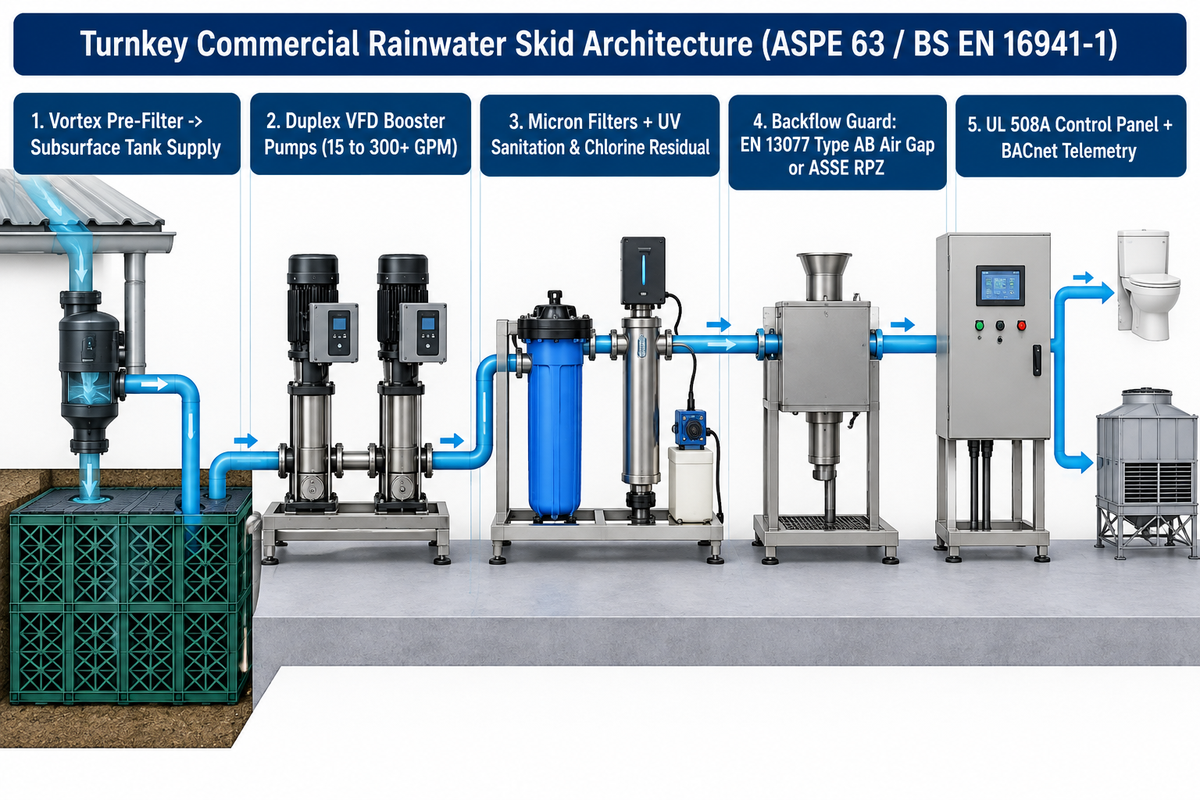
Only half of a commercial rainwater collection system involves water capture. Indoor reuse for toilet flushing, cooling towers, or commercial laundries follows local water quality codes and design standards such as ARCSA/ASPE/ANSI 63-2020 or BS EN 16941-1:2024. Facility engineers specify indoor treatment systems for both non-potable applications and potable systems built with NSF/ANSI 61 listed water-contact components. The six manufacturers below build pre-plumbed, factory-tested pump, filtration, sanitation, and control skids that draw from underground tanks or crate arrays.
9. Watts Water Technologies (RainCycle): Best for Pre-Engineered North American Commercial Rainwater Treatment Skids
Founded in 1874 in North Andover, Massachusetts, Watts Water Technologies is a major North American commercial plumbing manufacturer. Its RainCycle skid bundles vortex pre-filtration, micron filtration, SmartStream UV disinfection, variable-frequency pumps, and Watts RPZ or air-gap backflow prevention. Mechanical engineers favor RainCycle because Watts provides ready-to-use CSI 3-part specifications and Revit BIM families. Local commercial plumbing representatives back every package with field submittals.
Best For: Standardized North American commercial MEP rainwater harvesting skids (RainCycle) with factory-backed backflow and UV integration.
Buying Limitation: Focuses on the indoor treatment, pumping, and control package while relying on third-party tank or geocellular crate manufacturers for large underground retention volume.
Website: watts.com.
10. Wahaso (Water Harvesting Solutions, Inc.): Best for Custom-Engineered Multi-Source Commercial Cistern and BAS Skids
Based in Lombard, Illinois, Wahaso has operated since 2004 and builds custom commercial water reuse systems for LEED Platinum campuses. Its StormFlo skid series processes flows from 15 GPM to over 300 GPM. Each skid combines self-cleaning filters, ultraviolet sanitation, and continuous chlorine residual analyzers. Wahaso also blends rooftop rainwater, foundation groundwater, and HVAC condensate using a listed industrial control panel with BACnet telemetry.
Headquarters: Lombard, Illinois, USA.
Founded: 2004.
Type: Commercial rainwater, stormwater, greywater, and condensate harvesting skid manufacturer and design-build integrator.
Main Products: StormFlo commercial rainwater harvesting skids, multi-media/bag filtration modules, UV and chlorine residual dosing systems, and BACnet PLC controllers.
Manufacturing Capabilities: Daily rainfall mass-balance modeling and factory-tested turnkey skids rated from 15 GPM to over 300 GPM.
Certifications & Listings: IAPMO R&T product listings (IAPMO 324 and NSF/ANSI 350) and U.S. Green Building Council (USGBC) membership.
Notable Work: Engineers StormFlo commercial rainwater harvesting skids processing 15 to 300+ GPM with automated backwash filtration, UV/chlorine sanitation, and BACnet BAS integration.
Best For: Custom-engineered StormFlo commercial rainwater and greywater harvesting skids for LEED and Net-Zero institutional buildings.
Buying Limitation: Custom PLC-controlled skids carry higher upfront capital cost and engineering lead times than standardized rainwater transfer pump sets.
Website: wahaso.com.
11. Rainwater Management Solutions (RMS): Best for 3D-Modeled Skid-Mounted Commercial Filtration and Pump Systems
Founded in 1998 and operating from Roanoke and Salem, Virginia, Rainwater Management Solutions (RMS) contributed to early North American rainwater catchment standards. It also serves as the primary North American distributor for WISY stainless-steel vortex filters. RMS fabricates pre-plumbed, skid-mounted duplex pump and UV/ozone packages alongside its Series 100 to Series 600 controllers. Its engineers run daily historical rainfall simulations to help architects avoid oversizing underground cisterns.
Main Products: Pre-plumbed skid-mounted duplex pump and UV/ozone treatment packages, RMS Series 100/200/300 controllers, calming inlets, and floating cistern extractors.
Manufacturing Capabilities: Full-scale 3D CAD/BIM modeling, daily rainfall simulation, rainwater-catchment standards committee participation, and custom treatment skids for schools, data centers, and military bases.
Compliance & Design Scope: Systems engineered for local health, building-code, and Authority Having Jurisdiction (AHJ) compliance (third-party certificate numbers not listed on commercial harvesting service page).
Notable Work: Provides turnkey pre-plumbed commercial treatment skids, Series 100–600 controllers, and daily historical rainfall ROI modeling from its Virginia facility.
Best For: Turnkey commercial pump/treatment skids, WISY vortex filter distribution in North America, and 3D hydraulic modeling.
Buying Limitation: Acts as a system integrator and North American filter distributor that sources large underground storage tanks from partner tank fabricators.
Website: rainwatermanagement.com.
12. Stormsaver Ltd: Best for UK Packaged Commercial Rainwater Recycling and Header-Tank Control Units
Founded in 2002 in Newark, Stormsaver Ltd has delivered over 3,000 commercial rainwater systems across UK schools, warehouses, and hospitals. Stormsaver specializes in UK indirect gravity header-tank architectures and compact Combi-Tank pump units. An air gap physically separates the potable makeup supply from harvested water; EN 13077 covers Type AB air gaps used for Fluid Category 5 protection in UK installations, while North American requirements follow the applicable plumbing code. Its Smart SuDS active attenuation platform links tank discharge valves to live weather forecasts to satisfy Lead Local Flood Authority (LLFA) rules.
Headquarters: Newark, Nottinghamshire, United Kingdom.
Founded: 2002.
Type: UK commercial rainwater harvesting, greywater recycling, and active stormwater attenuation manufacturer.
Main Products: Commercial rainwater harvesting control panels, Combi-Tank break/header tanks, GRP underground tanks, and Smart SuDS active attenuation systems.
Manufacturing Capabilities: Over 3,000 UK commercial installations aligned with BS EN 16941-1:2024 and BS 8515, backed by nationwide commissioning engineers.
Approvals & Accreditations: WRAS approved valve and air-gap assemblies and SafeContractor accreditation.
Notable Work: Supplies UK commercial rainwater harvesting systems with Type AB air-gap break tanks, Combi-Tank pump packages, and active weather-forecast stormwater attenuation.
Best For: UK BS EN 16941-1 commercial rainwater harvesting header-tank systems and active dynamic stormwater attenuation.
Buying Limitation: Commissioning and maintenance service contracts are focused on the UK market, with export sales limited to equipment-only packages.
Website: stormsaver.com.
13. Kingspan Water & Energy: Best for Global Commercial GRP Tanks and Packaged Rainwater Harvesting Systems
Headquartered in Kingscourt, Ireland since 1965, Kingspan Group builds filament-wound glass-reinforced plastic (GRP) rainwater tanks through its Water & Energy division. Its commercial underground tanks scale from 6,000 liters to 300,000 liters under BS EN 976-1 structural specifications. Each tank ships with factory-fitted vortex filters, submersible pumps, and BMS-ready control panels. Kingspan therefore provides single-vendor warranty coverage across both the buried cylinder and the indoor control unit.
Headquarters: Kingscourt, County Cavan, Ireland.
Founded: 1965.
Type: Global building envelope and GRP/polyethylene commercial water management tank manufacturer.
Main Products: Commercial GRP underground rainwater harvesting tanks (6,000L to 300,000L), gamma header tank booster sets, and Klargester silt/oil separators.
Manufacturing Capabilities: Global manufacturing across Europe, UK, and Australia with BS EN 976-1 underground GRP structural tank fabrication and BMS telemetry.
Approvals & Standards: WRAS approved air-gap assemblies and BS EN 976-1 underground GRP tank fabrication.
Notable Work: Manufactures filament-wound GRP underground commercial rainwater tanks up to 300,000 liters paired with Klargester/EauZone smart pump control panels.
Best For: Factory-assembled GRP commercial underground rainwater harvesting tanks (EauZone / Titan) with integrated pump controls.
Buying Limitation: One-piece filament-wound GRP cylinders require wide-load flatbed transport and crane lifting on tight urban construction sites.
Website: kingspan.com.
14. Ecovie Water Management: Best for Commercial Multi-Residential Rainwater and Greywater Reuse Skids
Founded in 2009 with offices in Oak Park, Illinois and Miami, Florida, Ecovie Water Management builds decentralized water recycling packages. It serves multi-family residential buildings, hotels, and commercial office towers across North America. Ecovie integrates Purain self-cleaning pre-filters and NSF/ANSI 350 certified Aqualoop water-reuse systems with compact UV sanitation skids. Its cloud telemetry tracks daily municipal water savings for LEED and Living Building Challenge submittals.
Headquarters: Oak Park, Illinois / Miami, Florida, USA.
Founded: 2009.
Type: Decentralized commercial rainwater and greywater treatment skid integrator.
Main Products: Packaged commercial UV/chlorine booster skids integrating INTEWA Aqualoop ultrafiltration membrane systems and Purain self-cleaning rainwater pre-filters.
Manufacturing Capabilities: Decentralized membrane bioreactor and rainwater purification integration for LEED Platinum and Living Building Challenge green building projects.
Certifications: NSF/ANSI 350 certification for Aqualoop greywater and rainwater reuse treatment systems.
Notable Work: Designs and builds compact skid-mounted commercial rainwater and greywater recycling packages with automated self-cleaning filters and cloud monitoring.
Best For: Integrated commercial rainwater and greywater treatment skids with ultrafiltration for multi-family and office towers.
Buying Limitation: Focuses on indoor decentralized water-treatment skids rather than manufacturing heavy subsurface civil storage tanks or crates.
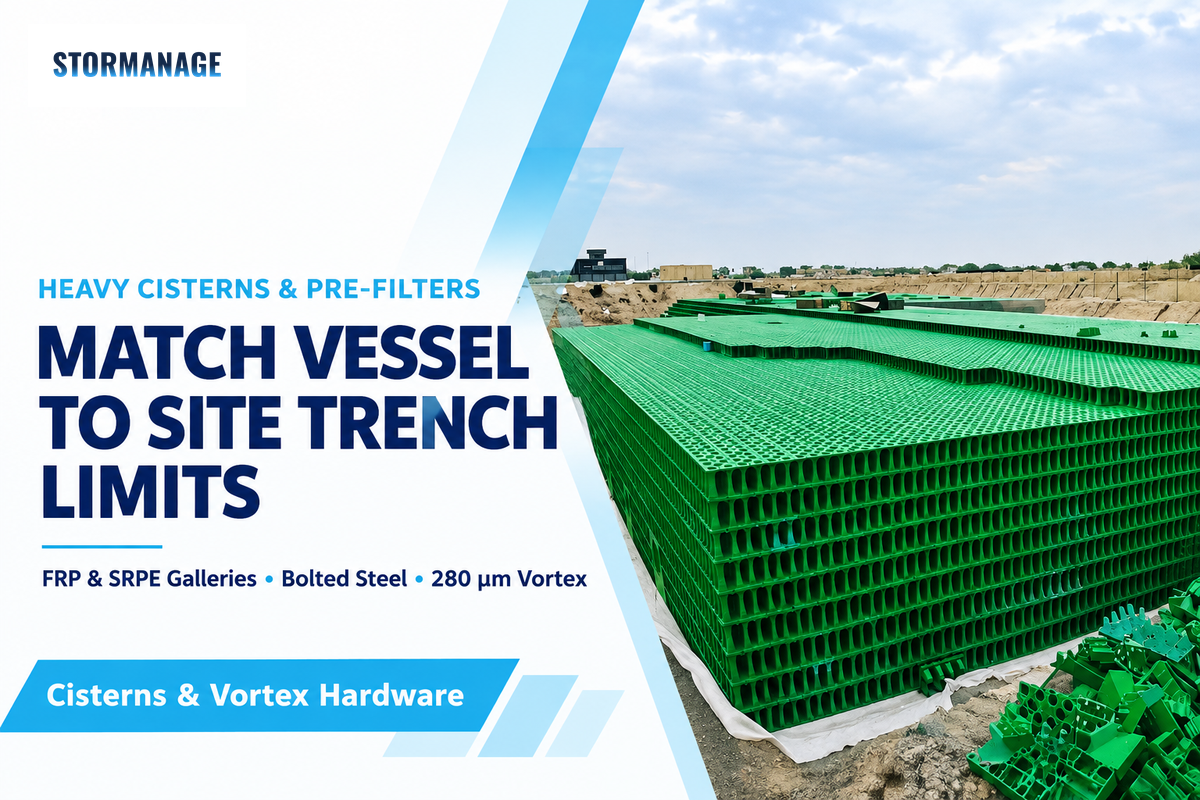
Certain industrial campuses and airports employ rigid underground pipe galleries or potable-grade fiberglass cylinders to store water. Other facilities require large above-ground multi-million gallon rainwater reservoirs made of bolted steel, or standalone vortex filters in concrete vaults. The six manufacturers listed below specialize in heavy cistern fabrication and pre-filtration hardware.
15. Contech Engineered Solutions: Best for Large-Diameter Metal, Precast, and Modular Subsurface Cisterns
Headquartered in West Chester, Ohio since 1986, Contech Engineered Solutions operates more than 50 manufacturing plants across North America. Contech fabricates custom-manifolded DuroMaxx steel-reinforced polyethylene (SRPE) cisterns and aluminized Type 2 corrugated metal pipe (CMP) galleries. Those buried pipe manifolds scale up to 120 inches in diameter under AASHTO HS-20 traffic loads. Engineers frequently place Contech’s CDS hydrodynamic separator upstream to trap trash and grit before storage.
Headquarters: West Chester, Ohio, USA.
Founded: 1986 (Armco Construction Products heritage dating to 1900s).
Main Products: DuroMaxx steel-reinforced polyethylene cisterns, aluminized Type 2 CMP cisterns, CDS hydrodynamic separators, and TerreArch precast chambers.
Manufacturing Capabilities: 50+ manufacturing plants across North America fabricating pipe cisterns up to 120-inch diameter to ASTM F2562 (DuroMaxx) and AASHTO M36 specifications for HS-20 / HL-93 vehicle loading.
Standards, Loading & Verifications: Product specifications ASTM F2562 (DuroMaxx) and AASHTO M36 (CMP); HS-20 / HL-93 vehicle loading; NJDEP and WA Ecology TAPE verified CDS pretreatment.
Notable Work: Manufactures custom-manifolded CMP, DuroMaxx SRPE, and precast concrete underground rainwater harvesting and stormwater detention vaults across North America.
Best For: Large-diameter corrugated metal pipe (CMP), DuroMaxx steel-reinforced polyethylene cisterns, and CDS hydrodynamic pretreatment.
Buying Limitation: Large-diameter pipe manifolds require heavy cranes and large trench footprints rather than hand-carried modular crates.
Website: conteches.com.
16. Xerxes (Mattr Infratech): Best for Corrosion-Resistant Underground Fiberglass (FRP) Commercial Water Cisterns
Founded in 1979 in Minneapolis within Mattr Corp., Xerxes is North America’s best-known producer of underground fiberglass-reinforced plastic (FRP) tanks. Its structurally ribbed FRP cisterns range from 600 gallons to over 60,000 gallons per cylinder. Multiple cylinders can be manifolded together for larger commercial storage demands. Because FRP never rusts or spalls, Xerxes tanks are widely specified for hospitals, data centers, and potable rainwater projects using optional potable-water resin.
Headquarters: Minneapolis, Minnesota, USA (Mattr Corp., Toronto).
Founded: 1979.
Type: Underground fiberglass-reinforced plastic (FRP) water, wastewater, and fuel storage tank manufacturer.
Main Products: Underground FRP potable and non-potable rainwater cisterns, HydroChain stormwater chambers, and prefabricated FRP pump and manway risers.
Manufacturing Capabilities: Multiple North American FRP filament-winding plants producing watertight cisterns in 4-foot to 12-foot diameters to AWWA D120 standards and AASHTO H-20 / HS-20 vehicle loading.
Notable Work: Fabricates single- and double-wall structurally ribbed fiberglass (FRP) underground water cisterns from 600 to 60,000+ gallons with a 30-year limited warranty.
Best For: Corrosion-proof underground fiberglass-reinforced plastic (FRP) commercial rainwater cisterns up to 60,000+ gallons.
Buying Limitation: Monolithic cylindrical FRP tanks require concrete deadman hold-down straps in high water tables and wide-load truck shipping.
Website: xerxes.com.
17. CST Industries, Inc.: Best for Bolted Factory-Coated Steel Above-Ground Commercial Rainwater Storage Tanks
Tracing its roots to 1893 in Kansas City, Missouri, CST Industries has installed over 350,000 bolted steel tanks in 125+ countries. CST supplies Aquastore glass-fused-to-steel and HydroTec epoxy-coated bolted panel tanks for above-ground commercial reservoirs. Storage capacities scale from 20,000 gallons to more than 5 million gallons. All steel panels are holiday-tested in the factory, shipped on compact pallets, and erected at ground level with hydraulic jacks.
Headquarters: Kansas City, Missouri, USA.
Founded: 1893.
Type: Factory-coated bolted steel storage tank and aluminum dome cover manufacturer (Solace Capital portfolio).
Main Products: Aquastore glass-fused-to-steel tanks, HydroTec epoxy-coated bolted tanks, CorGal galvanized corrugated tanks, and aluminum geodesic domes.
Manufacturing Capabilities: Over 350,000 storage tanks installed across 125+ countries engineered to AWWA D103-19 and EN ISO 28765 bolted steel tank standards with hydraulic jack field erection.
Approvals & Listings: FM Approved bolted steel fire and water storage tanks and potable-coating listings.
Notable Work: Manufactures Aquastore glass-fused-to-steel and HydroTec factory-applied epoxy bolted steel tanks scaling from 20,000 gallons to over 5 million gallons.
Best For: Large-scale above-ground bolted glass-fused-to-steel (Aquastore) and epoxy-coated steel commercial rainwater storage tanks.
Buying Limitation: Designed strictly for above-ground foundation pads rather than subsurface parking-lot installation.
Website: cstindustries.com.
18. WISY AG: Best for Stainless-Steel Vortex Rainwater Filters and Calming Cistern Intake Hardware
Founded in 1989 in Kefenrod, Germany, WISY AG invented the vertical stainless-steel vortex rainwater filter. Its WFF 150 and WFF 300 filters use capillary adhesion across a vertical 280-micron or 440-micron stainless mesh cylinder. Clean rainwater diverts into the storage tank while leaves and grit wash to the storm sewer. WISY also manufactures smoothing cistern inlets and floating suction intakes that draw water from the cleanest subsurface layer.
Headquarters: Kefenrod, Hesse, Germany.
Founded: 1989.
Type: Precision stainless-steel vortex rainwater filter and hydraulic component manufacturer.
Main Products: WFF 100, WFF 150, and WFF 300 commercial vortex fine filters (up to 3,000 m² roof area per filter), smoothing inlets, floating intake filters, and Multimat overflow siphons.
Certifications, Verifications & Conformity: DIN 1989-2 Type C filter test certification (superseded by DIN 1989-100:2022-07), ATV-DVWK verification, and European CE conformity.
Notable Work: Pioneered the vertical stainless-steel vortex rainwater filter (WFF 100/150/300) using capillary adhesion across 0.28 mm and 0.44 mm vertical mesh cylinders.
Best For: Stainless-steel vortex rainwater pre-filters (WFF 150 / WFF 300), smoothing inlets, and floating suction intakes.
Buying Limitation: Manufactures precision stainless-steel filtration and intake hardware rather than large commercial storage tanks or crates.
Website: wisy.de.
19. Snyder Industries (Tank Holding Corp.): Best for High-Capacity Rotational-Molded Polyethylene Commercial Rainwater Cisterns
Founded in 1957 in Lincoln, Nebraska within Tank Holding Corp., Snyder Industries is a major North American rotational molder of HDPE tanks. It molds one-piece vertical flat-bottom rainwater tanks up to 20,000 gallons for indoor mechanical rooms or outdoor pads. It also produces ribbed Captor underground cisterns for shallow non-traffic burial. Dark-tinted, UV-stabilized virgin HDPE resin blocks sunlight penetration to stop algae growth in above-ground commercial tanks.
Headquarters: Lincoln, Nebraska, USA.
Founded: 1957.
Type: Rotational-molded polyethylene water and industrial chemical storage tank manufacturer (Tank Holding Corp.).
Main Products: Vertical flat-bottom HDPE rainwater harvesting tanks (up to 20,000 gallons), Captor underground cisterns, and seismic/wind restraint clips.
Manufacturing Capabilities: Multi-plant North American rotational molding capacity producing algae-inhibiting dark-tinted virgin HDPE vessels engineered to polyethylene tank standards.
Certifications & Resin Compliance: NSF certified potable-water resin formulations and FDA food-contact compliant virgin polyethylene resins.
Notable Work: Produces one-piece rotational-molded UV-stabilized HDPE vertical rainwater tanks up to 20,000 gallons and modular underground cisterns across North America.
Best For: Rotational-molded high-density polyethylene (HDPE) commercial above-ground and shallow-burial rainwater cisterns.
Buying Limitation: Rotational-molded polyethylene underground cisterns have strict maximum burial depth limits and can’t take direct H-20 truck traffic without structural bridge slabs.
Website: snydernet.com.
20. Bushman Tanks (Bushmans Group Pty Ltd): Best for Industrial Poly and Steel Rainwater Harvesting Tanks
Established in 1989 in North Sydney, Bushman Tanks manufactures commercial rainwater vessels across Victoria, New South Wales, Queensland, and South Australia. For mid-sized commercial buildings, it molds one-piece Sunshield UV-20 stabilized polyethylene tanks up to 46,400 liters under AS/NZS 4766. For larger industrial estates, it builds Aqualine corrugated galvanized steel tanks with multi-layer food-grade polymer liners. Those bolted Aqualine reservoirs store from 20,000 liters up to 363,000 liters above ground.
Headquarters: North Sydney, New South Wales, Australia.
Founded: 1989.
Type: Commercial polyethylene and bolted steel rainwater tank manufacturer.
Main Products: Aqualine commercial steel rainwater tanks (20,000L to 363,000L), poly commercial tanks up to 46,400L, and stormwater detention orifices.
Manufacturing Capabilities: Manufacturing plants across Victoria, NSW, Queensland, and South Australia molding tanks to AS/NZS 4766 polyethylene standards with Sunshield UV-20 stabilization.
Certifications & Testing Compliance: AS/NZS 4020 potable water-contact testing compliance and Australian Standards product certification.
Notable Work: Manufactures Sunshield UV-stabilized polyethylene tanks and Aqualine galvanized steel liner tanks up to 363,000 liters for commercial and agricultural rainwater harvesting.
Best For: Australian and US Sunshield polyethylene rainwater tanks and Aqualine bolted steel commercial water storage.
Buying Limitation: Focuses on above-ground polyethylene and steel liner cisterns rather than traffic-rated underground modular attenuation crates.
Website: bushmantanks.com.au.
How to Choose and Size a Commercial Rainwater Harvesting System Manufacturer to Meet ASPE/ARCSA 63 and BS EN 16941 Standards
Defining a commercial rainwater collection system requires coordination of long-term water conservation, civil drainage calculations and indoor plumbing codes. Start by defining the catchment surface, daily non-potable water demand, time-series rainfall data, and the permitted end use for rain water harvesting. Roof runoff is commonly used. ARCSA/ASPE/ANSI 63 is an industry consensus standard, whereas Virginia Administrative Code 12VAC5-635 is a state regulation. When a modular tank is placed beneath a parking lot, indoor reuse normally comes from a clean roof. Runoff from vehicle pavement normally enters a separate attenuation or oil-separator train. Permits may allow treated surface harvesting for sustainable water management.
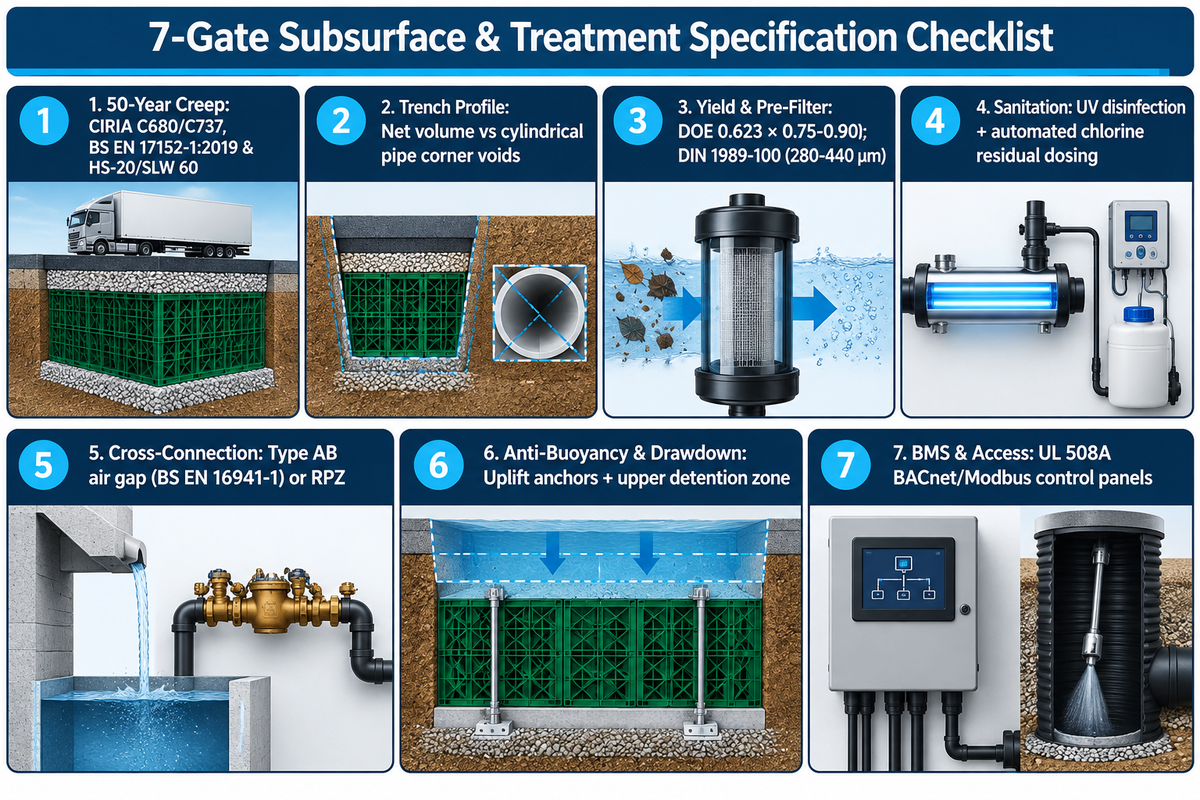
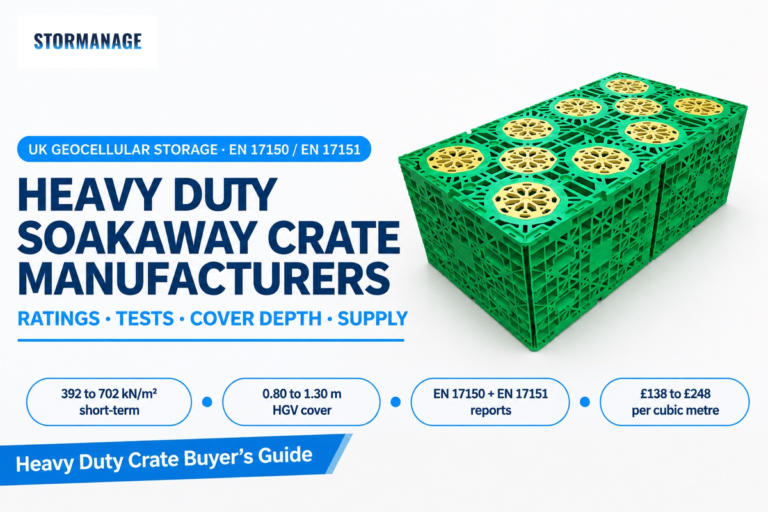
Polypropylene crate burial and 50-year polymer creep verification: Don’t bet on short-term ultimate crush tests for polypropylene crates buried in car park and fire lane constructions. Get structural calculations relative to the CIRIA C680 and C737 documents in conjunction with AASHTO HS-20 / HL-93 or European SLW 30 / SLW 60 vehicle loading standards. BS EN 17152-1:2019 prescribes the requirements for polypropylene and PVC-U stormwater boxes. Engineers assess long-term polymer creep, lateral soil pressure, and total burial depth by reviewing manufacturer creep test data and site geotechnical reports.
Net usable volume and total excavation profile: Modular geocellular crates allow more efficient use of net internal volume when compared to cylindrical pipes which leave corner voids. Total excavation depth isn’t necessarily dictated by internal crate geometry, and may be affected by traffic cover depth, inlet invert elevation, frost protection, groundwater buoyancy, and base bedding (as defined in the Minnesota Stormwater Manual).
Catchment yield modeling and pre-filtration selection: The U.S. Department of Energy FEMP Technology Review calculates preliminary catchment yield from roof area (sq ft) and local rainfall (inches). Multiply those inputs by the 0.623 conversion factor and a 0.75 to 0.90 collection efficiency factor, then run daily rainfall time-series modeling against water demand. Before water enters the dark underground tank, install pre-filtration or first flush diversion compliant with DIN 1989-100:2022-07 (which superseded DIN 1989-2:2004-08) or Virginia 12VAC5-635-240 G. Self-cleaning stainless-steel vortex filters (280–440 micron mesh) cut manual screen cleaning on large roofs, while basket filters and settling sumps remain code-compliant alternatives.
Post-storage sediment filtration and sanitation: As noted in DOE FEMP Best Management Practice 14, post-storage water purification scales to achieve the intended end use. Subsurface landscape irrigation often uses coarse strainers, while indoor flushing uses sediment filtration and disinfection in line with local code. Cooling tower makeup additionally requires site-specific control on scale, corrosion, and biologics. Ultraviolet disinfection leaves no disinfectant residual in the downstream water, while residual is maintained with automated chlorine dosing. Neither eliminates routine maintenance on strainer and solenoid valves.
Backup water supply and cross-connection control: Irrigation-only harvesting systems can shut down when storage is depleted, whereas essential indoor fixtures need a reliable backup from municipal water or another approved source. An air gap physically separates potable makeup water from harvested rainwater. UK installations use Type AB air gaps for Fluid Category 5 protection under BS EN 16941-1:2024. North American backflow protection follows the local plumbing code and hazard class, using ASME A112.1.2 air gaps or approved reduced-pressure-zone (RPZ) assemblies where permitted.
Groundwater anti-buoyancy and dual retention/detention drawdown: An empty underground cistern experiences strong upward hydrostatic uplift when groundwater rises. Anti-buoyancy safety factors may be calculated using an anchor slab, hold-down straps, overburden soil, or geocellular stone. According to the Philadelphia Water Department Stormwater Manual and the UK National Standards for SuDS, nominal tank volume isn’t to be considered flood storage volume. A dual-purpose rainwater and stormwater detention tank, for example, may use a dedicated upper zone for storage of stormwater. The capacity of the upper zone may be drawn down through a controlled outlet between storm events. A shared detention/retention zone relies on daily non-potable water demand or weather-actuated drawdown between storm events.
BMS telemetry and inspection access: Specify UL 508A listed control panels with BACnet or Modbus outputs. Facility operators can then track tank water levels, UV lamp hours, and makeup water flow. For underground modular crate matrices, include dedicated inspection ports, silt traps, and bi-directional CCTV and hydro-jetting channels as outlined in our attenuation tank maintenance and inspection guide.
Consolidated Buyer Submittal Note: Commercial procurement packages combine manufacturer creep and load test reports, current third-party product certificates, and project specific PE-stamped civil and plumbing drawings, prior to releasing a purchase order.
Frequently Asked Questions About Commercial Rainwater Harvesting System Manufacturers
Who are the leading commercial rainwater harvesting system manufacturers for large commercial and industrial buildings?
By documented supply-chain role, Storm Manage, Otto Graf GmbH, Wavin, and ADS StormTech manufacture underground modular polypropylene crates and arch chambers. Wahaso, Watts (RainCycle), Rainwater Management Solutions, and Stormsaver build packaged indoor pump, filtration, and sanitation skids. For monolithic fiberglass, GRP, steel-reinforced polyethylene, or bolted steel cisterns, Xerxes, Kingspan Water & Energy, Contech Engineered Solutions, and CST Industries serve large commercial projects worldwide.
Who is the largest commercial rainwater harvesting system manufacturer in the world?
At the parent-group level, ADS, Watts Water Technologies, Orbia (Wavin), and Kingspan Group operate the largest global plant networks across broader drainage, plumbing, and building-envelope divisions. Within dedicated commercial rainwater harvesting lines, Stormsaver focuses on UK commercial header-tank systems, while Wahaso and Rainwater Management Solutions specialize in custom North American institutional skids.
What is the difference between a commercial rainwater harvesting system manufacturer and a supplier?
A commercial rainwater harvesting system manufacturer physically molds storage tanks and geocellular crates, fabricates stainless-steel vortex filters, or assembles pump and UV skids in-house. A distributor instead resells third-party hardware without owning production tooling. Direct manufacturers provide role-specific engineering submittals, such as polymer creep test data from polypropylene crate molders. Meanwhile, Watts supplies Revit/BIM families and UL 508A listed control panels on RainCycle skids, and Xerxes offers a 30-year limited warranty on FRP cisterns.
What is the typical installed cost per gallon or cubic meter and lead time when buying a commercial rainwater harvesting system from a manufacturer?
Installed unit cost requires a project quote, while Storm Manage lists a 3–10 day standard crate lead time (up to 330 m³ per 40HQ container). Final installed pricing and delivery schedules shift with site burial depth, vehicle traffic loads, and custom PLC treatment skids.
How do underground modular polypropylene attenuation crates compare to fiberglass and concrete cisterns for commercial rainwater harvesting?
Modular polypropylene (PP) crates maximize rectangular trench storage geometry, with Susdrain citing up to 96% void ratio. Storm Manage flat-packs up to 330 m³ per 40HQ container, while ACO Stormbrixx half-elements nest on pallets for compact freight. Total trench depth still depends on traffic cover depth, frost-line depth, and base stone bedding.
Wrapped in a welded impermeable geomembrane, traffic-rated PP crates store rainwater beneath commercial parking lots without heavy cranes. By contrast, Xerxes fiberglass (FRP) cisterns offer an optional potable-water resin inside a factory-tested cylinder. Large monolithic cylinders still require wide-load freight, cranes, and site-engineered anti-buoyancy anchoring, such as hold-down straps, anchor slabs, or overburden, in high groundwater.
How does a dual-purpose commercial rainwater harvesting and stormwater attenuation system work for toilet flushing, cooling towers, and irrigation?
A dual-purpose tank partitions an underground cistern or modular crate system into a lower retention zone and an upper detention zone. The lower zone captures roof water and the upper detention zone drains through a passive orifice or a weather-actuated valve. Flood attenuation credit for shared storage depends on reliable drawdown between storms and daily non-potable water demand. Post-storage filtration and UV or chlorine sanitation scale with treatment needs for various uses, including toilets and cooling towers.
Conclusion & Requesting a Commercial Rainwater Storage Engineering Review
Aligning your project to the right manufacturer category for civil and mechanical submittals can save weeks of design rework. For a factory-tested indoor filtration, pump, and disinfection skid, compare Watts (offering UL 508A listed RainCycle control panels), Wahaso, Rainwater Management Solutions, or Stormsaver. For a buried one-piece fiberglass or corrugated pipe vessel, compare Xerxes, Contech or Kingspan.
For container-ready underground storage volume beneath commercial car parks, fire lanes, or plazas, review our commercial underground rainwater harvesting engineering guide. You can also visit Storm Manage to submit your target storage volume, burial depth, and traffic load class for a custom modular crate layout and 40HQ container loading plan.