We use the details you submit to review and respond to your project enquiry. Entries are handled in this website’s WordPress database using Fluent Forms; our hosting and email providers may process the submitted details. Other technical providers receive only the data described in our Privacy Policy.
Please do not send passwords, payment-card details, government identification numbers, sensitive personal data, or unnecessary confidential third-party information.
Heavy Duty Attenuation Crates for Car Park and Highway Drainage
Heavy duty attenuation crates can take the weight above a car park, an HGV yard or a highway drainage zone only when the load path via the crate is validated and not by a tonnage printed in a brochure. Storm Manage sells the StormGrid geocellular crates directly from our manufacturing plant, with the load-class data and the test data your designer actually has to sign off.
600 kN/m²vertical, short-term — did not fail in test
186 kN/m²lateral, short-term (same report)
SG-E20 → SG-H60five load grades
H400 / H500190 L / 237.5 L per module
15–30 daysproduction, 40HQ container-optimised
The “65 Tonne” Problem, Why Most Crate Load Ratings Cannot Be Specified
A geocellular attenuation crate does not carry a car park because a seller printed “65 tonne” beside it. It carries the load only once the designer has demonstrated that the buried crate, at a stated cover depth and a specified traffic loading, stays within its long-term strength. A raw tonnage figure is almost useless to your drainage engineer inside a calculation.
What the market actually publishes
We took a look at the top ranked crate supplier public product pages and specification pages and then ranked all of the load claim items against the four questions any specifier has to answer. This pattern is not marginal – it is near-total.
The Four-Question Load Test — aggregate audit of published load claims
01
The question a specifier must answerHow many kN/m² — not a bare tonne figure?
Published claims that did not answer itthe large majority
02
The question a specifier must answerAt what cover depth is that rating valid?
Published claims that did not answer italmost all
03
The question a specifier must answerAgainst which published test standard?
Published claims that did not answer itnone we reviewed stated one
04
The question a specifier must answerWhat long-term creep reduction was applied?
Published claims that did not answer itnone we reviewed disclosed one
What the people who install and sign off these tanks actually say
LOG.01
“Storm tank failed the day it was covered with fill overnight”
— a contractor describing collapsed attenuation tanks on site.
LOG.02
“Geocellular crate maintenance is questionable”
— a civil engineer weighing crates against alternatives.
LOG.03
“Fairly expensive vs typical drainage build-ups but highly effective”
— the cost-versus-benefit read from the same forums.
Method, so you can reproduce it
We publish it under the verifiability principle contained in the UK Business Protection from Misleading Marketing Regulations 2008. E.g.: Publicly visible product / specification pages for crate suppliers listed on the first page of searches for heavy-duty attenuation and soakaway crate (reviewed July 2026) answered a question only if a figure was present on the public page: a kN/m² value (rather than a raw tonne), a declared cover depth, a named test standard, and a declared long-term reduction. We publish it in aggregated format: i.e. we don’t name any individual suppliers, or publish their individual competitor values.
This is the area we explore for the remainder of the page. Each Storm Manage assertion regarding StormGrid has an associated kN/m² value, test report number and the truthful version of what that number does – and does not – prove. Storm Manage will not rate a system the factory has not tested.
SYS.REQ
Not all water companies accept modular systems either, and one UK water company states publicly that it won’t adopt geocellular storage at all. Each of those concerns has a technical answer, and this page gives all three, the failure mode in the build-up section, maintenance in the checklist, and the cost logic in the supply section.
Load Class Decoded, What D400, HS-25, SLW 60 and CIRIA Actually Govern
Half of the load badges on crate datasheets are copied from standards never written for a buried plastic box. A crate can be laid under a car park or a heavy truck yard – but the proof route is a buried-box design to the right standard, not a cover-and-gully rating printed on the box.
EN 124 D400
WHAT IT ACTUALLY GOVERNS
The 400 kN test load for gully tops and manhole covers in a carriageway — the metal grating and frame at the surface, per the EOTA assessment document for the EN 124 family
WHAT IT DOES NOT GOVERN
A buried storage crate. It rates the cover, not the box under it.
CURRENT STATUS
Current (BS EN 124-1:2015), but wrong product.
AASHTO HS-25 / HL-93
WHAT IT ACTUALLY GOVERNS
An HS-25 load rating is a design truck axle/wheel live load at the road surface
WHAT IT DOES NOT GOVERN
The resistance of a buried structure — meaningless without a cover depth. Superseded for bridge design by HL-93, after US federal policy moved new bridge design onto the AASHTO LRFD code.
CURRENT STATUS
Live-load input, not a product rating.
DIN SLW 60
WHAT IT ACTUALLY GOVERNS
A German bridge design wheel/axle load model
WHAT IT DOES NOT GOVERN
It is a demand standard — it rates no product. Superseded: German bridge loading moved to the Eurocode regime, and traffic actions are now taken from EN 1991-2.
CURRENT STATUS
Superseded by EN 1991-2.
CIRIA C737
WHAT IT ACTUALLY GOVERNS
The current design methodology for modular geocellular tanks: load factors, cover depth, creep and geotechnical checks
WHAT IT DOES NOT GOVERN
It is not a certificate and awards no load grade. It tells you how to prove one.
CURRENT STATUS
Current (replaced CIRIA C680:2008).
EN 17152-1
WHAT IT ACTUALLY GOVERNS
The product specification for storm water boxes in PP/PVC-U — explicitly for buried use in landscaped, pedestrian and vehicular areas
WHAT IT DOES NOT GOVERN
—
CURRENT STATUS
Current (2019).
EN 17150 / EN 17151
WHAT IT ACTUALLY GOVERNS
The test methods: EN 17150 short-term compression strength; EN 17151 long-term (50-year) creep strength
WHAT IT DOES NOT GOVERN
Neither is a certificate; they are how you measure the two numbers that matter.
CURRENT STATUS
Current (2019).
Two things follow from this table. First, an EN 124 D400 badge on a crate is a category error, that standard rates the manhole cover, not the box. Second, the honest way to say a crate suits a car park is through EN 17152-1 and a CIRIA C737 design, at a stated cover depth, which is exactly how a UK reviewer will check it.
It’s worth considering the wheel load experienced at the surface vs. load at the crate level. Tire contact pressure spreads through granular materials and cover as it moves deeper, thus the pressure arriving at the top of an underground tank will only be a fraction of that experienced on the surface. This is why claims for ‘60 tonnes’ without an associated cover depth are largely meaningless, and why the decoder below links each grade with a suitable structure buildup.
StormGrid stormwater attenuation crates are one stage in a sustainable drainage system, not the whole thing. They’re the underground water attenuation and water storage stage: the tank takes surface water runoff from upstream, often after permeable paving or a piped drainage network, and temporarily stores rainwater so the outflow to the existing drainage releases slowly during heavy rainfall.
Inside an impermeable membrane, attenuation systems temporarily store rainwater and release it at a controlled rate to manage surface water. This underground drainage stage is what people mean by stormwater attenuation.
Wrapped in geotextile instead, the same crates work as a soakaway, letting water soak away by infiltration into the soil where ground conditions permit. Attenuation and infiltration can be combined in one design, and domestic soakaways use the same permeable build-up in shorter runs. Small soakaway systems and large attenuation tanks are built from the same modules.
Because the crate gives no water-quality treatment, pre-treatment matters: a silt trap or pre-filter upstream keeps sediment out. On commercial applications this isn’t optional.
That same water management principle scales down to a domestic soakaway and up to a highway scheme. Crates can also feed rainwater harvesting or rainwater recycling where the stored rainfall is reused on site rather than discharged.
Short-Term vs 50-Year Strength, The Number on the Datasheet Is Not the Design Number
Two different numbers, two standards
Plastic, such as that used in crates, can creep; in other words, it gradually deforms over time under a continuous load. The long-term design strength is therefore a product of the short-term strength factored down by reduction factors for creep, installation damage and durability over the design life. This is a standard practice in the design of buried plastic structures and not a unique crate design feature.
Why the long-term number decides adoption
The standards are set by adoption regime, not us. EN 17152-1, the product standard for this sort of box, works to a design life of 50 years and, as a UK drainage engineering feature states, adoptable sewers – a term that now includes SuDS components – have design lives of between 50 and 120yr depending on the water company. No below-ground attenuation asset has been in the ground for this long so durability has to be proven by standards and tests, never by history.
ENGINEERING BRIEF
All crush strength figures published on a crate datasheet – including our own – refer to short-term load bearing capabilities. Designers need to reference long-term strength; the load capacity the tank can sustain for a 50-year design life without creep-induced failure. These are two separate metrics that are determined using distinct standards.
How the two numbers are produced
TEST STANDARD
DETERMINED CASE & SPECIFICATION
EN 17150
The short-term case; compression to failure of the crate in kN/m².
EN 17151
The long-term case; extended load and then extrapolated to 50 years at a 95% confidence lower bound.
Only after these do we apply our CIRIA C737 partial safety factors, and our geotechnical engineer tests the result against our cover, groundwater and traffic. This is how the Caltrans Geotechnical Manual puts the same concept for polymers: the long-term design strength of a polymer product is the ultimate strength divided by reduction factors for creep, installation damage and durability.
Since the reduction is real, the long-term design strength is often well under half the headline short-term figure – and the ratio is specific to the product and has to come from its EN 17151 test. Independent academic review on the topic has been quite harsh on the amount of data available: in 2025 just a handful of published compression tests were found on geocellular units, and their creep performance is largely unstudied. That’s why every single claim on this page makes a distinction between the two numbers and why our checklist later tells you to demand the long-term one from your supplier – including us.
EN 17150 COMPRESSION TEST PASSED • EN 17151 CREEP EXTRAPOLATION VALID • EN 17150 COMPRESSION TEST PASSED • EN 17151 CREEP EXTRAPOLATION VALID •
StormGrid Load Grades and Test Evidence
The grades are not marketing tiers
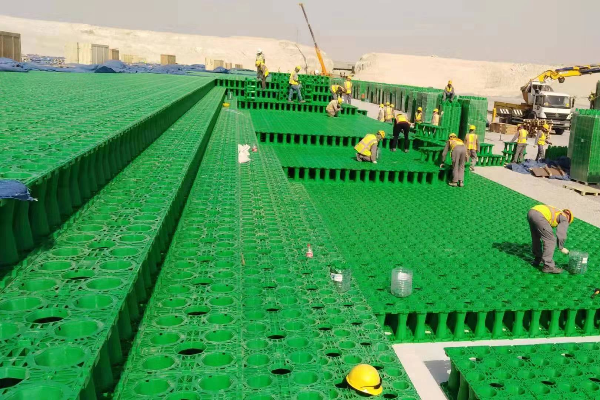
Storm Manage engineers each load grade around a different column wall thickness and rib configuration on our 8 injection moulding machines, all with 1000-2000 tonnes of clamping force. Heavier grades take more polymer into their load-bearing columns — the interconnected column-and-sidewall construction that defines a modular geocellular raintank (see e.g. US 7,677,835 B2). This is the structural reason that an SG-H60 costs more than an SG-E20 and the reason that you can't substitute a light grade in a HGV yard in order to save money.
DATA_MODULE
StormGrid crates come in 5 load grades and 2 heights. Grade names below include a nominal short-term rating; the test figures in parentheses are actual values recorded in independent and witnessed compression tests. We label every single one as short-term because - as discussed in the section above - that is what it is.
Grades, heights and where each one belongs
Grade
Nominal short-term
Module heights
Storage / module
Material
Typical use
SG-E20 Eco Light
~20 t/m² (~196 kN/m²)
H400 / H500
190 / 237.5 L
PP
Non-trafficked, landscaping
SG-L30 Light
~30 t/m² (~294 kN/m²)
H400 / H500
190 / 237.5 L
PP
Pedestrian, light driveway
SG-M40 Medium
~40 t/m² (~392 kN/m²)
H400 / H500
190 / 237.5 L
PP
Car parks, light traffic
SG-H60 Heavy Duty
~60 t/m² (~588 kN/m²)
H400 / H500
190 / 237.5 L
100% virgin PP
HGV yards, heavy trafficked areas
SG-Custom
By project
By project
By project
PP
Non-standard depth / load
The test evidence, and what it does not say
Two compression tests sit behind the heavy grades. They were both real but neither was a long-term creep test and we’re upfront about this fact, rather than burying it in the small print.
Test
Result (short-term)
Lab / report
What it proves — and doesn't
Vertical compression, SG-H60
Did not fail at 600 kN/m² (60 t/m²); the 300 kN load cell reached its limit before the crate broke, at 23 °C and after 40 °C conditioning. This is a short-term value, not the BS EN 17151 long-term one.
Intertek 190702149GZU-001
Proves a very high short-term ceiling. It is a run-out, not a failure load, and it is short-term only.
Lateral compression
186 kN/m² at 23 °C; 179 kN/m² after 40 °C conditioning
Intertek 190702149GZU-001
Confirms lateral strength — the plane where geocellular crates are typically weakest.
Top / lateral, SG-M40
468.5 kN/m² top; 121.9 kN/m² lateral
SGS-witnessed test at our own laboratory, report XMIN2401000036PL04_EN
A witnessed test at the manufacturer's lab — independent oversight, not an independent lab.
What we do not hold, stated plainly
We don’t have an EN 17151 long-term creep report, so can’t give you a signed 50-year allowable design load. Our vertical figure is based on the old CIRIA C680:2008 test method (since updated to CIRIA C737:2016). And we’ve no BBA, Kiwa or WRc certificate. Our checklist below tells you to demand all three – from us and from everyone else.
“We would rather write ‘600 kN/m², short-term, sensor-limited run-out’ and lose the argument on a headline number than print a bare tonne figure a reviewer can’t check. A crate that survives a 50-year car park is one whose long-term number and cover depth were both on the drawing.”
Trafficked Build-Up, Cover Depth, Granular Surround and Installation
A crate is only as strong as the build-up over it - and the minimum cover is a property of the crate, not of the industry. One published design white paper puts the typical figure at 800-1000 mm from finished surface to the top of the tank under a heavily trafficked area.
Yet an NSAI Agrément certificate for a different geocellular product sets its minimum cover by traffic load model: 450 mm in landscaped areas, 600 mm under a car park (CIRIA C737 load model LM3) and 900 mm under an HGV park (LM1).
Read the number as product-specific, never generic
A certified car-park minimum of 600 mm and a typical figure of 800-1000 mm are both correct - each for its own product, its own structural design and its own traffic load model. That's why no cover depth on this page, or on anyone else's, can be transferred to another crate. Your governing number is the manufacturer's own minimum for the grade you specify, checked against your traffic load.
The counter-intuitive part: two worst cases, not one
Most people assume deeper cover is always the harder case. It isn't. For the permanent (static) load - the weight of soil above - the deepest cover is worst. For the dynamic (wheel) load, the shallowest cover is worst, because the wheel load has spread the least. That wheel load comes from the traffic live-load model — HS-25 / HL-93 in the US, per the FHWA LRFD code, or EN 1991-2 in the UK. A specifier has to check both ends of the cover range, which is precisely what a single tonne figure hides.
Installation Sequence
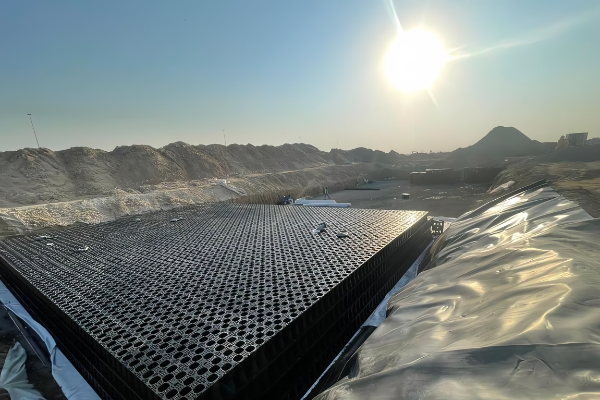
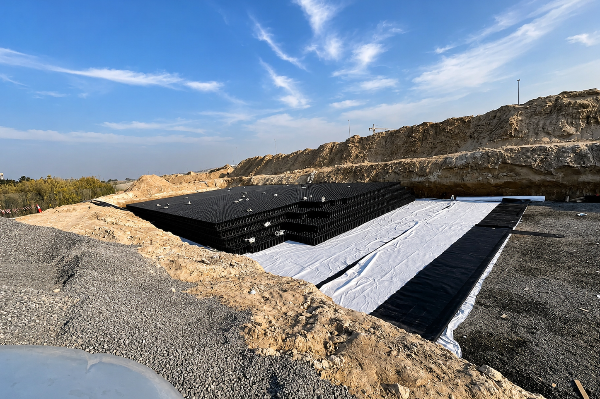
Attenuation crates installation is therefore a build-up problem, not a crate problem. It runs, from the crate outward:
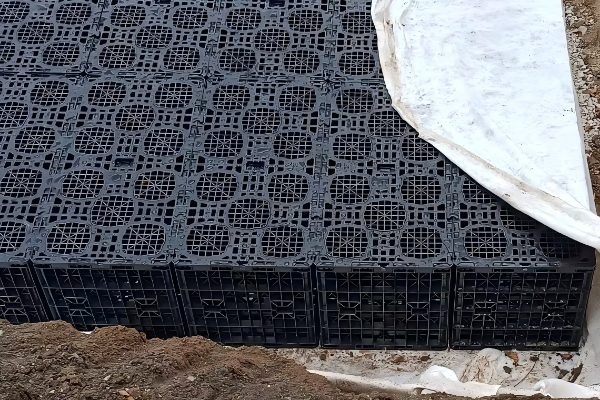
An impermeable membrane (for an attenuation system that stores stormwater and releases it slowly to help prevent flooding) or geotextile membrane (for a soakaway that lets rainwater infiltrate into the surrounding soil), wrapping the modular crate block.
A granular surround and a compacted, level base - the tank has no adjustment once assembled, so the base has to be right first time.
Bedding and side fill of the 150 mm class, placed and compacted to the manufacturer's method, then the cover build-up to finished surface.
Upstream, a silt trap or hydrodynamic separator, plus an inspection chamber, so the tank can be jetted and checked without digging it up.
CRITICAL NOTE
An honest point about failure - and we cite the freely readable summary, not the paid standard, so you can read it yourself - is that, as a UK drainage engineering feature summarising the CIRIA C737 report puts it, crate failures are relatively infrequent: most are due to poor installation and temporary works, or an inaccurate reading of ground and groundwater, with very few due to a lack of long-term strength. That’s why build-up details and installation method are as important as crate grade.
Two build-ups from real projects
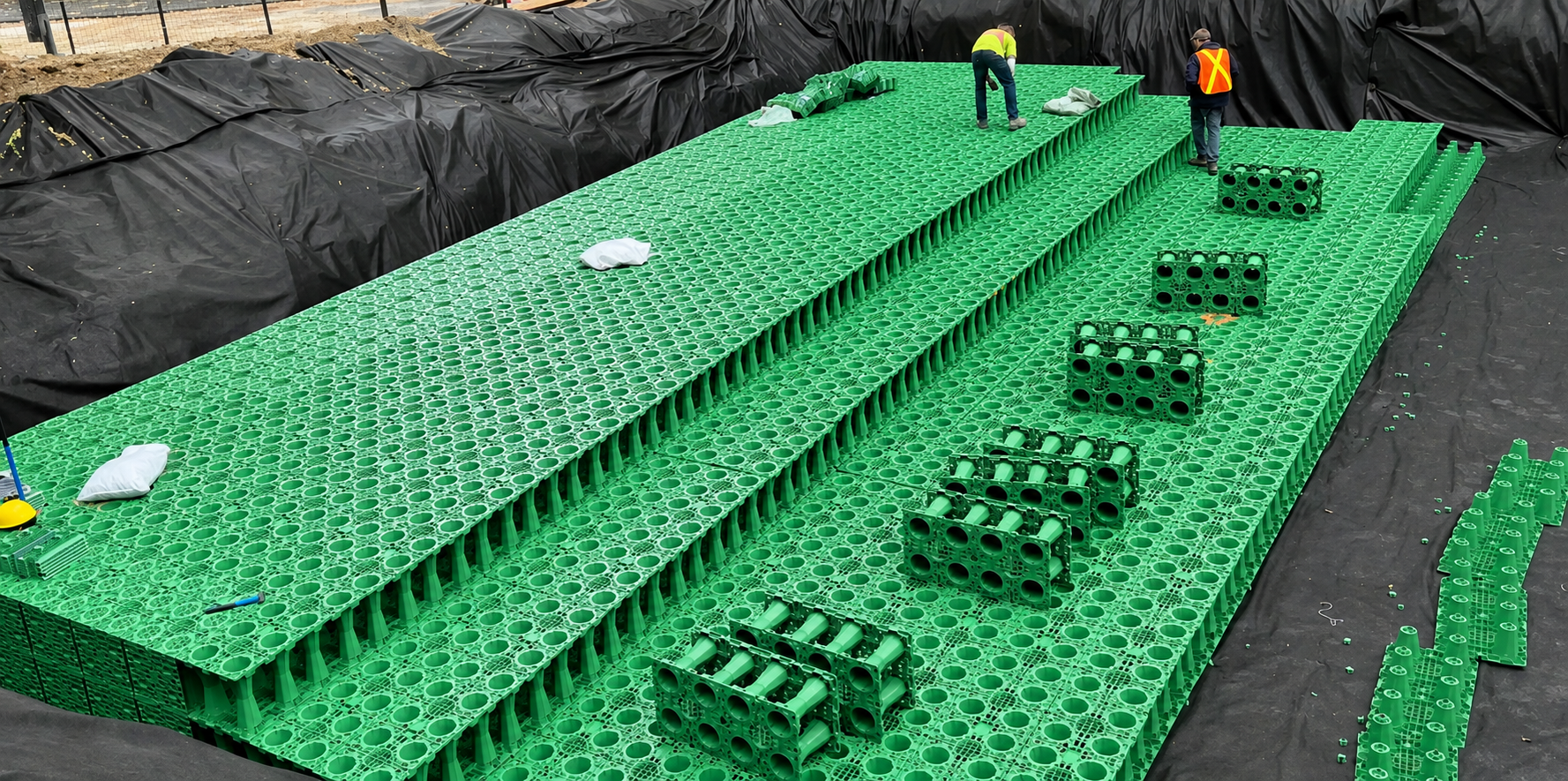
Build-up varies with what lies above and below it. Here are two examples of StormGrid installations in practice.
Application
Sub-surface attenuation beneath a trafficked highway drainage corridor
What the build-up had to solve
Dynamic wheel loading with a constrained vertical drainage zone — the shallow-cover dynamic case governed
How it was detailed
Heavy-duty grade throughout, cover build-up set to the manufacturer's minimum for trafficked areas, impermeable membrane, inspection access from the surface
Application
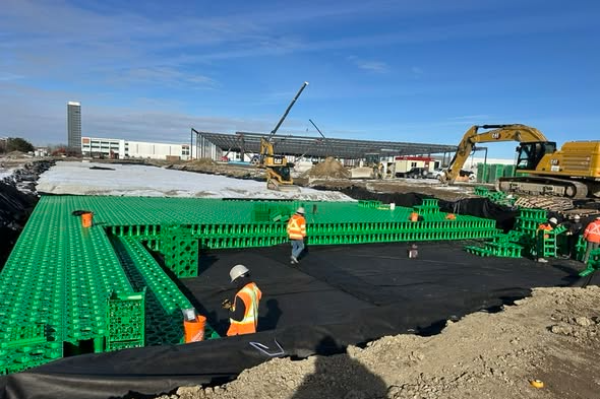
Attenuation under an industrial site with plant traffic, in a cold region
What the build-up had to solve
Assembly through a freezing-temperature window, plus a high-flow inflow that a plain crate base could not distribute
How it was detailed
Composite build-up — a stone trench and distribution pipework beneath the crate block — with modules assembled in layers so the tank could be built in short weather windows
Neither of these build-up details are ‘from the datasheet.’ Both came about because the crate had to deal with the ground, traffic and program it was actually given, and that is why the specification sheet we send back answers your cover depth and traffic class rather than a generic template.
The Specifier's Evidence Checklist, What to Demand From Any Crate Supplier, Including Us
If your UK drainage reviewer or lead local flood authority is going to sign a crate off, this is the evidence that does it. Send the list to every supplier on your shortlist and compare what comes back, because in practice the gap between the answers is where the risk sits: a 50 year adoptable asset signed off on a short-term test number nobody asked to see.
[SPEC-01]
EN 17152-1 compliance for the box, in PP or PVC-U, with third-party testing by an accredited body (BBA, Kiwa or WRc) rather than self-declaration, where possible.
[SPEC-02]
An EN 17150 short-term compression test result, with values in kN/m² (vertical and lateral).
[SPEC-03]
An EN 17151 long-term (50 year) creep strength test, giving the 95% confidence lower bound (which, not the datasheet ‘headline’ value, is your design value).
[SPEC-04]
A structural calculation for your specific cover depth, water table and traffic class, prepared to CIRIA C737, with partial safety factors applied.
[SPEC-05]
Confirmation that the factored design load is below the long-term strength, with the wheel load determined at the installed depth according to an approved standard (e.g. EN 1991-2).
[SPEC-06]
Strength data reflecting the installed orientation of the crate, including resistance to lateral earth pressure.
[SPEC-07]
A statement on third-party approval (BBA/Kiwa/WRc or none/pending), with evidence in the form of raw test reports and an installation method statement.
STATUS: EXEMPT // 0x07
The approval reality, and the route for a product without a BBA
In the UK, reviewer/approving bodies will want evidence from a third-party testing organisation (e.g. BBA, Kiwa, WRc) under Ofwat’s Code for Adoption Agreements. Many won't accept a geocellular system at all, and Storm Manage will not claim what it does not hold: StormGrid carries no BBA/Kiwa/WRc certification today. In fact, for any adoptable highway scheme or adoptable drainage, an accepted way to use a non-standard product is to issue a Departure from Standard: your engineer submits evidence that the product is fit for purpose according to the Water UK Design and Construction Guidance for adoptable drainage - and the evidence we provide (namely raw test data from Intertek and SGS, plus our CIRIA C737 calculations) forms the basis of just such a justification.
Two items on that list we cannot tick: the EN 17151 long-term creep report, and third-party certification. Storm Manage provides that answer on the page rather than behind a technical query, and the same two gaps sit quietly inside most of the datasheets you are comparing us against. Unlike a headline crush figure, an evidence pack is checkable — and the mistake most buyers make is comparing the numbers instead of the paperwork behind them.
Supply From the Injection-Moulding Factory, Loading, Lead Time, OEM/ODM
StormGrid crates are injection-moulded polypropylene boxes of the type specified by EN 17152-1, made in Storm Manage's own factory in China and shipped factory-direct, including the 100% virgin-PP SG-H60 heavy grade. That removes a distributor margin, and it means the load grade, height and material you specify are the ones that get made. The risk it removes is the one that costs most: a substituted grade nobody told your designer about.
Supply facts
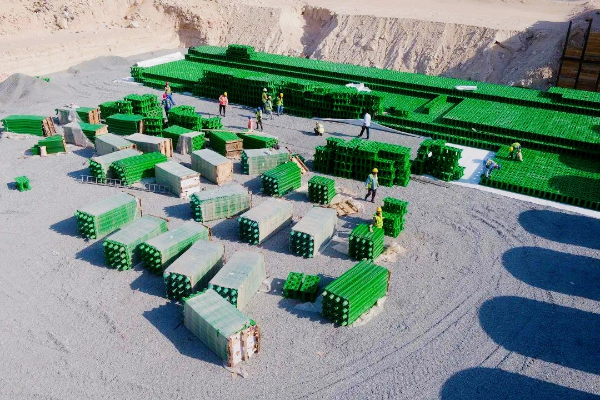
Production lead time is 15-30 days, set by the grade mix and volume. A grade substituted after the design was signed is what turns a lead time into a delay on site.
Components are nested and stackable, 40HQ optimised, which cuts shipped volume and the number of lorries arriving at a live carriageway.
Custom grades, heights and colours run as SG-Custom under OEM/ODM. Send the drawing and traffic class and request a quote against it.
Range, sizing and what a job needs
StormGrid comes in a range of sizes, two heights and five load grades, so a tank fits almost any footprint. Soakaway crates dimensions match the attenuation modules — 1000 × 500 mm on plan, in H400 and H500 depths: each H500 module holds 237.5 litres, so roughly four modules give 1 cubic metre of water storage, while H400 modules hold 190 litres each. Lighter grades can be made from recycled PP, while the heavy-duty SG-H60 uses 100% virgin PP.
Same product, different names on your drawing
The same modules are specified as attenuation tank crates, geocellular storage crates or SuDS drainage crates depending on the market. In North America the whole assembly is usually called an underground detention system rather than an attenuation tank, and the design guidance for it describes the same structural checks. Where the vertical drainage zone is tight, shallow attenuation crates in the H400 depth keep the tank inside the available cover.
What a StormGrid installation typically needs
Typical applications are car park and highway drainage solutions, HGV yards and other commercial applications, and the same crates are used in residential driveways and for building a soakaway on smaller plots.
Components needed are crates, membrane, a 150mm granular bedding, silt management and an inspection chamber. The crates are quick to install and easy to install by hand, so the installation process is faster than a concrete tank.
Sizing inputs are attenuation volume, cover depth, ground conditions and traffic class, with the discharge rate set by local water management rules and building regulations.
Check the volume twice: real usable storage isn't the nominal tank volume. Deduct for the crate solid fraction and for the silt allowance the design guidance requires over the tank's life, a nominal 10 m³ and a real 10 m³ of usable storage aren't the same thing.
Cost factors checkable against your drawing
We will not publish a price per cubic metre, because the grade mix, the height and the shipping terms move it further than the crate itself does. Unlike a headline rate, the cost factors below are checkable against your own drawing. The mistake is comparing rates per cubic metre when one tank is half SG-H60 and the other is not:
How much of the tank is to be SG-H60 versus lighter grades (you can mix grades within one tank if the module dimensions allow).
H400 versus H500, and the total cubic-metre storage target.
Which membrane and ancillaries: impermeable or geotextile, inspection chambers, silt management.
Destination and Incoterms - FOB or CIF - and container fill.
Send the tank volume, cover depth and traffic class, and you get back a load-class specification sheet and an FOB quotation built around those parameters.
~3×
A 95% void crate stores roughly three times the stormwater runoff of the same excavation filled with clean graded granular material at ~30% voids — so you dig a smaller hole for the same attenuation storage.
Illustrative volume comparison from void ratios (95% vs ~30% for clean graded stone); not a cost figure. Excavation cost depends on site, spoil and haulage.
Get the load-class detail your designer can actually sign off
The expensive mistake in a car park attenuation job isn't the crate price, but a tonnage claim that cannot survive a technical query and has to be re-designed, at greater cost than the tank itself. Unlike a bare rating badge, every number here is tied to a test report and a stated cover depth.
Specification
A detailed StormGrid load-class spec sheet, written against your cover depth and traffic class
Test Reports
The Intertek and SGS test reports, with short-term and long-term numbers kept separate
Documentation
An FOB quotation — and the two documents Storm Manage does not hold, named openly: a BS EN 17151 long-term creep report, and a BBA/Kiwa/WRc certificate
There's no way to answer that from the grade alone. Ask instead for the long-term strength (EN 17151) and for a design at your cover depth.
There's no universal answer. One published white paper suggests 800-1000 mm under heavy traffic; a national certificate for a different crate sets 600 mm under a car park and 900 mm under an HGV park, against 450 mm in landscaped areas. Take the minimum quoted for the grade and traffic model you have chosen, then check the shallowest and deepest cover on your site, because they represent two very different worst cases.
Failures are uncommon and most are blamed on poor installation (base prep, backfill or misreading the water table), not a weak crate. They're most common during the vulnerable phase between assembly and backfilling, when the unsupported block can be crushed by traffic, or under other conditions: creep (when a block deforms gradually under permanent load until it fails), flotation (when an empty tank is lifted by a high water table), and thirdly, lateral failure, which usually happens when deep installations attempt to resist earth pressure instead of the vertical load for which they're better suited. All four are installation or design issues with established checks, and that's why the cover build-up, base and granular surround are designed as carefully as the crate grade-and why we'll come to site for any critical installations.
As a storage-only system, a crate tank offers no water-quality treatment and requires upstream silt control, normally with a hydrodynamic separator or silt trap upstream. That tank can then be jetted and inspected from the surface - at around 12-month intervals, accessed through an inspection chamber. Otherwise, the anticipated maintenance becomes a significant issue.
Geocellular tanks are designed for a 50-year service life - the life expectancy adoptable drainage systems now expect - but that is a design intent based on the long-term strength calculation, not a measured age, since no crate has been in the ground that long. It is only reliable if the long-term strength, cover and maintenance plans were well calculated and executed.
Suitable for car parks, HGV yards and trafficked surface water drainage zones where cover and design are proven. They aren't meant as structure under a main carriageway - this is a separate design case. For an adoptable or highway scheme without a standard listing, it's a Departure from Standard based on test report data and a CIRIA C737 calculation.