We use the details you submit to review and respond to your project enquiry. Entries are handled in this website’s WordPress database using Fluent Forms; our hosting and email providers may process the submitted details. Other technical providers receive only the data described in our Privacy Policy.
Please do not send passwords, payment-card details, government identification numbers, sensitive personal data, or unnecessary confidential third-party information.
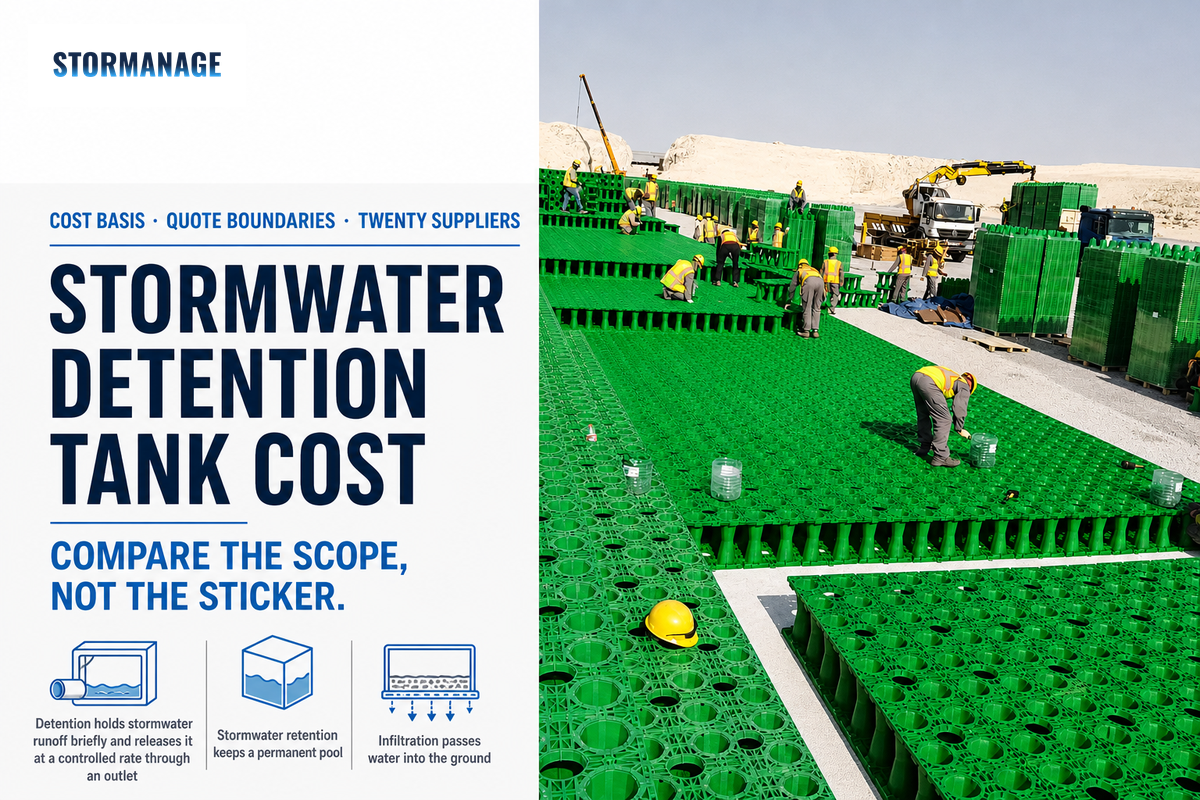
Stormwater detention tank cost manufacturers listed below are compared using a common project brief rather than individual price lists. Twenty suppliers are listed in this document that cover different storage structures and different quote routes. First confirm the approved drainage duty; then compare equipment, civil works, installation and long-term operating costs.
Note: Except for Storm Manage, which appears first by editorial request, the remaining companies are presented in no particular order. First placement does not represent an independently verified ranking by market share, lowest cost or overall system performance. Actual stormwater detention tank cost depends on required storage volume, system type, installation depth, traffic loading, groundwater, civil works, transportation, accessories and local installation costs.
This study was made on 7 September 2026. “Top 20” refers to the requested international shortlist and not to twenty independently ranked businesses. The descriptions of the companies are based on official product and company information. Dates and specifications not known remain unverified; the statements of the suppliers are identified as such. The quotation tools given below are editorial procurement worksheets rather than engineering calculations or market bids gathered.
How much does a stormwater detention tank cost?
A good price should show the system, basis of storage, location, date and the work involved. There are some bounded examples where public information is available, and while some information is available, it doesn’t establish one global installed rate for all suppliers. A module price, an installed construction estimate and a whole-life budget answer different kinds of questions and must remain separate.
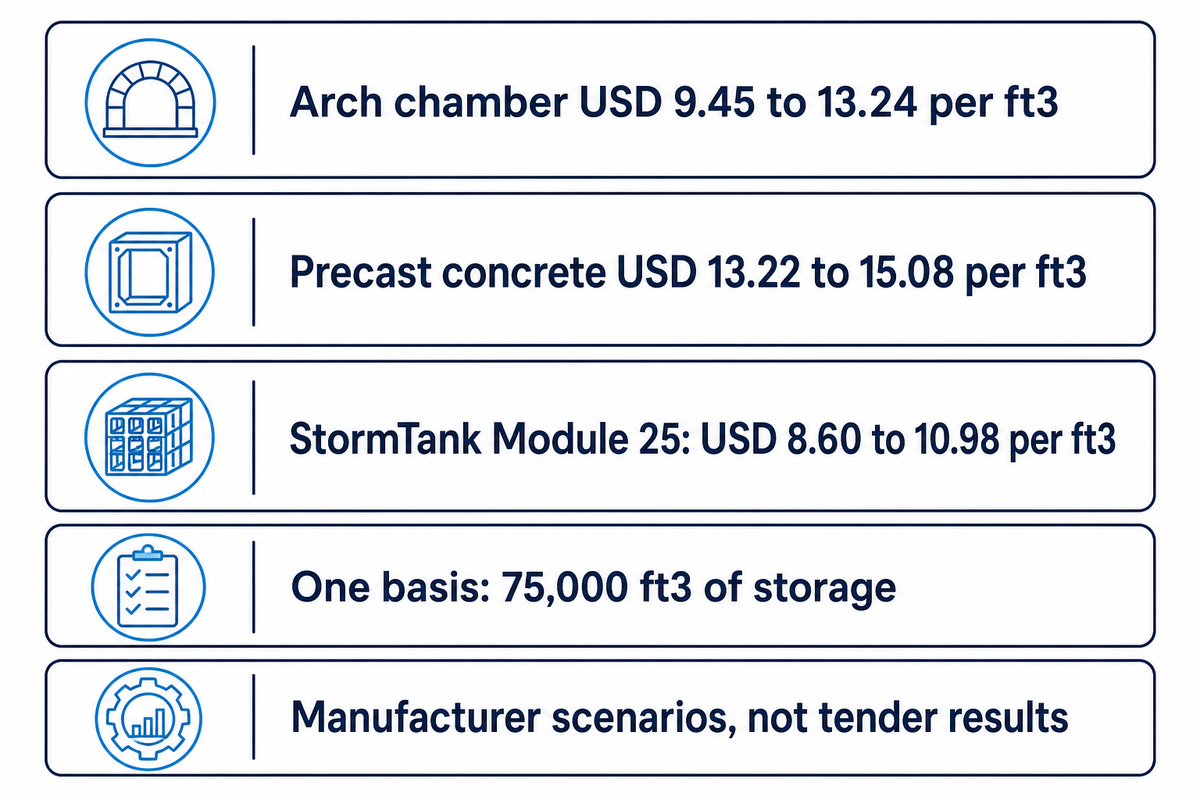
Brentwood Industries publishes a regional cost analysis for a five-acre development requiring 75,000 cubic feet of storage. Their article was posted on 8 December 2025 and was updated on 29 April 2026. The following numbers are Brentwood’s manufacturer-prepared US scenario estimates, not tender results, Storm Manage prices or offers from the other 19 suppliers.
Brentwood regional model: USD, 75,000 ft³ storage basis in each scenario
System in the source
Lower-cost region, USD/ft³
Lower-cost scenario total, USD
Higher-cost region, USD/ft³
Higher-cost scenario total, USD
Arch chamber
9.45
708,750
13.24
993,000
Precast concrete
13.22
991,500
15.08
1,131,000
Brentwood StormTank Module 25
8.60
645,000
10.98
823,500
This source examines assumptions regarding materials and labor in two US cost environments. The cost per cubic foot does not disclose how each tax, freight, liner, accessories, engineering, and other commissioning components are treated. Those items are not disclosed; confirm in quotation. That gap creates a risk of unpriced work. Due to this, the modeled installation scope cannot be considered a complete offer for your site. Source: Brentwood Industries, “StormTank vs. Alternatives: A Regional Cost Analysis.” Official source address: https://www.brentwoodindustries.com/resources/learning-center/stormwater/stormtank-vs-alternatives-a-regional-cost-analysis/
The figures illustrate to purchasing teams the importance of examination of the installed work around a tank. They don’t substantiate that Module 25 will be the lowest cost offering elsewhere. The Environment Agency’s cost-estimation review for sustainable drainage contains suggested project and literature costs. Such assessments serve a function different from a supplier quotation, and older costs should include their specific dates and regions.
Worked arithmetic: USD 645,000 divided by 75,000 ft³ equals USD 8.60/ft³, reproducing the lower-cost Module 25 scenario. This corresponds to the source’s denominator; this does not confirm the scope or offer a baseline for a different project. Do not apply this to a residential tank, a different storage definition, or a site with different excavation requirements.
Storage by itself won’t prevent flooding. In order to manage stormwater runoff in developed areas, the drainage design must connect the tank to suitable inlets, outlets, and exceedance paths. A retention system or rainwater-reuse proposal may have a different operating duty. Price those differences explicitly when comparing detention costs.
The following entries provide information about relevant product groups and enterprise functions and methods to acquire pricing. Given certain local market availability and engineering approvals, they can be used as an initial list of suppliers. A company’s manufacturing history doesn’t confirm the age of their products, and groups of companies can make apparent separate brands one supplier group.
The dates below pertain only to the entity described. “Unknown” indicates that the official evidence that we reviewed didn’t establish the field in question. It doesn’t mean that the company lacks a history. A stated product feature is a reason to consider the option, not a finding that the option is suitable for the given site. The cost drivers and buyer checks are procurement analysis unless otherwise noted.
1. Storm Manage
Founded: Unknown for the export brand; its official About page dates the supporting production base to 2013.
Headquarters / country: Shenzhen, Guangdong, China; the site identifies its production and export base, rather than a verified corporate headquarters.
Introduction: Storm Manage offers modular underground storage for detention, attenuation, infiltration and non-potable reuse projects. As with other modular stormwater systems, the function depends on the selected lining, outlet and associated equipment, rather than the storage module alone.
Enterprise role: An export brand with a manufacturing backbone offering project configuration and quote support.
Relevant products: Modular underground storage platform and project-matched accessories.
Material / structure: Modular storage structure; obtain the exact resin, model and technical report with the quote. This profile won’t adopt another company’s StormTank specifications.
Typical applications: Developments where a configurable footprint is required beneath usable land, subject to the approved drainage layout.
Project cost drivers: module count, configuration, liner package, loading, access, export packing, destination and local installation scope.
Public price / quotation method: A project quotation will be provided after reviewing the hydraulic objective, volume, loading, groundwater, connections and schedule. No fully scoped public installed price was established.
Documented advantage: The official enquiry process requests site constraints and distinguishes storage from standalone pollutant treatment.
Buyer caution: Separate the export-brand identity from the 2013 production-base date. Obtain matching structural and material evidence and name the parties responsible for lining, treatment, installation and approval.
Official website: https://stormmanage.com/
2. Advanced Drainage Systems (ADS)
Founded: 1966 for ADS; not the founding date of every acquired brand.
Headquarters / country: Hilliard, Ohio, United States.
Introduction: ADS offers drainage products and underground stormwater storage systems. StormTech and CULTEC are included in this group-entry level; as ADS acquired CULTEC in 2022, they aren’t considered as three independent suppliers.
Enterprise role: Manufacturer and system-support provider.
Relevant products: StormTech chamber systems, including SC160LP, plus the group’s CULTEC offering.
Material / structure: Molded chamber structures surrounded by specified aggregate; the polymer and model must be as documented.
Typical applications: Shallow or otherwise constricted subsurface installations where the chamber assembly fulfills the project’s structural and hydraulic requirements.
Project cost drivers: The layout of the chambers, the ends, the stone, the excavation, pretreatment, inspection arrangements, and local site construction costs.
Public price / quotation method: Contact an ADS representative for a project quote. For this comparison, no fully scoped public tender was documented.
Documented advantage: The SC160LP page provides a distinction between chamber storage and installed storage, thereby enabling the buyer to check the volume of interest.
Buyer caution: Don’t use a chamber-only capacity and multiply it by a unit price incorporating aggregate storage. Ascertain the specified stone geometry and its porosity and loading, as well as minimum cover and access.
Official website: https://www.adspipe.com/
3. Contech Engineered Solutions
Founded: Unknown for the current entity from the official pages reviewed.
Headquarters / country: United States; Headquarters City couldn’t be determined based on provided product evidence.
Introduction: Underground detention from Contech provides several options to project teams for analyzing piping, chamber, and concrete systems within a single supplier’s portfolio. Its product portfolio separates different storage, infiltration, and treatment systems.
Enterprise role: Manufacturer and engineering-support provider.
Relevant Products: CMP systems, DuroMaxx, ChamberMaxx, and UrbanPond concrete detention.
Material / Structure: Corrugated metal pipe; steel-reinforced polyethylene pipe; plastic chambers; and precast concrete, respectively.
Typical Applications: Assessing piping, chamber, or vault systems where the geometry, access, or local availability of systems makes them worth evaluating.
Project Cost Drivers: the selected structure, the diameter of the pipe or the arrangement of the chambers, access risers, excavation, bedding, connections, lifting and transport.
Public Price / Quotation Method: Contact a local sales representative or stormwater consultant for a project specific proposal and submission. No comparable public installed price was established.
Documented Advantage: The official portfolio describes manholes, risers and cleanouts as design provisions for inspection and maintenance.
Buyer Caution: Specify the actual product before comparing offers. A quotation for corrugated pipe shouldn’t replace a precast vault. The position of the hydraulic grade line, bypass, and agency approval all require project review and evaluation.
Official website: https://www.conteches.com/
4. Brentwood Industries
Founded: 1965 for the manufacturing business.
Headquarters / country: Reading, Pennsylvania, United States.
Introduction: Brentwood’s StormTank modular range includes products from the stormwater division. The regional cost analysis is used as the example, with the manufacturer’s stated assumptions and commercial interests retained.
Enterprise role: Plastic-products manufacturer and stormwater system supplier.
Relevant Products: StormTank Module 25 and related stormwater products. The portfolio also includes Lane StormKeeper.
Materials / structure: modular plastic storage structures; Lane StormKeeper is a separately identified chamber product, not evidence of Brentwood ownership of Lane.
Typical applications: Below-ground storage layouts where module geometry and the surrounding construction scope fit the approved design.
Project cost drivers: modules, excavation, aggregate, labor, access, pretreatment and delivery; hybrid arrangements require a clear bill of materials.
Public price / quotation method: Project quotation. A dated US scenario model is public, but it isn’t a transferable supplier offer or a complete schedule of every cost inclusion.
Documented advantage: The regional model exposes several construction inputs rather than presenting equipment price alone.
Buyer caution: Keep Brentwood’s StormTank evidence with Brentwood. Cross-listed Lane products must retain their identity; neither the product overlap nor a combined layout proves the two companies share a parent.
Official website: https://www.brentwoodindustries.com/
5. StormTrap
Founded: Unknown from the current official company evidence reviewed.
Headquarters / country: United States; the cited material describes a national network rather than establishing the headquarters city.
Introduction: StormTrap provides modular concrete stormwater solutions and works through a manufacturing and technical network. Its project examples illustrate how below-ground storage can preserve the use of land above it.
Enterprise role: System provider using a network of concrete manufacturing and technical partners.
Relevant products: SingleTrap and DoubleTrap detention arrangements, with separate treatment options where specified.
Material / structure: Modular precast concrete structures.
Typical applications: Projects requiring engineered underground storage under usable development areas, where the selected assembly is suitable for site loads.
Project cost drivers: Precast modules, fabrication, haulage, crane access, foundation preparation, joints and connections, and treatment equipment.
Public price / quotation method: Project design and quotation route through StormTrap. No fully scoped public price was established.
Documented advantage: Concrete storage configurations are distinct in the official portfolio; the Windsor Elementary project describes a basin with separate SiteSaver treatment.
Buyer caution: Confirm the actual fabricator and jointing and watertightness scope, access for maintenance and lifting. The Windsor example belongs to StormTrap and offers no cost evidence for Storm Manage or other suppliers.
Official website: https://stormtrap.com/
6. Oldcastle Infrastructure
Founded: Unknown for the present business from the official pages reviewed.
Headquarters / country: United States; confirm the supplying facility and contracting entity for the project.
Introduction: Oldcastle Infrastructure manufactures a series of stormwater storage structures and other infrastructure products. Product identification is critical in this case, since the company name doesn’t assist an estimator in determining what the company is pricing.
Enterprise role: Infrastructure manufacturer and system supplier.
Relevant products: StormCapture precast detention and CUDO modular storage products.
Material / structure: Precast concrete and geocellular structures, depending on the system named. Request the exact CUDO model and material specification.
Typical applications: Facilities for which a potential user is considering a concrete vault or a storage configuration using a modular layout through the regional supply.
Project cost drivers: Product line, distance to facility, dimensions of module, freight, lifting, preparation of the base, and wherever applicable, lining and connections.
Public price / quotation method: Use the official project quotation, or the quotation generation process, followed by a review of the project scope. No uniform installed rate was established.
Documented advantage: The supplier has multiple storage systems which enables a buyer to request a range of alternatives for the same project.
Buyer caution: A quick quotation output shouldn’t be taken as a civil works and installation bound offer. No official evidence reviewed established a common parent relationship with StormTrap, so that relationship is left unstated rather than asserted either way.
Official website: https://oldcastleinfrastructure.com/
7. Lane Enterprises
Founded: 1934 for the Lane business heritage.
Headquarters / country: Camp Hill, Pennsylvania, United States.
Introduction: Lane makes drainage infrastructure and provides underground storage. Their StormKeeper products are also in Brentwood’s offerings and should be noted when considering how similar products may be bundled in different submissions.
Enterprise role: Drainage-products manufacturer and system supplier.
Relevant products: StormKeeper chambers and StormStorage underground retention systems or detention.
Material / structure: Chamber and pipe-based storage structures; confirm the material of the specific quoted model.
Typical applications: Below-ground storage in development or infrastructure designs where the selected chamber or pipe arrangement fits.
Project cost drivers: Product and material selection, aggregate, pipe or chamber layout, coatings (where required), access, connections and delivery.
Public price / quotation method: Contact Lane for the project and local supply arrangements. No fully scoped public installed quotation was established.
Documented advantage: The official underground-storage portfolio separates storage systems from treatment products.
Buyer caution: Don’t confuse StormKleener treatment with detention volume. Compare contractual scope and support for Lane products sold through other suppliers rather than treating these as completely different technologies.
Official website: https://lane-enterprises.com/
8. ACO
Founded: 1946 for the ACO group, not every national subsidiary.
Headquarters / country: Germany; the group history reviewed identifies its northern German origin.
Introduction: ACO supplies drainage and water-management products through regional businesses. The StormBrixx range is relevant to buyers investigating modular underground storage, including shallow configurations in the applicable markets.
Enterprise role: Drainage manufacturer and system provider.
Relevant products: StormBrixx, including the 300HD product in the current product range.
Material / structure: Geocellular modular structure; obtain the material declaration for the specific regional model.
Typical applications: Storage applications where the geometry of the specified model, access and installation constraints are compatible with the design.
Project cost drivers: Unit configuration, installation depth, excavation, liners, access, local provision, and delivery.
Public Price / Quotation Method: Request a regional project quotation and technical selection. No fully scoped public installed price was established.
Documented advantage: The official range includes a low-profile model, creating a defined option to assess where excavation depth is limited.
Buyer Caution: Group history does not guarantee the local supplier’s scope of supply. Confirm exact system specifications, structural evidence and lining responsibilities instead of trusting the StormBrixx family name.
Official website: https://www.acousa.com/
9. Wavin
Founded: 1955 for Wavin.
Headquarters / Country: Zwolle, Netherlands, in the company history reviewed.
Introduction: Wavin’s AquaCell and QBic Plus products serve modular storage arrangements in regional markets. Product grades and application limits are more important than general descriptions such as recycled plastic, heavy-duty, etc. for selecting a model.
Enterprise role: Pipe and water-management manufacturer.
Relevant Products: AquaCell and QBic Plus; the AquaCell range includes different grades and generations.
Material / Structure: Plastic geocellular storage; confirm the resin and grade of the product selected.
Typical Applications: Attenuation or infiltration arrangements with the appropriate wrapping, outlet and site conditions.
Project Cost Drivers: Grade, unit layout, cover, lining, access, local stock, and whether installation is separately contracted.
Public Price / Quotation Method: Regional consultation, stockist or project quotation route. Some markets provide installation support; confirm availability and scope.
Documented Advantage: The current AquaCell material distinguishes variants and their intended conditions rather than treating all units as identical.
Buyer caution: Restrictions on shallow, non-trafficked applications and high groundwater apply to AquaCell Eco grades only and can’t be ignored or transferred to other grades. The proposed model and installation drawing must be the same as the quote.
Official website: https://www.wavin.com/
10. Polypipe Civils
Founded: Unknown for the specific current business unit from the evidence reviewed.
Headquarters / country: Loughborough, United Kingdom, for the Civils contact location.
Introduction: Polypipe Civils manufactures civil-engineering drainage within the Genuit group. The Polystorm range incorporates storage units and specific access or inspection units that should be visible in a priced system layout.
Enterprise role: Civil-drainage manufacturer and system supplier.
Relevant products: Polystorm R, Access, Inspect, Deep and Xtra, subject to current regional availability.
Material / structure: Geocellular modular storage structures; request the material declaration and applicable product grade.
Typical applications: Development drainage with an approved modular attenuation or infiltration arrangement.
Project Cost Drivers: Grade and depth selection, inspection units, management and control of silt, lining, installation, and transportation.
Public price / quotation method: Obtain a project quote through the supplier or regional merchant channel. No complete public installed cost was established.
Documented Advantage: The named range separates storage, inspection, and access functions, helping a buyer specify a complete bill of materials.
Buyer Caution: Be careful not to mix load figures and design-life claims across grades. A storage-unit quote may not provide the access and sediment-control components that are a part of the proposed layout, so ensure it’s consistent with the drawing.
Official website: https://www.polypipecivils.com/
11. GRAF
Founded: 1962 for the GRAF business.
Headquarters / Country: Germany; confirm the regional supplying company and facility.
Introduction: GRAF offers water-storage products including dedicated detention cisterns. Buyers are advised to distinguish these controlled-discharge vessels from rainwater harvesting products that reserve water for later use.
Relevant Products: Platin and Carat detention cistern arrangements described on the official detention page.
Material / Structure: Prefabricated cistern structure; select the precise model and material specification from project documents.
Typical Applications: Building or development projects where a vessel-based storage arrangement meets the required volume and installation constraints.
Project Cost Drivers: Selection of tank, outlet controls, connections, access, excavation, bedding, and transportation, and any separate reuse equipment.
Public price / quotation method: Contact the regional supplier for the specified detention configuration. No fully scoped public installed price was established for comparison here.
Documented advantage: The official detention offering describes controlled outflow and emergency overflow. This differs from the tank body alone.
Buyer caution:There’s no guarantee that a water tank or cistern’s nominal capacity is equivalent to the detention volume available above an outlet or permanent pool. Adding reuse requires the drawing to show the functions and reserved storage and how they’re separated.
Official website: https://www.graf.info/
12. FRÄNKISCHE
Founded: 1906 for the group.
Headquarters / country: Königsberg in Bayern, Germany.
Introduction: FRÄNKISCHE supplies drainage products that include modular stormwater storage and inspection components. Their Rigofill data provides specific material and inspection configuration, thus allowing a request for corresponding project data.
Enterprise role: Pipe and drainage-systems manufacturer.
Relevant products: Rigofill inspect and RigoCollect system offerings.
Material / structure:The reviewed Rigofill inspect full block is made of polypropylene with an inspection tunnel. This shouldn’t be generalized to other items sold by the group.
Typical applications: modular attenuation or infiltration storage where the selected installation, lining and access are appropriate.
Public price / quotation method: Request a regional project quotation and layout. No fully scoped public installed price was established.
Documented advantage: The official Rigofill inspect description identifies a continuous inspection route within the modular structure.
Buyer caution: An inspection tunnel in a storage product doesn’t define the complete cleaning method or maintenance equipment route. Check the access layout and current, model-specific documentation accepted for the site’s jurisdiction.
Official website: https://www.fraenkische.com/
13. Pipelife
Founded: Unknown for Pipelife from the current official evidence reviewed.
Headquarters / country: Vienna, Austria; official address for Pipelife International GmbH.
Introduction: Pipelife is involved in the supply of plastic piping and water-management systems. The group information references Pipelife as a solution brand of Wienerberger, and that reference is a statement for the organization dating to 2024, and not Pipelife’s founding year.
Enterprise role: Plastic-system manufacturer and regional solution provider.
Relevant products: Stormbox and Stormbox II modular storage.
Material / structure: Plastic crate storage structures; lined detention configurations require a specified watertight assembly and controlled discharge.
Typical applications: Development sites investigating modular storage via the local Pipelife business or partner.
Project cost drivers: Layout of crates, accessories, lining, access, local supply, earthworks and the scope of the contractor.
Public price / quotation method: For configuration and quotation, contact the relevant country business or local partner. No similar public installed price has been established.
Documented advantage: The product information distinguishes a lined detention arrangement from infiltration use, which assists the buyer in the specification of the intended functionality.
Buyer caution: Don’t link the 1819 history of Wienerberger to Pipelife. Verify the regional product generation, material, installation requirements and party responsible for the membrane package rather than relying only on the international brand.
Official website: https://www.pipelife.com/
14. REHAU
Founded: 1948 for REHAU’s origins.
Headquarters / country: The group headquarters are in Muri, Switzerland; the company was established in Bavaria, Germany.
Introduction: RAUSIKKO of REHAU satisfies underground storage via modular elements and provisions for inspection or flushing. When seeking a proposal, ensure the group identity and the national contracting identity are kept separate.
Enterprise role: Polymer-products manufacturer and system supplier.
Relevant products: RAUSIKKO storage and related access components.
Material / structure: modular storage crates comprising product-specific inspection and flushing channels; verify the material of the selected unit.
Typical applications: Attenuation or infiltration layouts using authorized storage, wrapping and connection designs.
Project cost drivers: Important factors in estimating the project cost: selected units, shafts, access channels, membrane, storage depth, excavation and regional logistics.
Public price / quotation method: Project-specific quotes through the relevant regional business. No public fully installed price was documented.
Documented advantage: The official system data identifies inspection and flushing channels rather than leaving access entirely outside the product description.
Buyer caution: verify that access features included in the technical design are provided in the bill of materials; don’t consider the company’s foundation date as the launch date or service history of a RAUSIKKO model.
Official website: https://www.rehau.com/
15. Geoplast
Founded: 1974 for the company.
Headquarters / country: Padova Area, Italy, for the production location provided in the company’s official records.
Introduction: Geoplast provides construction and water-management products. Drainpanel is one example of the company’s water product offerings, which include a defined storage option for which the material can be verified post-delivery.
Relevant products: Drainpanel, with other water-storage products within the company’s offerings.
Material / structure: The Drainpanel product under review uses recycled polypropylene in a layered modular structure.
Typical applications: Sites that are considering a modular below-ground storage footprint under an appropriately designed surface would be potential sites for this product.
Project cost drivers: Layout, number of layers, selected loading method, excavation, wrapping, access, and freight.
Public price / quotation method: Request product selection and a project quotation. No complete public installed cost was established.
Documented advantage: The official Drainpanel page shows the material and the layered configuration, giving the user a more detailed description than a tank product as a generic plastic description.
Buyer caution: The use of recycled material in and of itself doesn’t provide structural adequacy or lower total cost of ownership. Request the assembly’s evidence, installation limitations and inspection provisions, and keep them associated with the quote.
Official website: https://www.geoplastglobal.com/
16. Hewitech
Founded: 1993 for the company.
Headquarters / country: Ochtrup, Germany; the business in the UK has its own regional contact and supply remit.
Introduction: Hewitech has geocellular storage systems, and in the UK, a supply and install service for related membranes. The difference between the scope of a component order and a packaged, lined system can impact the offer.
Enterprise role: Manufacturer and system supplier, with region-specific installation services.
Relevant products: VARIO Box and CONTROL Box storage families.
Material / structure: Plastic geocellular structures; the material for the water-storage model must be confirmed separately from the company’s other plastic products.
Typical applications: Projects considering modular attenuation storage and a defined membrane installation package.
Project cost drivers: Units, membrane specification, welding, installation responsibility, site access, excavation and delivery.
Public price / quotation method: Ask the relevant regional business to confirm whether the offer is supply only or includes specified installation works.
Documented advantage: The UK offering provides a route to discuss both storage components and membrane work within the proposed package.
Buyer caution: Don’t assume UK service coverage applies worldwide. Confirm who installs and checks the liner, what preparation is required from the civil contractor and which penetrations and repairs the price covers.
Official website: https://www.hewitech.de/
17. SDS Infrastructure
Founded: Unknown for the current contracting business from the verified evidence.
Headquarters / country: Biddisham, Somerset, United Kingdom, for the SDS Limited contact location.
Introduction: SDS supplies stormwater storage systems using more than one structure. GEOlight and Weholite should therefore be evaluated as different product routes even when the commercial enquiry goes to the same provider.
Enterprise role: Drainage-system manufacturer and supplier.
Relevant products: GEOlight and SDS Weholite storage or attenuation systems.
Material / structure: GEOlight uses recycled PVC; the reviewed Weholite storage offering uses HDPE pipe or panel structures.
Typical applications: Developments evaluating geocellular storage or fabricated pipe/panel arrangements against a site-specific brief.
Project cost drivers: Selected structure, configuration, connections, fabrication, access, lining where required, transport and installation.
Public price / quotation method: Submit a design and project quotation request for the product of interest. No formal public installed price was set.
Documented advantage: The official portfolio provides multiple identifiable material and structural options in one supplier enquiry.
Buyer caution: Do not apply a GEOlight description to Weholite or vice versa. Historical company registration dates and certificate references can’t be used as procurement evidence, and won’t be used here, unless they’re correlated to the current entity and product.
Official website: https://sdsinfrastructure.com/
18. Atlan Stormwater
Founded: The reviewed evidence does not establish an exact founding year for the current business; historical experience statements can’t be considered as years of incorporation.
Headquarters / country: Operations in Australia and New Zealand with wider regional supply; confirm the contracting office.
Introduction: Atlan supplies stormwater solutions across several detention structures. Its portfolio includes concrete, plastic, and tank based products, so a useful enquiry needs to identify the proposed system rather than ask for an unspecified Atlan tank price.
Enterprise role: Stormwater product manufacturer and system provider.
Relevant products: AtlanVault, MegaVault, AtlanCube, AtlanChamber and TankStor, subject to regional availability.
Material / structure: Precast concrete vaults; HDPE modular or chamber products; and FRP TankStor storage, as described in the regional detention offering.
Typical applications: Commercial, residential or infrastructure projects requiring an approved underground storage solution.
Project cost drivers: Product type, hydraulic design, treatment interfaces, fabrication, excavation, lift, connections and local transport.
Public price / quotation method: Submit an official project enquiry for a model-specific quotation. No fully scoped public installed rate was established.
Documented advantage: The current detention portfolio includes several designs, which means the buyer can request specific alternatives for each site.
Buyer caution: Ensure that you check the model number and regional product spec sheets before comparing materials or capacity. Storage capacity and pollution treatment remain two separate tasks, even if one vendor takes up both, and the quote must specify both tasks and their respective functions.
Official website: https://atlanstormwater.com/
19. Marsh Industries
Founded: Unknown from the official evidence reviewed.
Headquarters / country: United Kingdom; the cited product page didn’t establish the exact headquarters.
Introduction: Marsh supplies Storm:Dammer attenuation tanks for holding excess runoff prior to controlled downstream release of stored water. This is a vessel-based system as opposed to an open crate, and as such should be priced with the specific outlet and access configuration.
Enterprise role: Manufacturer and supplier of attenuation tanks.
Material / structure: Prefabricated heavy-duty resin-shell tanks; the actual resin or reinforcement class will depend on the specification of the model.
Typical applications: Use where a prefabricated attenuation vessel and the conditions of its installation will match the approved site layout.
Project cost drivers: Configuration of tank, outlet baffles, access, connections, excavation, bedding, lifting, and any site-specific structural requirements.
Public price / quotation method: Please contact sales for the chosen configuration and project quotation. No complete public installed price has been given.
Documented advantage: The official description identifies inspection and cleaning access and describes orifice baffles in the standard flow-attenuation arrangement.
Buyer caution: Don’t assume an exact GRP classification from the word resin. Verify shell specifications, burial, loading, outlet duty, and groundwater measures for the specified tank.
Official website: https://marshindustries.co.uk/
20. Kingspan / Klargester
Founded: Unknown for the current Klargester product business from the reviewed evidence.
Headquarters / country: United Kingdom and Ireland product operations; this profile doesn’t substitute a group headquarters for the local supplying entity.
Introduction: Klargester provides water management products, part of Kingspan, which includes the current AquaHold attenuation tank. A product specific enquiry is required as the broader group experience includes several different water and waste water applications.
Enterprise role: Manufacturer and water-management system provider.
Material / structure: Prefabricated tank Attenuation Structure; the page reviewed didn’t define the shell material.
Typical applications: Development sites assessing vessel-based attenuation systems with suitable discharge control and access.
Project cost drivers: Selection of tank, site design, outlet configuration, installation conditions and costs, access, transport, and the work of the main contractor.
Public price / quotation method: The official contact and site-visit routes support selection and discussion of a project quote. A fully scoped Public Installed Price wasn’t established.
Documented Advantage: The current AquaHold Offering provides a named attenuation product and a route to discuss site selection and access for maintenance.
Buyer Caution: Request material, model, storage definition, loading, and scheduling of installation in writing. Historical GRP Descriptions of Other Klargester Products don’t define material or structural suitability of AquaHold.
Official website: https://waterandsafestorage.kingspan.com/
Cost Comparison Table: what is included in the quote?
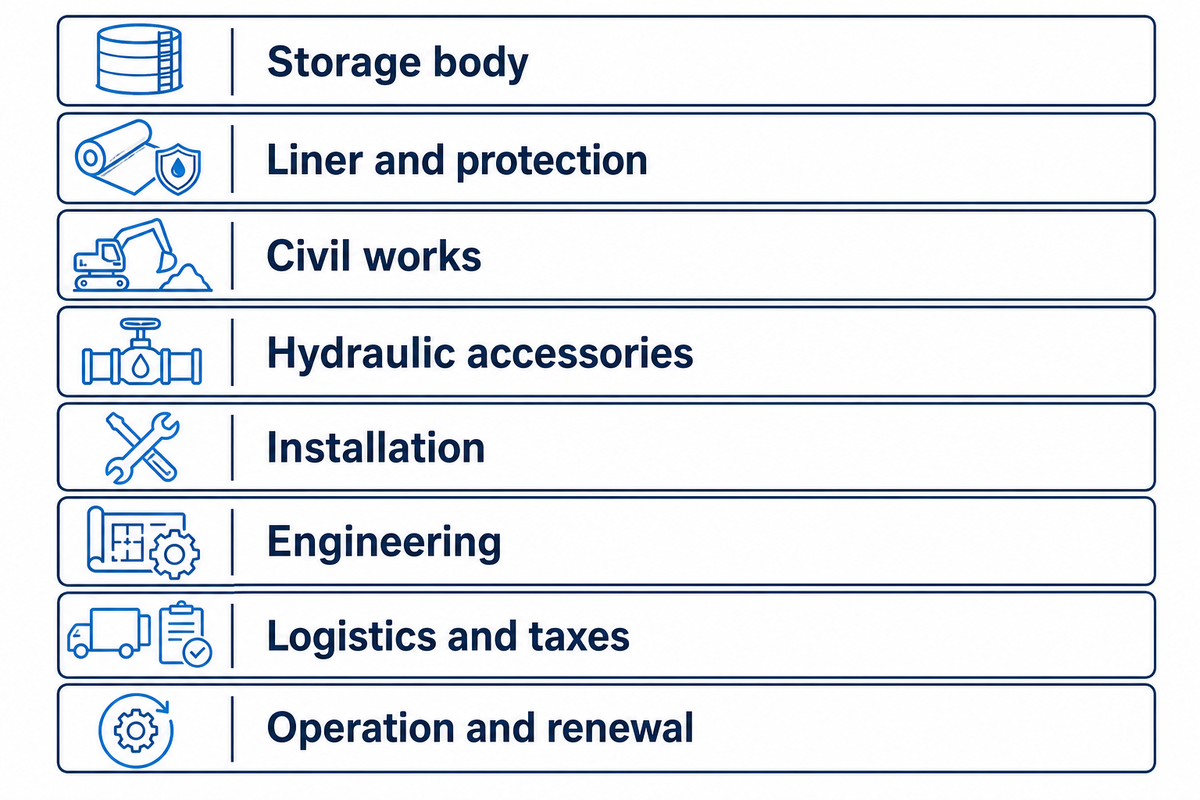
For the overall project, the most useful Cost Comparison Table shows who supplies each component of the installed system and what’s undefined. Complete the same ledger for every shortlisted manufacturer. A blank inclusion is unresolved scope, not a zero-cost item; an equipment quote cannot be compared fairly with a contractor’s complete construction offer.
detention Quote Boundary Ledger. Copy this editorial worksheet into your enquiry. Ask each bidder to enter Included, Separately priced, By others, or Not disclosed beside each row, with a quantity, currency and document reference. Keep a separate column for the party that accepts the work.
Detention Quote Boundary Ledger: complete one copy per supplier and named system
Cost item
Required basis
Written boundary to obtain
Storage body
Model, material, quantity and approved storage duty
Units, end pieces, connectors and spares included?
Liner and protection
Area, specification, seams and penetrations
Supply, installation, testing and repairs included?
Civil works
Excavation, support, groundwater, base and backfill quantities
Who prices unsuitable soil, disposal and reinstatement?
Installation
Assembly, lifting, labor, access and inspection stages
Who provides equipment, supervision and completion records?
Hydraulic accessories
Inlet, outlet, flow control, overflow and treatment schedule
Which components are separately supplied or priced?
Engineering
Named drawings, calculations and approval duties
Supplier design support versus project engineer’s responsibility
Logistics and taxes
Destination, packing, shipment terms and tax treatment
Freight, duties, unloading, storage and validity period
Operation and renewal
Common appraisal period and maintenance plan
Inspection, cleaning, waste handling, repair and replacement basis
Separate storage-system suppliers from installers, liner specialists, and approving designers and record their names individually. If the same company performs multiple services, the contract must specify their functions. The Philadelphia Subsurface detention Guidance describes a system comprising inlet, storage, outlet, and access components. Our ledger accounts for a complete system, and distinguishes that perspective from Philadelphia’s local dimensional rules, which must not be applied automatically in another country.
An example of a good bid clarification is “the offer includes the storage units named and delivery to the site indicated; the liner installation and the listed civil works are priced separately.” This example shows a boundary statement and isn’t referring to any particular company’s current offer. If the supplier can’t define the limits, then leave them undefined for the time being, and request a new bid quote before making a decision on price.
Compare cost per effective cubic metre
Effective comparable cubic meters can be used to compare the various offers, as long as the required hydraulic performance and the scope are the same. Similar volume doesn’t mean the same treatment, discharge, climate allowance or maintenance duty. Check those conditions first, then use one documented storage definition and one currency to calculate comparable unit costs.
stormwater detention systems will receive stormwater runoff from the contributing catchment, including impervious surfaces. The heavy rainfall and peak flow assumptions belong to the hydraulic design for the specified storm events. Additional measures of water quality may also be required; storage capacity doesn’t fulfill the purpose of pollutant removal. When considering stormwater management solutions, both functions must be delineated in the brief.
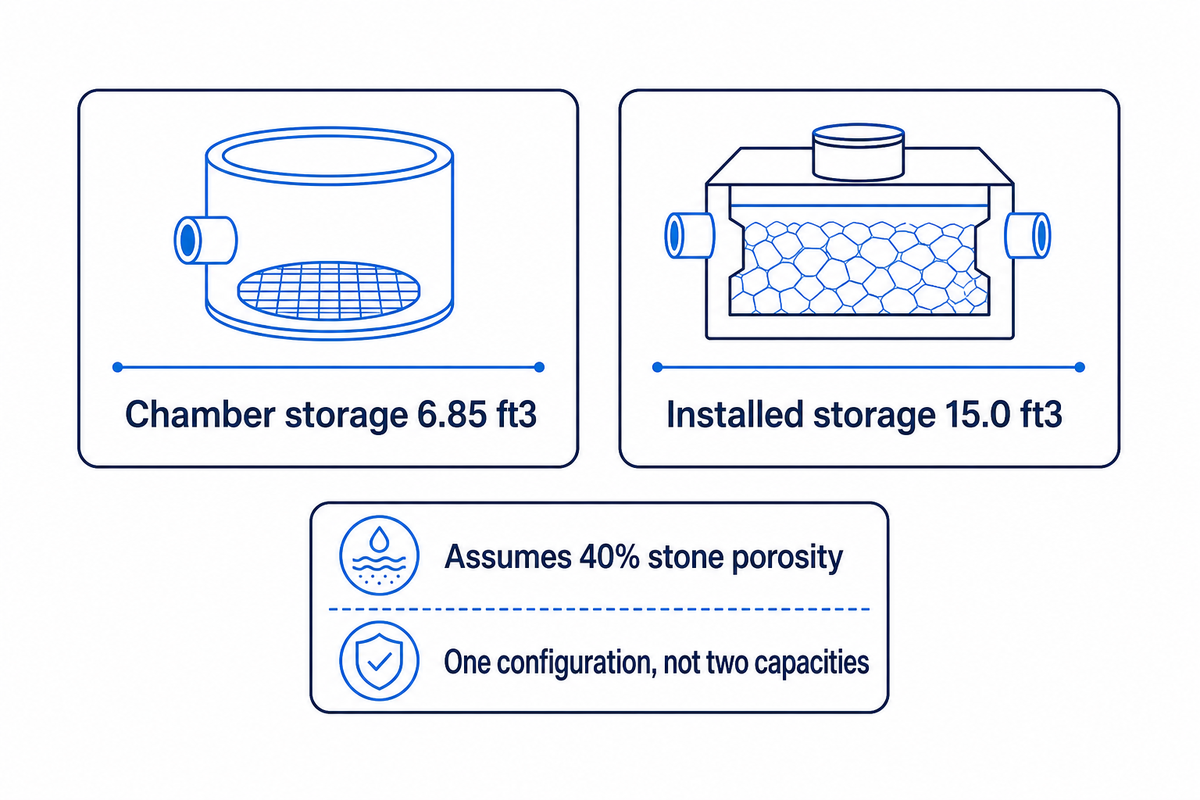
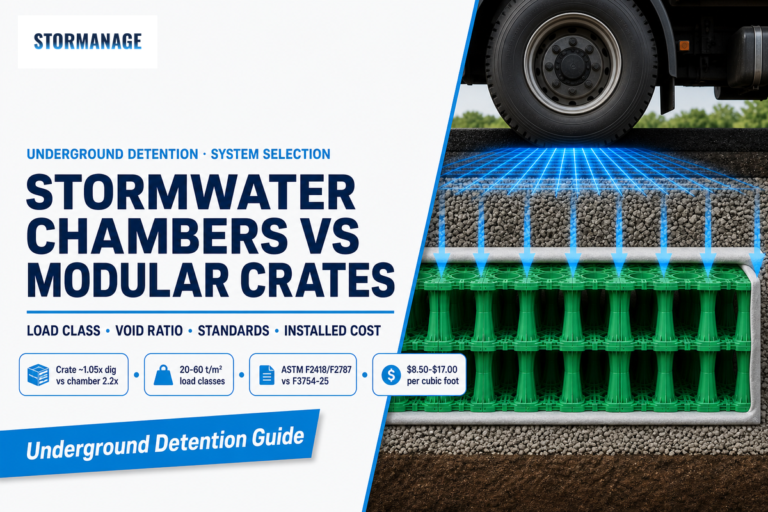
Five concepts tend to get mixed up. The gross envelope here refers to the outer limit of the structure. The nominal capacity refers to the rating of the product(s) and thus requires a definition. Effective detention storage is the volume available for the specified temporary storage duty. Chamber-only storage refers to the storage within the chamber(s) and doesn’t include stone storage (which may be counted in installed storage capacity). Installed storage may include specified aggregate voids, depending on the manufacturer’s assessment.
ADS is a good illustrative example. Its SC160LP information lists 6.85 ft³ of chamber storage and 15.0 ft³ of installed storage; these are different descriptions of one configuration, not interchangeable tank capacities. The installed figure assumes the stated stone arrangement above, below and between chambers with 40% stone porosity . Official source address: https://www.adspipe.com/water-management-solutions/detention-infiltration/stormtech-sc160
Once the scope of the quoted values is the same, divide the comparable installed amount by the approved effective storage in m³. Leave the quantity schedule in the same format as the original. An offer that’s in ft³ should be converted before comparison. In such a case, the unit rate can become higher, and the amount payable will remain constant.
The gross tank envelope is not the excavation volume. Several things can increase the actual excavation work scope such as working space, side support, bedding, cover, unsuitable materials, and access construction. A geomembrane package is priced based on area and specification with consideration of seams and penetrations, rather than a fictitious capacity of the liner. Resolution of both requires drawings and quantities.
As an illustrative case for one region, the national sustainable-drainage standards for England address climate allowances, runoff rate and volume, local requirements and distributed attenuation. Therefore, the comparison begins with the design duty rather than a unit-rate calculation. A project engineer should adopt the applicable approach for your site.
Modular vs concrete and other system costs
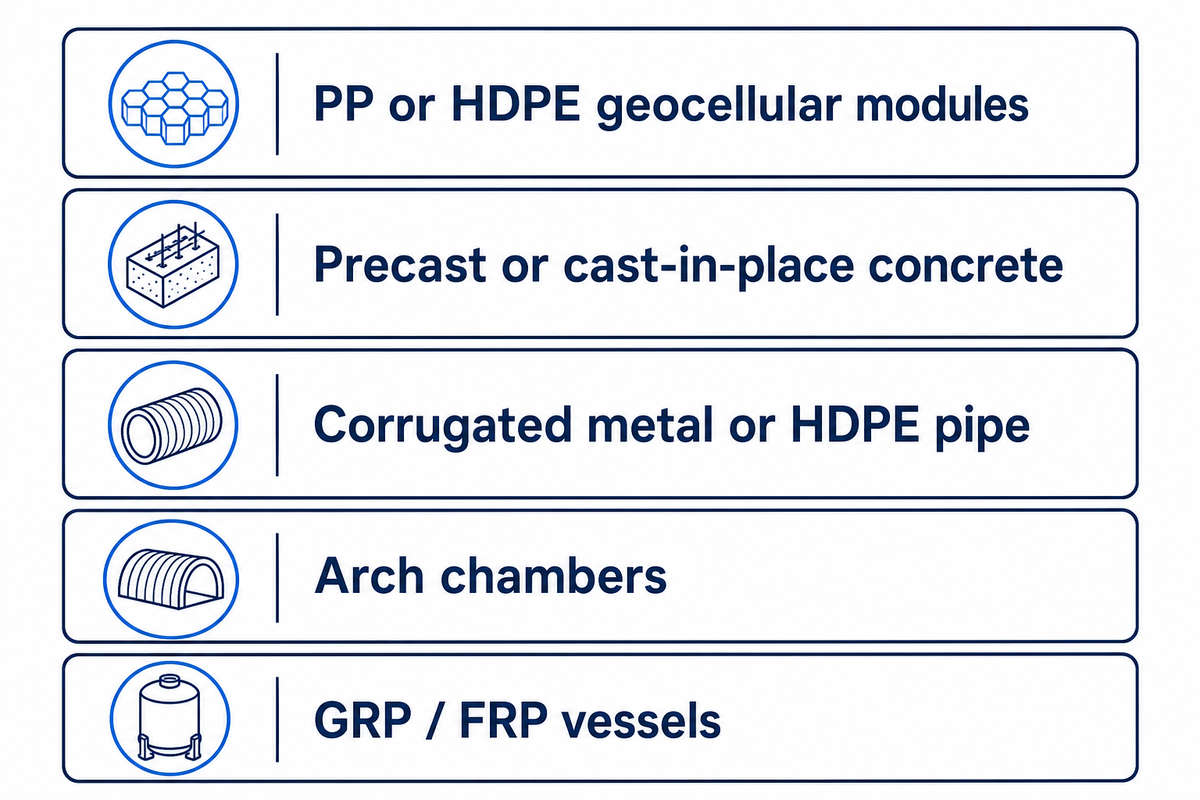
No building material is universally the cheapest. Situational factors like design and surrounding structures, supply and demand in the region, permitted uses, and maintenance can all alter cost. Approval and maintenance requirements may rule out an option before pricing begins. To compare systems, use a common design brief and consider polypropylene crates, concrete detention tanks, piping, chambers and vessels, amongst others.
System routes and the quantities to price; no universal price ranking
Route
Storage arrangement
Cost quantities to examine
Buyer check
PP or HDPE geocellular modules
Connected units; sealed lining for a watertight detention design
Units, assembly, liner area, earthworks, access and backfill
Exact polymer, grade, long-term structural evidence and cleaning route
Precast or cast-in-place concrete
Engineered vault or tank
Fabrication or formwork, haulage, crane or site plant, foundations and joints
Site access, groundwater, joint details and construction sequence
Corrugated metal or HDPE pipe
Parallel or connected pipe storage
Pipe, fittings, coating where applicable, bedding, backfill and access
Diameter, durability conditions, connections and maintenance method
Arch chambers
Chambers with specified aggregate assembly
Chambers, end pieces, stone, excavation, pretreatment and cleanouts
Chamber-only versus installed storage and exact stone assumptions
GRP / FRP vessels
Prefabricated composite tank
Vessel, shipment, lifting, base, anchorage if required and connections
Exact laminate specification and model-specific installation conditions
Structural routes in the matrix don’t mean all plastic products use PP or HDPE. For example, SDS specifies recycled PVC for GEOlight. Also, describing a resin shell doesn’t indicate a particular GRP composition. The actual manufacturer’s material specification should be used for the selected model.
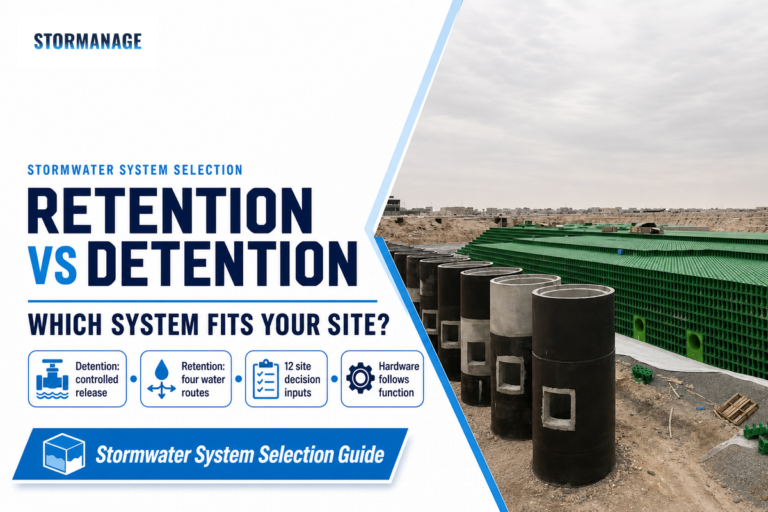
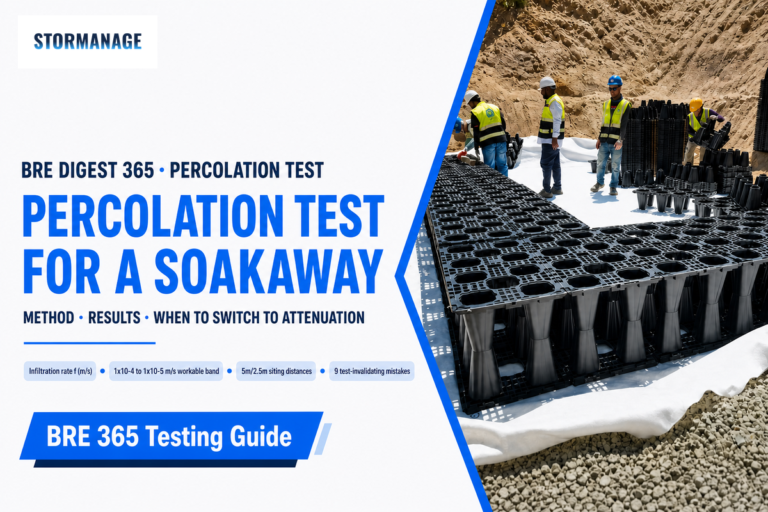
An OSD tank provides on-site detention. OSD describes the temporary control of runoff; it isn’t another tank material. A retention tank or another storage tank can be provided for detention and retention or for reuse only when the design allocates those functions. An infiltration arrangement also requires adequate ground conditions. The distinction is explained in our soakaway and attenuation comparison.
For underground stormwater management, site fit is of the utmost importance. In a 2018 Stormwater Solutions interview, engineer Patrick Kuehl described the challenge this way:
Finding a system that would fit into the space available at this site was a challenge,
The quotation refers to the Allouez aquatic-center parking project. The named-engineer account of underground system selection supports the importance of site geometry. It provides neither a current price nor a universal winning material.
Project inputs that change the quote
The strongest of early queries provides suppliers with physical and hydraulic constraints that may influence their configuration. Groundwater, traffic loading, depth, utilities, and maintenance access all impact more than the tank body. Address those inputs before considering an indicative quote as a budget for construction, and capture all assumptions that remain open.
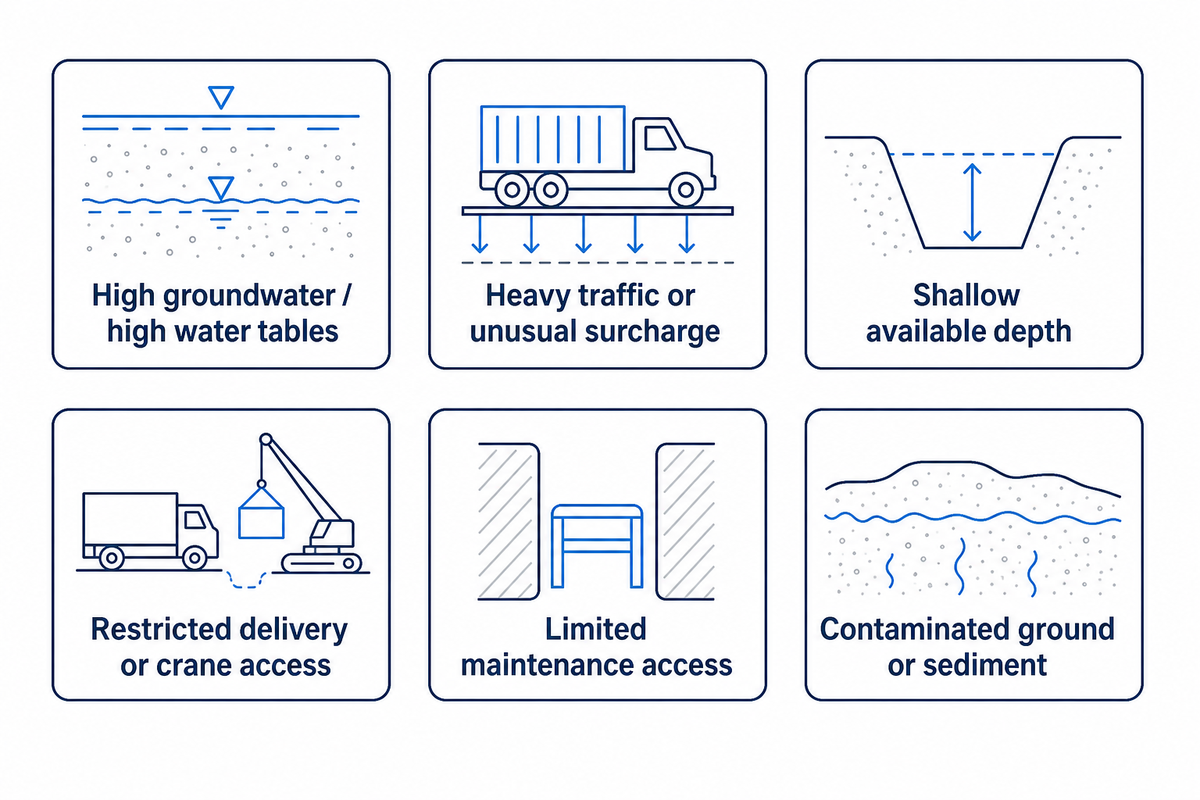
Site Constraint Cost Map. This editorial worksheet connects a site condition to the next document required. It’s designed to assist in the preparation of enquiries and isn’t a substitute for either investigation or engineering design.
Site Constraint Cost Map
Constraint
Possible effect on priced scope
Evidence to request
High groundwater / high water tables
Water exclusion, temporary works and uplift assessment
Groundwater basis, geotechnical report and project-specific structural design
Heavy traffic or unusual surcharge
Selected grade, cover, slab or structural assembly
Actual loads, installation drawing and matching calculations
Shallow available depth
Different footprint, product geometry or connection layout
Levels, utility survey and allowable excavation limits
Restricted delivery or crane access
Packing, shipment sequence, lifting or assembly work
Delivery route and installation method
Contaminated ground or sediment
Investigation, handling, treatment or disposal duties
Site assessment and applicable local requirements
Limited maintenance access
Revised shafts, pretreatment position or system route
Inspection and cleaning plan with equipment access
Illustrative procurement scenario, not a customer case: A developer receives a supply-only offer for modular storage under the delivery area. The enquiry stated a capacity requirement, but omitted loads of delivery vehicles and seasonal levels of groundwater. Prior to the contractor being able to price the work, the designer must resolve the structural assembly, cover system and water control. The revised offer may include different storage units, protective construction or installation duties. The most important step is to provide those missing conditions to every shortlisted bidder and request corresponding revisions. From the first offer, no savings can be calculated since the basis of the offer was considered to be incomplete. This scenario demonstrates the consequence of the missing information; it doesn’t suggest that any specified product failed.
According to the City of Philadelphia’s guidance: “Structural suitability for overburden support and traffic loading must be considered, where applicable.” The subsurface detention design criteria allow for the request for loading evidence. A brochure that states “trafficable” still requires the installation conditions and a project-specific assessment.
Installation and maintenance costs
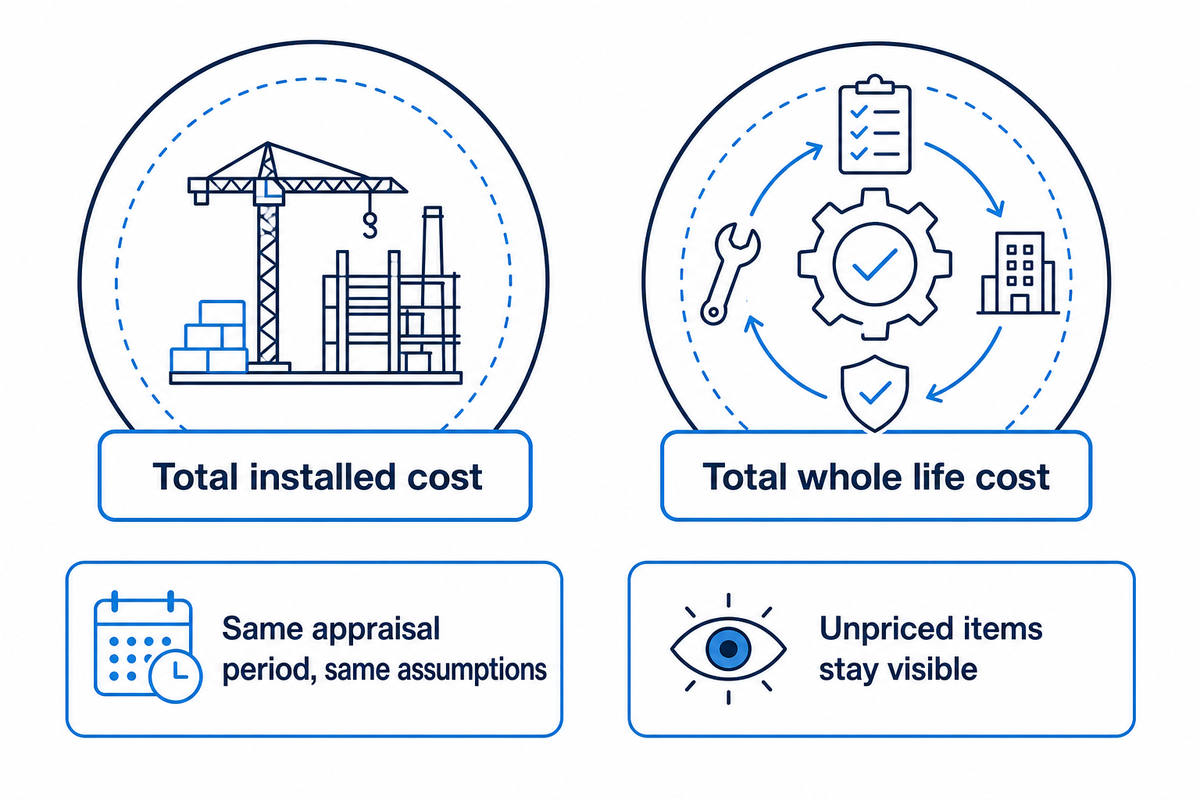
Total installed cost accounts for the expenditures needed for the system to become operational, whereas total whole life cost accounts for expenditures both at the construction phase and during the subsequent phases of maintenance and renewal. Compare both using written boundaries. Ownership costs can change as a result of inspection, cleaning, sediment removal, repair, and ultimately, replacement; however, none of these should be assumed to have an invented annual allowance or to be completely free.
The construction schedule should cover excavation and removal, temporary support, groundwater control, preparation of the base, assembly or lifting of the units, joints or membrane work, connections, backfill, surface reinstatement and completion records. Who checks each stage is equally important. For example, if the liner becomes inaccessible after backfill, the responsibility for its inspection and acceptance should be in the method statement.
Illustrative procurement scenario, not a customer case: A buyer considers a factory price for a small shipment of plastic units against a locally delivered precast proposal. The plastic price offer appears to be more economical because its scope stops at delivery. The precast proposal includes a lift and some installation work, and neither offer clearly prices reinstatement. The estimator breaks the cost into the unit cost of the product, the cost of transporting the product to the site, and the cost of site work. The estimator then asks the civil contractor to complete the missing items against both drawings. Only after that, can the team compare the costs. They may choose either system based on the scope and site constraints. The principle is to correct the scope incongruities before stating that one system is more cost-effective.
For regular maintenance, ask how sediment is intercepted, where it accumulates, how it’s inspected and how it can be removed. Access shown on a drawing must remain usable after paving, landscaping and occupation. The Philadelphia maintenance guidance emphasizes access to major components. Its local requirements aren’t global specifications, but the access question belongs in every supplier discussion.
For a whole-life comparison, evaluation should use the same appraisal period with the same assumptions regarding economic life and accounting. Obtain the maintenance plan and estimate the cost of performing the work, including waste handling where applicable. Separately record allowances for repair, replacement and decommissioning from the original purchase. Where evidence is lacking, make the item unpriced and visible rather than giving the offer an artificial advantage.
Information Needed for an Accurate Stormwater Detention Tank Quote
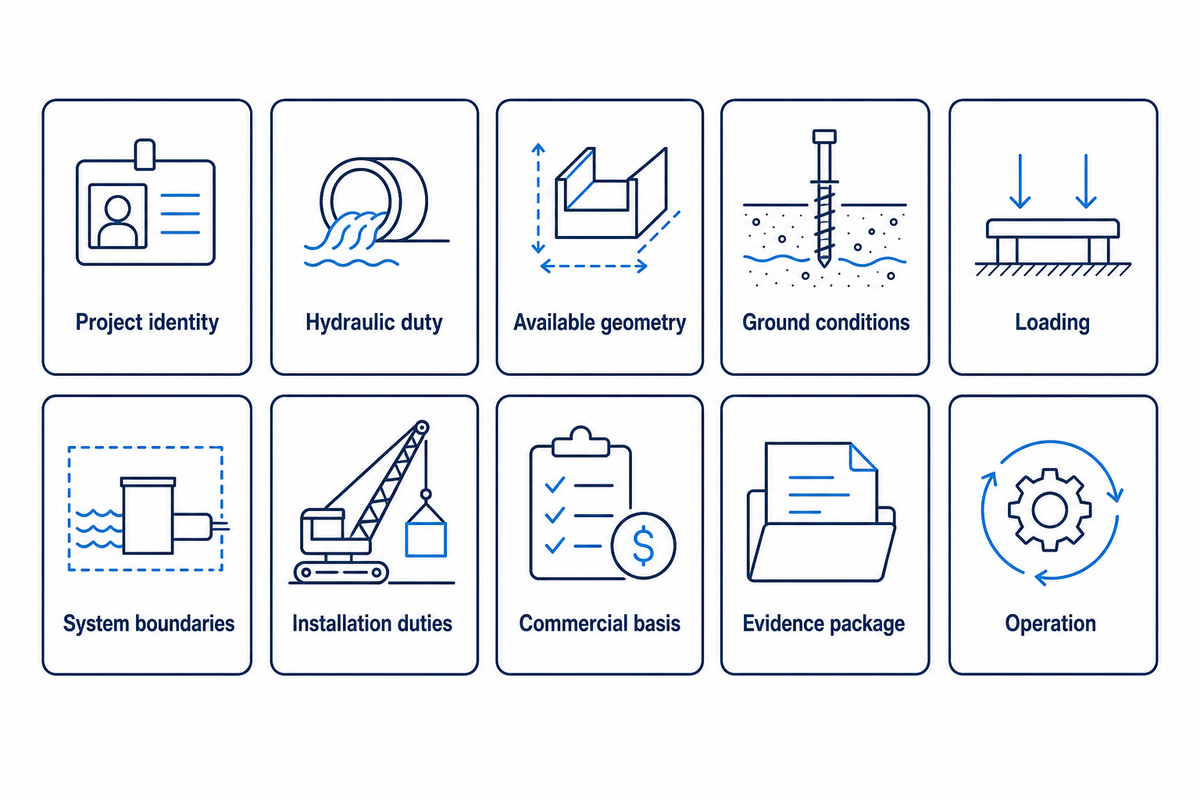
Send one controlled project packet to each potential supplier and ask them to indicate assumptions and exclusions. The packet should relate the approved drainage duty to a drawing and specific quantity, installation conditions and destination. A supplier of stormwater detention solutions can then create a configuration and explain what its commercial offer covers.
Project identity: country, site location, approving authority, project stage, and the party requesting the quote.
Hydraulic duty: detention, infiltration, attenuation or reuse function; required effective storage; design-event basis; discharge restrictions; overflow and treatment requirements.
Available geometry: footprint, levels, depth limitations, inlet and outlet placements, utilities and construction access.
Ground conditions: findings of investigation, groundwater basis, infiltration assessment where relevant and any constraints of contamination.
Loading: current surface use, conditions of vehicles and surcharges, and proposed cover and any influences of adjacent structural systems that need to be considered.
System boundaries: liner, geotextile, flow controls, pretreatment, shafts, monitoring and reuse equipment included or separately procured.
Installation duties: excavation, lifting, assembly, testing, backfill, reinstatement and the required handover documents.
Commercial basis: destination, currency, tax and freight treatment, requested shipment terms, quotation validity and proposed program.
Evidence package: model-specific material declaration, drawings, structural calculations, applicable test reports and any claimed certification with its current scope.
Operation: asset owner, inspection and cleaning access, maintenance schedule and the period used for ownership-cost comparison.
Illustrative procurement scenario, not a customer case: A buying team was getting ready to place a storage system order until the future system operator asked the team how a cleaning vehicle would get to the inspection points. The latest landscape drawing placed fixed features along that route. The volume calculation hadn’t changed, but the proposed handover arrangement was still incomplete. The team updated the access plan along with the designer and the operator. The team then requested suppliers to confirm the access shafts, pretreatment locations, and the cleaning method. This may impact the BOM or site work, without changing nominal capacity. Solving this before a system was purchased gave the operator a maintainable asset and the contractor a defined scope, rather than a remaining undefined duty at completion.
To evaluate a supplier’s documentation after receiving a bid, use our manufacturer evidence and procurement checks. For an Australian on-site detention system, the Australian OSD owner guide provides a separate starting point for owner questions; confirm the actual local council requirements for your site.
The Environment Agency’s sustainable-drainage cost review is a great resource for identifying initial and lifecycle costs. The quotation packet that’s available is our procurement synthesis, and not an official tender or an engineering standard.
What to check in 2026 quotations
When quotations are issued, product names and old standards should be reevaluated. A reference that was used can become obsolete, and a new product feature may apply only to one grade. The exact edition, material and structural scope should be verified before treating it as evidence for a proposed installation.
Clarity in how inspection, installation, and product scope documentation relates to one another is more important to a buyer when compared to unsupported claims of market growth. The 2025 product directory reviewed for this article contains supplier descriptions of inspection and design features. This doesn’t provide independent evidence that an entire technology class has developed or become more cost effective.
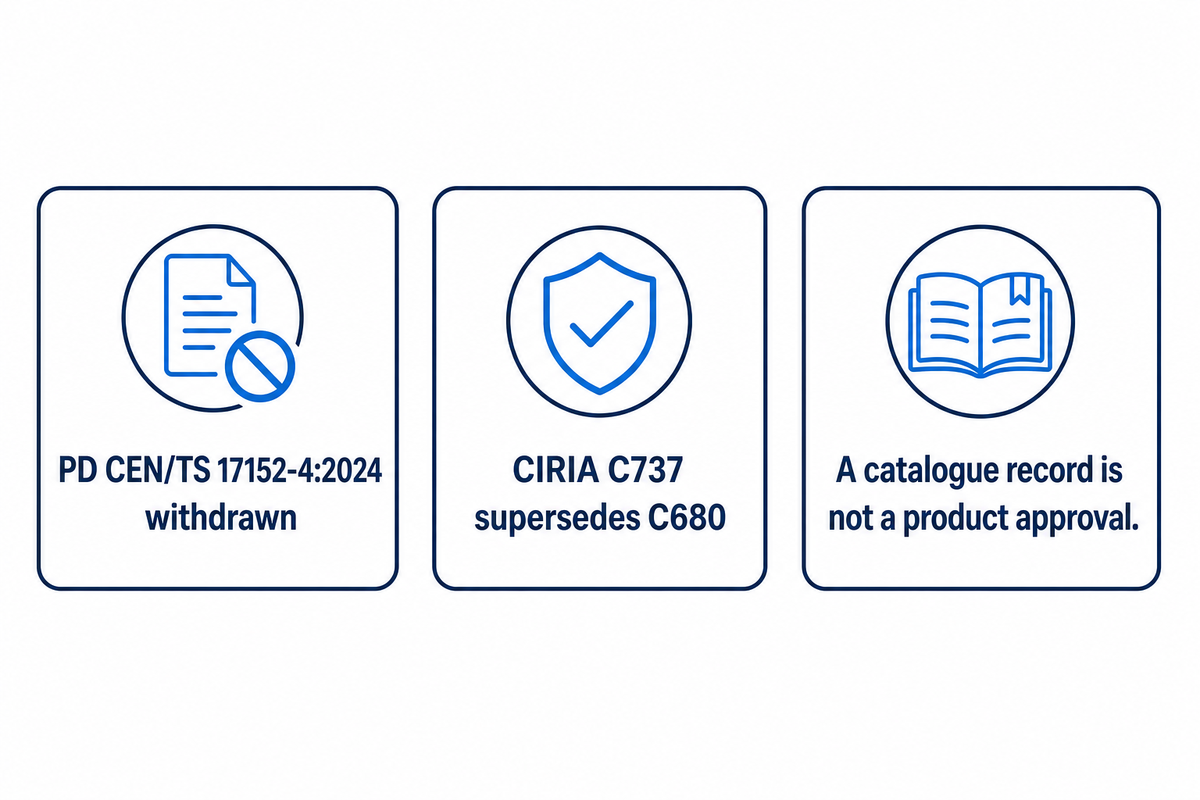
BSI lists PD CEN/TS 17152-4:2024 as withdrawn and its tracked-changes listing for 2025 as current. The public scope is on structural design advice for PP and PVC-U modular box systems conforming to the stated product standard. It excludes geotextiles and geomembranes and specifies other limitations. It does not certify a company on the list or establish suitability for a concrete vault, an HDPE chamber or an FRP tank. Check the current BSI public scope and edition record.
C737 on CIRIA’s public catalogue supersedes C680 for modular geocellular drainage structural and geotechnical guidance. We reviewed the C737 catalogue description, not the complete paid publication. We suggest asking the designer to identify the applicable design basis and explain older references; a catalogue record isn’t a product approval.
Before opting for underground storage, verify it’s a part of the approved stormwater management strategy. In England, national standards favor management in proximity to the source and the combination of drainage systems. Other jurisdictions set their own requirements through local regulations. An underground tank comes into consideration after all these requirements have been established, and not as a substitute for them.
Frequently asked questions
How much does a stormwater detention tank cost?
No single price applies to all stormwater tank systems. Price varies based on the approved storage duty, structure, site conditions, and works included. Scenarios used to illustrate estimates can’t fully substitute for a project quotation. Request clarification on currency, capacity definition, model, location, and treatment of freight, taxes, liners, engineering and installation. Only after the written boundaries and required performance align should the offers be compared.
Is a modular detention tank cheaper than concrete?
In some cases, a modular system may offer cost advantages over other systems, and in other cases, a system may use concrete. Neither is universally cheaper. Compare offers based on the same approved performance, and include excavation, foundations, aggregate or backfill, liners where applicable, lifting or assembly, transport and reinstatement. The lowest priced product may become the highest quoted installed price when the omitted works are calculated. Maintenance access and the ownership cost period also have to be comparable.
What is the main difference between a stormwater tank and a detention tank?
A stormwater tank describes a structure that stores runoff. A detention tank is a temporary system that stores and releases water at a controlled rate that’s part of the drainage design. A rainwater harvesting system stores water for reuse, while infiltration allows water to enter suitable soil. These functions can only be satisfied if the design provides the storage and flow paths for both. The product or the material doesn’t define the function for which a quotation is for.
Can suppliers quote without final project drawings?
An indicative offer may state assumed volume, levels, loads, ground conditions and installation scope. Treat unresolved inputs as open questions. Obtain a revised project quotation and the appropriate technical review before ordering. An early budget doesn’t prove final design or approval.
Does the quote include maintenance?
Only if the written offer includes it. Request an inspection and cleaning plan, and price the services separately from supply and installation. Confirm the maintenance scope, service period, access requirements and party responsible for inspection, cleaning and sediment disposal before budgeting.
To request a Storm Manage project quotation, prepare the same site packet and cost-boundary ledger used for the other eligible suppliers. Submit it through the project enquiry route on our Storm Manage website, with open assumptions clearly marked. That gives the supplier a basis to discuss configuration and commercial scope.
Manufacturer facts and the Brentwood cost scenario are first-party descriptions with official addresses on relevant lines. They don’t generate independent rankings, current certificates, or project-specific approvals. Product and quote availability must be confirmed with the respective supply entities.