We use the details you submit to review and respond to your project enquiry. Entries are handled in this website’s WordPress database using Fluent Forms; our hosting and email providers may process the submitted details. Other technical providers receive only the data described in our Privacy Policy.
Please do not send passwords, payment-card details, government identification numbers, sensitive personal data, or unnecessary confidential third-party information.
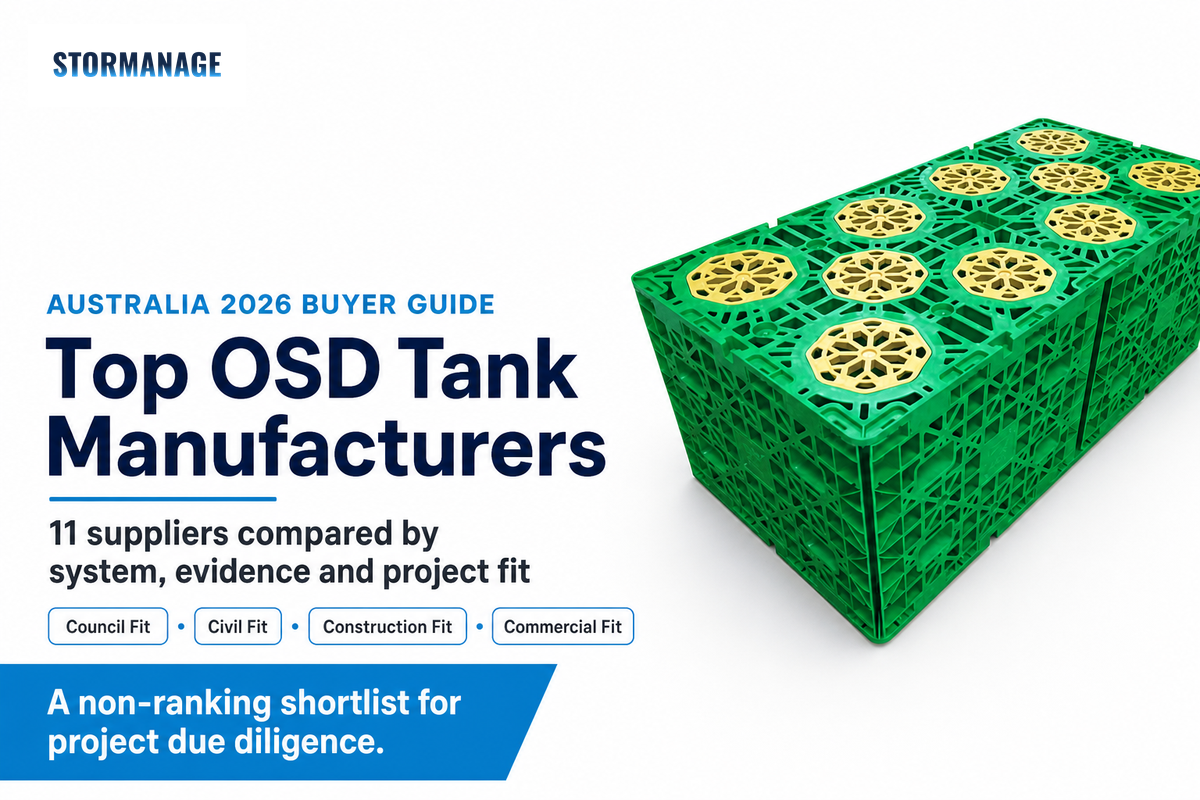
Top OSD Tank Manufacturers in Australia (2026) is a useful search only if “top” means suitable for a defined project, not a universal league table. This guide compares 11 companies with current evidence of an on-site detention product or supply route for Australian work, then shows what engineers and buyers still need to verify before a name reaches a tender list.
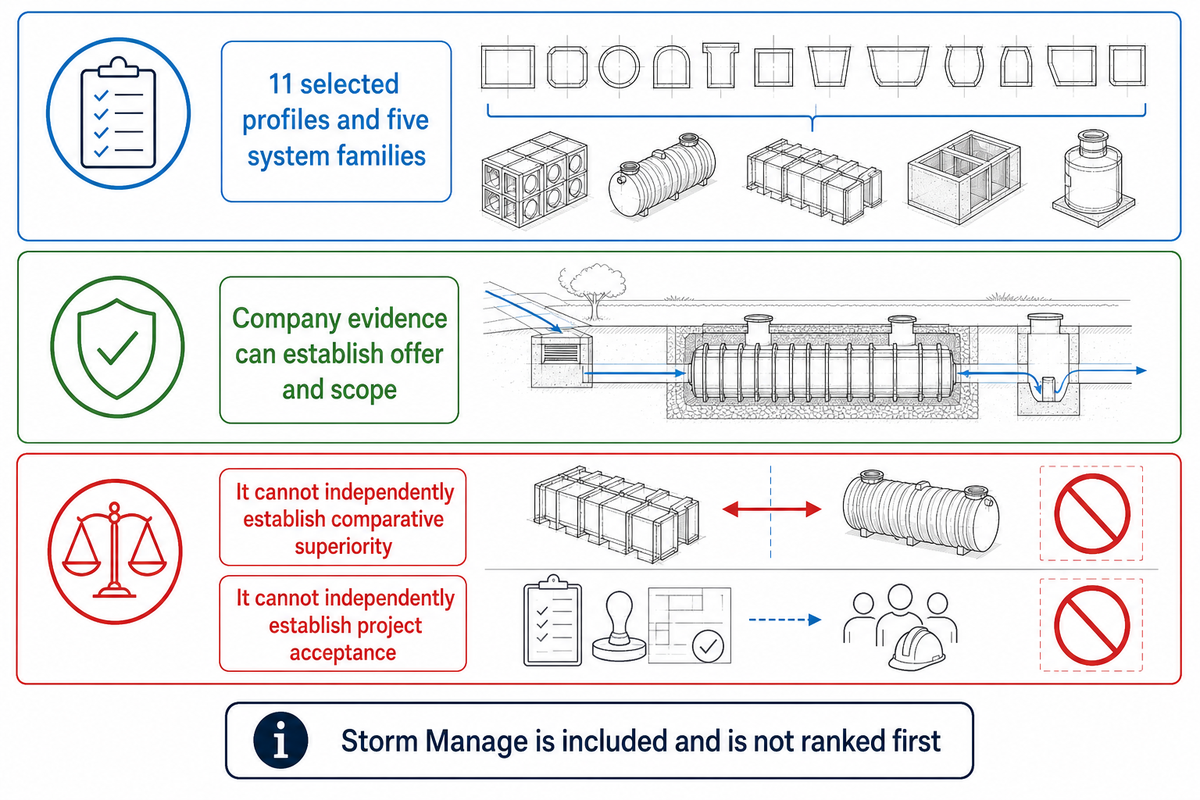
The shortlist is non-exhaustive, it mixes Australian manufacturers, Australian operating entities and one overseas export supplier, and inclusion isn’t evidence of council approval. Storm Manage publishes this article and is one of the listed suppliers; every company receives an identical set of profile fields, and Storm Manage isn’t ranked first.
An OSD system is also not necessarily a manufactured tank. Depending on the authority and site, storage can involve tanks, pipes, landscaped surface areas, reuse storage or a combination. The company list therefore covers one procurement pathway inside a wider drainage design, while the project hydraulic engineer and responsible authority retain the design and approval decisions.
Australian OSD search terms: what this guide covers. Search results mix “OSD tanks Australia,” “tanks in Australia,” “water tank manufacturers” and “water tanks in Australia.” This guide is narrower: it covers on-site stormwater detention and on-site detention tanks, not every water tank or long-term water storage product sold across Australia. It also separates detention systems from general water storage solutions and drinking-water supply equipment.
An OSD drainage system captures stormwater runoff from impervious surfaces, provides temporary storage and allows controlled release to the downstream drainage system. That stormwater management function can reduce downstream flood risk in urban development, but the approved stormwater system, water quality treatment and OSD volumes remain project-specific. Sydney Water or a council may be a stakeholder on a named project; neither turns this supplier list into approval.
Buyers comparing underground tanks will see tank systems, tank solutions, tank types, tank sizes and modular design claims. Before asking a contractor to “install OSD,” fix the design capacity, high water table condition, orifice plate and management system responsibilities. Statements that tanks are designed for a long service life need a named structural basis. Stored water for reuse is a different duty, and FRP is outside this shortlist unless current Australian OSD evidence is verified.
How to read this list
Use it to identify technically plausible suppliers. Do not use position in the article as a score, and do not treat a product page, an Australian address or an attributed project case as proof that a product fits your site.
Top OSD Tank Manufacturers in Australia: Quick Comparison
Eleven companies met the August 2026 inclusion rule: a current company-controlled page showed an OSD product or a supply pathway relevant to Australian projects. The table identifies the route and its evidence boundary; it doesn’t rate performance, price, ownership or approval readiness. That non-ranking boundary follows Australian Competition and Consumer Commission guidance that comparisons can mislead when they are inaccurate or unfair.
Selected OSD suppliers with current Australian-market evidence, checked August 2026
Company
System type / family
Market route
Useful fit signal
Verify next
ACO Australia
PP geocellular modules
Australian operating entity
Separate SD and HD grades
Exact grade, cover, groundwater and project load case
Atlantis Corporation
Modular recycled-PP storage
Australian supplier
Flo-Tank and Titan configurations
Case relevance, liner, access and structural basis
Atlan Stormwater
Precast, chamber and geocellular
Australian stormwater company
Several OSD families in one portfolio
Which family is actually offered for the site
Industrial Plastics
Fabricated HDPE and PP
Australian fabricator
Custom geometry
Material records, weld qualification and structural design
Landscape Tanks
Above-ground modular concrete
Australian supplier
Boundary or retaining-wall integration
Site engineering and independent patent status if material
Panthers Concrete Tanks
Precast concrete
Australian precast supplier
Published capacity steps
Roof/load option, lifting route and grouped-tank design
Polymaster
Moulded poly tanks
Australian manufacturer
Standard retention/detention range
Reserved detention volume, outlet and burial conditions
Puraflo
Corrugated steel with liner
Australian supplier
Standard and custom dimensions
Liner, corrosion, orifice and burial design boundaries
RainCycle
Precast concrete
Australian design-to-install supplier
Coordinated service scope
Named design owner and company-claim boundaries
Storm Manage
Modular PP crates
China-based export supplier
Container planning, accessories and drawings
Australian project engineering and local approval path
Versatile Tanks
Joint-free concrete tanks
Australian manufacturer
Compact rectangular geometry
Current capacity, load data and delivery constraints
Attributed numeric evidence register, comparison inputs, not universal design values
Evidence type
Published or company-supplied value
Boundary
ACO stated surface capacity
350 kN/m² and 455 kN/m²
Named SD/HD product grades only
ACO stated typical cover
0.5 m, 0.6 m and 0.8 m
Grade and loading case remain controlling
ACO stated maximum depth
4.5 m and 6.0 m
Company caveat excludes groundwater
Atlantis case
35 m³
Company-published project, not a portable approval
Panthers capacities
8,000 L, 14,500 L, 18,500 L and 22,500 L
Product-page steps only
Panthers stated roof options
3 kPa and 30 kPa
Exact option and project structure need review
Polymaster stated range
200 L to 50,000 L
Retention/detention range, not one OSD approval
Puraflo stated range
About 5,000 L to 60,000+ L
Steel/liner product-page claim
Production base supporting Storm Manage
8,000 m²
Company-supplied first-party figure
Supporting production base history
Established in 2014
Company-supplied first-party statement, not an ownership claim
Storm Manage output
About 5,000 m³/month and 60,000+ m³/year
Company-supplied capacity, not independent audit
Storm Manage press range
1000T to 2000T
Eight company-stated machines
Storm Manage equipment count
8 machines and 12+ mould sets
Company-supplied equipment inventory, not independent audit
Storm Manage programme
15–30 days
Typical production lead time after confirmation
Storm Manage loading
Up to 330 m³/40HQ
Installed volume under optimised nesting
Hornsby named condition
5% annual exceedance probability and 50 mm pipe
One 2026 planning condition only
Measured query context
+53.7% and +10.5%
Two query trends, not market growth
Aerotropolis context
A$644 million across 1,020 ha
Broad stormwater/recycled-water infrastructure, not OSD market size
Sydney pollution-removal context
300,000 kg
Reported debris removal, not tank performance
Evidence capsule: the table contains 11 selected profiles and five system families, but those numbers describe this editorial sample, not the whole market. Every availability signal comes from the named company’s own current material. Company-controlled evidence can establish offer and scope; it can’t independently establish comparative superiority or project acceptance.
How We Selected These OSD Tank Companies
A company qualified when its own current material showed an OSD product or service accessible to Australian projects on 25 August 2026. We excluded suspended sites, duplicate identities and businesses for which current Australian availability couldn’t be verified, and accepted no paid placement. The same evidence boundary keeps the comparison aligned with Australian Competition and Consumer Commission guidance on accurate and fair comparisons.
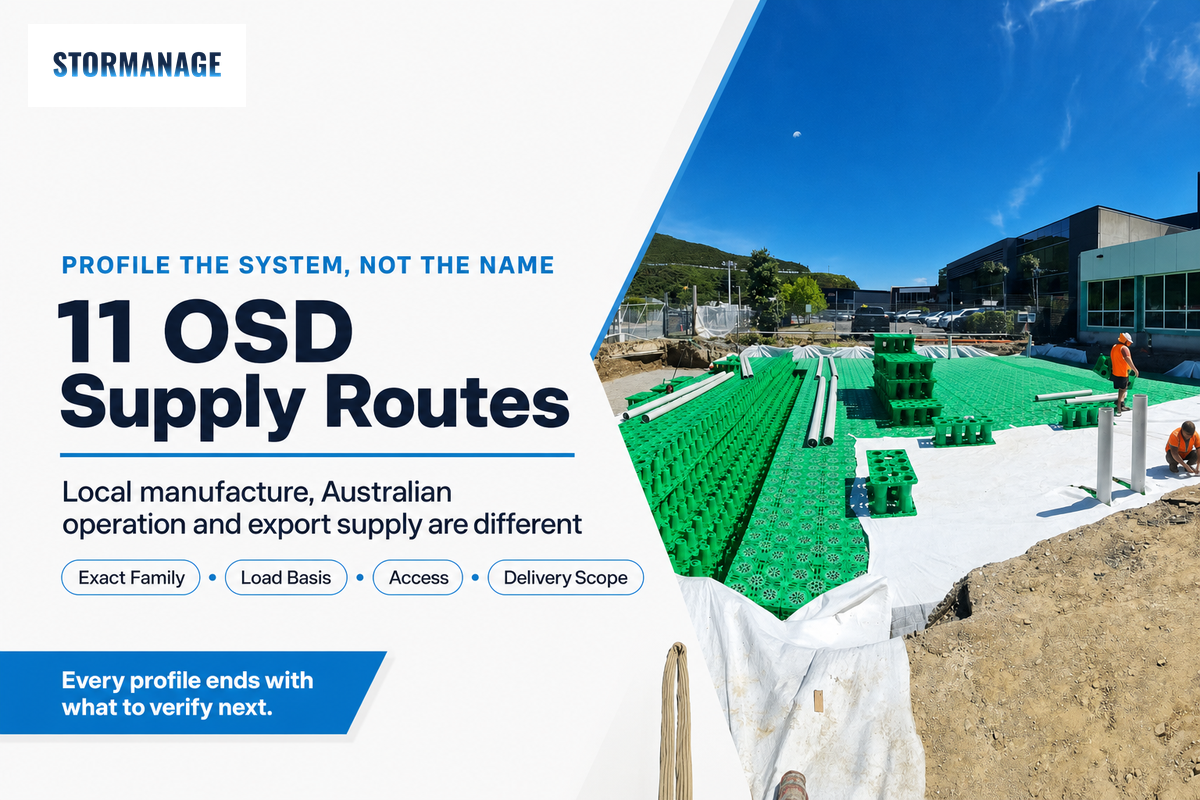
“In Australia” has three distinct meanings here: locally manufactured, supplied through an Australian entity, or exported to Australian projects. The profile and table label the route because an Australian web presence doesn’t prove local production, while overseas production doesn’t by itself prove that engineering, freight or support will fit an Australian job.
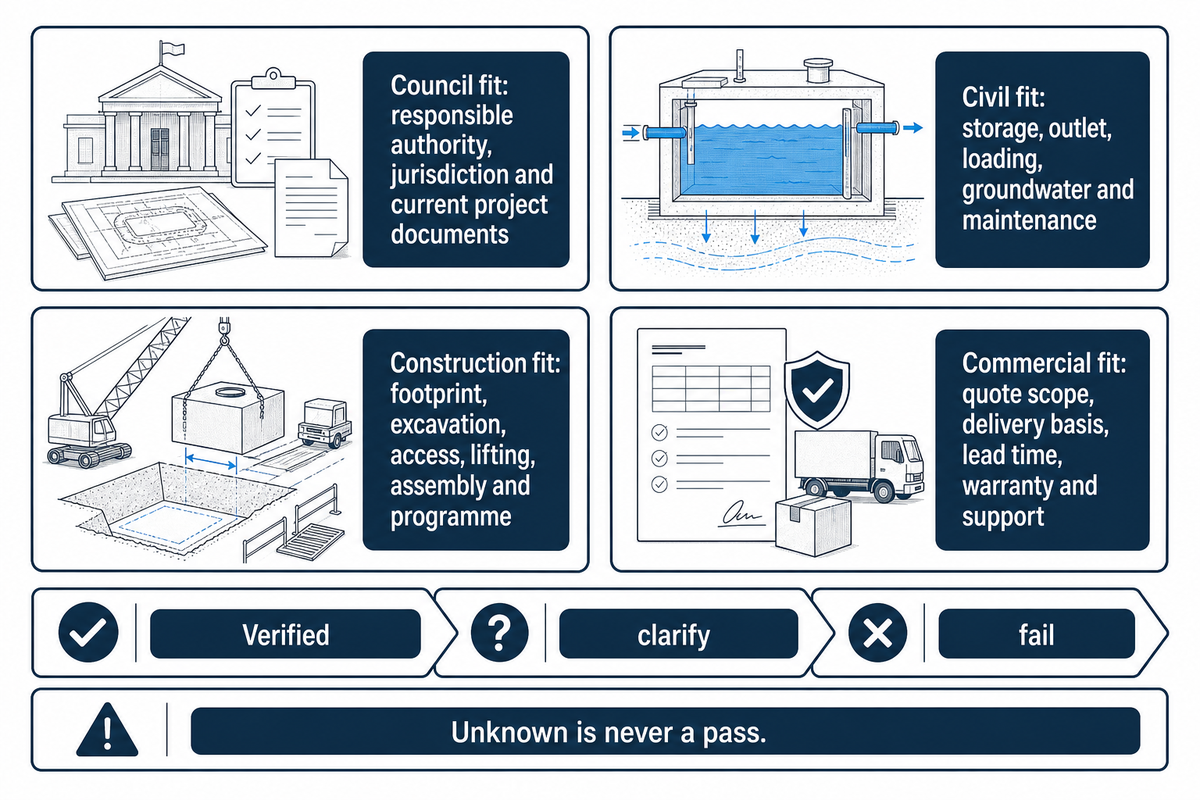
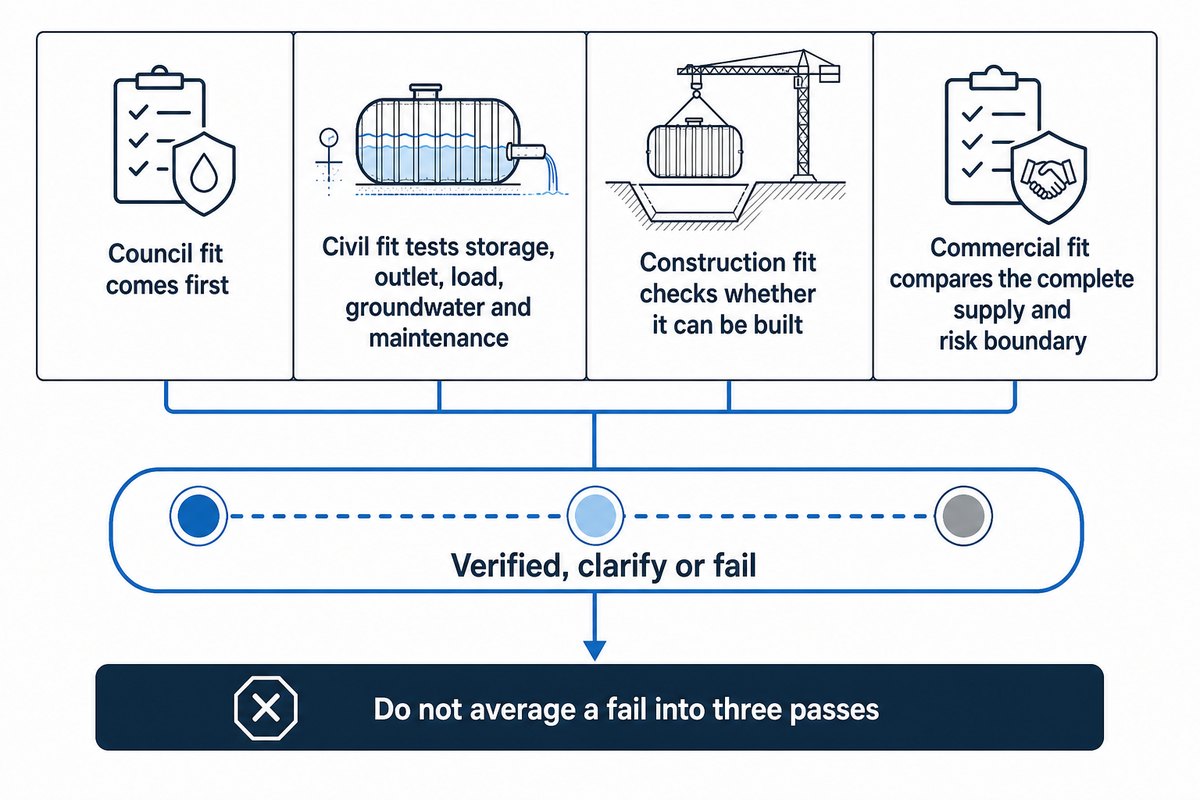
Council fit
Can the evidence be checked against the responsible authority, jurisdiction and current project documents?
Civil fit
Can the engineer verify storage, outlet, loading, groundwater and maintenance assumptions?
Construction fit
Do footprint, excavation, access, lifting or assembly and programme suit the site?
Commercial fit
Are quote scope, delivery basis, lead time, warranty and support genuinely comparable?
This is The Four-C OSD Fit Lens. A supplier is “verified” only where the relevant evidence exists for the actual site; “clarify” means the required input or document is missing; “fail” means a stated product boundary conflicts with the project. Unknown is never a pass.
Four-C decision rule: A supplier comparison is only valid after the project’s council, hydraulic, structural and construction constraints are fixed.
The publisher relationship matters. Storm Manage sells modular crate systems, so this article may help readers reach its product pages. That’s why supplier specifications are treated as first-party statements, why no winner is declared and why the same “verify next” field applies to Storm Manage.
Evidence capsule: Australia’s competition regulator says comparative claims can mislead when a comparison is inaccurate or unfair. That doesn’t ban a useful shortlist; it raises the standard for scope disclosure. Here, “top” means selected for due diligence under a published method, not independently proven to be the 11 highest-performing suppliers.
Company Profiles: OSD Systems, Strengths and Boundaries
These profiles translate different supplier terminology into the same five questions: what system is offered, how the company serves Australia, what makes it worth investigating, what the current first-party page actually supports and what remains unproven. Each profile is a starting hypothesis, not a purchase recommendation.
ACO Australia, StormBrixx Geocellular Systems
ACO Australia presents StormBrixx SD and HD as polypropylene geocellular systems with different published load, cover and maximum-depth data. That split is useful because it prevents the phrase “heavy duty” from floating free of a named grade. ACO’s own material also places conditions around groundwater and depth, so the strongest reason to investigate the range isn’t one headline number; it’s the existence of grade-specific decision data.
Shortlist ACO when an inspectable modular arrangement and more than one structural grade may suit the footprint. Ask for the exact grade proposed, the calculation and applicable loading case, minimum and maximum cover, groundwater assumption, access arrangement and the distinction between stated design life and project asset life. Product-table figures remain ACO claims until checked against the project design.
Atlantis Corporation, Flo-Tank and Titan Modular Systems
Atlantis Corporation publishes modular detention applications for Flo-Tank and Titan systems, including a 35 m³ Brisbane Flo-Tank example. This first-party case reference shows one system scale and configuration, but it isn’t independent proof that those details suit another soil profile, traffic case or authority.
Investigate Atlantis for irregular footprints or heavy-duty modular storage where project cases help an engineer frame questions. Request the case design basis, module configuration, liner or geotextile boundary, access and pretreatment, long-term structural method and local supply responsibility. Don’t turn recycled-polypropylene or project-volume statements into an approval claim.
Atlan Stormwater, Precast and Geocellular OSD Systems
Atlan Stormwater offers several families, including AtlanVault, MegaVault, AtlanCube, AtlanChamber and TankStor. The portfolio can be useful when a buyer wants to compare precast vaults, larger modular vaults and geocellular storage without beginning with separate companies. SPEL Stormwater states that it changed its name to Atlan Stormwater in July 2023, so SPEL isn’t counted as a twelfth supplier.
The breadth also creates a procurement risk: a group-level capability statement doesn’t specify which product family appears in the quote. Require the exact family, storage and outlet boundary, load basis, access and cleaning method, manufacturing/supply entity and project drawings. Treat the rename evidence as identity evidence only, not technical validation.
Industrial Plastics, Custom Fabricated HDPE and Polypropylene Tanks
Industrial Plastics advertises fabricated HDPE and polypropylene OSD tanks, including custom shapes for constrained spaces. Welded fabrication can be relevant where a basement, service corridor or irregular footprint makes standard moulds or precast units awkward. Its page also discusses access and coordination for traffic and soil loads, pointing to a project-specific route rather than a universal catalogue tank.
Shortlist the company when custom geometry is a genuine constraint. Verify material grade and traceability, design temperature, welding procedure, qualified personnel records, testing, connection details, structural design owner and how traffic, lateral soil pressure and groundwater are handled. Any DVS or ISO language remains a company claim until the underlying certificate, scope and currency are reviewed.
Landscape Tanks presents an above-ground modular concrete concept intended to combine detention with a boundary, landscape or retaining function. The proposition is materially different from hiding storage below a car park: it may reduce buried access and excavation while asking the architectural and civil design to accept a visible, integrated structure.
Investigate it when the site can use above-ground volume and a wall footprint carries value. Ask for structural design, waterproofing, controlled-outlet and overflow details, access, finish, foundation and interface responsibilities. The company page makes patent statements; unless patent-register evidence is separately reviewed, those statements should remain attributed rather than becoming an independent patent-ownership conclusion.
Panthers Concrete Tanks publishes standard capacities of 8,000, 14,500, 18,500 and 22,500 litres, with different residential and commercial roof-load options stated on its page. Standard steps can simplify early layout work, while grouped tanks may extend volume. The figures remain product-page claims and don’t remove the need for project engineering.
Shortlist Panthers for conventional precast storage when crane access, lifting sequence and standard dimensions suit the programme. Request the exact roof/load option, reinforcement and structural basis, inlet and outlet levels, group connection arrangement, base preparation, lifting plan, watertightness evidence and delivery boundary. A capacity match without a workable lifting route isn’t construction fit.
Polymaster, Poly Retention and Detention Tanks
Polymaster’s first-party page presents Australian-made retention and detention configurations across a stated 200 to 50,000 litre range. A standard moulded tank may suit residential or light-commercial work where a controlled outlet and accessible footprint align with the engineer’s calculations. The broad range doesn’t mean every size is suitable for every burial, load or OSD duty.
Ask which volume is permanently reserved for detention, which volume supports reuse, and where the outlet and overflow sit. Confirm above-ground or underground status, anchoring needs, vehicle exclusion or structural cover, inlet arrangement and maintenance access. A rainwater tank with an added outlet isn’t automatically an approved OSD design.
Puraflo, Corrugated Steel OSD Tanks
Puraflo advertises corrugated steel OSD tanks for New South Wales and South East Queensland, with standard and custom dimensions, a flexible polyethylene liner and roughly 5,000 to 60,000-plus litre options. It also states that orifice sizing is project-specific. Those details make the page useful for defining questions, but each number is still an attributed company statement.
Investigate Puraflo for above-ground, partly buried or buried storage where custom steel geometry fits the site. Request the coating and corrosion design, liner material and seam details, burial and backfill limits, groundwater position, anchoring, access, outlet responsibility and the hydraulic engineer’s interface. Don’t compare a lined steel shell price with a complete installed concrete or crate scope.
RainCycle advertises concrete OSD design, manufacture and installation, including Australian prefabrication and customisation. A coordinated service can reduce handoffs when the contract clearly names who owns hydraulic calculations, structural design, production, delivery and installation. The company’s broad compliance language isn’t used here; only its product and service-scope statements support inclusion.
Shortlist RainCycle when a precast route and bundled service may fit. Ask for the responsible designers, calculation and drawing deliverables, approval exclusions, crane and site-access assumptions, outlet equipment, commissioning, as-built documents and maintenance handover. “Design to install” should be unpacked into named deliverables before commercial comparison.
Storm Manage, Exported Modular PP Crate Systems
Storm Manage is the publisher of this comparison and a China-based export brand, not an Australian manufacturer. It focuses on modular polypropylene underground storage for detention, attenuation, infiltration and rainwater applications, with accessories, technical drawings, container-loading support and project cooperation. Its Australian relevance is an export supply pathway that still requires Australian hydraulic, structural and approval work.
Storm Manage supplied the following figures for this article on 25 August 2026: an 8,000 m² Shenzhen production base supporting the brand, about 5,000 m³ monthly and more than 60,000 m³ annual finished-module capacity, eight injection-moulding machines from 1000T to 2000T and more than 12 mould sets. The company also reports batch compression, dimensional, material-ratio and unit-weight checks. This article didn’t independently audit the underlying production records, so these remain attributed operational statements rather than comparative proof.
Storm Manage also supplied a typical production lead time of 15–30 days after order confirmation and an optimised nested-loading figure of up to 330 m³ of installed storage per 40HQ. Both are planning inputs, not binding promises; the signed quotation must state the exact product mix, production window, container plan and delivery basis. Verify project grade, load and groundwater assumptions, Australian design responsibilities, inspection terms and complete delivered scope through the OSD tank hub.
Versatile Tanks, Joint-Free Concrete OSD Tanks
Versatile Tanks advertises square and rectangular joint-free concrete tanks for OSD and detention uses, plus nationwide delivery. Compact rectangular geometry can be worth investigating where a circular tank wastes a constrained footprint. The current reviewed page didn’t provide enough bounded detail to infer a standard capacity, structural rating or universal service life.
Ask for the exact dimensions and usable detention volume, structural and waterproofing design, inlet and outlet configuration, lifting and access plan, delivery route, loading assumptions and warranty exclusions. The company’s manufacturing and delivery statements support inclusion; the project engineer must still determine whether the proposed unit works in the actual location.
Modular Crates, Concrete, Poly, Steel or Fabricated HDPE?
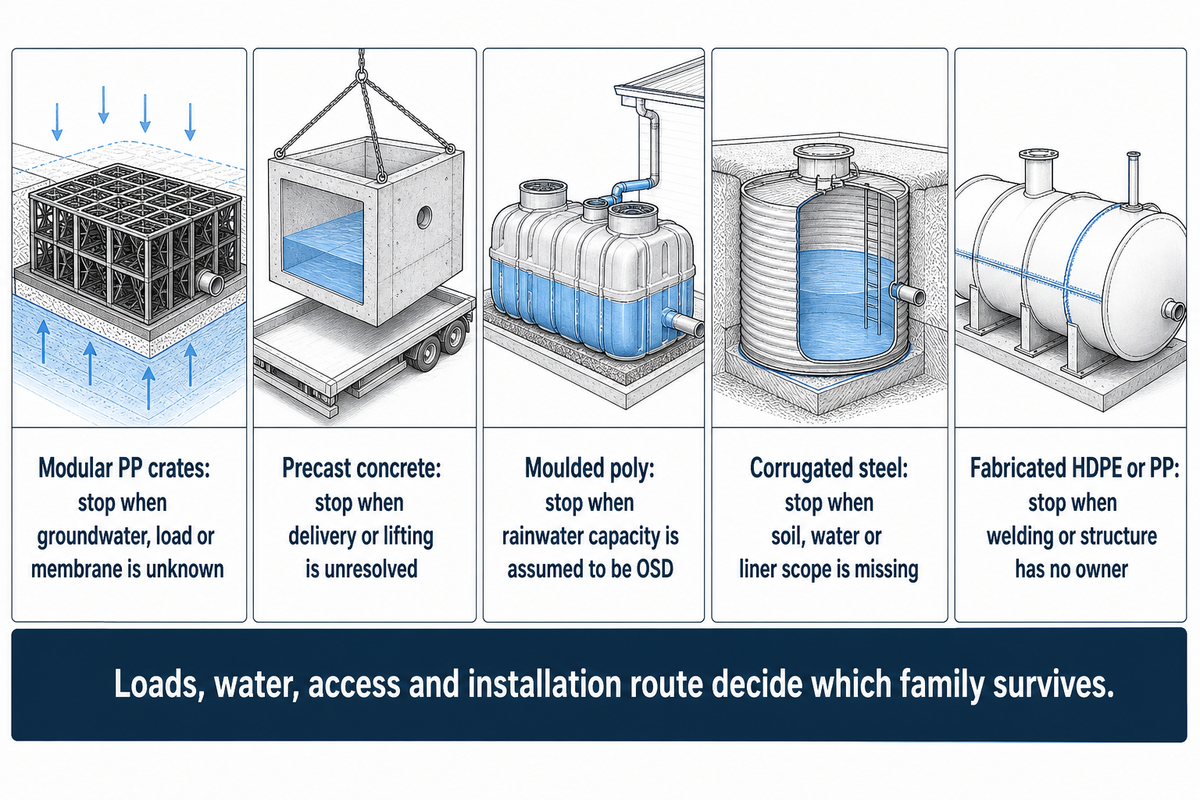
Material is a project constraint, not a quality ranking. Modular crates maximise geometric flexibility, precast concrete offers familiar buried construction, moulded poly suits standard smaller forms, corrugated steel offers configurable shells, and fabricated HDPE or PP can follow constrained geometry. Loads, water, access and installation route decide which family survives.
Family
Investigate when
Evidence needed
Do not shortlist yet when
Modular PP crates
Irregular footprint, high installed void, manual assembly
A rainwater configuration is being assumed to be OSD
Corrugated steel
Custom cylindrical dimensions and liner-based storage
Corrosion, liner, backfill, anchoring and access design
Soil/water exposure or liner scope is missing
Fabricated HDPE/PP
Basement or irregular constrained geometry
Material traceability, weld records, testing, structure
Welding or structural responsibility is unnamed
Can a plastic detention tank be installed under a car park?
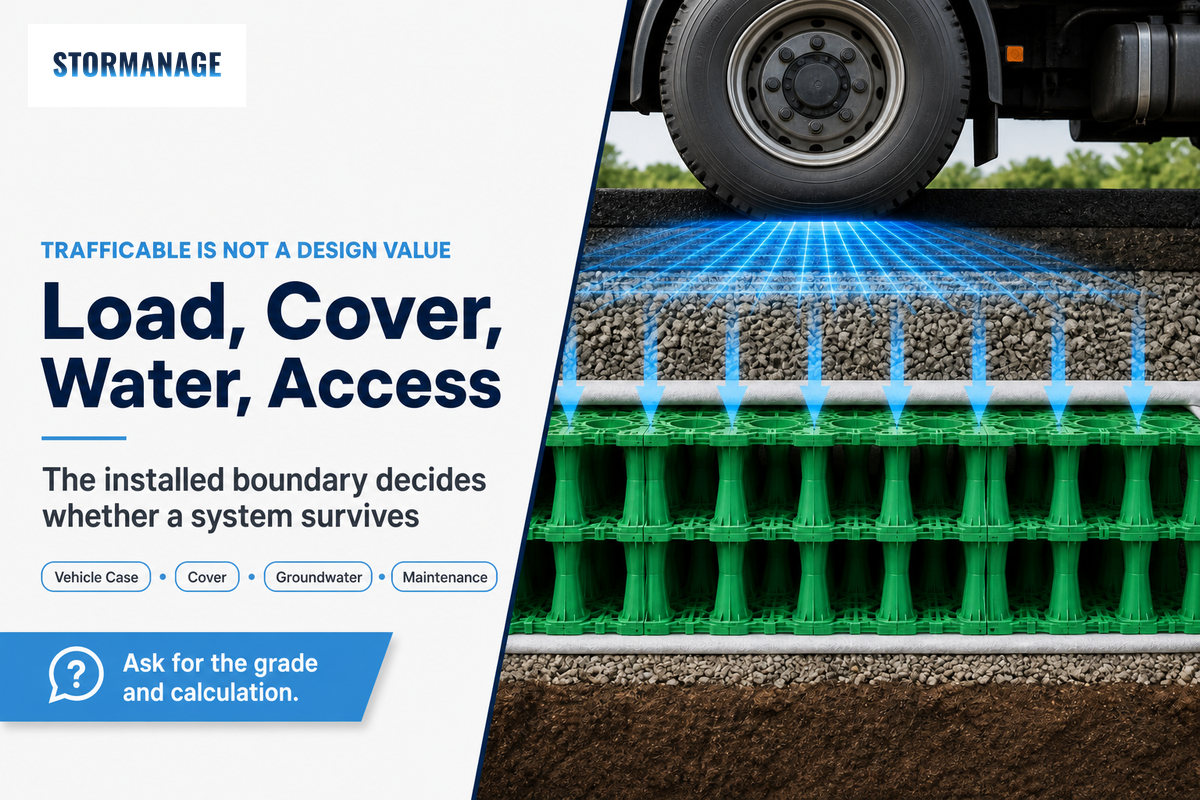
Yes, a plastic system can be proposed below a car park when the exact product grade, installed geometry, cover, backfill, pavement and long-term structural method are checked for the relevant vehicle loading. “Trafficable” isn’t a complete design value. Groundwater and temporary construction loads also matter, and some systems require measures outside the tank supplier’s standard scope. Have the project engineer review grade-specific data and installation limits rather than a generic compression result.
Authority guidance also prevents a reflex preference for burial. The Northern Beaches OSD specification says underground storage shouldn’t be used where surface storage can be provided and then sets hydraulic, cleaning, access and structural requirements for underground arrangements. That’s a local rule, not a national ban, but it shows why available surface space belongs in the material decision.
Evidence capsule:City of Casey identifies below-ground tanks or pipes, landscaped surface storage, reuse tanks, controlled-discharge tanks and combinations. The list matters because it breaks the false choice between five manufactured materials. It doesn’t transfer Casey’s requirements to another council; it shows that system form precedes supplier choice.
Material decision
Eliminate any family whose unresolved groundwater, access, loading or construction constraint can overturn the quote. Compare suppliers only after the viable system family is clear.
For a structured comparison before issuing enquiries, use the OSD material selector. It’s a screening aid, not a substitute for the engineer’s design.
Council and Engineering Evidence to Request Before Shortlisting
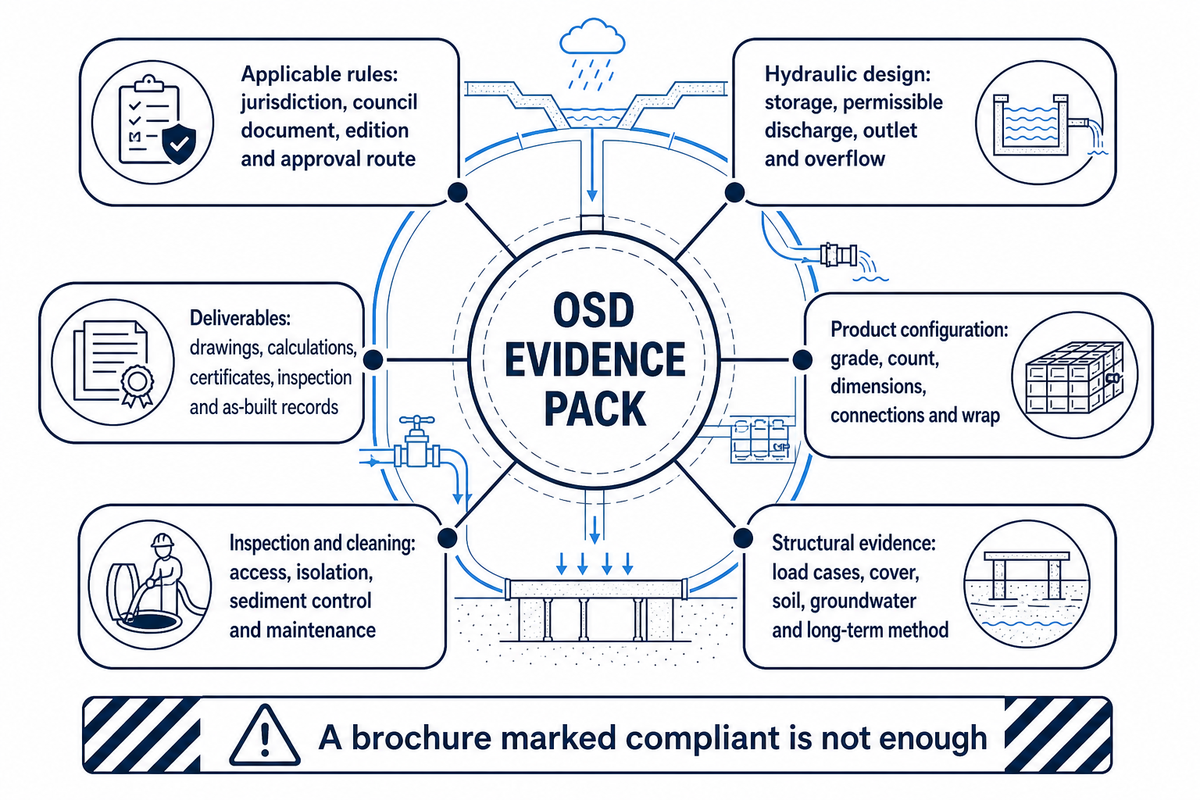
A council-ready evidence pack names the applicable project inputs, product grade, structural basis, layout, outlet interface, inspection access and responsible designer. That turns the material selector’s screening result into a council-ready document request. A brochure marked “compliant” isn’t enough because the published national standard, jurisdictional adoption, council conditions and approved drainage design may not point to the same edition or document set.
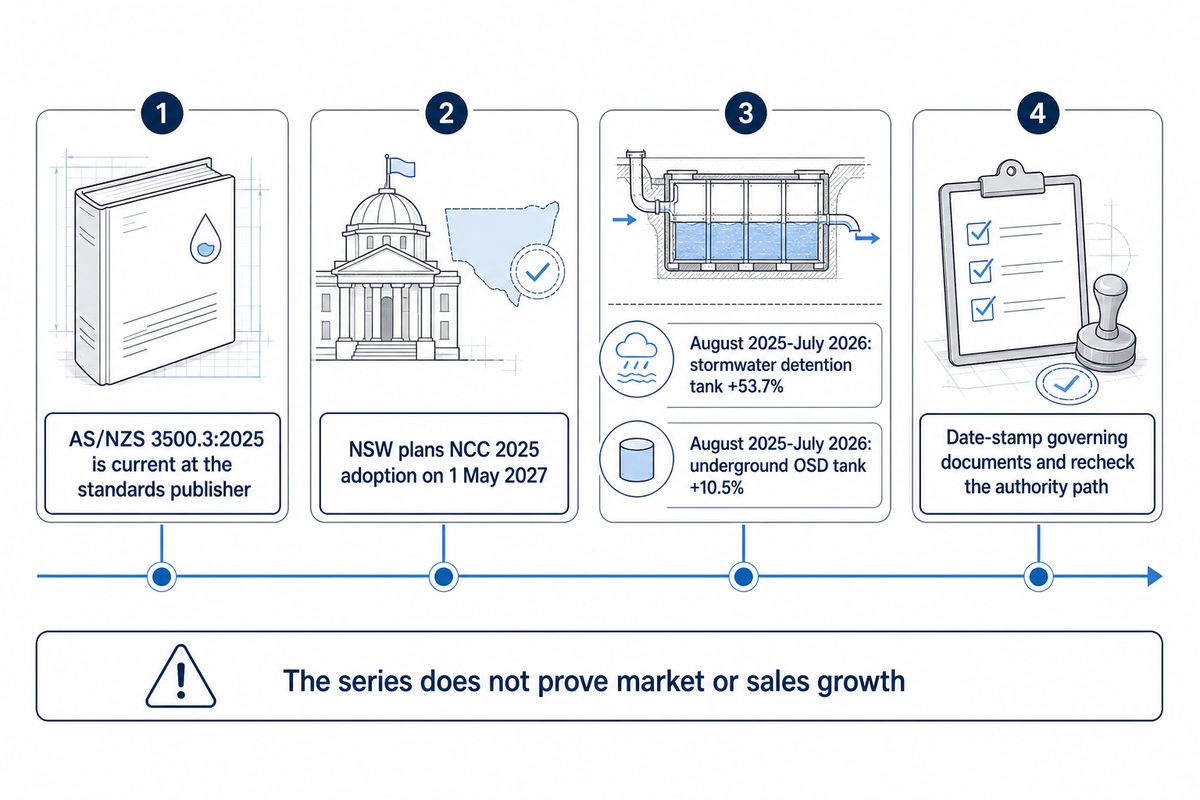
Standards Australia lists AS/NZS 3500.3:2025 as the current published Part 3 for stormwater drainage. That publication fact must be separated from legal or contractual application: New South Wales currently identifies NCC 2022 Amendment 2 and says it will adopt NCC 2025 on 1 May 2027. Other jurisdictions can take different paths.
OSD evidence request checklist
Item
Primary owner
Ask for
Stop condition
Applicable rules
Certifier / authority
Jurisdiction, council document, edition and approval route
“Australian compliant” without named basis
Hydraulic design
Hydraulic engineer
Required storage, permissible discharge, outlet and overflow
Supplier substitutes nominal capacity for design
Product configuration
Supplier
Grade, module/tank count, dimensions, connections, liner or membrane
Quote omits the exact grade
Structural evidence
Engineer + supplier
Load cases, cover, soil, groundwater and long-term method
One short-term number is offered as universal proof
Inspection and cleaning
Designer + operator
Access points, isolation, sediment control and maintenance plan
No practical access route
Deliverables
Contract administrator
Drawings, calculations, certificates, inspection and as-built records
“Included” has no document list
What size stormwater detention tank do I need?
The required size comes from the approved hydraulic design, not a household rule of thumb. The engineer assesses catchment areas and surfaces, design rainfall, allowable discharge, outlet behaviour, levels and local requirements, then establishes the detention volume and system response. Early tools can translate an already determined volume into a preliminary module count, but they don’t generate council approval. Use the detention volume module estimator only after the design volume is known.
Rainfall inputs need their own currency check. The Bureau of Meteorology says its 2016 design rainfalls exclude future climate-change effects and points users to Australian Rainfall and Runoff guidance. Nominal tank volume therefore doesn’t prove that a model contains the project’s applicable climate allowance.
Traffic Loads, Cover Depth, Groundwater and Maintenance Access
Four site conditions can eliminate a system before price matters: the real load case, allowable cover, maximum groundwater and practical maintenance access. Those are the installation interfaces the evidence pack must name. A catalogue compression figure lacks the installed boundary. Ask which grade, calculation, soil and pavement model, safety factors and life basis support the proposed arrangement.
Site condition
Evidence question
Decision
Trafficable car park, grade named
Does the calculation cover the actual vehicle, pavement, cover and long-term product grade?
Accept for engineering review only when all are named
Load stated, grade absent
Which product variant and installed geometry produced the number?
Defer; do not compare yet
Groundwater above system base
Who designs uplift resistance, anchoring and wrap integrity?
Reject if responsibility remains unnamed
Inspection requires entry
Can the work avoid entry; if not, what safe system and rescue arrangement applies?
Defer to operator and safety review
Access route blocked by future works
Can inspection, cleaning and component removal occur over the asset life?
Reject the location or redesign access
ACO’s own SD/HD tables illustrate the point: separate grades carry different figures and caveats, so “ACO StormBrixx” isn’t itself a structural answer. The same discipline applies to every material. The correct evidence is the named product and installed layout checked against the project load case, not the largest number in a brochure.
Maintenance can also become a worker-safety issue. Safe Work Australia lists tanks and pits among common confined spaces and describes risk assessment, entry permits, signage, communication and rescue duties where confined-space work applies. The actual space and task determine classification; a product label doesn’t.
Evidence capsule: one 2026 Hornsby planning condition assigns OSD design to a chartered civil engineer and includes a 5% annual exceedance probability check and a named 50 mm minimum outlet-control pipe in that condition. Those figures belong to that decision, not every project; their value is showing how specific approval evidence can become.
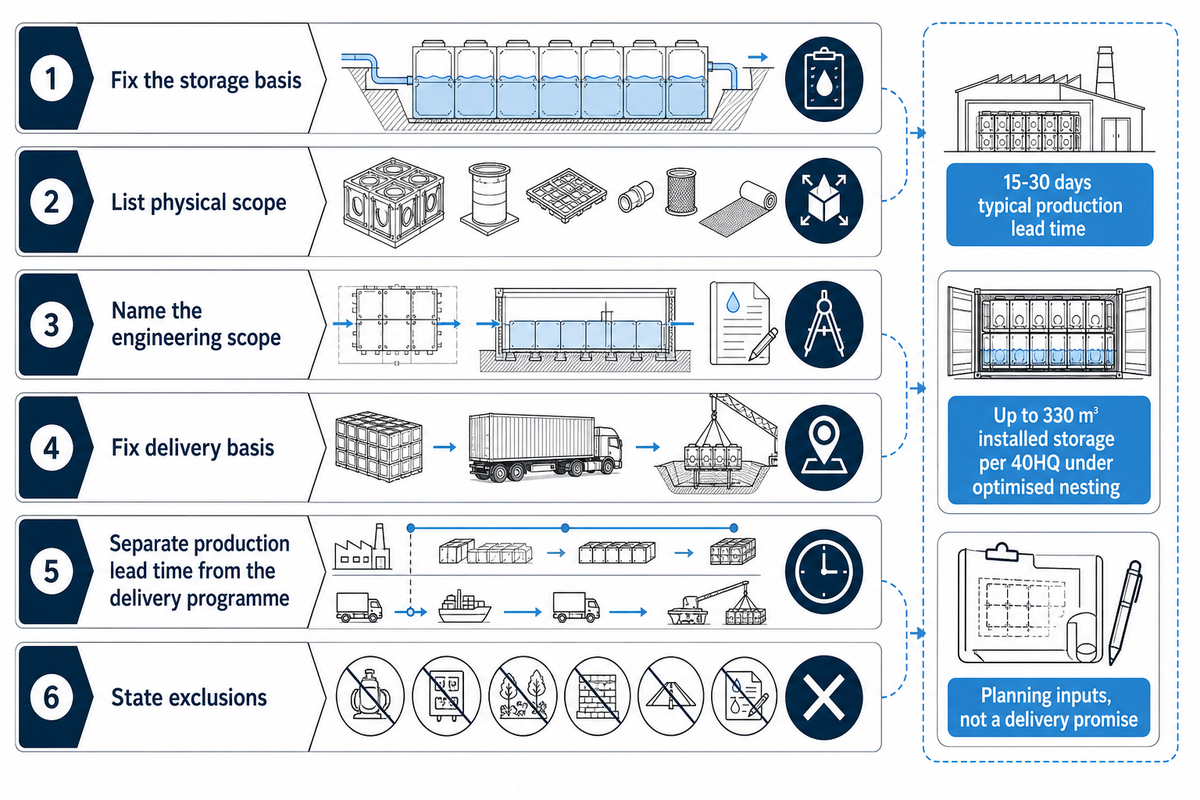
An inaccurate or unfair quote comparison may mislead buyers. Make quoted OSD tank prices comparable only after storage basis, accessories, liner or membrane, drawings, outlet scope, freight, lead time, installation and exclusions are standardised. The OSD load-class reference and project calculation carry into that comparison. No reliable Australia-wide installed-price band survived this review because these boundaries vary too much. A precise generic number would create false confidence.
Fix the storage basis: state whether the volume is gross vessel capacity, effective detention volume or installed system volume, and identify any stone or inaccessible volume.
List physical scope, including modules or tank body, connectors, end caps, membrane or liner, geotextile, vents, access, silt control and inlet/outlet items.
Name the engineering scope: layout drawings, structural calculations, hydraulic interface, certifications, revisions and approval responses.
Fix delivery basis by recording Incoterm, port or site, unloading, crane or assembly, packaging, container count and damage responsibility.
Separate production lead time from sea freight, customs, local delivery, inspection and document approval.
State exclusions. Earthworks, base, backfill, pavement, anchoring, pumps, outlet controls, installation and commissioning are common gaps.
For Storm Manage’s export route, the company reports 15–30 days as a typical production lead time after order confirmation and up to 330 m³ of installed modular storage per 40HQ under optimised nesting. Those first-party figures help container planning; they aren’t a delivery promise until the exact product mix, order, port, vessel and destination programme appear in the quotation.
Storm Manage prefers FOB Shenzhen, Yantian or Shekou and says Qingdao or Ningbo can be coordinated for project needs. The buyer still needs ocean freight, insurance, Australian import and local delivery responsibilities defined. Use the OSD tank cost and sizing guide to keep calculation intent separate from this supplier shortlist.
Commercial decision
A low tank price can become a high project price when it omits structural evidence, outlet components, access, freight, lifting or installation. Compare one written supply boundary, not two totals.
Which OSD Manufacturer Should You Shortlist?
Choose three or four candidates by scenario, then mark each Four-C dimension verified, clarify or fail. Use the normalised supply boundary from the quote comparison as the commercial input. A company can be strong for a constrained basement and irrelevant for an above-ground boundary wall. The framework selects questions and disqualifiers; it doesn’t create a universal winner.
Scenario
Plausible family / candidates
Verify before RFQ
Fail signal
Constrained basement
Fabricated HDPE/PP; Industrial Plastics
Custom structural design, weld evidence, access and levels
Geometry fits but maintenance or welding responsibility does not
Exact load, grade, cover, pavement, groundwater and installation
Generic “heavy duty” claim
Standard residential or light commercial
Precast or moulded poly; Panthers, Polymaster, RainCycle, Versatile
Detention volume, outlet, lifting/delivery and burial boundary
Rainwater capacity substituted for OSD design
Above-ground boundary integration
Modular concrete wall or suitable steel; Landscape Tanks, Puraflo
Architecture, structure, outlet, foundation and access
Visible storage conflicts with planning or safety
Export modular volume
PP crates; Storm Manage and relevant Australian modular suppliers
Australian engineering, grade, container plan, delivery basis and inspection
Unit price is clear but local responsibility is not
Apply The Four-C OSD Fit Lens in order. Council fit comes first because a technically credible product is still unusable if the documentation can’t enter the approval path. Civil fit tests storage, outlet, load, groundwater and maintenance assumptions. Construction fit checks whether it can be built. Commercial fit compares the complete supply and risk boundary.
Don’t average a fail into three passes. A missing groundwater responsibility isn’t rescued by a good lead time, and an inaccessible tank isn’t rescued by a familiar material. “Clarify” is the correct state when an input is genuinely unknown; obtain it before scoring.
Shortlist rule
Shortlist by project fit, then tender on equivalent evidence and scope. If a candidate fails one controlling condition, replace it instead of compensating with marketing strengths elsewhere.
What Is Changing for Australian OSD Procurement in 2026?
The main 2026 change is documentation risk, not proof that one material became superior. Buyers must reconcile the current published drainage standard with the code edition, council conditions and project documents that actually apply. That makes evidence currency and jurisdiction part of product selection.
Local conditions remain concrete. Hornsby’s 2026 material assigns design responsibility and project-specific discharge controls, while a NSW planning record documents an OSD location problem involving overflow, accessibility and maintenance. These aren’t universal design values; together they show that product choice, location and approval evidence can’t be separated.
Measured search language is supporting context only. The local DataForSEO series stored as keyword-trends.json covers August 2025–July 2026: “stormwater detention tank” was 53.7% higher in the last six months than in the preceding six, while “underground OSD tank” was 10.5% higher. This is a first-party workflow measurement, not independently audited market data; other phrasing moved down, exact long-tail volume was unmeasured, and the series doesn’t prove market or sales growth.
Evidence capsule: one current publication date, one state adoption date and two measured query changes are useful only inside their boundaries. The procurement action is simple: date-stamp the governing documents, require suppliers to name the product revision and recheck the authority path before freezing the shortlist.
Frequently Asked Questions
These answers define common boundaries. They can’t replace a hydraulic calculation, structural design, work-health-and-safety assessment or council decision for a particular site.
What is the difference between an OSD tank and a rainwater retention tank?
An OSD tank temporarily holds runoff and releases it through a controlled outlet at the rate set by the approved drainage design. A rainwater retention tank keeps water for later reuse. Some projects combine both functions in one vessel, but the reserved detention volume, reuse volume, outlet level and overflow still need to match the hydraulic engineer’s calculations and the relevant council conditions. Don’t assume that any rainwater tank automatically satisfies an OSD requirement.
Which OSD tank material is best for an Australian project?
There is no universally best material. Precast concrete may suit conventional buried construction; fabricated HDPE can fit constrained shapes; moulded poly tanks suit standard smaller volumes; corrugated steel can provide custom above-ground or buried storage; and modular geocellular crates can use irregular underground footprints efficiently. The correct shortlist depends on the storage and discharge design, traffic and soil loads, groundwater, access, installation route, council evidence and complete supplied scope.
Can an OSD tank be installed under a driveway or car park?
Yes, some systems are designed for trafficable locations, but a generic “heavy-duty” label isn’t enough. The designer must check the relevant vehicle loading, cover depth, lateral pressure, backfill, groundwater and long-term structural basis for the exact product and layout. Ask the supplier for the named test or design method, grade-specific data and installation limits, then have the project engineer confirm that evidence against the site loading case.
Do buried plastic OSD tanks need buoyancy anchoring?
They may. Where groundwater creates net uplift, the engineer must design anchoring for the exact tank, installation and design water level.
How long do OSD tanks last?
No single service-life number applies to every OSD system. A manufacturer may state a design life for a product grade, but actual suitability depends on the structural design basis, material, loading, groundwater, chemical exposure, installation quality, sediment control, inspection access and maintenance. Compare the claimed life, named calculation or standard, applicable cover and loading limits, warranty and exclusions. Keep a product claim separate from the civil asset’s design life.
What information should I send an OSD tank manufacturer for a quote?
Send the required detention volume, permissible discharge or outlet design, site plan and available footprint, inlet and outlet levels and sizes, burial and cover conditions, traffic loading, groundwater information, access requirements, delivery location and programme. State which drawings, calculations, accessories, liners or membranes, inspection components, freight and installation services must be included so every supplier prices the same boundary.
Next Step: Issue One Evidence-Bound Request
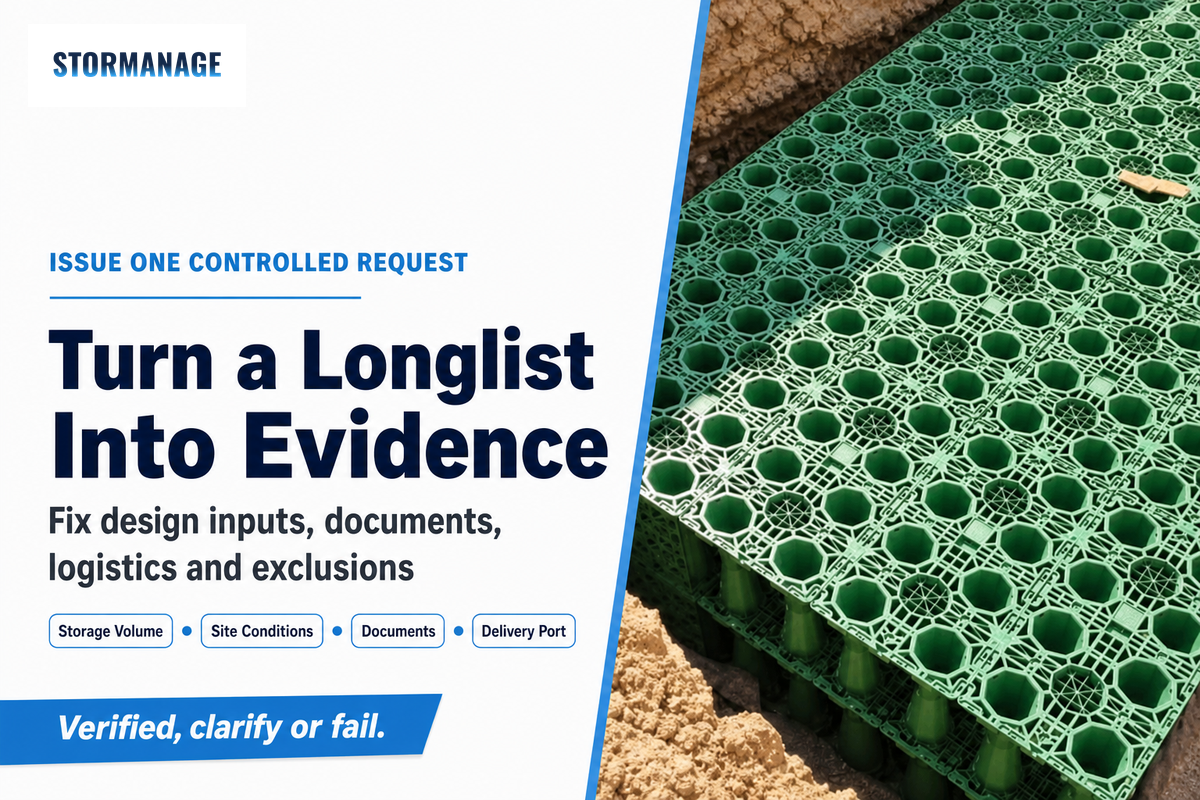
Reduce the 11-company longlist to technically plausible candidates, mark every Four-C field verified, clarify or fail, and send one controlled request to the survivors. The request should make the engineer’s design inputs visible and force every commercial scope onto the same page.
For a modular crate review, send Storm Manage the required storage volume, available footprint, cover, traffic case, groundwater information, inlet and outlet details, delivery port, required documents and whether the company-stated ceiling of up to 330 m³ per 40HQ is relevant. We can return a project-specific configuration and export scope for engineering review; we can’t replace the responsible Australian designer or authority. A current council checklist, such as the City of Casey OSD design checklist, shows why design inputs and submission evidence need to travel with the request.
Updated 25 August 2026. Written by XCX and reviewed for Storm Manage. Supplier product details are attributed first-party statements unless an authority source is explicitly named. Storm Manage’s production, quality-control and logistics figures are company-supplied first-party information.


![Stormwater Detention Tank Manufacturers [2026 Vetting Guide]](https://stormmanage.com/wp-content/uploads/2026/08/stormwater-detention-tank-manufacturers-featured-768x512.png)

![Stormwater Detention Tank Manufacturers [2026 Vetting Guide]](https://stormmanage.com/wp-content/uploads/2026/08/stormwater-detention-tank-manufacturers-featured-150x150.png)