We use the details you submit to review and respond to your project enquiry. Entries are handled in this website’s WordPress database using Fluent Forms; our hosting and email providers may process the submitted details. Other technical providers receive only the data described in our Privacy Policy.
Please do not send passwords, payment-card details, government identification numbers, sensitive personal data, or unnecessary confidential third-party information.
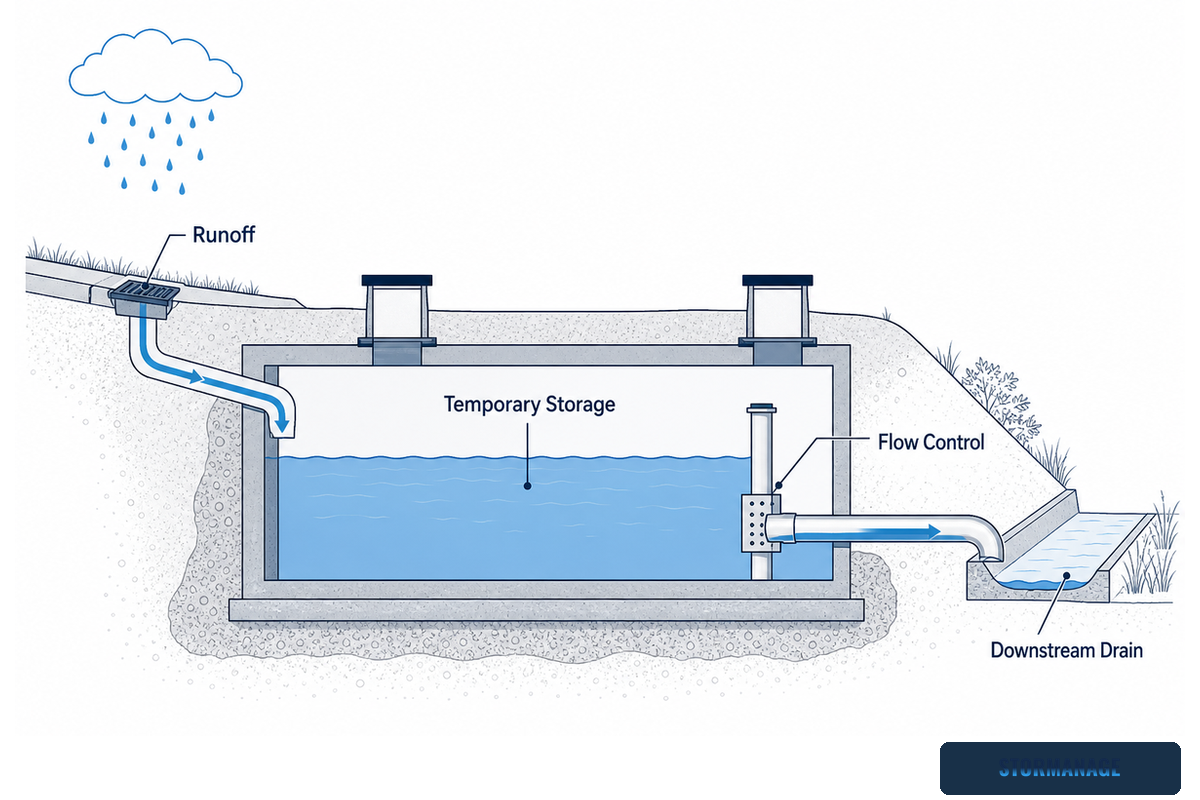
A stormwater detention tank is an engineered underground storage system that temporarily holds runoff and releases it through a controlled outlet. It can reduce a site’s peak discharge, but it doesn’t by itself prove channel protection, water-quality treatment, structural suitability, or approval.
Useful project briefs start with hydraulic behavior and responsibility, not a product label. This guide explains the water path, system forms, required interfaces, design inputs, installation evidence, and maintenance questions that should be settled before a supplier reviews a modular layout.
In practical terms, underground stormwater storage receives excess stormwater from urban areas or a roadway catchment, reserves the required stormwater volume, and meters discharge so a network is less likely to overload. Reducing downstream flooding, flooding and erosion may be a stormwater design objective, but the project model and approval process must verify the outcome.
Quick specs
Primary functionTemporary runoff storage with restricted discharge
Typical locationBelow parking, roads, yards, landscaped areas, or buildings where approved
System formsModular geocellular, concrete vault, pipe, or chamber
Design ownerProject civil or hydraulic engineer, with structural and geotechnical input
Supplier roleProduct arrangement, accessories, drawings, production, packing, and delivery support
Approval basisCurrent requirements of the governing authority and project documents
What project teams often miss
Reducing peak flow can still leave an erosive flow duration in a receiving channel.
Detention volume isn’t automatically a water-quality treatment measure.
Compact storage layouts can be difficult to inspect or clean.
Factory quality records can’t verify buried installation or site conditions.
1. What Is a Stormwater Detention Tank?
Stormwater detention tanks are engineered storage structures that receive runoff during a storm, hold it for a limited period, and release it at a controlled rate. Restricted outlets aim to keep post-development discharge within the criterion set by the drainage design and approving authority. Afterward, the tank draws down so storage is available for a later event.
Federal Highway Administration guidance describes tanks and vaults as below-ground storage used to control peak stormwater flows where surface space is limited. That definition matters because it describes a hydraulic job, not a particular material. Concrete vaults, pipe networks, chamber fields, and modular crate assemblies may all provide detention when configured for temporary storage and controlled release.
WHATRunoff is held below ground.
WHYRestricted outlets limit the peak rate sent downstream.
SO WHATProject teams must define storage and discharge behavior before selecting a physical format.
BOUNDARYOther objectives, such as treatment or reuse, need their own criteria.
Detention is usually considered when development adds impervious area, the existing drainage network limits discharge, or valuable land can’t be dedicated to an open detention basin. Buried storage can sit beneath parking lots and release stormwater runoff into a storm drain, a dedicated surface-water network, or, where permitted, a combined sewer system. It remains only one way to manage stormwater. Civil or hydraulic engineers still have to coordinate the catchment, inflow points, downstream sewer or drainage system, overflow route, levels, maintenance plan, and approval evidence.
2. How Does a Detention Tank Store and Release Runoff?
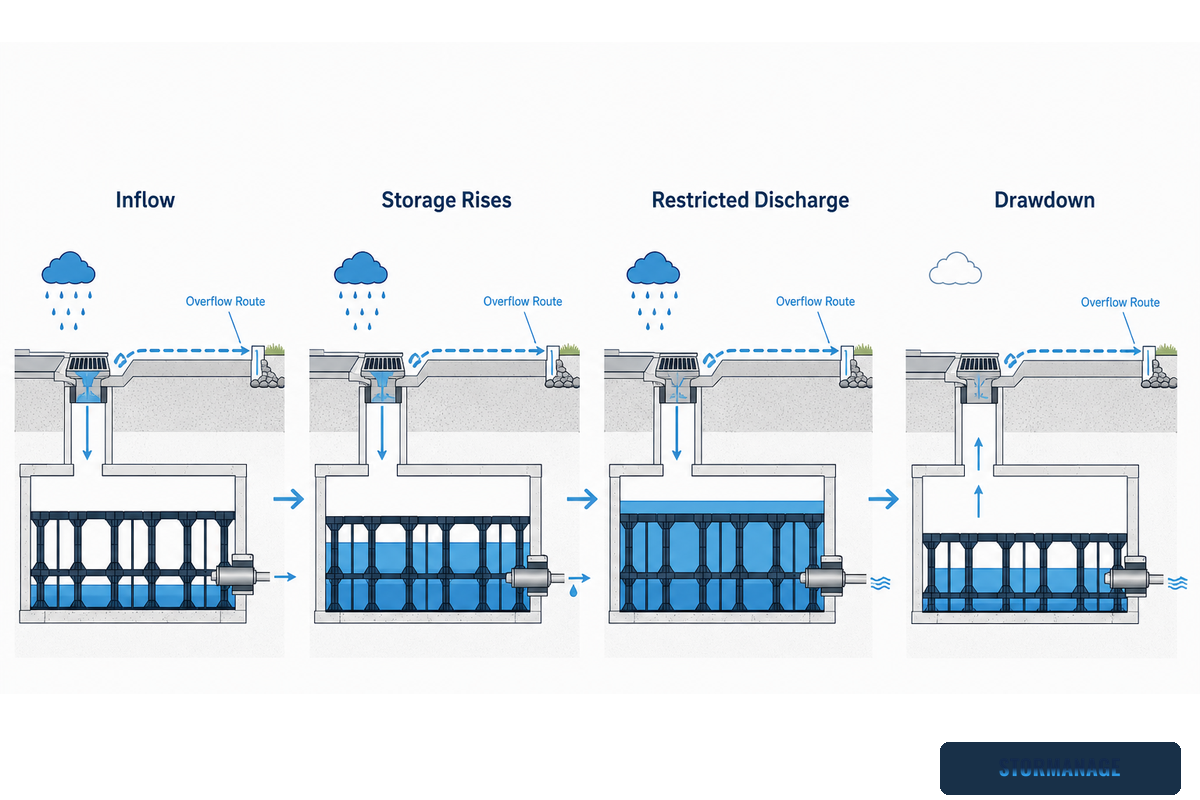
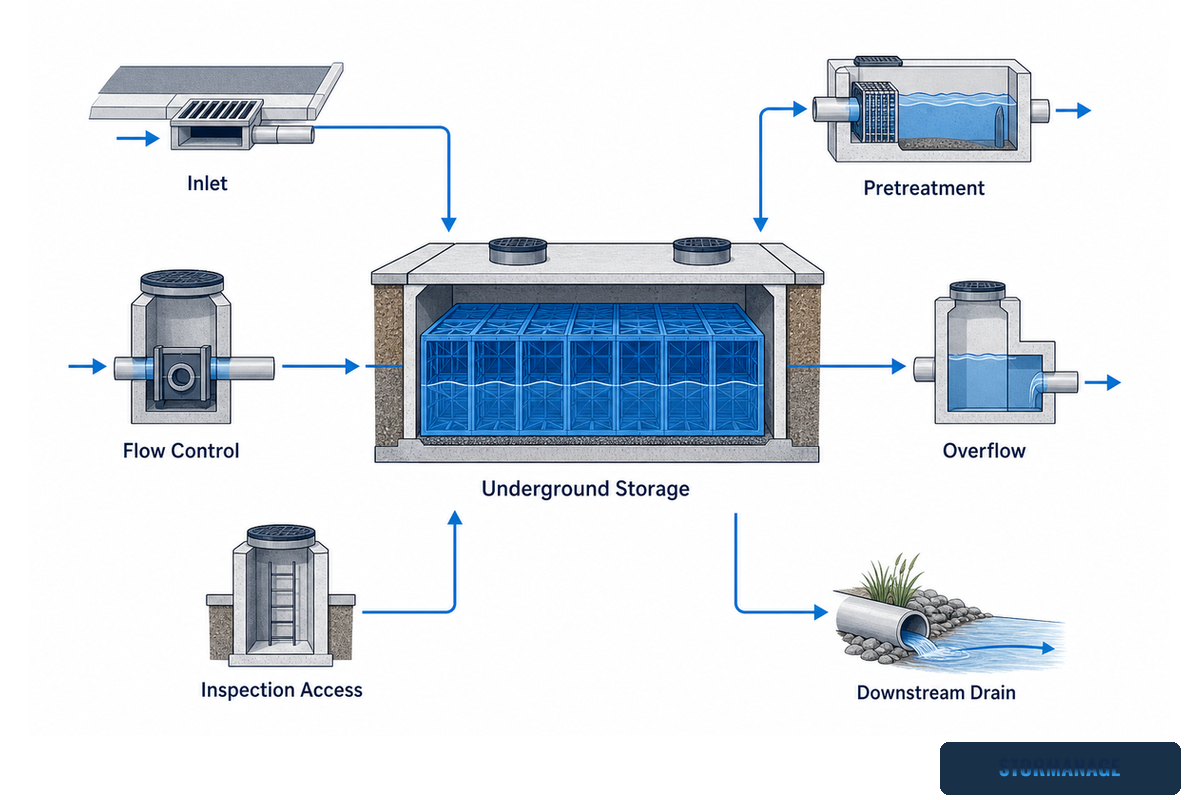
On a drawing, the operating sequence looks simple, yet most avoidable problems occur at the interfaces. Sediment can arrive before the storage body. Inlets can distribute water unevenly. Small outlets can block. Overflow paths can be omitted from coordinated drawings. In practice, hydraulic performance depends on coordinating all four stages; treating the tank as an isolated box hides those failure paths.
1. Runoff enters through a defined inflow path
2. Pretreatment intercepts debris and sediment where required
3. Storage level rises while the outlet restricts discharge
4. The system drains down and is inspected after triggering events
Runoff enters through pipes, channels, or manholes sized and coordinated by the drainage designer.
Temporary storage fills while the downstream release is constrained. Air movement, inlet energy, and internal distribution may need explicit treatment.
Controlled discharge passes through an orifice, vortex device, weir, or another approved control. Because a small blocked opening can change the entire operating response, the control must remain accessible.
Drawdown occurs over the defined period, while a separate emergency path manages conditions beyond the design event or a blocked outlet.
Peak control is not the final channel check.Peer-reviewed receiving-channel research found that conventional detention can, in some settings, prolong flows above an erosive threshold. That result does not call for rejecting detention; it calls for the project engineer to assess the applicable peak, duration, erosive-flow, and channel-stability criteria.
A common assumption says that meeting one peak-discharge limit settles the downstream question. Receiving-channel evidence shows why the approved design may also need duration, erosive-flow, or stability checks.
What does stormwater detention mean?
Stormwater detention means holding runoff temporarily and releasing it after the inflow peak has passed. “Temporary” describes the water cycle, not the structure’s life. Buried tanks remain in place while active storage drains. Permanent storage, reuse, or infiltration indicates a different or combined function.
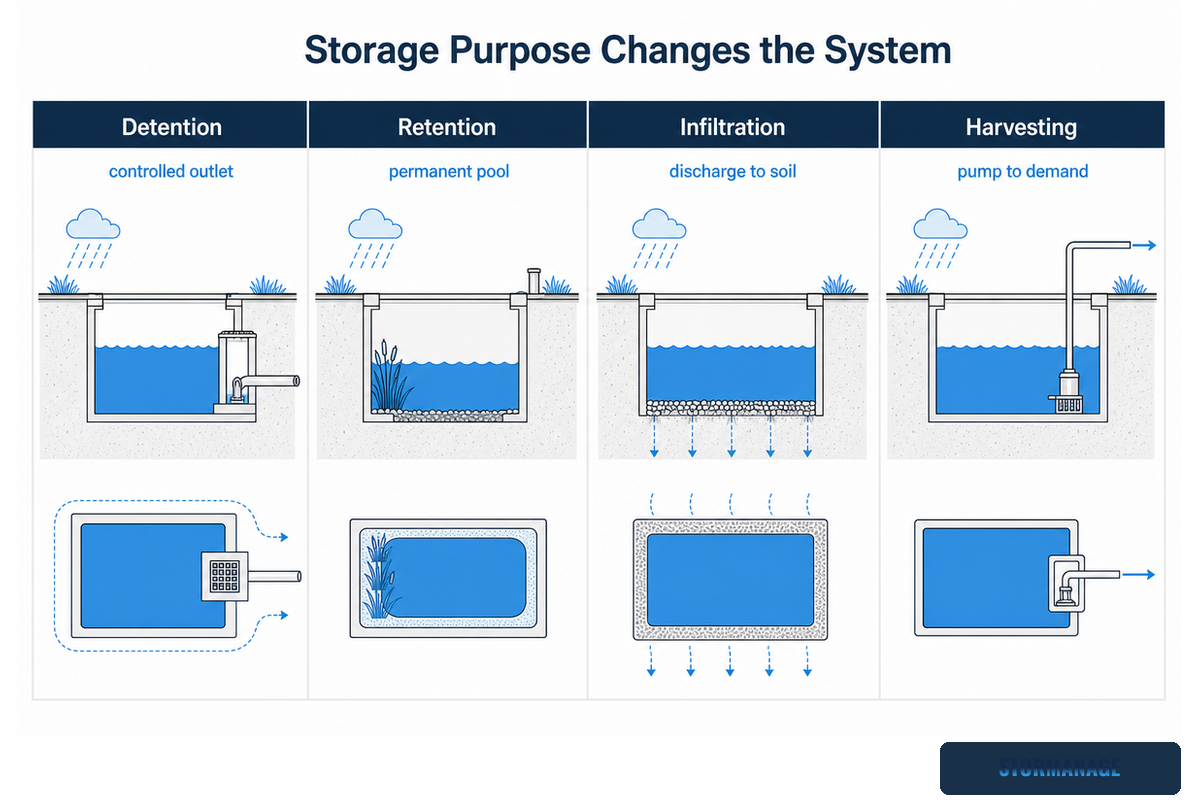
3. Detention vs Retention Tanks, Infiltration, Attenuation, and Harvesting
Authority guidance commonly distinguishes detention from retention, while project and vendor documents can group several water-management functions under “stormwater tank.” Define the required behavior in the brief instead of assuming the label carries one meaning in every market.
When specifications compare detention and retention tanks, stormwater retention must be defined by its intended water path. Some retention configurations store water permanently or for reuse, while detention capacity is intended to drain and become available for the next event.
Function
What happens to the water?
Key project question
Common boundary
Detention / attenuation
Water is stored temporarily and released at a restricted rate.
What storage and allowable discharge have been approved?
Peak-flow control does not automatically provide water-quality treatment.
Retention
Water is retained as a permanent pool, for later use, or until it leaves by another intended path.
Is permanent storage, reuse, evaporation, or infiltration intended?
The word “retention” is used differently between documents.
What demand, treatment, top-up, overflow, and water-quality rules apply?
Reuse storage and storm attenuation may compete for the same volume.
Treatment train
Several measures remove sediment or pollutants before discharge.
Which pollutants and treatment performance must be addressed?
A storage chamber is not evidence of pollutant removal.
US Environmental Protection Agency guidance separates controlled-release detention from retention or infiltration and places underground storage within a treatment train where water quality is part of the objective. By contrast, a reviewed cemetery project case uses one product family for several functions: detention, retention, treatment, and harvesting. Together, those sources show why functional wording matters. Project and supplier language may group systems that need different hydraulic details.
Scenario 1 — The word “tank” reaches procurement too early
Project schedules call for an underground stormwater tank beneath a paved yard, but the hydraulic notes require restricted discharge while an architectural note mentions landscape reuse. One bidder assumes a sealed detention system; another allows infiltration; a third reserves water for irrigation. All three can claim that they offered a stormwater tank. Correction begins with a one-page functional brief stating the active attenuation volume, reuse reserve, discharge route, infiltration permission, water-quality duty, overflow route, and approving authority. That clarification may change the envelope, outlet, pump, controls, access, and responsibility split before price is compared. Where the approved brief calls for pumped drainage, compare drainage pumps from BBP against the required flow, head and solids duty rather than sizing a pump from tank volume alone.
What is the difference between a stormwater tank and a detention tank?
“Stormwater tank” names what the structure handles; “detention tank” states one specific hydraulic role. Detention tanks hold runoff temporarily and drain through a controlled outlet. Other stormwater tanks might support harvesting, infiltration, permanent retention, treatment, or a combination. Specifications should name the required water path, not just the container.
State where inflow comes from, what volume is reserved for each function, how water leaves, what happens if the outlet fails, and who approves the design. Also identify whether treatment occurs upstream, whether the envelope must be sealed, and whether the owner can inspect and clean the system without entry. This prevents a supplier from solving a different problem than the engineer intended.
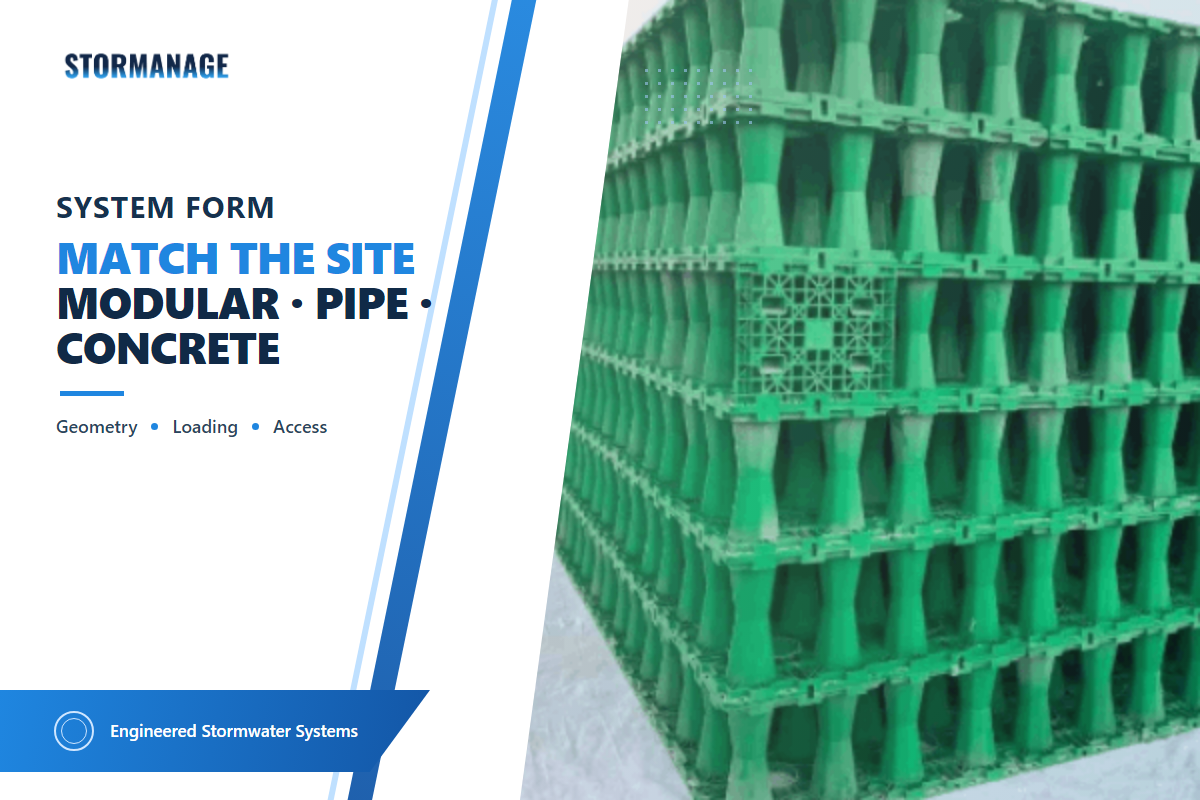
4. Detention Tanks and Vaults: Modular, Pipe, and Concrete Forms
Underground stormwater detention tanks create void space in different structural ways. None is universally “best.” The useful comparison is whether a form fits the project’s loading, geometry, groundwater, access, cleaning method, programme, local acceptance, and evidence requirements.
Common underground detention tanks include modular geocellular fields, poured-in-place concrete vaults, and corrugated metal pipe systems. Their versatility can preserve developable land when systems are installed beneath parking lots, but accessibility, soil conditions, structural loads, and the need for a sealed impermeable envelope still have to be resolved for the site.
Storage form
Where it can fit
Questions before shortlisting
Do not assume
Modular geocellular crates
Irregular footprints, shallow layouts, staged installation, and sites where shipment density matters
Published in 2025, a review of geocellular modules emphasizes that both vertical and lateral behavior matter. One US patent granted that year likewise focuses on load path, lateral deformation, assembly, and shipment. Neither source proves that one product fits a site; both show why a single compression number or void percentage can’t carry the structural decision.
A common assumption ranks the highest void percentage first. Whole-system review can reverse that ranking when cleanout access, groundwater, lateral restraint, or authority evidence becomes the controlling boundary.
“Developing a functional stormwater management system requires a good understanding of existing conditions, a well-modelled design, and field experimentation for design confirmation.”
Practical reading: a format comparison creates a shortlist, not a design approval. Project engineers, geotechnical advisers, structural designers, suppliers, installers, and authorities each produce different parts of the final evidence.
5. Detention Systems: Components and System Boundaries
Storage is only the middle of a detention tank system. Complete scopes follow the water from catchment to receiving network and also follow people and equipment from inspection access to a safe maintenance method.
Component type or interface
Function
Briefing question
Pretreatment
Intercepts sediment, debris, or specified pollutants before they enter difficult-to-clean storage.
What can be isolated and cleaned from the surface?
Inlet and distribution
Moves inflow into the storage without unacceptable erosion, scour, or local loading.
How many inlets exist, at what levels, and how is energy managed?
Storage body
Provides the approved active volume within physical and structural limits.
What gross and usable volume definitions apply?
Outlet control
Restricts the discharge rate and establishes drawdown behavior.
Can it be inspected, isolated, and cleared?
Emergency overflow
Provides a defined route when inflow exceeds the operating condition or the outlet is impaired.
Where does exceedance flow go without creating a new hazard?
Access and ventilation
Supports inspection and the approved maintenance method.
Can work be completed without entry, and who assesses any confined-space duty?
Envelope and connections
Separate or connect stored water to surrounding soil as the hydraulic brief requires.
Is the system sealed, infiltrating, or divided into functional zones?
Monitoring and records
Preserves inspection, maintenance, and acceptance evidence.
Who owns the asset and keeps the records after handover?
Scope test: If the drawing shows cubic storage but not pretreatment, outlet control, overflow, inspection access, wrapping, downstream connection, and ownership, it is not yet a complete system brief.
Philadelphia Water’s subsurface detention guidance is unusually direct about access and cleaning: grid systems can be harder to clean than vaults after sediment accumulates. In practice, the maintenance method should influence storage format and pretreatment before the footprint is fixed, not after the system is buried.
6. System Size Inputs and Project Data Before Review
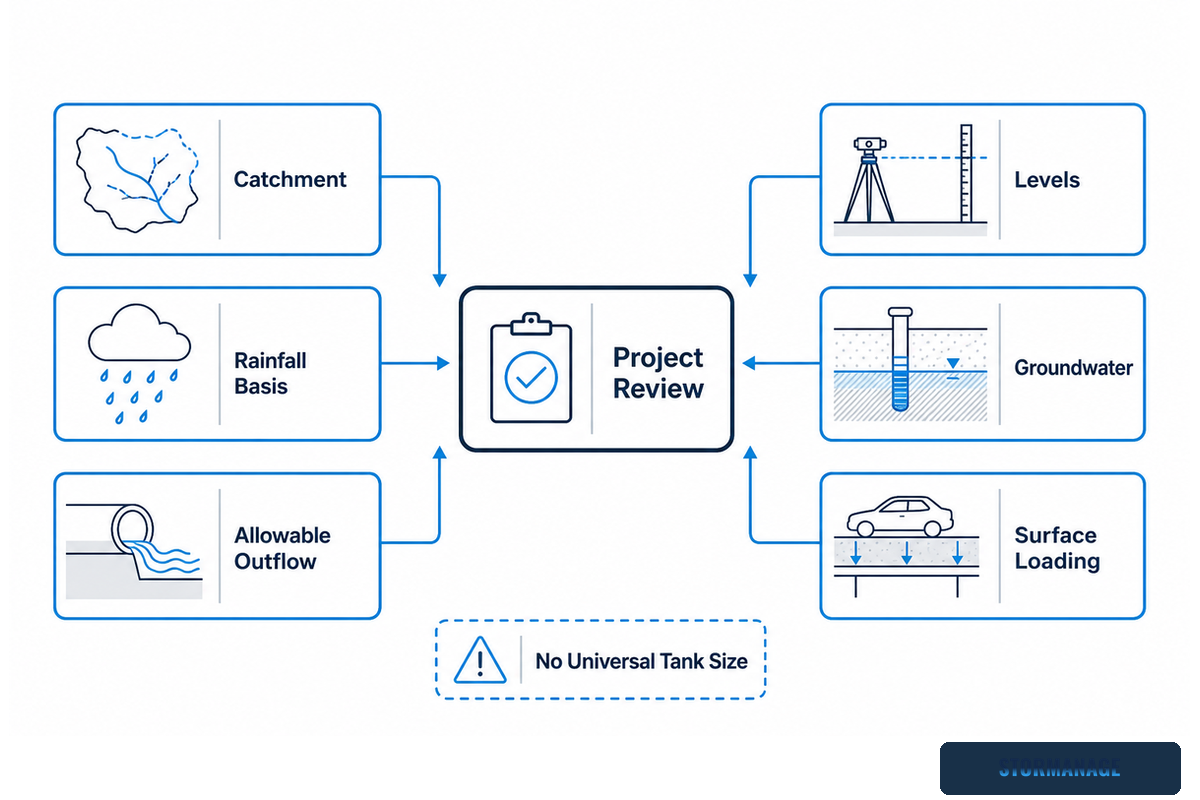
Suppliers can arrange modules only after the project team defines the engineering problem. “Please quote 500 cubic metres” isn’t a sufficient design pack: it omits whether that number is active storage, the permissible discharge, levels, receiving-system limits, structural loads, groundwater, treatment duties, and approval basis.
Selection and monitoring criteria should identify the relevant water level, soil conditions, regulatory requirements, and applicable industry standards. If project documents cite an American Society of Civil Engineers reference, name the document and edition. A site near a wastewater treatment plant may also need interface, access, contamination, or owner-specific requirements stated explicitly rather than inferred.
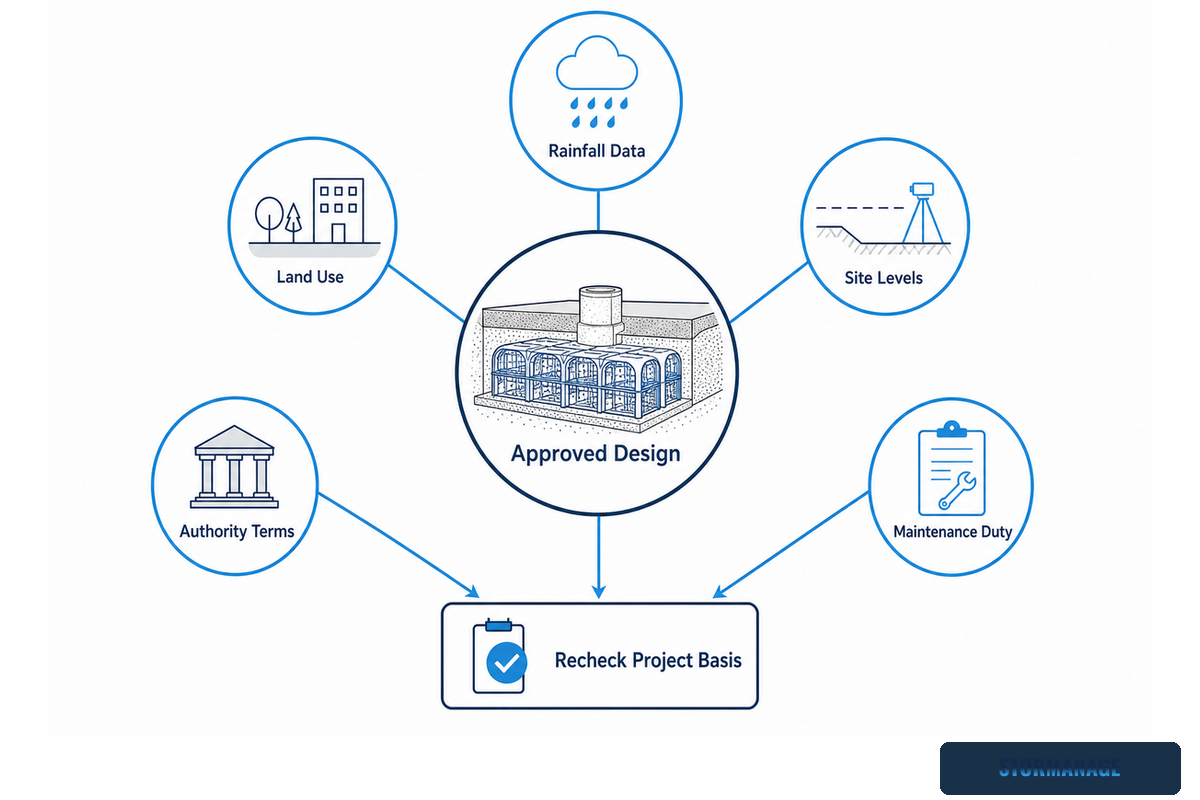
For the hydraulic basis, supply the approved catchment, rainfall data, design events, required storage, allowable discharge, drawdown, and overflow case.
Receiving-system criteria cover downstream levels, capacity, surcharge, outfall condition, and any peak, duration, erosive-flow, or channel-stability requirement.
Water-quality duties identify target pollutants, treatment-train position, pretreatment, and separation from quantity-only storage.
Geometry records the available length, width, depth, inlet invert, outlet invert, cover, slopes, clashes, and construction tolerance.
Ground and water inputs cover soil, bearing condition, groundwater range, contamination constraints, infiltration permission, buoyancy, and dewatering assumptions.
Loads and design life include traffic, construction plant, buildings, landscaped cover, lateral loads, material exposure, and the governing structural basis.
Access and safety inputs state inspection points, cleaning equipment, isolation, lifting, ventilation, no-entry method, and responsibility for any confined-space assessment.
Approval evidence includes authority requirements, calculations, drawings, product data, testing, installation records, hold points, as-builts, and maintenance ownership.
Rainfall inputs must come from the basis currently adopted by the governing authority. NOAA Atlas 15 is under development and is intended to address nonstationary precipitation-frequency methods and future trends. Until a new dataset is issued and adopted for the project’s jurisdiction, preliminary development work shouldn’t be presented as the governing design standard.
Party
Typical decision or evidence
Boundary
Civil / hydraulic engineer
Runoff model, storage, discharge, levels, overflow, receiving-system and treatment criteria
Does not transfer design responsibility by requesting a supplier layout
Geotechnical / structural engineer
Ground, groundwater, foundation, buoyancy, loading, stability, and structural verification
Product test data is an input, not the completed site design
Supplier
Product configuration, accessories, technical drawings, data, production, packing, and delivery
Does not approve the drainage model, soil assumptions, or statutory submission
Installer
Method, foundation, assembly, connections, backfill, protection, inspection records
Must work to approved documents and resolve deviations before concealment
Owner / authority
Approval, inspection requirements, asset acceptance, maintenance and records
Requirements vary by jurisdiction and asset owner
Detailed calculation methods and budget drivers belong in the separate stormwater detention tank cost and sizing guide. This article keeps the boundary clear: identify the inputs and owners without publishing a second sizing worksheet or price table.
Scenario 2 — A car park layout arrives before the load case
Because utilities restrict depth, a developer wants a shallow modular tank under a car park. Hydraulic volume fits, but the review pack doesn’t identify pavement build-up, minimum cover, fire-appliance routes, temporary crane loading, groundwater, or the sequence for placing side fill. Supplier drawings can show a crate arrangement, yet can’t close those site decisions. Project engineers first mark permanent and construction load zones, confirm groundwater and foundation assumptions, define the approved cover build-up, and assign structural verification. Only then can module grade, layout, accessories, inspection channels, and protection layers be reviewed against one coordinated case.
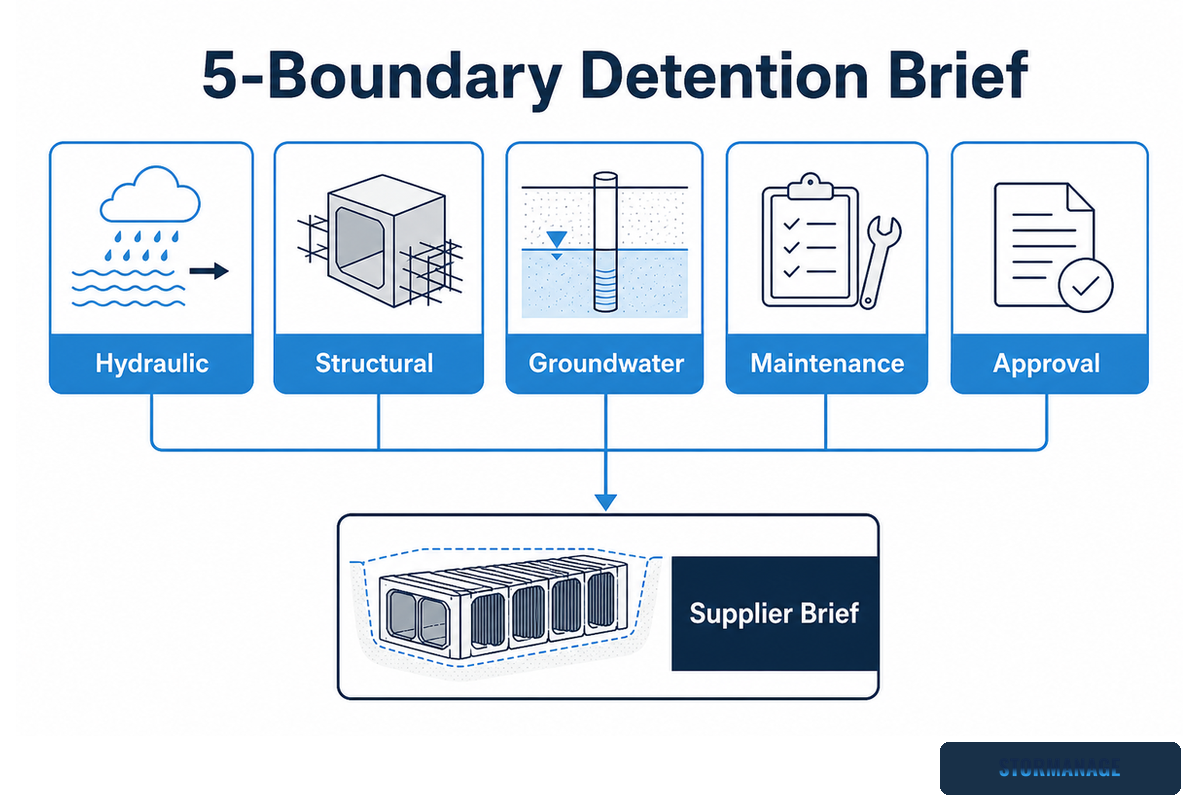
7. The 5-Boundary Detention Brief
This 5-boundary framework is a pre-supplier brief that checks whether project inputs and responsibilities are complete enough for meaningful system review.
The Five-boundary project screening grid below turns those checks into a reusable review prompt.
5-Boundary Detention Brief
Hydraulic and receiving-system role, define inflow, storage, discharge, drawdown, overflow, channel criteria, and any separate water-quality duty.
Rainfall, ground, and water, record the adopted rainfall basis, soil, groundwater, infiltration permission, contamination, foundation, and buoyancy case.
Structural loading, map cover, surface use, traffic, construction plant, adjacent structures, lateral restraint, design life, and required proof.
Access, maintenance, and safety, state pretreatment, inspection and cleaning routes, isolation, no-entry method, and safety responsibility.
Approval evidence and responsibility, assign calculations, drawings, testing, hold points, as-builts, asset ownership, records, and final sign-off.
This method prevents one-variable selection. Tight footprints may favour modular grids, but difficult sediment removal may favour a more accessible vault. Heavy rigid structures may look stable, but groundwater can still raise buoyancy and waterproofing questions. Strong crate compression data may still sit outside the project’s lateral restraint, cover, or installation case. Each boundary can change the shortlist.
Which load path and cover build-up have been verified for permanent and construction stages?
Project structural check, supplier test data, pavement details and hold points
High groundwater
How are buoyancy, leakage, foundation, dewatering, and envelope behavior resolved?
Groundwater basis, geotechnical advice, sealed-envelope details and stability verification
High sediment risk
Can pretreatment and storage be cleaned with the intended equipment?
Maintenance method, isolation, access plan and sediment-removal route
Export procurement
Can modules, accessories, drawings, packing and delivery align with the installation programme?
Bill of materials, production plan, loading plan, marked drawings and inspection records
Storm Manage reports an 40,000 sqm injection-moulding base with 200+ injection-moulding machines and more than 12 mould sets covering module and accessory variants. It also reports a typical 3–10 days lead time after order confirmation and container loading of up to 330 m³ of installed storage volume per 40HQ with optimized stacking. These are first-party capability statements; actual production allocation, module mix, packing efficiency, and delivery timing remain order-specific.
After the brief is complete, project teams can review modular stormwater detention tank systems against the defined hydraulic, structural, access, and evidence boundaries. That commercial step should follow the engineering brief, not replace it.
Framework guardrail: The 5-Boundary Detention Brief does not calculate storage, prove receiving-channel protection, establish water-quality compliance, classify confined spaces, or replace engineer and authority approval.
Scenario 3 — The module list is ready, but the handover evidence is not
An overseas contractor receives a module schedule and optimized container plan for a buried system. Programme dates look achievable, yet the documents don’t assign checks for base level, cell orientation, connectors, wrapping seams, penetrations, side-fill sequence, damaged units, or storage volume before backfill. Those items become hold points shared by the installer, supplier, engineer, and client inspector. Photos, survey records, batch references, non-conformance decisions, and as-built levels are captured before concealment. Modules haven’t changed; project risk has. Coordinated evidence makes the buried work inspectable after access to the assembly itself is gone.
8. Geotextile, Installation Interfaces, Quality Checks, and Sign-Off
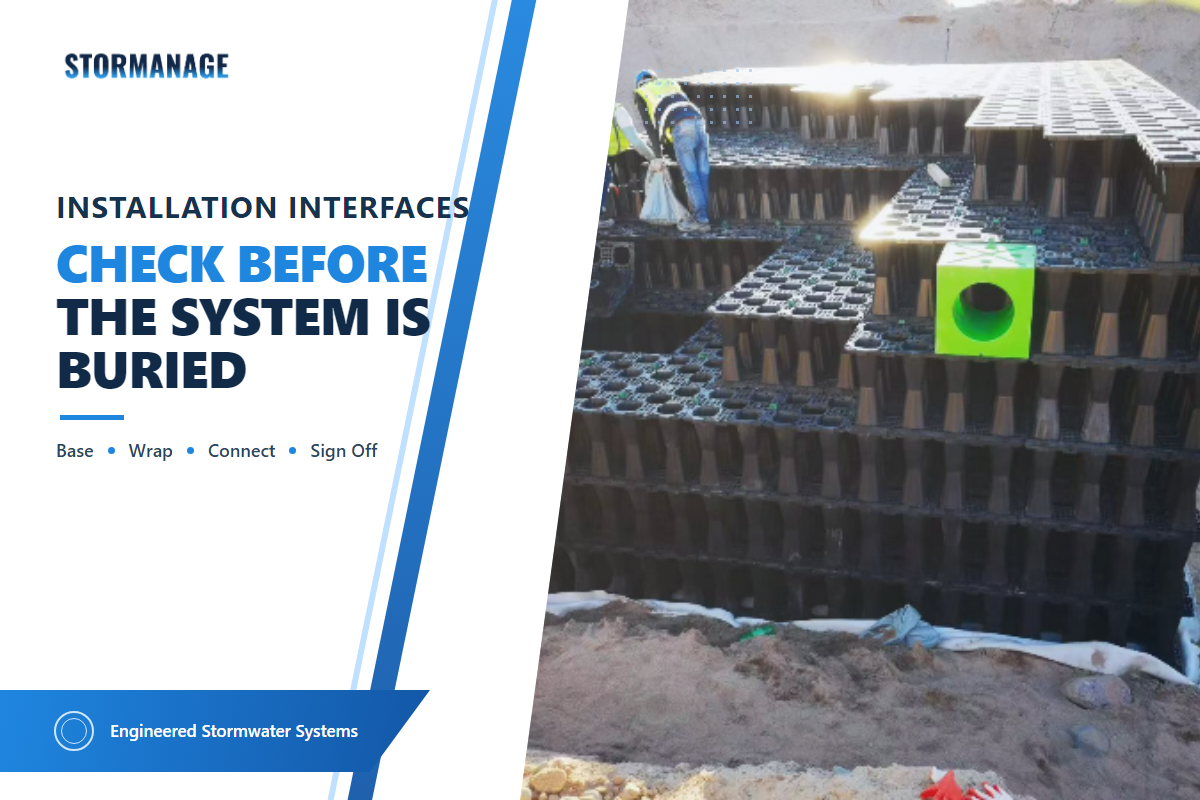
Wrapping is a hydraulic decision as well as an installation detail. Permeable geotextile can separate soil while allowing infiltration where the approved design permits it. Sealed detention applications may require a geomembrane and protective layers with controlled seams and penetrations. Hybrid functions need clearly divided zones. Substituting one envelope for another can change the discharge path.
Stage
Primary records
Who normally verifies?
Before installation
Approved drawings, base and groundwater conditions, materials, batch references, handling plan
Engineer, contractor, supplier, and inspector within their assigned scope
During assembly
Base level, unit condition and orientation, connectors, inspection channels, inlets, outlets, venting
Installer with project inspection hold points
Wrapping and connection
Geotextile or membrane type, overlaps or seams, protection, penetrations, tests where specified
Installer and designated quality or authority representative
Backfill
Material, lift thickness, placement sequence, compaction method, side balance, construction loads
Contractor under approved method and inspection plan
Before concealment / handover
Surveyed volume and elevations, photographs, deviations, tests, as-builts, maintenance manual
Engineer, owner, and authority as project documents require
Storm Manage states that its batch checks include compression-performance verification, dimensional-tolerance checks, Virgin PP or Recycled PP material-ratio control, and per-unit weight-consistency control. These checks can support product traceability and incoming inspection. They don’t verify the bearing surface, module assembly, field connections, membrane work, backfill, pavement, or the project engineer’s site-specific structural design.
Philadelphia’s stormwater review guidance requires key subsurface detention information to be documented before the system is covered. That’s a useful acceptance principle in any jurisdiction: identify irreversible checks, place them before backfill in the inspection plan, and name the person authorized to release each hold point.
For road and parking applications, the highway and car park drainage guide provides a related site-interface discussion. Governing project specifications and authority requirements still control.
9. Inspection and Maintenance After Commissioning
Maintenance should follow condition, site exposure, the approved plan, and authority rules rather than a universal calendar copied from another system. Inspection starts at the catchment and finishes at the outfall.
Long-term stormwater asset planning benefits from strategically placed surface access and monitoring points. Effective management does not mean frequent maintenance by default; it means inspection and cleaning frequencies respond to observed condition, sediment exposure, trigger events, and the approved maintenance plan.
At the catchment and pretreatment stage, check debris, erosion, sediment loading, filter condition, sumps, and safe cleaning access.
Inlets and inspection points reveal blockage, damage, unexpected standing water, displaced covers, and unsafe surface access.
Storage observations include high-water evidence, drawdown, visible sediment, deformation signals, and leakage or infiltration inconsistent with the brief.
Outlet-control checks cover obstruction, corrosion or damage, isolation, control-device condition, and downstream tailwater.
Overflow and downstream reviews look for obstruction, erosion, evidence of exceedance, and effects on the receiving drainage system.
Records capture the date, rainfall or trigger, observations, photographs, work completed, waste handling, unresolved defects, and responsible person.
Prefer inspection and cleaning from the surface where practicable. Tanks and vaults may have limited entry and can fall within confined-space duties. In the United States, OSHA 1910.146 requires covered employers to evaluate workplace spaces and identify permit-required conditions. Other jurisdictions and sectors apply their own rules. Product access openings are not permission to enter.
A common assumption treats an access opening as a complete maintenance plan. In reality, the team must define reachable components, equipment, isolation, waste removal, surface working space, safety duties, and escalation for defects.
How is an underground detention system maintained?
Asset owners inspect accessible pretreatment, inlets, observation points, outlet control, overflow, and downstream condition, then remove debris or sediment through the method defined in the maintenance plan. No-entry cleaning is preferred where it can achieve the required result. Inspection should also compare observed drawdown with expected behavior, note high-water marks, trace unexplained leakage, and check whether upstream site changes have increased sediment or debris loading. Unexpected standing water, blocked controls, or damaged access covers trigger escalation before routine cleaning continues.
If entry could be needed, the owner and employer must assign the competent safety assessment, isolation, atmospheric testing, rescue, and permit duties required by the applicable jurisdiction. Maintenance plans should state trigger events, waste-disposal requirements, record retention, defect escalation, and who can authorize return to service. Records need enough detail to distinguish routine cleaning from a hydraulic, structural, or safety defect that requires engineering review.
An EPA enforcement summary updated in 2025 links alleged failures in permanent stormwater controls to requirements for inspection, maintenance, restoration, and accountability. Beyond that case, underground assets need a named owner, an accessible method, and records that survive the construction handover.
10. What’s Changing: Documentation, Land Use, and Regional Language
Near-term change isn’t one universal new tank. It’s the rising importance of traceable inputs, land-efficient layouts, current rainfall methods, structural evidence, maintenance ownership, and clear functional language.
Driver
What is changing
Project implication
Approval evidence
Authorities and asset owners increasingly expect construction inspections, permanent-facility records, and assigned maintenance responsibility.
Build the evidence schedule with the design, not after installation.
Land use
Dense sites continue to push storage beneath parking, roads, yards, and other working surfaces.
Hydraulic efficiency must be reviewed with access, construction loads, utilities, and whole-life maintenance.
Rainfall methods
NOAA Atlas 15 is under development with nonstationary methods and future precipitation trends.
Use the dataset currently adopted by the governing authority and track formal updates.
Structural proof
Recent research and patents focus on vertical load paths, lateral deformation, assembly, and efficient shipment.
Ask which evidence applies to the actual cover, groundwater, restraint, installation, and design life.
Regional language
Detention, attenuation, retention, infiltration, and harvesting labels can overlap in project and supplier documents.
Write the water path and responsibility into the brief.
Search demand and market forecasts can’t establish a technical trend by themselves. Defensible 2026 reviews start with dated government, water-authority, academic, and project evidence. They also state what isn’t yet adopted. That discipline matters because rainfall inputs, regulations, and terminology change at different speeds among overseas markets. A “stormwater attenuation tank” may describe a detention function in one market, but the project brief must still define the water path.
Frequently Asked Questions
What is a stormwater detention tank?
It’s an engineered structure that temporarily stores runoff during or after a rain event, then releases water through a controlled outlet. Concrete vaults, pipes, chambers, and modular geocellular units can all provide that function. Required storage, discharge, drawdown, receiving-system criteria, treatment duties, and overflow behavior come from the approved project design and governing authority.
What is the difference between a stormwater tank and a detention tank?
“Stormwater tank” is a broad label, while “detention tank” names temporary storage followed by restricted discharge. Other tanks can support harvesting, infiltration, retention, treatment, or combined functions. Because product names can’t settle the design, the brief should state inflow, active and reserve volumes, outlet behavior, overflow, treatment duty, maintenance access, and the responsible approving party.
What is the difference between detention and retention?
Detention generally means temporary storage followed by controlled release. Retention may describe a permanent pool, reuse storage, or water kept until it leaves by another intended route. Infiltration sends water into suitable soil, subject to verified ground, groundwater, contamination, and setback conditions. Supplier and project documents can group those functions under broad terms, so a sound brief records the actual water path: inflow source, active attenuation volume, retained or reuse volume, restricted outlet, infiltration permission, treatment train, overflow, and approving authority. That functional statement also tells the team whether the envelope should be permeable, sealed, or divided into separate zones.
How is an underground detention system maintained?
Maintenance focuses on accessible pretreatment, inlets, inspection points, sediment, outlet controls, overflow, and downstream condition. The plan should define a safe no-entry cleaning method where practicable, inspection triggers, records, defect escalation, and asset ownership. Frequency follows the approved plan, site exposure, observed condition, and local requirements.
What information is needed before a detention system is selected?
Start with the approved storage and discharge requirements, rainfall basis, receiving-system criteria, treatment duty, site levels, footprint, cover, loads, groundwater, ground conditions, inlet and outlet levels, access, envelope, overflow, evidence, and authority requirements. A supplier can then review arrangement, accessories, drawings, packing, and delivery. Hydraulic, geotechnical, structural, installation, safety, and statutory responsibilities remain with the parties assigned in the project documents.
Methodology and review
This guide separates independent authority and research evidence from Storm Manage’s first-party production data. It doesn’t provide a storage calculation, price estimate, structural design, confined-space classification, water-quality certification, or regulatory approval. Requirements vary by site and jurisdiction.


![Stormwater Detention Tank Guide: How It Works [2026]](https://stormmanage.com/wp-content/uploads/2026/07/stormwater-detention-tank-featured-1.png)