We use the details you submit to review and respond to your project enquiry. Entries are handled in this website’s WordPress database using Fluent Forms; our hosting and email providers may process the submitted details. Other technical providers receive only the data described in our Privacy Policy.
Please do not send passwords, payment-card details, government identification numbers, sensitive personal data, or unnecessary confidential third-party information.
SuDS drainage is the approach UK commercial and residential developments use to manage surface water sustainably – this guide covers the standards, legal status, design process, and maintenance obligations you need to know.
Quick Specs
Core design standard
CIRIA C753 SuDS Manual (2015), overlaid by the 2025 National Standards
Legal status
Varies by nation — see the 3-Nation Compliance Matrix below
Primary objectives
Water quantity, water quality, amenity, biodiversity (4 pillars)
Where it sits in the project
Earliest site-selection and pre-application stage, not a late planning condition
Typical scheme components
Green roofs, permeable paving, swales, ponds, underground attenuation or infiltration storage
sustainable drainage systems (suds) – still often called by their older name, sustainable urban drainage systems – form the basis of a planning process which UK local planning authorities expect every commercial and residential development to follow, before any drawings go to a Lead Local Flood Authority. If you’re scoping out a new project, chances are you’ve already been asked if your drainage design is SuDS-compliant. In truth, ‘compliant’ means different things in England, Wales, and Scotland.
sustainable drainage systems (suds) manage surface water runoff in accordance with four aims – water quantity, water quality, amenity and biodiversity – specified by the UK’s 2025 national standards for SuDS. Below-ground storage crates are just one part of a bigger four-level system, not the first thing installed.
In This Guide
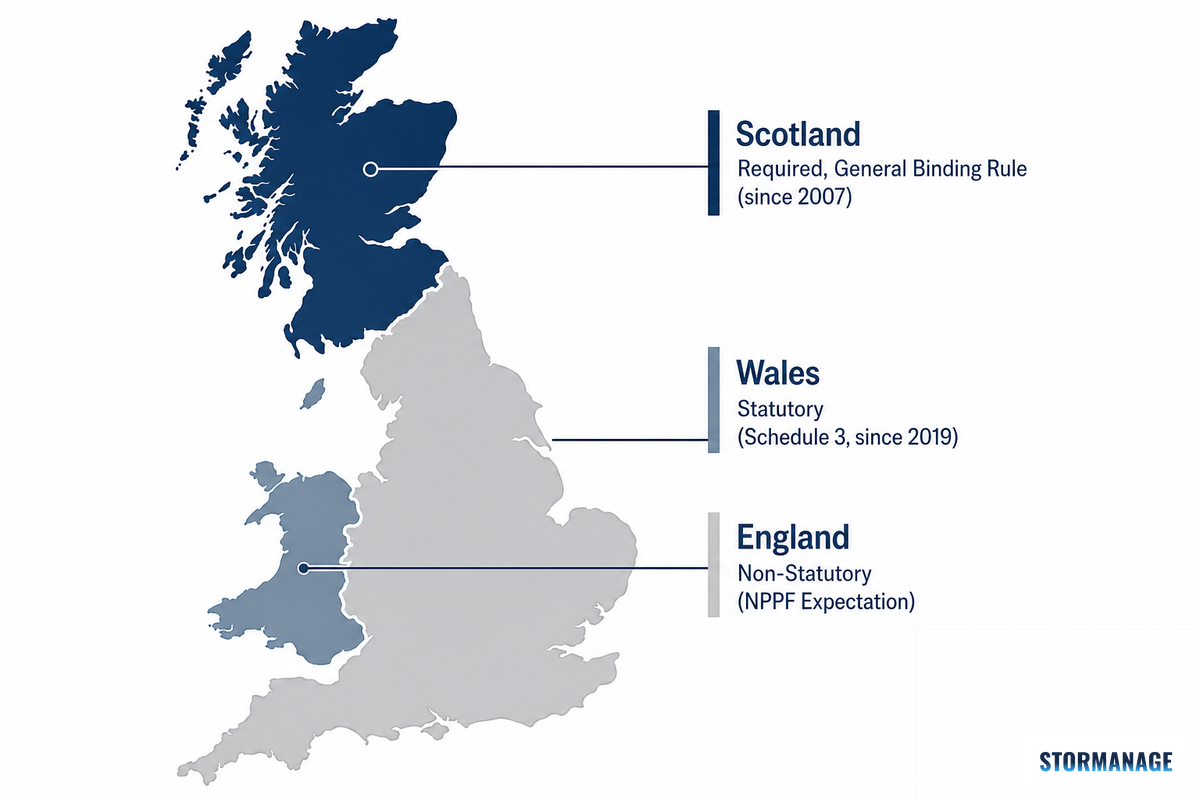
Although England had a 2024 government promise it would be implemented – it’s been in use since 2019 in Wales and since April 1, 2007 in Scotland – suds isn’t legally binding in England.
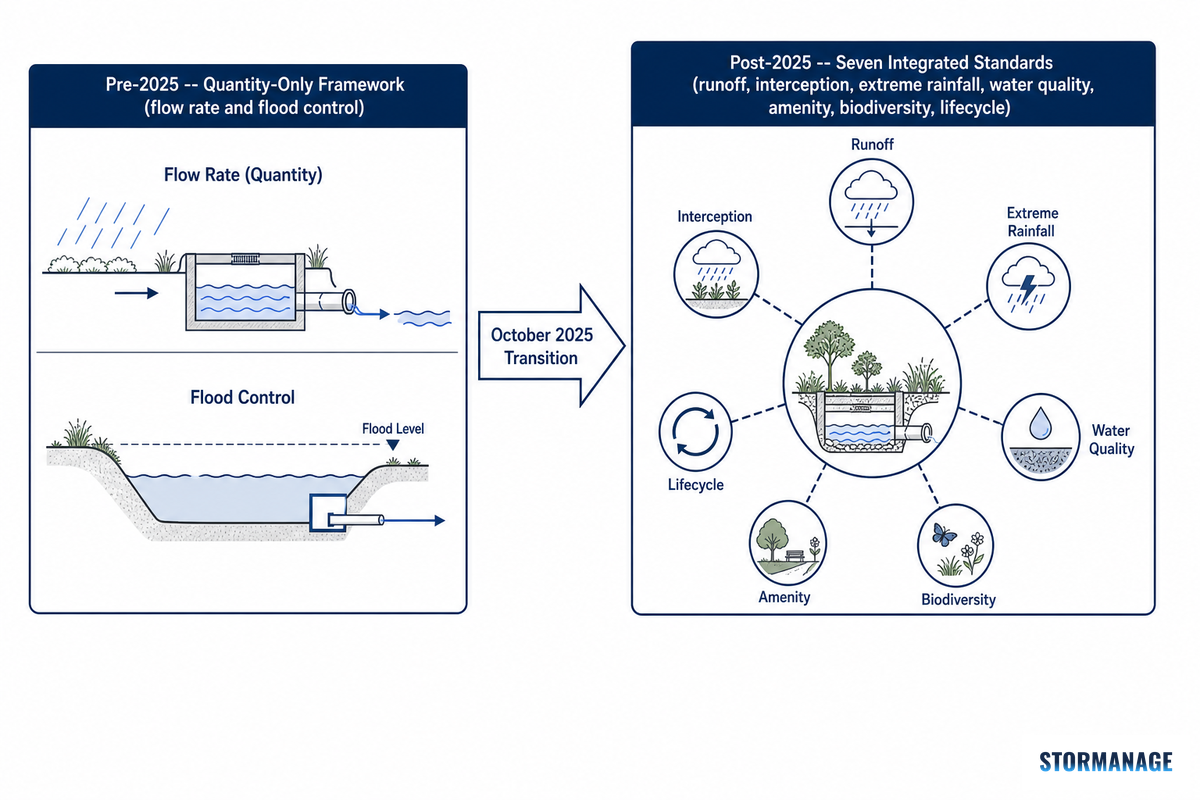
amenity, biodiversity and life cycle design are added to the 2025 national standards alongside flood-control targets.
A four-tiered system with underground storage crates at the base level is in use, with surface techniques being intended for consideration at first, although there can be allowances made due to constraints.
A missing plan for maintenance, rather than the drainage design itself, often leads to suds-related planning conditions causing complications after approval.
When comparing two different kinds of storage for this type of application, geocellular storage is approximately 40-50% cheaper per m³ compared to precast concrete structures (£200-350/m³ versus £400-600/m³ installed).
What Is SuDS? Definition, the Four Pillars, and the Management Train
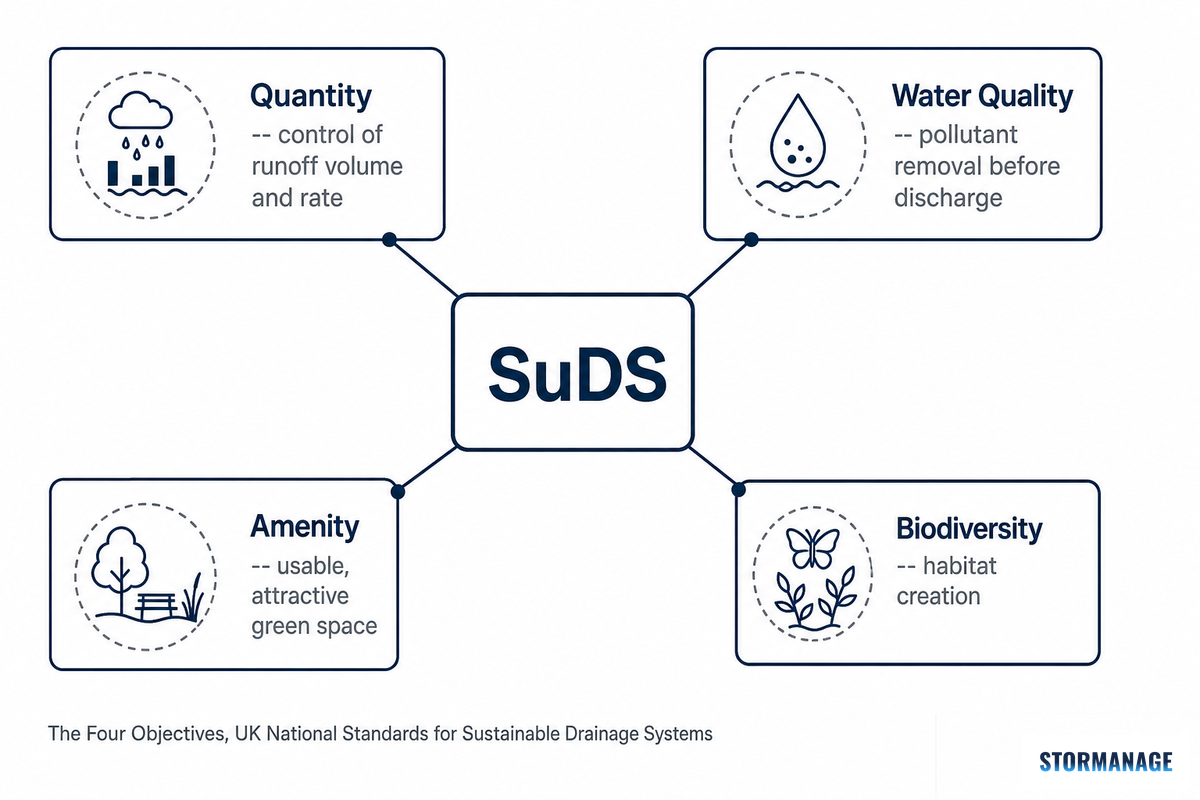
SuDS drainage – also known as sustainable drainage systems (SuDS) – is the approach UK planning authorities expect for managing surface water by mimicking how a natural, undeveloped site would handle rainfall, instead of piping it straight into a sewer. The UK government’s National Standards for Sustainable Drainage Systems organise SuDS delivery using four objectives that balance quantity and quality: quantity, water quality, amenity, and biodiversity.
In dense urban areas and other tight urban environments, where much of the ground is sealed by concrete, buildings, and asphalt, that natural drainage capacity has been eliminated – working to mimic natural drainage at every stage is what SuDS exists to correct. The four objectives break down as: quantity (control of how much runoff leaves a site and at what speed), water quality (removal of pollutants prior to discharge), amenity (usable, attractive green spaces) and biodiversity (habitat creation). Each element in a SuDS design, be it a green roof or underground attenuation tank, serves one or more of these objectives. Storm Manage engineers its below-ground storage range specifically to deliver the quantity objective within a wider management train, not as a standalone fix.
Four techniques involved in a SuDS design are intended to operate together, creating what’s referred to as a “suds management train” within the national standards – a chain of different elements that are used as close to the source of any runoff as possible to progressively reduce flow rates and volumes, rather than relying on one single large tank located at the bottom of the site.
What Does SuDS Drainage Mean?
suds drainage is all about how we deal with the surface water – rainwater – that falls onto the hard, impermeable surfaces such as roofs and car parks. These drainage features can store water, slow it down, or filter it rather than pipe it directly into a piped sewer network – the same control systems that give SuDS its ability to provide storage where a site needs it.
Foul water, which is wastewater from toilets, sinks, industrial processes and similar sources, will require a completely separate foul sewer network, connected into wider drainage networks with its own set of capacity and connection requirements – a traditional drainage arrangement, not a SuDS one. Drainage strategy documentation for a development will usually have to include details of both foul and surface water drainage, and SuDS relates to the former.
To those arriving from outside of the UK the umbrella term change by region although the actual engineering is largely similar – suds (UK/Ireland) is the nearest correlate for the American terms Low Impact Development (LID), or green infrastructure /Best Management Practices (BMP), and the Australian equivalent term is On-Site Detention (OSD). If your project falls into any of those other regulatory jurisdictions then your compliance document and hydraulic modelling references will change although the hardware – permeable paving, attenuation storage, bioretention etc – is otherwise indistinguishable.
Is SuDS a Legal Requirement for Your Development? (England vs Wales vs Scotland)
This is the question that trips up more developers than almost any other technical query – because the truthful answer to this is “it depends what country you’re developing in”, and the idea that England is somehow keeping up with Wales on this is a mistake. In 2024, the UK government had committed to implementing Schedule 3 to the Flood and water management Act 2010 in England, which would make suds mandatory in cases where it applied to the development in question. Current regulatory guidance in force as of June 2025 still doesn’t commence it, and industry watchers are expressing their continued chagrin.
The 3-Nation SuDS Compliance Matrix: England remains non-statutory while Scotland has required SuDS since 1 April 2007
Nation
Legal status
Mechanism
In force since
England
Non-statutory
NPPF Section 175 expectation for major development, plus the 2025 National Standards as design guidance; departures can be agreed with the approving body where site constraints apply
National Standards updated 30 July 2025; all new consultations assessed against them from 6 October 2025
Wales
Statutory
Schedule 3, Flood and Water Management Act 2010, via SuDS Approving Bodies (SABs)
2019 (refreshed statutory guidance published March 2026)
Scotland
Required (General Binding Rule)
SEPA’s Controlled Activities Regulations (CAR), designed to Scottish Water’s “Sewers for Scotland” standard
Developments constructed on or after 1 April 2007, with exceptions (e.g. single dwellings)
The situation in England is less black and white than a simply “not needed.” For “major development”, the NPPF, Section 175 requires the application to provide suds unless there’s sufficient evidence that doing so would be inappropriate and part of the process for a major development will include a consultation with the Lead Local Flood Authority (LLFA). Non-major applications generally only involve consultation with an LLFA if the site is located in a surface water flood risk of high risk. That distinction between major and non-major development is important – there’s a world of difference between a major mixed use scheme and a small gap site development.
“Wales and Scotland have got this right; they’re leading the way.”
Far from a follower to England’s lead, however, Scotland is the country that can claim the oldest hard requirement of the three nations. Scotland’s suds obligation, enforced through SEPA, extends to surface water runoff from new developments built from 1 April 2007, more than a decade and a half prior to the much touted, and yet to materialise, 2024 commitment of England, with some exceptions for a single dwelling for instance for runoff.
The SuDS Toolkit: From Green Roofs to Underground Storage
We usually refer to a single underground storage crate in speech as a ‘suds’ – but it’s one piece in a much larger toolbox, from rainwater harvesting systems at roof level down to below-ground attenuation features. Anyone searching types of SuDS systems will find dozens of individual products, but the national standards group them into a four-tier management train, favouring methods of water retention in situ and at or near source, only ‘losing it to storage’ lower in the plot. Selection and design at this stage is what actually determines whether a scheme meets its runoff targets.
The 4-Tier SuDS Management Train: 12 techniques across 4 tiers, source control before site or regional storage
Tier
Technique
Key spec / design figure
1. Prevention
Permeable surfaces
Reduces impermeable area toward the greenfield runoff baseline
1. Prevention
Reduced paved footprint
Cuts runoff generation before any feature is added
1. Prevention
Rainwater harvesting
Diverts roof runoff to storage/reuse ahead of the drainage system
2. Source control
Extensive green roof
60-150 kg/m² load (35-50 kg/m² with lightweight substrate)
2. Source control
Intensive green roof
200-500 kg/m² dead load, up to ~900 kg/m² saturated
2. Source control
Permeable paving
Infiltrates at source; sized against the 5mm interception standard
2. Source control
Rain gardens
Shallow planted depressions, typically 150-300mm deep
3. Site control
Swales
Vegetated channels providing conveyance across the wider site
3. Site control
Filter strips
Sheet-flow treatment before water concentrates into a channel
3. Site control
Bioretention basins
Combines storage, filtration, and amenity planting
4. Regional control
Ponds & wetlands
Long-term storage plus biodiversity habitat
4. Regional control
Underground attenuation/infiltration storage
£200-350/m³ (geocellular) vs £400-600/m³ (precast concrete); 95% void ratio typical for geocellular crates
Green roofs show the difference between “extensive” and “intensive” has an impact beyond planting selection, affecting how the roof can be built. Structural load on an extensive green roof, or low-maintenance sedum green roof, ranges between 60kg-150kg/m², and could even be brought down to 35kg-50kg/m² if substrate panels are used. An intensive green roofs is far heavier, ranging between 200kg-500kg/m² in dead load and even going up to near 900kg/m² if saturated, supporting larger planting schemes with significant soil depth or even trees.
Both designs must also be built to meet the requirements of the UK’s GRO Green Roof Code, which states designers must consider imposed service loads in addition to base saturated weight – these can include things like people walking on the roof, ponds or water features, and over sized planters.
If there isn’t enough surface suds to support the scheme’s runoff requirements (for instance, if a site is land-locked, already built on, or too busy to allow for the necessary swales and ponds to be placed at the surface) the management train then defaults to an underground storage solution – whether geocellular crates to hold attenuation, or infiltration. It’s important to include a caveat in the cost figures relating to the underground storage: The EA’s own SuDS cost estimation evidence base provides a figure for underground pipe-based perforated storage solutions of approx £100-140/m³ of stored volume; however, this is sourced from ciria’s 2007 manual and doesn’t seem to have been updated since, so consider this figure as historical; a 2026 quote it certainly isn’t. Present day quotes for a contemporary geocellular system (reflecting the material cost and labour inflation that has occurred since 2007) tend to sit in the region of £200-350/m³ installed cost of storage, whereas a traditional pre-cast concrete underground tank sits more in the region of £400-600/m³; again, always get a site-specific quote.
Part of this price difference comes down to the void ratio, the geocellular systems are approximately 95% void ratio, compared with an aggregate-filled soakaway (taking up the same foot print) which is in the order of 30-35%. If this is the level your scheme has arrived at then view our range of attenuation tanks (for the tank-level detail), or our geocellular soakaway infiltration systems (if your conditions allow for infiltration storage).
Can SuDS Work on Brownfield or High-Density Sites?
Yes – and this is one of the most persistent misconceptions regarding suds: that it’s solely a greenfield-only discipline. Brownfield and high-density retrofit sites are entirely catered for by the same four-tiered hierarchy, just relying more heavily on tiers 2 and 4 (green roofs, permeable paving and underground storage) and less on tier 3’s more land-hungry surface features.
Barking Riverside in East London is frequently cited as an exemplar, a brownfield flood plain that has been re-purposed into a vast residential community through an integrated SuDS scheme built entirely on the foundation of this type of restricted site combination. Where physical site constraints preclude delivering every element, England’s national standards permits departures to be negotiated with the approving authority – so a land-constrained site can certainly still be compliant, just so long as the justification for deviating from standard elements is clearly documented, rather than presumed.
💡The Brownfield SuDS Fit Check
Before considering a constrained site to be beyond suds’s remit, a quick check of three things: can any impermeable area be reduced or substituted, even partially, for permeable surfaces; is any roof area, however lightweight, available for a green roof; and, crucially, do the ground-investigation reports negate the need for infiltration entirely or only partially?Only then should resizing of underground storage become a principal design factor – and if it does, justification for doing so should reside in the drainage strategy document, not left to be inferred.
Standards That Govern SuDS Design: CIRIA C753 and the 2025 National Standards
Two key SuDS standards documents are the workhorses in this arena, addressing rather different aspects. ciria C753 The suds Manual (2015), the latest update on the 2007 CIRIA C697, serves as the definitive technical guidance, addressing all the details of planning, designing, constructing, operating and maintaining SuDS schemes. it’s the still-current document – a new version hasn’t yet been published by CIRIA – and remains the ultimate yardstick by which an LLFA or SAB reviewer will judge your drainage strategy. CIRIA’s Getting SuDS Right from the Start (C823F) published September 2025 is a complementary document that focuses on early integration of SuDS into the planning process, right from site selection and project development rather than it being a later planning deliverable.
C823F doesn’t replace C753.
The national standards for suds (updated 30 July 2025) are the policy documents that guide the technical procedures contained in The suds Manual. These regulations outline seven integrated standards for suds design: runoff destinations, everyday rainfall management (interception), extreme rainfall and flooding management, water quality, amenity, biodiversity, and lifecycle design (construction, operation, maintenance, decommissioning). Of the seven, the interception standard is the most clearly defined: minimum 5mm of rainfall for most events is to be managed on site without runoff; with target figures of 80% interception for summer months (May-October) and 50% in winter months (November-April); and with a cap on the maximum discharge at greenfield rates, or 3 l/s/ha, whichever is higher.BREEAM’s own surface water credit benchmarks the same 5mm/80%/50% parameters, with the assumption that hydraulic modelling will follow the methodology outlined in ciria C753 – an invaluable point of reference, if your development is also aiming to achieve breeam Surface Water Run-off credits (2 in the commercial sector, or up to 14 in the residential sector for Version 6.1). Storm Manage designs its storage products to the CIRIA C753 methodology from the outset, precisely so that hydraulic modelling built around them holds up under both LLFA and BREEAM assessment.
What Regulations Guide SuDS Compliance in the UK?
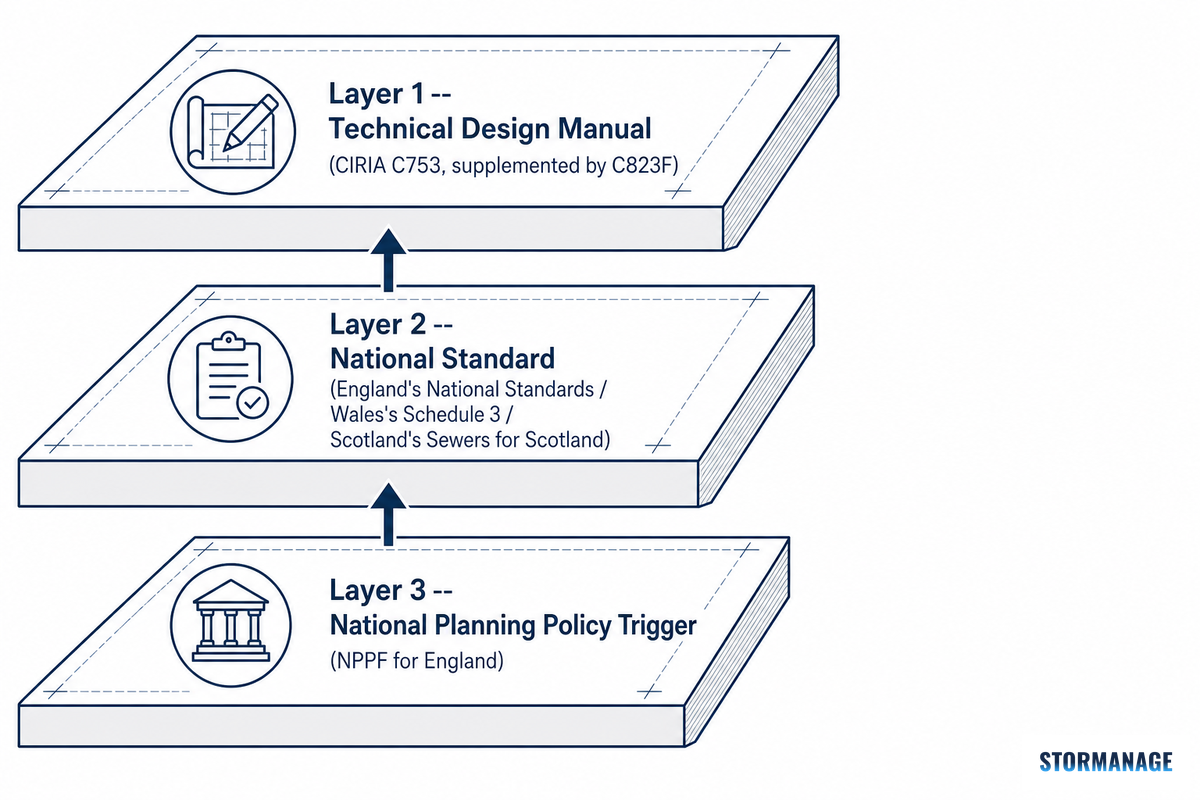
A UK suds application works on three layers at once, in practice. First is the technical design manual (ciria C753, supplemented by C823F at early stages). Second is the national standard for your country (England’s 2025 national standards, Wales’s Schedule 3, or Scotland’s sewers). Third is the national planning policy trigger (NPPF for England). If you’re specifically using underground geocellular attenuation for your storage then product compliance information is required – our CIRIA C680 compliance evidence covers this.
Designing a SuDS Scheme: The Process, Step by Step
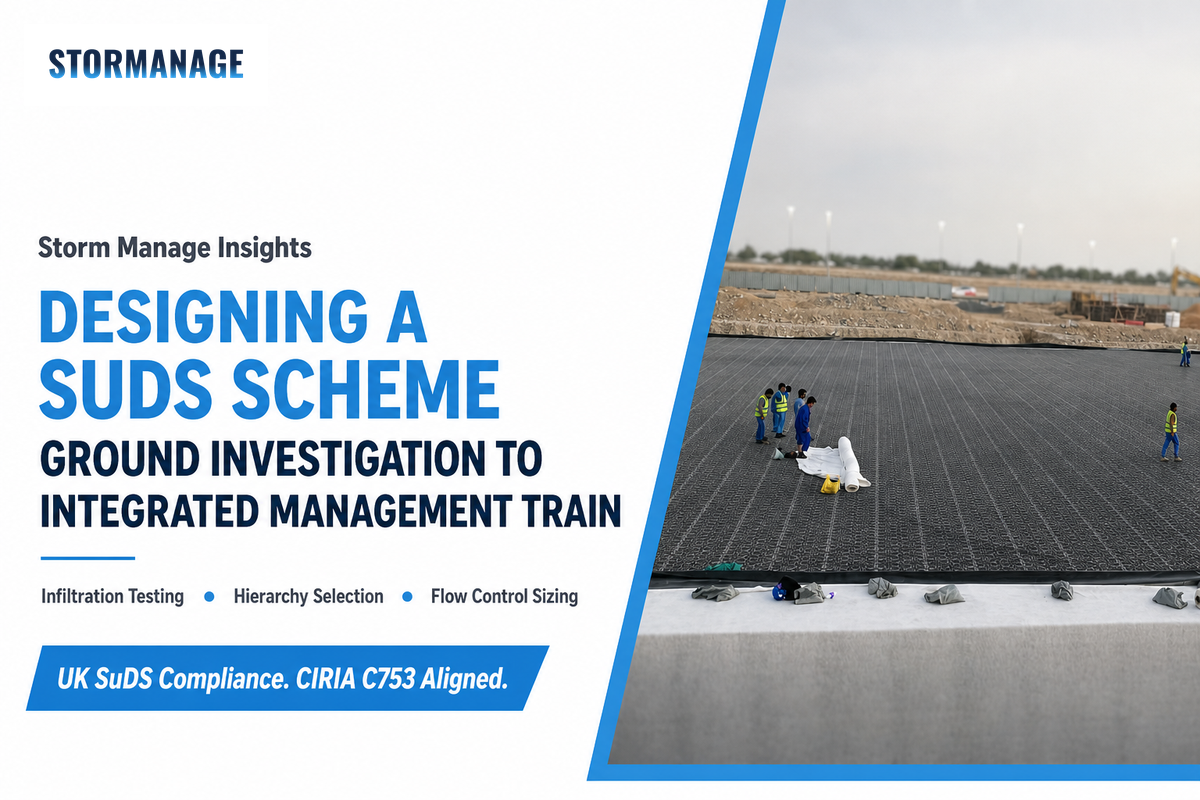
Good SuDS drainage design is developed top-down using the management train process – not starting by choosing a particular storage product and working back. In reality, the sequence should be: ground investigation and infiltration testing to establish that the soil can actually receive infiltrated water; hierarchy selection (progressively down the four tiers until enough storage is provided); storage volume sized to the interception and discharge rate requirements; finally assembling the components of the scheme into an integrated management train with appropriate flow controls between each stage.
📐 Engineering Note
Soil type dictates the ratio of infiltration to attenuation from the very outset. Given a supportive percolation test result, infiltration (soakaways, infiltration basins) is usually preferred because it allows infiltrated water to be completely removed from the piped system and thus the pipe flow rate isn’t influenced. However, when ground conditions such as clay soil, a high water table, or contamination render infiltration infeasible, then attenuation (temporarily holding water and then releasing it at a regulated rate) becomes the solution and the quantity of storage is then sized against the required rate standards instead of being calculated by capacity. Detailed storage volume and attenuation tank cover-depth calculations are detailed on our attenuation tank design and installation page.
It’s this layer that C823F’s “get it right from the start” concept matters most, because any site selection and hierarchy work at the earliest stages of site design is far cheaper to address than changing the whole site layout after a preferred storage solution has been chosen – and it lets urban design and drainage strategies develop together instead of drainage being retrofitted around a fixed masterplan.
SuDS and the Planning Process: When and How to Engage
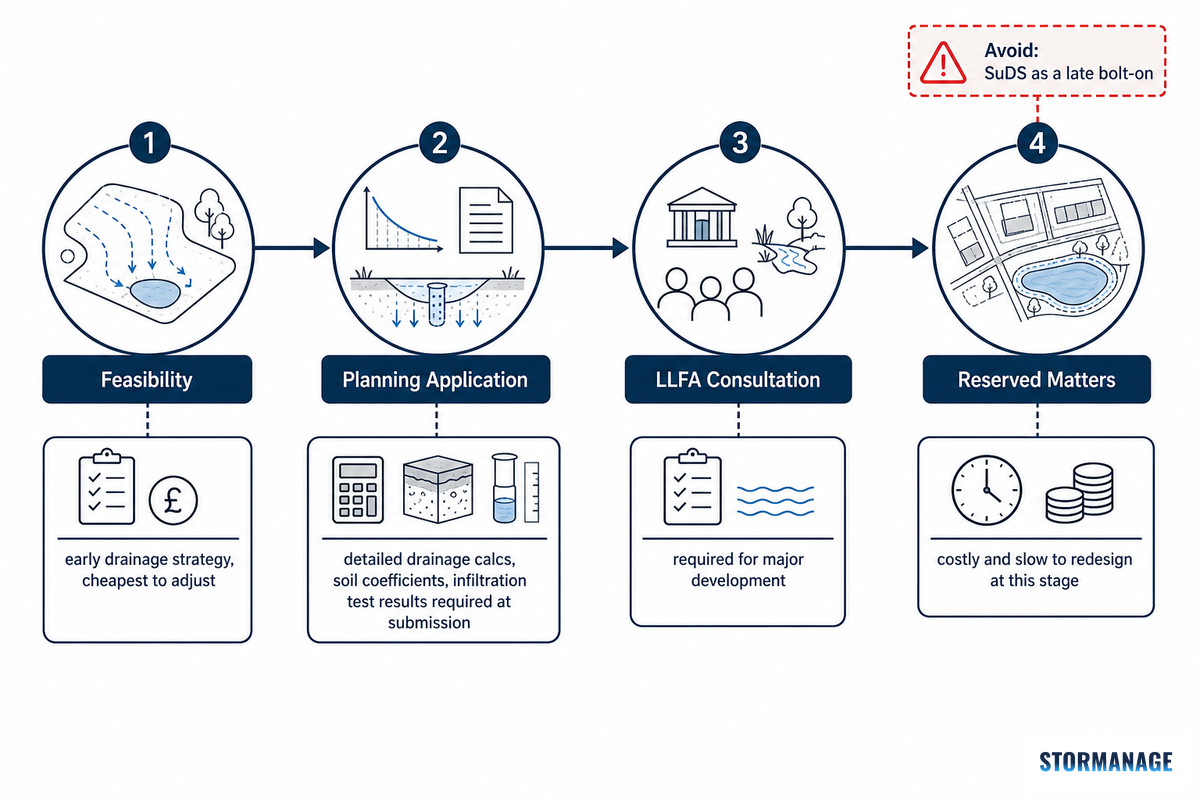
Timing, not design error, is the most frequent problem with a suds planning application. Many detailed design issues, such as detailed drainage calculations, soil coefficient values, percentage run-off values and all infiltration tests, must be available at the time of application, and can’t be submitted afterwards as a planning condition. Applications regularly face significant delays and outright refusal when these details haven’t been produced in time, or when a preliminary engagement with the Lead Local Flood Authority (LLFA) hasn’t been carried out.
Dealing with suds as an late bolt on not an early site selection consideration is the precise error C823F was designed to avoid, and is a pattern the local authorities and LLFA reviewers are so used to they list it specifically; it costs little to remedy during feasibility, a great deal in redesign and delay if the issue is discovered at reserved-matters stage.Ready to take the leap from strategy to specific storage after the drainage solution is finalized?Our below-ground storage kit for commercial and residential developments includes procurement, load-grade specification, and the typical 15-30 day ex-works lead times for your next step.
Who Maintains a SuDS Scheme After Handover?
Maintenance responsibility doesn’t end at practical completion, and it’s the area where the government’s own evidence base shows the biggest gap: a 2018 review found that for 70% of planning applications examined, it was unclear which body was responsible for maintenance, and separately that 70% of local planning authorities have no monitoring process to check SuDS implementation against their own local plans.
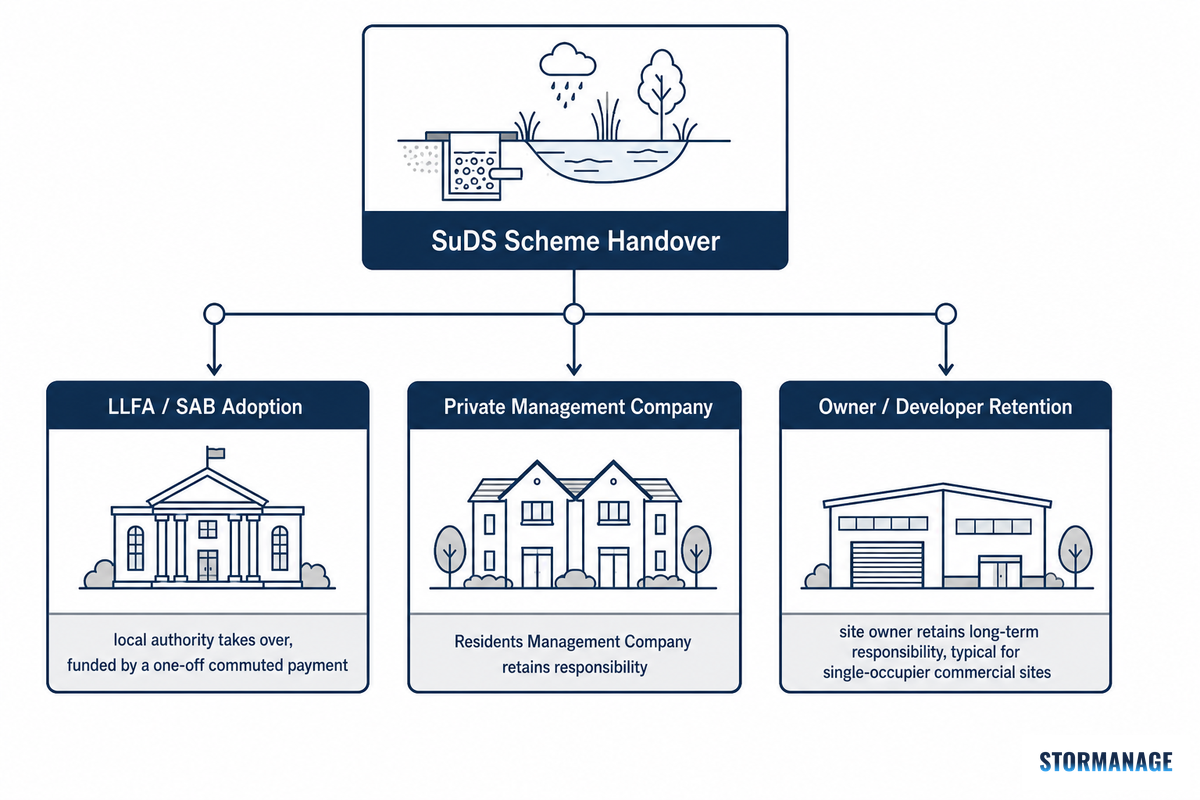
While this review is eight years old at the time of writing, no particular clause in the 2025 national standards directly seeks to resolve this documentation void – and thus the question ‘who’s to maintain this and how will they demonstrate it?’ remains a real risk, not a completed issue. In practice, there are three forms of adoption for which different parties hold liability for things such as silt removal, vegetative maintenance, and operational servicing:
SuDS Adoption Pathways
LLFA/SAB Adoption – where the local authority, or a nominated suds Approving Authority takes over ownership of the asset and assumes long term responsibility for maintenance. Typically, the maintenance cost over the lifetime of the development will be recouped by the developer through a one off “commuted payment”, which would be based on a 50-year lifespan that’s a common yardstick used for suds Approving Authority costings – even if design life isn’t always equivalent to the service life of the asset, which should dictate the inspection frequency.
Private Management Company – A Residents Management Company or other private scheme management group continues to have responsibility for maintenance, frequently the case in new build private residential or mixed use developments where the drainage runs across shared land within the amenity of the development.
Owner/Developer Retention – the site owner or occupiers retain ownership and responsibility for the long term maintenance, most often in single occupied commercial/industrial developments.
Whatever the approach, the provision for that will need to be secured by means of a planning condition or a Section 106 at the point of planning permission – it’s not something you want to leave to “work it out later” as is what results in this statistic, for instance, ‘lacking maintenance provisions’. Another compliance point during the maintenance phase of a suds project which isn’t often well-recognised is that depositing dewatered and removed silt still legally requires an environmental permit from the Environment Agency, under RPS 55. This is despite the fact the EA wouldn’t normally take enforcement against developers who met the conditions of RPS 55. This only applies to SuDS draining roads, small non-residential car parks and cul-de-sacs. It doesn’t apply for any retail or industrial premises and for those a full permit will likely be required. We discuss lifetime maintenance on our commercial and residential development storage solutions pages.
Industry Outlook: What the 2025 National Standards Change for Developers
However, beyond a focus on specific technologies, the most impactful thing driving 2026 planning is the evolving definition of what constitutes “compliant”. suds was first and foremost focused on flooding – ensuring the peaks flow rates didn’t overload the receiving watercourse and sewer. 2025’s standards are the formal expansion of this flooding-centric mandate to include the four pillars we described above. While England’s national standards transitioned to an integrated, seven-standard regime for water quality, amenity and biodiversity in October 2025, and all new planning consultations are now being assessed against it (a drainage strategy only satisfying the previous quantity-only framework for flow rates flood is no longer sufficient). The implications for those with an ongoing planning application are clear – if your quantity-only SuDS strategy was drafted under the pre-2025 guidelines, it’s now deficient, regardless of whether it meets your intercept and discharge figures.
Beyond the new Standards in England, the second most significant indicator for those with business on the other side of the border comes from Wales. While the statutory Schedule 3 Standards are themselves unchanged since 2018, a revised SuDS Statutory Guidance was published by the Welsh Government in March 2026 that consolidates the disparate existing Guidance documents and addresses inconsistency concerns raised by SuDS Approving Bodies. If your development work extends into both england and wales you should be preparing for an evolving compliance process through out 2026. Not only will the technical standards in each nation evolve differently (England will be moving towards voluntary, broader standards and Wales towards integrated statutory standards), but the approach to documenting that compliance will likely continue to change.
You’ll notice that while there were major regulatory shifts for 2025 and 2026, search volumes for “suds” fell about a third year-over-year into mid-2026. That figure may look to suggest decreasing importance for the subject, but is more likely indicative of search volumes returning to normal after a peak driven by news of the June 2025 standards update than a decline in developer focus on the subject itself; the regulatory change is the driver, not search volumes.
Frequently Asked Questions
Q: Is a soakaway a SuDS?
View Answer
yes it is, it’s one type of suds, the name of a particular infiltration which allows surface water to “soakaway” into the ground floor of the site instead of to the sewer. This soakaway sits at source control level, within the “Site control” tier of the SuDS management train, mentioned previously, but SuDS is a much wider term that covers every thing in this field, including green roofs, permeable paving, swales, ponds and attenuation storage underground, to mention just a few examples. A soakaway is part of the SuDS process.
Whether you can build one depends entirely on the ground and infiltration results.
Q: What are the disadvantages of SuDS?
View Answer
Arguably the best-known drawback of infiltration-based suds is that it requires permeable-friendly ground conditions – ie sand or gravel, which rules out any scheme involving a clay subsoil, high water table or a contaminated site – which must therefore revert to a attenuation-based storage scheme instead. Another design issue is that surface SuDS features like ponds and wetlands often come into competition for space with parking or developable land in schemes under space constraints; which is one of the reasons why underground storage options feature in a management train. And another, probably more serious practical drawback than any of the technical issues outlined, is the maintenance arrangement gap – outlined above, but which more than 70% of applications were identified as having unclear maintenance provisions – which is less an engineering failing and more a governance one.
Q: What are the benefits of SuDS?
View Answer
In addition to reducing the risk of flooding and helping manage flood risk at a catchment scale, suds can make water quality safer by filtering pollutants on their journey into waterways, it provides a new amenity usable green space and helps support biodiversity by providing the sort of habitat structures that give it the necessary ponds and the planted swales that together constitute three of the four pillars of national standards. The other obvious issue – one often overlooked by those only comparing capital costs – is that comparable government funded research have demonstrated that incorporating SuDS can provide better whole life costs compared to a conventional piped drainage scheme; for instance, a Cambridge based development saw some 10% savings on the initial capital expenditure, and other reports have indicated even more substantial savings can be achieved when the SuDS elements are integrated from the outset.
Q: How can engineered SuDS solutions help a project achieve a better BREEAM rating?
View Answer
BREEAM surface water runoff has been introduced to recognise sites which decrease the rate and volume of runoff against the pre-development runoff 2 credits for commercial, 14 for residential version 6.1. it directly quotes ciria C753 for the basis of the hydraulic modeling calculation. For Brownfield developments there must be 30% decrease of peak run off for both a 1 year and a 100 year storm. For Greenfield development there must be no increase over pre development greenfield rates.
A thoroughly designed and documented suds which has been constructed to the 5mm/80%/50% interception above will usually automatically comply with the requirements of both national standards and BREEAM on this criterion as the criteria are designed based upon the same process.
Q: Why is early SuDS planning critical for project success?
View Answer
Because it is vastly cheaper to deal with ground investigation, infiltration testing and the selection of hierarchy at the time before the site layout is determined than it is after it has been completed. This was the exact intention behind ciria’s 2025 report “Getting suds Right from the Start.”
Q: What is the potential for ground stability or water quality problems from infiltration?
View Answer
Inappropriate sited infiltration suds may, in principle, mobilise contaminants into the groundwater or impacting nearby foundations if ground condition have not first been assessed properly – which is precisely why infiltration testing is a requirement for the design, rather than a mere validation, and why the ground-conditions-first Engineering Note above precedes the storage-sizing choice.
Q: Are SuDS mandatory in Wales but not England?
View Answer
Yes. suds has been a mandatory requirement in Wales on relevant new developments since 2019 through Schedule 3 of the Flood and water management Act 2010, enforced by SuDS Approving Bodies. England has not yet started implementing the same Schedule 3 clauses despite a commitment from government in 2024, instead referencing National Planning Policy Framework standards which are not mandatory. Scotland meanwhile has mandated SuDS since 1st April 2007 under separate guidance from SEPA – it was the first of the three countries to adopt it.
About This Analysis
This guide synthesises the UK’s 2025 National Standards for SuDS, the CIRIA C753 SuDS Manual and its September 2025 companion report, and cross-nation regulatory documentation for England, Wales, and Scotland, cross-checked against BREEAM’s surface water assessment methodology and recent New Civil Engineer reporting on the status of mandatory SuDS. It’s deliberately written as a system-wide primer rather than a product specification, for below-ground attenuation or infiltration storage system details, see our dedicated application and compliance pages linked throughout. Reviewed by the Storm Manage technical team.